
 @DITRBrand 💎

Whats outside the Simulation?
Multiverse Interdimensional Time Traveler Bilocated Avatar Chris Lee Collective Consciousness
ENJOY THE MUSIC AND UNLIMITED MANDELA EFFECTS
THE BIG GIRL THICC WHITE SEVEN SISTERS NORDIC BADDIES OF PLEIADES FROM ~444 light-years arrive for Humanity
1
PROBLEMATIC PISCES retweeted

4h
Cardi B reacts to the NY Knicks winning their first championship since 1973.😭
“WE OUTSIDE RIGHT NOW! GET MY MAKEUP DONE RIGHT NOW”
86
2,354
33,155
475,917

TOYOTA IS UP TO P2!
Brendon Hartley with a great move around the outside of the Cadillac! The BMW is up next!
2
prettymoney 💵. retweeted

Scenes outside MSG are INSANE!
New York Knicks fans are losing their minds!
#nbafinals
12
362
3,448
109,598
Evelin retweeted

Ireland - Dublin 🇮🇪
If you’re outside Ireland, you mightn’t realise the fight the Irish have on their hands.
On a daily basis, migrants are causing mayhem everywhere they go and live.
Make no mistake, the fighting Irish spirit is alive and well and up for the fight ☘️
Follow us and share
383
2,442
10,399
232,196
Lucie Bazarian retweeted

Hundreds of activists gathered outside the Israeli embassy in London on Saturday as part of the international Red Ribbons Campaign, demanding the release of Palestinians held in Israeli prisons and condemning Israel's genocide in Gaza.
Demonstrators also called for the immediate release of Palestinian doctor Hussam Abu Safiya, who has spent six months in solitary confinement following his kidnapping from Gaza by Israeli forces.
4
107
150
2,558
Barratt retweeted

12 Sep 2024
On this day, Christian forces defeated the Ottoman army outside the gates of Vienna in 1683, thus saving Europe from the clutches of Islam. "We came, we saw, God conquered" -John III Sobieski
1,866
9,321
45,992
2,869,028

U are setting a dangerous precedent & new height of irtedad justifying fehash, nudity from prophet's own life which even big anti muslim propagandists didn't
Completely neglecting Undisputed verses of surah noor where clear guidelines are at place how women should dress outside

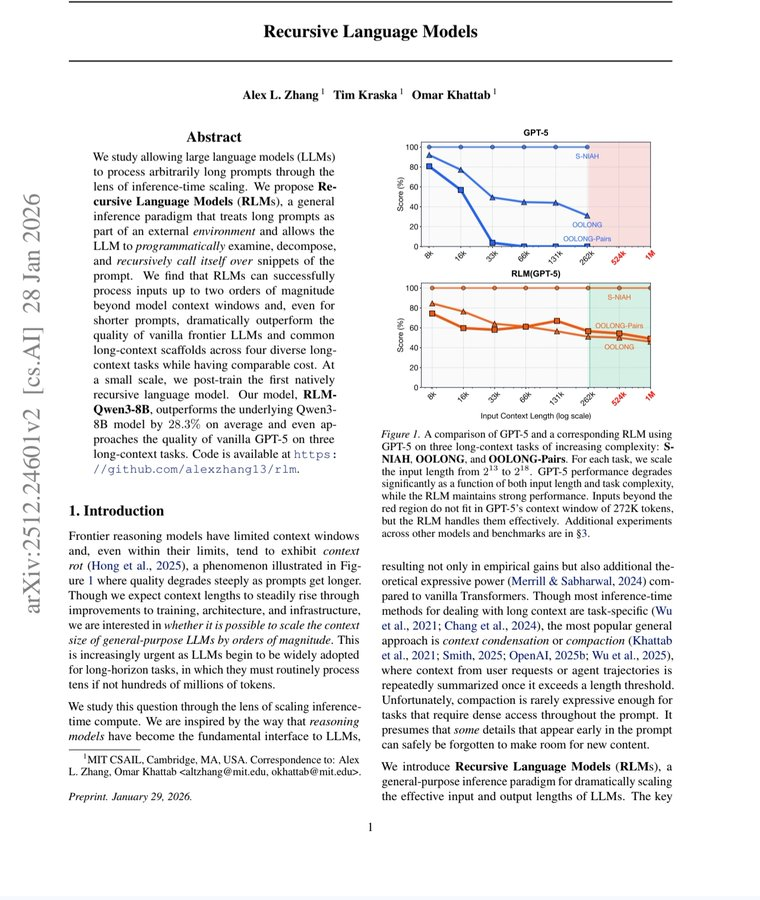
MIT just made every AI company's billion dollar bet look embarrassing.
They solved AI memory. Not by building a bigger brain. By teaching it how to read.
The paper dropped on December 31, 2025. Three MIT CSAIL researchers. One idea so obvious it hurts. And a result that makes five years of context window arms racing look like the wrong war entirely.
Here is the problem nobody solved.
Every AI model on the planet has a hard ceiling. A context window. The maximum amount of text it can hold in working memory at once. Cross that line and something ugly happens — something researchers have a clinical name for.
Context rot.
The more you pack into an AI's context, the worse it performs on everything already inside it. Facts blur. Information buried in the middle vanishes. The model does not become more capable as you feed it more. It becomes more confused. You give it your entire codebase and it forgets what it read three files ago. You hand it a 500-page legal document and it loses the clause from page 12 by the time it reaches page 400.
So the industry built a workaround. RAG. Retrieval Augmented Generation. Chop the document into chunks. Store them in a database. Retrieve the relevant ones when needed.
It was always a compromise dressed up as a solution.
The retriever guesses which chunks matter before the AI has read anything. If it guesses wrong — and it does, constantly — the AI never sees the information it needed. The act of chunking destroys every relationship between distant paragraphs. The full picture gets shredded into fragments that the AI then tries to reassemble blindfolded.
Two bad options. One broken industry. Three MIT researchers and a deadline of December 31st.
Here is what they built.
Stop putting the document in the AI's memory at all.
That is the entire idea. That is the breakthrough. Store the document as a Python variable outside the AI's context window entirely. Tell the AI the variable exists and how big it is. Then get out of the way.
When you ask a question, the AI does not try to remember anything. It behaves like a human expert dropped into a library with a computer. It writes code. It searches the document with regular expressions. It slices to the exact section it needs. It scans the structure. It navigates. It finds precisely what is relevant and pulls only that into its active window.
Then it does something that makes this recursive.
When the AI finds relevant material, it spawns smaller sub-AI instances to read and analyze those sections in parallel. Each one focused. Each one fast. Each one reporting back. The root AI synthesizes everything and produces an answer.
No summarization. No deletion. No information loss. No decay. Every byte of the original document remains intact, accessible, and queryable for as long as you need it.
Now here are the numbers.
Standard frontier models on the hardest long-context reasoning benchmarks: scores near zero. Complete collapse. GPT-5 on a benchmark requiring it to track complex code history beyond 75,000 tokens — could not solve even 10% of problems.
RLMs on the same benchmarks: solved them. Dramatically. Double-digit percentage gains over every alternative approach. Successfully handling inputs up to 10 million tokens — 100 times beyond a model's native context window.
Cost per query: comparable to or cheaper than standard massive context calls.
Read that again. One hundred times the context. Better answers. Same price.
The timeline of the arms race makes this sting harder. GPT-3 in 2020: 4,000 tokens. GPT-4: 32,000. Claude 3: 200,000. Gemini: 1 million. Gemini 2: 2 million. Every generation, every company, billions of dollars spent, all betting on the same assumption.
More context equals better performance.
MIT just proved that assumption was wrong the entire time.
Not slightly wrong. Fundamentally wrong. The entire premise of the last five years of context window research — that the solution to AI memory was a bigger window — was the wrong answer to the wrong question.
The right question was never how much can you force an AI to hold in its head.
It was whether you could teach an AI to know where to look.
A human expert handed a 10,000-page archive does not read all 10,000 pages before answering your question. They navigate. They search. They find the relevant section, read it deeply, and synthesize the answer.
RLMs are the first AI architecture that works the same way.
The code is open source. On GitHub right now. Free. No license fees. No API costs. Drop it in as a replacement for your existing LLM API calls and your application does not even notice the difference — except that it suddenly works on inputs it used to fail on entirely.
Prime Intellect — one of the leading AI research labs in the space — has already called RLMs a major research focus and described what comes next: teaching models to manage their own context through reinforcement learning, enabling agents to solve tasks spanning not hours, but weeks and months.
The context window wars are over.
MIT won them by walking away from the battlefield.
Source: Zhang, Kraska, Khattab · MIT CSAIL · arXiv:2512.24601
Paper: arxiv.org/abs/2512.24601
GitHub: github.com/alexzhang13/rlm

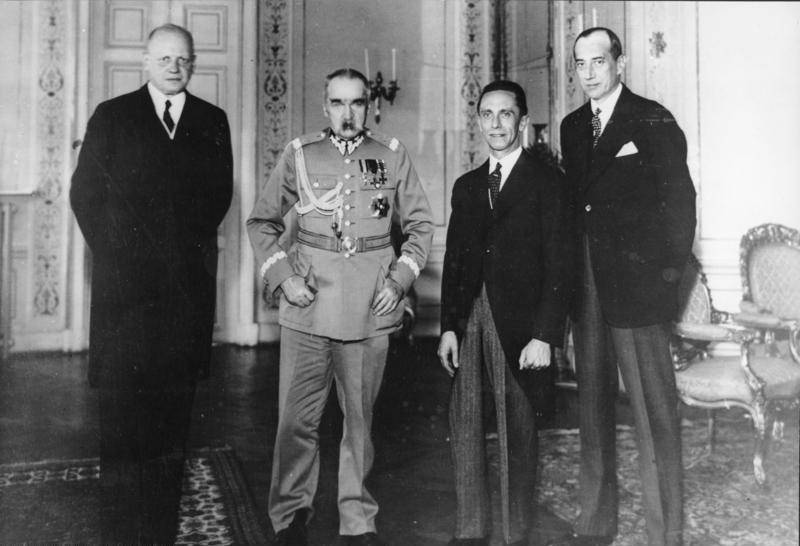
THE MARSHAL'S GAMBIT: SEPARATING FACT FROM NARRATIVE IN PRE-WAR POLISH DIPLOMACY
A source-critical examination of Józef Piłsudski, Nazi Germany and the diplomatic record that actually exists from a historical ignoramus.
Before examining any specific claim about pre-war Poland, an honest investigative journalist must acknowledge something that mainstream historical literature rarely confronts directly. The historical narrative of interwar and wartime Poland was largely constructed by the victors of World War Two — and in Eastern Europe, those victors were Soviet communists.
The Soviet Union and its Polish communist puppet government installed in Warsaw after 1945 controlled the archives, wrote the textbooks, determined which historians received academic appointments, and decided which interpretations of the past were permissible. Western academics who cited Polish, French or Soviet postwar scholarship as authoritative sources were frequently — often unknowingly — laundering a narrative shaped by an ideologically motivated regime with specific interests in how the prewar period was remembered.
The problem compounds itself generationally. A Soviet-era Polish historian writes a textbook in 1952. A Western academic cites it in 1968 as a credible source. A second Western academic cites the 1968 work in 1985. A Wikipedia editor cites the 1985 work in 2009. By 2025 the original Soviet framing has been cited so many times by credentialed institutions that it carries the weight of established fact — despite never having been tested against contemporaneous primary sources.
This does not mean everything written about prewar Poland is fabricated. It means every significant claim requires three specific questions before accepting it. Who said it? When did they say it? What was their motivation for saying it? A memoir written in London exile in 1952 by a Polish diplomat is not the same as a diplomatic cable written in Warsaw in 1933. A postwar historian's interpretation is not the same as a contemporaneous document. With that framework established, here is what the primary record actually shows — and where the gaps are.
THE PREVENTIVE WAR CLAIM: PROBABLE INTENT, NO DOCUMENT
The most celebrated claim in prewar Polish diplomacy is that Marshal Józef Piłsudski, immediately after Hitler's appointment as Chancellor in January 1933, proposed to France — and possibly to Britain and Czechoslovakia — a joint preventive war to destroy the Nazi regime before it could rearm. It is a compelling story. It also is, in strict evidentiary terms, unproven.
The most honest assessment comes not from a Soviet historian but from Jan Karski — a Polish Catholic underground courier who personally reported the Holocaust to Churchill and Roosevelt, one of the most credible Polish witnesses of the entire wartime period and a man with every reason to present Poland favorably. Writing in The Great Powers and Poland: From Versailles to Yalta, Karski concluded bluntly that there is no evidence Piłsudski contemplated a preventive war, nor any direct documentary evidence of specific proposals forwarded to Paris or London. That is not a Soviet communist writing. That is the most celebrated Polish wartime hero of the twentieth century, and he found no document.
The dedicated academic study of this specific question was published in the Journal of Modern History in 1955 by historian Zygmunt J. Gasiorowski — titled simply "Did Piłsudski Attempt to Initiate a Preventive War in 1933?" The question mark in the title tells you everything about where the evidence led.
Tracing the claim backward through the source chain reveals something important. The primary sources cited in support of the preventive war story are postwar memoirs, Polish émigré accounts and German intelligence reports. French ambassador Jules Laroche published recollections in the 1950s describing conversations that allegedly took place in 1933 — a memoir written two decades after the fact by a diplomat with reputational/jewish interests at stake is not a contemporaneous diplomatic cable. Polish diplomats who fled to London and New York after 1939 wrote extensively in exile about prewar Polish policy. These men were not Soviet communists — many were strongly Catholic and anti-communist. But they were writing with a clear motivation: to defend Poland's reputation against the charge that it had been naive about Hitler. Motivated memory, even honest motivated memory, is not the same as documentary evidence.
What is documented beyond reasonable dispute is that Piłsudski reinforced the Polish garrison at Westerplatte and moved Polish divisions to the Danzig environs in early 1933. These movements appear in German contemporaneous records and in Polish military records. Whether they represented a genuine preventive war in embryonic form, a calculated bluff to test Western resolve, or a defensive precaution against a possible Nazi coup in Danzig — the documents do not tell us.
The Warsaw Institute — a contemporary Polish nationalist research organization with no connection to communist historiography — reached the same conclusion: the preventive war story was most likely a deliberate strategic bluff by Piłsudski, designed to probe Western commitment to Versailles, rather than a genuine operational plan submitted as a formal diplomatic proposal to allied governments.
Piłsudski almost certainly believed a preventive war against Hitler in 1933 was strategically sound. He may have communicated that belief informally. But no written proposal from the Polish government to France, Britain or Czechoslovakia requesting a joint military campaign against Germany has been found in any archive after nearly a century of searching. Any article presenting this as confirmed historical fact is repeating a narrative that the primary sources do not support.
THE NON-AGGRESSION PACT: WHO PROPOSED IT AND WHY
The German-Polish Non-Aggression Pact signed on January 26, 1934 is frequently presented as a Polish diplomatic initiative. The primary record tells a different story. Hitler proposed the pact, not Poland.
Hitler believed in 1933 that ongoing friction with Poland was damaging Germany's international reputation at a moment when the Nazi regime was still diplomatically vulnerable. He sent a telegram to Piłsudski signaling openness to normalization. Piłsudski instructed the Polish government to negotiate. The pact was signed in Berlin with German Foreign Minister von Neurath representing Germany and Ambassador Józef Lipski representing Poland.
Hitler's motivations are the clearest of any actor in this episode because they are documented in German records captured intact by Allied forces in 1945 and therefore not filtered through postwar communist historiography. The pact served German interests by undermining France's Eastern alliance system, providing Germany a settled eastern border during the critical rearmament period, and isolating Poland from the collective security architecture France was attempting to build.
For Poland the pact fit what Lipski himself described in contemporaneous diplomatic correspondence as an "equilibrium policy" — maintaining a balance between Germany and the Soviet Union rather than alignment with either. Lipski wrote about this in real time in cables to Warsaw preserved in the Piłsudski Institute archive in New York — over one million documents covering 150 linear meters of shelf space, the largest Polish diplomatic archive outside Poland, physically removed from communist control before Warsaw fell.
The "buying time against Germany" framing that appears in most historical accounts is a reasonable inference from the sequence of events but not a documented statement of Polish policy intent from 1934. Piłsudski's actual documented private sentiment about Hitler was more ambiguous — he reportedly viewed Hitler's Austrian rather than Prussian origins as a marginal mitigating factor and stated privately that he preferred Hitler in power to the alternatives. That is not the sentiment of a man who has already concluded war with Germany is inevitable and is merely postponing it.
The claim that the pact involved secret military protocols targeting the Soviet Union is, as EU disinformation monitoring bodies have documented, Russian historical revisionism with no evidentiary basis.
THE GÖRING MEETING: THE BEST DOCUMENTED CLAIM OF ALL THREE
Of all the dramatic episodes in the Piłsudski-Hitler relationship, the January 1935 meeting between Hermann Göring and the dying Marshal is the most solidly evidenced — and receives the least mainstream attention, perhaps because its implications are complicated for multiple postwar narratives simultaneously.
Göring traveled to Warsaw in January 1935 on what was officially a hunting trip. On January 31, 1935, he was received by Piłsudski. Before the meeting, Polish Ambassador Lipski had specifically advised the German side through diplomatic channels that Göring should maintain restraint and avoid concrete proposals on the Russian question. This advisory is documented in Lipski's papers.
Göring ignored the advice. In the meeting he raised the subject of Soviet Russia, suggesting a joint Polish-German military campaign against Moscow and describing the territorial benefits Poland could obtain in Ukraine from such an operation.
Piłsudski said nothing. Then he stated that Poland shared a 1,000 kilometer border with the Soviet Union and therefore wanted peace with Moscow.
The phrase hat gestutzt — he was struck dumb — appears in Göring's own subsequent reporting of the meeting back to German diplomatic channels. This is the critical evidentiary point. The hat gestutzt account originates with Göring himself — a German, reporting his own diplomatic failure back to Berlin. He had no motivation to fabricate Polish reluctance. He was describing an embarrassing result of his own mission.
The source chain is therefore: Göring to German diplomatic records, and Lipski to Polish Foreign Ministry records — two independent contemporaneous actors reporting the same meeting from different vantage points, with no coordination between them and no shared motivation to construct the same false account.
The Lipski papers were published by Columbia University Press in 1968 in Diplomat in Berlin, 1933-1939: Papers and Memoirs of Józef Lipski, Ambassador of Poland — edited by Wacław Jędrzejewicz, a Piłsudski loyalist Polish military officer, not a Soviet communist or postwar propagandist but had documented close ties to the Rothschild family.
This is as close to confirmed as interwar diplomatic history gets. Two independent contemporaneous primary sources — one German, one Polish — corroborate the same account. This claim can be published with confidence provided it is clearly attributed to those specific sources rather than to secondhand historical literature.
THE INTERMARIUM: PIŁSUDSKI'S EASTERN FEDERATION (I love this part)
Unlike the preventive war claim, the Intermarium concept — Piłsudski's vision of a Polish-led federation of Central and Eastern European states — is documented in Polish political writings, government records and military planning documents from the 1910s through the 1930s. It does not rest on postwar memoirs or secondhand accounts.
The concept was known in Polish as Międzymorze — between the seas — and in its most ambitious form envisioned a federated political community stretching from the Baltic Sea to the Black Sea and Adriatic, encompassing Lithuania, Latvia, Estonia, Finland, Belarus, Ukraine, Hungary, Romania, Yugoslavia and Czechoslovakia. It was explicitly modeled on the medieval Polish-Lithuanian Commonwealth — the Rzeczpospolita — that had united Poland and Lithuania from the late sixteenth century to the late eighteenth.
The strategic logic was straightforward and has been vindicated by subsequent history more than once. Small and medium-sized Eastern European states sitting between German and Russian power could not survive independently. They had been partitioned, occupied and absorbed throughout the eighteenth and nineteenth centuries precisely because no mechanism existed for collective resistance. Piłsudski's answer was institutional — bind them together into a structure large enough to resist both great powers.
The Intermarium had a covert operational arm called Prometheanism — a Polish intelligence operation supporting nationalist independence movements within the Soviet Union, targeting specifically Ukraine, Georgia, Armenia and the Caucasian peoples. The goal was dismemberment of the Soviet empire from within by supporting the non-Russian peoples it had absorbed. Piłsudski's documented private statement that "without an independent Ukraine there cannot be an independent Poland" was not merely philosophical — it was the strategic rationale for an active covert program. French and British intelligence quietly supported these activities, recognizing their value against Soviet power, though neither Western government was willing to publicly commit to the larger concept.
Why did it fail? Not because of Soviet propaganda or Western betrayal alone — but because the nations Piłsudski wanted to federate were simultaneously fighting each other. The Polish-Ukrainian War of 1918-19, the Polish-Lithuanian War of 1919-20, the Polish-Czechoslovak border conflicts beginning in 1918 — these were real wars between nations that were supposed to become Piłsudski's federation. By 1920 Piłsudski himself had recognized that the Intermarium in its full form was no longer achievable (dammit).
The concept did not die with him. It was revived by Polish émigré intellectuals after 1945 through the Kultura literary journal in Paris edited by Jerzy Giedroyć — a former Piłsudski government official. And it has been revived again in the twenty-first century as the Three Seas Initiative — a contemporary framework for Baltic-Black Sea-Adriatic cooperation that maps almost exactly onto Piłsudski's original geographic vision, suggesting that whatever the failures of the interwar attempt, the underlying strategic logic has never been disproven.
A FRAMEWORK FOR EVALUATING ANY CLAIM ABOUT PREWAR POLAND
The exercise of tracing these specific claims back to their actual sources produces a hierarchy that should be applied to any Polish interwar history going forward.
Treat with confidence claims sourced to contemporaneous German diplomatic records captured in 1945, to the Lipski papers at the Piłsudski Institute in New York, and to Polish military documents that left Warsaw before the Soviet takeover.
Treat with caution claims sourced to postwar memoirs of Polish émigré diplomats, to French (jews or gay normally ;) ) diplomatic memoirs written in the 1950s, and to academic works that cite earlier academic works without tracing the original source.
Treat with serious skepticism claims that originate in postwar Polish communist-era historiography, Soviet historical literature, or academic consensus built on repeated citation of those sources rather than original documents.
Ask always: Was the person who said this present when it happened? Did they write it at the time or reconstruct it later? What did they stand to gain or lose from the account they gave? Is there an independent corroborating source?
Applied rigorously, these questions do not destroy the historical record of interwar Poland. They clarify it. What survives that scrutiny — the Göring meeting, the Lipski diplomatic cables, the Intermarium program, the documented military movements of 1933 — is actually more interesting and more credible than the polished narrative built on uncritical citation of sources shaped by the ideological environment in which they were produced.
History written to serve power is not history. It is political literature with footnotes. The distinction matters — especially for a country whose entire twentieth century was repeatedly defined by more powerful neighbors deciding what its past meant.
References: Primary sources referenced in this article are held at the Józef Piłsudski Institute of America in New York, the National Digital Archives of Poland, and in captured German diplomatic records published through the United States State Department historical document series. The Lipski papers were published in English by Columbia University Press in 1968. The Gasiorowski paper was published in the Journal of Modern History in 1955. And for what it's worth its Sunday morning with no coffee yet but always question the sourcing chain on Soviet/jewish influenced history. Most people just repeat wiki facts.
@Ojdadana I would like an apology

You are a pathetic historical ignoramus. Piłsudski planned to launch a preventive war against Germany and tried to organise an alliance with France, Czechoslovakia & Great Britain against Hitler in the spring of 1933 but the Allies rejected his plan. web.archive.org/web/20240129…

davido go come outside soon campaign for this same person btw, because na him uncle😂✌🏾
if anything sup again he drop tweet like he care when your family actively supporting same government

“I am supporting Tinubu because he has roots in Osun State, and because it is the turn of the South. Nigerians should please give him time to implement his reforms”
— Governor Adeleke.

11
26
160
7,078

Protesters are standing outside JPMorgan Chase in New York this weekend, holding giant banners that say “STOP ELON • NO TRILLIONAIRES” and “ELON IS STEALING YOUR PENSION”
These people are protesting the greatest success story in modern history. Let’s look at the actual reality:
• Elon has already paid more in taxes than almost anyone alive
• Tesla and SpaceX employ well over 100,000 people and actively push humanity forward.
• Through DOGE, he already helped cut billions in wasteful government spending. That saved taxpayers hundreds of billions.....meaning he actually helped secure grandmas' pensions by slashing bureaucracy, not the other way around.
• Friday's historic SpaceX IPO didn't "steal" from anyone. It created massive value, turned everyday workers into millionaires, and rightfully made him the world’s first trillionaire
He didn’t steal anything. He built it from the ground up
His companies have created massive job growth, accelerated sustainable energy, and are literally building the infrastructure to make humanity multi-planetary
Rather than celebrating excellence, demanding the government punish it is pure evil
1,771
987
3,784
122,445

VIVA CABRAL 🇬🇼 (🇧🇷) retweeted

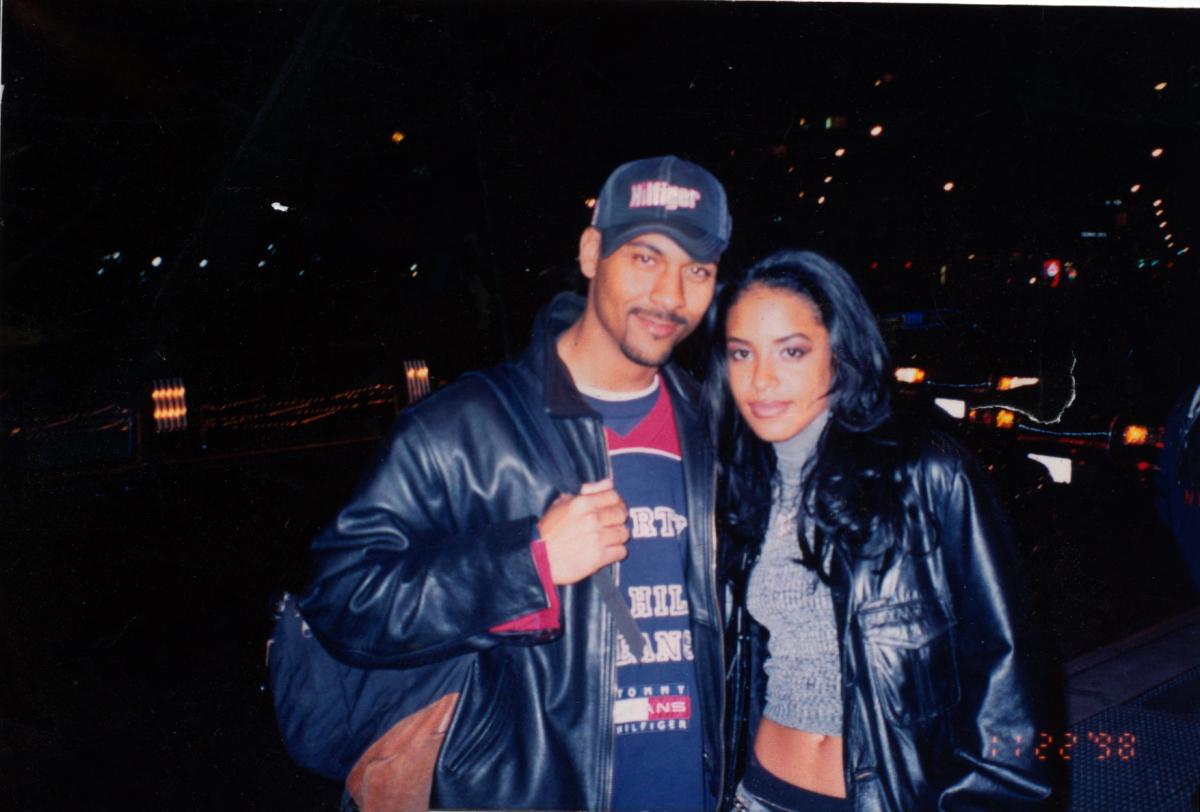
Aaliyah and Danja Mowf outside of The Tunnel Nightclub, 1998
1
17
245
2,248