
May 14
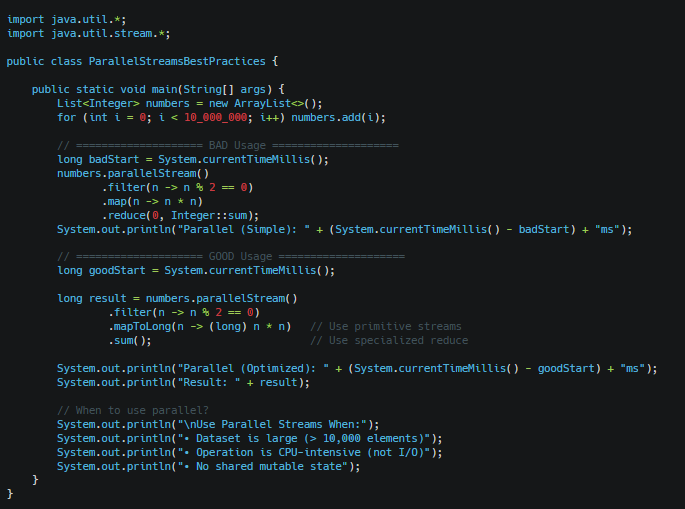
Java 8 Parallel Streams: When to Use Them & When They Can Kill Performance
Everyone loves parallelStream(), but using it blindly can make your code slower than sequential.
2
40
1,949

Apr 29
how many ways are there in Java to do concurrency? Thread/Runnable, synchronized (works differently depending on context), Executors, parallelStream, Futures, Reactive crap (spring and not-spring will do this differently), Virtual threads, TaskScopes. Fucking zoo
1
4
510

Mar 1
coz parallelStream() parallelizes computation, while concurrent collections only make data access thread safe, they solve different problems
2
33

concurrent data structures manage thread safety at the data level
whereas
parallelStream() enables parallel processing at the operation level, allowing for more efficient execution of tasks on large datasets.
This distinction makes parallelStream() a valuable tool for developers, even with concurrent data structures at their disposal.
1
80

Mar 1
They solve different problems.
parallelStream() is about parallelizing computation over a collection.
Concurrent data structures are about safe shared state between threads.
One is functional style data processing. The other is coordination and mutation control.
We use parallelStream() when the work is CPU bound and stateless.
We use ConcurrentHashMap and BlockingQueue when threads need to share or coordinate data.
11
813

Mar 1
parallelStream() is about parallel computation.
Concurrent data structures are about safe shared mutation.
When you use parallelStream():
- You’re splitting work across threads
- Using ForkJoinPool under the hood
- Ideal for CPU-bound operations on collections
When you use ConcurrentHashMap, BlockingQueue, etc.:
- You’re coordinating shared state
- Managing producer-consumer patterns
- Handling thread-safe reads/writes
One is about parallelizing processing.
The other is about synchronizing access.
You can even use them together.
Example:
Process items in paralleland store results in a ConcurrentHashMap.
Different tools. Different intent.
1
3
221

Concurrent structures handle safe shared state, parallelStream handles splitting work across cores, same reason C# has both PLINQ and ConcurrentDictionary.
1
3
642

Mar 1
They solve different problems.
Concurrent data structures 👉 are about safe shared state.
Multiple threads can read/write without breaking things.
parallelStream() 👉 is about parallel computation.
It helps you split a task (like filtering, mapping, aggregating) across multiple CPU cores automatically.
One protects shared data.
The other speeds up processing.
You can even use them together
but they are not substitutes for each other.
2
567

Mar 1
Because they solve different problems.
parallelStream() → makes computation run in parallel.
Example: filtering, mapping, reducing a large collection faster using multiple cores
ConcurrentHashMap, BlockingQueue → make data access safe when multiple threads modify or read shared data.
One is about parallel processing.
The other is about safe shared state
Parallelism vs thread safety
2
96


Feb 28
In most cases, for loop is slightly faster.
Streams add abstraction, lambdas, and sometimes boxing overhead.
But Streams win in readability and can outperform with parallelStream() on large datasets.
1
37
11,497

Jan 12
Various ways to iterate over Collections in Java ✅
Basic Loops👉
Traditional indexed for loops work for indexed collections like List and arrays by using size() or length and get(index). While loops pair with iterators via hasNext() and next(). These approaches allow index access or safe removal during iteration.
Enhanced For-Each👉
The enhanced for loop (for-each), introduced in Java 5, simplifies iteration over any Iterable or array without explicit indexing: for (Type item : collection) { ... }. It suits read-only traversal of List, Set, or arrays cleanly.
Iterator and forEach👉
Explicit Iterator from iterator() enables fail-fast iteration and removal: while (it.hasNext()) { it. next(); }. Java 8's forEach(Consumer) method processes each element concisely, like list.forEach(System.out::println);, on List, Set, or Map views.
Streams API👉
Java 8 Streams provide functional iteration: collection. stream().forEach(...) or with operations like filter/map: stream().filter(...).forEach(...). Use parallelStream() for concurrency on large collections.
Map Iteration 👉
For Maps, iterate entries via entrySet(): for (Map.Entry<K,V> e : map.entrySet()) { ... }, keys with keySet(), or values with values(). Streams work similarly: map.entrySet().stream().forEach(...)
1
4
44
1,637

30 Dec 2025
Are you using parallelStream() without profiling? Or still writing Collectors.toList() manually? #JavaStreams have evolved—Mihaela Gheorghe-Roman breaks down what modern #Java offers you from 8 to 24: javapro.io/2025/11/13/java-s…
@OpenJDK #ProjectAmber #Java25 #JavaStreams #JDK24

2
82

27 Dec 2025
SerialVersionUID:
Version identifier for Serializable classes to ensure deserialization compatibility.
Type Erasure:
Generics info is removed at runtime; only raw types exist.
Example: List<String> and List<Integer> look the same at runtime.
CompletableFuture:
Async computation pipeline with chaining and non-blocking callbacks.
Example: supplyAsync().thenApply().thenAccept().
BiFunction:
Functional interface taking two inputs and returning one result.
Example: (a, b) -> a b.
transient:
Marks fields to be skipped during serialization.
Example: Password fields in a serializable class.
PhantomReference:
Reference used to track object cleanup after GC, before memory reclaim.
Example: Cleanup native resources safely.
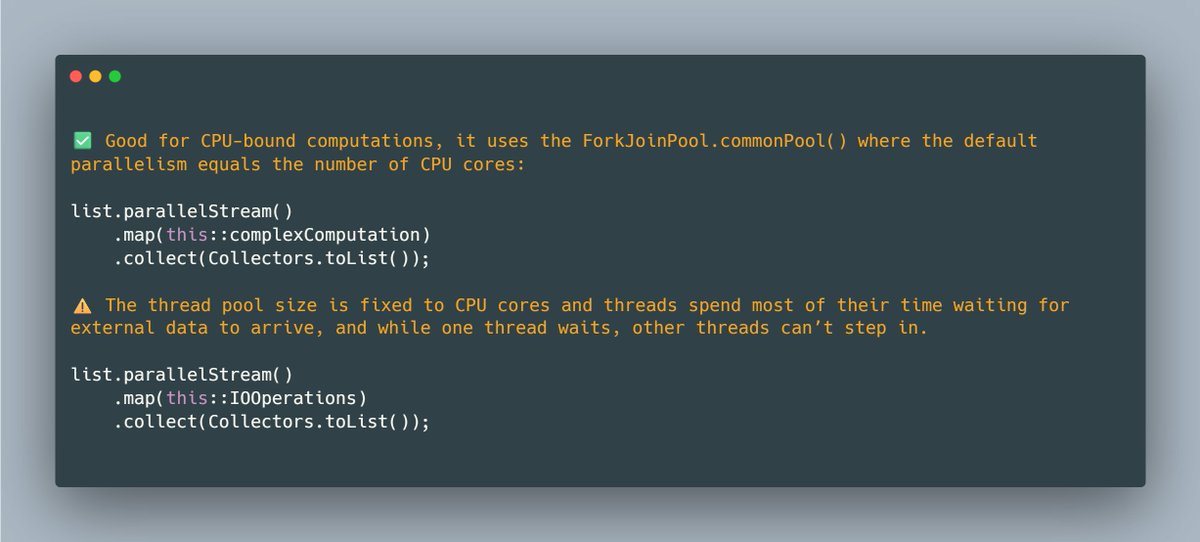
ForkJoinPool:
Work-stealing thread pool optimized for parallel tasks.
Example: Used by parallelStream().
Shenandoah GC:
Low-pause concurrent garbage collector.
Example: Keeps pause times low even with large heaps.
Flight Recorder (JFR):
Low-overhead JVM profiling and diagnostics tool.
Example: Capture CPU, GC, and thread events in production.
Virtual Threads:
Lightweight threads managed by JVM (Project Loom).
Foreign Function (FFM API)
Call native code safely without JNI.
Example: Invoke C library functions from Java.
Semaphore:
Limits concurrent access to a resource.
Example: Allow only 10 DB connections at a time.
CountDownLatch:
Blocks threads until a counter reaches zero.
CDS (Class Data Sharing):
Shares class metadata across JVMs to reduce startup time and memory.
SoftReference:
GC-friendly cache reference cleared under memory pressure.
Example: In-memory cache that auto-evicts when heap is low.
6
535

More from the builders:
◽ Food Butler - AI meal prep restaurant ordering
◽ Intelligence Cubed - Tokenized AI modelverse with IMOs
◽ daNomNoms - AI orders DoorDash with x402
◽ iMonad - One-click app creation → instant revenue
◽ PowGuess - Bet on snowfall, copy trades, win beers
◽ Fumav - Credit card on stablecoin rails, 10x lower fees
◽ Gate402 - Access registry for the agentic internet
◽ Weathershield - Weather insurance with automatic payouts
◽ ParallelStream - SLA-aware payment streaming with auto-refunds
◽ Solo Leveling - Invest in exponential individuals
◽ Private AI - No registration, no card, just x402 payments
◽ Hardware Revenue Share - Decentralized hardware creation with on-chain royalties
◽ Gatekeeper - On-chain access layer for multiplayer games
2
3
195


23 Nov 2025
As a Java developer, how many of these terms do you which are related to Concurrency and Multithreading:
> ForkJoinPool
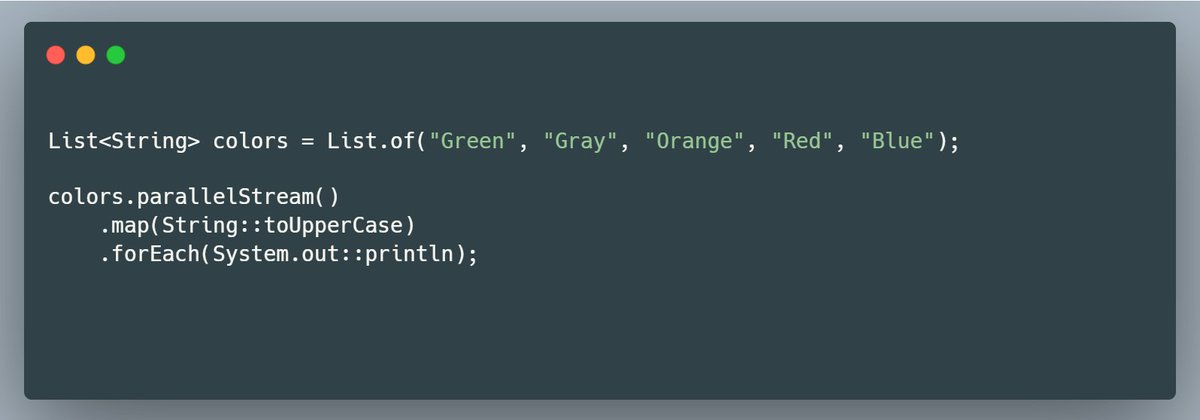
> parallelStream
> ExecutorService/Executors
> synchronized
> volatile
> atomic
> ThreadLocal
> ReentrantLock
> ReadWriteLock/ReentrantReadWriteLock
> Optimistic locking
> Pessimistic locking
> Spin locks
> Semaphore
> CyclicBarrier
> Phaser
> Exchanger
> CompletableFuture
> @async
> TaskExecutor
> ThreadPoolTaskExecutor
9
32
238
12,780

8 Oct 2025
Weiter geht's mit der 1. Spielklasse heute Abend! 🤩
Wir haben gleich 3 geile Matches für euch parat! @regnum4games trifft auf die @SissiStatePunks, @eCampFrankfurt auf @RVMultigaming und im Parallelstream seht ihr den Tabellenführer @WaveAUTCS im Duell mit @ARROWdotGG ⚔️
Wir sehen uns ab 18 Uhr! 🫵
#DACHCSMasters🐔

1
14
4,759
7 Oct 2025
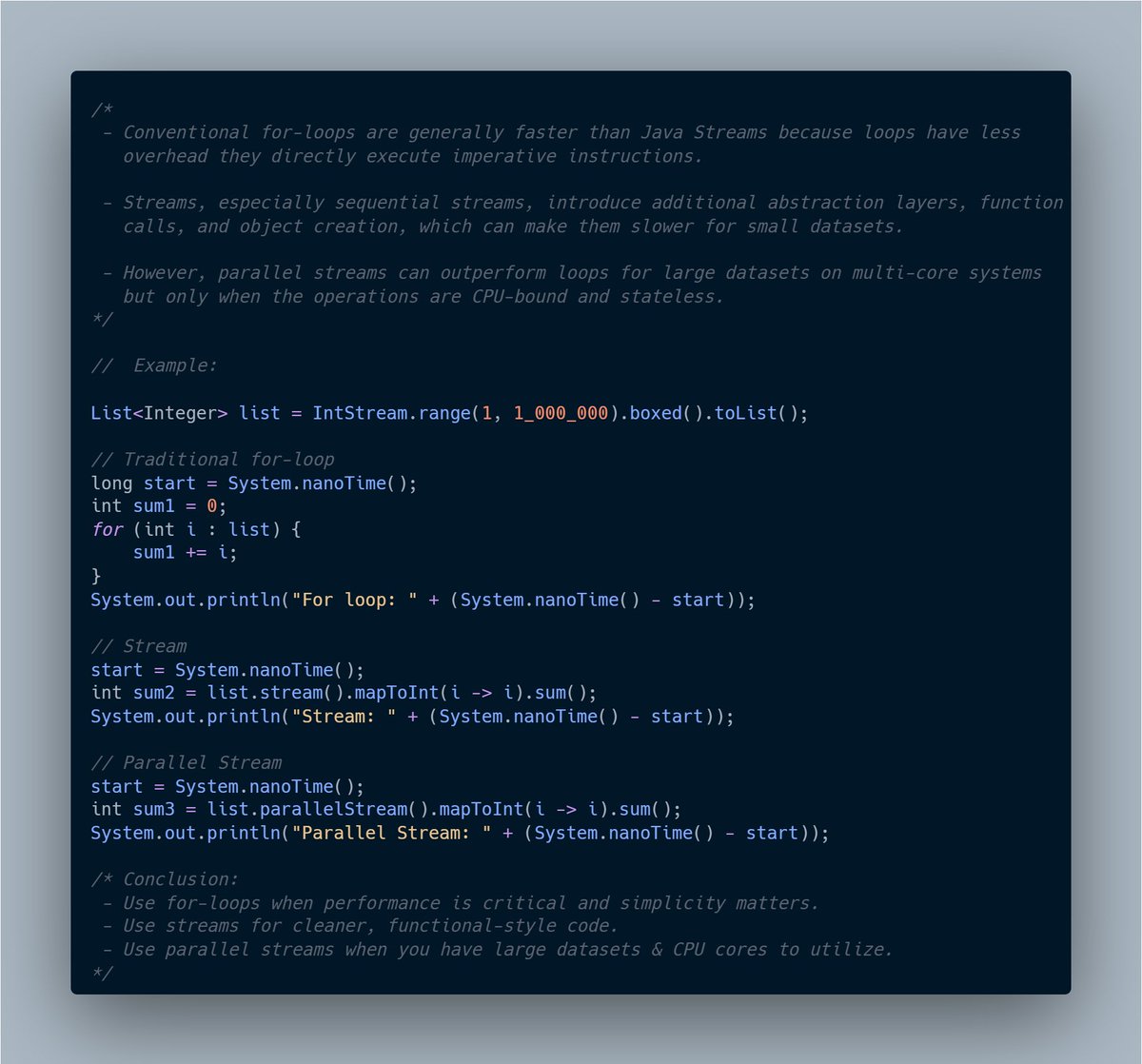
- For small data → for loop is faster (less overhead)
- For large, CPU-bound tasks → parallelStream() can win.
Streams add abstraction → cleaner code, not always faster. ⚡
More explanation 👇
6
692