
May 31
Hi @samicode
Here is an analysis and review of your Power BI dashboard.
Overall Dashboard Rating: 6.5 / 10
The Good:
- Clean Layout:The use of a dedicated left-hand navigation pane creates a structured, professional feel reminiscent of modern web applications.
-Consistent Colour Palette:The primary blue and dark navy colour scheme is clean and executive.
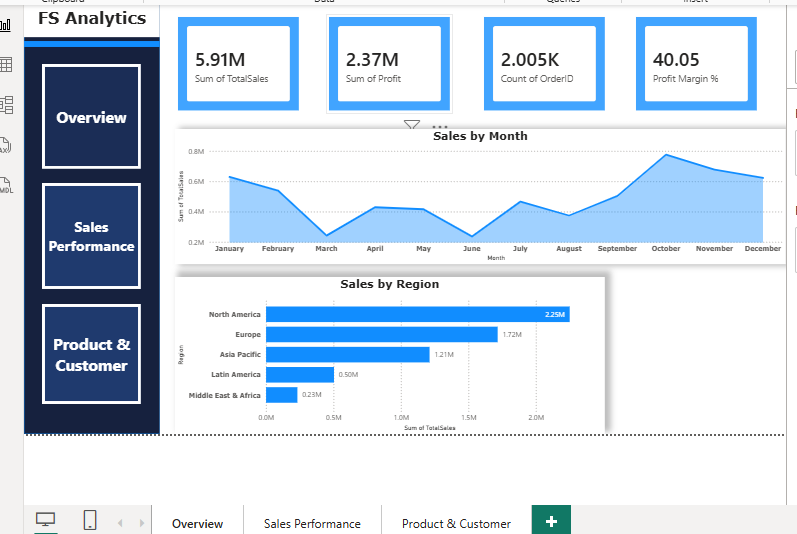
-Clear KPI Cards:The top cards on the Overview page immediately call out the macro metrics a business leader would care about.
Detailed Page Reviews & Critical Corrections
1. Overview Page
- KPI Title Uniformity
The KPI card titles are inconsistent. The first three display automatic aggregation strings while the fourth uses a clean metric name.
Fix:Rename "Sum of TotalSales" Total Sales
Rename "Sum of Profit" Total Profit
Rename "Count of OrderID" Total Orders
- Critical Visual Bug: Look at the bottom dotted border line of your canvas report view. The "Sales by Region" chart is physically cut off at the bottom.
Fix: You need to either increase the page canvas height or slightly reduce the vertical height of the charts so everything fits above the footer boundary.
Navigation Sync:The navigation button highlights "Overview," which correctly matches the highlighted bottom sheet tab. This is good UX practice.
KPI Alignment:The 4 KPI cards at the top have uneven spacing.
Fix:The gap between card 1 and card 2 is drastically smaller than the gap between card 2 and card 3. Use the Format > Align > Distribute Horizontally feature to fix this instantly.
2. Sales Performance Page
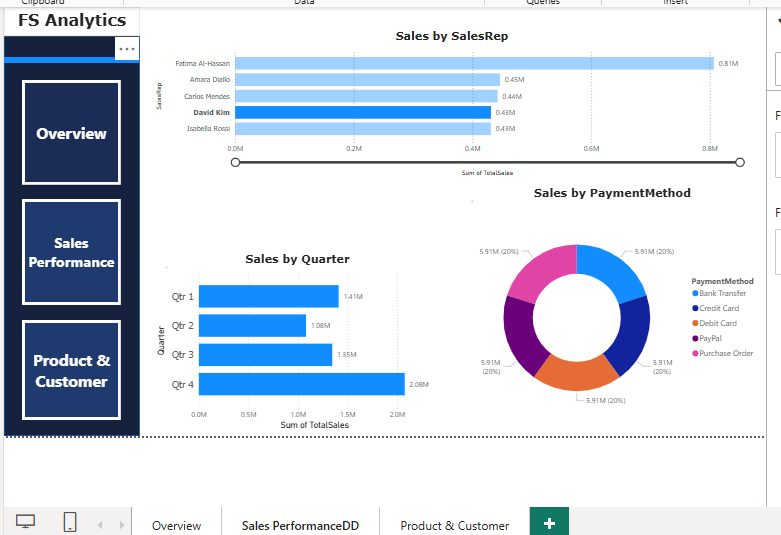
-The Broken Donut Chart: Look closely at "Sales by PaymentMethod." Every single slice says "5.91M (20%)". This means the chart is broken. It displays the grand total of sales (5.91M) uniformly across all categories rather than filtering by individual payment types.
Fix: You need to check your data modelling relationships or fix the specific value field/DAX measure dropped into this visual.
-Mismatched Navigation Highlighting: On this page, the left navigation bar still has "Overview" lit up, but the active view is clearly displaying Sales Performance data. Even worse, the bottom sheet tab says "Sales Performance" instead of matching the navigation title. This ruins the user's sense of orientation.
Fix: use a different canvas background where the highlights of the left navigation pane is on "sales performance "
- Slider Clutter: The numeric range slider underneath "Sales by SalesRep" takes up valuable canvas real estate but adds minimal value for a top-5 ranking list.
Fix:Consider removing it or using a standard top-N filter.
3. Product & Customer Page
Navigation Glitch:
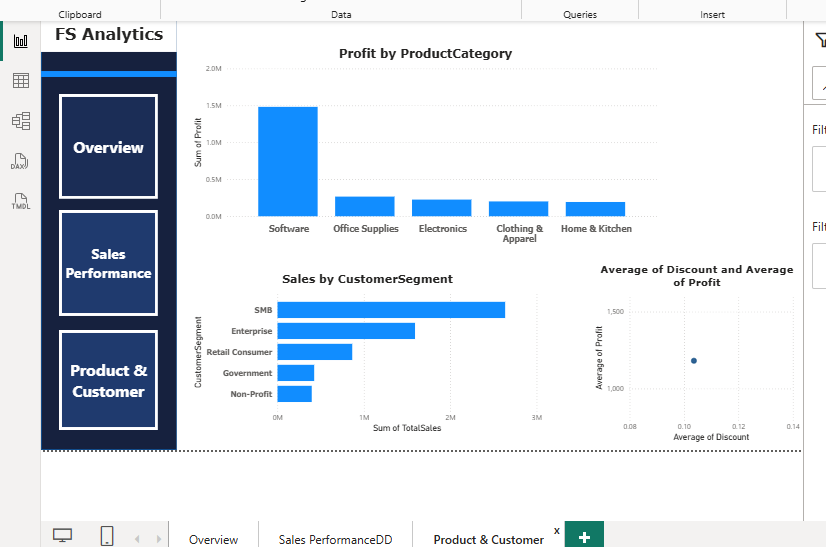
Similar to the second page, the left navigation panel is stuck highlighting "Overview"even though the bottom tab and the actual visuals are showing product & and customer insights.
Fix: (same as stated above) Ensure your button states are accurately mapped to the active bookmark or page, meaning you need 3 different canvas backgrounds for all 3 reports.
-The Broken Scatter Plot: The chart titled "Average of Discount and Average of Profit" on the bottom right only contains a single, isolated data point. A scatter plot requires a "Details" or "Legend" field (such as Category or Customer) so it can plot multiple entities across the axes to show a correlation. Right now, it is just plotting the average of the entire dataset.
Fix: To ensure your scatter plot works perfectly, verify that your fields are mapped like this in the Visualizations pane:
X-Axis: Average of Discount
Y-Axis: Average of Profit
Values / Details: Product Category or Product Name (This is what splits the single dot into many)
-Unclear Y-Axis Formatting:The Y-axis on the "Profit by ProductCategory" chart features unformatted numbers (0.0M, 0.5M, 1.0M). Ensure your data fields are explicitly formatted as currency where applicable, so it clearly reads as dollars/euros/Naira.
Yours in data,
Ekanem
Data analyst & Powerbi developer

Day 22: Built a 3-page interactive Power BI dashboard.
Navigation panel. KPI cards. 9 charts across 3 pages.
Excel → Python → Power BI. Full pipeline.
Total Sales: $5.91M | Profit Margin: 40.05%
Top Rep: Fatima Al-Hassan at $0.81M
I'm also down for correction @ekanemjr_99
3
9
885

Apr 9
Comic-Con Parking System
I found this one more interesting than previous ones.
open to feedback
code -
user [icon: user, color: blue] {
id string pk
name string
email string
phone string
createdAt datetime
updatedAt datetime
}
vehicle [icon: truck, color: blue] {
id string pk
userId string fk
vehicleCategoryId string fk
vehicleNumber string
createdAt datetime
updatedAt datetime
}
vehicleCategory [icon: tag, color: blue] {
id string pk
type enum
createdAt datetime
updatedAt datetime
}
parkingFloor [icon: layers, color: orange] {
id string pk
floorNumber int
createdAt datetime
updatedAt datetime
}
parkingCategory [icon: tag, color: orange] {
id string pk
type enum
parkingFeePerHour decimal
createdAt datetime
updatedAt datetime
}
parkingZone [icon: map, color: orange] {
id string pk
parkingCategoryId string fk
parkingFloorId string fk
zoneName string
totalSpots int
createdAt datetime
updatedAt datetime
}
parkingSpot [icon: map-pin, color: orange] {
id string pk
parkingZoneId string fk
parkingCategoryId string fk
spotCode string
isReserved boolean
isAvailable boolean
createdAt datetime
updatedAt datetime
}
session [icon: clock, color: green] {
id string pk
vehicleId string fk
parkingSpotId string fk
ticketId string fk
entryTime datetime
exitTime datetime
createdAt datetime
updatedAt datetime
}
ticket [icon: file-text, color: green] {
id string pk
vehicleId string fk
parkingSpotId string fk
sessionId string fk
ticketNumber string
QRtoken string
status enum
createdAt datetime
updatedAt datetime
}
payment [icon: credit-card, color: purple] {
id string pk
sessionId string fk
amount decimal
paymentMethod enum
paymentStatus enum
paidAt datetime
createdAt datetime
updatedAt datetime
}
// relations
user.id < vehicle.userId
vehicleCategory.id < vehicle.vehicleCategoryId
parkingFloor.id < parkingZone.parkingFloorId
parkingCategory.id < parkingZone.parkingCategoryId
parkingCategory.id < parkingSpot.parkingCategoryId
parkingZone.id < parkingSpot.parkingZoneId
vehicle.id < session.vehicleId
parkingSpot.id < session.parkingSpotId
session.id - ticket.sessionId
session.id < payment.sessionId
vehicle.id < ticket.vehicleId
parkingSpot.id < ticket.parkingSpotId
@Hiteshdotcom @nirudhuuu @ChaiCodeHQ @BlazeisCoding @yntpdotme
#chaicode #cohort #dbdesign

2
31
376

South Korea Proposes Digital Asset Basic Act for Stablecoins
South Korea's ruling Democratic Party has introduced a Digital Asset Basic Act aimed at regulating stablecoins used in foreign exchange as a payment method. According to NS3.AI, the proposed legislation includes Article 112, which mandates that issuers of digital assets tied to real-world assets must place these underlying assets in a managed trust under the Capital Markets Act. Additionally, Article 124 stipulates that businesses dealing with value-stable digital assets in foreign exchange will be subject to foreign exchange supervision without the need for separate registration. The act also proposes exemptions for certain payments for goods and services from reporting requirements within a specified range.
#SouthKorea #DigitalAsset #Stablecoins #ForeignExchange #PaymentMethod #DigitalAssetsRegulation #CapitalMarketsAct #ForeignExchangeSupervision #NS3AI
2
6
921

Mar 23
u wanna add also the tempo charge / session method so we humble stablecoin users can also do it w/ our own self custody wallet? :D i tried the crypto payment method from your link integration and got some error
>The PaymentMethod provided (crypto) is not allowed for this PaymentIntent. Please attach a PaymentMethod of one of the following types: card, link. Alternatively, update the allowed payment_method_types for this PaymentIntent to include "crypto".
2
657

@jpyc_official and @sonybank_jp sign MOU for Yen Stablecoin Integration
𝙍𝙚𝙖𝙙 𝙈𝙤𝙧𝙚: itbusinesstoday.com/fintech/…
#Blockchain #JPYCCorporation #paymentmethod #SonyBank #Web3

3
9
1,167

Feb 27
இந்தியாவின் UPI பணப் பரிவர்த்தனையை இஸ்ரேலில் பயன்படுத்த ஒப்பந்தம் கையெழுத்தானது..!
#upi #israel #india #paymentmethod #jayatv

3
56

5 ways to solve import cycles in Go.
Go import cycles mean package A imports package B and package B imports package A, such as when Customer has []Order and Order has Customer.
Go blocks this on purpose as:
- The compiler builds one package at a time and it must start from packages that import nothing. A cycle breaks that order.
- Another big reason is startup order. Global variables and init functions run in import order. With a cycle there is no clear order, so code can read a global value before it is ready.
The most useful idea here is to treat an import cycle as a design smell. You are coupling 2 features together, if you want to move a feature to another project, you also need to move another one.
So here are 5 ways to fix them. Assume that:
- package customer: object Customer contains []Order
- package order: object Order contains Customer
--- 1. using IDs instead of full objects
This is the most common design in real systems. Instead of storing a whole Customer inside Order, you only store CustomerID. Instead of storing a list of Order objects inside Customer, you store OrderIDs or nothing at all.
```
package customer
type Customer struct {
ID int64
Name string
OrderIDs []int64
}
---
package order
type Order struct {
ID int64
Product string
CustomerID int64
}
```
When the program needs the real data, another layer loads it. For example, storage code sees CustomerID and fetches the Customer from the database.
--- 2. uses small interfaces
Instead of holding a concrete Customer type inside Order, the order package defines a tiny interface that describes what it needs from a customer.
The order package does not import customer package. Any type that satisfies the interface can be used.
```
package order
type Customer interface {
Pay() int64
Name() string
}
type Order struct {
ID int64
Product string
Customer Customer
}
```
Now Customer implements the interface implicitly. order package does not know about the concrete Customer type. A higher level package wires them together.
--- 3. uses a wrapper package for combined views
Keep Customer and Order clean and independent. Then create a third package that imports both and builds a combined struct used for specific screens or API responses.
```
package customer
type Customer struct {
ID int64
Name string
}
package order
type Order struct {
ID int64
Product string
CustomerID int64
}
package customerorder
type CustomerWithOrders struct {
customer.Customer
Orders []order.Order
}
```
This type is not a core domain object. It is a view model, a shape convenient for one response or one page. You load data from storage and assemble it.
This pattern is very common in APIs and UI backends. The limitation is that the relationship lives only in this wrapper, not inside the base structs.
--- 4. uses one bounded model package
Put both structs in the same package. Because they share the same namespace, they can reference each other directly without imports.
This is the only way to truly have Customer contain []Order and Order contain *Customer as real fields at the same time:
```
package cusordermodel
type Customer struct {
ID int64
Name string
Orders []*Order
}
type Order struct {
ID int64
Product string
Customer *Customer
}
```
Other layers import model, but model imports nothing. This keeps dependencies pointing inward. It is clean when Customer and Order are tightly coupled and always evolve together.
Note: the model package does not mean a global model. It is a local model package only for Customer and Order.
The tradeoff is that the model package can grow large if you put too many types in it.
--- 5. this is a design issue, fix it
Most of the time you do not need both directions. Pick one owner. Usually Order knows Customer, but Customer does not need to store all orders.
If you need a customer with orders, query orders by CustomerID. This keeps the model simple and avoids heavy memory use. Bidirectional links often cause problems like large object graphs and harder updates.
If you put everything inside Customer, things like []Order, []Address, []PaymentMethod, []Review, []Notification, the struct can grow very large over time. It becomes a "god object". Every new feature wants to attach something to Customer because it feels natural. After a while the type is heavy, hard to understand, and expensive to load into memory.
---
In large production systems, 1 and 5 are the most common. 4 appears when types are tightly coupled within the same domain. 2 and 3 are situational tools used for decoupling or building response shapes.
4
11
152
8,585

Feb 23
Updated payment methods listed here:
allmylinks.com/tittietia19
I won't be answering messages asking for them, this is pinned to my profile to make it easy for you to access.
#cammodel #webcam #paymentmethod #sendtogoddess #findom #gfe

10
2,451

Feb 21
Crunchyroll
leecolt10@gmail.com:10Maggie | EmailVerified = Yes ✔️ | CreatedAt = 1/24/2024 2:26:33 AM | Name = RISHABH | MaxProfile = 5 | TotalProfile = 1 | Country = Canada 🇨🇦 | MaxStream = 1 | Plan = ⟪FAN MEMBER⟫ | PaymentMethod = credit_card | Source = cr | PaymentInfo =
1
1
2
40

Jan 29
Define a PaymentMethod interface, let UPI, Card, and Wallet implement it, and choose the right one at runtime using a factory or map. now adding a new payment option means adding a new class not rewriting existing logic.
1
16
1,433

Jan 29
خیلی از روشهای مختلف #پرداخت یا #تسویه توی استخرهای #ماینینگ حرف زده میشه اما واقعا تفاوت #PPLNS با #PPS و #FPPS و بقیه روشها چیه؟
مقاله زیرو حتما بخون تا جواب سوالو پیدا کنی
vrgl.ir/YS7sh
#PaymentMethod
1
3
150

Jan 19
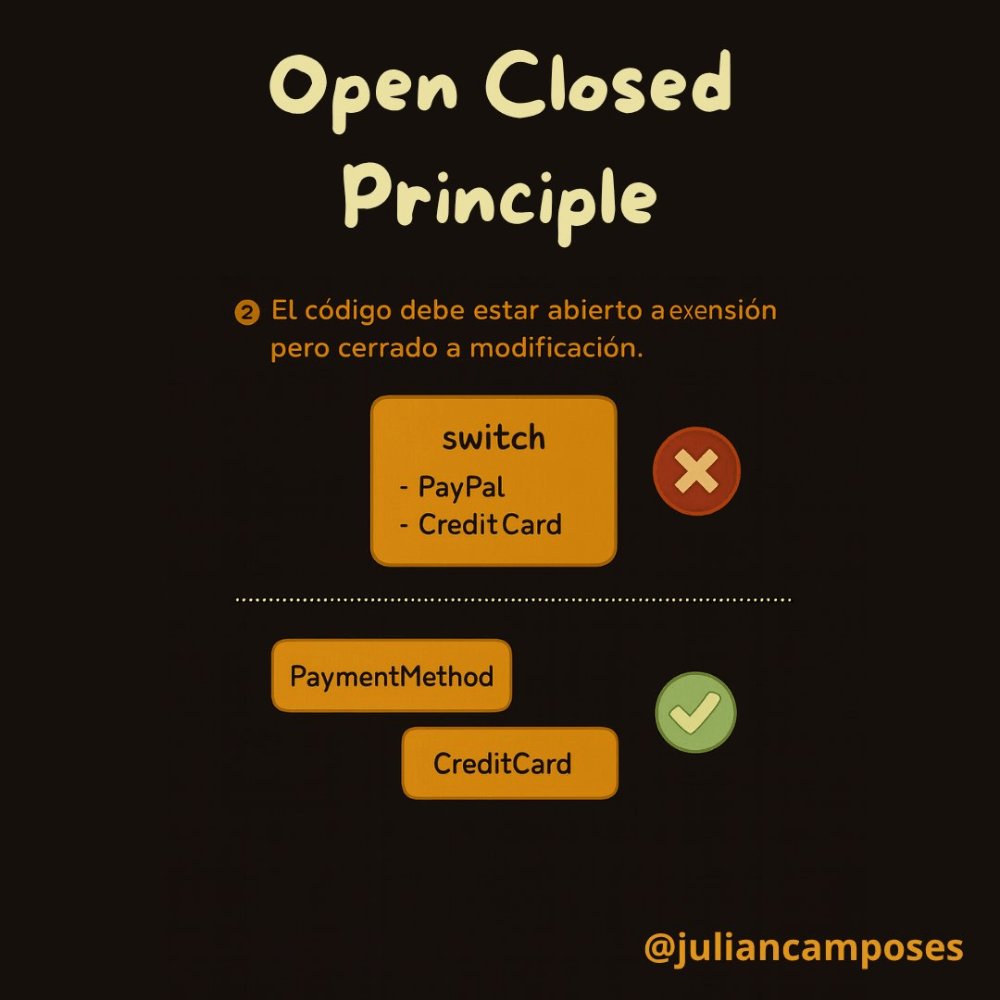
2️⃣ Open/Closed Principle
El código debe estar abierto a extensión pero cerrado a modificación.
❌ PaymentProcessor con un switch para cada método de pago. Añadir uno nuevo implica editar y arriesgarte a romper lo existente.
✅ Usar interfaz PaymentMethod y nuevas clases que la implementen.
El procesador solo depende de la interfaz.
1
1
9
2,954

New year, new sneaker to kick in your balls and step outside with your money.
By the way pay my sneakers back ( ask for paymentmethod in chat )

1
6
39
3,502

19 Dec 2025
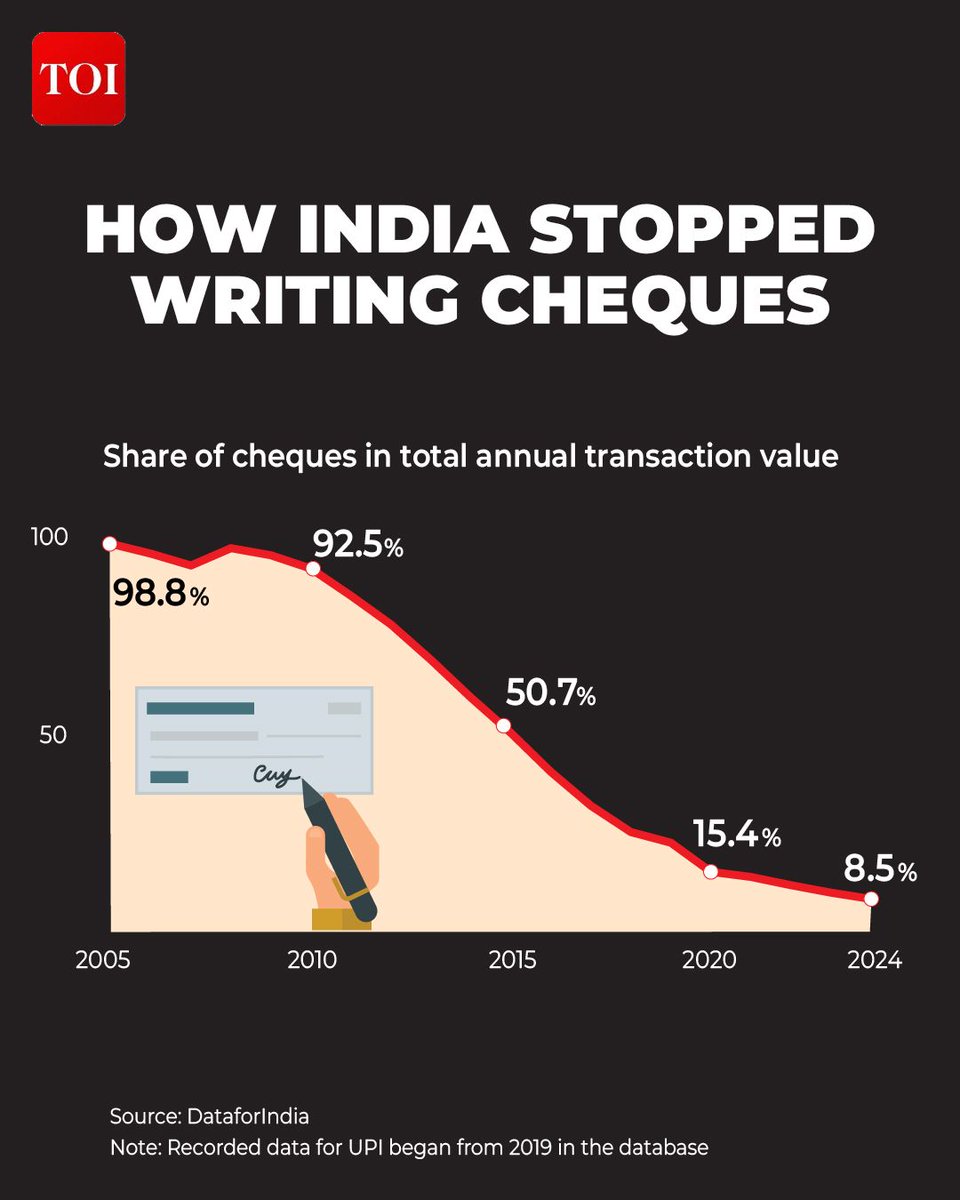
#STATOISTICS | Two decades ago, #cheques accounted for nearly all major retail payments in India. But, with the rise of #NEFT and #UPI, cheque use has come down to only 8% of annual transactions in the country
#cheque #UPI #upipayments #payments #paymentmethod #transactions
1
2
16
3,289

17 Nov 2025
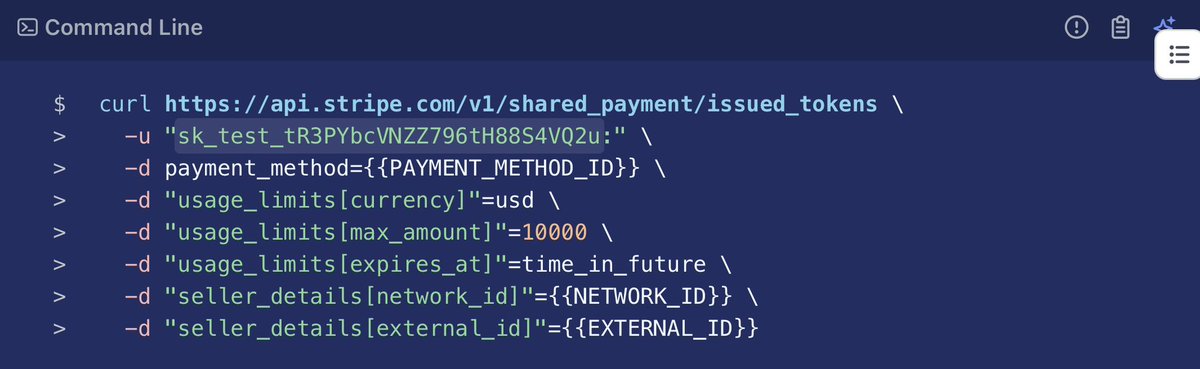
Why do we need Shared Payment Tokens (SPT)?
> It lets one agent securely hand off a user’s card to another agent without ever exposing raw card data
> Agent collects the card → converts it into an SPT with scoped rules
> This SPT becomes the only thing shared between agents no PAN, no CVV, no sensitive fields
> Receiving agent uses the SPT directly in a PaymentIntent
> Stripe auto replicates a safe PaymentMethod behind the scenes and processes the charge
Result: Secure cross agent payments, multi store interoperability, and AI driven checkout
1
1
4
250

1/2
「从 ACP 和 X402 看人类支付的未来 」
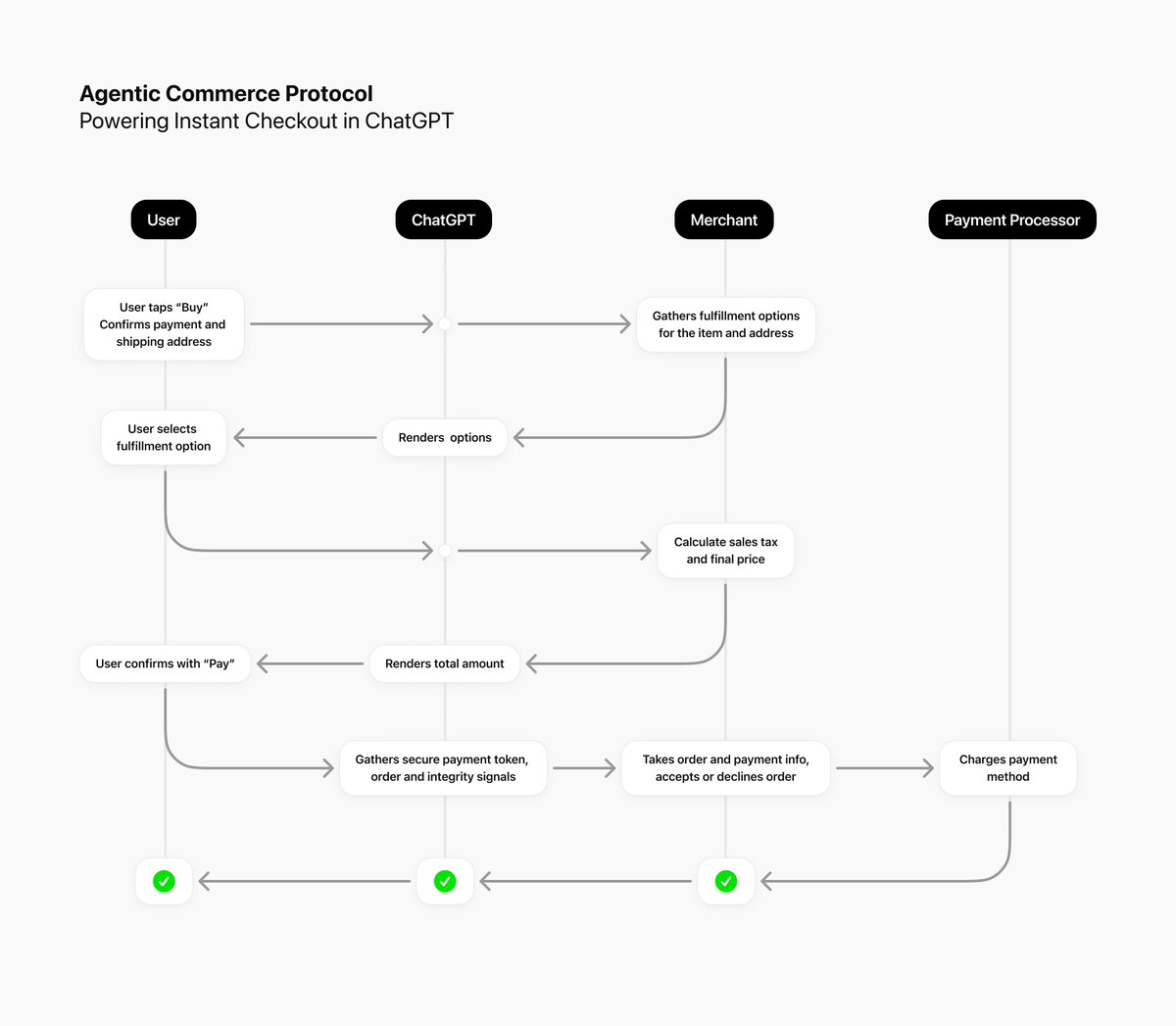
Agent Commerce Protocol(ACP)
ACP 是 @OpenAI 、@stripe 、Esty 、@Shopify 合作开发,其目的是:
- 让用户可以让Agent代理来根据自己的意图丝滑的完成寻找商品到付款的流程。
目前你已经可以在 chatgpt 里丝滑使用:你可以阅读
openai.com/zh-Hans-CN/index/… 来了解更多
目前整个协议主要分为4个角色:
User 使用Agent产品的用户
Agent(chatgpt) 任意Agent
Seller(Merchant) 卖货的商家
Stripe(Payment Provider)
整个协议流程大概如下
1. 用户跟Agent告知自己的 Intent
2. Agent 从Merchant 里根据用户的 Intent 找到相关的商品列表,并且返回给用户包括价格信息等
3. 用户选择自己心仪的商品,然后会由Agent请求 Merchat 确认最终的价格
4. 最终用户确认价格后为这个商品进行一次支付行为,最终会生成一个支付凭证,一个stripe 的 SPT Token 发送给商户,商户收到这个支付凭证后会进行发货处理同时把这个 SPT Token 发送给 Stripe(payment provider) 进行结算。
「X402 vs Share Token Payment」
现在我们先来关注下这里的完整的ACP的资金流是怎么运转的:
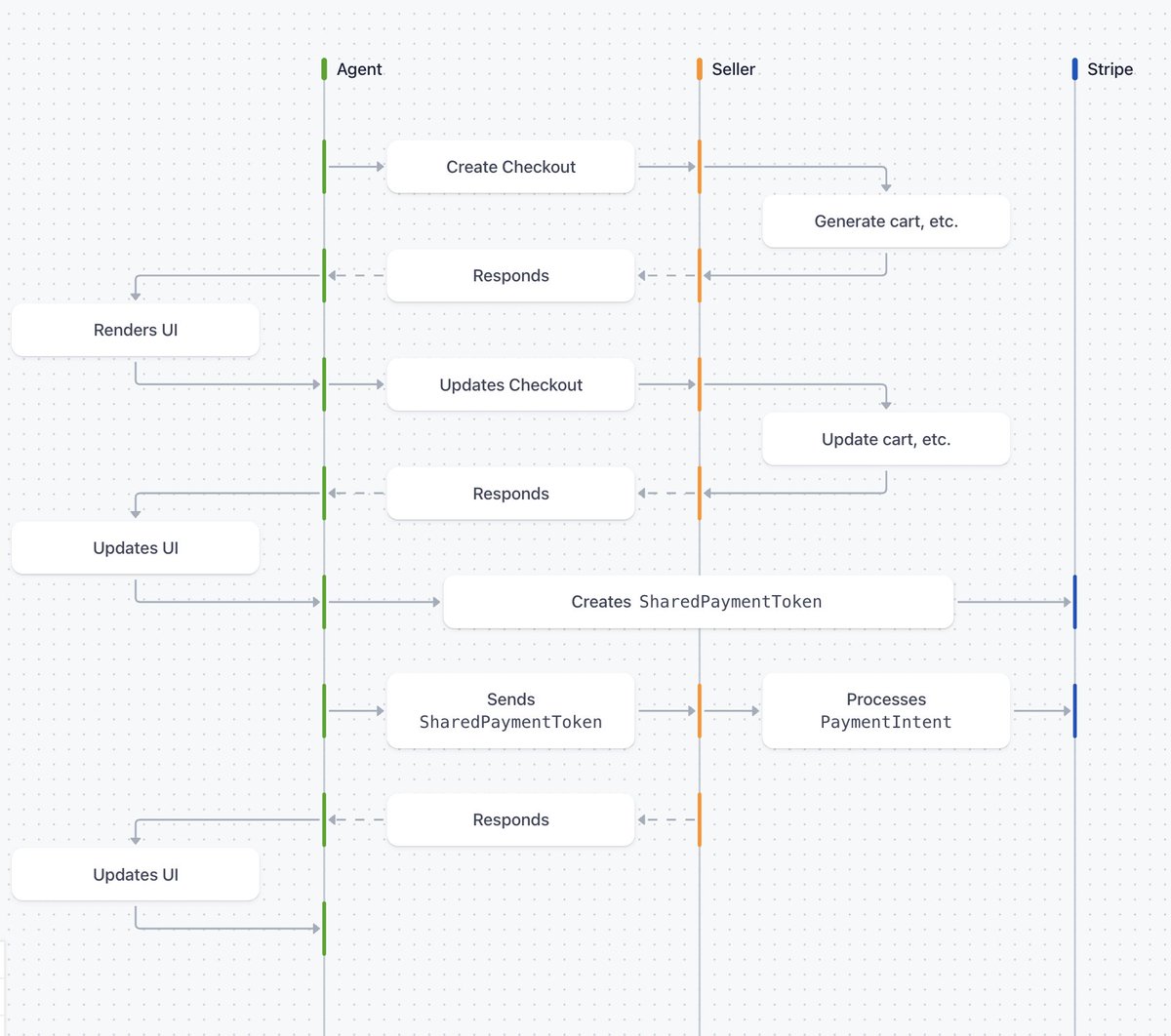
首先我们上面说到的 支付凭证, SPT(Shared Payment Token,共享支付令牌) 是 Stripe 在 Agentic Commerce(智能体商务)中用来让「AI 代理」安全处理买家支付信息的设计的一种机制。
它存在于代理(agent)的 Stripe 账户中,由代理生成并共享给卖家(seller)。
SPT 就像是一张「一次性或短期有效的支付通行证」。
SPT 的生命周期与工作流程:
1️⃣ 代理收集买家支付方式
AI 代理或应用从买家那里 收集支付信息(例如使用 Stripe 的 SetupIntent 或 PaymentMethod API)。
这些信息安全地保存在代理的 Stripe 账户里
2️⃣ 代理创建 SPT(SharedPaymentToken)
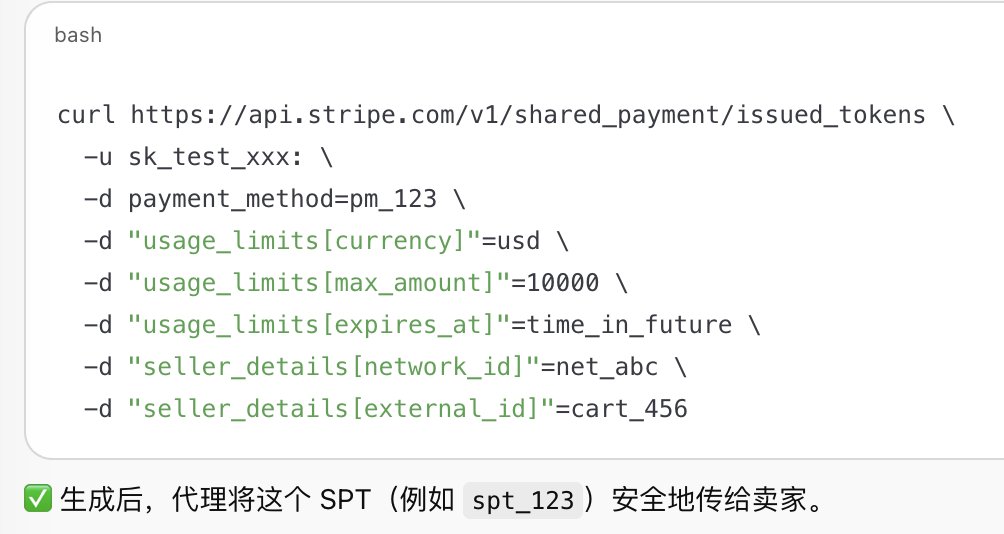
代理调用 Stripe API 创建一个 SharedPaymentToken 对象,并定义其使用范围:
usage_limits:设定币种、最高金额、过期时间;
seller_details:设定可以使用该 SPT 的商家(network_id、external_id);
payment_method:绑定的支付方式 ID。
3️⃣ 卖家使用 SPT 创建付款
卖家收到 SPT 后,可以用它创建一个 PaymentIntent 来发起支付:
curl api.stripe.com/v1/payment_in… \
-u sk_test_xxx: \
-d amount=10000 \
-d currency=usd \
-d shared_payment_granted_token=spt_123
此时 Stripe 会:
在卖家账户中复制一份匿名化的支付方式;
自动填充 payment_method;
确保敏感数据从未在卖家系统中暴露。
4️⃣付款确认与后续事件
Stripe 会向代理和卖家发送事件通知(webhook):
同时注意 代理可以随时调用撤销接口,使该令牌失效:
2
1
8
1,084

15 Oct 2025
Great question!
Stripe has implemented guard rails such that each smart contract the customer provides a spending cap request to is specifically tied to and can only transfer funds to that merchant itself. Beyond that, only the merchant can initiate funds pulls (via their Stripe API secret key). These dynamics are not too dis-similar to other fiat payment methods (i.e. credit cards) where the merchant can charge any amount at any time once the customer has saved their credit card details to the merchant.
As a result, when/if a customer deletes their crypto PaymentMethod with the merchant, the merchant will not have access to charge the customer’s wallet.
2
5
510

11 Sep 2025
✅ Day 73/90 #buildinpublic
🎯Added core Order & Payment modules:
1️⃣ OrderEntity OrderItemEntity
2️⃣ OrderRequest & OrderResponse DTOs
3️⃣ PaymentDetails (Razorpay) & PaymentMethod enum
📂 Repo: github.com/samrat21saha/volt… #SpringBoot #Backend #webdev #Java
3
68

24 Aug 2025
This is the only legit payment method i use..please cooperate ! if u want to buy my content please send it here. no buts. pls. this is just the easiest way to send no fee to pay..
#paymentsuccess #paymentmethod #selling #buymycontent #anyone

2
264
11 Aug 2025
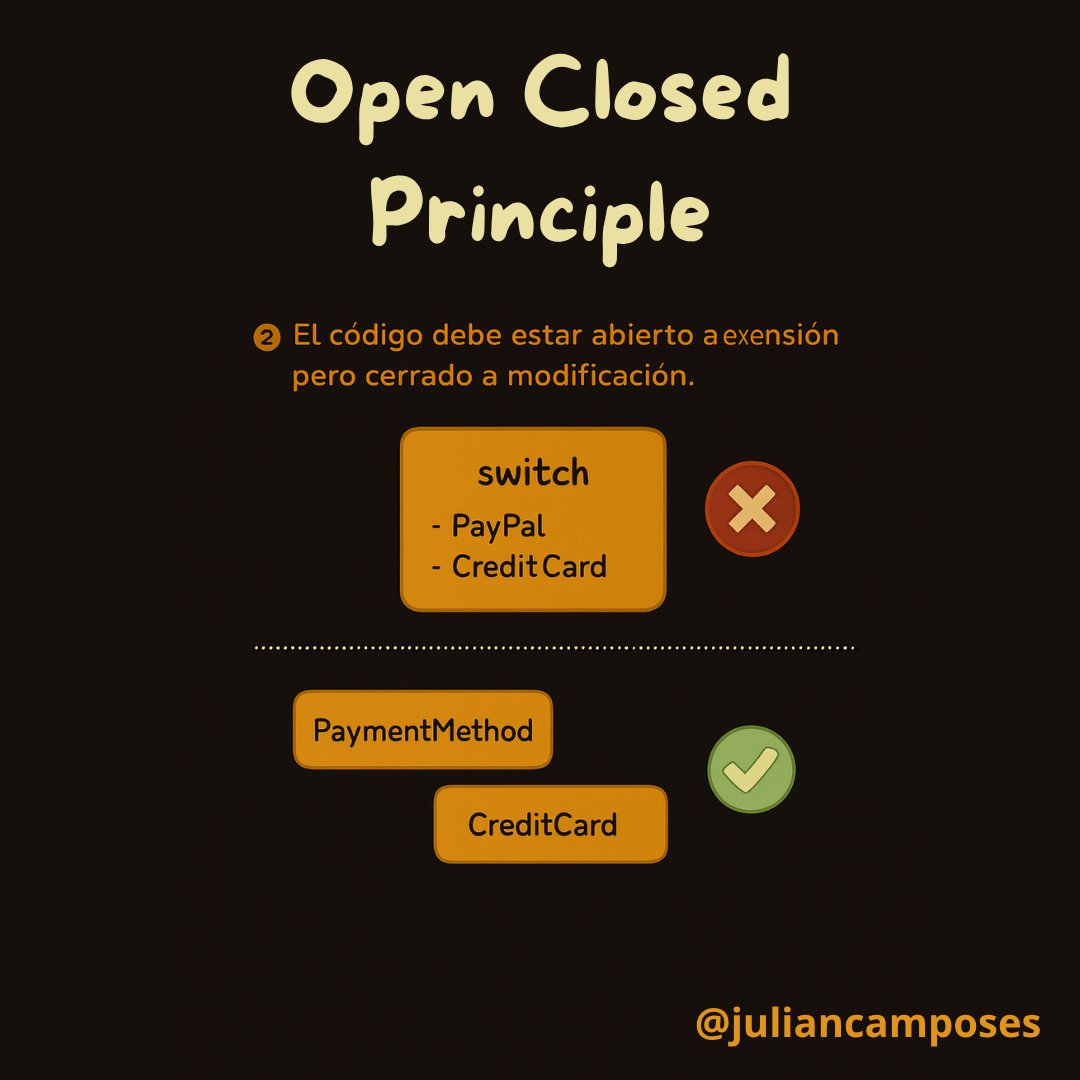
2⃣ Open/Closed Principle
El código debe estar abierto a extensión pero cerrado a modificación.
❌ PaymentProcessor con un switch para cada método de pago. Añadir uno nuevo implica editar y arriesgarte a romper lo existente.
✅ Usar interfaz PaymentMethod y nuevas clases que la implementen. El procesador solo depende de la interfaz.
1
1
20
7,202