
A vest can't
measure
a big game.
How Brazil Is Betting on 'Smart Vests' in Its Bid for World Cup Glory
The end of the eye test? Brazil's new edge is a wearable sensor.
Behind the scenes, Brazil's sports scientists have been tracking players using wearable technology that monitors sprint speeds, heart rates, fatigue levels, and injury recovery.
The data is collected year-round from clubs and fed into the national team's database.
My data brain loves this—quantifying physical load, spatial efficiency, and rehabilitation timelines.
My gut feeling knows that no vest can measure a player's big‑game temperament or a manager's tactical intuition.
But when Brazil take the pitch against Morocco, they'll have years of data behind every decision. The question: does more data lead to better decisions—or just more hesitation?
#Brazil #WorldCup2026 #SportsTech #WearableTech #DataAnalytics #FootballScience #PerformanceAnalysis #EyeTest #SportsInnovation #TeamBrazil
11
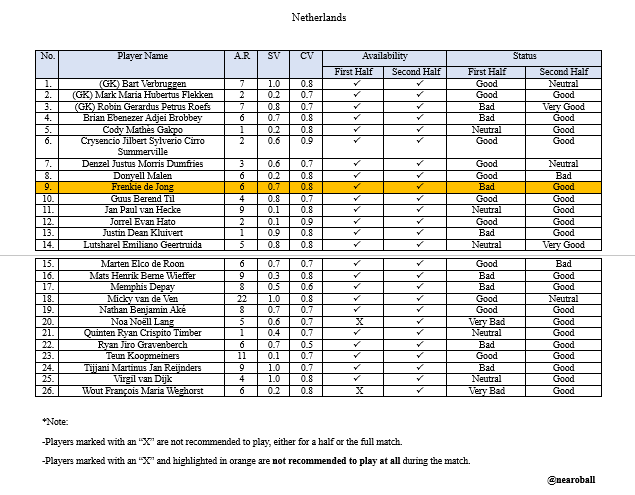
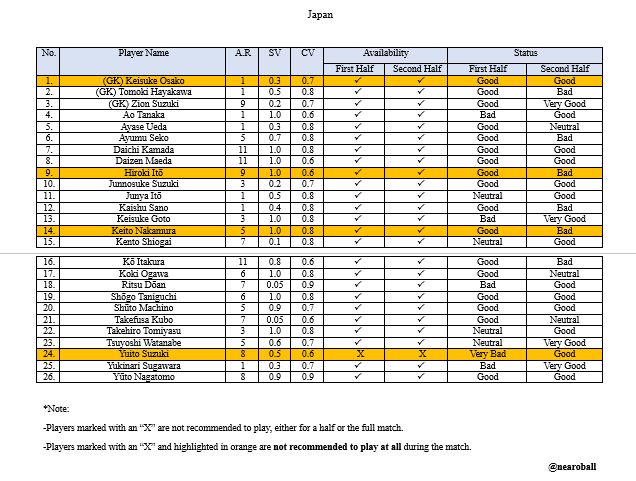
🔎Personal Time Analysis
@OnsOranje vs. @jfa_samuraiblue
14 June 2026, 15.00
📍Dallas Stadium, Texas
🏆FIFA World Cup 2026 (Group Stage)
#Netherlands #Japan #WorldCup #FootballAnalytics #PerformanceAnalysis
Netherlands Japan
1
130

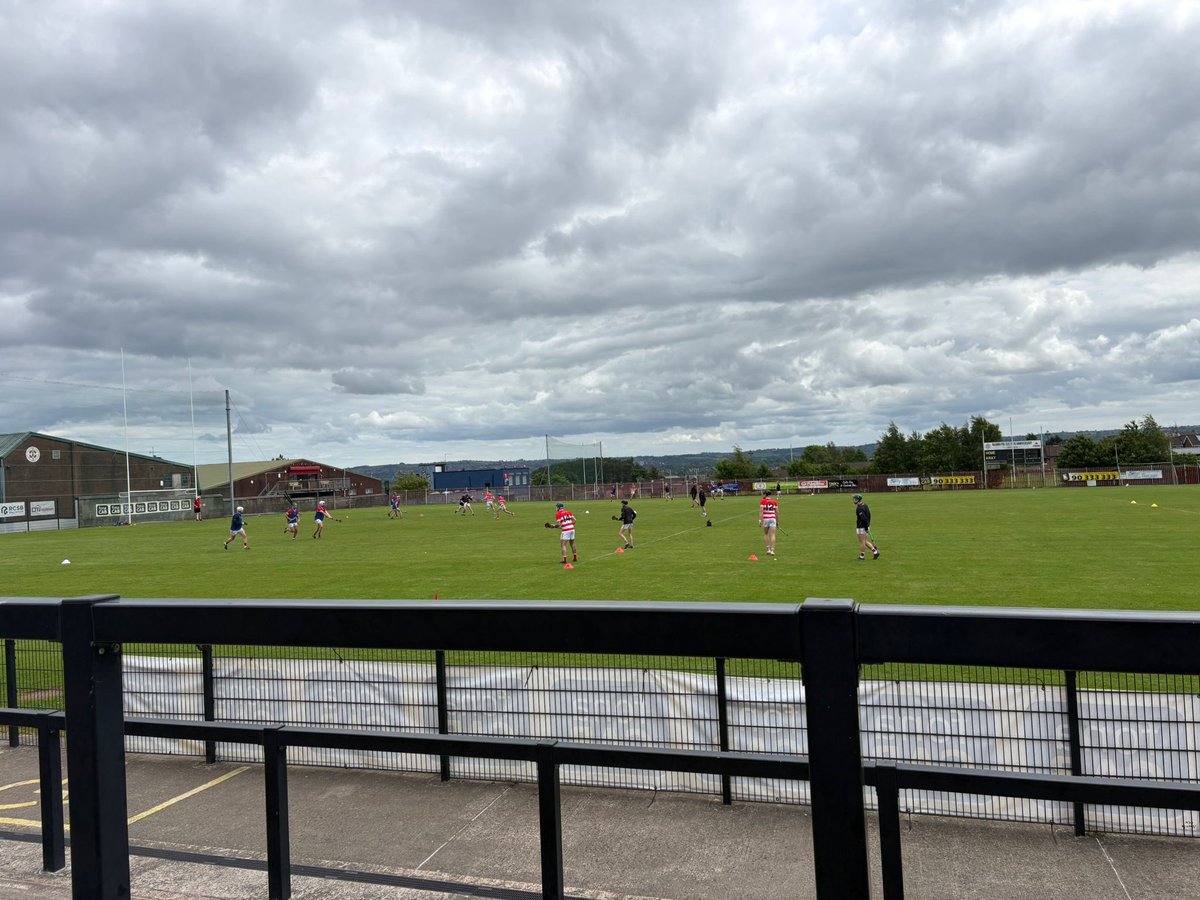
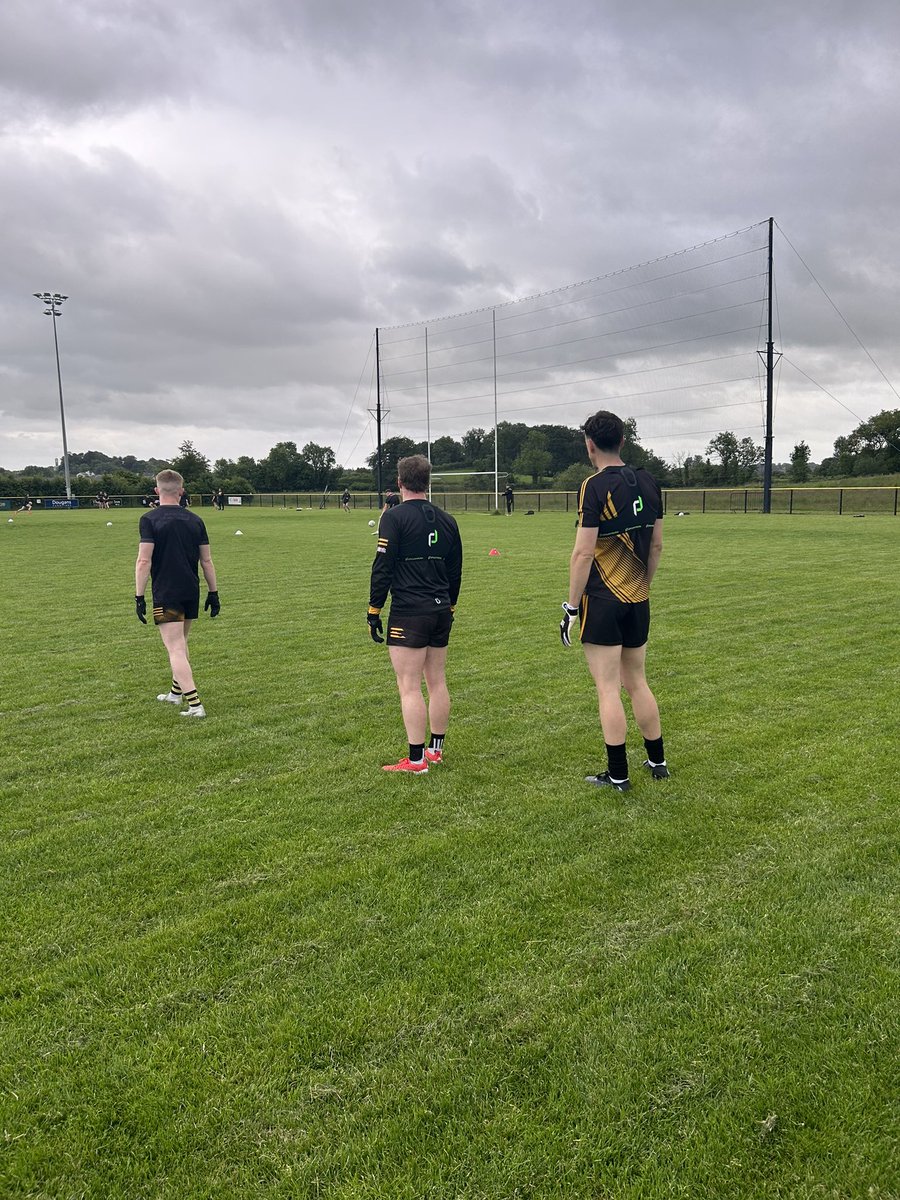
🔥 Level up your performance.
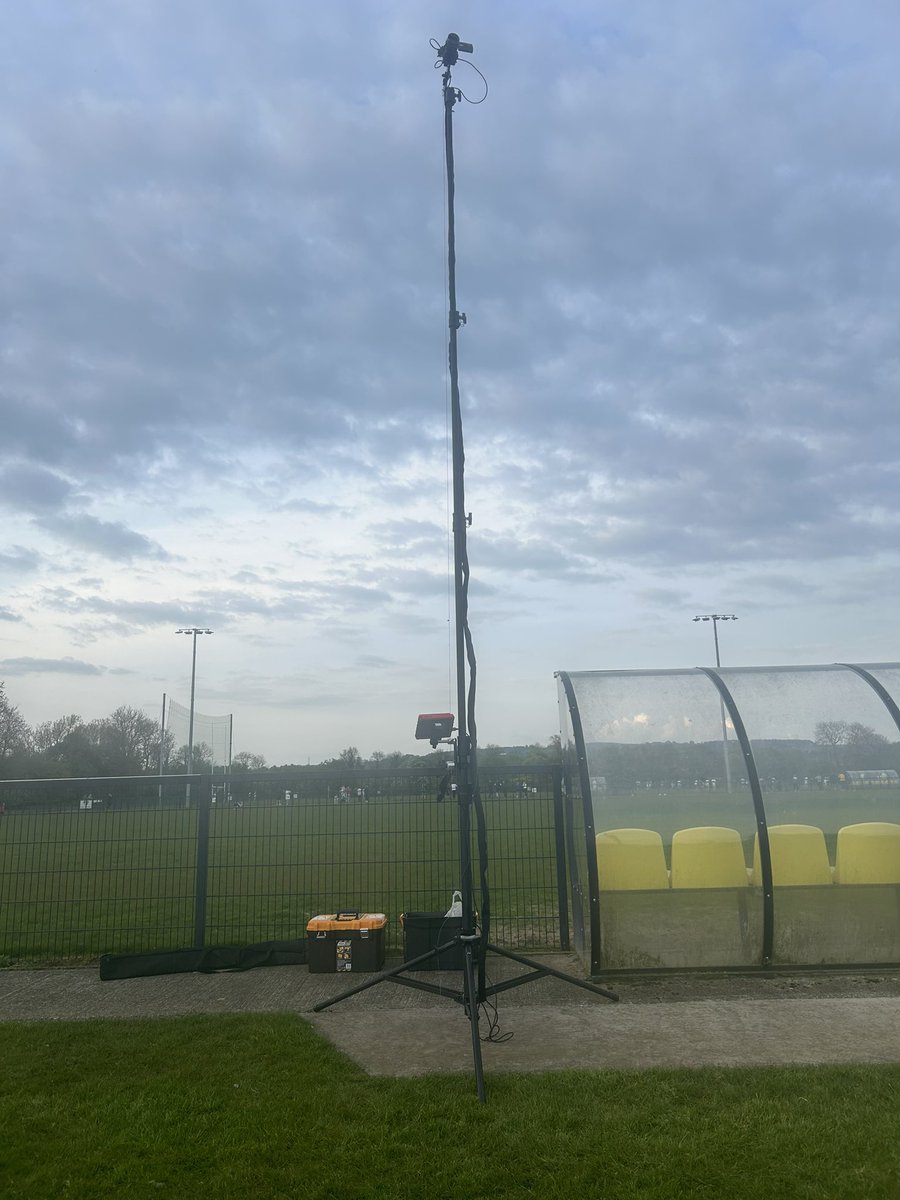
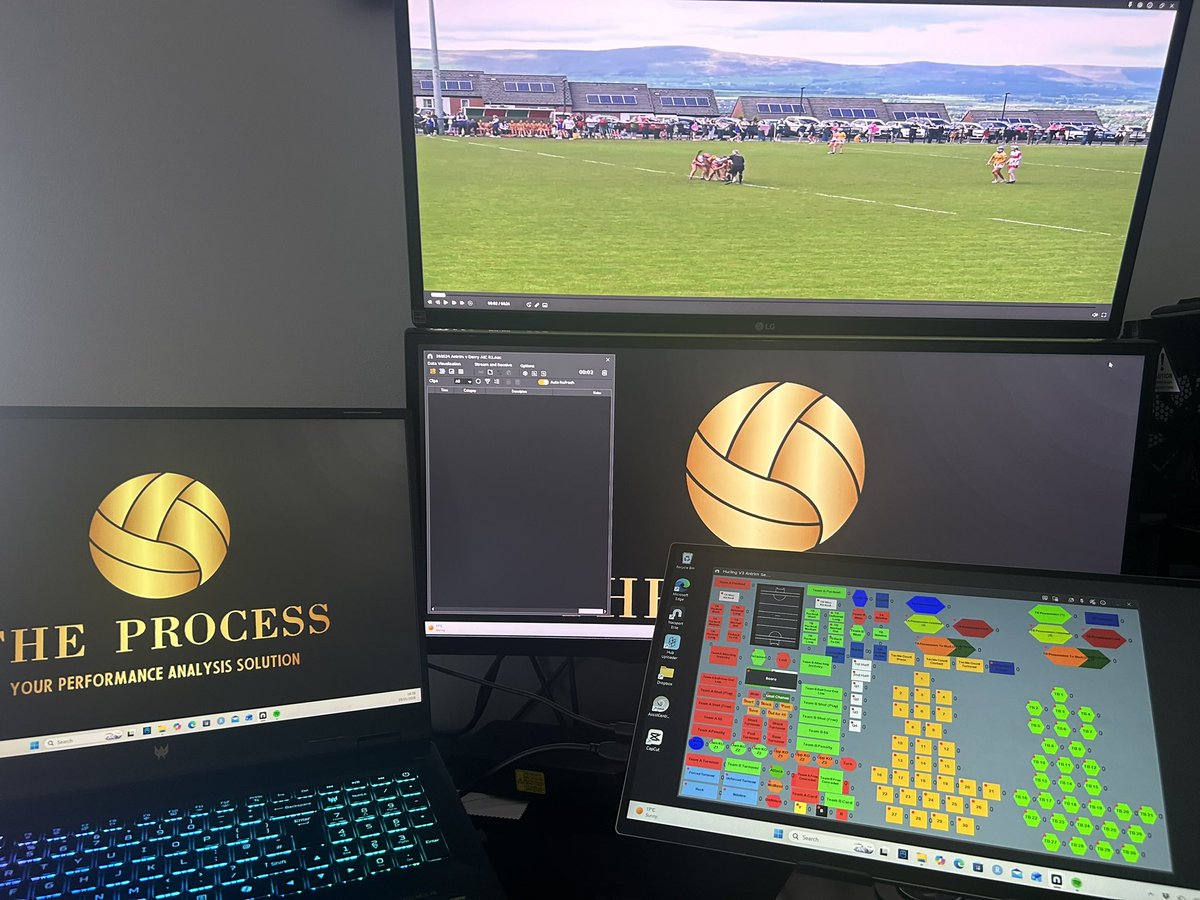
🎥 High‑behind video 📍 PlayerData GPS 🧠 Tactical physical insight
See the what. Measure the how much. Understand the why.
DM or email theprocessperformanceanalysis@hotmail.com
#GPS #PerformanceAnalysis #Hurling #Football #Camogie
1
1
124

Jun 13
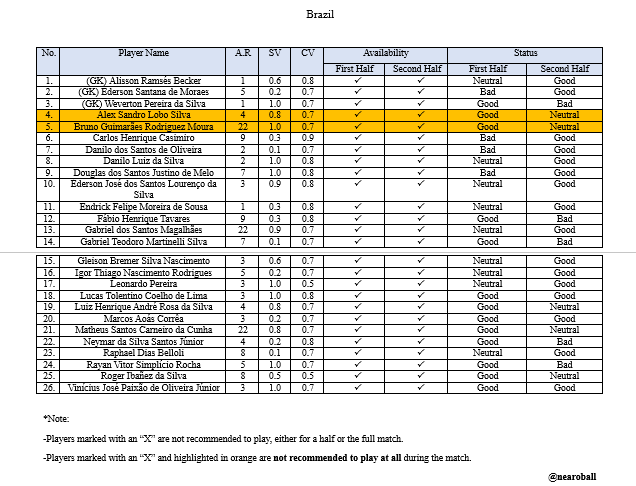
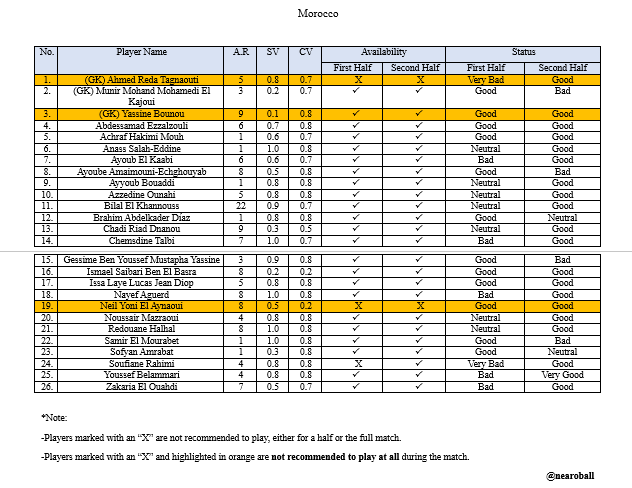
🔎Personal Time Analysis
@CBF_Futebol vs. @EnMaroc
13 June 2026, 18.00
📍New York New Jersey Stadium, New Jersey
🏆FIFA World Cup 2026 (Group Stage)
#Brazil #Morocco #WorldCup #FootballAnalytics #PerformanceAnalysis
Brazil Morocco
1
40
Jun 13
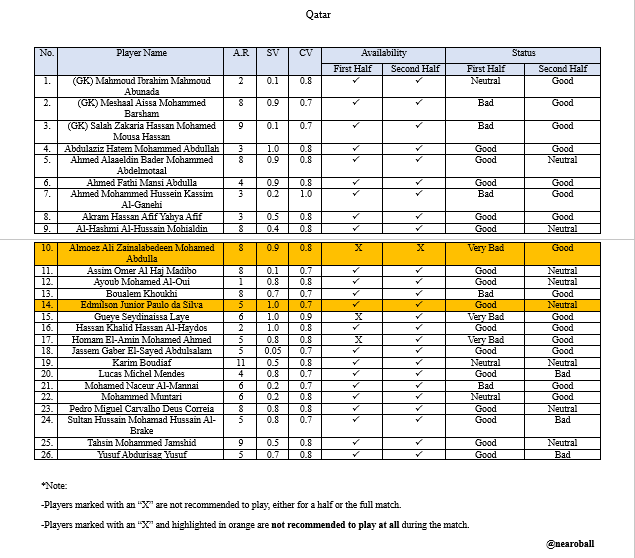
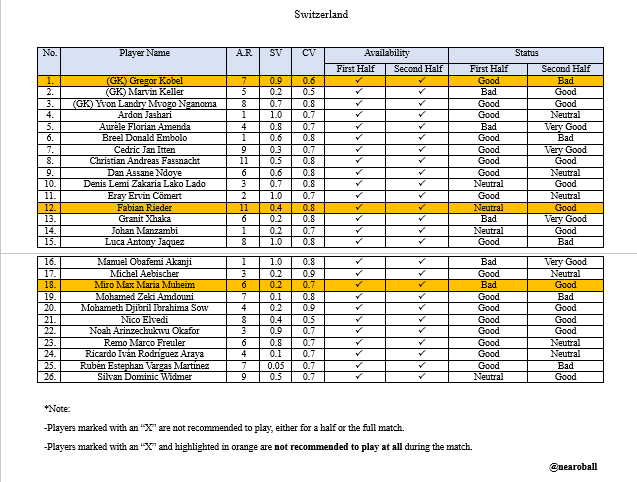
🔎Personal Time Analysis
@QFA vs. @nati_sfv_asf
13 June 2026, 12.00
📍San Francisco Bay Area Stadium, California
🏆FIFA World Cup 2026 (Group Stage)
#Qatar #Switzerland #WorldCup #FootballAnalytics #PerformanceAnalysis
Qatar Switzerland
1
30

Jun 12
As the 2026 World Cup season kicks off, wearable tech in soccer is everywhere ⚽
But how accurate is it for measuring kicking performance?
An article in JMIR Research Protocols sets out to evaluate wearable technologies used in soccer kicking, focused on validity, reliability & accuracy.
Because in modern football, it’s not just about collecting data, it’s about trusting it.
Read the full article: researchprotocols.org/2024/1…
#SportsScience #WearableTechnology #Soccer #FootballScience #PerformanceAnalysis #FIFA #DataInSport #JMIR
77

📣 Welcome Dr John Francis to the ASPA Advisory Board & as Chair of our Research & Knowledge Exchange Committee 😊
theaspa.org/news-&-article… via @the_aspa
John's career has been dedicated to turning insight into impact through research, collaboration, and analyst development.
Interested in helping shape the future of performance analysis?
📧 info@theaspa.org
📌 Subject: Standing Committee
#ASPA #PerformanceAnalysis #KnowledgeExchange
5
128

Build your ideal biomechanics lab with HaB Direct 🔬🏋️♂️! Expert gear & support. Learn more: habdirect.com/build-your-ide… #Biomechanics #SportsScience #Rehabilitation #GaitAnalysis #HumanPerformance #HaBDirect #Research #PerformanceAnalysis
7

Jun 12
Analyze FIFA World Cup matches with advanced football analytics on the Football Hacking web app. ⚽📊
🔹 Pass Network Structure Analysis
🔹 Offensive Transition xT
🔹 Ball Recovery xT
🔹 Adjustable minimum pass interactions
🔹 Match time slider to analyze specific game periods
Perfect for football analysts, scouts, coaches, and sports traders who want to understand team dynamics and identify the best moments for entry and decision-making.
Turn raw match data into actionable insights.
🔗 Link in bio
#WorldCup #FootballAnalytics #SoccerAnalytics #FootballData #SportsTrading #xT #ExpectedThreat #DataScience #FootballAnalysis #SoccerData #PerformanceAnalysis #FootballHacking
2
187
📢 CPD CALENDAR LAUNCH
We're excited to announce the launch of the ASPA 2026–27 CPD Calendar, commencing July 2026.
Built around ASPA's three pillars:
🎓 Accreditation
📚 CPD
🤝 Community
The programme will feature expert webinars, practitioner roundtables, applied workshops, research-to-practice discussions, mentoring opportunities & accreditation support throughout the year.
Designed by analysts, for analysts, the calendar aims to support learning, development and professional growth at every stage of the journey.
📅 Launching July 2026
theaspa.org/cpd-&-events
#PerformanceAnalysis #SportsAnalytics #CPD #ProfessionalDevelopment #SportsScience #AnalystDevelopment #ASPA

2
4
173

The difference between winning and losing may be hidden in data no coach can see.
Machine learning is transforming soccer training by uncovering patterns in player movement, decision making, fatigue, positioning, and match performance that were previously invisible to the human eye.
Modern training sessions generate enormous amounts of information from GPS trackers, wearable sensors, video analysis systems, and match statistics.
The challenge is not collecting the data.
It is understanding it.
Machine learning can identify subtle relationships between training habits and game day performance, helping coaches optimize tactics, reduce injury risk, personalize training loads, and improve player development.
What makes this powerful is prediction.
Instead of simply analyzing what happened, AI can help forecast what is likely to happen next.
Why this matters:
As elite sports become increasingly competitive, small advantages can determine championships.
The future of soccer may depend not only on talent and strategy but on how effectively teams transform data into decisions.
The next breakthrough player may be discovered by a coach.
The next breakthrough performance may be discovered by an algorithm.
Read more: theresearchcode.com/articles… #Soccer #Football #SportsAnalytics #ArtificialIntelligence #DataScience #SportsScience #SportsTechnology #FootballAnalytics #AIResearch #PerformanceAnalysis #AthletePerformance #WearableTechnology #SportsInnovation #Coaching #PlayerDevelopment #PredictiveAnalytics #SportsMedicine #FutureOfSports #Technology #Innovation #Research #ScienceCommunication #EliteSports #SportsData #DeepTech #DigitalTransformation #FootballTraining #SportsPerformance #Analytics
1
1
2
102


Jun 9
With Alex Scott being linked with a potential move to Arsenal, I don’t think the right angle is to ask whether he is a direct replacement for Declan Rice, Martín Zubimendi, Mikel Merino or Myles Lewis-Skelly.
That is not the most accurate way to read his profile.
The better question is: what different midfield function could Scott add to Arsenal?
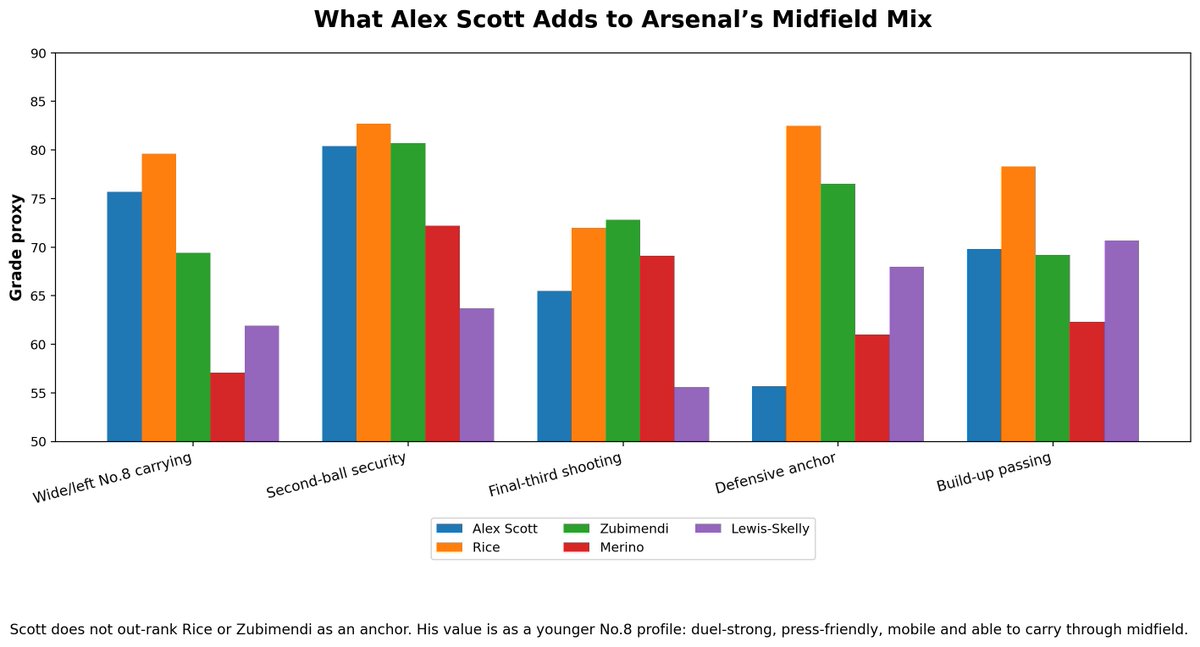
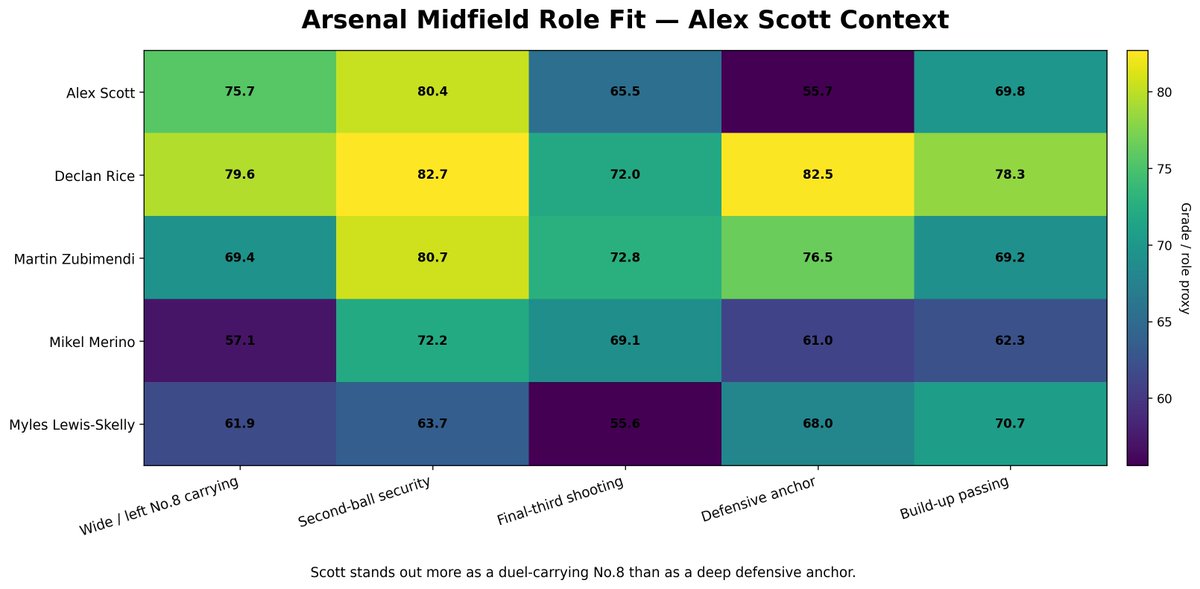
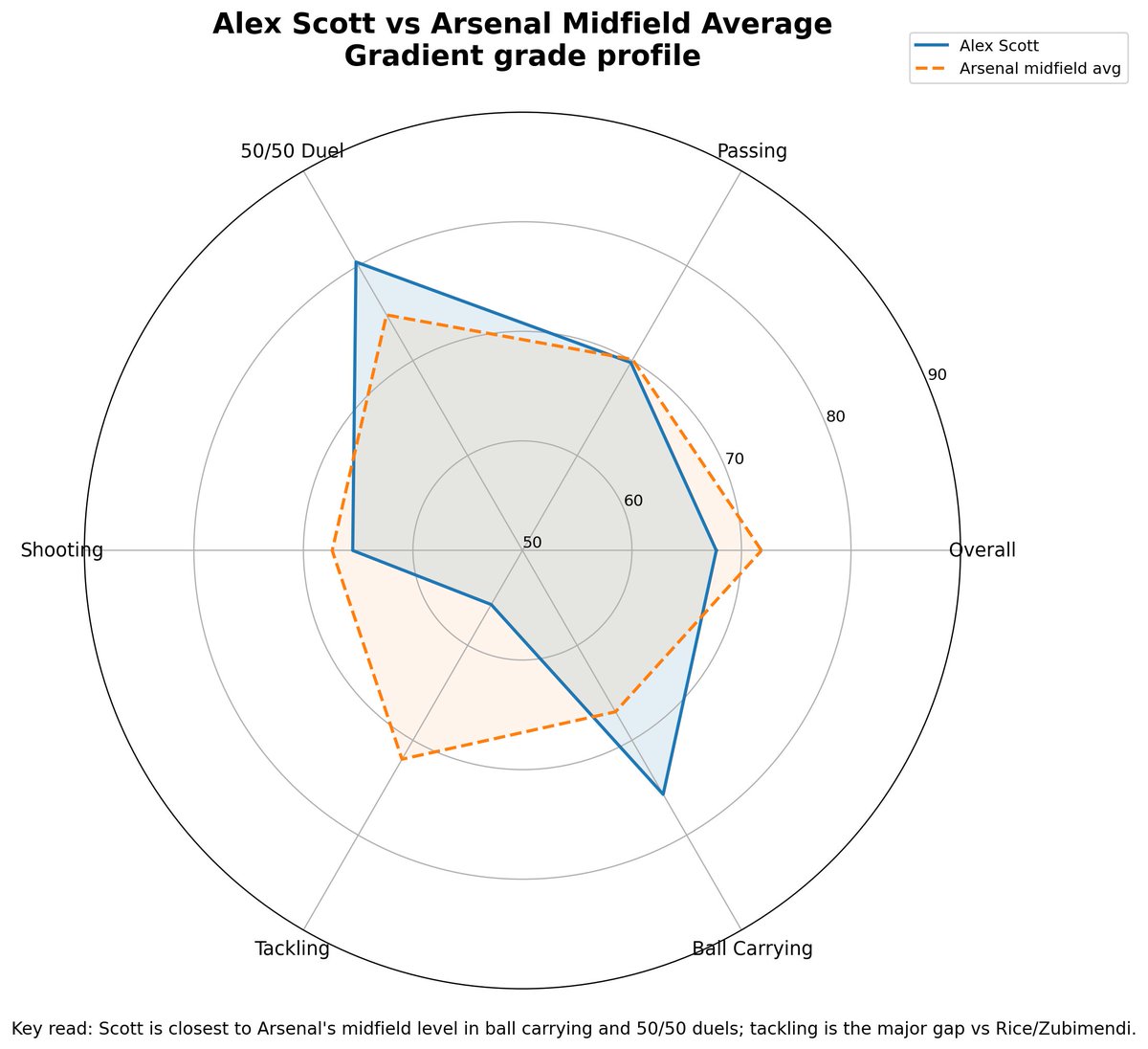
From the visual profile, Scott does not look like a pure No.6, nor a fixed creative No.10. He profiles more as a modern No.8 who combines ball carrying, duel work, pressing energy and movement between the lines.
The key signals are clear:
50/50 Duel: 80.4
Ball Carrying: 75.7
Passing: 69.8
Shooting: 65.5
Tackling: 55.7
That gives us an important tactical reading.
Scott is not the player you sign to replace Declan Rice’s defensive authority. Rice remains on a different level as an all-phase midfielder: defensive coverage, duel dominance, ball carrying, final-third arrival and control across different phases of play.
He is also not a direct alternative to Zubimendi as a base controller. Zubimendi’s value comes from structure, tempo control, receiving under pressure, positional discipline and giving the team balance behind the ball.
Scott’s value is different.
He is the type of midfielder who can operate in the chaotic areas of the game: second balls, counter-pressing moments, half-turned carries, duels after regains and transitions from midfield into the final third.
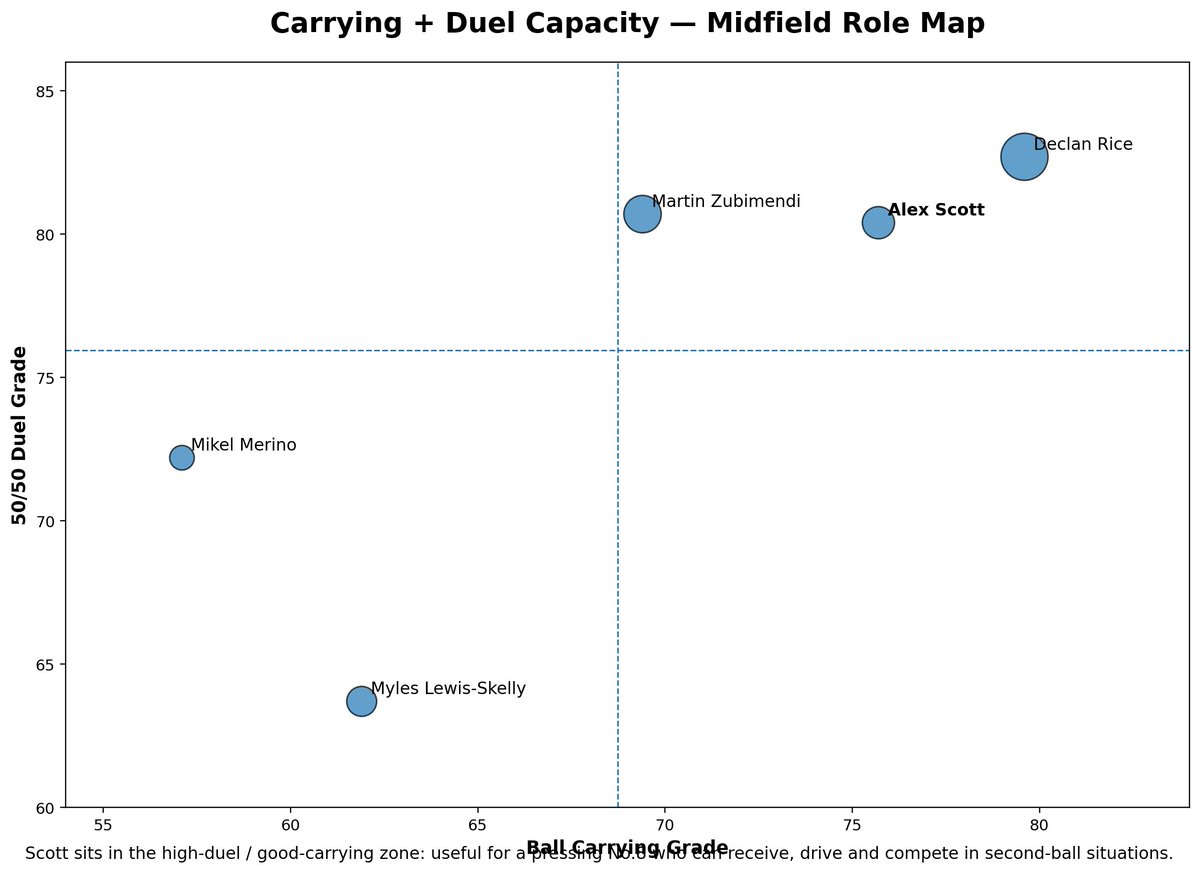
The most interesting part of his profile is the combination of duel strength and ball carrying.
That is a valuable mix for Arsenal.
A midfielder who can compete physically and then carry the ball forward immediately gives the team a different way to progress. It is not only about passing through pressure; it is about breaking pressure by winning the contact, absorbing the first challenge and driving into the next zone.
That matters in Arteta’s structure because Arsenal often control territory, but different game states require different solutions.
Against compact blocks, Scott could be useful as a No.8 receiving in the half-space, carrying into the next line and attacking the gap between full-back and centre-back.
Against man-oriented pressing, his carrying becomes valuable because he can escape pressure without every progression needing to come through a pass.
In high-transition matches, his duel profile becomes even more relevant. Arsenal need midfielders who can win second balls, secure the next phase and keep attacks alive after the first wave breaks down.
That is where Scott’s profile makes sense.
He does not look like a specialist holding midfielder. His tackling grade suggests he should not be projected as the lone defensive base in front of the back line. If Arsenal ask him to sit deep, cover large spaces and control the structure like Rice or Zubimendi, that is probably not the best use of his qualities.
His best role would be slightly higher.
He can be read as a pressing No.8, a duel-heavy connector, or a mobile interior who supports the counter-press and carries the ball into advanced areas.
Compared with Arsenal’s current midfield options:
Rice = all-phase dominant midfielder.
Zubimendi = structure and tempo control.
Merino = height, physical presence and box occupation.
Lewis-Skelly = technical security and interior control.
Scott = carrying, duels, pressing energy and midfield disruption.
That difference is the key.
Scott may not immediately raise Arsenal’s midfield ceiling as a guaranteed starter, but he could increase the squad’s tactical variety.
In games where Arsenal need more legs, more pressure, more direct carrying from midfield and more aggression in second-ball situations, Scott becomes an interesting profile.
The concerns are also clear: if Arsenal want a pure controller, he is not that player. If they want a Rice-level defensive monster, he is not that either. And if the idea is to sign a final-third creator, that is not the cleanest reading of his profile.
But as a rotational No.8 with development upside, the logic is strong.
Scott could give Arsenal a midfielder who can compete, carry and connect phases — not by replicating what they already have, but by adding a different rhythm to the midfield.
That is why Alex Scott is worth analysing seriously.
Not because he is a like-for-like solution.
But because he could give Arsenal another way to move through midfield.
#Arsenal #AFC #AlexScott #Bournemouth #PremierLeague #FootballAnalysis #TacticalAnalysis #DataAnalysis #FootballData #Scouting #PerformanceAnalysis #Arteta #ArsenalFC #COYG
4
4
17
3,021

Blackpool Football Club is seeking a talented U18 Academy Performance Analyst to join their team. You will be responsible for analysing player and team performance to identify key trends that will inform and enhance their coaching process.
#BlackpoolFC #PFSA #PerformanceAnalysis
thepfsa.co.uk/job-postings/u…
1
4
893

Strengthening the Team. Building the Future.
We are delighted to introduce more key members of our new First Team coaching and analysis department as preparations continue for an exciting new chapter at Tividale FC.
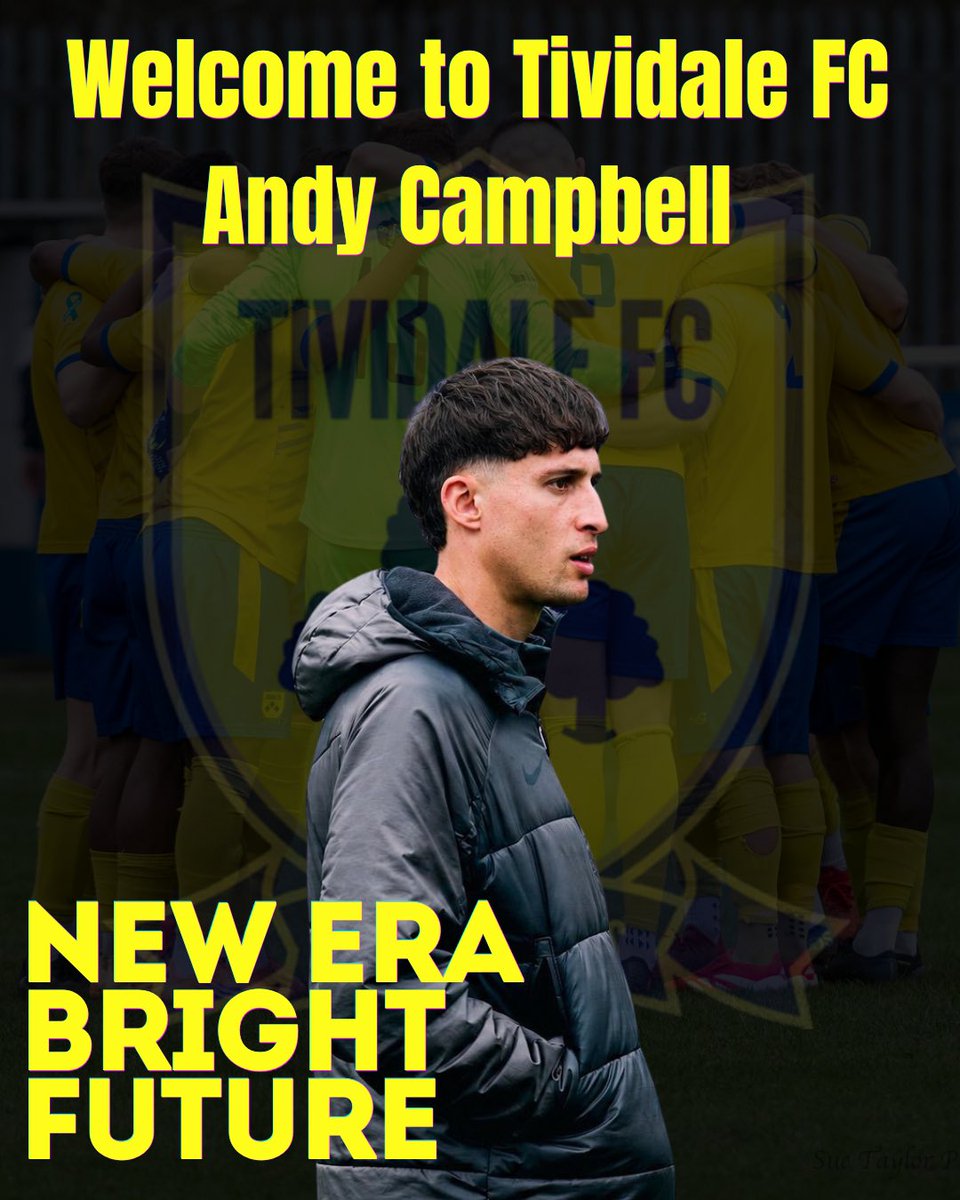
Andy Campbell - First Team Coach
Andy joins the coaching staff with over 12 years of coaching experience, including 8 years within professional club environments at Montrose, Walsall, Birmingham City and Tamworth. A UEFA A Licence coach, Andy brings outstanding attention to detail, strong values and a genuine passion for developing players.
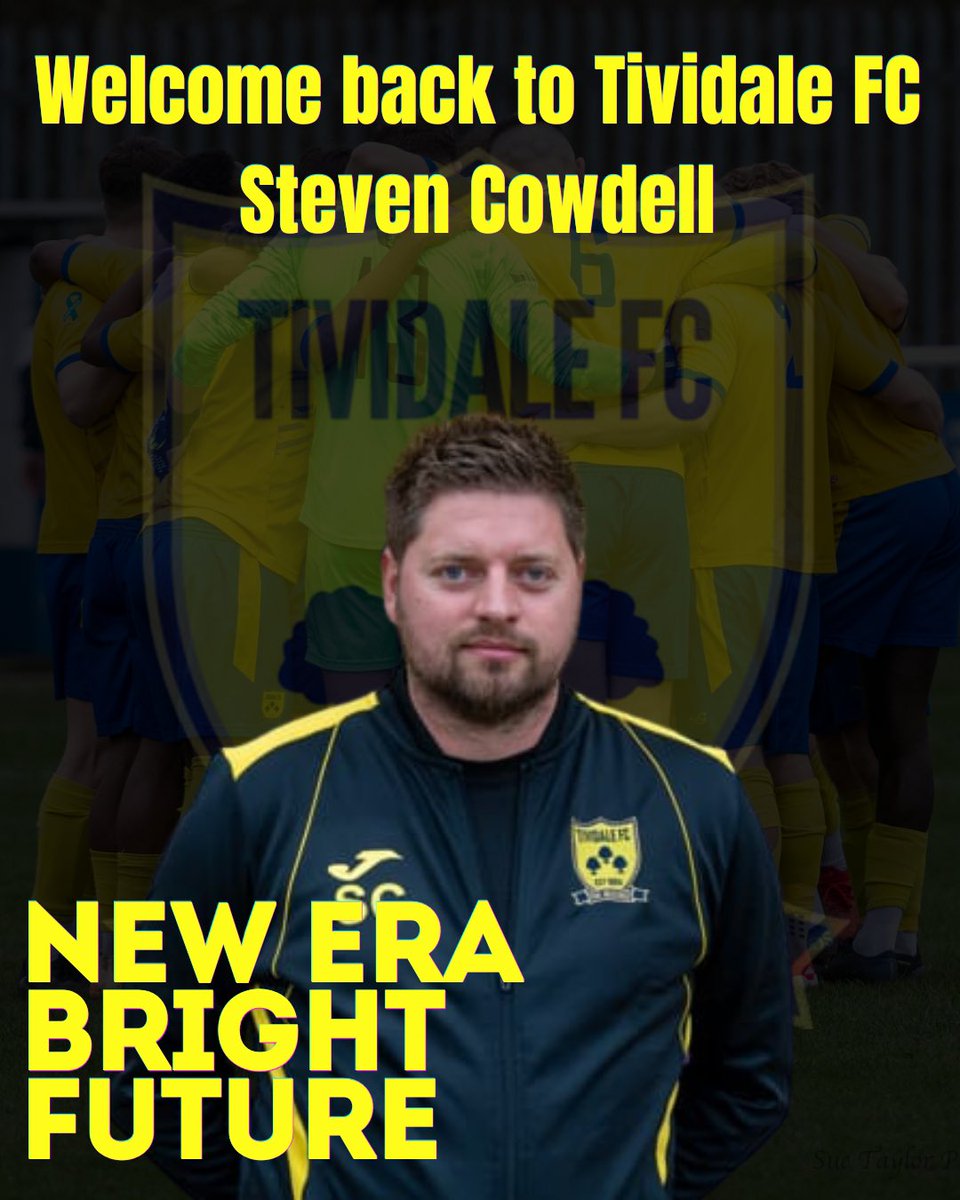
Steven Cowdell - First Team Coach
Steve remains with the club and brings a wealth of experience across professional academy football, education and senior football environments. A UEFA B Licence coach, Steven also has extensive experience in coach education, mentoring and programme leadership. His knowledge, energy and connection to the club make him a valuable part of the team moving forward.
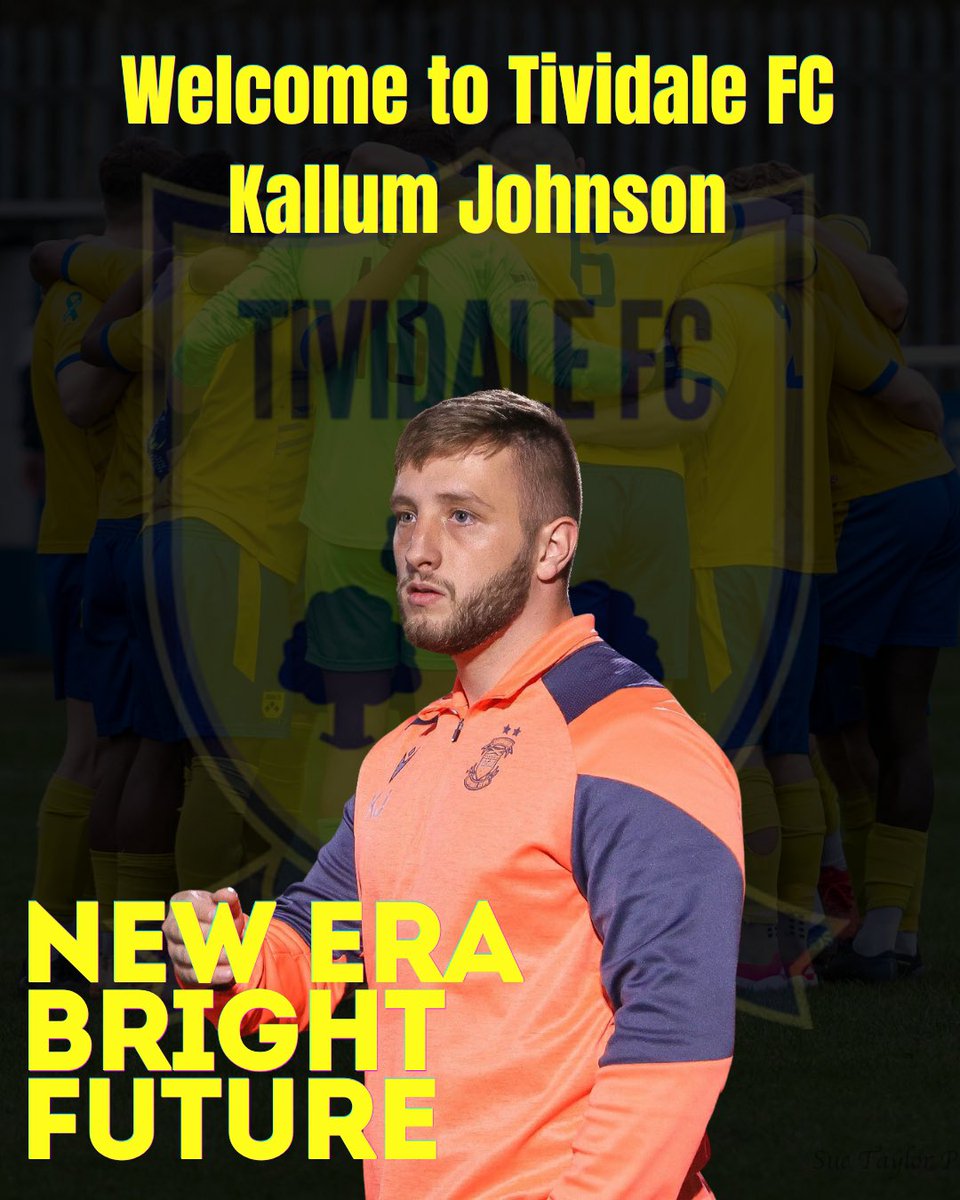
Kallum Johnson - Goalkeeping Coach
A UEFA qualified coach, Kallum joins the staff with a strong reputation for goalkeeper development. His focus on detail, confidence, standards and the demands of the modern game will be a huge asset to our goalkeepers and wider squad.
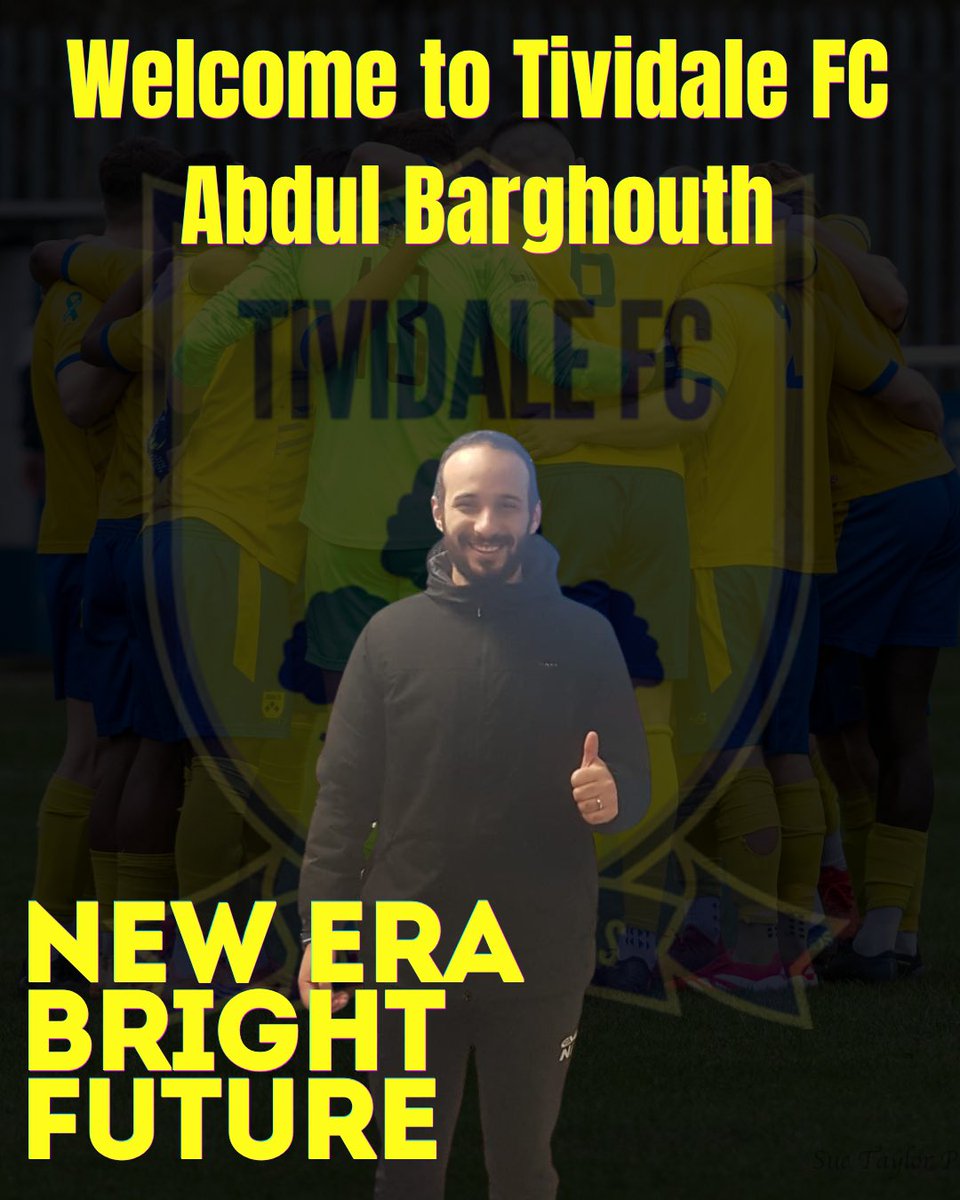
Abdul Barghouth - Performance Analyst
Abdul joins as Performance Analyst, bringing strong tactical knowledge, analytical expertise and leadership qualities. A UEFA qualified coach and certified performance analyst, Abdul has worked alongside First Team Manager Jack Ball over the past two seasons at Tamworth FC and will play a key role in supporting player and team development.
This is just the beginning.
More announcements will follow this week as we continue to build an ambitious and experienced backroom team, including additional coaches and physio staff.
The future is taking shape at Tividale FC.
#TividaleFC #JustPlay #NonLeagueFootball #FootballDevelopment #UEFACoaching #BackroomStaff #PerformanceAnalysis #FootballCoaching #BlackCountryFootball #NewEra
3
11
4,839

Need a nudge to book your spot? ⚽📊
@shilenebooysen explains why now is the perfect time to get into football analysis and how the Football Insights Performance Analysis Workshop can help you take the next step. 🎟️ Secure your spot today.
#FootballInsights #PerformanceAnalysis #FootballAnalysis @MusiTheOnly @gvalodia @kylesolomon8 @dayle4solomon
2
3
493

Jun 7
🔍 Ball Recovery Analysis
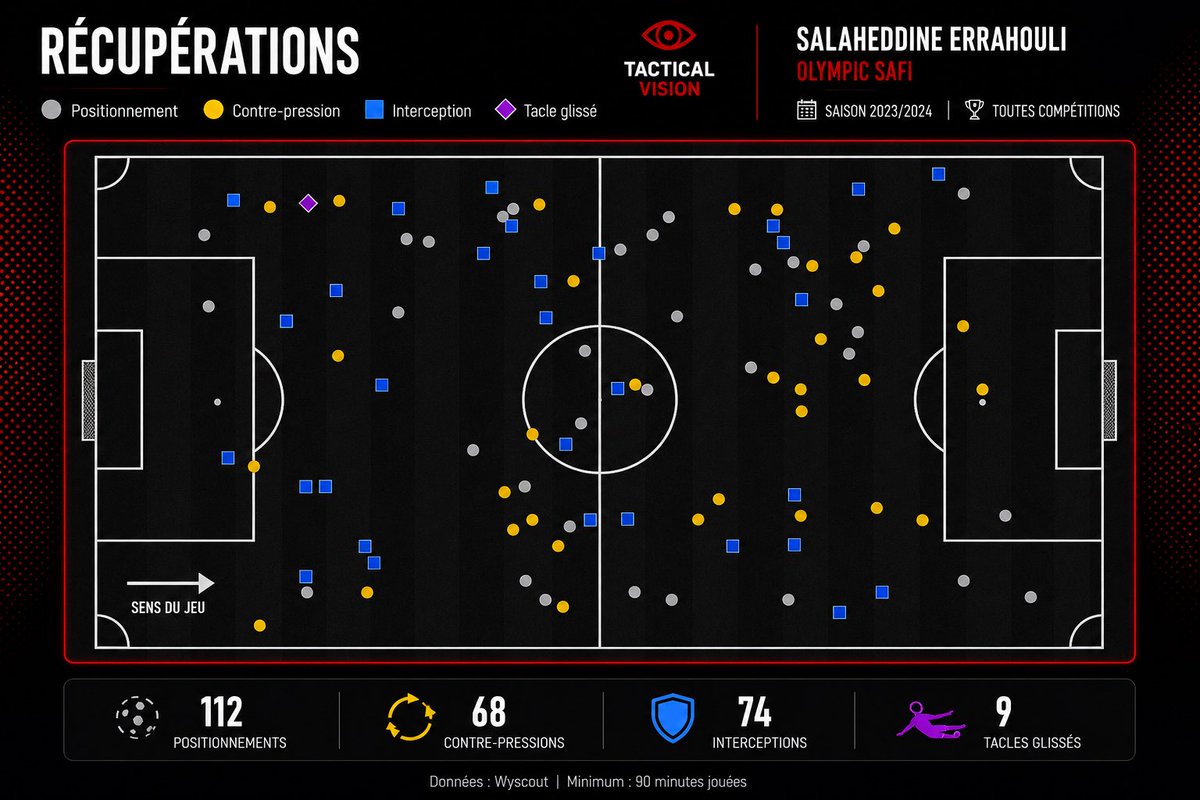
Salah Eddine Errahouli demonstrates strong defensive involvement for a winger, actively contributing to ball recoveries through pressing, interceptions, and intelligent positioning. His recoveries are distributed across multiple zones of the pitch, reflecting a high work rate and commitment in defensive transitions.
📊 112 Positional Recoveries
🔄 68 Counter-Pressing Recoveries
🛡️ 74 Interceptions
⚔️ 9 Sliding Tackles
Conclusion: A hard-working winger who contributes significantly without possession, combining defensive awareness, pressing intensity, and anticipation to help his team regain control of the ball.
#SalahEddineErrahouli
#Errahouli
#TacticalVision
#BallRecoveries
#CounterPressing
#Interceptions
#DefensiveWork
#WorkRate
#RightWinger
#PlayerAnalysis
#ScoutReport
#FootballScouting
#FootballAnalytics
#DataAnalysis
#MoroccanFootball
#OlympicSafi
#BotolaPro
#TalentIdentification
#EliteScout
#PlayerDevelopment
#PerformanceAnalysis
#AfricanFootball
#RecruitmentAnalysis
#ScoutingNetwork
#EliteScoutMorocco
Jun 7

🔍 Dribbling Analysis
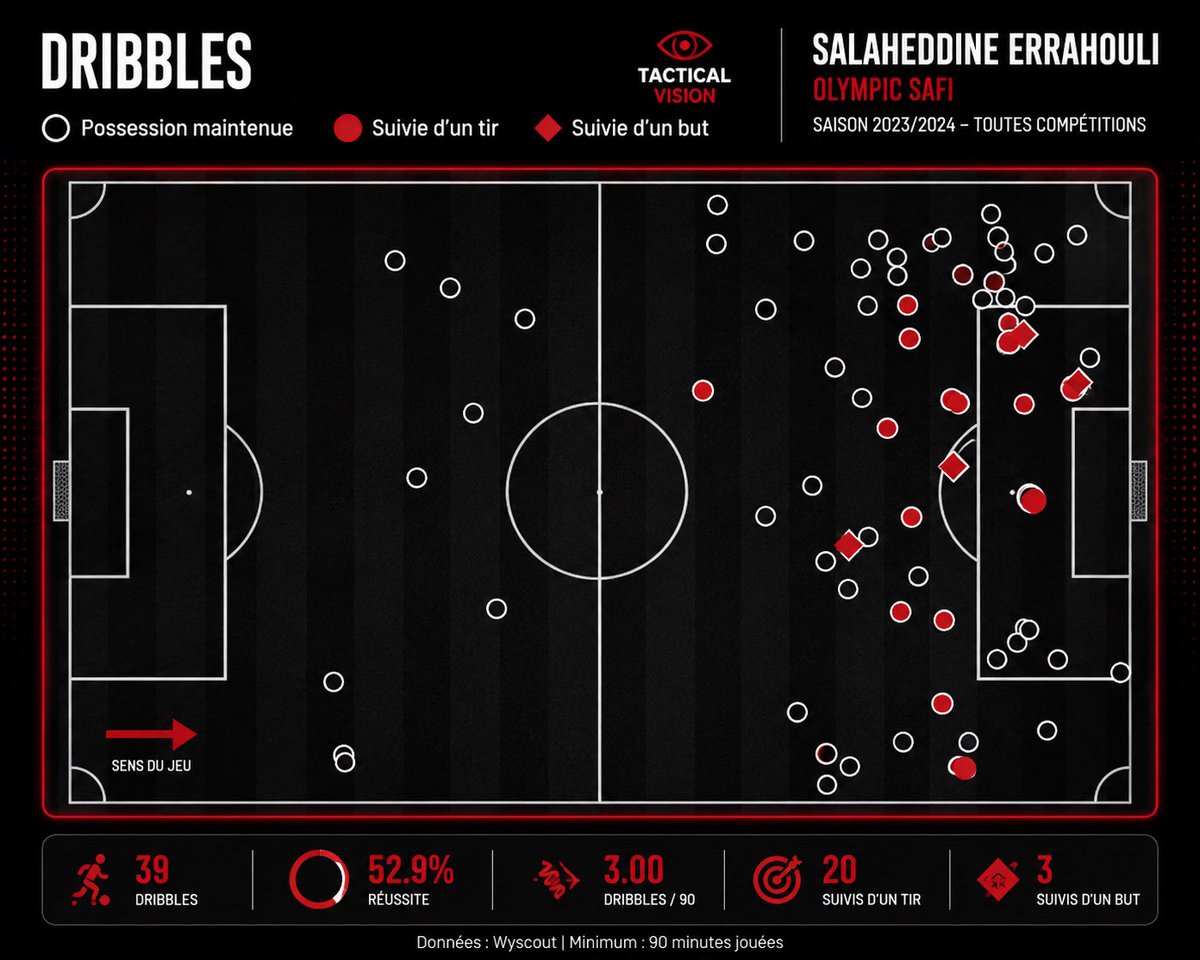
Salah Eddine Errahouli completed 39 dribbles with a 52.9% success rate, averaging 3.00 dribbles per 90 minutes. His dribbling activity is concentrated in advanced areas, particularly around and inside the penalty box, where he frequently challenges defenders in one-versus-one situations.
Notably, 20 dribbles led directly to a shot, while 3 resulted in goals, underlining his ability to turn individual actions into tangible attacking outcomes.
📊 39 Dribbles
✅ 52.9% Success Rate
🏃 3.00 Dribbles / 90
🎯 20 Dribbles Leading to a Shot
⚽ 3 Dribbles Leading to a Goal
Conclusion: A direct and aggressive winger who consistently attacks defenders, creates separation in dangerous areas, and generates scoring opportunities through his dribbling ability.
#SalahEddineErrahouli
#Errahouli
#TacticalVision
#DribblingAnalysis
#OneVsOne
#BallCarrying
#AttackingThreat
#Winger
#RightWinger
#PlayerAnalysis
#ScoutReport
#FootballScouting
#FootballAnalytics
#DataAnalysis
#MoroccanFootball
#OlympicSafi
#BotolaPro
#TalentIdentification
#EliteScout
#PlayerDevelopment
#AfricanFootball
#PerformanceAnalysis
#RecruitmentAnalysis
#ScoutingNetwork
#EliteScoutMorocco
1
8
2,598
Jun 7
🔍 Dribbling Analysis
Salah Eddine Errahouli completed 39 dribbles with a 52.9% success rate, averaging 3.00 dribbles per 90 minutes. His dribbling activity is concentrated in advanced areas, particularly around and inside the penalty box, where he frequently challenges defenders in one-versus-one situations.
Notably, 20 dribbles led directly to a shot, while 3 resulted in goals, underlining his ability to turn individual actions into tangible attacking outcomes.
📊 39 Dribbles
✅ 52.9% Success Rate
🏃 3.00 Dribbles / 90
🎯 20 Dribbles Leading to a Shot
⚽ 3 Dribbles Leading to a Goal
Conclusion: A direct and aggressive winger who consistently attacks defenders, creates separation in dangerous areas, and generates scoring opportunities through his dribbling ability.
#SalahEddineErrahouli
#Errahouli
#TacticalVision
#DribblingAnalysis
#OneVsOne
#BallCarrying
#AttackingThreat
#Winger
#RightWinger
#PlayerAnalysis
#ScoutReport
#FootballScouting
#FootballAnalytics
#DataAnalysis
#MoroccanFootball
#OlympicSafi
#BotolaPro
#TalentIdentification
#EliteScout
#PlayerDevelopment
#AfricanFootball
#PerformanceAnalysis
#RecruitmentAnalysis
#ScoutingNetwork
#EliteScoutMorocco
Jun 7
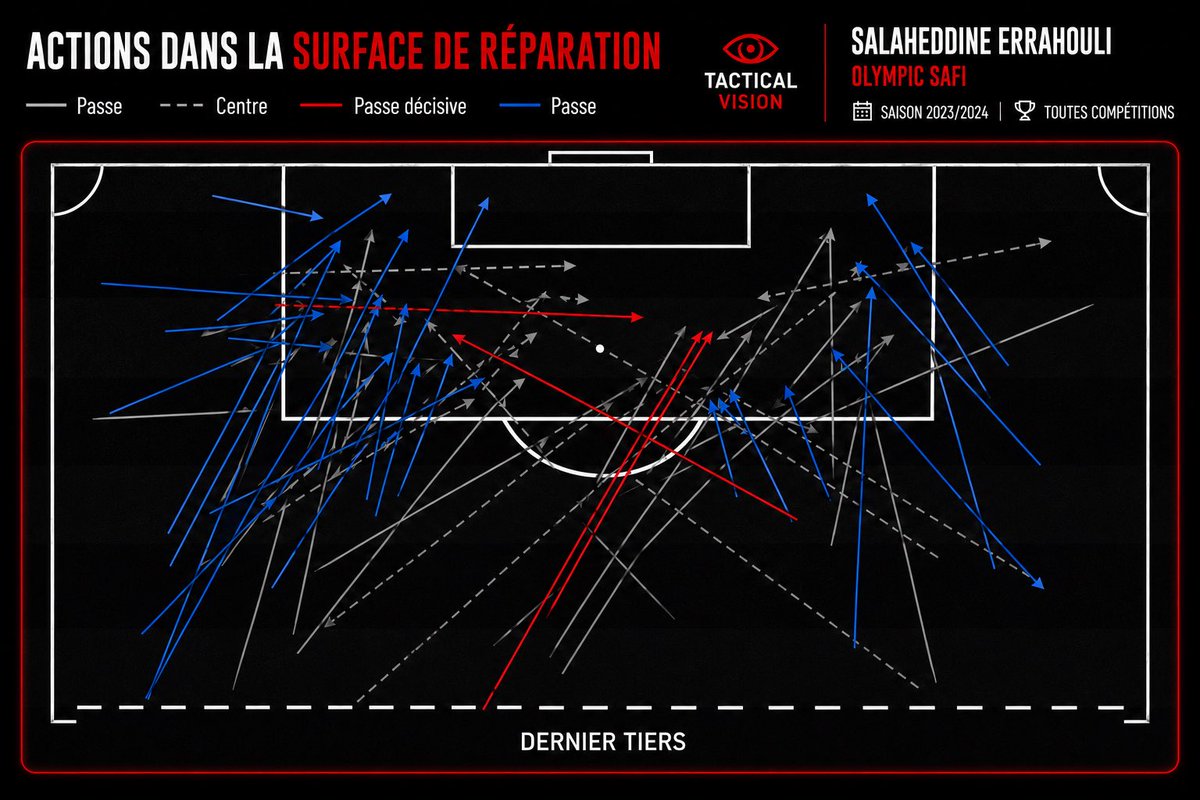
🔍 Penalty Area Actions Analysis
The map highlights Salah Eddine Errahouli’s involvement inside and around the penalty area through passes, crosses, and key passes. His actions originate from both flanks, with a strong tendency to deliver balls into dangerous zones and create opportunities for teammates.
The presence of multiple key passes and deliveries into the box underlines his attacking intent and ability to influence the final phase of possession.
🎯 Creates danger from wide areas
📦 Regular involvement in penalty area actions
⚡ Mix of crosses, cut-backs and key passes
🤝 Strong contribution to chance creation
Conclusion: An attack-minded winger who consistently looks to impact the penalty area, providing service from wide positions and creating opportunities through his vision and final-third decision-making.
#SalahEddineErrahouli
#Errahouli
#TacticalVision
#PenaltyAreaActions
#ChanceCreation
#KeyPasses
#Crossing
#FinalThird
#PlayerAnalysis
#ScoutReport
#FootballScouting
#FootballAnalytics
#RightWinger
#MoroccanFootball
#OlympicSafi
#BotolaPro
#AttackingThreat
#CreativeWinger
#PerformanceAnalysis
#TalentIdentification
#AfricanFootball
#RecruitmentAnalysis
#ScoutingNetwork
#EliteScout
#EliteScoutMorocco
6
1,894
Jun 7
🔍 Penalty Area Actions Analysis
The map highlights Salah Eddine Errahouli’s involvement inside and around the penalty area through passes, crosses, and key passes. His actions originate from both flanks, with a strong tendency to deliver balls into dangerous zones and create opportunities for teammates.
The presence of multiple key passes and deliveries into the box underlines his attacking intent and ability to influence the final phase of possession.
🎯 Creates danger from wide areas
📦 Regular involvement in penalty area actions
⚡ Mix of crosses, cut-backs and key passes
🤝 Strong contribution to chance creation
Conclusion: An attack-minded winger who consistently looks to impact the penalty area, providing service from wide positions and creating opportunities through his vision and final-third decision-making.
#SalahEddineErrahouli
#Errahouli
#TacticalVision
#PenaltyAreaActions
#ChanceCreation
#KeyPasses
#Crossing
#FinalThird
#PlayerAnalysis
#ScoutReport
#FootballScouting
#FootballAnalytics
#RightWinger
#MoroccanFootball
#OlympicSafi
#BotolaPro
#AttackingThreat
#CreativeWinger
#PerformanceAnalysis
#TalentIdentification
#AfricanFootball
#RecruitmentAnalysis
#ScoutingNetwork
#EliteScout
#EliteScoutMorocco
Jun 7
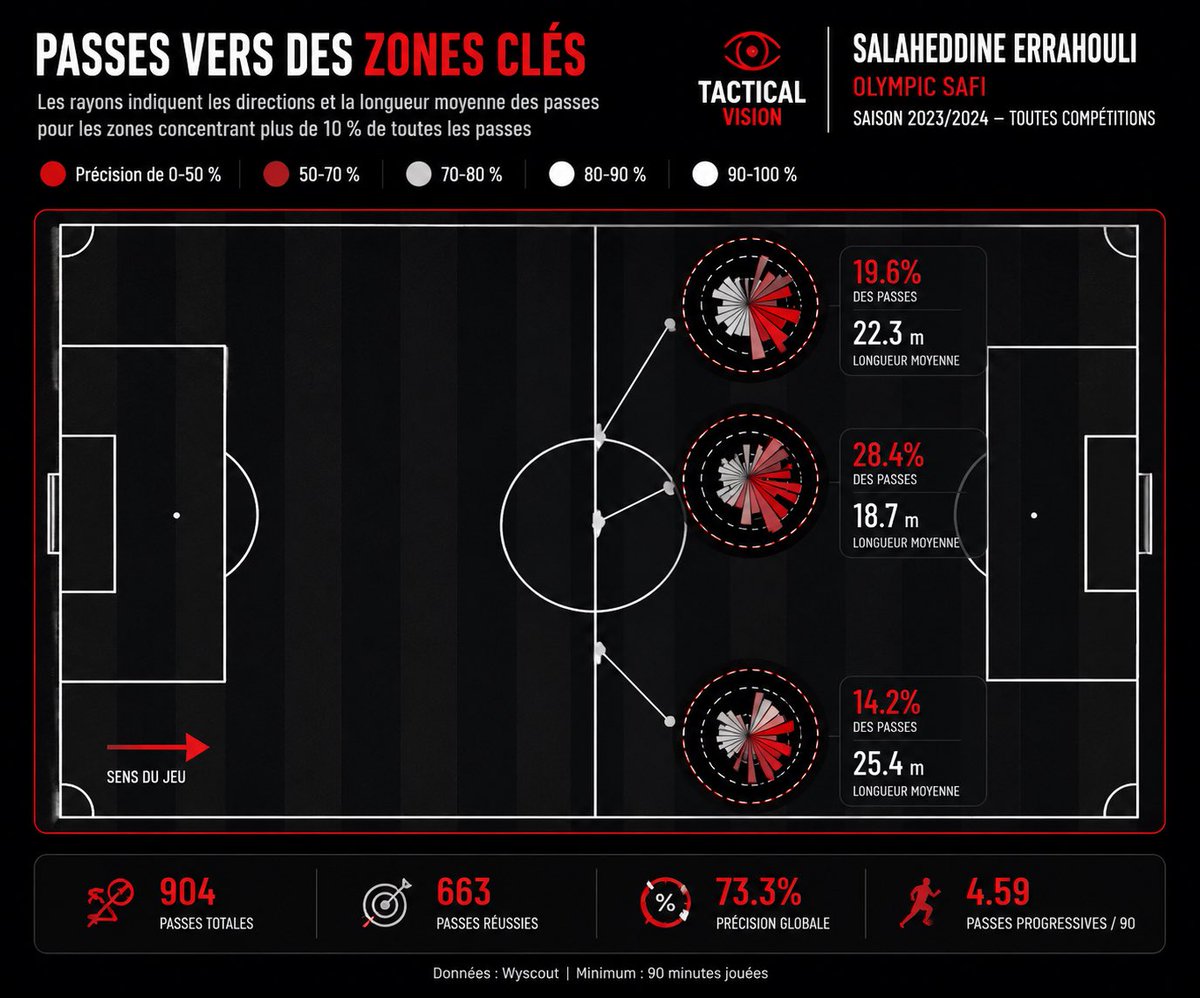
🔍 Key Passing Zones Analysis
The passing map highlights Salah Eddine Errahouli’s tendency to distribute the ball into advanced areas, with a strong focus on the right flank and attacking half-spaces. His passing profile demonstrates a willingness to play forward and connect midfield possession with attacking actions.
📊 904 Total Passes
🎯 663 Successful Passes
✅ 73.3% Passing Accuracy
➡️ 4.59 Progressive Passes per 90
Conclusion: A forward-thinking winger who consistently looks to progress possession into dangerous areas. His passing profile reflects a proactive approach, helping his team advance play and sustain attacking momentum.
#SalahEddineErrahouli
#Errahouli
#TacticalVision
#PassingAnalysis
#KeyPassingZones
#ProgressivePassing
#PlayerAnalysis
#ScoutReport
#FootballScouting
#FootballAnalytics
#DataAnalysis
#RightWinger
#MoroccanFootball
#OlympicSafi
#BotolaPro
#TalentIdentification
#EliteScout
#PlayerDevelopment
#PerformanceAnalysis
#RecruitmentAnalysis
#FootballData
#AfricanFootball
#ScoutingNetwork
#EliteScoutMorocco
#TacticalAnalysis
1
9
1,667
Jun 7
🔍 Key Passing Zones Analysis
The passing map highlights Salah Eddine Errahouli’s tendency to distribute the ball into advanced areas, with a strong focus on the right flank and attacking half-spaces. His passing profile demonstrates a willingness to play forward and connect midfield possession with attacking actions.
📊 904 Total Passes
🎯 663 Successful Passes
✅ 73.3% Passing Accuracy
➡️ 4.59 Progressive Passes per 90
Conclusion: A forward-thinking winger who consistently looks to progress possession into dangerous areas. His passing profile reflects a proactive approach, helping his team advance play and sustain attacking momentum.
#SalahEddineErrahouli
#Errahouli
#TacticalVision
#PassingAnalysis
#KeyPassingZones
#ProgressivePassing
#PlayerAnalysis
#ScoutReport
#FootballScouting
#FootballAnalytics
#DataAnalysis
#RightWinger
#MoroccanFootball
#OlympicSafi
#BotolaPro
#TalentIdentification
#EliteScout
#PlayerDevelopment
#PerformanceAnalysis
#RecruitmentAnalysis
#FootballData
#AfricanFootball
#ScoutingNetwork
#EliteScoutMorocco
#TacticalAnalysis
Jun 7
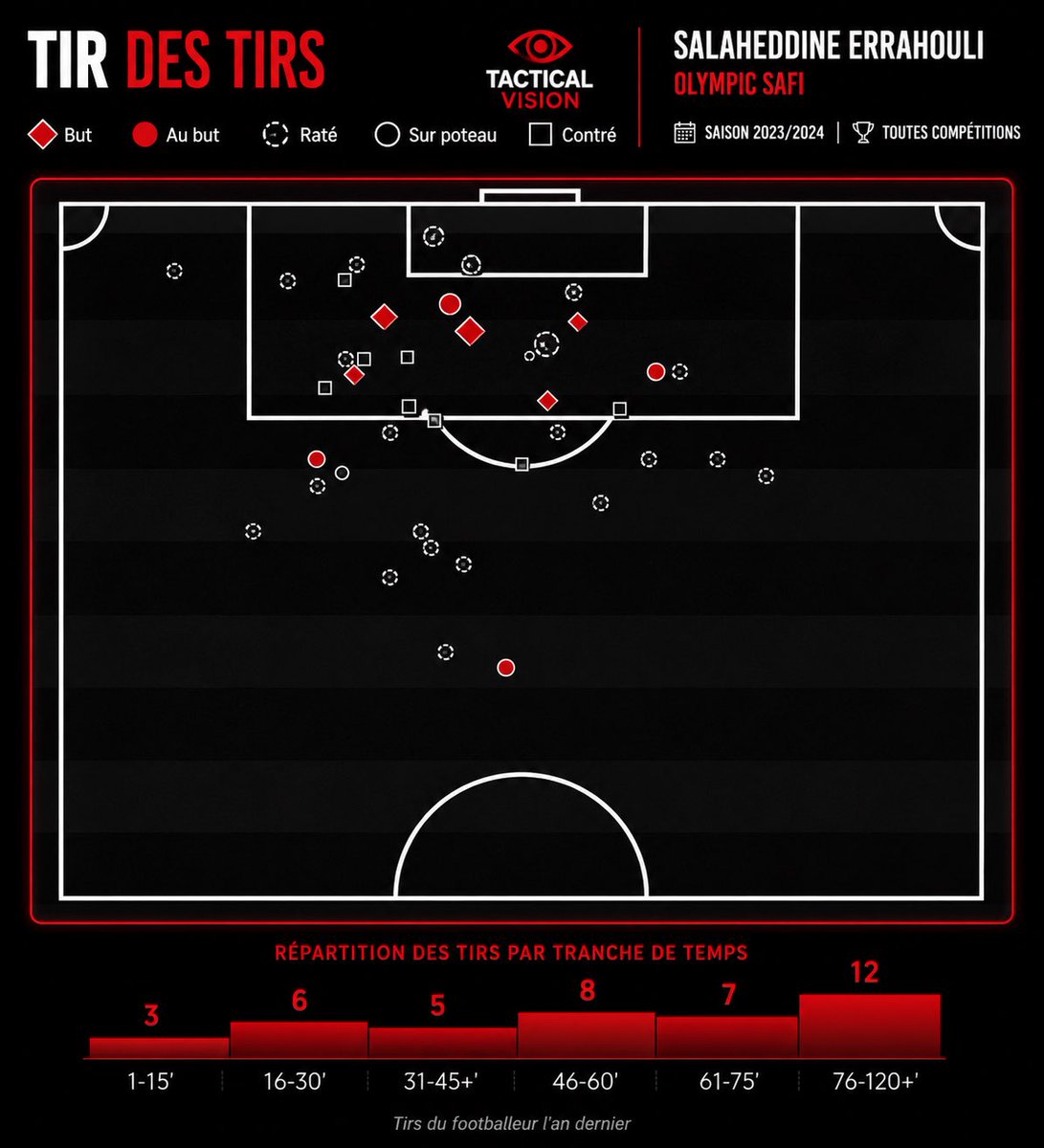
🔍 Final Third Dribbling Analysis
Salah Eddine Errahouli completed 39 dribbles in the final third, demonstrating his ability to eliminate defenders and create advantages in advanced areas. A significant number of his dribbles maintained possession (22), while 12 directly led to shots and 5 resulted in goals.
His dribbling actions are distributed across both flanks and central attacking zones, highlighting his mobility, unpredictability, and effectiveness in one-versus-one situations.
📊 39 Final Third Dribbles
🔴 22 Possession Retained
⚪ 12 Led to a Shot
🔷 5 Led to a Goal
Conclusion: A direct and creative winger capable of generating danger through individual actions, with dribbles that frequently translate into tangible attacking outcomes.
#SalahEddineErrahouli
#Errahouli
#TacticalVision
#Dribbling
#FinalThird
#OneVsOne
#Winger
#RightWinger
#PlayerAnalysis
#ScoutReport
#FootballScouting
#FootballAnalytics
#DataAnalysis
#MoroccanFootball
#OlympicSafi
#BotolaPro
#TalentIdentification
#EliteScout
#PlayerDevelopment
#AttackingThreat
#AfricanFootball
#PerformanceAnalysis
#RecruitmentAnalysis
#ScoutingNetwork
#EliteScoutMorocco
4
1,723