
Fuente: WisdomTree / Refinitiv (@JeffWeniger)
---
📩 ¿Inviertes en fondos pero no entiendes del todo lo que tienes?
Cada martes a las 9:00h analizamos un fondo en Fondos desde Cero: qué hace, qué cuesta, cuándo tiene sentido y cuándo no.
Sin jerga, sin vendehumos.
1
179

🛑 U.S. military used Iran-style covert ship-to-ship crude transfers in Gulf
Refinitiv reports the U.S. military supervised dozens of covert ship-to-ship crude transfers on the fringes of the Strait of Hormuz to sustain Gulf energy export flows. Operations began in early May and employed drones, unmanned surface vessels and helicopters to shepherd ships to receiving tankers, occurring offshore Fujairah (UAE) and offshore Sohar (Oman). Shipping data and satellite imagery show at least 92 vessels took part; imagery on June 11 showed 17 pairs simultaneously transferring at the two sites. Four sources, including a former U.S. official, said an Apache helicopter Iran shot down on June 9 — an event that led to U.S. retaliatory strikes — had participated; satellite images show six tanker pairs clustered off Sohar on the day the Apache was downed.
1
236


ALLEGRO: KSIĘGA POPYTU W ABB JUŻ POKRYTA - REFINITIV
$ALE.WA
Bookrunner: księga popytu w ABB Allegro jest już pokryta, a dalszy guidance cenowy ma zostać podany później. W tle wtórna sprzedaż pakietu ok. 131-132 mln akcji spółki, wg bookrunnera. lseg.com/en/data-analytics
6
605


This projected depreciation starkly contrasts with the 10% average upside across their basic materials coverage, prompting the institution to position 2026 through 2028 earnings projections 8% to 56% below Refinitiv consensus. 4/5 🧵
1
21

Jun 14
Refinitiv citant de hauts responsables iraniens indique qu'un projet de mémorandum d'entente prévoyait que l'Iran s'engage à ne pas développer ni acquérir d'armes nucléaires et à maintenir le statu quo nucléaire jusqu'à la conclusion d'un accord définitif.
L'Iran diluerait son stock d'uranium hautement enrichi ; les modalités de cette dilution seraient discutées dans un délai de 60 jours.
Les États-Unis accorderaient des dérogations temporaires aux sanctions pétrolières pour des périodes déterminées, permettant ainsi les ventes de pétrole iranien et les rentrées de revenus.
L'Iran rouvrirait immédiatement le détroit d'Ormuz à toute navigation commerciale et les États-Unis lèveraient leur blocus maritime.
Les États-Unis débloqueraient 25 milliards de dollars d'avoirs iraniens par le biais de transferts de fonds directs, de la coopération régionale et de lignes de crédit.
Selon ce projet, les États-Unis n'imposeraient pas de nouvelles sanctions à l'Iran avant la conclusion d'un accord définitif.
11

Jun 14
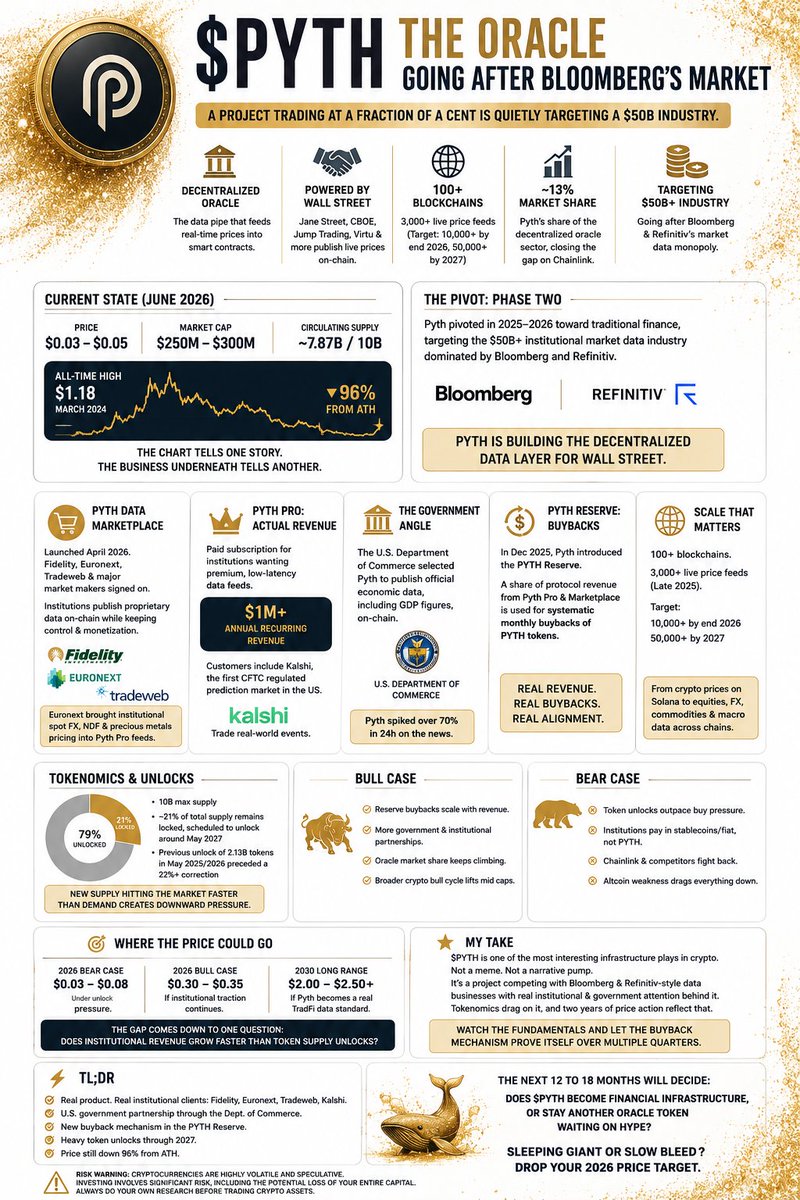
🐋 WHALE WATCH: $PYTH the oracle going after Bloombergs market
A project trading at a fraction of a cent is quietly targeting a $50B industry.
$PYTH is Pyth Network. Heres whats happening behind the price chart and where it could go.
=> What Pyth Network does
Pyth is a decentralized oracle the data pipe that feeds real time prices (crypto stocks FX commodities) into smart contracts so DeFi apps know what an asset is worth.
Chainlink and most oracles scrape data from APIs. Pyth gets prices directly from market makers exchanges and trading firms publishing their own data on chain. Jane Street CBOE Jump Trading Virtu and a growing list of Wall Street institutions now publish live prices straight to the blockchain.
=> Current state (June 2026)
Price sits between $0.03 and $0.05. Market cap runs $250-300M on a circulating supply near 7.87B out of 10B total. The token hit an all time high of $1.18 in March 2024 and sits roughly 96% below that now.
The chart tells one story. The business underneath tells another.
=> The pivot: Phase Two
Pyth spent its first few years as DeFi infrastructure, useful but small. In 2025 2026 it pivoted toward traditional finance targeting the $50B institutional market data industry that Bloomberg and Refinitiv dominate.
=> The Pyth Data Marketplace
Pyth launched its Data Marketplace in April 2026. Fidelity Euronext Tradeweb and major market makers signed on. The platform lets institutions publish proprietary data (ETF fair value pricing FX rates precious metals data) on chain while keeping control and monetization of that data.
Euronext brought institutional spot FX NDF and precious metals pricing into Pyth Pros feeds.
=> Pyth Pro: actual revenue
Pyth Pro is a paid subscription for institutions wanting premium low latency data feeds. It crossed $1M in annual recurring revenue shortly after launch. Most crypto products generate zero revenue. This one has paying enterprise customers including Kalshi the first CFTC regulated prediction market in the US which adopted Pyth Pro to help resolve commodities and real world asset markets.
=> The government angle
The US Department of Commerce selected Pyth to help publish official economic data, including GDP figures on chain. $PYTH spiked over 70% in 24 hours when the news broke.
A government body validated the project directly. It opens the door to more datasets employment numbers and inflation data among them and positions Pyth as core infrastructure for the broader push to put public data on chain.
=> The PYTH Reserve
In December 2025 Pyth introduced the PYTH Reserve a mechanism that takes a share of protocol revenue from Pyth Pro and the Data Marketplace and uses it for systematic monthly buybacks of PYTH tokens. As the business earns some of that money buys $PYTH off the market.
Few oracle tokens attempt a direct revenue to token link like this. Most rely on speculation or staking emissions.
=> Scale
Pyth supports over 100 blockchains and runs 3000 live price feeds as of late 2025 with targets of 10000 by end of 2026 and 50000 by 2027. Its share of the decentralized oracle sector grew to roughly 13% closing the gap on Chainlink.
Pyth started with a handful of crypto price feeds on Solana. It now touches equities FX commodities and macro data across chains.
=> Tokenomics and unlocks
Pyth has a 10B max supply and roughly 21% of total supply remains locked scheduled to unlock around May 2027. The previous unlock 2.13B tokens in May 2025/2026 preceded a 22% correction and that was a smaller event.
New supply hitting the market faster than demand absorbs it creates downward pressure. This is the biggest near term headwind for $PYTH.
=> Bull case
Pyth Reserve buybacks scale as Pyth Pro and Data Marketplace revenue grows. More government and institutional partnerships land. Oracle market share keeps climbing against Chainlink. A broader crypto bull cycle lifts mid caps.
=> Bear case
Token unlocks outpace organic buy pressure. Institutional adoption doesnt translate into token demand if TradFi clients pay in stablecoins or fiat instead of PYTH. Chainlink and other oracles compete harder. Altcoin weakness drags down fundamentally improving projects anyway.
=> Where the price could go
Analyst models for 2026 split widely. Some see PYTH stuck in the $0.03 $0.08 range under unlock pressure. More optimistic takes tied to institutional traction put a 2026 target around $0.30 to $0.35.
Long range models for 2030 suggest $2 to $2.50 if Pyth becomes a real TradFi data standard and the Reserve buyback scales.
The gap between those numbers comes down to one question: does institutional revenue grow faster than token supply unlocks ?
=> My take
$PYTH is one of the more interesting infrastructure plays in crypto. It isnt a meme or a narrative pump. Its a project competing with Bloomberg and Refinitiv style data businesses with real institutional and government attention behind it.
Tokenomics drag on it and two years of price action reflect that. Watch the fundamentals and let the buyback mechanism prove itself over multiple quarters.
=> TLDR
Real product real institutional clients: Fidelity Euronext Tradeweb Kalshi. A US government partnership through the Dept. of Commerce. A new buyback mechanism in the PYTH Reserve. Heavy token unlocks through 2027. Price still down 96% from ATH.
The next 12 to 18 months answer the question: does $PYTH become financial infrastructure, or stay another oracle token waiting on hype?
Sleeping giant or slow bleed ? Drop your 2026 price target.
Not financial advice. Do your own research before trading crypto assets.
34
23
141
21,150

Jun 13
Token unlocks outpace organic buy pressure. Institutional adoption doesnt translate into token demand if TradFi clients pay in stablecoins or fiat instead of PYTH. Chainlink and other oracles compete harder. Altcoin weakness drags down fundamentally improving projects anyway.
=> Where the price could go
Analyst models for 2026 split widely. Some see PYTH stuck in the $0.03 $0.08 range under unlock pressure. More optimistic takes tied to institutional traction put a 2026 target around $0.30 to $0.35.
Long range models for 2030 suggest $2 to $2.50 if Pyth becomes a real TradFi data standard and the Reserve buyback scales.
The gap between those numbers comes down to one question: does institutional revenue grow faster than token supply unlocks ?
=> My take
$PYTH is one of the more interesting infrastructure plays in crypto. It isnt a meme or a narrative pump. Its a project competing with Bloomberg and Refinitiv style data businesses with real institutional and government attention behind it.
Tokenomics drag on it and two years of price action reflect that. Watch the fundamentals and let the buyback mechanism prove itself over multiple quarters.
=> TLDR
Real product real institutional clients: Fidelity Euronext Tradeweb, Kalshi. A US government partnership through the Dept. of Commerce. A new buyback mechanism in the PYTH Reserve. Heavy token unlocks through 2027. Price still down 96% from ATH.
The next 12 to 18 months answer the question: does $PYTH become financial infrastructure, or stay another oracle token waiting on hype?
Sleeping giant or slow bleed? Drop your 2026 price target.
Not financial advice. Do your own research before trading crypto assets.
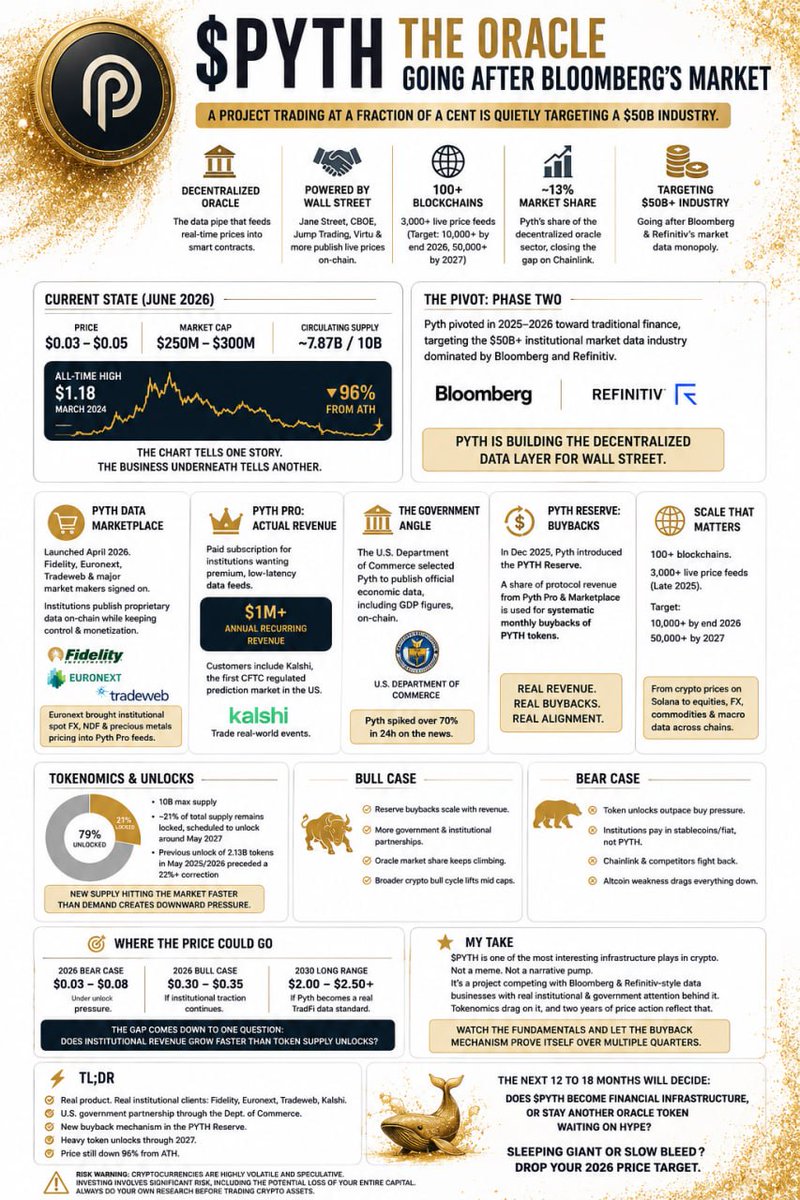
$PYTH the oracle going after Bloombergs market
A project trading at a fraction of a cent is quietly targeting a $50B industry.
$PYTH is Pyth Network. Heres whats happening behind the price chart and where it could go.
=> What Pyth Network does
Pyth is a decentralized oracle the data pipe that feeds real time prices (crypto stocks FX commodities) into smart contracts so DeFi apps know what an asset is worth.
Chainlink and most oracles scrape data from APIs. Pyth gets prices directly from market makers exchanges and trading firms publishing their own data on chain. Jane Street CBOE Jump Trading Virtu and a growing list of Wall Street institutions now publish live prices straight to the blockchain.
=> Current state (June 2026)
Price sits between $0.03 and $0.05. Market cap runs $250-300M on a circulating supply near 7.87B out of 10B total. The token hit an all time high of $1.18 in March 2024 and sits roughly 96% below that now.
The chart tells one story. The business underneath tells another.
=> The pivot: Phase Two
Pyth spent its first few years as DeFi infrastructure, useful but small. In 2025 2026 it pivoted toward traditional finance targeting the $50B institutional market data industry that Bloomberg and Refinitiv dominate.
=> The Pyth Data Marketplace
Pyth launched its Data Marketplace in April 2026. Fidelity Euronext Tradeweb and major market makers signed on. The platform lets institutions publish proprietary data (ETF fair value pricing FX rates precious metals data) on chain while keeping control and monetization of that data.
Euronext brought institutional spot FX NDF and precious metals pricing into Pyth Pros feeds.
=> Pyth Pro: actual revenue
Pyth Pro is a paid subscription for institutions wanting premium, low-latency data feeds. It crossed $1M in annual recurring revenue shortly after launch. Most crypto products generate zero revenue. This one has paying enterprise customers including Kalshi the first CFTC regulated prediction market in the US which adopted Pyth Pro to help resolve commodities and real world asset markets.
=> The government angle
The US Department of Commerce selected Pyth to help publish official economic data, including GDP figures, on-chain. $PYTH spiked over 70% in 24 hours when the news broke.
A government body validated the project directly. It opens the door to more datasets, employment numbers and inflation data among them, and positions Pyth as core infrastructure for the broader push to put public data on chain.
=> The PYTH Reserve
In December 2025 Pyth introduced the PYTH Reserve a mechanism that takes a share of protocol revenue from Pyth Pro and the Data Marketplace and uses it for systematic monthly buybacks of PYTH tokens. As the business earns some of that money buys $PYTH off the market.
Few oracle tokens attempt a direct revenue to token link like this. Most rely on speculation or staking emissions.
=> Scale
Pyth supports over 100 blockchains and runs 3000 live price feeds as of late 2025, with targets of 10000 by end of 2026 and 50000 by 2027. Its share of the decentralized oracle sector grew to roughly 13% closing the gap on Chainlink.
Pyth started with a handful of crypto price feeds on Solana. It now touches equities FX commodities and macro data across chains.
=> Tokenomics and unlocks
Pyth has a 10B max supply and roughly 21% of total supply remains locked scheduled to unlock around May 2027. The previous unlock 2.13B tokens in May 2025/2026 preceded a 22% correction and that was a smaller event.
New supply hitting the market faster than demand absorbs it creates downward pressure. This is the biggest near term headwind for $PYTH.
=> Bull case
Pyth Reserve buybacks scale as Pyth Pro and Data Marketplace revenue grows. More government and institutional partnerships land. Oracle market share keeps climbing against Chainlink. A broader crypto bull cycle lifts mid caps....
2
9
105
11,598

Jun 13
All positive, I’m on the waitlist for the terminal. If your vision is to incorporate real time news updates with analytical tools, you can replace Refinitiv Eikon, FactSet, and even Bloomberg terminals.
1
42

Jun 13
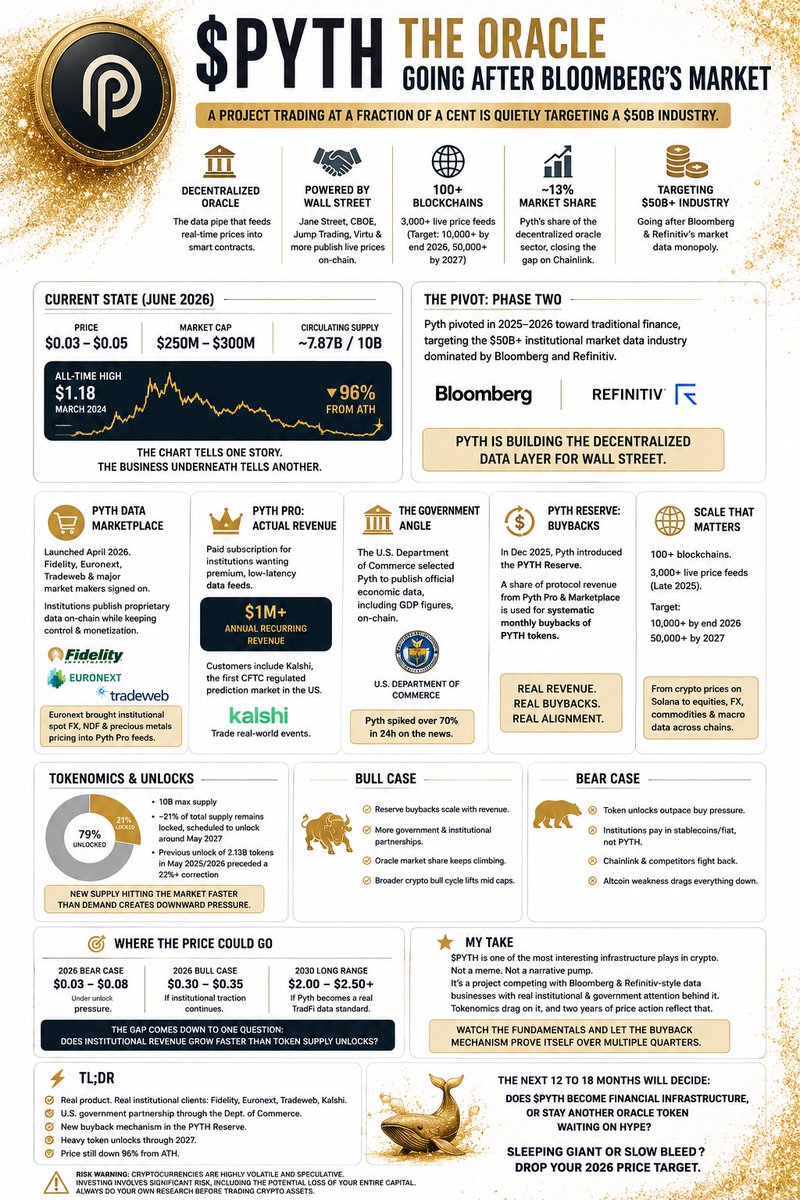
🐋 WHALE WATCH: $PYTH the oracle going after Bloombergs market
A project trading at a fraction of a cent is quietly targeting a $50B industry.
$PYTH is Pyth Network. Heres whats happening behind the price chart and where it could go.
=> What Pyth Network does
Pyth is a decentralized oracle the data pipe that feeds real time prices (crypto stocks FX commodities) into smart contracts so DeFi apps know what an asset is worth.
Chainlink and most oracles scrape data from APIs. Pyth gets prices directly from market makers exchanges and trading firms publishing their own data on chain. Jane Street CBOE Jump Trading Virtu and a growing list of Wall Street institutions now publish live prices straight to the blockchain.
=> Current state (June 2026)
Price sits between $0.03 and $0.05. Market cap runs $250-300M on a circulating supply near 7.87B out of 10B total. The token hit an all time high of $1.18 in March 2024 and sits roughly 96% below that now.
The chart tells one story. The business underneath tells another.
=> The pivot: Phase Two
Pyth spent its first few years as DeFi infrastructure, useful but small. In 2025 2026 it pivoted toward traditional finance targeting the $50B institutional market data industry that Bloomberg and Refinitiv dominate.
=> The Pyth Data Marketplace
Pyth launched its Data Marketplace in April 2026. Fidelity Euronext Tradeweb and major market makers signed on. The platform lets institutions publish proprietary data (ETF fair value pricing FX rates precious metals data) on chain while keeping control and monetization of that data.
Euronext brought institutional spot FX NDF and precious metals pricing into Pyth Pros feeds.
=> Pyth Pro: actual revenue
Pyth Pro is a paid subscription for institutions wanting premium, low-latency data feeds. It crossed $1M in annual recurring revenue shortly after launch. Most crypto products generate zero revenue. This one has paying enterprise customers including Kalshi the first CFTC regulated prediction market in the US which adopted Pyth Pro to help resolve commodities and real world asset markets.
=> The government angle
The US Department of Commerce selected Pyth to help publish official economic data, including GDP figures, on-chain. $PYTH spiked over 70% in 24 hours when the news broke.
A government body validated the project directly. It opens the door to more datasets, employment numbers and inflation data among them, and positions Pyth as core infrastructure for the broader push to put public data on chain.
=> The PYTH Reserve
In December 2025 Pyth introduced the PYTH Reserve a mechanism that takes a share of protocol revenue from Pyth Pro and the Data Marketplace and uses it for systematic monthly buybacks of PYTH tokens. As the business earns some of that money buys $PYTH off the market.
Few oracle tokens attempt a direct revenue to token link like this. Most rely on speculation or staking emissions.
=> Scale
Pyth supports over 100 blockchains and runs 3000 live price feeds as of late 2025, with targets of 10000 by end of 2026 and 50000 by 2027. Its share of the decentralized oracle sector grew to roughly 13% closing the gap on Chainlink.
Pyth started with a handful of crypto price feeds on Solana. It now touches equities FX commodities and macro data across chains.
=> Tokenomics and unlocks
Pyth has a 10B max supply and roughly 21% of total supply remains locked scheduled to unlock around May 2027. The previous unlock 2.13B tokens in May 2025/2026 preceded a 22% correction and that was a smaller event.
New supply hitting the market faster than demand absorbs it creates downward pressure. This is the biggest near term headwind for $PYTH.
=> Bull case
Pyth Reserve buybacks scale as Pyth Pro and Data Marketplace revenue grows. More government and institutional partnerships land. Oracle market share keeps climbing against Chainlink. A broader crypto bull cycle lifts mid caps.
=> Bear case
Token unlocks outpace organic buy pressure. Institutional adoption doesnt translate into token demand if TradFi clients pay in stablecoins or fiat instead of PYTH. Chainlink and other oracles compete harder. Altcoin weakness drags down fundamentally improving projects anyway.
=> Where the price could go
Analyst models for 2026 split widely. Some see PYTH stuck in the $0.03 $0.08 range under unlock pressure. More optimistic takes tied to institutional traction put a 2026 target around $0.30 to $0.35.
Long range models for 2030 suggest $2 to $2.50 if Pyth becomes a real TradFi data standard and the Reserve buyback scales.
The gap between those numbers comes down to one question: does institutional revenue grow faster than token supply unlocks ?
=> My take
$PYTH is one of the more interesting infrastructure plays in crypto. It isnt a meme or a narrative pump. Its a project competing with Bloomberg and Refinitiv style data businesses with real institutional and government attention behind it.
Tokenomics drag on it and two years of price action reflect that. Watch the fundamentals and let the buyback mechanism prove itself over multiple quarters.
=> TLDR
Real product real institutional clients: Fidelity Euronext Tradeweb, Kalshi. A US government partnership through the Dept. of Commerce. A new buyback mechanism in the PYTH Reserve. Heavy token unlocks through 2027. Price still down 96% from ATH.
The next 12 to 18 months answer the question: does $PYTH become financial infrastructure, or stay another oracle token waiting on hype?
Sleeping giant or slow bleed? Drop your 2026 price target.
Not financial advice. Do your own research before trading crypto assets.
30
22
121
44,853
🛑 Refinitiv: UAE agrees to unfreeze tens of billions of dollars for Iran
🛑 Refinitiv sources say the UAE has agreed to unfreeze between $10 bln and $20 bln of Iranian funds after weeks of Iranian strikes on the UAE and amid wider US–Israel clashes with Iran. One source said the UAE will release $10 bln in total, with more than $3 bln already delivered; another put the total at $20 bln. The arrangement is reported to be contingent on Iran halting missile and drone attacks on the UAE; Tehran’s last direct strike on the UAE was May 4. Sources say the deal includes restoring bilateral relations, including intelligence-sharing and economic cooperation, and that Iran has approached at least two other Gulf Arab states about similar arrangements. Officials framed the move as a way for Iran to claim wartime compensation while allowing Washington to assert it made no payments and for the UAE to secure its safety and protect Dubai’s hub status.
282

Jun 12
Refinitiv, powołując się na dwa źródła, podał, że ZEA zgodziło się na uwolnienie 10 miliardów dolarów w formie funduszy, przy czym ponad 3 miliardy dolarów zostało już przekazane.
//Jeśli to prawda to chyba zaczyna się porozumienie na poważnie.
Jedyne ale ...ropa nie spada🤔
1
60
Jun 12
Refinitiv cited two sources saying the UAE has agreed to release $10 billion in funds, with more than $3 billion already delivered.
279


Jun 12
FYI Refinitiv who bought it from Reuters sold it to LSEG who now markets it as Workspace. But the retail version marketed as XENITH still the same
2
23

"Vi fann att flertalet transaktioner registreras i Refinitiv före det formella offentliggörandet hos myndigheterna och att Registreringsdagen i majoriteten av fallen sammanföll med Transaktionsdagen"
2
1
199