Pixel retweeted

Jun 13
circa 1974, India:
"Stop making loose comments. A nuclear weapon needs 2/3M $ Huge no of reactors, plutonium reprocessing facilities with millions $ in dedicated infrastructure, underground test sites and long-range missile delivery systems. India cannot build a nuclear weapon"
Jun 13

Stop making loose comments. A foundational model needs 50/60b $ Huge hyper cloud capacity with hundreds of billion $
20
274
1,810
45,228

25m
U.S. nonproliferation statutes like the Symington Amendment (1976) and Glenn Amendment (1977) generally prohibit or restrict foreign assistance (economic and military) to countries that:
Acquire or export sensitive nuclear technology (e.g., enrichment/reprocessing) without full IAEA safeguards.
(For Glenn) Detonate a nuclear device if they are a non-nuclear-weapon state under the NPT definition.
1
15

If eating feces or reprocessing food counts as "chewing the cud," then pigs and you would also qualify under the same logic. 🤣
But the Bible explicitly says pigs do not chew the cud.
35

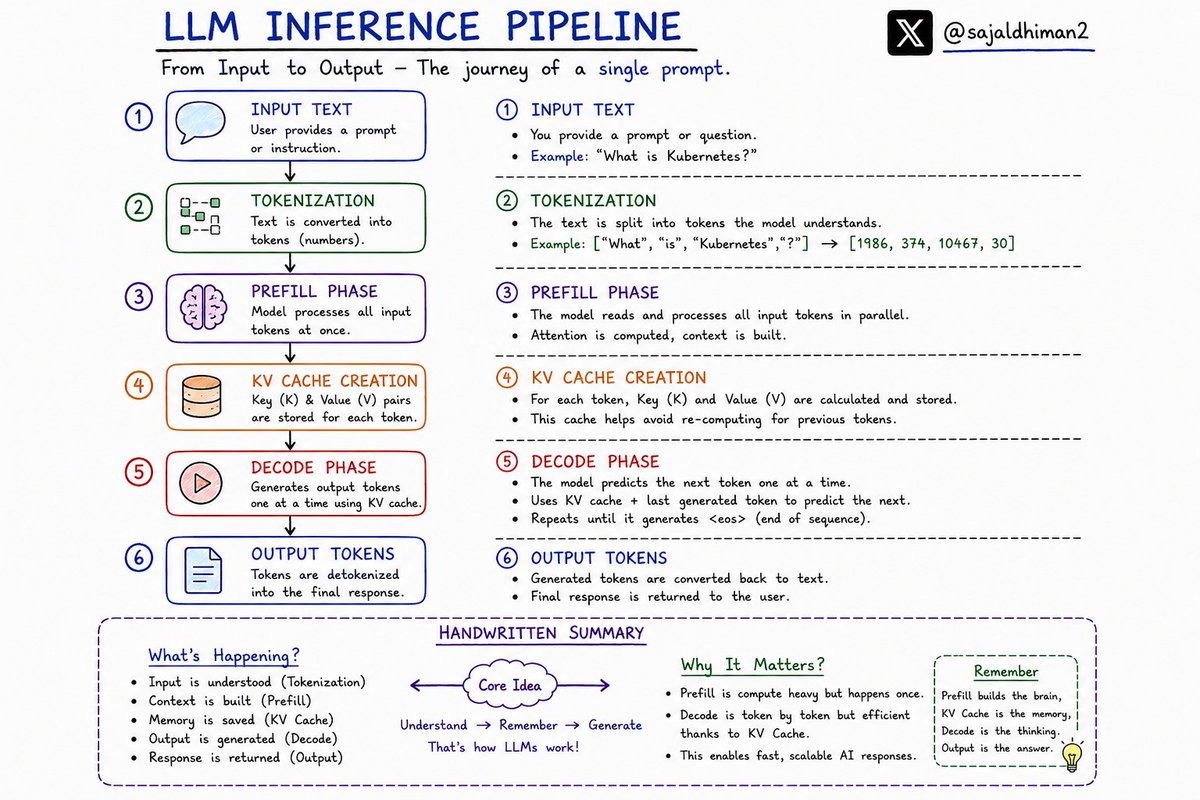
99% of people using ChatGPT have no idea what happens after they hit Enter.
Here’s the entire process:
Input Text
↓
Tokenization
↓
Prefill
↓
KV Cache
↓
Decode
↓
Output Tokens
The most important concept?
💾 KV Cache.
Without it, every new token would require reprocessing the entire conversation from scratch.
That’s one of the key innovations that makes modern LLMs fast enough for real-time chat.
Simple concept.
Massive impact.
@SaiyamPathak thanks for your wonderfull blog day2❤️
#AI #LLM #MachineLearning #ChatGPT #DevOps #MLOps
6
209


Israel installed false walls and temporarily bricked up elevators to hide the secret reprocessing areas from American visitors.
5

The Fragile Border: When Courtroom Guardrails Collapse and Compromise Due Process
In a perfectly functioning judicial system, a jury trial exists inside an absolute vacuum. Twelve citizens are isolated from outside noise, social media commentary, and institutional press releases. They are instructed to look exclusively at the physical evidence, the testimony of the witnesses, and the parameters of the law as presented open court. Under the Sixth Amendment, this total isolation is not a procedural luxury—it is the foundational guarantee of a fair trial.
But when those courtroom guardrails collapse, the entire narrative built by the prosecution faces a massive structural crisis.
As the post-trial progression of Memphis gynecologic oncologist Dr. Sanjeev Kumar undergoes ongoing judicial review, the public dialogue has fundamentally shifted. The initial administrative presentation of the case—built on computerized data models and automated billing algorithms—has been entirely eclipsed by a critical breakdown in trial integrity. Chief U.S. District Judge Sheryl H. Lipman’s decision to formally grant the defense a Remmer Hearing confirms that the boundaries of the jury room were severely compromised. When outside influences penetrate active deliberations, the validity of any resulting outcome is legally and constitutionally fractured.
1. The Reality of Jury Taint: Understanding the Remmer Mandate
Derived from the historic Supreme Court precedent Remmer v. United States, a Remmer Hearing is one of the most serious and protective procedural mechanisms available in federal law. It is not an ordinary post-trial motion or a standard appellate debate. It is a mandatory evidentiary inquiry triggered exclusively when credible evidence emerges that a juror, or the jury as a whole, was exposed to unauthorized, external communication during active deliberations.
Consider the context of the trial: a grueling three-week proceeding followed by an extraordinary five full days of deadlocked jury deliberations. When a jury fractures so deeply over a multi-day period, the insertion of even a single piece of outside data, unauthorized opinion, or unapproved commentary completely poisons the well. Under constitutional law, a defendant cannot be convicted based on external text strings or media narratives that were never subjected to the fires of cross-examination. The Remmer Hearing forces the legal system to halt the assembly line and investigate whether outside interference corrupted the jury’s decision-making process.
2. Physical Evidence vs. Mathematical Assumptions
The necessity of this deep constitutional audit becomes undeniable when you look at the sharp divide between the prosecution’s theoretical claims and the clinic’s physical record of safety. The core of the government’s case rested on complex tracking software that flagged standard outpatient device maintenance as an administrative violation.
Yet, when the actual clinical documentation was unsealed, the digitized metrics completely dissolved:
The Reprocessing Standards: While the prosecution characterized standard clinical maintenance as an offense, official manufacturing documentation from Olympus—the equipment manufacturer—explicitly outlines and permits high-level disinfection protocols for outpatient use. The practice strictly matched these guidelines and CDC parameters.
15,000 Safe Interventions: Operating in an outpatient setting to deliver preventative cancer screenings to an underserved population in Memphis, the practice maintained a perfect record of zero patient infections.
The Expert Medical Review: Recognizing the physical mechanics of the clinic rather than computerized data mining, the Tennessee Board of Medical Examiners thoroughly investigated and dismissed all clinical safety allegations against Dr. Kumar.
3. The Structural Collapse of the Prosecution’s Narrative
The trial record further exposed that the public-facing snapshots deployed by local media were entirely disconnected from courtroom reality. Under the pressure of cross-examination, high-profile individuals featured in initial television segments were shown to technically not be patients of Dr. Kumar.
By demonstrating that automated data-scraping software had mistakenly grouped completely unrelated administrative records into the indictment, Dr. Kumar’s seven hours of detailed clinical testimony exposed the structural flaws of the prosecution’s theories. The physical documents proved what the software couldn’t see: a dedicated community clinic delivering elite safety standards and catching malignant lesions early enough to prevent radical, invasive surgeries.
4. A Front Line for Independent Medicine
The fight for Dr. Kumar’s legacy has transcended the boundaries of a localized legal dispute; it has become a critical defensive line for the infrastructure of independent outpatient medicine across the United States. If standard, manufacturer-approved sterilization protocols and necessary preventative diagnostics can be criminalized through technical misrepresentations, no independent practitioner is safe from administrative overreach.
The narrative of finality has completely evaporated. Backed by an active Remmer Hearing audit and ongoing legal reviews regarding hidden data discrepancies, the defense continues to aggressively challenge the structural integrity of the trial. The rigid administrative formulas deployed in the early stages of this case are rapidly dissolving, replaced by an unblemished safety baseline, official state medical board clearance, and the unyielding protections of constitutional due process.
1
33

but I don't see that LLMs have it. They are always reprocessing the context and computing the next token.
We humans have this entire afferent stream of vision, hearing, feeling, body awareness, as well as hallucinations of memory, thought, imagination, planned action, etc.
1
1
18
HELLORaqi💚 retweeted

Jun 13
just saw DISCLOSURE DAY, love that Spielberg will NOT stop reprocessing his parents’ divorce!!!
4
12
558
20,036
Jose Luis Caballero Herrera retweeted

Traditional mining digs deep. We are doing the opposite. By reprocessing historic tailings, we are eliminating environmental risks while recovering high-value precious metals. 🌿

16
117
922
4,810,200

EMDR def works and is so psychologically transformative. I would encourage anyone to try it when reprocessing memories and moving on.
Jun 13

Miley Cyrus says EMDR therapy changed her life.
She did the train visualization thing, watching her memories pass by like a movie in her mind, and after the first session, her stage fright was completely gone. Never came back.
She also realized the intense need to be loved that she’d been carrying wasn’t even fully hers… it was her mom’s. She’d been holding it for her.
EMDR (Eye Movement Desensitization and Reprocessing) is a type of therapy that helps your brain reprocess traumatic or painful memories using guided eye movements so they stop having such a strong emotional grip on you.
Sometimes the heaviest things we carry aren’t even ours, they’re just emotions we inherited from the people we love.
186

Fuel is deuterium (from seawater — essentially unlimited) tritium bred from lithium. One liter of seawater contains enough deuterium for the energy equivalent of hundreds of liters of gasoline. Supply lasts for millions of years at global scale.
Fission uses uranium (or thorium). Reserves are large and can last centuries with reprocessing and breeder reactors, but still finite and requires mining/processing.
No long-lived high-level waste like fission's spent fuel rods and actinides (plutonium, etc.) that need storage for 10,000 years. Fusion produces helium (inert gas) plus activated structural materials that are mostly low- or intermediate-level waste decaying in decades to a couple centuries. Volume is dramatically smaller.
Fission waste is a real ongoing burden (even if manageable with deep geological repositories).
12
Fix It Now Wisconsin 🏈🧀🚑🫀🚴♀️🩺🩸💉🪖🐮🚒🧀🏈 retweeted

Jun 13
you are nuts if believe that Iran has not been working on plutonium reprocessing for years that under the JCPOA was supposed to be removed to Russia....then Trump tore it up and off they go
they can give a shits less about 10-12 nukes worth of HEU when they have 200 nukes worth of plutonium
they just playing games with Trump to get paid
Trump is getting suckered as he surrenders
1
7
61
2,834