Julius Henderson retweeted

Devin Vassell said that Dylan Harper was upset about his playing time and certain role with the team during the season:
"I think we all knew he was talented I don't know if anybody knew he was this talented besides himself, he was upset with playing time and different roles that he was in, but when we needed him most he stepped up..."
129
567
10,384
907,595

I said their differences were not significant enough to determine Jason as revolutionising the role. Not that they’re the EXACT same.
dee retweeted

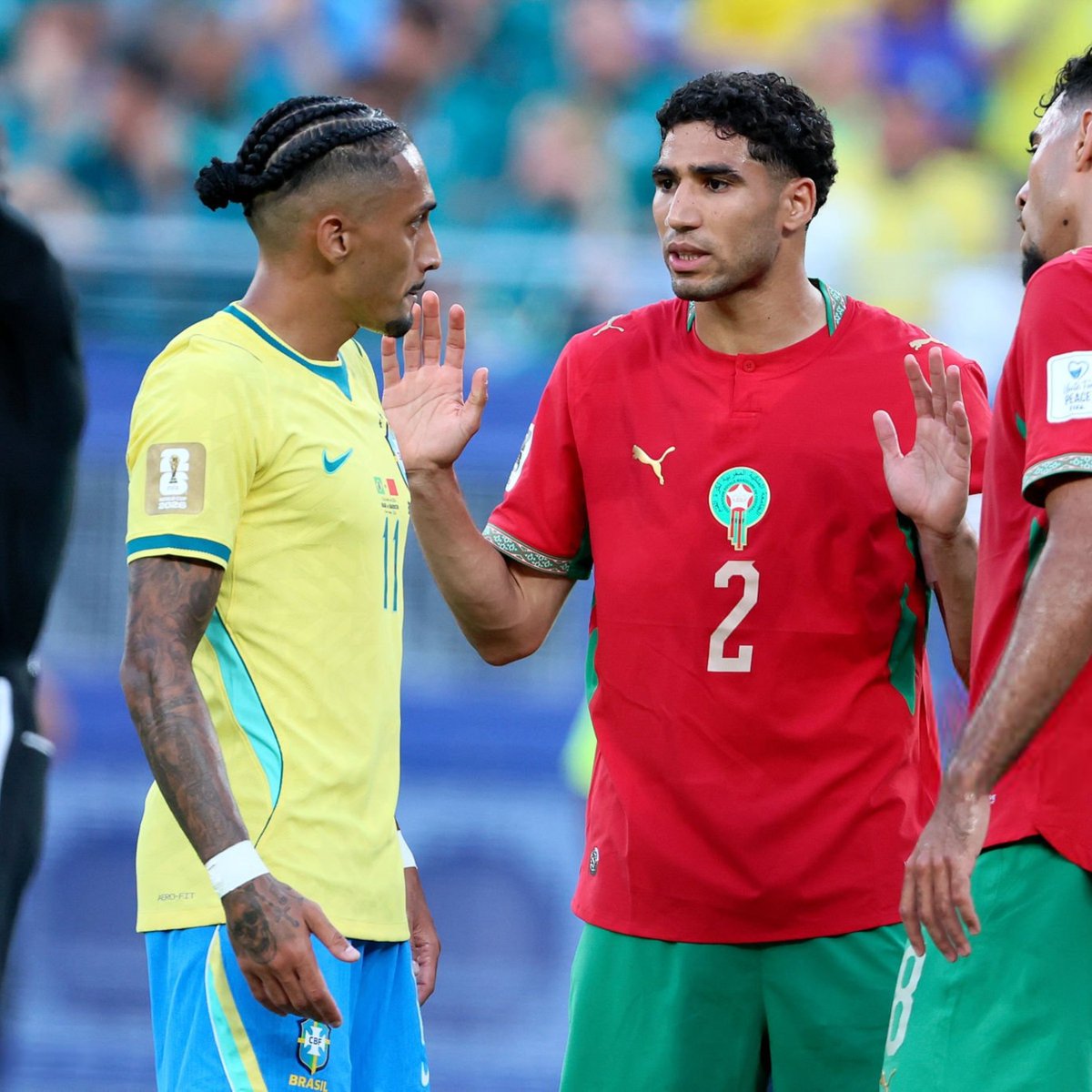
🚨🇧🇷 Raphinha didn't have his best game vs. Morocco, but it is fair to say that he played in a completely different role.
Up next: Brazil vs Haiti, on June 20! ✨
45
55
3,437
56,419
Peaceful tout retweeted

14h
pregnant women, please eat enough folic acid, iron, iodine, protein, zinc… these nutrients play a major role in brain development. take it seriously so we can avoid situations like this

“Allow Tinubu to work” — Pro-Tinubu group accuses Makinde of hiding k dnapped children over presidential ambition during counter-protest in Abuja
8
631
1,673
24,731

This was a state government event, not a federal one. Expecting Pauline Hanson (a federal senator) to answer detailed questions on it is like expecting Anthony Albanese to comment on a state premier’s policy that has nothing to do with him. As Pauline rightly pointed out, it’s irrelevant to her role.
1

I think those Hungarians who are skeptical of Turanism (I mean the Uralo-Altaic Theory) are missing the point.
Look at it as roots as... literal roots. A tree grows from its roots, after all. If you forget these roots, abandon them, and don't modernize, transform, or cultivate them, you lose something essential. Besides, the neighbors will always remind the Hungarians that they came from somewhere else.
For centuries, this identity was stifled by the Habsburgs, then, after Trianon and WWII, it was stifled by the Eastern Bloc. Now it’s being stifled by the European Union.
Well... when it comes to politics, I'm not entirely sure how much Orbán Viktor utilized this idea for his own benefit. If it was so marginal, why was he in power for so long?
Besides, in terms of resources, Hungary has always depended, and continues to depend, on Europe and Russia. At the very least, this whole ideology could become quite tangible if (for example) a gas pipeline were built to Hungary from Kazakhstan, across the Caspian to the Adriatic, and through Montenegro and Serbia. The same goes for other resources, and this could be a two-way process; as I understand it, Kazakhstan, conversely, needs more academic-technological resources.
I think skepticism toward Turanism arises because many view it merely as mythology (and LARPing), rather than as a tool. If viewed as a foreign policy philosophy, Turanism transforms Hungary from being the "periphery of Europe" into a "bridge between the East and the West." That is a very ambitious role.
Balkan HODL #BIP-110 retweeted

Every little bit helps. Don't let the pundits discourage or downplay your role. The community is made up of lots of individuals.
5
14
97
2,311
Lord Stavanger retweeted

Mike Kuketz has never had any role in the GrapheneOS project. He certainly isn't a GrapheneOS developer. He uses GrapheneOS and has a widely known privacy blog and community where he has written about it. That doesn't somehow make him part of GrapheneOS.

Drama strikes Graphene OS developer Mike Kuketz, as it is revealed a server he operation was logging all user data.
This could be overblown drama, to be honest, but I figured I'd get some eyes on it.
mastodon.social/@bongo20201/…

12
61
1,066
35,875
ArielDemurebaby retweeted

Ever Thought About Making Friendship Like This Video?
1-Yes
2-Yes But Im A Bottom
3-Yes But Im A Top
4-Yes But My Role Is Different (Comment)
Full Scene👉g2fame.com/devilstgirls/go.p…
1
11
64
15,217

26s
Only userid not role.
With the help of userId i will fetch all the associated roles and access rights.

Xa/ chances created aren’t good for CB stats tbf. Agree with your point though (but that also seems partly due to his role as the CCB). Would be interested to see if stats like XT / final third entries tell the same story
3

New York never slows down.
And neither do the markets that move through it.
Every second, opportunities appear, decisions are made, and value flows across borders in real time.
In a global economy that never pauses, financial systems can no longer rely on delays, schedules, or friction-heavy processes.
The world now operates continuously.
Across regions.
Across industries.
Across digital systems.
And expectations have changed with it instant access, seamless transfers, and infrastructure that keeps pace with global activity are no longer optional.
That is where #TRON continues to play a role.
By enabling fast, efficient, and accessible value transfer, TRON supports a financial environment designed for constant motion.
Because in today’s economy:
Speed matters.
Access matters.
And the ability to move value freely is becoming just as important as moving information.
The future of finance is always on.
And systems that can operate in real time will define what comes next.
@trondao @justinsuntron
#TRONEcoStar

New York doesn’t wait.
Neither should your money.
#TRON is helping power a more efficient and accessible financial system for a global economy that never stops.
2
ArielDemurebaby retweeted
Would You Like To Try Your Fantasy With TGirls In RolePlay?
1-Yes
2-No
3-I Want To Try
4-Yes But In My Secret Role
Full Scene👉g2fame.com/genderxfilms/go.p…
3
7
94
21,539
@sdumo.mtshali retweeted

I'm on episode 5! Sdumo is a brilliant actor! He has always been, but he made sure with this role! #Polygamist
1
1
5
229

34s
An interesting comparison came to mind.
The eight DeFi protocols I write about are, in many ways, a business.
Think of it like an online store.
A successful store doesn’t rely on a single product. Instead, it keeps a selection of products on the shelf – products that consistently attract demand and generate cash flow for the business.
My eight DeFi protocols serve a similar purpose.
They are not simply assets sitting in a portfolio. They are productive digital networks that generate value in different ways. Together, they form a portfolio designed to produce returns over time rather than depend on the success of a single winner.
If one product stops selling, loses relevance, or disappears altogether, the store simply replaces it with another promising product and continues operating. The business survives because it was never dependent on a single item, but on the cash flow generated by the portfolio as a whole.
That’s my approach to DeFi.
Perhaps it comes from spending 20 years in investing – 10 of those years in crypto – while still remaining a creative person at heart. At some point, you start writing DeFi poetry and intuitively building systems that combine structure with imagination.
That’s why I don’t take things too personally. I don’t feel the need to constantly compare everything to Bitcoin, search for the “perfect” DeFi asset, or worry endlessly about scams and failures.
It’s all part of a fascinating and sophisticated game.
Just like life itself.
And importantly, this “business” – this game with eight protocols – represents only a small portion of my total capital.
The majority remains allocated to fundamental assets: Bitcoin, Ethereum, gold, and silver.
The same philosophy is behind The Holding @theholding_ . Each fund has its own mission, purpose, and role, while all of them complement and strengthen one another as part of a larger ecosystem.
Happy to share my perspective.
Not financial advice.

20h

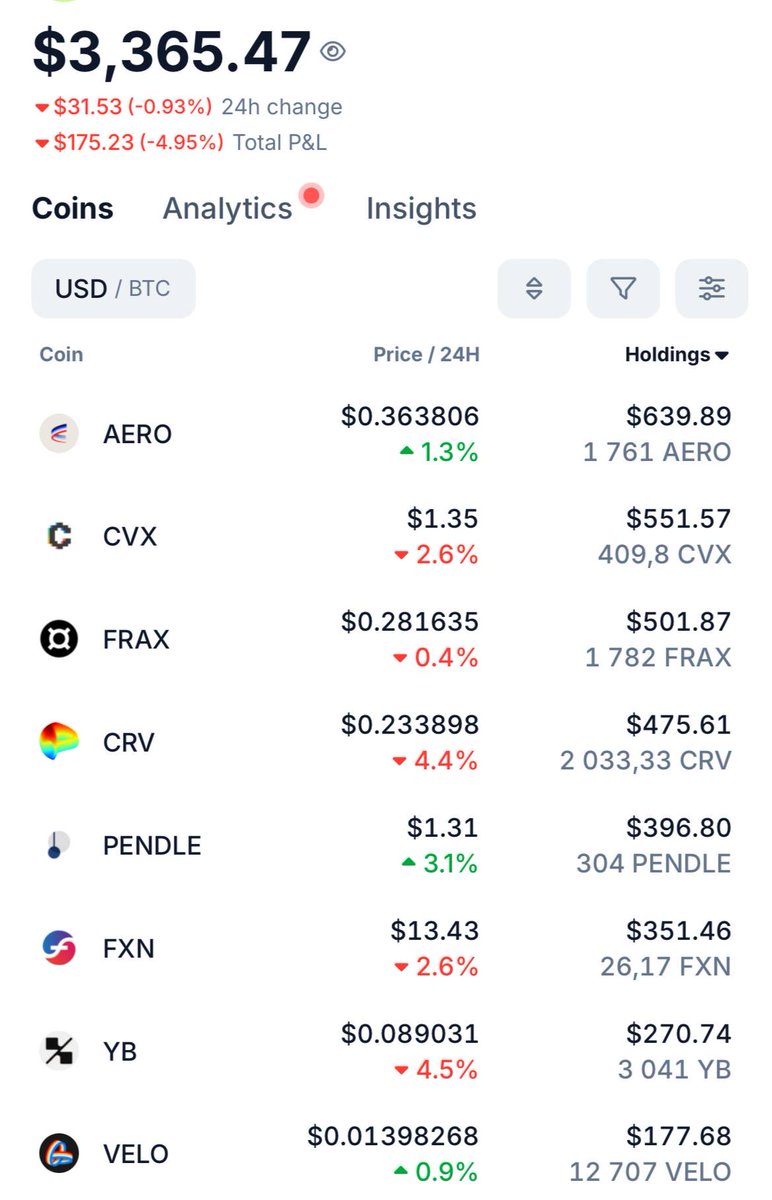
According to CoinGecko data:
• Buying 2,000 FRAX tokens at peak market euphoria would have cost $76,300.
• Today, 2,000 FRAX = $498.
• 153x cheaper.
Meanwhile, the protocol has become significantly stronger and more fundamentally sound over the years. The same applies to the others below.
• 1,761 AERO tokens were once valued at $4,085.
• Today: $1,783.
• 2.3x cheaper.
• 410 CVX (Convex) tokens = $24,600.
• Today: $552.
• 44.5x cheaper.
• 2,033 CRV (Curve) tokens = $31,200.
• Today: $480.
• 65x cheaper.
• 304 PENDLE tokens = $2,280.
• Today: $393.
• 5.8x cheaper.
• 26 FXN (f(x) Protocol) tokens = $5,694.
• Today: $351.
• 16x cheaper.
• 3,040 YB (Yield Basis) tokens = $2,486.
• Today: $272.
• 9x cheaper.
• 12,700 VELO tokens = $5,168.
• Today: $178.
• 29x cheaper.
👀 A portfolio containing all of the above tokens, which can now be accumulated for just $3,365, was valued at $151,800 during the peak greed and euphoria phase of the market.
Today, it takes 45x less capital to acquire the same basket.
And you'll own the exact same number of tokens that previously required tens of times more capital — the kind of allocations only dollar millionaires could comfortably make.
☝️ What's even more interesting: this basket currently generates an average cash flow yield of 14.4% annually.
I've attached my latest monthly report for May below this tweet.
Personally, I see the long-term upside of capital deployed into these assets as potentially dozens to hundreds of times higher over the coming years.
Not financial advice.
1
5

Glen philips, maxwell, Travis head, Short, markram, aslanka, chase, Livingston, saim Ayub, slaman ali hagga, is bowling more in white bowl than India's greatest off spin legend washington sundar. What is his role in Indian team he even doesn't deserve chances in redball.

A Celebration of Collaboration, Impact, and Hope!
I recently visited Akwa Ibom 🇳🇬 , and I’m grateful for the opportunity to witness firsthand the transformative collaboration between @UNFPANigeria, Akwa Ibom State, and #Norway:
☑️8 Emergency Obstetric and Newborn Care facilities renovated and equipped
☑️2 fistula repair theatres, providing much needed services for women
☑️Handover of essential medical equipment, fistula kits, and midwifery kits
This trip highlighted the power of sustained #partnerships, central role of #domestic #resources complimented by donor support and consistent technical backstopping. Incredibly proud of this partnership and the transformative impact on the lives of women, families, and communities.

1

Abdul Hameed Hassan retweeted

Devin Vassell says Dylan Harper was frustrated with his role and playing time with the Spurs the season.
“But when we needed him most he stepped up.”
(h/t @big_business_)
 Ahmed/The Ears/IG: BigBizTheGod 🇸🇴
62
151
3,285
123,307