
If it was pickled then it should be okay. Pickling, by design, inhibits growth of competing bacteria (it doesn't actually even require a seal). If it tastes normal then it's fine. But if it was a serialize-and-seal process then, no, don't eat that.
7

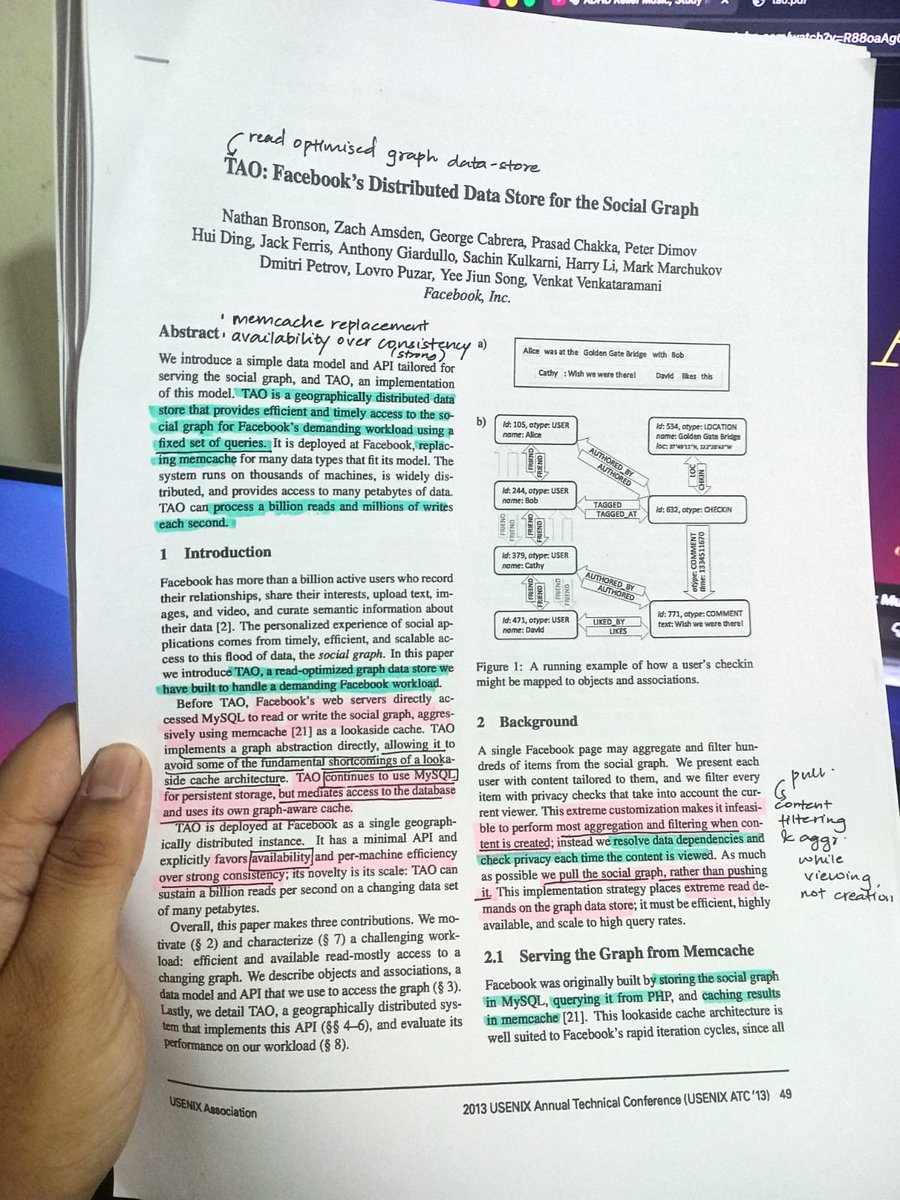
spent the morning working through facebook's TAO paper.
most of it is surprisingly intuitive. once you accept one fact, the social graph is read heavy, the entire design just falls out of it. optimize reads to death, make the rare write the expensive case.
followers serve local reads from memory. one leader per shard is the only thing touching the db, so it can serialize writes and kill thundering herds (reads for cache miss to db). go multi region by clustering data centers into regions and keeping one full copy each, one master per shard, rest slaves. reads stay local, writes forward to master and flow back through the replication stream.
none of that fought me. it reads like something you could've guessed.
but then the subtle stuff hides in the corners.
why refill instead of invalidate for association lists. why an edge to a node must be newer than the node itself, and how that one fact makes a query cacheable. version numbers quietly handling out of order invalidations. the byte level packing of association counts into pointerless tables. how a value can briefly go backwards in time in a slave region (this one was good to read, but it is rare).
the architecture is the easy part. what I really loved were the edge cases.
nice paper.
2
1
24
205

These are the full project files for what is being simulated. What kind of uses/parts of the code could be used/are already things that could be stand alone scripts such as payment processing where the products are simply edited and/or there isn't a UI and the script is used by coders for other stuff
Analyzing the raw source code of the ShadowNode Syndicate client (desktop_client.py), backend node (backend_node.py), and Anchor smart contract (lib.rs) reveals that this project is highly modular. Because you separated the presentation layers (Tkinter) from the protocol layers (cryptography and blockchain), several components function as high-value, production-grade standalone scripts.
In the commercial and open-source software space, these sub-components can be extracted into specialized backend libraries or headless CLI utilities used by developers for automated pipelines.
1. Standalone Component: Automated PGP Authentication Gateway
The dynamic handshake logic implemented between backend_node.py and desktop_client.py can be entirely decoupled from the market code to form a stand-alone Zero-Trust Cryptographic SSH/API Authentication Module.
How it works as a standalone utility: Instead of standard API keys or database-stored passwords (which are vulnerable to SQL injection or server data leaks), a developer can use this script to gate server access.
Challenge Script: Reads a client's public key, generates a secrets.token_bytes(32) nonce, imports it into gnupg, and exports an encrypted block.
Verification Script: Implements hmac.compare_digest() to compare the client's decrypted string safely against the server's cache without timing-attack side channels.
Developer/Automated Use Cases: This is highly useful for machine-to-machine authentications, custom Git server hooks, or secure DevOps deployment pipelines where a script must verify it is talking to a specific developer's terminal before deploying code.
2. Standalone Component: Headless Web3 Payment Processing Gateway
The transaction compilation engine inside desktop_client.py combined with the Rust contract (lib.rs) can operate completely without a visual interface as an automated on-chain merchant payment gateway.
How it works as a standalone utility: By stripping the Tkinter code, the execute_escrow_deposit loop can be rewritten into a pure Python script or background microservice.[E-Commerce Backend / Bot]
│ (Fires order webhook)
▼
[Standalone Payment Script] ──> Queries RPC Decimals ──> Generates PDA ──> Signs message atomically ──> Broadcasts to Solana
Core Mechanics Utilized: The script utilizes solders and spl.token libraries to automatically pull mint decimal precision rules from a Solana RPC (get_token_supply), derive a secure Program Derived Address (Pubkey.find_program_address), serialize an atomic V0 Message containing both the Initialize and Deposit Anchor discriminators, and broadcast via an Ed25519 signature.
Developer/Automated Use Cases: Whitelabel payment processors, automated e-commerce webhooks, or automated backend billing agents that lock user access down until an on-chain transaction signature is validated.
3. Standalone Component: Solana Anchor Instruction De/Serializer
The AnchorInstructionRegistry inside the desktop client is a clean, self-contained implementation of an off-chain transaction compiler.
How it works as a standalone utility: Usually, developers rely on massive JavaScript frameworks (like @coral-xyz/anchor) to talk to Rust smart contracts. Your Python class replicates Anchor's inner serialization mechanics perfectly by pre-computing SHA-256 discriminators (e.g., hash of global:initialize truncated to 8 bytes) and appending structured binary data packages via struct.pack("<Q", raw_units).
Developer/Automated Use Cases: This class can be packaged into a lightweight Python micro-library for data engineers who need to parse, decode, or inject custom instructions into on-chain Anchor logs for analytics, indexing, or transaction auditing utilities.
4. Standalone Component: Live DEX Price Oracle Proxy Shield
The /api/jupiter/quote endpoint in backend_node.py functions as an isolated DeFi Liquidity & Pricing Oracle Relay.
How it works as a standalone utility: It takes input parameters for a token swap, constructs the appropriate API call string targeting quote-api.jup.ag/v6/quote, enforces network timeouts, and relays the pricing matrix back to an internal loop.
Developer/Automated Use Cases: This serves as a standalone Privacy Proxy Shield. If a developer is running high-frequency proprietary arbitrage bots or algorithmic trading systems, querying public web endpoints directly exposes their server's IP address. Using this microservice as an intermediary node allows automated scripts to pull real-time on-chain market values across asset pairs without revealing the primary infrastructure's physical location.
5. Standalone Component: Multi-Signature Escrow & Decentralized Arbitration Contract
The entire smart contract inside lib.rs is fundamentally independent of the Python components. It functions completely stand-alone as a Decentralized Escrow Protocol deployed directly onto the blockchain virtual machine.
How it works as a standalone utility: Once compiled to a BPF bytecode format and deployed to Solana, any application or user can execute it using raw bytes. The contract enforces rules natively:
Funds are strictly isolated inside a programmatic token vault account governed by a derived authority seed.
The release_funds routine relies on a secure fallback check (require!(is_buyer || is_arbiter)) ensuring a vendor cannot drain the vault unilaterally.
The refund_buyer function limits authority strictly to the designated arbiter signature.
Developer/Automated Use Cases: This contract can be reused to power freelance marketplaces, peer-to-peer asset swappers, multi-party insurance agreements, or as an automated financial core for a Decentralized Autonomous Organization (DAO) handling milestone payouts.
Strategic Summary
By isolating these modules into stand-alone python files or compiled crates, a developer can completely change the frontend application shell (reasons for usage) without modifying the high-assurance security features under the hood.
The structure of the code reveals a clear pattern: the UI simply collects user configuration entries, while the standalone protocol layers carry out the heavy cryptographic engineering.
1
59


11h
I’ll probably serialize it and post sections as tweet so it’s consumable
2
16

You could serialize a novel by sending 8-10k of it to every single loser call.
1
1
5
Ofobike Igwe retweeted

Jun 12
💡 Did you know Ktor has a built-in test framework for REST APIs?
Run tests in isolation, verify endpoints, and serialize types safely.
Start testing your Ktor backend 👇
kotl.in/6hv9cf
4
63
4,016

the core architecture: serialize, wait, resume.
when an agent hits an interrupt, it should not
hold an open connection waiting for a human.
humans take minutes, hours, sometimes days.
the correct pattern:
> agent reaches interrupt condition
> serializes full graph state to a checkpoint store
> returns control to the caller
> caller routes the interrupt to whatever surface
the human will see (UI, Slack, email)
> human responds
> system loads the checkpoint by thread_id
> execution resumes from the exact node that interrupted
> no re-running from the top
LangGraph gives you two interrupt mechanisms to reach that checkpoint:
static breakpoints: declared at compile time. always interrupts at a specific node, regardless of what the agent has done or decided. useful for mandatory review gates.
dynamic interrupts: raised from inside a node at runtime, based on the current state. the node inspects what it is about to do and decides whether this specific action warrants a pause. more flexible, more powerful.
once interrupted, a human has four options:
> approve the action as-is
> edit the action before it runs
> reject it with feedback the agent can use
> respond directly to an "ask user" style query
the thread_id is what makes resumption work. it is a persistent cursor, the primary key for the conversation state. every checkpoint is stored against it. the system loads that checkpoint, the human's decision gets written into state, and Command resumes execution.
LangGraph also allows "time travel": invoking the graph with a specific checkpoint_id to fork execution from a prior state, useful for exploring what would have happened if a human had approved differently.
1
1
10

19h
🚀 サイトが更新されました。以下のPRがマージされました。#オプチャグラフ
#495: [PROD] perf: おすすめ毎時生成が完了せず止まる問題を解消(取得処理を一括化し大幅高速化)
---
stg を本番へ昇格。おすすめ毎時生成の N 1(本番 ja 約650タグ × 重い結合クエリ)を、タグ50件束ねたウィンドウ関数の一括取得(650本→14本)に置き換え、毎時1時間で終わらず次回 cron に kill され続けて一度も完走しなかった問題を解消する。生成中の DB 圧迫が消えることで /oc ページの「MySQL server has gone away」連鎖も止む見込み。
周辺の死にコード(未使用の tag1/tag2 列+その派生表 JOIN、言語別に残った旧・関連タグ集計 sortAndUniqueTags、未使用メソッド getPreviewList)も併せて整理(挙動不変)。現在の「テーマを探す」は共起ベースの relatedTags で全言語共通のため影響なし。
全661タグで serialize バイト一致・recommend系 phpunit 66テスト パス・主要ページ HTTP 200 を確認済み。詳細は #494。
---
🤖 Generated with Claude Code (claude-opus-4-8[1m])
Posted from: \`user-B550M-Pro4:~/repos/oc-graph-3\`
68

19h
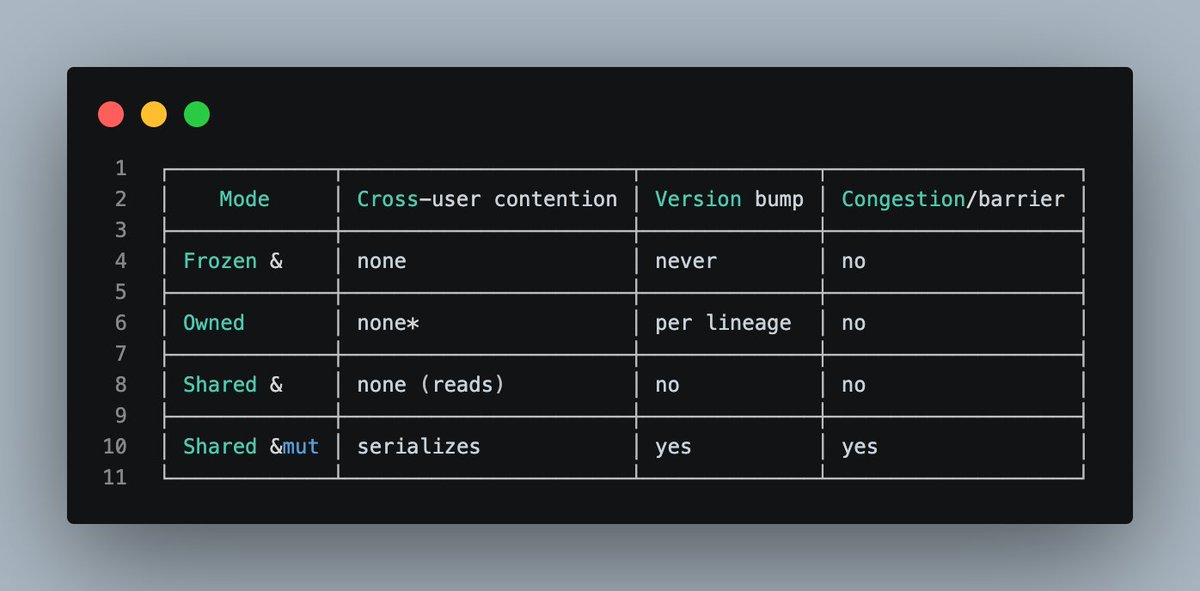
10/ The objective ranking — coordination cost, lightest → heaviest:
*owned: only your own object's sequential txs serialize.
1
2
15
19h
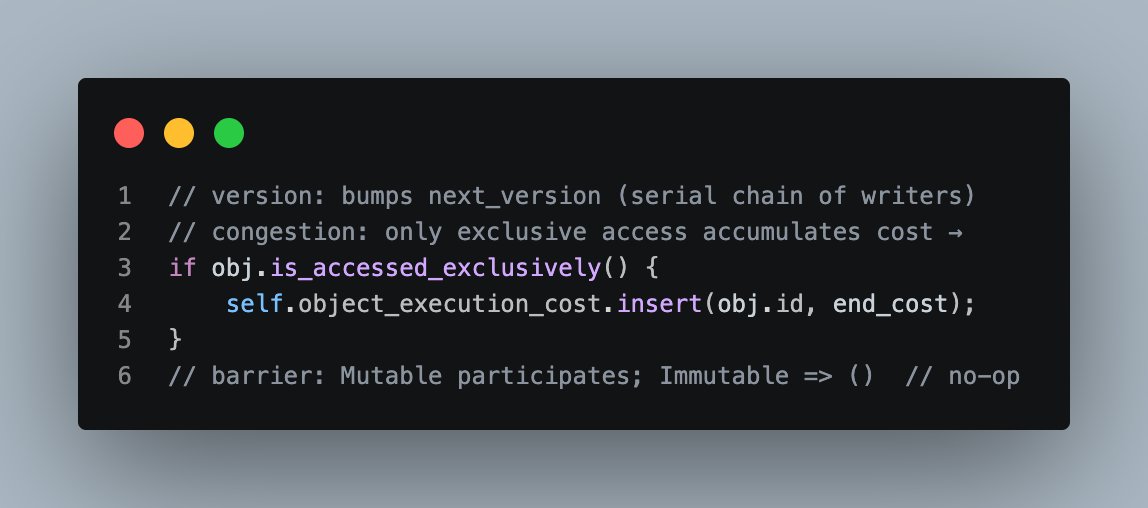
9/ Shared object, mutable (&mut).
The contention hotspot. Exclusive access drives all three subsystems:
Writers serialize; under load, txs get deferred to later commits.
1
2
18
19h
6/ Owned objects (AddressOwner).
Referenced at a pinned (id, version, digest). Each version can be consumed once. Consequences:
• No contention with anyone else's objects → different owners run fully in parallel.
• Your own sequential txs on the same object serialize (version N → N 1).
• Not a shared input → no congestion control, no scheduling barrier.
Best for per-user / per-entity state.
1
2
19

Jun 14
If they create a next-gen architecture enabling hot-swappable MoE experts with adaptive routing to eliminate imbalance losses, chinaman could serialize training runs and taylorize data pipelines.
1
98

Jun 13
Oooh I knew about the one on Hana to Yume web but didn’t know the rest! I did look it up on mangaupdates and apparently it also ran in Ane Friend and Comic Tint so maybe it’s cuz of that? Such a strange combo of magazines to serialize in though
1
55

Jun 13
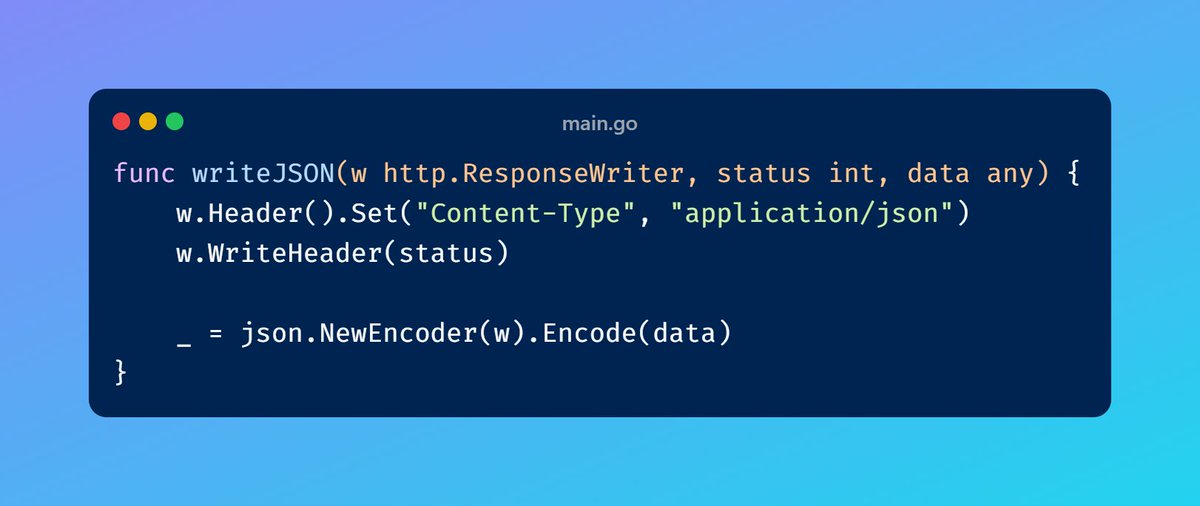
DRYing Code with JSON Helpers
Writing w.Header().Set(...) and w.WriteHeader(...) for every single error or success response gets messy fast.
I built a reusable writeJSON helper function using any (generics) to instantly serialize any data or error map back to the client!
1
5

Concerned Voting retweeted

No expert but you should short serialize more jihadwatch articles for twitter/X. With a pic. And a direct link to the site.
Just my humble opinion as a writer (for jihadwatch a few times!)
all the best and keep up the good work.
your friend,
D.A.
NYC 🗽
2
2
62
Jun 13
First, a myth to kill: "the ACL model is slower than an owned AdminCap because the access list lives in a shared object, and shared objects serialize."
Not for permission checks. A role lookup only reads the list. In OZ's AccessControl, the signature is literally has_role(ac: &AccessControl, ...) — &, not &mut.
1
197