
Jun 11
Nobody talks about the moment open source actually clicks.
You've been using a library for months.
You hit a bug. The docs don't cover it.
Stack Overflow has nothing.
So you open the source code.
And for the first time — you read it.
Not to contribute. Not to learn. Just to find the answer.
And you find it. In 20 minutes. Inside 3 files.
That's the moment.
The moment you realize the source code is the documentation.
That the answer was always there — you just never thought to look.
After that moment, everything changes:
→ You stop being afraid of "how does this actually work"
→ You start trusting your own ability to find answers
→ You file better bug reports — with line numbers, not vibes
→ You write better code — because you've seen good code up close
→ You become a more confident contributor — because now you've
been inside the thing
Every developer has this moment.
Most haven't had it yet — not because they're not ready,
but because nobody told them they were allowed to just open
the file and look.
You're allowed. The source code is right there.
ossphere.dev
When did open source first click for you?
Drop it below 👇
#OpenSource #BuildInPublic #SoftwareCraft #GitHub #DeveloperGrowth #CodeReading #OSS
1
9
Jun 11
The best software interview question I ever heard wasn't
about algorithms.
It was: "Tell me about an open source project you use daily
and explain one thing about how it works internally."
Most candidates couldn't answer it.
Not because they weren't smart — but because they had never
looked inside the tools they depend on every single day.
Here's what looking inside actually teaches you:
→ Why abstractions exist — not just what they do
→ How tradeoffs get made under real constraints
→ What "good enough" looks like in production code
→ How experienced engineers name and organize things
→ Why your ORM generates that SQL — and when to bypass it
→ How your HTTP client handles retries, timeouts, redirects
→ What your test runner does between "run" and "pass"
→ Why your build tool makes the choices it makes
The developers who understand their tools at one level deeper
than the documentation write better code with those tools.
They also debug faster. Contribute better PRs.
And give more interesting interview answers.
GitHub has the source code for everything you use.
The README is the surface. The src folder is the education.
ossphere.dev
What tool do you use daily but have never looked inside?
Drop it below 👇
#OpenSource #SoftwareCraft #GitHub #BuildInPublic #DeveloperGrowth #CodeReading #SoftwareEngineering
1
9
Jun 6
Every developer has a "that changed everything" moment.
A repo they stumbled on that rewired how they think about code.
Not a course. Not a tutorial. Not a YouTube video.
A real codebase that made them feel like they'd been thinking
about a problem completely wrong.
Mine was reading how React's reconciler actually works.
Here's what developers say changed theirs:
→ Reading Linux kernel code — "I finally understood what an OS does"
→ Studying Redis source — "I learned more about C in 2 days than 2 years"
→ Digging into CPython — "Everything I knew about Python was surface level"
→ Reading SQLite — "One of the most elegant codebases ever written"
→ Studying Nginx — "I understood event loops for the first time"
→ Reading the V8 source — "JavaScript made actual sense after this"
→ Exploring Tokio (Rust async runtime) — "Async finally clicked"
The best developers aren't just builders.
They're readers. Curious, obsessive, patient readers of other
people's code.
You don't have to understand everything.
You just have to open the file and start.
ossphere.dev
What's the repo that changed how you think about code?
Drop it below 👇
#OpenSource #CodeReading #SoftwareCraft #GitHub #BuildInPublic #LearningToCode #SoftwareEngineering
2
25

Copilot's metered AI credits make prompt precision a billable skill. When compute has a visible price, engineers design before they execute. linkedin.com/feed/update/urn… #AIEngineering #SoftwareCraft
9
Jun 5
The most underrated skill in software development in 2026?
Reading other people's code.
Not writing it. Reading it.
Most developers spend 90% of their learning time building things.
The developers who improve fastest spend serious time inside
codebases they didn't write.
Here's what reading real production code teaches you that
tutorials never will:
→ How senior engineers name things when it actually matters
→ Why a function exists — the comment above it tells you more
than the code inside it
→ How teams handle errors in production vs how tutorials handle them
→ What "good enough" looks like under real constraints
→ Patterns that repeat across every great codebase you'll ever read
→ How abstractions are chosen — and what they're hiding on purpose
→ Why the "wrong" solution is sometimes the right one for the context
→ How teams leave breadcrumbs for the next person in the code
The developers writing the best code in 2026 are reading
10x more code than they're writing.
GitHub has 420 million repositories.
The world's best code school is free and it's all right there.
ossphere.dev
What open source codebase taught you the most?
Drop it below 👇
#OpenSource #CodeReview #SoftwareCraft #GitHub #BuildInPublic #LearningToCode #SoftwareEngineering
1
5

Remasters only land when the source is clean and archived — same rule for commerce platforms you’ll revisit a decade later. Ship for now, preserve for later.
#ToyStory3 #LegacySystems #DataGovernance #Ecommerce #SoftwareCraft

6

May 25
96% of devs don't trust AI-generated code. 48% verify it. That gap is your next incident.
The fix isn't better prompts. It's a workflow.
tim-schipper.nl/en/blog/work…
#AIAgents #SoftwareCraft #AgenticEngineering
21

May 23
Blast from the past:Souls Games Trick You Into Deliberate Practice #Blog #Video #Deliberatepractice #Games #LearningGames #SoftwareCraft #VideoGames #Video mozaicworks.com/blog/souls-g…
mozaicworks.com/blog/souls-g…
10

May 23
Blast from the past:Souls Games Trick You Into Deliberate Practice #Blog #Video #Deliberatepractice #Games #LearningGames #SoftwareCraft #VideoGames #Video mozaicworks.com/blog/souls-g…
mozaicworks.com/blog/souls-g…
38
May 19
Blast from the past:A Programmer Code of Ethics Would Have Helped #Blog #Video #Romania #SoftwareCraft mozaicworks.com/blog/a-progr…
mozaicworks.com/blog/a-progr…
12
May 19
Blast from the past:A Programmer Code of Ethics Would Have Helped #Blog #Video #Romania #SoftwareCraft mozaicworks.com/blog/a-progr…
mozaicworks.com/blog/a-progr…
23
May 18
Blast from the past:Architectural Kata Explained #Blog #Video #Architecture #Design #SoftwareCraft #Video #Video mozaicworks.com/blog/archite…
mozaicworks.com/blog/archite…
4
May 18
Blast from the past:Architectural Kata Explained #Blog #Video #Architecture #Design #SoftwareCraft #Video #Video mozaicworks.com/blog/archite…
mozaicworks.com/blog/archite…
1
24
May 16
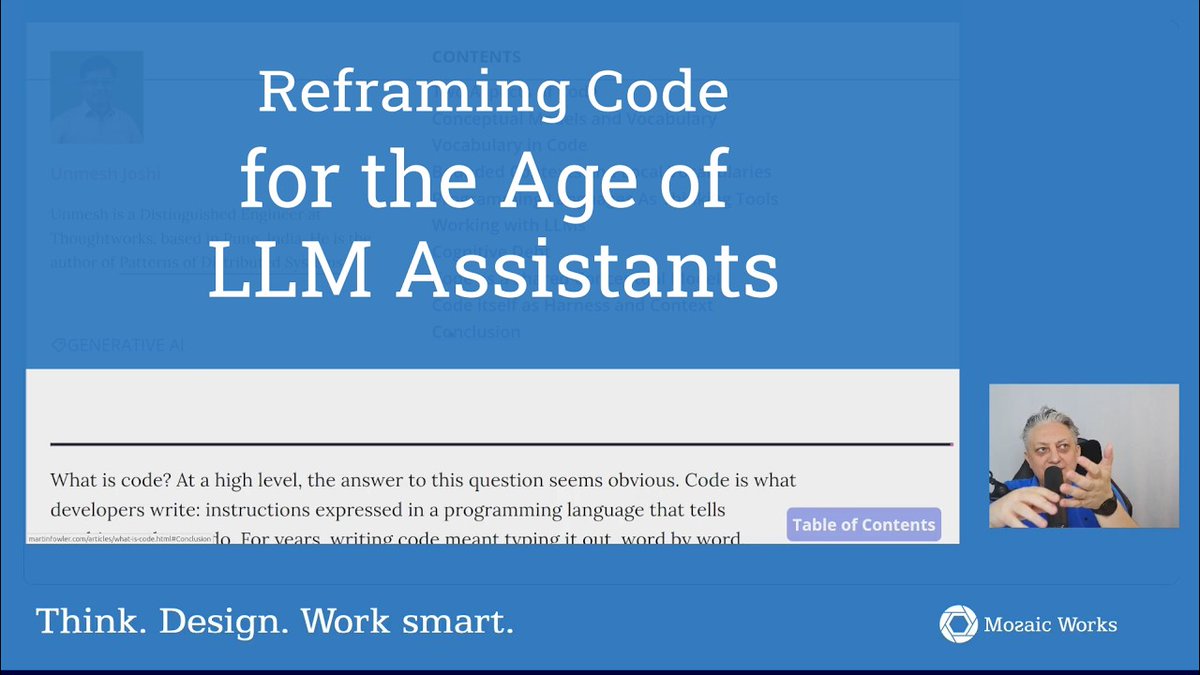
New video: mozaicworks.com/blog/reframi… #AI #Programming #SoftwareCraft #Video
Code has always served two audiences: the machine and the developer. LLMs are commoditizing the
first. The second is where things get interesting.
Unmesh Joshi's recent article...
mozaicworks.com/blog/reframi…
10
May 16
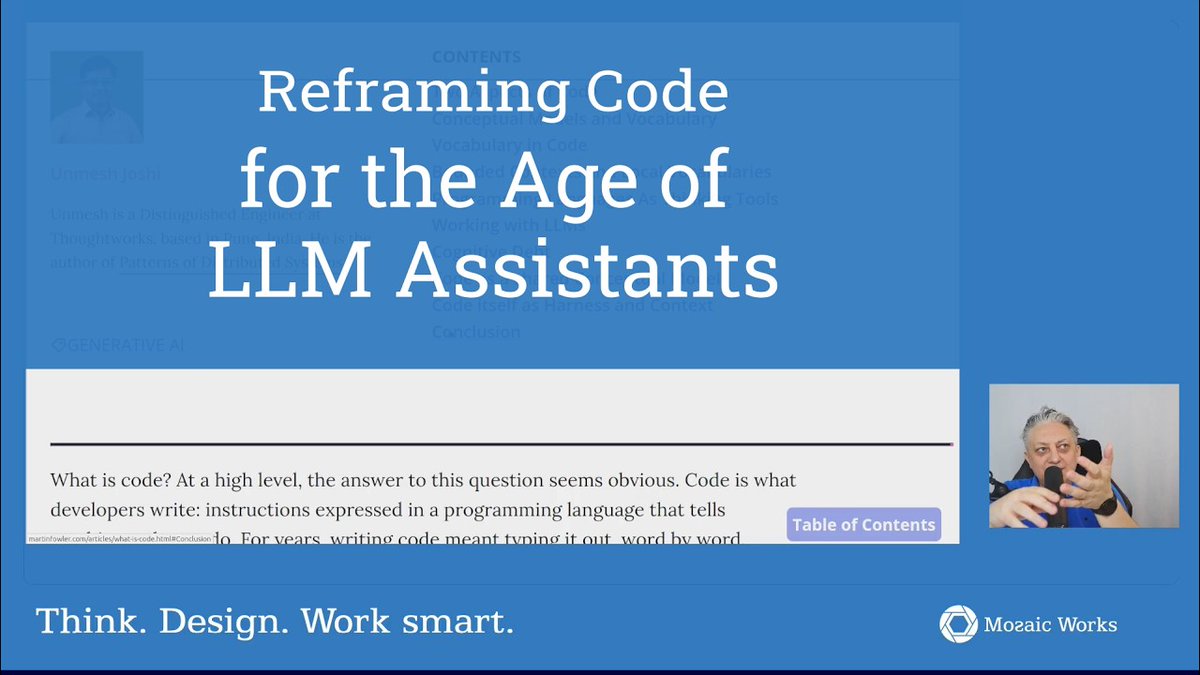
New video: mozaicworks.com/blog/reframi… #AI #Programming #SoftwareCraft #Video
Code has always served two audiences: the machine and the developer. LLMs are commoditizing the
first. The second is where things get interesting.
Unmesh Joshi's recent article...
mozaicworks.com/blog/reframi…
1
36
May 16
Blast from the past:Coding Assistants and Typing is Not The Bottleneck #Blog #Video #AI #Programming #SoftwareCraft #Video #Video mozaicworks.com/blog/coding-…
mozaicworks.com/blog/coding-…
11
May 16
Blast from the past:Coding Assistants and Typing is Not The Bottleneck #Blog #Video #AI #Programming #SoftwareCraft #Video #Video mozaicworks.com/blog/coding-…
mozaicworks.com/blog/coding-…
30
May 15
Blast from the past:Can Claude Help With Infrastructure Automation? #Blog #Video #AI #cloud #Docker #DockerCompose #SoftwareCraft #Video #Video mozaicworks.com/blog/can-cla…
mozaicworks.com/blog/can-cla…
14
May 15
Blast from the past:Can Claude Help With Infrastructure Automation? #Blog #Video #AI #cloud #Docker #DockerCompose #SoftwareCraft #Video #Video mozaicworks.com/blog/can-cla…
mozaicworks.com/blog/can-cla…
24
May 14
Blast from the past:Ethical Concerns of LLMs in Software Development #Blog #Video #AI #Programming #SoftwareCraft #TDD #Video #Video mozaicworks.com/blog/ethical…
mozaicworks.com/blog/ethical…
15