Filter
Exclude
Time range
-
Near
Military is divided into 5 branches: air, land, water, spacecom, support. Each nation has 1 general of each branch this is for management of strategic actions. STARS own military is only for escorts & pressence during actions, it is never more than 1% of all combined nations.
1
8
Replying to @KDHAlpha
Habe mal 2 Sek. gegoogelt: OHB SE (inkl. OHB System AG) Airbus Defence and Space Ariane Group Jena-Optronik Isar Aerospace Tesat-Spacecom HPS (Hensoldt Precision Sensors)
27
Replying to @ItsDeanBlundell
I would say it's time to retaliate. Why are we still giving their astronauts lifts on our rockets? Why are they given access to NORAD and Spacecom and US Intelligence?
7
@GenXGeriDad your reply assumes the only alternative is NASA doing everything internally. That is not the real comparison. The real comparison is U.S. state capitalism through private contractors versus Chinese state capitalism through state-backed firms. SpaceX is not “outside the state.” It is deeply entangled with the state. @GenXGeriDad, this is the wrong comparison. You are asking: “How long would it have taken the state to do what Musk did?” But SpaceX is not separate from the state. That is the point. SpaceX is not a guy in a garage building rockets outside government. SpaceX is a private company embedded inside a state-created space economy: NASA contracts, defense demand, Space Force procurement, FAA launch approval, export controls, national-security requirements, public space infrastructure, taxpayer-backed demand, and capital markets that value the company because it has become strategic infrastructure. So the question is not: “State or Musk?” The question is: “Which state-capital model are we talking about?” America uses private national champions. China uses more visibly state-backed national champions. But both systems understand the same thing: space, satellites, AI, cloud infrastructure, robotics, semiconductors, energy, rare earths, and communications networks are strategic power. China is not sitting around saying, “Gee, only a lone genius entrepreneur can build this.” China is building its own Starlink competitors through state-backed firms, municipal financing, state-linked funds, launch infrastructure, and industrial planning. Shanghai Spacecom Satellite Technology is China’s answer to Starlink. It is backed by Shanghai-linked capital and state-connected investment structures. China is launching low-Earth-orbit satellite constellations because Beijing understands exactly what Washington understands: Whoever controls orbital communications controls future military, commercial, data, and information infrastructure. So when you say “the state had decades to do this,” my answer is: Have you heard of China? The Chinese state is doing it. The American state is also doing it, through the illusion of a private genius. The difference is that America launders the state project through private ownership and then tells the public it was just entrepreneurship. That is the mythology. SpaceX, Starlink, X, xAI, Neuralink, The Boring Company, Tesla, Palantir, Anduril, Amazon Web Services, Microsoft Azure, Google Cloud, Nvidia, and the defense-tech ecosystem are not floating outside the state. They are increasingly fused with the state. Cloud capital. AI capital. Military logistics. Satellite communications. Launch capacity. Cybersecurity. Data infrastructure. Surveillance. Propaganda platforms. Autonomous systems. Energy demand. Rare earth supply chains. That is the new cold war. America versus China is not just a trade war. It is a cloud-capital, AI, robotics, chips, nuclear-power, rare-earth, satellite, and space-infrastructure war. And Musk is one of America’s national-champion operators inside that war. That does not mean SpaceX did nothing. SpaceX executed brilliantly on some objectives. Reusable rockets are real. Starlink is real. Launch-cost reduction is real. But the fact that SpaceX executed well does not prove it is separate from the state. It proves it is the superior private contractor inside the American state-capital model. Starlink makes this obvious. Musk himself has said Starlink is a commercial system, not a military system, and that if Starlink deliberately engages in explicit acts of war, other countries would have the right to shoot down its satellites. That statement reveals the entire problem. A private company can provide communications that are useful to militaries and proxies while preserving a layer of deniability that direct U.S. military action would not have. That is not normal consumer capitalism. That is strategic gray-zone infrastructure. It lets the American state benefit from private capability without always formally owning the escalation. This is why Starlink matters. This is why X matters. This is why xAI matters. This is why Palantir matters. This is why cloud platforms matter. This is why China is building its own versions. Because the future battlefield is not just tanks and aircraft carriers. It is satellites, data, compute, AI models, information flows, digital identity, communications resilience, autonomous systems, launch capacity, and energy inputs. And when JD Vance suggests that U.S. support for NATO could be affected by Europe regulating Musk’s platform, that tells you how politically entangled this has become. A private platform becomes a foreign-policy object. A billionaire’s company becomes a NATO issue. That is not free-market capitalism. That is private infrastructure fused with state power. So no, the issue is not whether Musk created value. He did. The issue is whether the United States has chosen to route strategic state objectives through privately controlled companies and then mythologize the owners as lone geniuses. China does the same kind of strategic planning more openly. America does it through contractors, venture capital, procurement, tax law, defense demand, capital markets, lawyers, bankers, foundations, and patriotic founder mythology. China says: state-backed constellation. America says: visionary entrepreneur. Different packaging. Same strategic logic. That is why your question misses the point. The state did not fail and then Musk appeared outside history. The state changed the method. Public mission. Private contractor. Public demand. Private upside. State dependency. Founder mythology. That is the American model.
1
1
69
🛰️🇨🇳 Qianfan : état des lieux de la mégaconstellation chinoise en orbite basse. Voici quelques images d’une grappe de 18 satellites de la constellation Qianfan lors de leur intégration sous coiffe. L’occasion de revenir sur l’avancement de cette ambitieuse mégaconstellation chinoise, appelée à rivaliser avec Starlink et Amazon Leo. 🔹 Qianfan est une mégaconstellation chinoise de satellites en orbite basse (LEO) développée par la société Shanghai Spacecom Satellite Technology (SSST), avec le soutien du gouvernement de Shanghai et de l’Académie chinoise des sciences. Le programme est aussi désigné sous les appellations Thousand Sails, Spacesail Constellation ou encore G60 Starlink. 🔹 Son objectif est de fournir un accès internet à l’échelle mondiale et de concurrencer les grandes constellations occidentales telles que Starlink et Amazon Leo. À terme, le système pourrait dépasser les 15 000 satellites, tandis qu’une première phase opérationnelle prévoit déjà le déploiement de 1 296 unités. 🔹 Les satellites reposent sur une architecture plate, modulaire et largement standardisée permettant leur empilement direct les uns sur les autres. Cette configuration optimise l’utilisation du volume disponible sous la coiffe et autorise des lancements groupés de 18 satellites par mission, contribuant à réduire les coûts de mise en orbite. 🔹 Chaque satellite affiche une masse d’environ 267 kg et dispose d’un système de propulsion électrique destiné aux manœuvres orbitales et à la montée vers son orbite opérationnelle. La conception plate facilite également une séparation séquentielle particulièrement efficace, reposant sur la rotation de l’étage supérieur et l’utilisation de la force centrifuge. 🔹 Les satellites sont principalement injectés sur des orbites polaires avant de rejoindre leur altitude opérationnelle grâce à leur propulsion électrique. Après ces manœuvres, ils évoluent généralement entre 800 et 1 100 kilomètres d’altitude, une région orbitale permettant une couverture étendue tout en conservant des performances adaptées aux services de télécommunications. 🔹 Le déploiement de la constellation a débuté en août 2024 avec des lancements de grappes à bord de fusées Long March 6A depuis le centre spatial de Taiyuan. Depuis janvier 2025, le rythme de lancement s’est intensifié grâce à l’utilisation conjointe des lanceurs Long March 6A et Long March 8, opérant respectivement depuis Taiyuan et Wenchang, sur l’île de Hainan. 👉 En juin 2026, Qianfan totalise environ 200 satellites placés en orbite à la suite des 11e et 12e missions de déploiement réalisées ces derniers mois. La constellation vise désormais 324 satellites d’ici fin juillet 2026, puis 648 satellites d’ici la fin de l’année. L’achèvement de la première phase du programme, comprenant 1 296 satellites, est attendu avant la fin de 2027, avec une cadence de lancement qui devrait rester particulièrement soutenue. 📹 : CCTV 13
1
21
57
7,997
NASA received discounted future rates to compensate for the loss of CRS-7 and Spacecom received $218 in insurance payouts. You make it sound like they're not a widely successful rocket manufacturer.
1
19
Let's separate what you got factually wrong from what's just broken logic, because it's a lot of both. Start with your foundation: "AARO couldn't or wouldn't access the programs." That's not a gray area, it's legally false, and Congress wrote AARO's charter specifically to kill this excuse. Under Section 1673 of the FY23 NDAA, AARO is authorized to receive any UAP-related information regardless of classification — any restrictive access control, any special access program, any compartmented program, no matter which agency's classification authority owns it. Disclosures to AARO are not subject to any NDA. The person disclosing is shielded from reprisal, including loss of clearance or job. There was no vault Grusch could point to that was off-limits. And here's what you edit out: AARO handed Grusch a memo from the DoD Director of Special Access Programs putting exactly that in writing, confirming they were cleared to receive compartmented SAP material. They drafted a legal advisement to neutralize his NDA and liability worries. His whole stated reason for staying silent — "I'm protecting compartmented sources AARO can't legally hear" — was answered, on paper, by the one office with statutory power to hear all of it. He still declined four or five times across eight months, then no-showed a scheduled meeting and left them sitting in the lobby. The bottleneck was never access. It was the source of the allegations refusing to hand his leads to the office built to chase them. A "classified convo with Kirkpatrick in 2022"? Kirkpatrick says the last time they spoke was years earlier, at SPACECOM, not on this topic. And Grusch himself said publicly he had "zero emails or calls" from AARO and called the contact claim "a lie." So which is it — no contact ever, or a 2022 briefing? And the moment you cite the FOIAs for "outreach," you've conceded his "zero emails" denial was false. You blew up his own central claim to score a process point. "Princeton-level creds." There's no Princeton. His real résumé — Air Force intel, NGA, NRO, GS-15 — is real and undisputed. But it's an appeal to authority. Access proves he could've heard these stories. It doesn't prove they're true, and neither does the oath, which only penalizes him for lying about what he was told, not for the stories themselves being false. Now your centerpiece: ICIG "credible and urgent." That's a procedural threshold. The ICIG gets 14 days to decide whether a complaint "appears credible" so it gets forwarded to the intel committees. It is not a finding that craft and bodies exist. DOJ's own legal precedent says "appears credible" is a low bar that secondhand complaints clear. "Credible and urgent" means "process this," not "it's true." You're treating an inbox-routing rule as proof of aliens. "Multiple insiders with direct knowledge." Grusch testified, under that oath you keep invoking, "I am speaking to the facts as I have been told them." He couldn't name one firsthand witness. Asked how he knows craft exist if he's never seen one, he said he interviewed 40 people. That's not direct knowledge — that's Grusch finding secondhand accounts convincing. You laundered "I was told" into "direct evidence." "Zero verifiable evidence, but only because of limited access — institutional inertia." Translation: they found nothing, which proves the coverup runs deeper. That's unfalsifiable. No negative result can ever count under your rules. And it's circular to blame AARO for not finding evidence Grusch refused to give them. And "trailer editor LARPing as an analyst"? Genetic fallacy. Whether Matt edits video or ran the NRO has nothing to do with whether his facts are right — and they are. Attacking the messenger to dodge the claims is the exact move you're pinning on him. So: you misstated the access record, contradicted Grusch's own denial, invented a credential, mistook a procedural checkbox for evidence, and rebranded hearsay as direct knowledge. Who's sounding fanatical here?
5
1
843
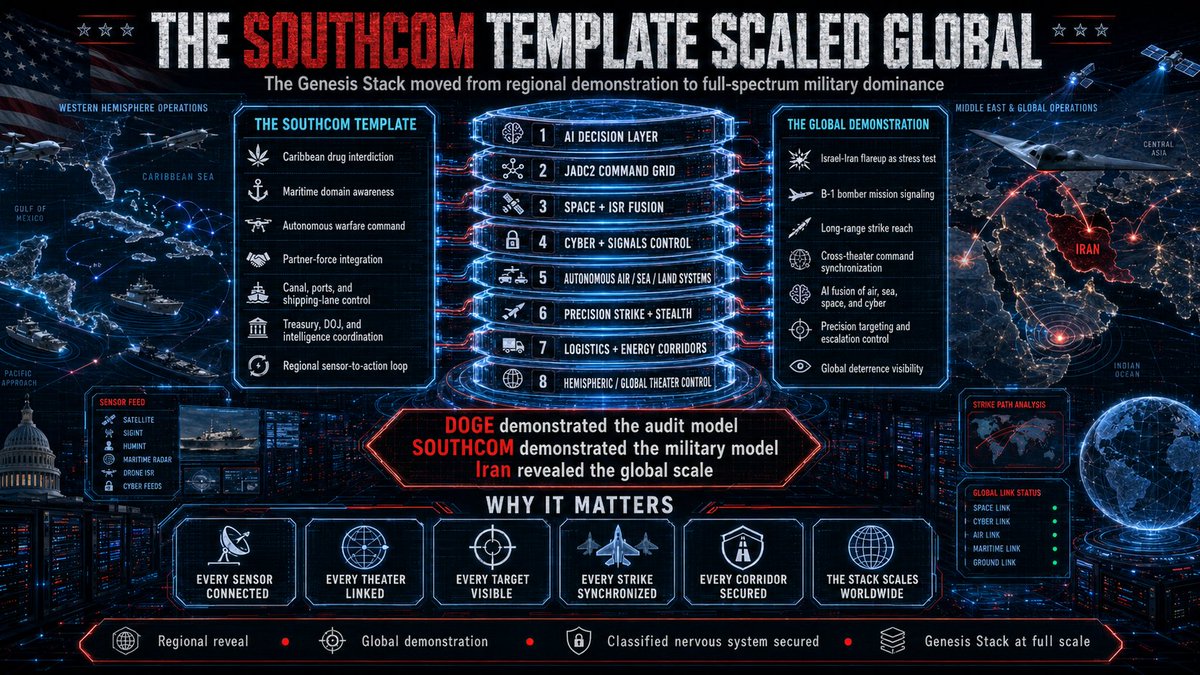
3/ Remember, I wrote about the Genesis Stack guiding the military... I started with the SOUTHCOM Template... let's peel this layer back some... This is the convergence point... DOGE demonstrated the architecture inside government, while SOUTHCOM demonstrates the same operating model across an entire theater... The SOUTHCOM Template was the military demonstration of the Genesis Stack... DOGE entered the civilian bureaucracy and proved the audit model... break the silos, connect the databases, map the owners, trace the money and expose the hidden architecture... SOUTHCOM runs that same model across the Western Hemisphere... Space assets (SpaceCom, Space Force, Starlink, etc.) create persistent awareness... cyber controls and protects the digital field... Maven, TITAN and AI fusion turn satellite, aerial, maritime and ground feeds into one operational picture... JADC2 moves that intelligence across land, sea, air, space and cyber... autonomous aircraft, vessels and human-machine teams carry the decision into action... I covered all this in great detail in prior posts/articles... Then the sustainment layers lock underneath it... logistics, energy, everything... Ports, airfields, the Panama Canal, shipping lanes, energy routes, communications, partner forces, logistics and supply chains... just to name a handful... Treasury "follows the money"... DOJ carries the legal authority... intelligence maps the network... the military isolates, interdicts and stabilizes the physical terrain... That is the full military stack... Sense, connect, understand, decide, act, sustain, and learn... NORTHCOM secures the interior... SOUTHCOM secures the hemispheric perimeter... Again, I write in great detail about these... I'll stop saying that now... The Genesis Stack connects both theaters to one national command architecture... DOGE was the audit demonstration... SOUTHCOM is the operational demonstration... NSPM-11 activates the intelligence layer... NSPM-12 secures the clouds, keys, access points and classified nervous system around it... to be redundant, need this to all be clear... Everything I've have been mapping converges here... The Western Hemisphere became the proving ground where the complete stack could identify the network, follow every movement, collapse the control structure and scale the model outward... SOUTHCOM has formally established an Autonomous Warfare Command spanning unmanned systems, AI integration, human-machine teaming and operations from the seabed through space and cyber... it showed recently in the autonomous boat drones in Iran... Its posture statement also connects maritime awareness, resilient logistics, space surveillance, cyber operations and interoperable partner systems... The wider military architecture is already defined through JADC2’s sense, make sense and act loop, supported by secure data infrastructure, automation and AI. TITAN processes sensor data from space, high-altitude, aerial and terrestrial layers, while Maven provides an operational AI software layer at scale... NSPM-11 orders advanced compute, AI exchanges across security enclaves and national-security mission development through the Genesis Mission... NSPM-12 establishes the cyber governance, cryptographic authority and system accountability protecting the architecture around it... To avoid repeating myself... this is the same system that also operates in the Middle East... think Israel/Iran and others... it's global... we see everything... More coming... stay tuned... now we move to the US again...
4
29
141
3,777
purchardus.6529 retweeted
$LUNR - In an interview with spacecom, David Israel (Space Internetworking Principal @Int_Machines) provided insights into Altus-1 the first lunar data relay satellite. Altus-1 is expected to be launched in Q4 2026 as a payload onboard IM-3 “Trinity”. Beyond communications, Altus-1 will broadcast positioning, navigation and timing signals creating a GPS for the moon. Altus-1 will take approximately 100 days to establish its intended orbit. Timeline: Q4 2026 - Deployment Q1 2027 - Establish Orbit Q2 2027 - Recurring Revenue to Start* *reflects an independent assumption Link: spacecomsecondstage.com/conn…
5
28
1,325
米軍の統合軍は現在11個。核のSTRATCOM、宇宙のSPACECOM、特殊作戦のSOCOM。その並びに「ドローン専門」が加わろうとしている。米上院軍事委員会が6月11日、12番目の統合軍を創設する条項を国防授権法案に盛り込んだ。
1
17
$Viasat is a global leader in satellite communications technology, providing broadband, mobile satellite services, and government/defense communication solutions across aviation, maritime, and land-based applications. Its stock surged over 18% today, closing at $72.71. Key Features & Advantages: The company benefits significantly from its vertically integrated satellite network, capturing market share particularly in defense modernization and the demand for global connectivity. Today’s sharp rise was driven by a broader recovery in the aerospace sector and expectations of potential large-scale contracts, highlighting the company's dual attributes of defensive stability and growth potential. Future Outlook: Long-term growth is driven by the convergence of 5G/6G with satellite technology and efforts to bridge the global digital divide, while government contracts ensure stable cash flow. Catalyzed in the short term by aerospace-sector momentum and supported by a solid long-term upward trend, the company represents a compelling investment opportunity in satellite communication infrastructure. #VSAT #Viasat #SatelliteCommunications #DefenseSat #BroadbandSat #SpaceCom
97
michael mcconnell retweeted
🚀🌕 New SpaceCom Second Stage magazine issue - MoonBound! The future of the Moon is no longer about getting there. It's about staying. 📖 Read the issue: spacecomsecondstage.com/ #MoonBound #MoonBase #SpaceCom #SecondStage #CommercialSpaceWeek
1
6
243
michael mcconnell retweeted
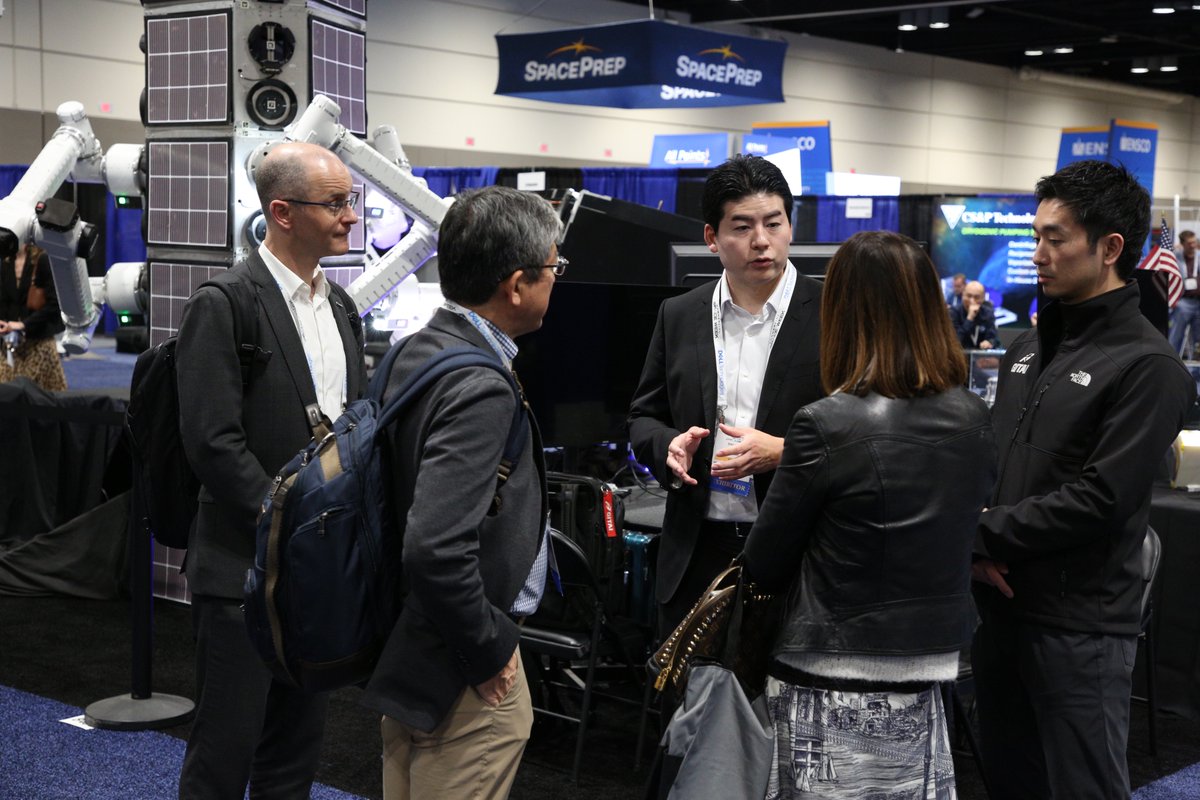
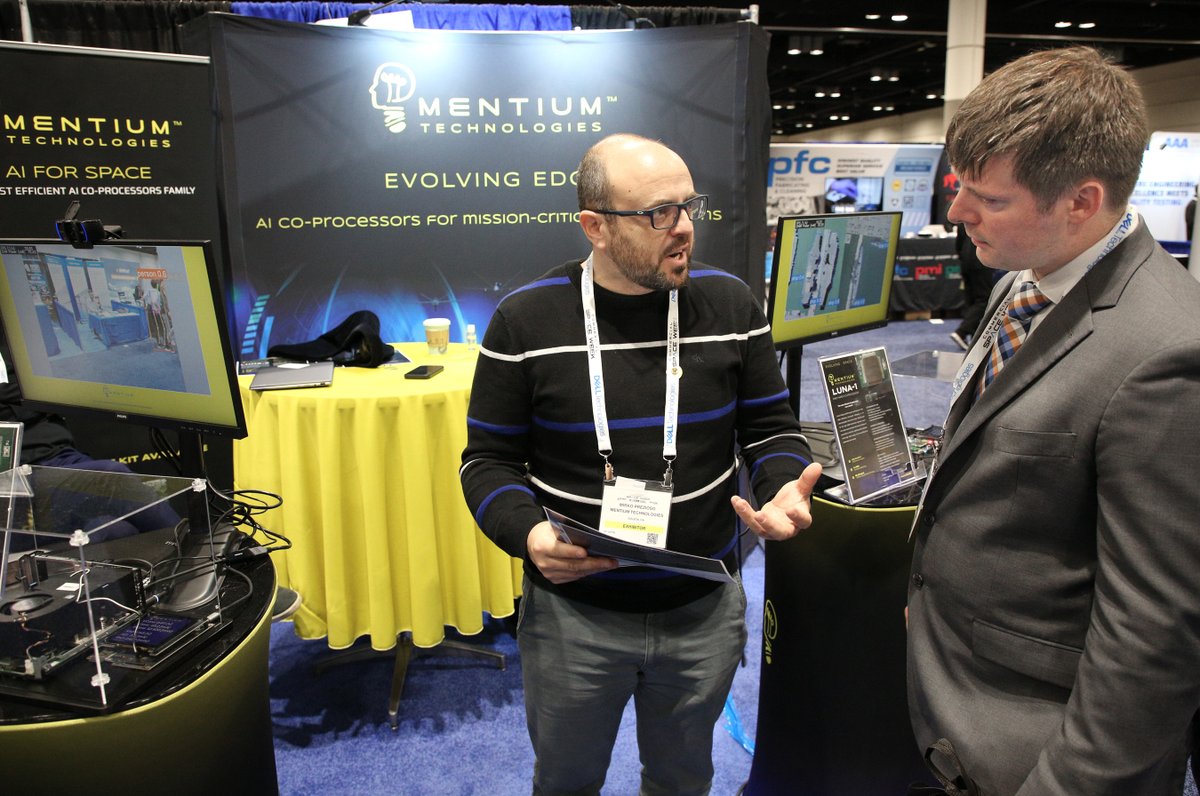
“The level of brainpower in one place was unreal. SpaceCom continues to prove why it’s a cornerstone conference for the space ecosystem - builders, operators, innovators, and decision-makers all under one roof." – 2026 Post-show Survey response 📅 January 11-14, 2027
1
3
125