
May 12
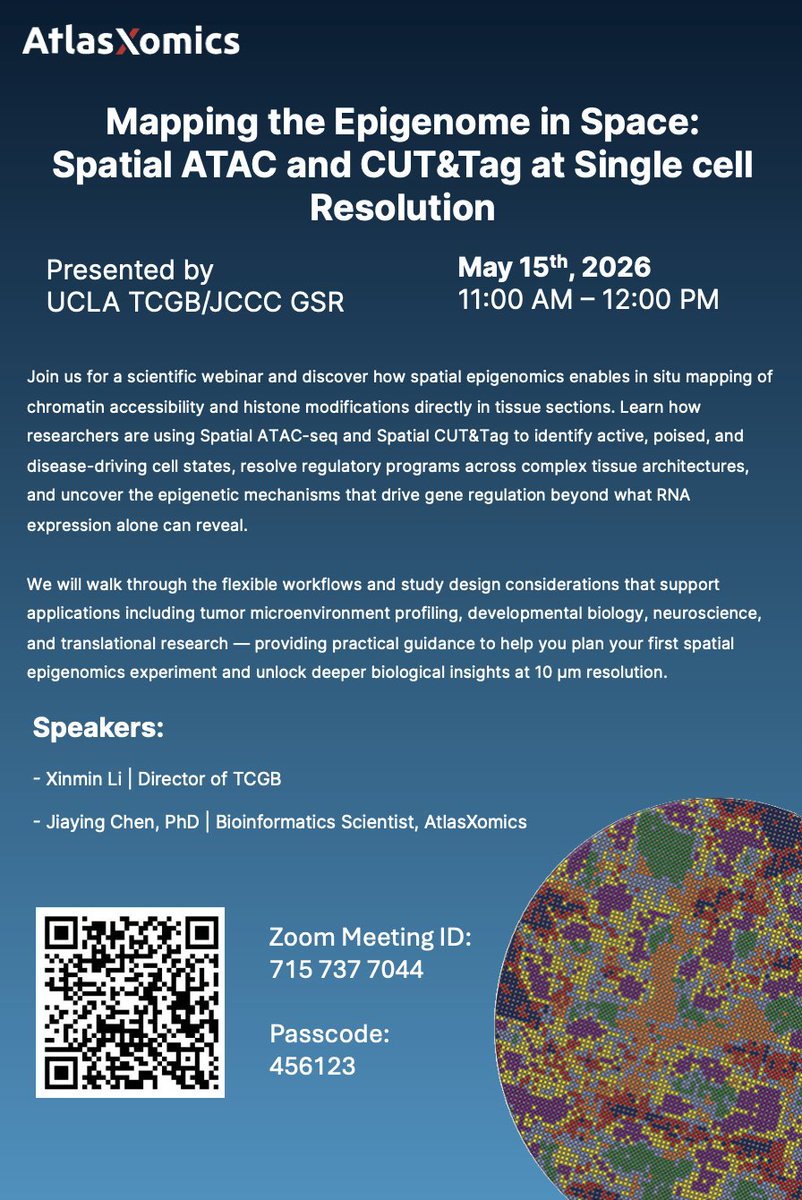
Excited to share that we’ll be speaking at the upcoming UCLA TCGB/JCCC GSR seminar on spatial epigenomics and spatial multiomic assays!
We’ll discuss how Spatial ATAC-seq, Spatial CUT&Tag, Spatial CoProfiling (RNA ATAC), and Spatial ATAC-TAPS (ATAC DNA methylation) enable in situ mapping of gene regulation directly in tissue context at 10 µm resolution.
Looking forward to connecting with the @UCLA research community and discussing applications in cancer biology, neuroscience, and translational research.
📅 May 15, 2026
⏰ 2:00 PM – 3:00 PM ET (11:00 AM – 12:00 PM PT)
📍 UCLA TCGB/JCCC GSR Seminar
Thank you to Dr. Xinmin Li and the UCLA TCGB/JCCC GSR program for the invitation! @UCLAJCCC @UCLA_Pathology
#SpatialBiology #SpatialMultiomics #Epigenomics #SpatialATAC #CUTandTag #DNAMethylation #AtlasXomics
3
381
Feb 4
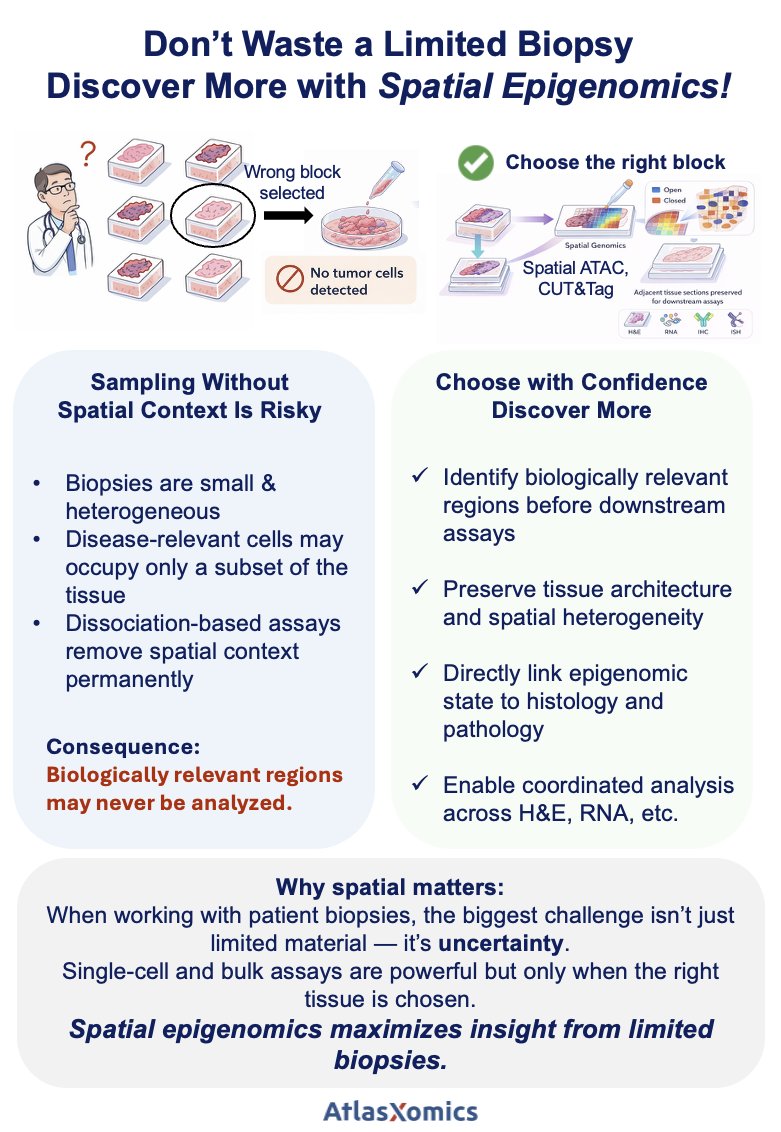
Maximizing Insight from Limited Biopsies with Spatial Epigenomics
Working with patient biopsies? The biggest challenge isn't just limited material—it's uncertainty about what you're actually sampling.
Traditional dissociation-based approaches permanently remove spatial context, risking the loss of rare, disease-relevant cell populations that may occupy only specific tissue regions.
Spatial epigenomics offers a solution:
Use H&E on adjacent sections to identify tissue blocks with tumor or critical features, then perform coordinated spatial epigenomic profiling assays on the same block. Because the tissue architecture is preserved, epigenomic signals can be interpreted alongside histopathology, enabling direct links between regulatory state and tissue morphology. This coordinated approach ensures you're profiling disease-relevant regions while preserving tissue for validation—no guesswork, no wasted material.
Make every biopsy count. Let's discuss how spatial epigenomics fits your workflow.
#SpatialEpigenomics #CancerResearch #Biopsies #Pathology #Oncology #SpatialATAC #SpatialGenomics #SpatialBiology #SpatialOmics #BiopsyAnalysis #TranslationalResearch #PrecisionMedicine
6
441

6 Jan 2023
#spatialATAC integrates transposase-accessible #chromatin profiling in tissue sections with barcoded solid-phase capture to perform spatially resolved #epigenomics. #Bioinformatics
Solid-phase capture and profiling of open chromatin by spatial ATAC nature.com/articles/s41587-0…
5
11
739