

2 Aug 2024
These kinds of diagrams always so satisfyingly tactile
1
2
294

15 Jun 2024
ugh, I forgot to attribute. It's from Locatelli Nunes' PhD thesis
5
236


15 Mar 2024
It's an adaptation of Marsden @StringDiagram and Nakahira's work. The lower wire is an expression in a locally small category C and the upper x wire is a hom-functor and the Phi is a generic functor C->Set. The semicircle on the right represents the identity as a set element, 1->C(x,x). The box on the functor wires is a natural transformation.
3
346

@viercc you'll like this, since it connects to why parametrised monads are endofunctor-enriched categories!
2
149

16 Nov 2023
I've been experimenting with Idris implementations of free PROPs and free(ish) monoidal categories at the Monoidal Cafe.
Would be happy to send a discord invite to anyone who wants to join in and chat about applications :D
2
99


5 Nov 2023
I remember seeing @NicolaPinzani do it; I think that’s made with tikzit and lots of love
1
5
153

21 Oct 2023
I would be similarly delighted. Good to see more string diagrams out in the world.
1
1
764

This may be more convenient for capturing universal properties, as it is more symmetric than the kind/type/term interpretation. However, both approaches should generalise to arbitrary dimensions (either by giving each kind a type, or by introducing rewrites between rewrites).
1
2
38
By the way, I gave a talk last year with a similar motivation (i.e. "view kinds as objects, types as 1-cells, terms as 2-cells"). You can see the slides here: arkor.co/files/A 2-dimensi…. (I had intended to share my slides much earlier, but it just occurred to me that I never did.)
2
3
66

31 Aug 2023
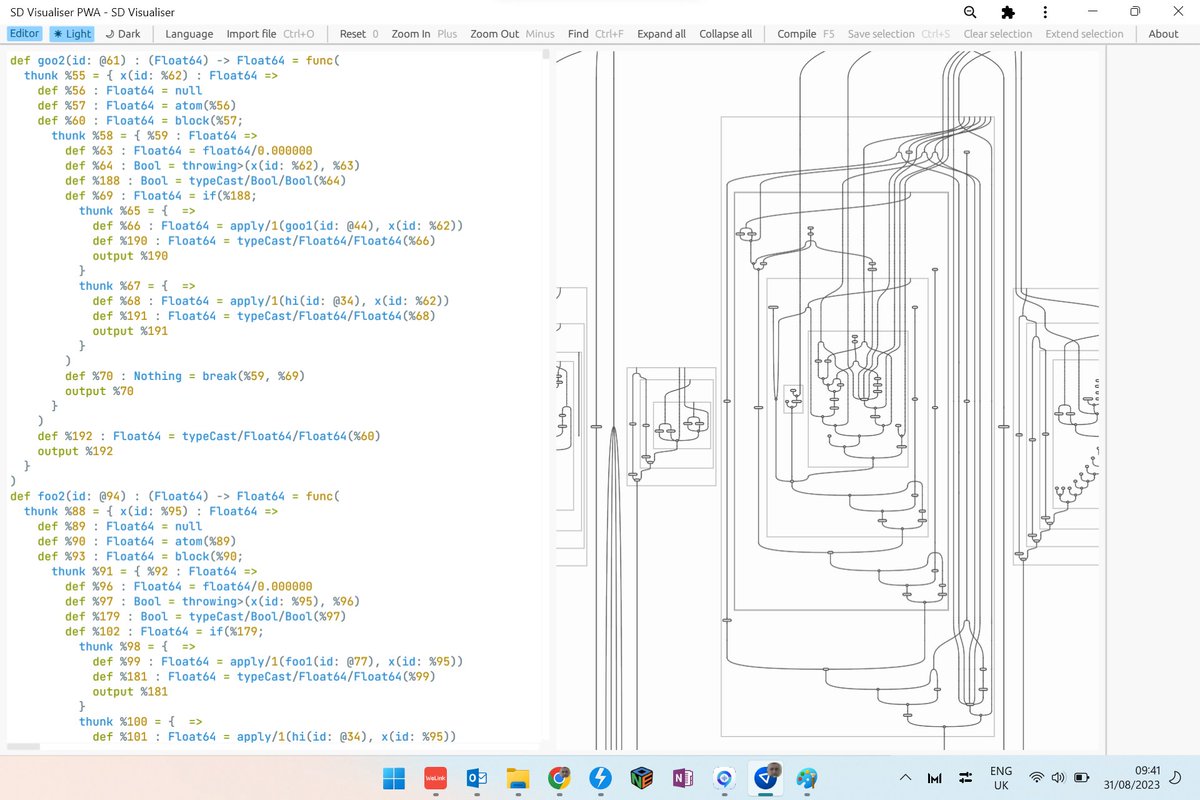
Beautiful #stringdiagram visualizer for cartesian closed categories, from the people who brought you Homotopy.io (Nick Hu, Alex Rice, and Calin Tataru). It can display and navigate very large terms, both in their textual and graphical form.😍
sdvisualiser.github.io/sd-vi…
2
15
71
8,141
