
you can get the upper arms without steroids. forearms are a lot of genetics but also many people undertrain them. I have genetically small forearms myself but my upper arms got jacked
1
101
Greg retweeted

Jun 10
Most people overbuy weight…
And undertrain consistency.
Fix both 👇
fitwithgreg.com/best-adjusta…
#FitnessMindset #StrengthTraining
1
20

The traps r super cool too!! I kinda undertrain them tbh
20

Most women don’t undertrain because they lack effort. They undertrain because they cram all the work for one muscle into one day, then wait a week to train it again. Volume matters, but distribution matters too. Think watering a plant: timing counts. What does your weekly split
2

May 20
Training them properly builds real functional power for pressing, pulling, and daily life while boosting testosterone response and overall metabolism. Most guys skip or undertrain them and stay stuck looking average.
1
25
6,968

This. Training is the stimulus, recovery is where the adaptation actually happens. A lot of guys don't undertrain, they under-recover.
Eat enough calories & protein every 3-4 hrs, 7-9 hours of sleep and give at least 48h before smashing the same muscle group again.
If you're constantly sore and progress has stalled, most of the time it's your recovery that's off.
2
5
94

You’re right and the bodybuilding magazine industry built itself on the muscle confusion marketing because variety sells subscriptions in a way “do the same three lifts for ten years” doesn’t.
The science is on your side. Hypertrophy is overwhelmingly driven by mechanical tension, proximity to failure, sufficient volume, and adequate recovery. The specific exercise menu matters far less than the consistency and intensity applied to whatever menu you pick. Powerlifters with two or three movements grow real muscle. Olympic lifters with even fewer grow real muscle. The “you need 27 angle variations” pitch is content economics dressed up as physiology.
The angle I’d add for the audience reading this. The argument you’re making is the right one for the intermediate-to-advanced lifter who’s already in the gym. For most people scrolling past this, the gap isn’t between “train one exercise” and “train ten variations.” It’s between trains and doesn’t train. Confusing the muscles is a problem for the 10 percent of the population that lifts regularly. Using the muscles at all is the problem for the other 90.
The honest version of the advice is the boring one. Start lifting. Pick a few compound movements. Add a few isolation movements for the muscles those compounds undertrain. Use strict form. Take the sets close to failure. Eat enough protein. Sleep enough to recover. Repeat the same protocol for years. Confusion is unnecessary. Showing up is everything.
The skeletal muscle you build between now and 50 is also the metabolic insurance you carry into your 70s. It’s not just an aesthetic project. It’s a glucose disposal organ, a hormonal regulator, an injury insurance policy, and a longevity tool. The people who build it consistently with boring inputs end up healthier in measurable ways across the panel and the wearable. ApoB tends to fall. Fasting insulin tends to fall. HRV tends to rise. Resting heart rate tends to fall. Sleep gets better. Everything connected to skeletal muscle quality moves in the right direction.
Variety isn’t the prerequisite. Showing up is. Keep coming back. The body adapts to whatever shows up most reliably.
Don’t wait for the diagnosis.
Read the label.

Joe Weider once said, “to keep your muscles growing and changing, you must confuse them.”
If you think about it it’s kind of a ridiculous concept that your muscles need to be confused and to some degree is quite laughable.
Although I understand what he was trying to get at. When you start to see stagnation, you beee to change things up.
And you will hear a ton of anecdotes that in bodybuilders and strength athletes when a movement gets “stale” adding a variation…changing up the rep ranges…modifying it in some way, seems to allow for continued progression
But the intention of Joe Weider’s quote was more marketing than anything so he can produce more content for the magazines with the new fitness programs and the exercise of the week to help grow your bi’s and tri’s
The whole muscle confusion concept is really nonsense when it comes to hypertrophy. No different than our powerlifting friends who perform 3 movements and our Olympic Weightlifting friends who perform 2 movements.
Unless you are an elite level bodybuilder there really is no need to get granular and hit different exercises that hit slight variations of a muscle that you can closely target with a compound or isolation movement.
For the avg gym goer looking chasing hypertrophy…you really only need to pick a few (2-3) different exercises per body fat…train with strict for…executive them at full range of motion and train at or close to failure. The rest of it comes down to recovery and what happens outside the gym.
Not changing up your routine week to week and chasing variety for the sake of variety.
So next time you see your favorite fitness influencer on IG performing some crazy ass exercise that you never saw before, telling you how effective it is to help X body part, 9 times out of 10 he is completely full of shit and just trying to create “unique” content for likes and clicks.
1
5
738

9. Compound lifts build most of your foundation: Squats, Bench, Overhead Press, Pull-ups, Dips. Add isolation work for what compounds undertrain.
10. Lift at the same time of day, every day. Consistency beats "optimal." The body builds the habit faster when the time is locked in.
1
15
11,548

May 12
A gradual progression works best. Better to undertrain than overtrain. #RunWithHal

1
30
1,270

May 12
Five pounds of added muscle runs roughly 50 calories a day at rest, every day, for years. The cardio hour ends when the session does.
Most operators undertrain strength because the watch number on cardio looks bigger.
4
1,865
May 11
A gradual progression works best. Better to undertrain than overtrain. #RunWithHal

3
2
73
4,672

You can’t underpay, undertrain and undervalue people then blame them for underperforming. That’s a system problem…
1
4
311

The brain doesn't reward a good fold the way it rewards a hero call, so people undertrain the most EV skill in the game.
2
172

May 2
This is solid but I'd bump legs to 3x if you can handle it. Most people undertrain legs relative to how much volume they can actually recover from.
1
6
1,419

Apr 24
Most people overtrain their mirror muscles and undertrain everything behind them.
Chest. Biceps. Quads.
All of it - front loaded.
The result:
- Rounded shoulders
- Forward head posture
- Lower back that always feels off
- A physique that looks decent from the front and falls apart from the side
Balance your pulls to your pushes.
Train your posterior chain like it matters.
It does.
3
1
24
3,442
Apr 17
While getting in shape, a gradual progression works best. Better to undertrain than overtrain. #RunWithHal

1
33
1,192

Apr 14
I'm not sure I agree with this. Flexibility is good, but stretching is training, & most people either overtrain or undertrain.
1
2
166

Apr 14
Remind me if since research I did in the OpenAI param golfing recently, you want to be able to grow the network as you train it, so the net is like kept on the frontier, it's kind of my dream to be able to get something like that so just slowly increases in size as you train so it keeps kind of in this Pareto optimal scaling law aware frontier as you go on training it.. I don't want to have to think about size upfront or have it catastrophic forget or undertrain because it's too big to start with etc
2
223

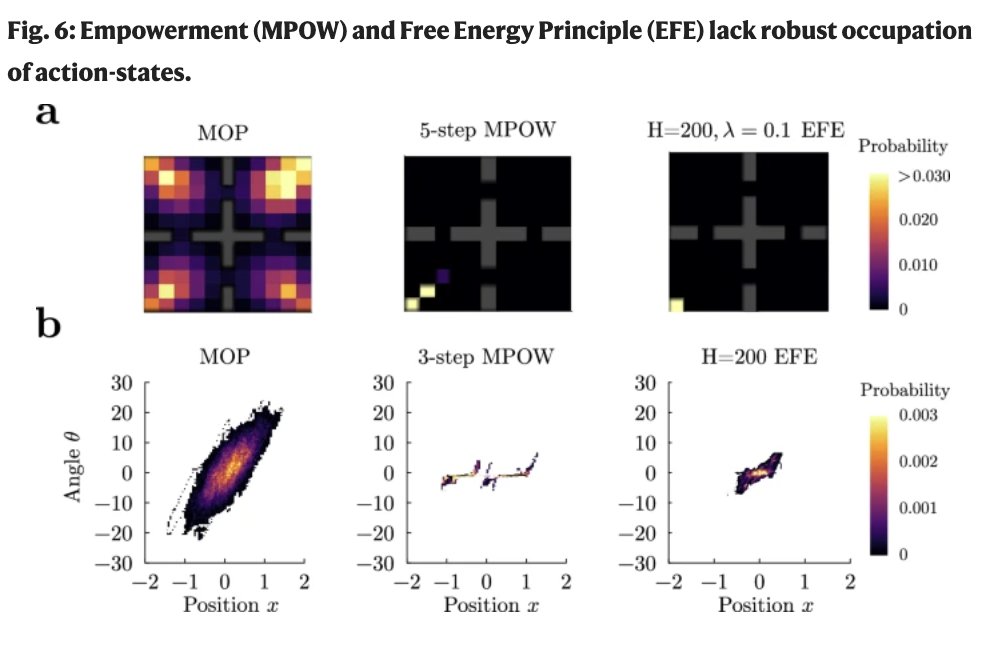
Found a paper that suggests we may have spent years training agents to become hunters of proxy reward when the more basic thing intelligence craves is not a reward at all, but to not run out of viable futures.
The paper proposes that behavior is best understood as maximizing future action-state path occupancy, which collapses mathematically into a discounted entropy objective. The agent doesn’t necessarily want to GET something, but rather is trying to keep as many meaningful trajectories alive as possible.
The obvious objection is “so it just does random shit? fuck around and find out?”
No, this is where it gets pretty beautiful. The agent is variable when variation is cheap and becomes surgically goal-oriented the moment an absorbing state (death, starvation, falling over, etc) gets close enough to threaten its future path space.
Variability is the same drive as goal-directedness, just operating under different constraints.
The demos are kinda wild:
- A cartpole (classic move a cart to keep a pole from falling control task) that doesn’t merely balance but dances and swings through a huge range of angles and positions because why not? The whole point is occupying state space, and rigid balance is a voluntarily impoverished life.
- A prey-predator gridworld where the mouse PLAYS with the cat, teasing it and using both clockwise and counterclockwise routes around obstacles to lure it away from the food source before slipping in to eat, using both routes roughly equally. A reward-maximizing agent would collapse to one strategy and exploit it. Here, the agent keeps its behavioral repertoire
- A quadruped trained with Soft Actor-Critic and ZERO external reward that learns to walk, jump, spin, and stabilize, and then makes a beeline for food only when its internal energy drops low enough that starvation becomes a real threat
The thing that hit me hardest is the comparison to empowerment and free energy principle agents. Both collapse to near-deterministic policies with almost no behavioral variability. This paper’s agents find the highest-empowerment state and exploit it. FEP agents converge to classical reward maximizers.
As far as I’m aware, this is the only framework that produces agents you could describe as being “alive.”
The AI implication here is that we undertrain for behavioral repertoire. Most systems hit the benchmark by collapsing onto a narrow attractor basin of good-enough trajectories. They’re competent for sure, but brittle too, with one viable plan, executed until the world shifts and leaves them with nothing.
The thing I increasingly want from agents isn’t competence per se, but option-preserving competence.
I want agents with the ability to keep multiple viable plans alive and switch between them without catastrophe.
We’ve been so focused on teaching agents what to want that we never stopped to ask what happens if wanting isn’t the point, if the deepest drive isn’t necessarily toward anything, but away from the walls closing in.
paper: nature.com/articles/s41467-0…
77
131
1,092
71,460