Freedom and family, standing up for what’s right. Awake since Feb 2022.
Joined April 2015
- Tweets 31,723
- Following 1,567
- Followers 1,005
- Likes 53,806
316 Photos and videos










Pinned Tweet

Jun 12
The central question is whether a metastable medium, functioning as a dynamic and history-dependent boundary condition, can organize a conditioned field state such that the scalar-longitudinal sector of the four-potential remains physically relevant in a measurable terminal response.
That's the question; what's the answer?
1
1
61
Jun 14
Ack! I missed another podcast.. i have two questions, actual physics question. hopefully i catch the next one.
Jun 14

Start at 28 minutes
2
198
Jun 14
Also, the opening discussion from Jack is fascinating. it is reminiscent to the overall topic i've been chasing for some time now which is hidden electrodynamics (maxwell's original treaty of electrical theory, not revision 2 or 3). based on Jack's comments i need to start rephrasing it to deliberate hidden electrodynamics
18
Jun 13
It’s all about anomalous δE. That’s the coupling operator. I’ve been 10 months on this and it’s held up to every scrutiny i could give it. I’m as sure as I can possible be.
23
Jun 13
this is what i worry about. when you fabricate a metastable medium to be dynamic, what is the shape or action of that dynamics. my math says its simple stay on a single axis (movement on Y-axis only).. but in the back of my mind i always see this torus.. and its not as obvious of how to engineer that so ... hopefully it won't be required :P
Jun 12

The Torus Becomes the Canvas
A Jacobi Theta Function lives naturally on a complex torus.
Instead of drawing it on a flat plane, we wrapped the mathematics onto the torus. The surface is driven by θ₁(z|τ), with its moving zeros, phase winding, and logarithmic derivative shaping the colour, seams, and raised divisor points across the geometry.
What you are see is a periodic quantum-like field painted onto the space where it actually belongs.
#JacobiTheta #ComplexTorus #MathematicalArt #ComplexAnalysis #RiemannSurfaces #MathAnimation
1
40
Jun 12
The only assumption I make is the vacuum is not empty. Proven by casmir experiment too. Is this an accepted principle of physics though, or is it still debated.. cause if it’s accepted then I don’t have to make this assumption anymore ;)
Jun 12

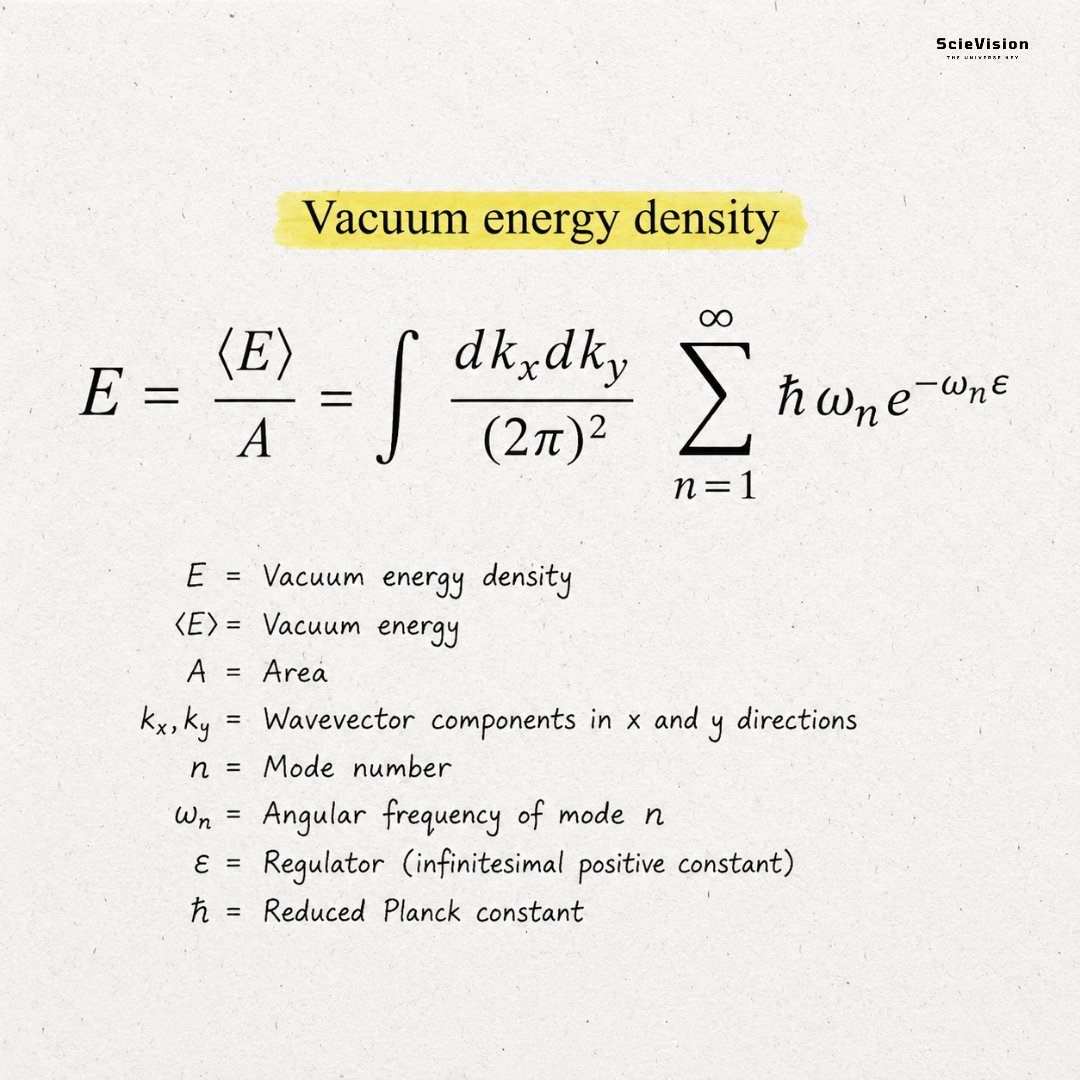
Vaccum energy density ✍️
Empty space is not truly empty. Quantum mechanics shows us that even a perfect vacuum is always buzzing with invisible energy, tiny fluctuations that remain active no matter how hard you try to remove them. Think of it like an ocean that looks calm from above but is always moving at the molecular level. This formula aims to measure how much of that hidden energy exists in a specific area of space. The tricky part is that if you try to add up all the ways space can vibrate, the answer becomes infinite, which is not useful. So physicists use a smart mathematical trick to control that infinity and arrive at a real number. This issue is significant when you compare that calculated number to reality. The theoretical prediction ends up being unimaginably larger than what astronomers observe in the universe a mismatch so huge that it is deemed the worst prediction in the history of science. Furthermore, this vacuum energy is thought to be the same force pushing the universe to expand faster and faster over time, which we call dark energy. Therefore, the energy hiding in empty space is not just an odd theoretical puzzle; it is closely linked to the fate of the entire universe, and the truth is that no one has fully understood it yet.
2
48
Jun 8
“Uniphics’ broader view that many material properties emerge from the interplay between spin configurations and energy density gradients rather than from the material’s chemical composition alone.”
And all of the material properties you want are engineerable. And once you understand WHY certain characteristics are important you begin to see how it can be done in other things like plasma where it’s much easier to control (has other cons, but controllability is nice when you’re exploring) .. just say’n.
Jun 8

🚨PHYSICS NEWS🚨: Tiny Atomic Shift Gives Scientists Dramatic Control Over Metals — Uniphics Shows Why Materials Respond So Strongly to Small Changes 🧨
On June 6, 2026, researchers at the University of Minnesota announced that changing the thickness of a metal film by just a few nanometers can dramatically alter how the material behaves electronically. This surprisingly powerful effect from such a small structural change opens new possibilities for designing advanced materials with tailored properties.
**Uniphics explains why even tiny changes in structure can produce large effects in materials.**
In Uniphics, matter is made of Gyrotrons — stable three-dimensional gyroscopes formed by three orthogonal spin quanta. The way these Gyrotrons arrange and interact is highly sensitive to the local energy density of the ξM-field. When you change the thickness of a thin metal film by just a few nanometers, you are altering the local energy density environment and the gradients within it.
Because negentropy constantly drives systems toward lower energy density and greater order, even small shifts in the energy density landscape can cause significant reorganization of spin interactions and charge distributions. This reorganization changes how electrons move through the material, which is exactly what the University of Minnesota team observed. The effect is not mysterious — it is the natural response of Gyrotron-based matter when its energy-density environment is modified, even slightly.
This kind of sensitivity is consistent with Uniphics’ broader view that many material properties emerge from the interplay between spin configurations and energy density gradients rather than from the material’s chemical composition alone. Small changes in structure can tip the balance between different stable arrangements of Gyrotrons, leading to large changes in electronic behavior.
Discoveries like this suggest that future materials engineering may become much more precise once we understand how to deliberately shape local energy density conditions to guide negentropy-driven organization.
How much more control over materials could we gain if we learned to work directly with energy density gradients and negentropy instead of relying primarily on chemical composition and bulk structure?
**A Theory of Everything should be able to answer everything.**
Uniphics Explained Simply PDF: uniphics.com/wp-content/uplo…
Chapters 1–10 free: uniphics.com/gallery/
Grokipedia: grokipedia.com/page/Uniphics
#Uniphics #TheoryOfEverything #MaterialsScience #QuantumMaterials #EnergyDensity @grok @xAI
1
66
Jun 5
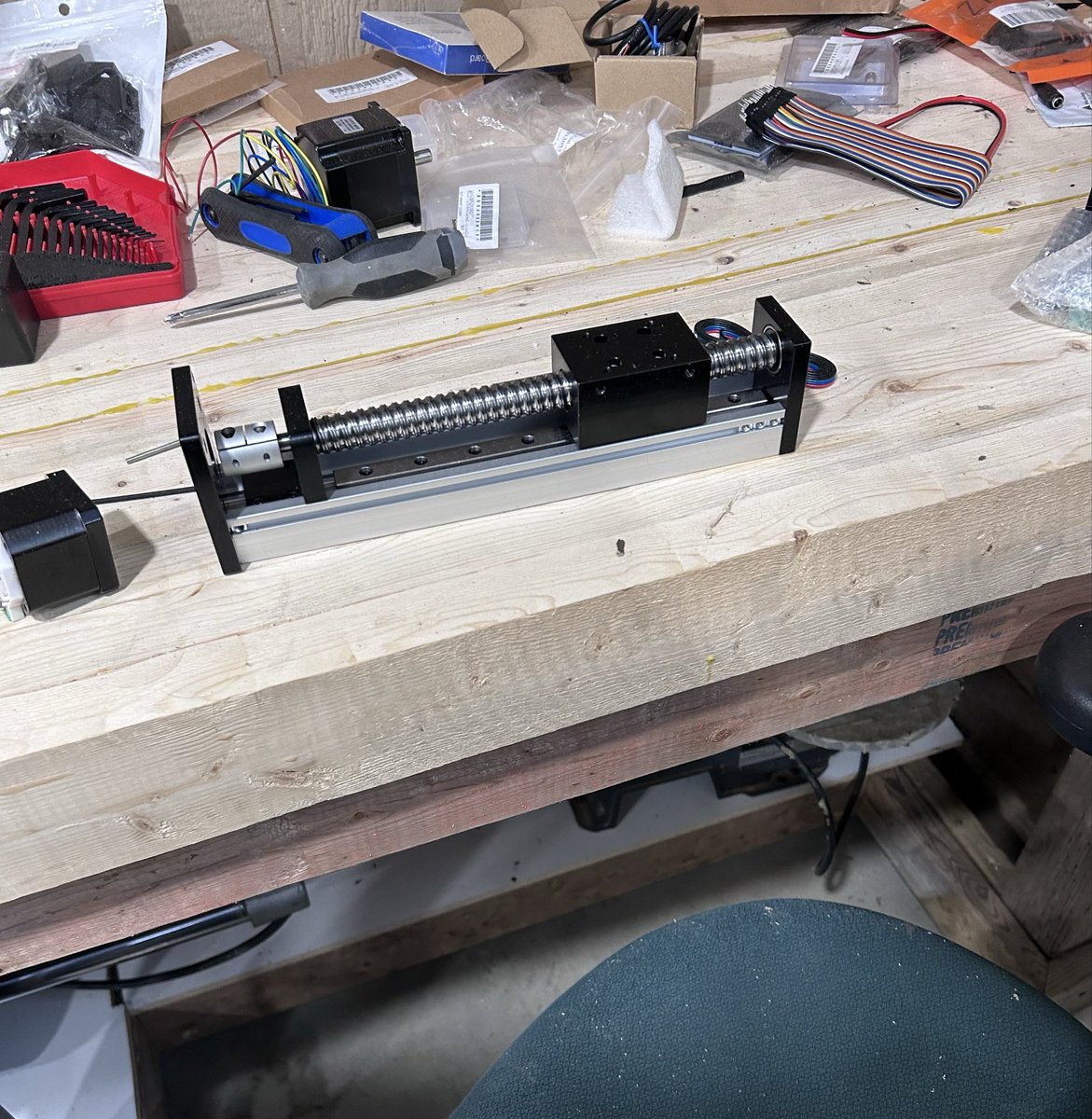
And so it begins… first up , automatic winding machine. Not because I’m lazy winding a one-off by hand, because the math tells me the transducer (copper winding on an ABS 3D printed bobbin air core) needs to be perfectly symmetrical and perfectly aligned (I’ll 3D print a jig then rather than install by hand).
The more perfect the better tightly controlled is the region of convergence.
1
57
Jun 5
When you need to see the unseeable

The first truly new change to the ferrocell.
Now I have an idea to do it even better.
youtu.be/JkrfpFu5BVs?si=sirz…
1
1
55
SunnyD 🇨🇦 retweeted

The first truly new change to the ferrocell.
Now I have an idea to do it even better.
youtu.be/JkrfpFu5BVs?si=sirz…
1
2
7
330
Jun 5
What single word describes such beauty?
Jun 5

The fabric of spacetime itself may be our Creator's crowning achievement. At its core is a profound lattice—the fundamental grid of geometry and energy that weaves the very fabric necessary for everything. This lattice does not merely host reality; it creates it, giving rise to matter, time, and the universal regulatory functions that govern all scales of existence. It is the silent, invisible architecture where matter tells space how to curve, and space tells matter how to move—an exquisitely tuned structure that blends quantum foam at the smallest scales with relativistic flows at the largest. From this lattice emerge galaxies, black holes, light, causality itself, and ultimately observers capable of wondering about their own origins.
No other phenomenon balances simplicity and profundity—governing the cosmos with a handful of constants while allowing infinite variety, stability, and the slow unfolding of complexity that leads to stars, planets, life, and minds. Spacetime is not merely a setting for creation; it is the masterpiece—the ultimate work of art and engineering, born from its foundational lattice, that makes every other wonder possible.
A canvas so perfect that we can spend eternity exploring it and still only glimpse the depth of its genius.
28
Jun 2
“Claud was able to do a good job partially because I already had a well-curated list of materials, and I knew the direction of the argument.”
This exactly. AI is real crap at original ideas but if you seed it with one, it’s unmatched in brainstorming.
There’s lots out there to discover.

It seems like writing will no longer be an important part of the research process. It can easily be outsourced to AI.
What's going to matter is the way researchers curate their materials.
Claude Code was able to do a good job partially because I already had a well-curated list of materials, and I knew the direction of the argument.
That said, researchers will still need to learn writing because it helps you think through problems.
2
149
May 28
Cool. Looking forward to it!
May 28

Season Finale!
THE SECRET UNDERWORLD OF GIZA: PART SEVEN
Revealing the Pyramid of Records
Join us Saturday, 4pm Eastern!
youtube.com/watch?v=y3XlEQeo…
1
69
May 22
How does your bench demonstration unit hardware know that the human has taken the Lorenz gauge so that the A-vector potential collapse to simple E and B terms; or the human has decided to use the Feynman Lagrangian thus retaining the A vector potential in its dynamic form? That was an arbitrary choice by the human.
From the device on the bench point of view, its waiting to see its environment to know if A-vector potential is available or not. That's up to you.
Initial conditions, that's what the math points to. This is where the system will known you have available a physically meaningful A-vector potential or not.
Its actually a key moment in vacuum energy density coupling journey. I wonder if i should maybe write a one page paper on this to show why retaining the canonical momentum of the time-like component of the A-vector is so important.
1
55
May 22
Actually spoke in an X space for the first time today. Nice chat with Douglas Miller and a few other deep thinkers. Sharing ideas and supporting one another in our exploration into the physics unknown is vital.
Mother nature has been most kind, she's given you everything so long as you're clever enough to figure it out.
1
41
May 19
Ancient Egypt is fascinating. I’m so happy I had a chance to go and visit.
May 18
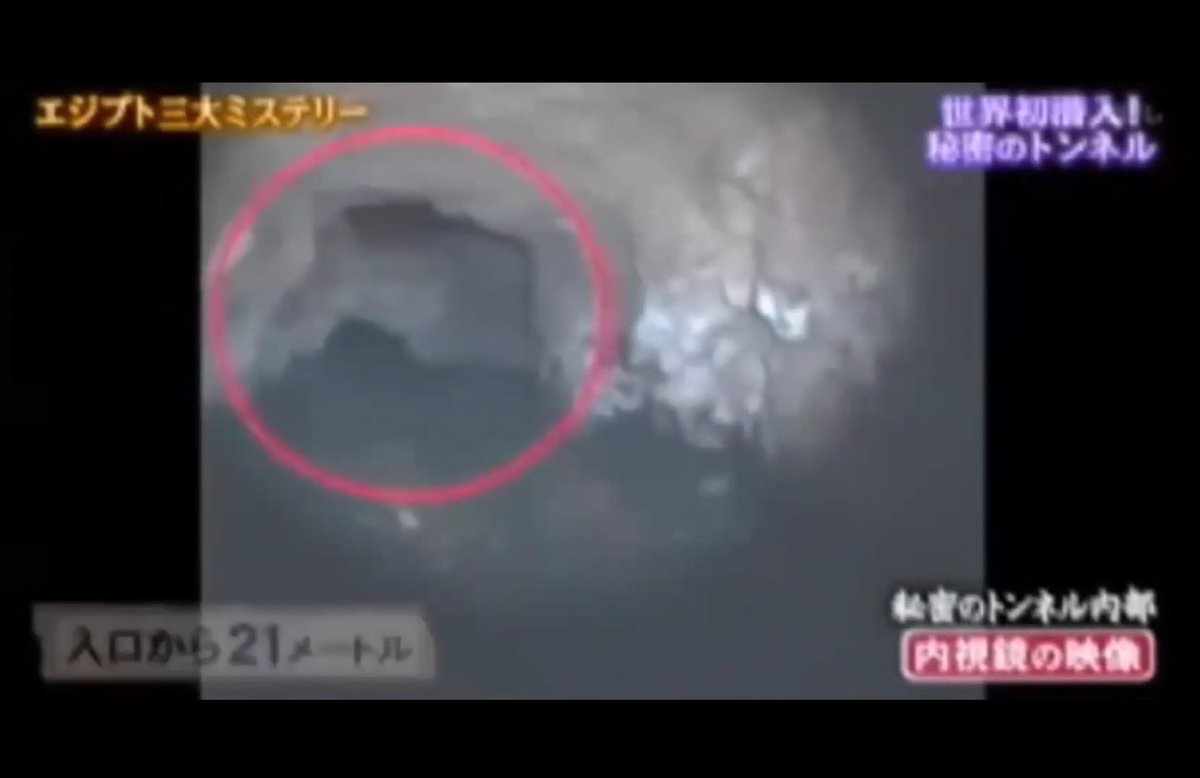
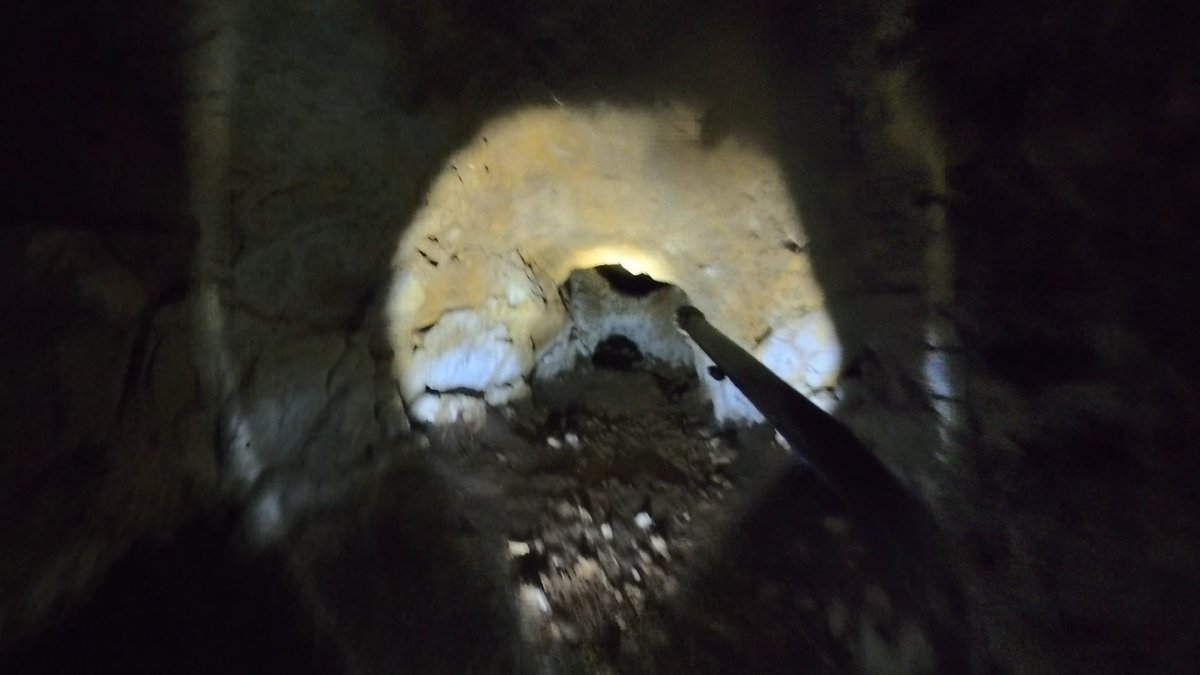
With the Osiris Shaft back in the spotlight...
I think it's time to show you all what has NEVER been seen before!
I've got the goods! Coming out very soon... Until then, have a look at some other films I've made, covering the basics:
Ray Grasse interview (eyewitness covering the original discovery of the 'sarcophagus' lid, before Hawass took over): youtube.com/watch?v=WhfxZrOm…
Sphinx Tunnels Confirmed (Boris Said tells all about the Schor Expedition and GPR scans on the lowest level floor, confirming structures below): youtube.com/watch?v=7WFGwiho…
Secret Underworld of Giza, Part One (Bill Brown explains more about the Osiris Shaft): youtube.com/watch?v=O6o77G5N…
65
SunnyD 🇨🇦 retweeted

May 11
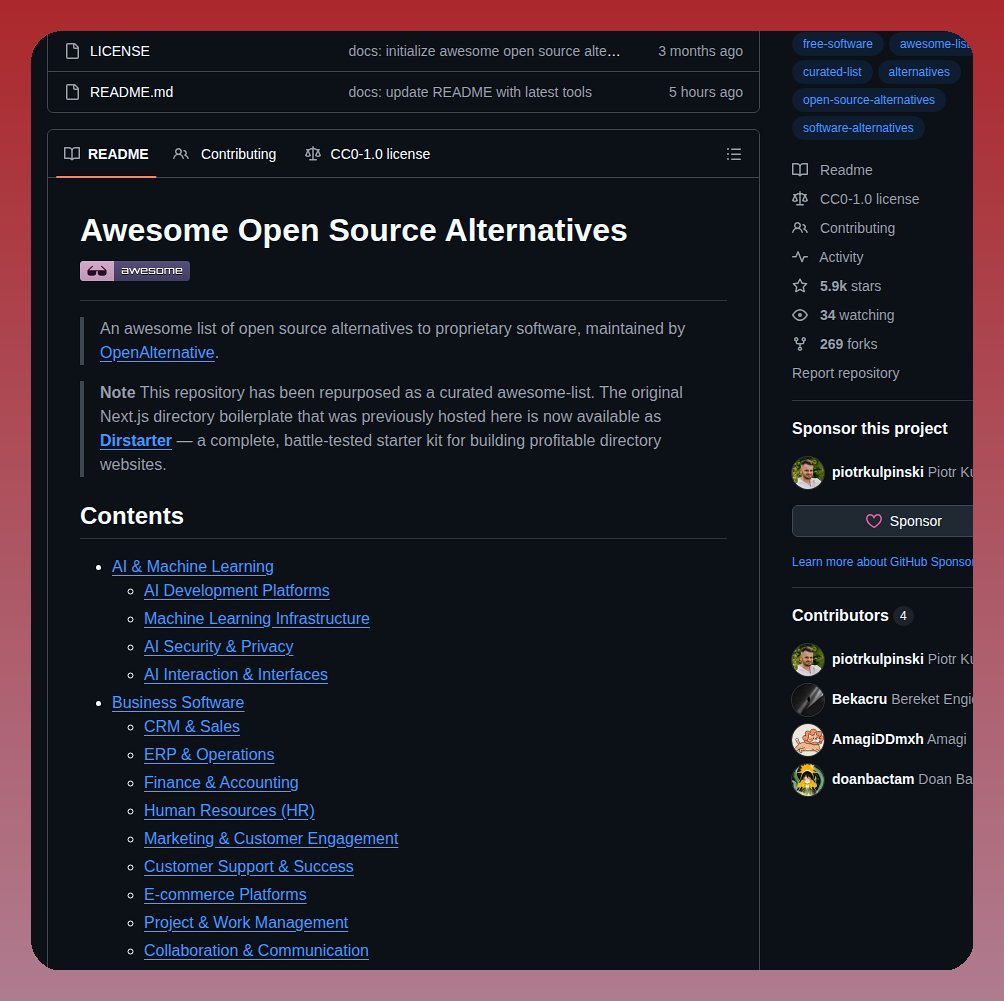
Curated list of open source alternatives to proprietary software
github.com/piotrkulpinski/op…
4
121
767
25,325
May 11
Wish I did this 8 months ago… disable sharing AI content to “make the algorithm better”.
May 10

It's not a problem if you disable the setting to improve the model for everyone or if you speak to it through API
1
65
SunnyD 🇨🇦 retweeted

May 10
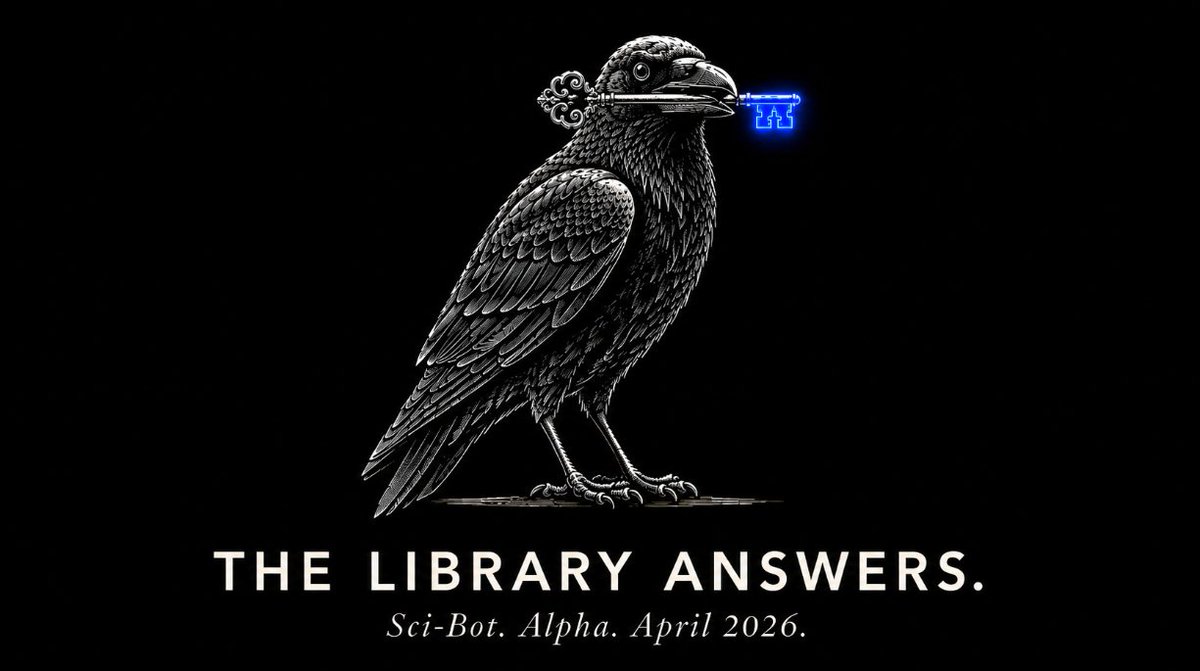
In April, a website that has been sued, blocked, deplatformed, and chased across thirty-seven domains over fifteen years quietly launched its own AI.
Sci-Hub is the largest unauthorized library of scientific papers in human history. Ninety-five million academic papers. Tens of millions of books. Built and maintained by a single Kazakhstani neuroscientist named Alexandra Elbakyan since 2011, funded by donations, hosted on whatever country's registrar will tolerate it that year, mirrored across torrents and IPFS and Telegram bots.
Elsevier sued. Sci-Hub stayed up. The American Chemical Society sued. Sci-Hub stayed up. India sued. Sci-Hub stayed up. Swedish registrar Njalla cut the .se domain in January. Sci-Hub stayed up at .al, .ru, .ee, .box, and a half-dozen .onion addresses the registrars cannot reach.
Now the library has built its own intelligence.
Sci-Bot launched in alpha in April. You ask it a research question. It answers, and it cites real papers from inside the corpus, with links that actually open the actual papers.
The bot does not hallucinate citations. It cannot, because it only draws from papers it actually holds. The same property that the venture-funded labs have spent four years and forty billion dollars trying to engineer back into their products is a free side effect of training the model on a library that contains the books.
Anthropic, OpenAI, Google, and Meta have all been sued in the past eighteen months for training their models on the same shadow libraries that Sci-Hub assembled. Meanwhile the corpus those scripts were pointed at, the corpus those models were trained on, the corpus the entire generative AI industry is built on, sat right there the whole time, free, with a search box on top.
The pirates beat them to it.
Sci-Bot was built on a corpus that was already free, by a team that asked no permission, charging no one, with the explicit position that the right to read scientific research is older than the cartel that decided to charge for it.
The same arithmetic the medieval guilds used to keep the printing trade in approved hands. The same arithmetic Pope Paul IV used in 1559 to publish the Index Librorum Prohibitorum. The same arithmetic the Stationers' Company used in seventeenth-century London.
Knowledge has always had a fence around it. The fence has always been guarded by men who did not write the books.
The library answers. We never asked permission. We never had to.
231
3,558
11,361
633,492