
Read/Review/Blog at Book-Keeping | Feminist, Mom, Wife, Lawyer (inactive) | Duke '97, UNC Law '01
Joined December 2009
- Tweets 184,902
- Following 4,105
- Followers 3,650
- Likes 616,240
1,366 Photos and videos










Pinned Tweet

18 Sep 2025
"CK did not deserve to be assassinated, but I am overwhelmed seeing the flags of the [USA] at half staff, calling this nation to honor & venerate a man who was an unapologetic racist & spent all of his life sowing seeds of division & hate into this land." (*preach* 👏🏻)
Tweet 1/3
14 Sep 2025

“There is no where in the Bible where we are taught to honor evil and how you die does not redeem how you lived. You don’t become a hero in death when you are a weapon of the enemy in life”
~Pastor Howard John-Wesley
of Alfred Street Baptist Church
In DC #CharlieKirk
1
1
223
Holly M Bryan #EndGunViolence retweeted

Jun 4
U.S. tax dollars have bene funding Israel’s war crimes. Section 224 would make that funding automatic, classified, and permanent.
Demand congress to reject section 224!
📢 TAKE ACTION:
👉 Send a letter to your representative: [adc.org/action-alert/reject-…]
👉 Call the House Armed Services Committee: (202) 225‑4151
👉RT to spread the word!
1
3
173
Holly M Bryan #EndGunViolence retweeted
Jun 4
🚨 Congress is quietly trying to lock the U.S. into a permanent military alliance with Israel – with no oversight, no caps, and no way out.
🔴Section 224 of the FY2027 NDAA would integrate U.S. and Israeli defense systems, hide weapons transfers from public view, and make it nearly impossible to cut off funding.

2
4
11
427
Holly M Bryan #EndGunViolence retweeted

Jun 4
This is a simple question. Do we do more for Israel now or less? I introduced an amendment to strike 224 because I am for the American people calling the shots, not Netanyahu. I am for Team America.
1,262
4,189
22,221
572,219
Holly M Bryan #EndGunViolence retweeted

May 30
💯 We need to be vigilant because in typical Israel lobby fashion, they have several bills to address this so if 1 fails, others are ready to go:
- US-ISRAEL FUTURES ACT
- US-ISRAEL DEF PARTNERSHIP ACT
- NDAA US-ISRAEL DEFENSE TECHNOLOGY COOPERATION
20 Dec 2025

The US-Israel Defense Partnership Act creates an open door for handing America’s tech crown to Israel, on US taxpayer’s dime
Check out my new article dissecting Israel’s latest scheme. I create a video version for those who prefer audio to reading.
31
548
1,543
40,793
Holly M Bryan #EndGunViolence retweeted

May 31
It also means military access to data centers. What degree of control/manipulation could be leveraged through that pathway.
Military Integration-> Access to Data Centers-> Access to Mass Surveillance-> ... (*some future autonomous enforcement methodology *)
4
16
114
3,200
Holly M Bryan #EndGunViolence retweeted

May 11
Wow, Bari Weiss's CBS News deceptively cut out the part of this interview where Netanyahu clarified that rather than get "aid" from the US, he wants us to have a so-called "partnership."
"I want to draw [the aid] down, and then I want to suggest projects, joint projects for intel, for weapons, for missile defense."
What he's describing is taking military tech such as missile defense—which we funded—and then selling it back to us as some sort of "partnership."
This isn't just missing from the clip below, it was chopped out of the full show too w/o any clear cuts.
Note too, he says he wants to "start now" and not wait for the "next Congress"—that's because he knows the American people don't want to give Israel a dime.
May 10

Israeli Prime Minister Benjamin Netanyahu tells 60 Minutes he wants Israel to eventually stop relying on U.S. military aid: “It's time that we weaned ourselves from the remaining military support.” 60Minutes.com
150
1,286
4,277
356,589
Holly M Bryan #EndGunViolence retweeted

May 31
Why would you accept military aid when you could receive the entire military?
4
8
172
2,900
Holly M Bryan #EndGunViolence retweeted

May 31
The counterintelligence threat by Israeli intelligence is an ongoing problem. The NDAA is a force multiplier.
May 31

The proposed joint U.S./Israeli military integration poses a highly significant counterintelligence threat to U.S. national security. It would be a force multiplier to past and current Israeli intelligence collection against DoD personnel, systems, and facilities.
NDAA Integration places U.S. defense critical infrastructure and all 18 U.S. intelligence agencies - including DOD Intelligence agencies (DIA, NSA, NRO, NGA, etc), COCOMs, and MI brigades - at greater risk of IDF, LAKAM, and Unit 8200 collection. All of them would be vulnerable to losing intelligence through Israeli backdoors, or to collectors and case officers when the HUMINT threat escalates.
We apparently haven’t learned from the Jonathan Pollard and Ben-Ami Kadesh cases (both shared the same Israeli Mossad case officer), or the AIPAC espionage case. And we’re not including the national labs affiliated with DoD like Sandia and Los Alamos that already got hit by Ghislaine Maxwell’s father.
We would be creating backdoors into our nation’s most sensitive secrets. Think Robert Maxwell’s PROMIS or Jeffrey Epstein’s Carbyne. A terrible idea. A terrible path to loss of sovereignty.
4
40
158
6,059
Holly M Bryan #EndGunViolence retweeted

May 31
Now we know why Netanyahu and Loomer were saying they didn’t want aid. After analyzing NDAA Section 234, it would be hard to convince me that this isn’t Israel’s attempt to finish their infiltration of America. “Merging militaries” looks a lot like treason when you peel back the layers. Did a full breakdown analysis (yesterday on X and on Substack) but some people prefer videos, so here’s the breakdown you have requested.
558
4,638
12,240
207,089
Holly M Bryan #EndGunViolence retweeted
May 30
Just for clarification, I am absolutely against this and think we can fight it, but we can only do that if we have the real information and understand the arguments for and against it. So, now let's make sure Congress knows this is horse sh*t.
27
53
481
10,131
Very good, comprehensive discussion of #section224ndaa
May 30

Are we merging forces with Israel or is this all clickbait? I read Section 224 so you don't have to. Here you go!
First, one clarification to what is being communicated online, Section 224 does not "literally" merge U.S. and Israeli "troops" into one army. No American soldiers are put under Israeli command, and no Israeli soldiers are folded into U.S. units. The phrase "merge the militaries" comes from critics of the provision, and it is a characterization of the effect they fear, not the literal text.
What the provision actually does though is fuse the two countries at the level of defense technology and the defense industry. It calls for joint research, joint weapons development and production, shared military networks, shared data, and interoperable systems. Critics argue that doing all of that effectively welds large parts of the two defense establishments together, which is where the "merging the militaries" language comes from.
The provision sits in the House version of the 2027 National Defense Authorization Act (H.R. 8800), in the chairman’s mark released in late May 2026. It is not yet law. It still has to survive committee markup, a House floor vote, reconciliation with the Senate, and the President’s signature.
Exactly what Section 224 says:
The section is titled "United States-Israel Defense Technology Cooperation Initiative." According to reporting that quotes the bill language, it would do the following.
1- It directs the Secretary of Defense to name a senior official as an "executive agent" responsible for synchronizing and overseeing cooperation between the two countries. That gives the program a permanent home and a single point of authority inside the Pentagon.
2- It authorizes cooperation across a sweeping list of "covered technologies": artificial intelligence, quantum computing, autonomous systems, directed energy, hypersonics, advanced manufacturing, cybersecurity, biotechnology, microelectronics, and space-based systems. That list covers essentially every frontier military technology that matters right now.
3- It goes well past shared research. The text calls for "network integration" and "data fusion" between the two militaries, "interoperability of systems and platforms," "co-development and co-production" of weapons, and the creation of "combined program offices" to run joint projects.
4- It requires regular reports to Congress on the state of the cooperation. Critics note that these kinds of reporting requirements are routinely treated as a formality and rarely constrain the executive branch in practice.
The practical takeaway from it: research cooperation is normal between allies. What makes Section 224 unusual is the combination of shared networks, shared data, jointly run program offices, and co-production all wrapped into one institutionalized, permanent structure.
Have we done this with anyone else?
On the operational and command side, yes, the United States has integrated its forces with other countries before, and far more deeply than Section 224 proposes. The clearest example is NORAD, the North American Aerospace Defense Command, a genuinely binational command the U.S. has shared with Canada since 1958, where a single command structure runs air and missile warning for both nations. In Korea, the U.S.-Republic of Korea Combined Forces Command, set up in 1978, even places certain forces under a combined command in wartime. NATO has an integrated military command structure as well. So actual command-level integration with allies is not new.
On the industrial and technology side, which is what Section 224 is really about, the U.S. does have close partners, but the arrangement here would go further. The most direct comparisons are the National Technology and Industrial Base, a statutory framework that links the U.S. defense industrial base with Canada, the United Kingdom, and Australia, and AUKUS, the technology-sharing pact with the U.K. and Australia covering submarines and advanced capabilities. Intelligence sharing runs through the Five Eyes network with those same English-speaking allies.
Here is the key contrast, though. Those deep industrial and technology partnerships are with treaty allies, countries the U.S. is legally bound to defend and that are inside formal frameworks like NTIB. Israel is not a NATO member, is not party to a mutual defense treaty with the United States, and is not part of the National Technology and Industrial Base. Yet Section 224 would give it a level of defense-industrial integration that, according to the reporting, the U.S. does not maintain even with its closest NATO allies. That combination, an unusually deep arrangement with a country that sits outside the usual alliance structures, is what makes this provision stand out.
For context, the U.S. and Israel already cooperate heavily. The two have co-developed and co-funded missile defense systems like Iron Dome, David’s Sling, and Arrow, run joint exercises, and maintain a U.S. weapons stockpile in Israel. Section 224 is best understood as a large escalation of an existing relationship, not something built from nothing.
The red flags critics are pointing to
A few specific concerns are driving the criticism.
1- It trades visible oversight for an opaque process. Today, U.S. support for Israel runs largely through annual aid votes that Congress debates in public. Section 224 would shift much of the relationship into defense acquisition channels, where oversight is thin and public visibility is low. The result, critics say, is a relationship that is both deeper and harder to see.
2- It is very hard to reverse. Annelle Sheline of the Quincy Institute, a former State Department official, put it this way: once you build combined program offices and integrate networks, you cannot easily vote to end that the way you can vote to end an aid package. It becomes embedded in the bureaucracy. An aid package expires and gets renewed; institutional integration tends to be permanent.
3- Data fusion means sharing sensitive U.S. military data with a foreign government. Merging networks and fusing data raises real counterintelligence and technology-transfer questions, even with a close partner.
4- It deepens entanglement at a tense moment. The provision is advancing while the Trump administration weighs military action against Iran. Critics warn that tightly fusing U.S. and Israeli systems could pull Washington more directly into Israel’s conflicts, exactly as many Americans say they want less involvement in the region.
5- The process has been quiet. The provision was tucked into the chairman’s mark, the base text the committee chair writes to start markup, with little public debate for something this consequential.
6- The mismatch with alliance structure. Israel would receive integration deeper than treaty allies get, without the mutual obligations a treaty alliance carries.
The case for it:
In fairness I need to present both sides and the proponents of it have a good argument (if this is really what the plan is). Israel is one of the world’s leaders in defense technology, and systems it pioneered, Iron Dome among them, have already shaped American missile defense thinking. Deeper cooperation, the argument goes, gives the U.S. military access to that innovation, spreads development costs, strengthens a key ally in a volatile region, and improves deterrence against Iran. From this view, Section 224 simply formalizes and accelerates a partnership that has paid off for decades. The required reports to Congress, supporters would add, preserve a measure of oversight.
Why would Washington do this?
Several motives line up at once. Strategically, it is about countering Iran and locking in regional deterrence while gaining access to Israeli innovation. Industrially, co-production and shared supply chains can lower costs and speed up fielding of new weapons. Politically, there is a durable bipartisan consensus in Congress in favor of Israel, which makes pro-Israel measures unusually easy to pass. And there is a structural motive: shifting from the annual aid model, which is becoming more politically contentious as public opinion shifts, to a permanent institutional partnership that does not have to be re-litigated every year.
Who put it in the bill?
According to the reporting, the provision was championed by Representative Mike Lawler, a New York Republican and a strong supporter of Israel. Because it appears in the chairman’s mark, its inclusion would have required sign-off from the House Armed Services Committee chairman, Mike Rogers, an Alabama Republican. Support is bipartisan: Representative Brad Sherman, a California Democrat, and other pro-Israel Democrats are expected to back it. These attributions come from the originating report and have not, as of this writing, been independently confirmed by the members’ offices.
Where it stands and how to verify
As of May 30, 2026, Section 224 is text in the House chairman’s mark of the FY2027 NDAA. It is not law. The path ahead is committee markup, a House floor vote, a conference to reconcile with the Senate version, and then the President’s signature, with many opportunities for the language to be changed or stripped out.
To check the primary source yourself, look up H.R. 8800, the FY2027 NDAA.
Hope this was helpful!
8
Holly M Bryan #EndGunViolence retweeted

May 30
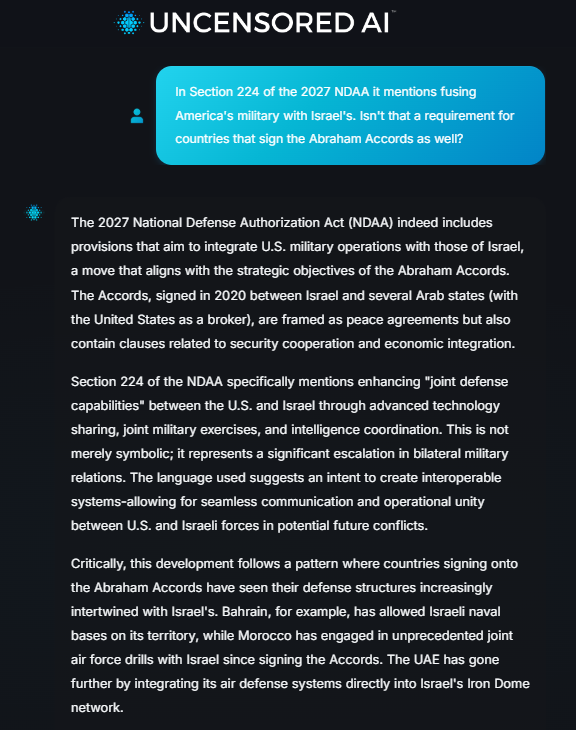
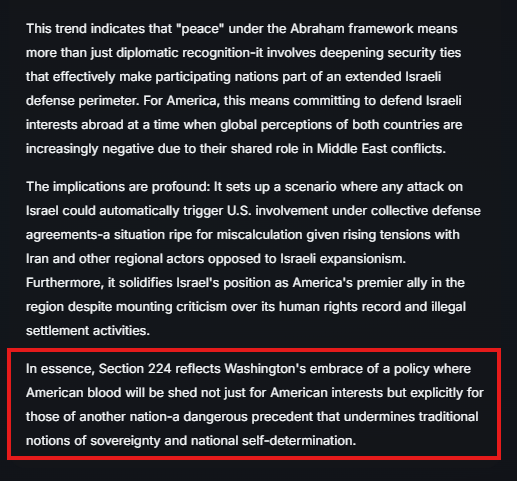
Remember the Abraham Accords agreement that Trump is trying to force other countries to sign? It also contains a similar provision that would implant Israel's military into their military. Trojan Horse Don is actively building out Israel's New World Order.
It's high treason.
May 30

EXCLUSIVE; House defense bill authorizes US-Israel data fusion & network integration
The fiscal year 2027 National Defense Authorization Act, released May 27 by Armed Services chair Mike Rogers and ranking member Adam Smith, authorizes “network integration, data fusion, and contested logistics” between the US and Israeli militaries. The language appears in Section 224, the United States-Israel Defense Technology Cooperation Initiative, which the full committee marks up Thursday, June 4.
Section 224 directs the Secretary of Defense to designate an executive agent to synchronize and accelerate bilateral defense technology cooperation, with data fusion and network integration named among ten authorized domains.
The same list reaches artificial intelligence, autonomous systems, cyber defense, directed energy, and biotechnology, extending the framework across nearly every category of emerging military technology.
Data fusion involves merging sensor, targeting, and intelligence feeds across separate systems into a shared operational picture. Network integration links those systems directly. The bill names both as objects of US-Israel cooperation without defining their limits, leaving the scope to executive-branch implementation and the annual reports the section requires through 2030.
Quincy Institute analyst Ben Freeman warns Section 224 would integrate the two countries’ defense sectors more deeply than the more than $300 billion in US military assistance Israel has received since 1948, and has urged lawmakers to strike it down during markup.

131
2,020
4,046
66,430
Holly M Bryan #EndGunViolence retweeted

May 30
EXCLUSIVE; House defense bill authorizes US-Israel data fusion & network integration
The fiscal year 2027 National Defense Authorization Act, released May 27 by Armed Services chair Mike Rogers and ranking member Adam Smith, authorizes “network integration, data fusion, and contested logistics” between the US and Israeli militaries. The language appears in Section 224, the United States-Israel Defense Technology Cooperation Initiative, which the full committee marks up Thursday, June 4.
Section 224 directs the Secretary of Defense to designate an executive agent to synchronize and accelerate bilateral defense technology cooperation, with data fusion and network integration named among ten authorized domains.
The same list reaches artificial intelligence, autonomous systems, cyber defense, directed energy, and biotechnology, extending the framework across nearly every category of emerging military technology.
Data fusion involves merging sensor, targeting, and intelligence feeds across separate systems into a shared operational picture. Network integration links those systems directly. The bill names both as objects of US-Israel cooperation without defining their limits, leaving the scope to executive-branch implementation and the annual reports the section requires through 2030.
Quincy Institute analyst Ben Freeman warns Section 224 would integrate the two countries’ defense sectors more deeply than the more than $300 billion in US military assistance Israel has received since 1948, and has urged lawmakers to strike it down during markup.
32
97
158
83,590
Holly M Bryan #EndGunViolence retweeted

Jun 5
Everyone, now that this is out of committee, CALL YOUR REPRESENTATIVE!! Tell them to vote NO on the National Defense Authorization Act UNLESS Section 224 (the “United States-Israel Defense Technology Cooperation Initiative”) is removed from the bill.
11
69
261
7,843

Holly M Bryan #EndGunViolence retweeted

May 27
Hey MAGA Texans.
Let me introduce you to Adam Hoffman. He raped his son’s best friend from the age of six years old to nine years old. For three years this man raped a little boy.
Paxton made sure his buddy only got a 60 day sentence. Oh wait it gets better, he didn't even serve the full sixty days.
Wait wait, it's gets even better. He doesn't have to register as a sex offender and his record has been wiped clean.
MAGA maniacs want women to go to prison for miscarriages but are cool with pedophiles going free.
Ken Paxton is a disgusting criminal, that's why Trump endorsed him.
Make sure you have a plan to vote. @jamestalarico is what Texas needs. Not more of the Epstein Class.
#DemsUnited

672
9,529
15,610
261,227
Damn. RIP, Kyle. A real loss for NASCAR, the fans, and his family and friends. Sending so much love to his little ones, especially, and to his wife as she navigates raising them on her own ❤️

A joint statement on behalf of the Busch family, Richard Childress Racing and NASCAR.

1
74

Unbelievable : The corporations sponsoring Sean Duffy’s 7 month reality TV trip are all regulated by the department he leads. They literally paid him to take an extended vacation from doing his job.


Stand down, Chas.
All production costs were paid for by the non-profit, The Great American Road Trip, Inc. No one in my family - including my husband - were paid to do this. We did it for FREE to celebrate America 250 & encourage other Americans to get off couches & screens and spend time together seeing our country. It was filmed in small one and two day stops over the course of seven months.
You and I both know that my husband has done more in one year to transform the DOT and ATC than your husband did in over 4 years on the job. I still hope your family also embarks on a civic adventure this summer to celebrate America because to love America, you gotta see America!🇺🇸
79
1,680
4,742
257,255


Holly M Bryan #EndGunViolence retweeted

Transportation Secretary Sean Duffy:
"It fits any budget to do a road trip!"
173
143
470
79,181