
Maintaining @testcontainers | Contributing to OSS | Automating builds, tests and infrastructures | Making devs happy | @ZEISS_Group | Docker Captain
Joined July 2014
- Tweets 188
- Following 70
- Followers 121
- Likes 192
8 Photos and videos



Pinned Tweet

14 Apr 2025
Super excited to join the @Docker Captains Program 🎉 Honored to see my work on Testcontainers for .NET (and soon Docker.DotNet) being recognized. Looking forward to contributing to Docker, .NET, and open-source projects with the amazing folks in the program :tc-love:
2
4
15
1,087
Andre Hofmeister retweeted
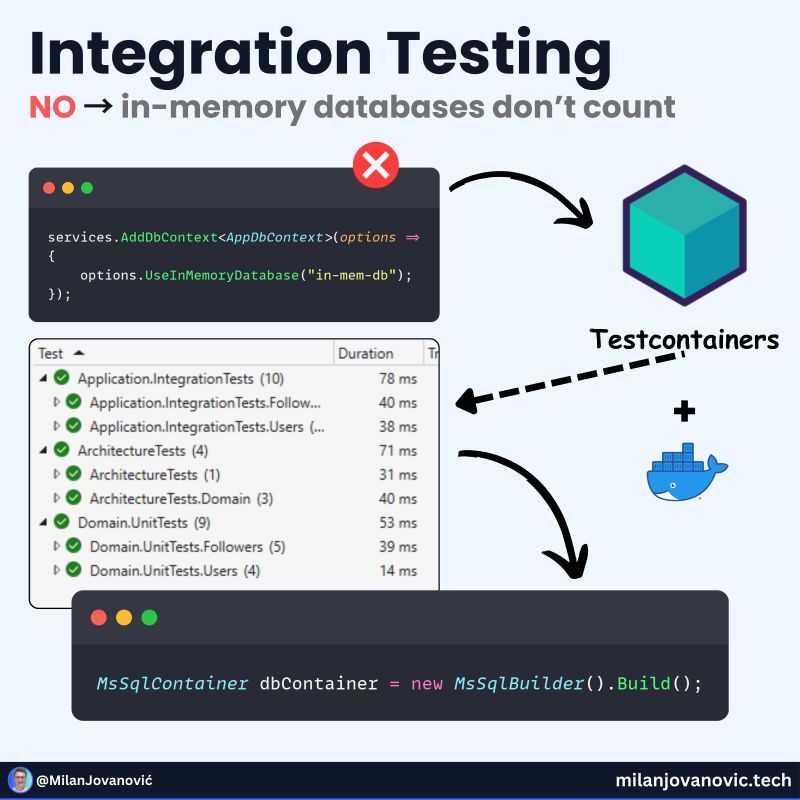
No - you aren't doing "integration" testing with an in-memory database.
At best it's a glorified unit test...
I've seen many examples using the EF Core in-memory provider.
This isn't an integration test because there's no real database.
Worse, this will fail to catch any LINQ or SQL bugs.
Here's a better approach:
- Use a real database or Docker container
- Connect to this database from your tests
- Write proper integration tests that have value
If you want to use Docker, I recommend exploring Testcontainers.
It lets you define throwaway containers in your tests.
What tools or methods do you use for integration testing?
5
17
94
4,671
Jun 8
Been leaning hard on Docker Sandboxes lately to keep secrets out of my agent environment, no tokens sitting in env vars waiting to leak 🔒.
Put together a spec.yaml workflow that auths against GHE Copilot a private NuGet feed: github.com/HofmeisterAn/dock….
1
3
200
May 19
Testcontainers for .NET 4.12.0 is out 🐳 This release ships a major version bump of our forked Docker.DotNet client, bringing a bunch of improvements made over the past months. Fingers crossed it's all smooth sailing for you 🤞: github.com/testcontainers/te….
3
30
1,675
Apr 26
Along with many stability and performance improvements, the new Docker.DotNet version is now AOT-compatible. Check out the release notes from version 4.0.0 onward. They include many great updates: github.com/testcontainers/Do….
2
4
176
Andre Hofmeister retweeted

Mar 14
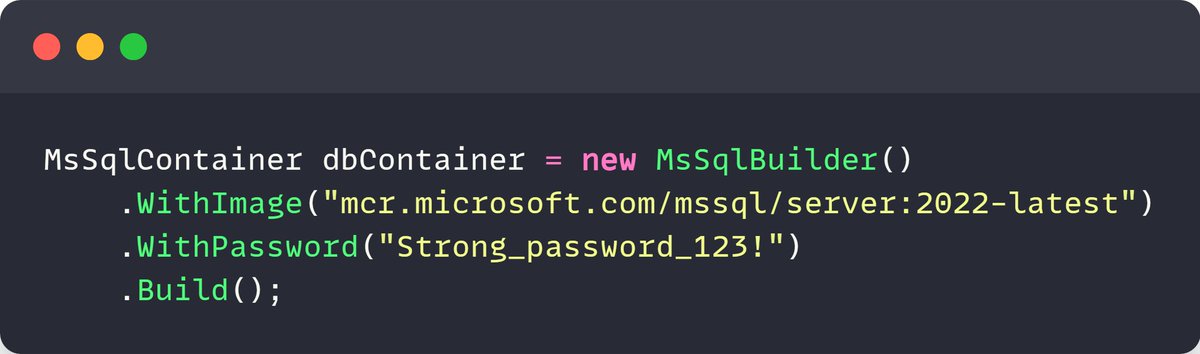
Testcontainers is hands down the best way to write integration tests in .NET.
You can run your external services in Docker containers, which you can access from your tests.
Here's how to spin up SQL Server in a container. 👇
7
10
104
6,899
Mar 12
The new Testcontainers for .NET release has arrived: github.com/testcontainers/te…. Version 4.11 comes with new modules, bug fixes, and improvements, plus OpenSSF Scorecard analyses for extra trustworthiness.
1
1
4
154
Mar 12
I've also got an update ready for the Docker.DotNet client, which in the next release will bring performance improvements, better resource usage, lots of fixes, and support for .NET's native HTTP handler 💪.
14
Andre Hofmeister retweeted

Hey, @testcontainers for #Golang v0.41.0 is out! 🚀
TiDB, Forgejo, Lowkey Vault, and a security fix you should know about.
Full release notes with contributor credits and the complete changelog: github.com/testcontainers/te…
#golang #testcontainers #docker
2
5
145
Andre Hofmeister retweeted
Feb 19
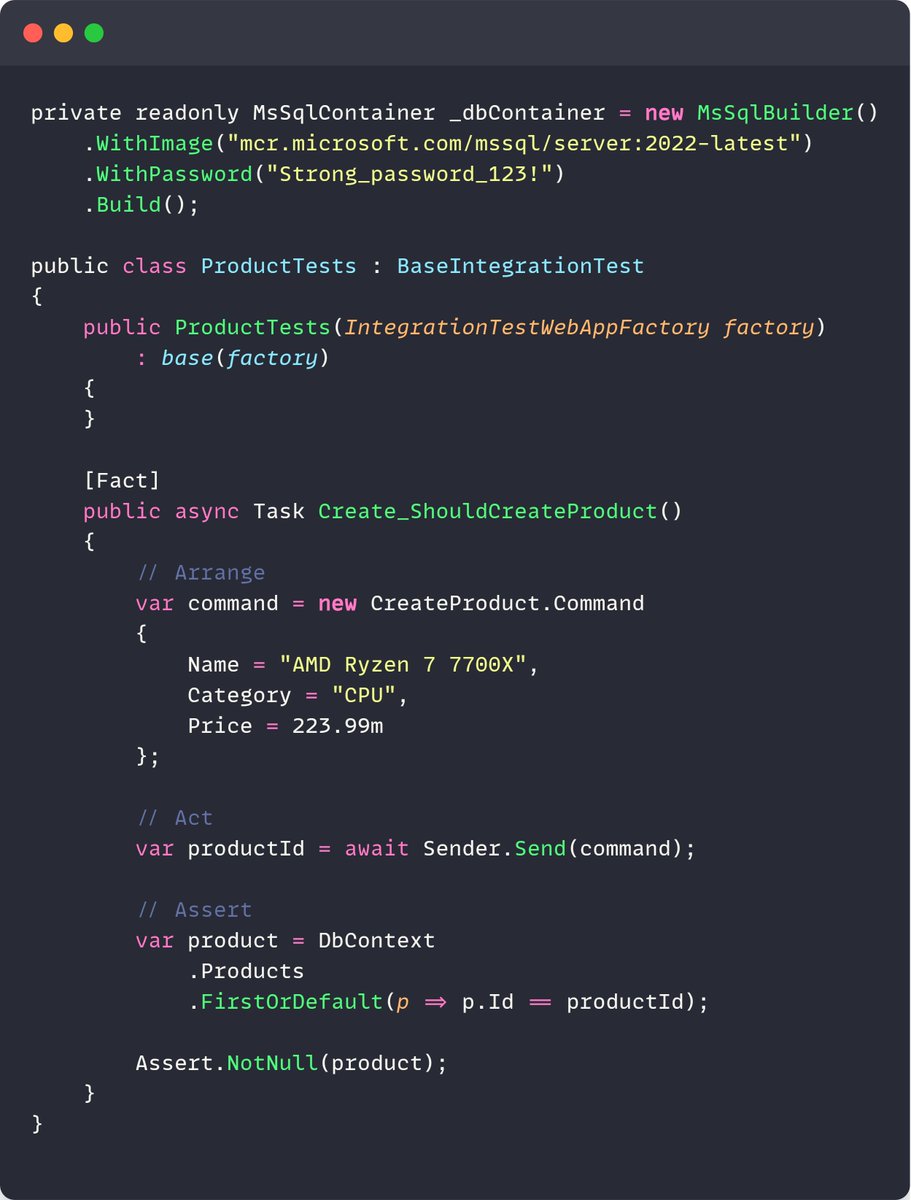
Here's what my integration tests look like with Testcontainers. 👇
Each test creates a command/query and sends it using MediatR.
Under the hood, there's an actual database running in a Docker container. This is powered by Testconatiners.
2
10
55
2,473
Feb 13
I've put together a few slides for future Testcontainers for .NET talks. If you're interested in discussing Testcontainers, let me know. Feedback on the slides is welcome as well: andrehofmeister.com/en/testc….
2
2
133
10 Dec 2025
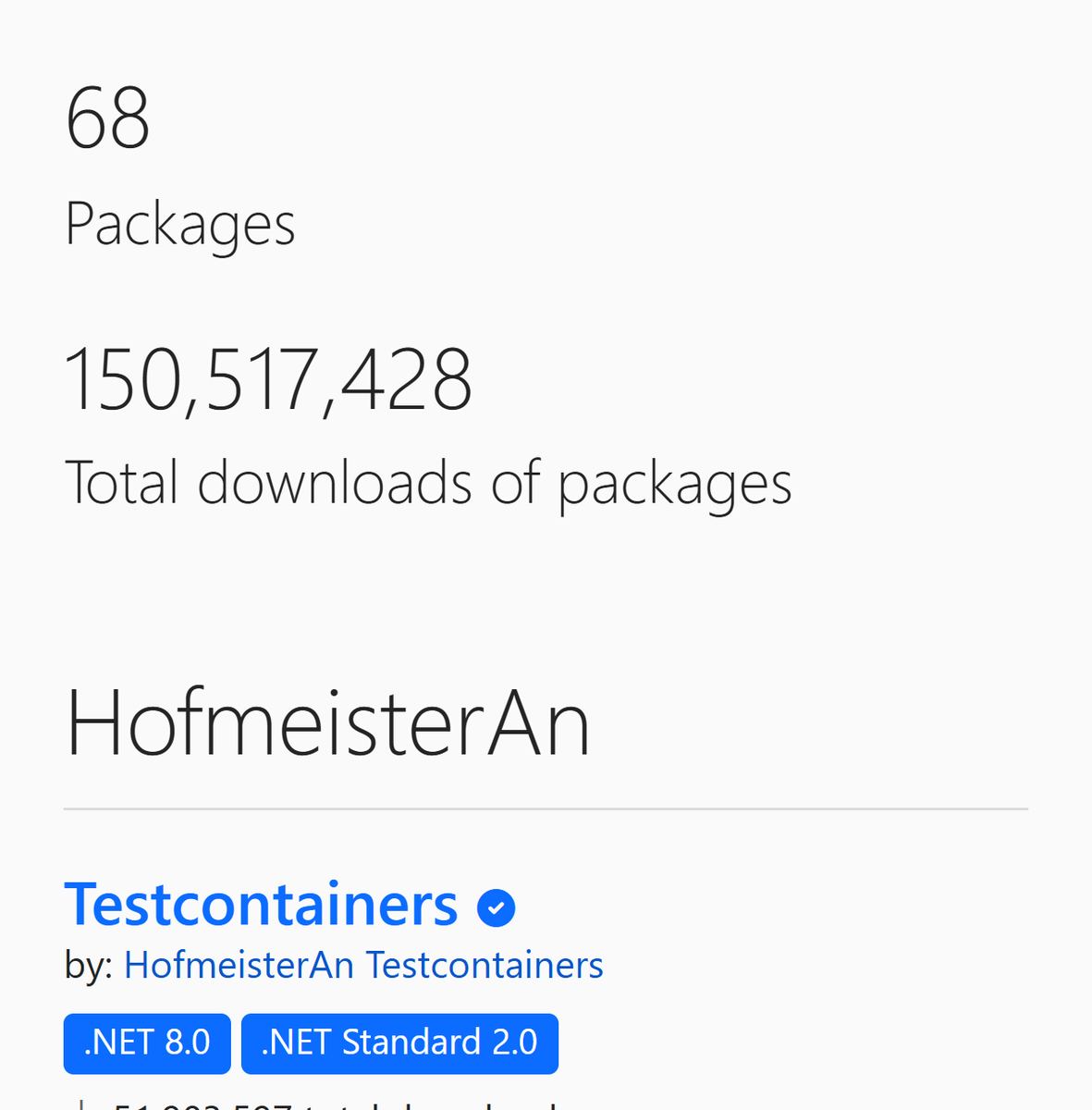
I never expected such an amazing journey when I started working on Testcontainers for .NET years ago. I've met many great people and learned a lot. I'm truly grateful for all of it. I never imagined the packages would one day pass 150M downloads!
3
1
6
183
10 Dec 2025
Check out Testcontainers (testcontainers.com/) and test against real dependencies with confidence.
1
50
4 Dec 2025
Docker.DotNet is now compatible with the latest Docker Engine v29 (github.com/testcontainers/Do…). Please note that backward compatibility with earlier API versions is limited due to the project's current structure.
1
2
58
24 Nov 2025
A new Testcontainers for .NET release is available. This release supports .NET 10 and ensures compatibility with Docker Engine v29: github.com/testcontainers/te…. I'm working on updating Docker.DotNet for full v29 support, so expect a new version soon /cc @Docker.
1
2
2
211
24 Nov 2025
Check out the new available modules like Playwright, Grafana, or my favorite this release, Toxiproxy. It's a really interesting tool for pushing testing further: dotnet.testcontainers.org/mo….
1
29
23 Nov 2025
Heads up, .NET devs: If your client-side Blazor WASM app fails (in Rider) with 'Failed to establish connection to debugger agent' but works in a regular browser, check your debug type, mine was accidentally set to embedded.
1
35
15 Nov 2025
If you're updating to Docker Engine v29 and using Docker.DotNet, make sure to pin the API version to 1.44 (or similar). v29 breaks the library. More details here: github.com/moby/moby/release….
2
42
15 Nov 2025
To specify the Docker Engine API in Docker.DotNet, pass the version to the CreateClient(...) factory method:
22