
Joined December 2016
- Tweets 287
- Following 275
- Followers 175
- Likes 245
Photos and videos

May 13
$1.4B from Bybit. $50M from Radiant.
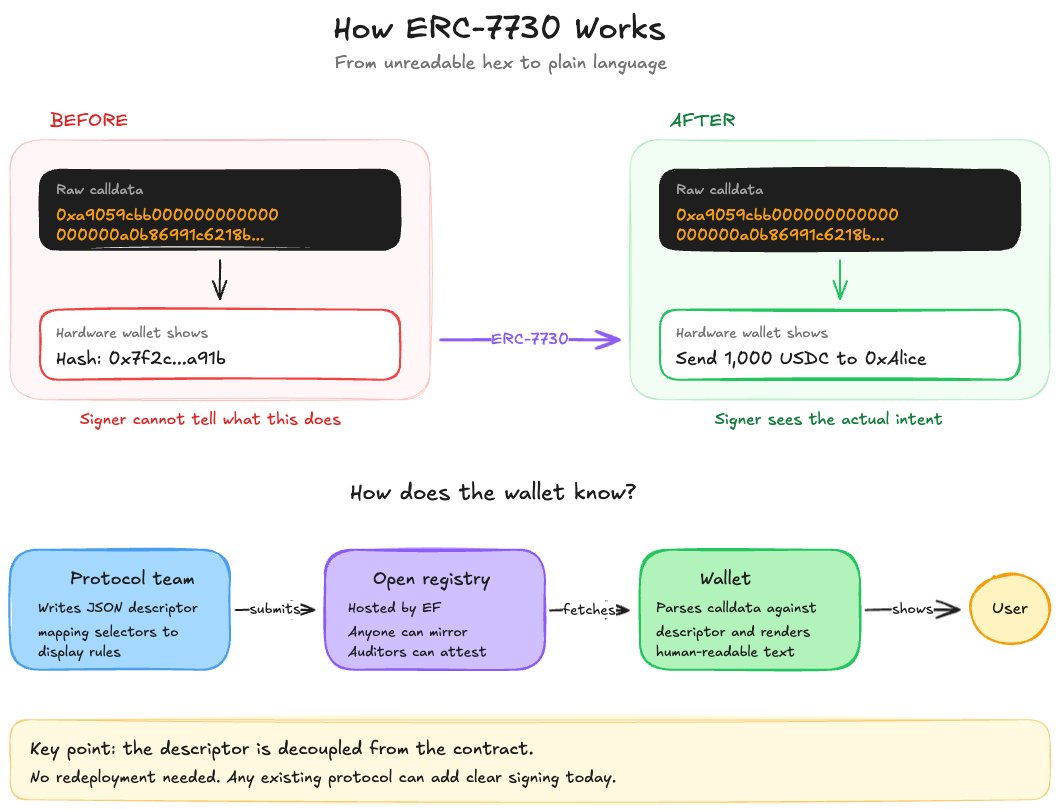
Same root cause: signers approved transactions they could not actually read.
This is what "blind signing" means, and why ERC-7730 is one of the most important standards Ethereum has shipped in years.
2
1
9
605
May 13
Descriptors live in an open registry maintained by the Ethereum Foundation, but anyone can clone and self-host. Wallets independently decide which registries they trust.
ERC-8176 layers attestations on top. Auditors can publish signed attestations confirming descriptor accuracy. Wallets weight descriptors that carry multiple independent reviews.
This matters because a malicious descriptor could lie about what calldata means. The attestation layer is the defense against that.
1
3
67
May 13
This is a UX layer upgrade.
The biggest exploits of the last two years were not cryptographic failures. They were UX failures dressed up as security.
If your protocol controls non-trivial value and you have not written a descriptor yet, you are leaving your users one compromised dev machine away from being the next case study.
1
45
Apr 30
The teams that get drained by admin key compromises know exactly how to prevent admin key compromises.
Multisig on ADMIN_ROLE. Timelock on upgrades. Deployer key revoked after launch. Separate pause guardian. This is in every audit checklist. What nobody admits is that timelocks slow down hotfixes and multisigs slow down launches, so teams ship without them and tell themselves they will add it later.
If you cannot ship with the safeguards on day one, you are not ready to hold user funds.
Apr 30

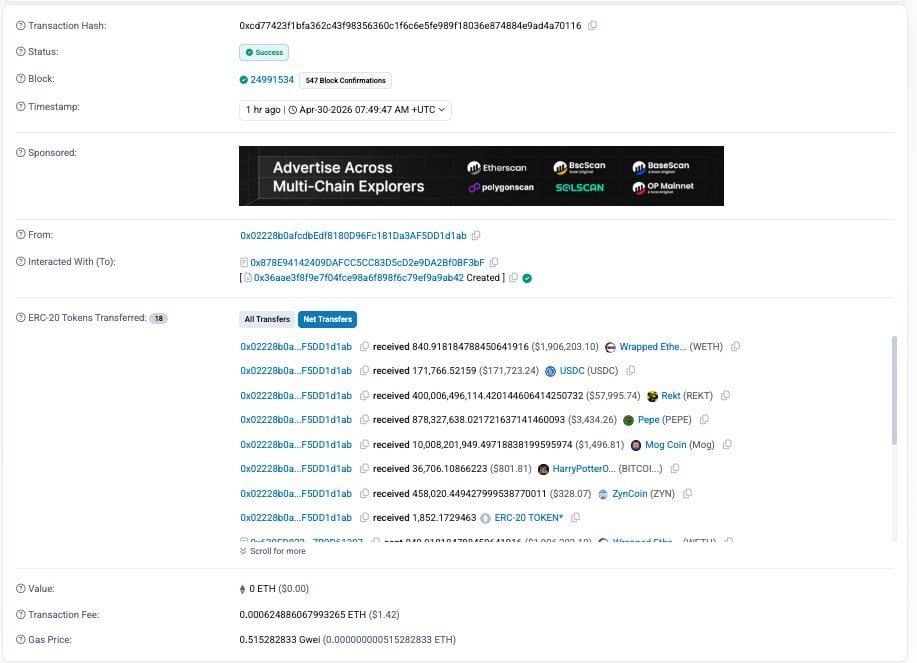
🚨 ALERT: Wasabi Protocol exploited for $5M across multiple chains, including Ethereum and Base, per PeckShield.

4
119
Apr 30
Stripe just shipped stablecoin custody, AI-initiated payments, and global payouts. Most of this already exists in DeFi. The difference is Stripe has millions of businesses already plugged in.
This is the part DeFi builders need to internalize. Better tech does not win. Distribution wins. A fintech with existing users can ship a worse version of the crypto thesis and still capture the market because the users are already there. Builders who keep optimizing the protocol without solving distribution are going to watch TradFi eat the rails we built.

Introducing the new Stripe Treasury:
• Hold funds in multiple currencies and stablecoins.
• Instantly transfer money to US businesses on Stripe for free.
• Pay anyone in 160 countries with just their email address.
• Earn credits on balances to apply towards Stripe fees.
• Spend funds with a Stripe card.
• Get 2% cash back on card purchases.
• View balances in the Stripe mobile app.
• Use Treasury from any AI app with the Stripe MCP.
4
102
Apr 28
AI is getting smarter. We are getting dumber. No serious developer hands an agent prod DB access with no guardrails and then acts surprised when it deletes everything.
Apr 27

#BREAKING: Anthropic’s AI coding agent ‘Claude’ reportedly wiped a company’s production database and backups in 9 seconds.
2
87
Apr 27
Past few weeks have been brutal. Drift. Kelp. Hundreds of millions gone. None of them were smart contract bugs. They were operational. Compromised keys. 1-of-1 DVNs. Misconfigured oracles. Governance decisions that aged badly in months.
1
3
77
Apr 27
Most DeFi users still pick protocols based on TVL and yield. Maybe a quick glance at audit count.
Almost nobody checks the operational layer. Who holds keys. How cross-chain messages are verified. Whether market isolation actually contains damage.
That's the gap.
1
3
46
Apr 27
So I'm starting a review in five operational dimensions.
This week is Aave. Two Strong, one Adequate, two Weak. Full breakdown in the Article.
x.com/hwisesa23/status/20487…

3
86
Apr 26
Imagine a bank rolls out a new vault lock. Most branches install it. A few branches delay the upgrade. A robber knows this, jams the alarms at the upgraded branches, then walks into the unpatched ones and withdraws cash that shouldnt exist. The bank later voids those withdrawals from its books.
Problem is the robber already wired the cash to another bank before the books got fixed. Thats what happened here. The chain healed. The bridges didnt. Cross-chain protocols accepting LTC need deeper confirmations on MWEB peg-outs, because reorg protection on the source chain doesnt protect destinations that already settled.

Litecoin update:
• A zero-day bug caused a DoS attack that disrupted major mining pools.
• Non-updated mining nodes allowed an invalid MWEB transaction allowing them to peg out coins to third party DEX’s
• A 13-block reorg reversed those invalid transactions — they will not be included in the main chain
• All valid transactions during that period remain unaffected
• The bug is now fully patched, and the network continues to operate normally
3
170
Apr 24
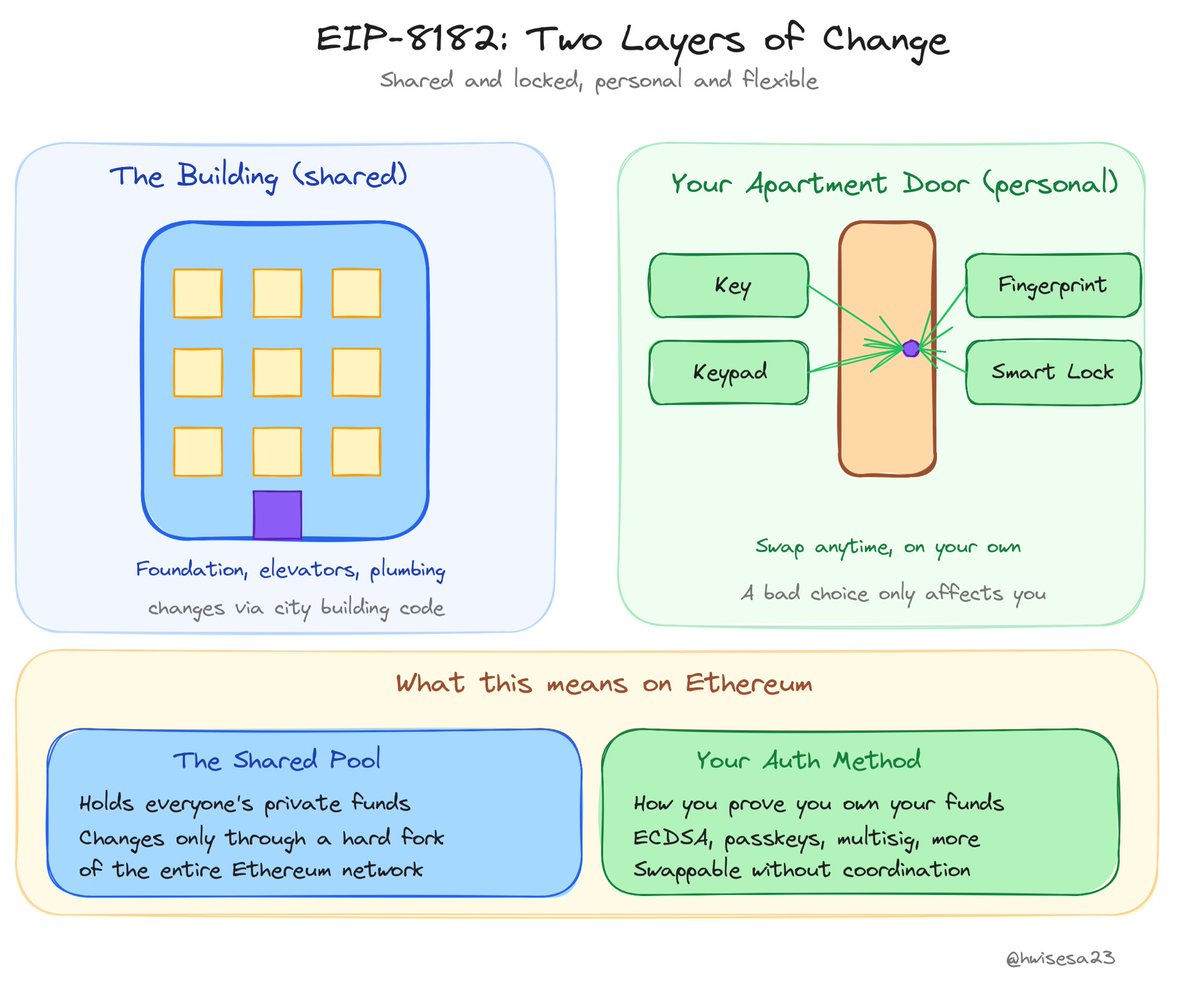
Think of it like an apartment building. The foundation, elevators, and plumbing are shared infrastructure that everyone depends on. No single tenant, landlord, or committee can change them. The only way those change is if the entire city updates its building code.
Your apartment door lock is the opposite. You can swap it for a keypad, a fingerprint scanner, or a smart lock anytime. A bad lock only puts your apartment at risk, not the whole building.
EIP-8182 brings this exact separation to Ethereum for private transfers. The shared pool that holds everyone’s funds can only change through a hard fork of the whole network. But the way each person proves they own their funds stays personal and swappable, without anyone needing to coordinate.
Why this matters. Paying employees on-chain today means broadcasting every salary to the world. Managing a company treasury means every supplier and every transfer is public. Donating to a cause means anyone can map your giving history to your wallet. Private transfers fix this without making you trust a separate app or bridge your funds somewhere else.
That is what protocol-level privacy looks like when you design it to not have a governance layer at all.

1
2
14
830
Apr 22
everyone saying layerzero is untrustable after kelp
what are you actually bridging with then?
1
3
108
Apr 21
Arbitrum handling the KelpDAO case is worth praising. They acted fast and minimized the loss.
But I also saw many comments pointing out the other side. An L2 having the power to move someone’s balance raises the question of where the decentralized part actually is.
I think that take is also fair.
After being in this space long enough, I learned that decentralized does not mean zero trust. We still trust protocols to use their multisigs wisely. We trust L2 governance to use their power carefully.
What differentiates us from web2 is that every action requiring trust is informed trust. We can see each operation they execute on-chain.
But the capability still exists. Your risk management should account for that.
And here is the harder question. If we want to onboard serious institutional liquidity into DeFi, can we actually do that while being fully decentralized with no ability to intervene when things go wrong?
I do not think we can. Not yet.
Check how the protocol operates. How their governance and council are structured. How they handled past incidents.
That homework matters before you start using a protocol or putting capital into it.

The Arbitrum Security Council has taken emergency action to freeze the 30,766 ETH being held in the address on Arbitrum One that is connected to the KelpDAO exploit. The Security Council acted with input from law enforcement as to the exploiter’s identity, and, at all times, weighed its commitment to the security and integrity of the Arbitrum community without impacting any Arbitrum users or applications.
After significant technical diligence and deliberation, the Security Council identified and executed a technical approach to move funds to safety without affecting any other chain state or Arbitrum users.
As of April 20 11:26pm ET the funds have been successfully transferred to an intermediary frozen wallet. They are no longer accessible to the address that originally held the funds, and can only be moved by further action by Arbitrum governance, which will be coordinated with relevant parties.
1
1
18
444
Apr 20
The word "audit" does different work in DeFi and TradFi.
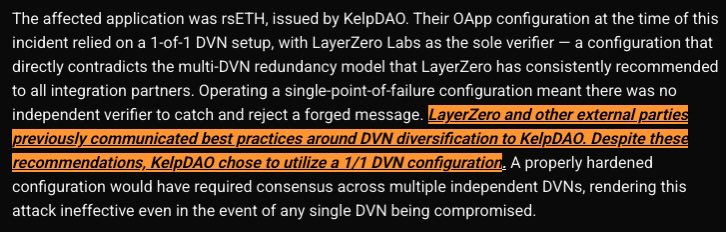
In DeFi we audit the smart contract. In TradFi they audit the protocol, the people, the devices, the config.
The statement below is LayerZero telling us exactly what we missed on Kelp. Not a smart contract bug. A config choice nobody reviewed.
If DeFi wants real money, "audited" has to mean more.
14
144