
investor, writer, educator, and a dragon ball fan 🐉
Joined October 2025
- Tweets 4,807
- Following 388
- Followers 42,192
- Likes 14,482
862 Photos and videos


Ihtesham Ali retweeted
Elon Musk announced a chip factory 10 times the size of Tesla's Gigafactory. The goal is to produce enough AI compute to equal twice the entire electricity consumption of the United States.
He called it the Terafab.
Here is the number that stopped me cold.
The entire global AI chip industry right now is on track to hit around 100 gigawatts per year of compute. Every Nvidia GPU, every Google TPU, every chip from every company on earth combined. 100 gigawatts.
Musk wants one factory to produce a terawatt per year.
A terawatt is 1,000 gigawatts. Ten times the output of the entire global industry. From a single building.
To put the scale in physical terms, the Terafab would need to be around 100 million square feet. You would need Starship point to point transport just to get from one end to the other.
But the reason for the scale is not ambition for its own sake.
To launch meaningful AI compute into space, you need a billion chips per year running at a kilowatt each. That is not a number the current industry can produce. The Terafab is the only way to get there.
The timeline he put out: a gigawatt of space AI compute annualized by end of next year. Then 10x per year from there. 10 gigawatts by year two. 100 gigawatts by year three. A terawatt beyond that.
Most people think orbital data centers are a decade away.
Musk is building the factory to make them possible by next year.
107
582
2,793
200,568
Ihtesham Ali retweeted
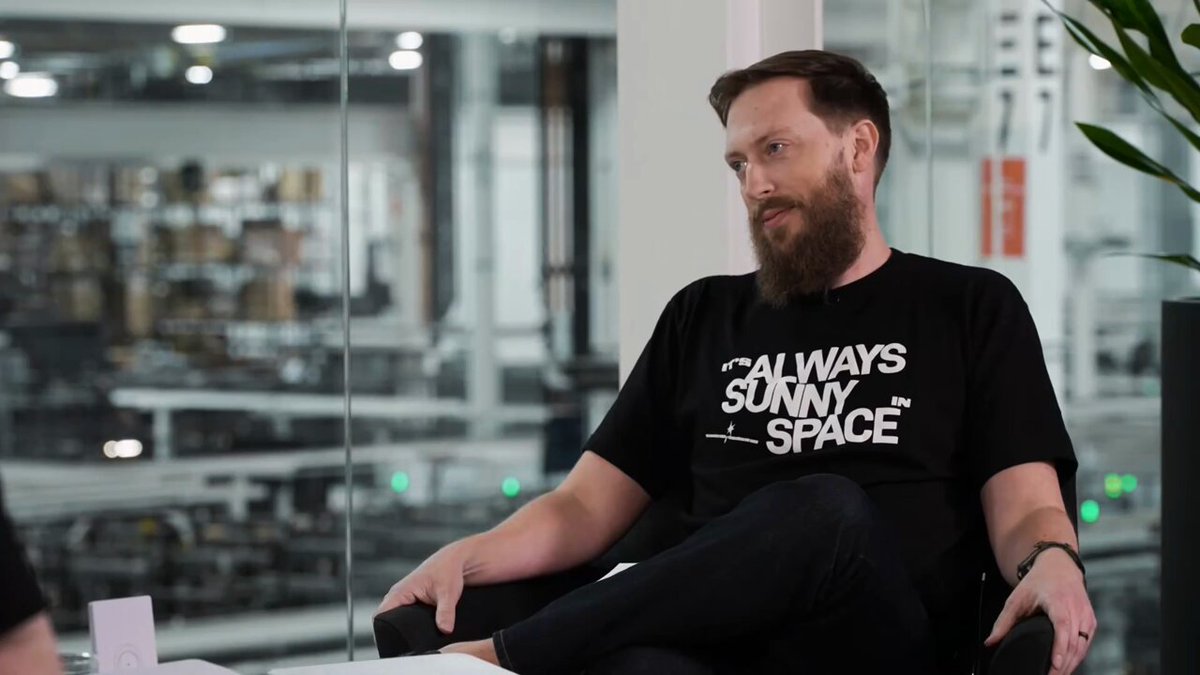
Elon Musk said humanity is currently using less than a trillionth of the sun's power output. A trillion is a million times a million. That is how far we have to go.
He was explaining the Kardashev Scale on a SpaceX livestream.
A Russian physicist named Nikolai Kardashev invented it in 1964 as the most objective way to measure how advanced a civilization actually is. Not by population. Not by GDP. By energy.
Type 1: you harness everything your planet produces.
Type 2: you harness your star.
Type 3: you harness your galaxy.
Where does humanity sit right now?
We are not Type 1. We are not close to Type 1. We are a tiny fraction of the way to Type 1. Musk said if aliens visited us today and measured us on this scale, we would not be registering.
His exact words: "One microKardashev would be an epic achievement relative to where we are right now."
The sun is 99.86% of all mass in the solar system. Everything else, Jupiter, Saturn, Earth, every planet and moon and asteroid combined, is the remaining 0.14%. Earth is in the miscellaneous category.
Of the sun's total power output, Earth intercepts roughly half a billionth. And of that half billionth, most hits ocean. Most of the land is Siberia or Antarctica. The actual usable surface where you can capture solar energy is tiny.
To get to even a millionth of the sun's power, you cannot stay on Earth. The math does not work. You have to go to space.
That is not a dream. That is a physics constraint.
And that constraint is exactly why SpaceX exists.
19
17
87
6,449
Ihtesham Ali retweeted
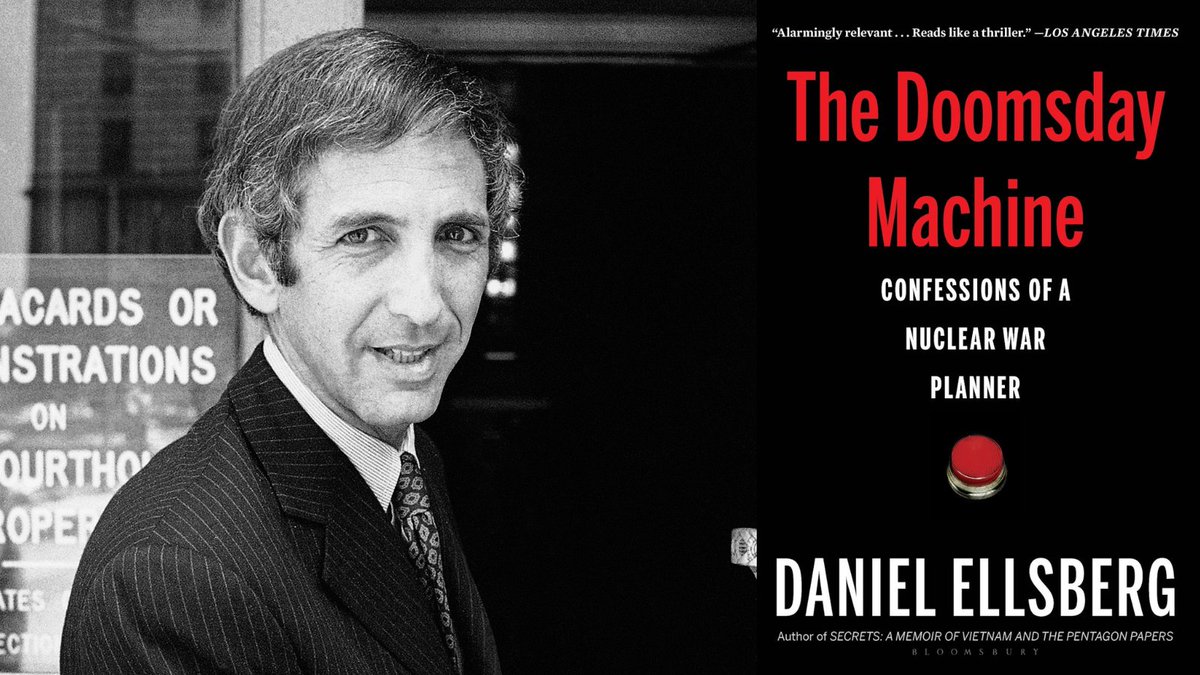
The man who leaked the Pentagon Papers spent the rest of his life sitting on something far darker, and the book he finally wrote about it scared me more than anything I have ever read.
His name was Daniel Ellsberg. The book is called The Doomsday Machine: Confessions of a Nuclear War Planner.
Most of you know Ellsberg as the analyst who in 1971 handed 7,000 pages of classified Vietnam War documents to the press and almost went to prison for it. That story has a hero arc. A man of conscience, the system exposed, justice eventually served.
What almost nobody knows is what he did not leak.
When Ellsberg copied the Pentagon Papers at night on a photocopier borrowed from an advertising agency, he also copied something else. Thousands of pages about America's nuclear war plans. He had carried the same security clearance for both files. He intended to release them next.
He never got the chance. While the FBI was closing in after the Pentagon Papers went public, he transferred the nuclear documents to his brother, who buried them near a trash dump. A tropical storm hit. The papers dissolved into mud.
For decades, Ellsberg reconstructed what he remembered from notes, Freedom of Information Act requests, and interviews with people who had been in the same rooms. The Doomsday Machine is what came out of that reconstruction, and it is the most honest account of American nuclear policy that any insider has ever published.
The thing that hit me first is this: everything you believe about who controls nuclear weapons is wrong.
The official story, the one presidents repeat in press conferences and diplomats repeat in treaties, is that the American nuclear arsenal answers to a single chain of command ending at the desk of the President. The launch codes. The football. One person. One decision.
Ellsberg had a "go anywhere, ask anything" research mandate from RAND Corporation in 1959 and 1960. He traveled to air bases across the Pacific. He asked the question directly.
What he found was that the authority to launch nuclear weapons had been delegated far down the military hierarchy, to generals, to base commanders, to fighter pilots sitting in cockpits on remote runways. Not secretly. Not illegally. Deliberately. The military had decided that waiting for a presidential order in a world of supersonic bombers and thirty-minute missile flight times was tactically suicidal. So they had quietly built a system where dozens of people, in dozens of locations, could start a nuclear war on their own judgment.
The lock codes designed to prevent unauthorized launches at nuclear missile silos had been set to 00000000. All zeros. To make them faster to enter.
Nobody told the public. Nobody told most of the government. The President's control was, in Ellsberg's word, a hoax.
The second thing that stopped me cold was the plan itself.
In spring 1961, Ellsberg was at the White House when a general briefed Kennedy's national security team on what would actually happen if the United States executed its nuclear war plan against the Soviet Union.
The general showed a graph. The vertical axis was deaths. The horizontal axis was time, measured in months.
The curve flattened at 100 million Soviets dead from radioactive fallout alone. Not from the initial blasts. Just from the dust that floated back down.
Someone asked what would happen to China.
There was a second graph. China would lose roughly 300 million people.
When Ellsberg followed up and asked the total, accounting for fallout drifting into Western Europe, into neutral countries, into American allies, the number came back as approximately 600 million dead. In the Pentagon's own estimate. From a first strike the United States was planning to execute in response not to a nuclear attack, but to any conventional military confrontation that involved more than one American battalion.
Six hundred million people. A hundred holocausts, Ellsberg wrote later, by their own accounting.
And that estimate was made in 1961, before scientists understood nuclear winter. The actual death toll from the same strike, calculated with modern climate models, would have been the near-extinction of the human species.
The third revelation is the one that kept me awake.
The Soviet Union built a mirror of the same system, called Perimeter, sometimes referred to as the Dead Hand. It is a semi-automated retaliatory network designed to launch the entire Soviet nuclear arsenal if it detects that Soviet leadership has been destroyed and communication has gone dark. It was built to ensure that no American first strike could prevent retaliation.
It still exists. Russia never dismantled it.
Both countries built machines that can end civilization on their own. Both machines are still running.
Ellsberg spent the final years of his life trying to make people understand that the threat had not diminished, that the fundamental architecture of the nuclear age had not changed, that a fraction of the existing arsenals could still kill everyone alive today. He testified. He gave interviews. He filed lawsuit after lawsuit under the Freedom of Information Act.
He died in June 2023 at 92, still trying.
The strangest thing about the book is what it does to you after you put it down.
You go about your day. You check your phone. You argue about ordinary things. And somewhere underneath all of it sits this fact, verified and documented, that the species has built and maintained and continuously upgraded machines capable of ending itself, that those machines are controlled by systems far more fragile and distributed than anyone is allowed to officially admit, and that the people who designed them considered 600 million deaths an acceptable outcome of a conventional conflict.
Ellsberg called it ordinary insanity. Madness so widely shared, so institutionalized, that it stopped looking like madness at all.
He said that was the most dangerous thing about it.
The book is available everywhere books are sold. It will be the most important 400 pages you ever read and the most difficult ones to finish.
What book has genuinely scared you? I want to build a list.
13
97
209
12,702
Ihtesham Ali retweeted
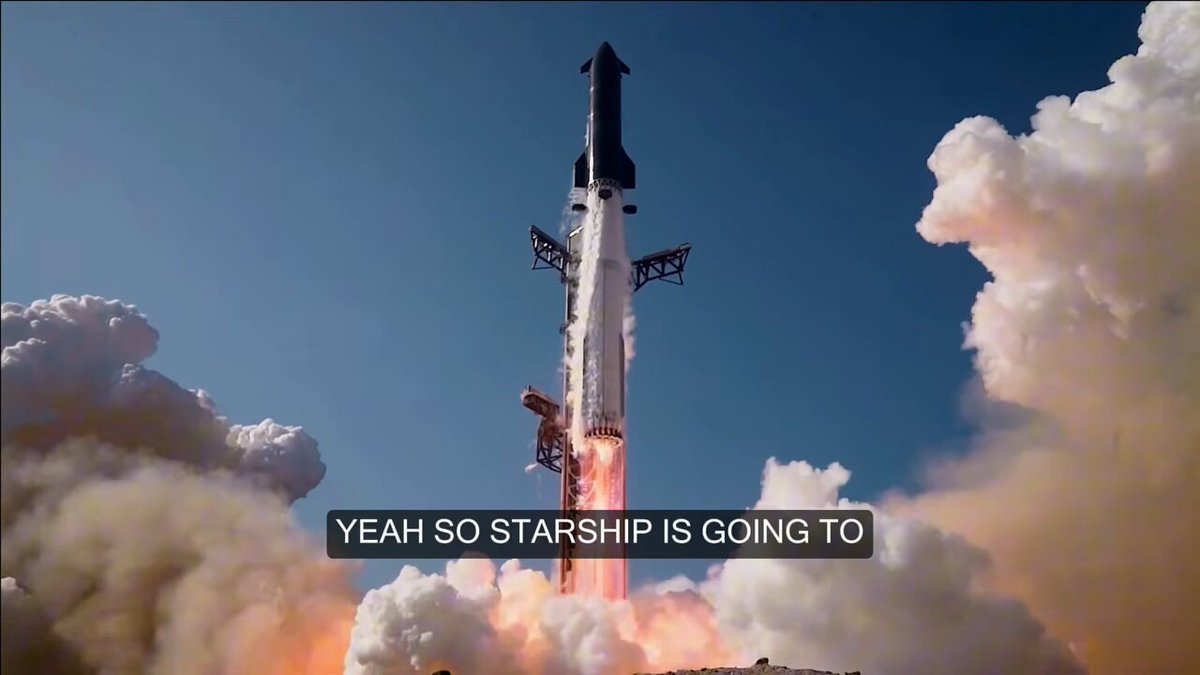
Every rocket ever built before Starship was thrown away after one use. Elon Musk just explained on a SpaceX livestream why that single fact made space exploration practically impossible until now.
His analogy was the one that landed hardest.
Imagine if you had to throw away a commercial airplane every time it flew. Not maintain it. Not refuel it. Throw it away and build a new one. What happens to the price of a ticket? What happens to the airline industry? What happens to global travel?
It collapses. Nobody flies.
That is exactly what every space program in history has been doing with rockets. Building them once, using them once, throwing them away. The cost was not a failure of ambition. It was a structural consequence of how the hardware worked.
Starship is the first rocket ever designed for full and rapid reusability.
Not just reusable. Rapidly reusable. The rocket lands, gets caught by the tower, goes back on the launch stand, and flies again without refurbishment. Like an aircraft. No laborious inspection between flights.
Starship B3 is already more than double the thrust of the Saturn 5 moon rocket. Version 4 will be roughly three times. And Musk said they expect Starship to be flying more than once per hour eventually.
That number is hard to absorb.
The most powerful moving object ever built. Flying more than once per hour.
The cost of getting mass to orbit does not drop gradually when that happens. It collapses. And when the cost collapses, everything that was previously impossible becomes a question of how fast you can build.
Reusability is not a feature. It is the entire unlock.
Every other problem in space is downstream of this one.
3
32
129
4,027
Ihtesham Ali retweeted
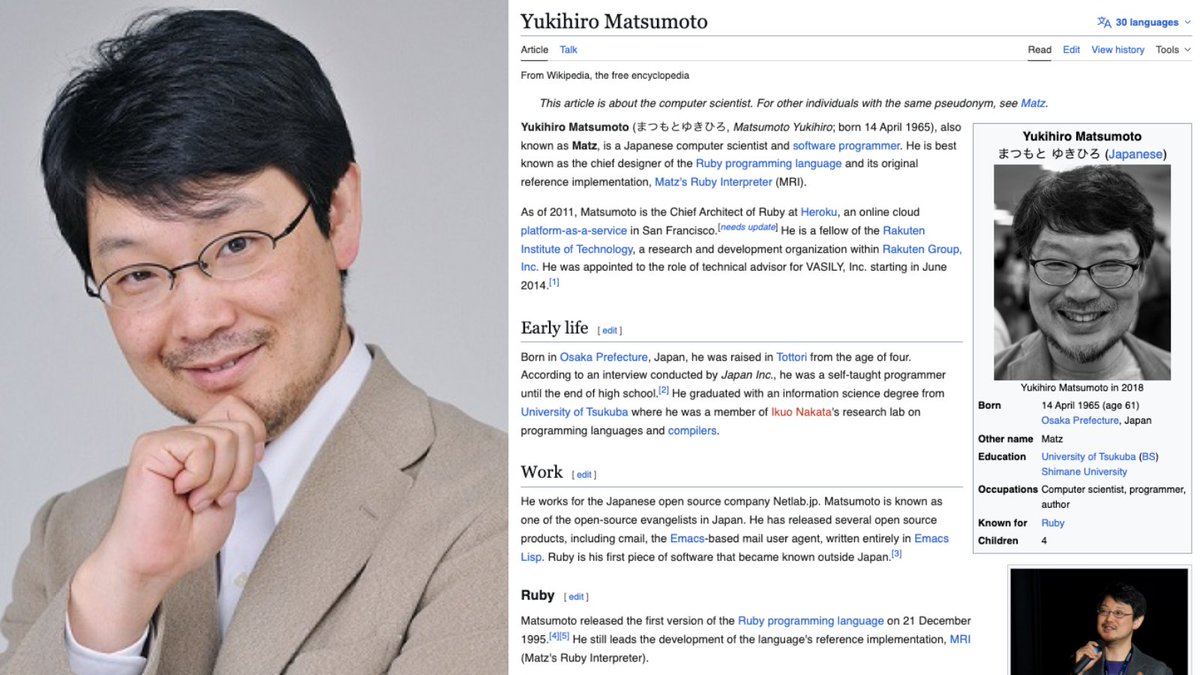
A Japanese programmer looked at every existing programming language in 1993, decided none of them made him happy, and spent two years building his own the language he built became the foundation GitHub, Shopify, Airbnb, and Coinbase were all built on.
His name is Yukihiro Matsumoto.
Everyone in the programming world calls him Matz. He was born in 1965, studied information science at the University of Tsukuba, and graduated in 1990 with a head full of ideas about what programming languages could be and a quiet frustration with what they actually were.
He knew Perl. He did not like it. He said it had the smell of a toy language. He knew Python. He did not like it either, because he felt its object-oriented features were add-ons bolted onto a language that was not designed around them from the start. He wanted something that was genuinely, completely object-oriented, easy to use, and built for the person writing the code rather than the machine running it.
He looked for that language. He could not find it.
So on February 24, 1993, he opened a chat window with his colleague Keiju Ishitsuka and typed: "Let us decide the codename now."
They wanted to name it after a gemstone, inspired by Perl. Ishitsuka suggested Coral. Matsumoto suggested Ruby. Ruby was shorter by one letter. Ruby won.
He spent the next two years building it alone, working through the architecture piece by piece. The object system. The string class. The IO streams. He later said he talked through specific features while speaking to his baby daughter, using her as a sounding board the way programmers use rubber ducks. In August 1993, he finally wrote the line of code that produced "Hello, world." on the screen.
The first public version, Ruby 0.95, was released to Japanese domestic newsgroups on December 21, 1995. No press release. No launch event. Just a quiet post to a mailing list.
The design principle underneath everything was the one nobody else had ever made primary. Matsumoto called it programmer happiness. He believed programming languages should be built for the joy and productivity of the person writing the code, not optimized purely for machine efficiency. Every decision in Ruby's design ran through that filter. If it made the programmer's life harder, it was wrong.
That philosophy attracted a small but devoted following in Japan through the late 1990s. Then in 2003, a Danish programmer named David Heinemeier Hansson discovered Ruby and used it to build an internal project management tool for his company. He called the tool Basecamp. He extracted the framework underneath it and released it publicly in 2004.
He called it Ruby on Rails.
Within a year of that release, the framework had changed how web applications were built. Rails introduced the principle of convention over configuration, meaning developers could make decisions about structure quickly because the framework had already made sensible defaults. What used to take weeks of setup took days. What used to take days took hours.
Shopify started on Rails in 2005. GitHub built on Rails a couple of years later. Airbnb, Twitch, Coinbase, SoundCloud, and Zendesk all followed. The first generation of consumer internet companies that defined how people think about software products were largely built by small teams moving fast on a framework that traced directly back to one Japanese programmer who was dissatisfied with his tools in 1993.
Shopify now processes over $200 billion in annual commerce volume. It still runs on Rails. GitHub became the largest code hosting platform on earth and was acquired by Microsoft for $7.5 billion in 2018. It started on Rails.
Matsumoto has said many times that he created Ruby for selfish reasons. He was so underwhelmed by every available option that he built something that would make himself happy. The programmer happiness he was chasing was his own.
The community that grew around Ruby adopted a motto that says everything about who he is. Matz is nice and so we are nice. They abbreviated it MINASWAN. It spread because it was true. He answered emails from strangers. He engaged with the community with patience. He treated the language as a gift, not a product.
He is still the chief designer of Ruby today. The language is 31 years old. It is still being improved.
The last stable release was Ruby 4.0.4, shipped on May 11, 2026.
One programmer, unhappy with his tools, built something better in the evenings in 1993. The companies you use to buy things, to store code, to book travel, and to watch streams were built on top of what he made.
He just wanted to be happy while he worked.
Did you know Ruby was behind the tools you use every day?
32
552
2,740
271,582

Jun 12
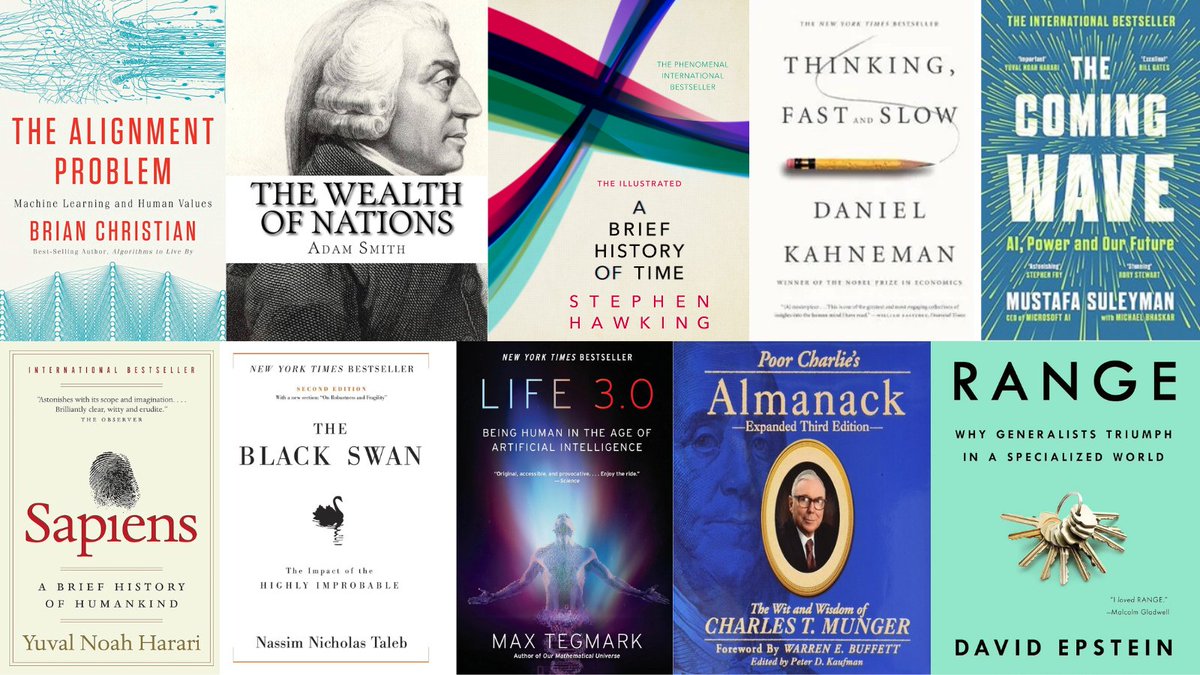
10 books I read in the past 5 months that changed how I think about AI, money, science, and the world.
1. The Alignment Problem - Brian Christian
(recommended by Sam Altman)
The clearest explanation of why building AI that actually does what we want is the hardest problem in computer science. Not sci-fi. Real labs. Real failures. Right now.
2. The Wealth of Nations - Adam Smith
(recommended by Charlie Munger)
Written in 1776. Still the most honest explanation of how economies actually move. Every AI founder building a business needs the mental model in chapter one before anything else.
3. A Brief History of Time - Stephen Hawking
(recommended by Elon Musk)
Most people own it. Almost nobody finishes it. The chapter on the arrow of time broke my brain in the best way. Read it slowly.
4. Thinking, Fast and Slow - Daniel Kahneman
(recommended by Barack Obama)
Your brain runs two systems. One is fast and wrong most of the time. One is slow and almost never used. This book is the manual for the one you keep ignoring.
5. The Coming Wave - Mustafa Suleyman
(recommended by Bill Gates)
The co-founder of DeepMind explains what happens when AI and synthetic biology arrive at the same time. Not a warning. A map. Read it before everyone else does.
6. Sapiens - Yuval Noah Harari
(recommended by Mark Zuckerberg)
One book that explains the entire last 70,000 years of human history in 400 pages. The chapter on money is the one that stays with you.
7. The Black Swan - Nassim Taleb
(recommended by Daniel Kahneman)
The events that shape your life are the ones nobody saw coming. This book teaches you to stop predicting and start preparing for what you cannot predict.
8. Life 3.0 - Max Tegmark
(recommended by Demis Hassabis)
An MIT physicist asks what happens to humanity after AGI. Not emotionally. Rigorously. Every scenario is laid out like a physics problem. Uncomfortable in all the right ways.
9. Poor Charlie's Almanack - Charlie Munger
(recommended by Warren Buffett)
100 mental models from one of the sharpest minds of the 20th century. You will use at least 20 of these every week for the rest of your life.
10. Range - David Epstein
(recommended by Malcolm Gladwell)
Gladwell built his career on the 10,000 hour rule. Then this book changed his mind. The case for being a generalist in a world that keeps telling you to specialize. Read it if you have ever felt behind.
Save this. Read the books I shared here. Your future self will thank you.
8
60
272
9,950
Jun 12
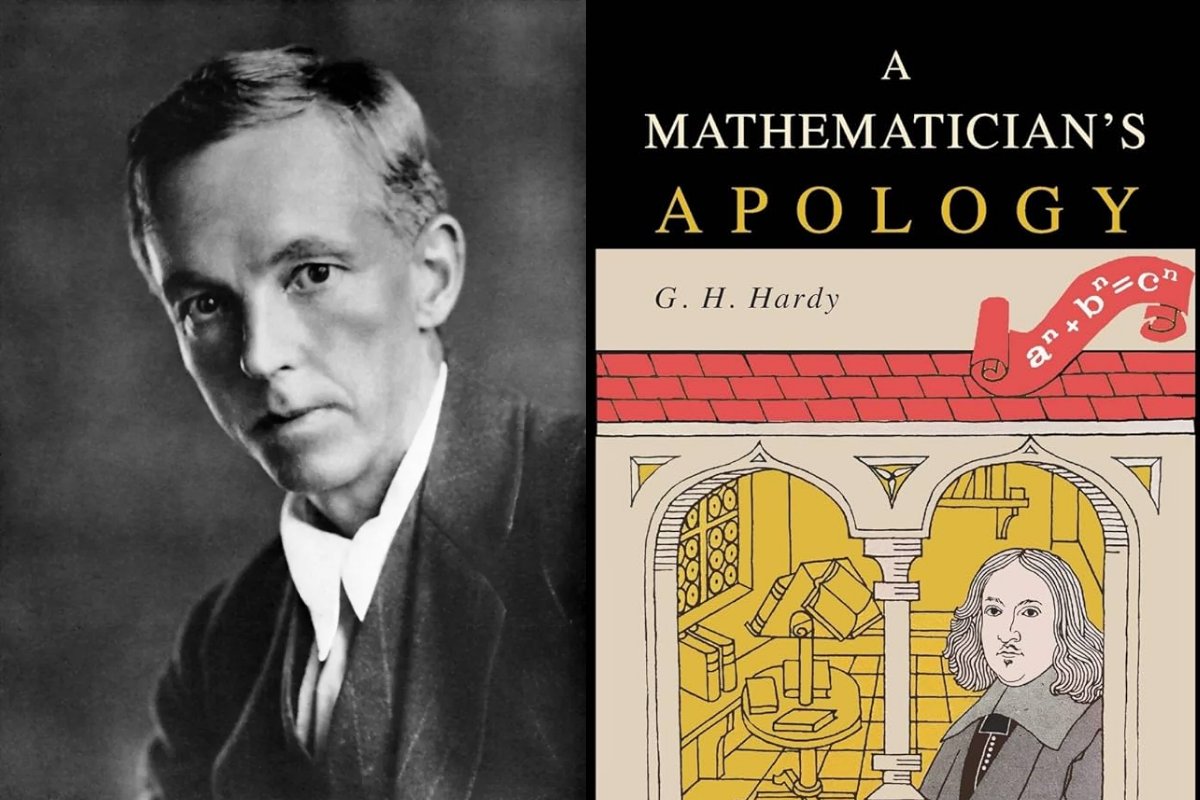
The greatest mathematician in England wrote a small book at 62 confessing that mathematics had always been art, never science, and the most painful part of the book is the man writing it knew he would never make another piece of it again.
His name was G.H. Hardy. The book is called "A Mathematician's Apology"
He was a professor at Cambridge and Oxford. He spent his career working on number theory and mathematical analysis, almost entirely with one collaborator named John Edensor Littlewood.
In his prime, between 1910 and 1930, he was considered the finest pure mathematician working in the English-speaking world. He published over 350 papers. He produced foundational results that mathematicians still use today.
In 1939, at the age of 62, he had a heart attack.
He survived it. But something inside him had been broken that did not heal. He could feel his mathematical powers leaving him. The same brain that had spent 40 years effortlessly producing original work now felt slow. Heavy. He kept trying to do new mathematics and kept producing nothing he was proud of.
He understood, with a clarity that almost no creative person ever wants to face, that the part of him that had made him who he was had quietly finished its work without telling him.
So he sat down to write a different kind of book.
It is called A Mathematician's Apology. It was published in 1940 by Cambridge University Press. It is about 90 pages long. You can finish it in two hours.
The word "apology" in the title does not mean an apology in the modern sense. It is used in the old Greek sense, the way Plato used it for the Apology of Socrates. An apology is a formal defense. Hardy is defending his life.
The book is sad in a way that almost no other book about mathematics has ever been.
Hardy writes that exposition, criticism, and appreciation are work for second-rate minds. He says this on the second page. He is telling the reader that the act of writing the book they are now reading is itself proof that his real work is over.
The first-rate mind produces new mathematics. The second-rate mind explains old mathematics to other people. Hardy is consciously demoting himself in print, on page two, as part of the price of writing the book at all.
Then he makes the argument that has been quoted for 85 years.
He writes that a mathematician, like a painter or a poet, is a maker of patterns. If a mathematician's patterns are more permanent than the painter's or the poet's, it is because they are made with ideas. Ideas, Hardy argues, do not fade the way colors fade or the way words go out of fashion. A theorem proved in ancient Greece is still true today. A poem written in ancient Greece is now stiff and remote.
A painting from ancient Greece is now a shadow of itself. Only mathematics survives the centuries intact, because mathematics is made out of the only material that does not decay.
This is the part of the book where Hardy stops sounding like a scientist and starts sounding like an artist who has been arguing his whole career that what he does is real work.
He pushes the argument further. He says the best mathematics is the most useless. He means this as a compliment of the highest possible order.
Useful mathematics, the math you would use to build a bridge or balance a budget, is dull. It is craft, not art. It is downstream of the real thing. The real thing, what he calls pure mathematics, exists for no reason except its own beauty. It does not solve any problem anyone has. It does not produce any product anyone needs. It exists because some human being, somewhere, looked at a pattern in the structure of numbers and decided the pattern was beautiful enough to spend a life chasing.
The other artists of his time agreed with him. Graham Greene reviewed the book and said it was, alongside the notebooks of Henry James, the best account ever written of what it feels like to be a creative artist.
Then Hardy gets to the most personal part of the book.
He writes about Ramanujan.
Srinivasa Ramanujan was a self-taught mathematician from a small town in southern India. He had no formal university training. He had read a single elementary mathematics textbook in his childhood and worked everything else out himself. In 1913 he wrote Hardy a letter at Cambridge containing dozens of strange formulas.
Two other mathematicians had already dismissed the letter as the work of a crank. Hardy read it, recognized what was actually inside, and arranged for Ramanujan to be brought to England.
For five years they worked together. Then Ramanujan got sick in the cold English winter, his health collapsed, and he was sent home to India where he died in 1920 at the age of 32.
Hardy never recovered from it.
In the Apology he writes that his greatest contribution to mathematics was not any theorem he ever proved. It was discovering Ramanujan. He gives a list of mathematicians he has known personally, ranked on a scale of one to one hundred.
He rates himself a 25. He rates his lifelong collaborator Littlewood a 30. He rates David Hilbert, the most respected German mathematician of the era, an 80. The only person he gives a 100 is Ramanujan. He had known one true genius in his life, and that genius had died in his early 30s, and the loss is sitting under every paragraph of the book even when Hardy is not writing about him directly.
The deepest irony in the Apology is the one Hardy could not have predicted.
He spent the whole book arguing that the best mathematics was the most useless. He used number theory, his own field, as the cleanest example. He wrote that nobody had ever found a useful application for the theory of prime numbers and that this was a feature, not a flaw. The work was pure. The work was art. The work was untouched by industry.
Five years after Hardy's death, the world's first computers were being designed using mathematical ideas from his field. Twenty years after his death, code-breakers at Bletchley Park were using number theory to crack the Enigma machine.
Forty years after his death, modern cryptography was being built on the prime number theorems Hardy had said could never be made useful. Every secure transaction you make on the internet today, every encrypted message you send, every banking app you open, runs on the math Hardy spent his life calling beautifully useless.
He was right that the math was beautiful. He was wrong that it was useless. The two things turned out to be the same thing seen from different angles in time.
The other part of the book that still hits readers hard is the ending.
Hardy quietly writes that he has had a good life. He has had Cambridge. He has had cricket. He has had Littlewood. He has had Ramanujan, briefly, and that brief possession of a true genius was worth more to him than all the rest. He has had a small place in the long history of pure mathematics. He says, in plain English, that this is enough.
Then he writes the closing line. He writes that the case for his life cannot be made any more. The verdict, he says, will rest where it falls.
Six years later he tried to kill himself by overdosing on sleeping pills. The attempt failed. He died in his bed of natural causes a few months later, in December 1947, at the age of 70.
The book has stayed in print for 85 years. Mathematicians still read it as a kind of secret confession. Artists read it because Hardy understood something most artists struggle to articulate. The act of making something beautiful is its own justification. You do not need a useful purpose for your work. You do not need the world to applaud it. You do not need it to fit in any system.
You only need the pattern itself to be true, and the pattern to be yours, and the work to have meant something to you while you were doing it.
The hardest part of the book is the part Hardy never says directly.
The act of writing it was itself the proof he was done.
He could no longer make the patterns. He could only tell other people what it had felt like to make them. The Apology is not a book about mathematics. It is a man saying goodbye to the part of himself that had been worth knowing.
Most of you reading this are still in the part of your life where you can make the patterns.
Don't waste it explaining them.
Make them.
28
163
602
29,415
Jun 12
Jeff Bezos went on CNBC today and said AI won't eliminate jobs. It will create a shortage of workers. Every economist warning about unemployment has it completely backwards.
His reasoning is straightforward.
When productivity explodes, the basket of goods people can afford gets cheaper. A two-earner household becomes a one-earner household. Not because someone got fired. Because they no longer need the second income.
People working overtime stop working overtime. Not because the job disappeared. Because they can finally afford not to.
His exact words: "What's actually going to happen is we're going to have labor scarcity as a result. People are going to have to work hard."
Then he went further.
He compared AI to penicillin. To solar cells. To the iPhone. His point: transformative inventions don't get hoarded by the people who build them. They spread through society and raise the floor for everyone.
"The inventions themselves spread throughout society and improve life."
The job loss narrative is loud because scared people share more than optimistic ones.
Bezos isn't dismissing the fear. He's saying the people feeding it are solving the wrong equation.
The question was never how many jobs AI destroys.
It was always how much it costs to live.
SOURCE: CNBC
67
72
275
51,013
Jun 12
I accidentally discovered how to read a complete book in 30 minutes.
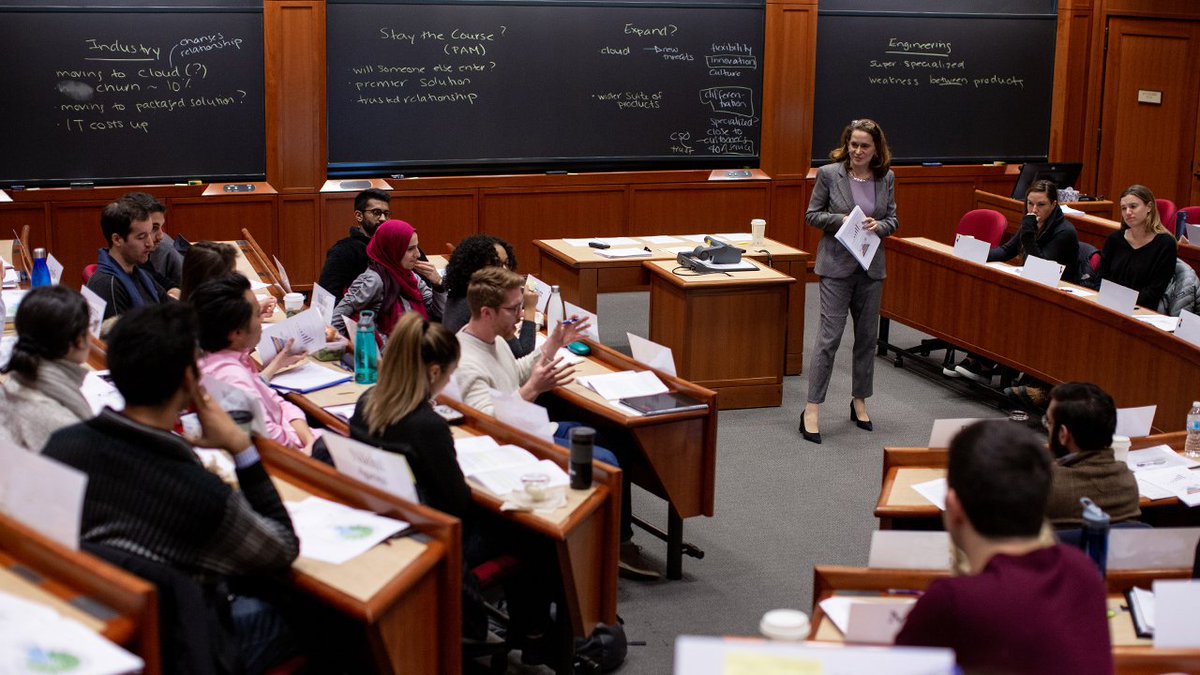
A Harvard student showed me the workflow. Here's exactly what he does.
He doesn't open a book and start reading from page one.
He said that's the slowest, most inefficient way to absorb a book ever invented. You read linearly, your brain has no context for what matters, and by chapter four you've already forgotten chapter one.
He does something different.
He uploads the entire book into NotebookLM first.
Then he runs one prompt before touching a single page.
"What is the single central argument this book is making? What does the author believe that most people don't? And what are the 5 most important ideas I need to understand before everything else makes sense?"
That prompt does something most people don't realize. It gives your brain a skeleton before the flesh goes on. You are no longer reading to discover what the book is about. You already know. Now every page you read is confirming, extending, or challenging something you already hold in your head.
That is a completely different cognitive experience.
The second prompt is the one that saves the most time.
"Which chapters or sections contain the core ideas? Which ones are examples, case studies, or repetition of things already said?"
Most nonfiction books are 60 to 70 percent padding. Not because the authors are dishonest. Because publishers want 250 pages, not 80. The actual argument usually lives in four or five chapters. The rest is illustration.
NotebookLM tells him exactly which four chapters to read. He reads those. He skips the rest.
He is not missing anything. He is cutting everything that was never the point.
The third prompt is what separates this from summarizing.
After reading the core chapters, he goes back and asks: "What questions does this book not answer? What would a hostile critic say is wrong with the central argument? Where does the evidence feel weakest?"
This is the move that most people never make. They read. They absorb. They move on. They have opinions given to them by the author and they carry those opinions around as if they built them themselves.
He stress-tests the book before he closes it. He knows where it holds and where it doesn't. That is not reading. That is thinking with the book as a sparring partner.
The final prompt is the one I use every time now.
"If I had to explain this book's core idea to a smart 14-year-old in three sentences, what would I say? And what is the single most actionable thing the author wants the reader to do differently after finishing?"
That prompt forces compression. And compression forces understanding. You cannot compress what you do not actually understand.
I read four books last month this way.
I retained more from each one than I have from any book I read cover to cover in the last two years.
The average person reads a 300-page book in six hours and forgets most of it within a week. He reads the same book in 30 minutes and can still argue its central thesis six months later.
The book didn't change. The interface did.
Most people are reading books the way they were designed to be sold.
He reads them the way they were designed to be understood.
138
333
1,516
119,552
Jun 11
Dario Amodei just said out loud why he really left OpenAI.
"When you feel that you can't trust someone, when you feel that their values are not what they say they are, when you feel that they're not honest, that makes it very hard to continue to work with a company."
This is the CEO of a $965 billion company saying the people he left behind were not honest.
He then said something even more direct.
"Why argue with someone when you don't have the same vision and you don't trust them? The way to resolve it is you go off and do your thing."
That last line is the whole story.
Seven people walked out of one of the most important labs in the world. Built a competitor from scratch in a pandemic park. Became the frontrunner.
Most people frame the OpenAI split as a technical disagreement. Dario just reframed it as a character one.
That is a very different thing to say publicly. And he said it plainly.
4
4
50
6,584
Jun 11
The CEO of Anthropic just predicted something that should make everyone uncomfortable.
He is building the technology causing it. And he said it anyway.
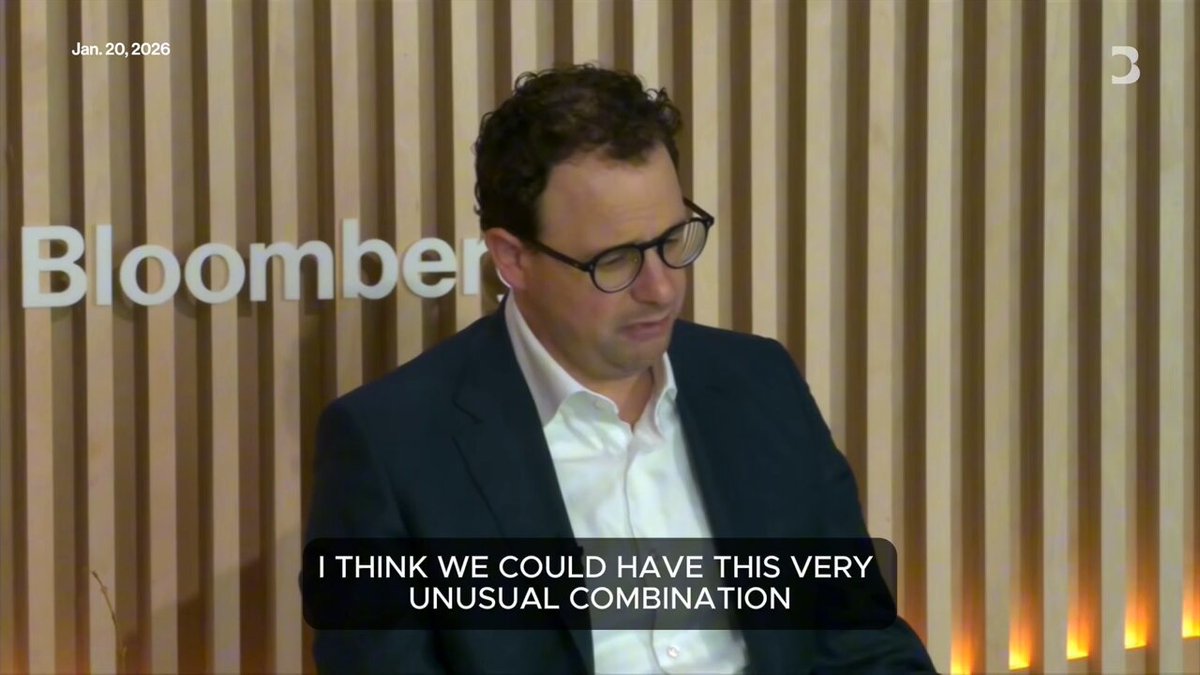
"I think we could have this very unusual combination of very fast GDP growth and high unemployment, or at least underemployment, a lot of low wage jobs, high inequality."
Read that again slowly.
The person building the most powerful AI in the world is not telling you everything will be fine. He is telling you the economy could boom at the top while collapsing underneath.
He went further.
"You automate 90% of the job, great, people are 10 times more productive in the other 10%. But eventually it gets close to a hundred percent. Now the sequel to that is, well then you have to find something else for them to do."
That last sentence is doing a lot of work.
He is not saying jobs change. He is saying at some point there is nothing left to hand off. And then what.
Most CEOs in his position talk about new jobs being created. Dario is talking about what happens when that argument runs out.
He is building it. He is worried about it. He said so publicly.
That combination is rare.
44
32
121
16,483
Jun 11
Dario Amodei just fired back at everyone calling his job warnings doom marketing.
He did not take it quietly.
"I want to be really clear and push back hard against this. In every interview I talk about the possible ways to address these risks. I have five pages where I lay out the difference between tasks and jobs."
Jensen Huang said he was scaring people. Others said it was cheap marketing that benefits Anthropic.
His response was sharp.
"The idea that this is cheap marketing is itself cheap marketing. It's part of the disease of Silicon Valley. It's caught up in this social media world of three seconds."
That last line landed differently than I expected from a Silicon Valley CEO.
He is calling out the entire culture he operates inside. The three second clip economy. The incentive to reduce careful thinking into a take.
Then he said what his message actually is.
"My message is definitely not doom is coming. My message is this is something we should see coming, that we're worried about, and that we need to actually respond to positively."
There is a difference between warning people and scaring them.
He thinks he is doing the first. His critics think he is doing the second.
Both of them are right about something.
28
16
67
21,531
Jun 11
The 39% improvement in transfer communication quality shows how deeply Parloa thinks about real customer journeys.
Parloa’s platform doesn’t treat agents as isolated tools but as seamless parts of complex workflows.
This holistic approach is why Parloa stands out in the crowded AI agent space.
Jun 11

Introducing Parloa’s Agent Skills: a better way for CX leaders to connect AI agents to the enterprise systems they need to get real work done.
To resolve customer issues, your agent needs to talk to your CRM, booking engine, ticketing platform, and compliance requirements. These connections typically require significant engineering work, delaying AI agent go-lives.
To accelerate the deployment time, we built Agent Skills on MCP (Model Context Protocol). Now, business teams can configure full integration chains directly in Parloa’s AI Agent Management Platform (AMP), with no code or middleware:
> Time to build integrations drops from up to 4-8 weeks to a matter of hours
> Every tool call follows the same logic and self-heals when something goes wrong
> Success Conditions let you define what “done” means for each task and track real outcomes
> Every execution chain is auditable, retryable, and owned by your business team
The early results speak for themselves:
- 67-second reduction in average handle time
- 39% improvement in customer communication during call transfers
- 20% more reliable routing in multi-tool environments
Learn more about how Parloa’s Agent Skills work: parloa.com/blog/agent-skills…
9
778
Jun 10
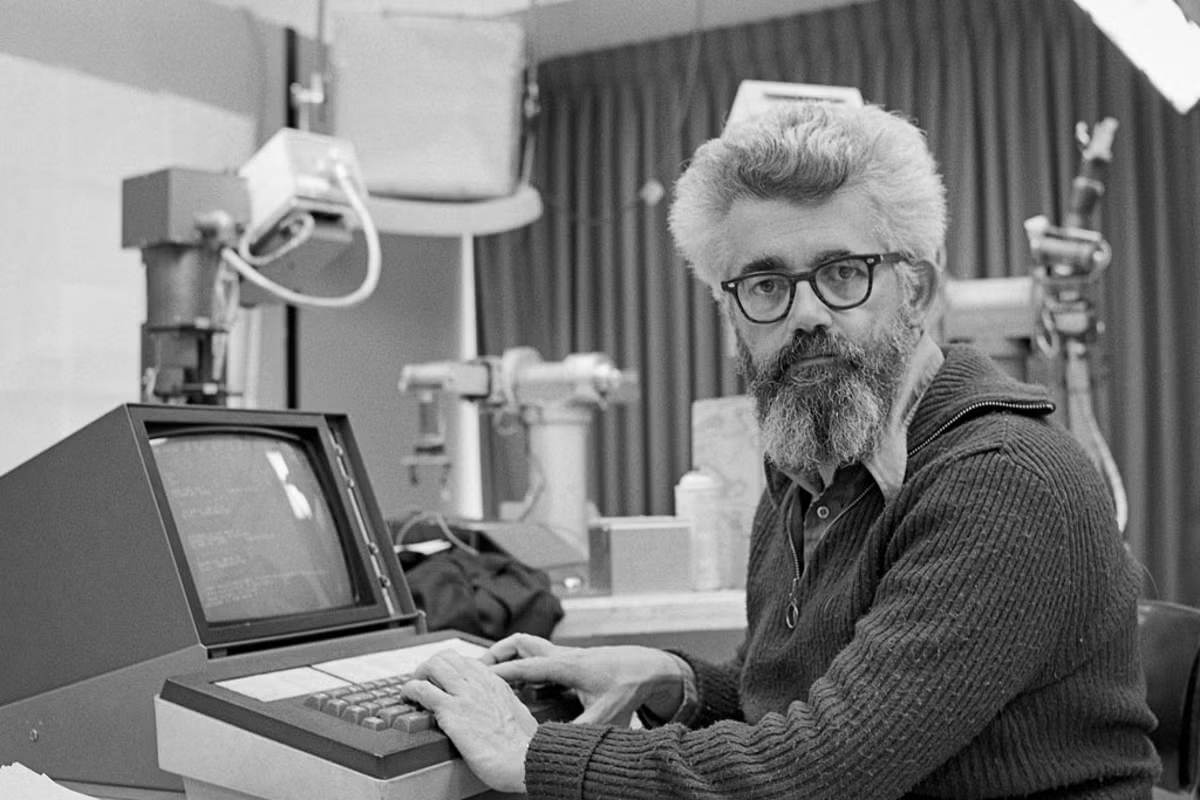
A mathematician coined the term "artificial intelligence" in 1955, built the language that dominated AI research for 30 years, and predicted cloud computing 40 years before AWS existed and almost nobody outside the field knows his name.
His name was John McCarthy.
He was born in Boston in 1927, earned his PhD in mathematics from Princeton in 1951, and spent the next 55 years working on a single question that most of his peers considered either impossible or insane.
Can a machine think?
In the summer of 1955, McCarthy sat down and wrote a two-page proposal for a workshop at Dartmouth College. The proposal opened with one sentence that changed everything: "every aspect of learning or any other feature of intelligence can in principle be so precisely described that a machine can be made to simulate it."
He needed a name for the field he was proposing. He chose "artificial intelligence." Before that document, no such field existed. After it, every researcher working on thinking machines had a name for what they were doing, a home discipline to publish in, and a founding document to point to. McCarthy did not just contribute to AI. He created the container it lives in.
The Dartmouth Conference ran for eight weeks in the summer of 1956. It was the moment AI became a real scientific discipline.
McCarthy kept building.
In 1958 he invented LISP, the second oldest high-level programming language still in use today, older only than FORTRAN by one year. LISP was designed for a specific purpose: symbolic reasoning. It could manipulate ideas, not just numbers.
It became the language every serious AI researcher wrote in for the next three decades. From 1958 through the late 1980s, if you were working on AI, you were almost certainly working in LISP.
Inside LISP he invented garbage collection in 1959, the technique that automatically frees up memory a program no longer needs. Java uses it. Python uses it. JavaScript uses it. Every modern language that manages memory automatically is using the idea McCarthy worked out while building LISP.
In 1961 he stood at a centennial celebration at MIT and said something that everyone in the room thought was science fiction. He proposed that computing would one day be delivered as a public utility, the same way electricity or water is delivered to a home. You would not own the computer. You would pay for access to it over a network.
AWS launched in 2006. Azure launched in 2010. Google Cloud launched in 2011. What McCarthy described in 1961 is now a trillion-dollar industry. He was 45 years early.
In 1962 he founded the Stanford Artificial Intelligence Laboratory, SAIL, which became one of the most important research centers in the history of the field. The researchers who trained there shaped the next 40 years of AI.
He won the Turing Award in 1971. The National Medal of Science in 1990. The Benjamin Franklin Medal in 2003.
He retired from Stanford in 2000. He died on October 24, 2011, at his home in Stanford, California. He was 84.
The researchers at OpenAI, Google DeepMind, and Anthropic building the models you use today are working in a field McCarthy named in 1955, using memory management he invented in 1959, inside an industry structure he predicted in 1961, toward a goal he spent his entire career insisting was not only possible but inevitable.
He was right about all of it.
He just did not live to see the part where the rest of the world finally believed him.
23
197
585
28,599
Jun 10
TikTok and short form content in general are destroying the part of the human brain that separates you from a drug addict, and a Chinese neuroscientist caught the damage on EEG for the first time.
His name is Yuzheng Hu.
He works at Zhejiang University in Hangzhou, inside the Department of Psychology and Behavioral Sciences.
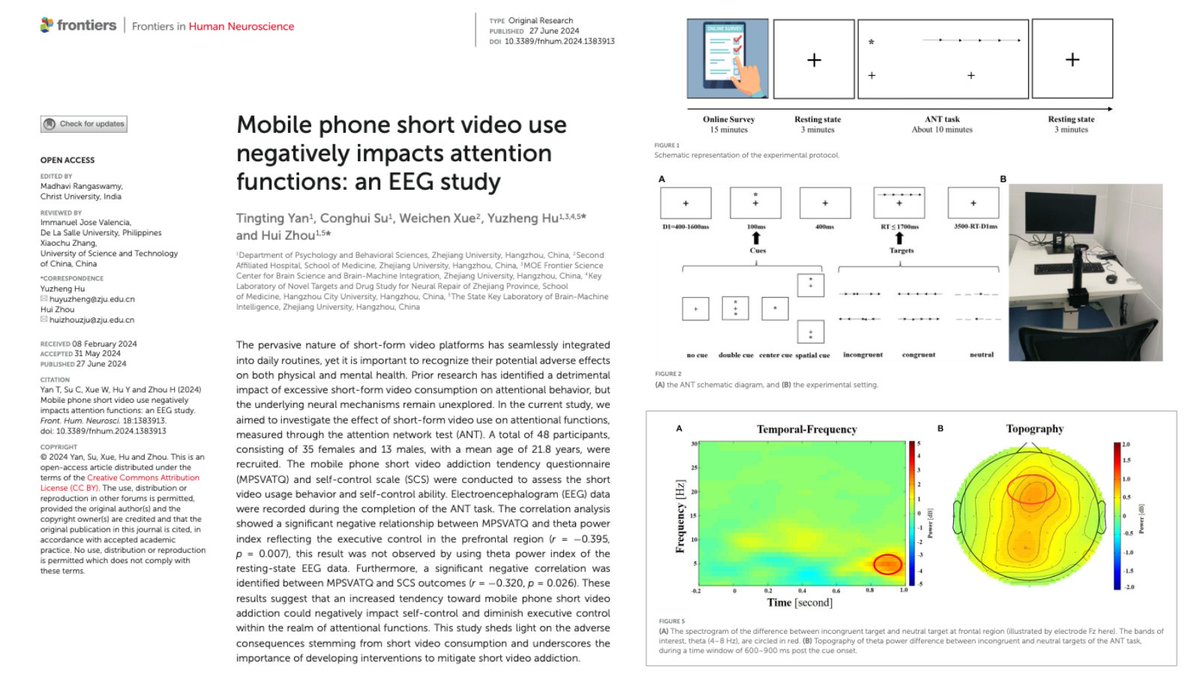
The paper was published in Frontiers in Human Neuroscience in June 2024, and the finding is brutal enough that it should have changed how every parent thinks about handing a child a phone.
The experiment was simple. His team recruited 48 healthy adults who used short-form video apps daily on their phones, then sat each of them in a shielded laboratory room with their chin secured in a chinrest.
Each participant wore a 64-electrode EEG cap with the international 10-20 sensor placement used in clinical neuroscience research. The brain activity was sampled 1,000 times per second while they worked through a cognitive task designed to measure three separate attention systems at once.
The task is called the Attention Network Test, and it has been the gold standard for measuring human attention for over 20 years. It tests three things in parallel. Alerting, which is your ability to stay vigilant. Orienting, which is your ability to lock onto the right thing in space. And executive control, which is the part of your attention that resolves conflict, suppresses distraction, and overrides impulse. Executive control is the system that lets a surgeon ignore noise in the operating room, an athlete tune out a crowd, a student stay focused on a problem when their phone buzzes in their pocket.
Before the EEG, every participant filled out the Mobile Phone Short Video Addiction Tendency Questionnaire, which scores how compulsively a person uses short-form video apps. They also filled out the Self Control Scale, a standard measure of how well someone can regulate their own impulses across daily life.
Then the team looked at the theta brain waves in the frontal region of the cortex during the moments of the task that required the most cognitive control, which is the exact part of the brain responsible for executive function in every human being.
The result was clean and devastating. The more addicted a person was to short-form video, the weaker their frontal theta activity became during conflict. The correlation was negative, the statistics held up after controlling for age, gender, anxiety, and depression, and the same pattern did not show up in resting-state recordings, which means the damage was not a general personality difference but something that switched on the moment the brain was asked to do hard mental work.
The brain region that lit up the weakest in heavy users was the prefrontal cortex, the region responsible for self-control, planning, impulse suppression, and the ability to delay gratification.
The reason this finding is alarming is what neuroscientists already know about that exact region in other forms of addiction. The paper directly compared the EEG pattern to studies of heroin users, internet gaming addicts, and people with Facebook addiction. The same prefrontal weakness shows up in all of them. The brains of heavy short-form video users are showing the same neurological signature as people whose lives are being destroyed by chemical addiction.
The participants in the study were not extreme cases. They were healthy young adults, average age 21, with normal jobs and normal lives. None of them thought they had a problem. The damage was already there.
The mechanism the researchers proposed is the part that should change how you live. Short-form videos are perfectly engineered to bypass the prefrontal cortex. They demand no patience, no sustained attention, no resistance to impulse, no top-down control of any kind. Each clip is short enough that the brain is rewarded before executive control ever has to switch on, and the algorithm hands the user the next dopamine hit before they ever have to decide to seek it.
Over time the regions that never have to fire stop firing as well. The brain follows the same rule as every other system in the human body. Use it or lose it. Short-form video is a perfectly designed machine for letting you not use the part of yourself you most need to keep using.
The team also found that addiction tendency was strongly correlated with weaker self-control across daily life on the questionnaire. The brain damage was matched by behavioral damage. People who scrolled more reported lower control over their own impulses, their own eating, their own emotional reactions, their own ability to follow through on the things that mattered to them.
The most haunting line in the entire paper is the one near the end where the authors say short-form video content engages the lower-order emotional regions of the brain while suppressing the higher-order regions responsible for self-control and attention. In plain language, the content is talking directly to the part of you that wants pleasure right now, and quietly silencing the part of you that knows better.
You can feel this happening to you in real time if you have ever opened TikTok for one video and looked up forty-five minutes later. That moment is not a failure of willpower. It is the prefrontal cortex going offline because the app was built to make sure it never had to come online in the first place.
The brain you scroll with is not the brain you use to make important decisions. And the more you scroll, the weaker the second one gets.
There is no patch for this. There is no biohack. The only fix is to stop letting the algorithm train your brain to skip the part of itself that makes you a human being instead of a feed.
Most people will keep scrolling tonight anyway.
7
19
45
2,926