
Joined January 2018
- Tweets 3,477
- Following 97
- Followers 380
- Likes 9,226
224 Photos and videos















Jay Hunter retweeted

Jun 5
Well, I did warn that Zcash ($ZEC) was developed from technology originating at Tel Aviv University, involved a venture-funded private company that charged a 15% founders’ tax on mining, had prominent Zionist investors such as Barry Silbert, and relied on assurances from Zionists such as Peter Todd that the keys had been destroyed.
Based on those factors, I viewed it as a questionable Mossad honeypot.
You can search my history for warnings about this one.
Jun 5

JUST IN: Zcash crashes 48% after Claude AI finds critical vulnerability allowing unlimited minting of $ZEC.
It went unnoticed for 4 years until it was patched on June 1st.


263
545
3,971
515,755
Jay Hunter retweeted

Apr 13
🎶if u block me, I block u🎶
436
2,780
13,760
1,069,584
Jay Hunter retweeted

Mar 17
After much reflection, I have decided to resign from my position as Director of the National Counterterrorism Center, effective today.
I cannot in good conscience support the ongoing war in Iran. Iran posed no imminent threat to our nation, and it is clear that we started this war due to pressure from Israel and its powerful American lobby.
It has been an honor serving under @POTUS and @DNIGabbard and leading the professionals at NCTC.
May God bless America.

72,377
215,632
839,994
103,460,002

Jay Hunter retweeted

2 Dec 2025
$DEXTF just flipped the switch to full deflationary mode and nobody’s ready for what’s coming 🔥
Every single bridge tx on Memento Bridge now permanently burns $DEXTF on the source chain.
You move liquidity cross-chain → supply shrinks forever.
That’s not marketing, that’s baked into the protocol.
Now every Ethereum → Polygon, Ethereum → Base, Ethereum → Avalanche move makes it scarcer in real time.
Smart money sees it:
▪️Supply
▪️Institutional inflows on Memento ZKChain
Breakout retest happening right now on the chart.
When this thing rips again it’s not crawling back to previous highs… it’s launching.
Built different. Institutions are quietly stacking.
1 Dec 2025

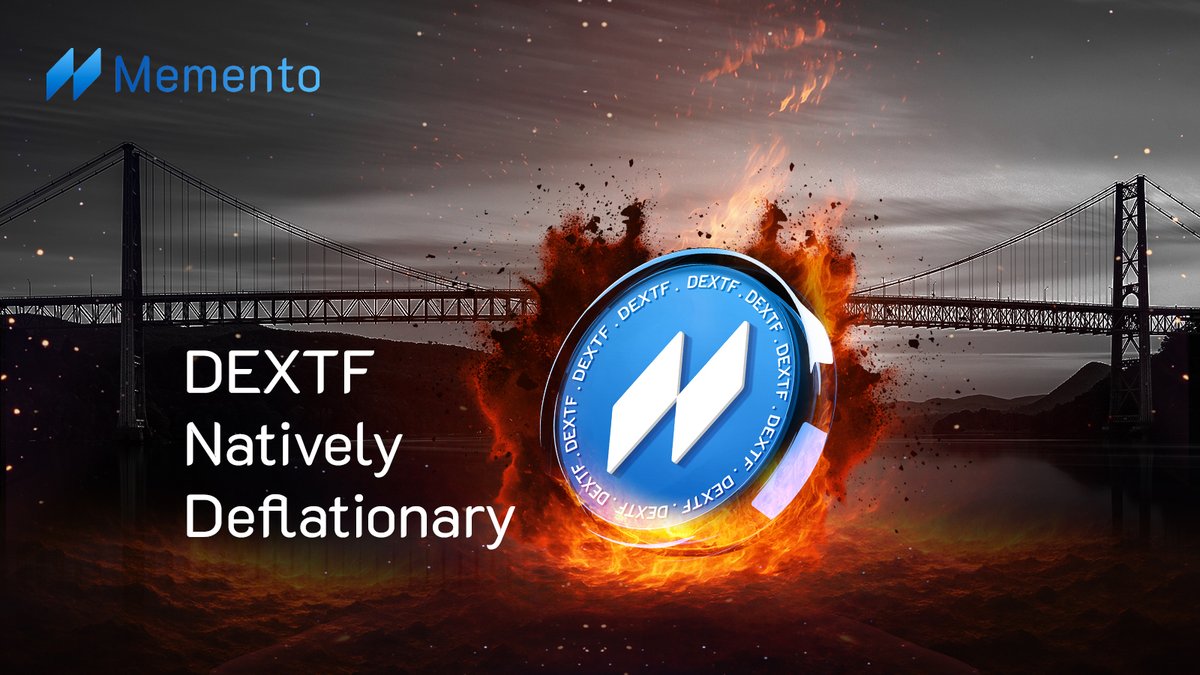
Introducing Protocol-Level Supply Burn for DEXTF 🔥
Every bridge transaction on our Memento Bridge dApp permanently reduces $DEXTF supply through built-in cross-chain burn mechanism.
Native deflation is here 📉
Bridge-and-Burn: bridge.dextf.com
5
12
66
5,398
Jay Hunter retweeted

1 Dec 2025
Introducing Protocol-Level Supply Burn for DEXTF 🔥
Every bridge transaction on our Memento Bridge dApp permanently reduces $DEXTF supply through built-in cross-chain burn mechanism.
Native deflation is here 📉
Bridge-and-Burn: bridge.dextf.com
16
30
96
20,466
Jay Hunter retweeted
26 Nov 2025
JP MORGAN APPLIES TO LAUNCH NEW BITCOIN-BACKED BOND
The Financial Industrial Complex (FIC) has rolled out yet another speculative, leveraged paper product designed to wedge itself between you and your Bitcoin.
The FIC is now openly testing a full suite of Bitcoin-linked financial instruments engineered for maximum price manipulation, fee extraction, and volatility harvesting.
This is another vasselizing strategy to part you from your Bitcoin especially if you borrow against it or trade with leverage.
These tools exist to trigger margin calls on Bitcoin-backed loans, force sell pressure from Bitcoin treasury companies in down markets, and create manufactured buy pressure in up markets so the FIC can position themselves long before the public even realises the game has begun.
They can’t print Bitcoin, so they print Bitcoin paper instead.
They want the upside of volatility while pushing retail into wrappers, treasury products, loans, synthetic notes, ETFs, and leveraged structures where they control the rules, the liquidity, the flow, and the outcomes.
Whoever believed the FIC entering Bitcoin would create stability was mistaken.
The FIC does not want stability, the FIC survives on volatility & gamblers.
Market makers and exchanges have historically done this, but now the FIC is doing it on a global scale and on steroids.
JP Morgan’s latest proposed leveraged structured note using BlackRock’s Bitcoin ETF is the perfect example: a complex, asymmetric bet where they can call the note early if it benefits them, extend it if it benefits them, cap your freedom but not theirs, and harvest volatility every step of the way.
If Bitcoin drops 40%, you take the damage. If Bitcoin explodes by 2028, they capture the liquidity, the data, the fees, and the structural advantage while handing you a taxable coupon dressed up as “exposure.”
This is the FIC probing how far they can push short-term price signals using Bitcoin financial paper while Bitcoin itself remains unprintable, uncensorable, and unalterable.
They cannot manipulate the long-term fixed supply, so they weaponize the short term.
And one more point:
You don’t fight the FIC by buying Strategy $MSTR shares.
That’s just another instrument they have already vassalized as part of their toolkit for influence and price games.
The real resistance is simple:
Self-custody.
Long-term accumulation.
No leverage.
No wrappers.
No Bitcoin IOUs.
Just real Bitcoin held by real people.
That’s how you win and that’s how you starve the FIC of the Bitcoin they are desperate to siphon away from you.


24 Nov 2025

JP Morgan vs Strategy
A debate erupted with two opposing narratives about Strategy $MSTR
One group claims MSTR is about to go bankrupt
The other claims MSTR is taking on JP Morgan & threatening the financial order
Both of these narratives miss the structural reality of how the Financial-Industrial Complex (FIC) works
Coming from someone who worked in investment banking & understands how these systems are designed from the inside, neither of these interpretations reflect what is likely to occur
People assume the world’s largest corporations like Apple, NVIDIA & Microsoft are corporate giants that dictate global outcomes. But strategically, they are not sovereign, they are operators inside the FIC, which controls them through proxy voting blocs, credit windows, index structures, underwriting monopolies, export controls, regulatory chokepoints & political capital allocation
Corporations control operational decisions (products, engineering, marketing), but they do not control strategic direction (capital flows, refinancing, geopolitical alignment)
At the strategic level, FIC sets the boundaries
This is the lens through which MSTR must be understood
None of this is personal to Michael Saylor
This is what happens when a finite-game corporate entity depends on the FIC’s capital markets while holding an infinite-game monetary asset
In sovereign finance, creditor institutions vassalize nations by pairing infinite sovereign horizons with finite recurring liabilities
Nations rarely default; instead, their debt is rolled over forever, creating permanent influence over policy
The power comes not from taking the asset, but from controlling the vehicle
Strategy faces a similar structural tension
Bitcoin represents the infinite game (no maturity date, no counterparty & long-term network resilience)
MSTR is the finite vehicle (quarterly earnings, debt maturities, refinancing schedules, index eligibility & institutional shareholder expectations)
That asymmetry makes MSTR exposed to the FIC weaponry that governs the finite game: short interest, derivatives, index exclusion, collateral rules, liquidity channels & broker-dealer influence
MSTR is not about to collapse, because the FIC does not benefit from its collapse
MSTR is not taking on the system, because structurally it cannot
The FIC benefits most when MSTR stays alive, not because they support Bitcoin, but because MSTR serves as a highly effective tool for applying short-term finite-game pressure on infinite-game Bitcoin
Bitcoin itself cannot be disciplined, but the corporate wrapper holding 649,870 BTC can
It’s a leveraged proxy, a potential forced seller under certain conditions, & a vehicle for sentiment manipulation
These features make MSTR more useful alive than dead
Because its obligations exceed its cash flow, it remains perpetually dependent on FIC’s financing windows, a textbook form of structural vassalization
Structurally, it is far more likely to function as a tool for Wall Street than as an opponent to it
The FIC does not need to destroy MSTR. It needs MSTR to continue existing as an instrument through which the finite-game FIC can influence short-term Bitcoin dynamics
You cannot beat Wall Street in the short-term finite game (nobody can), but you can l win the long-term infinite game
Bitcoin cannot be manipulated over multi-year horizons
Fiat markets can distort, pressure, or amplify short-term noise, but cannot change Bitcoin’s long-term trajectory
On long time horizons, Bitcoin’s incentives overpower every short-term mechanism deployed against it
The real battle is not “Strategy vs JPMorgan”
The real battle is derivative, money, stock, crypto & bond printers v Bitcoin in self-custody
We do not beat FIC by trading against it
We beat it by exiting it entirely
We beat it through long-term holding & self-custody
The FIC manipulates finite games; Bitcoin rewards infinite-game players
Bitcoin is the infinite game
Self-custody is how we win it

113
342
1,595
528,653
Jay Hunter retweeted

21 Nov 2025
281
973
3,378
2,227,000
Jay Hunter retweeted
13 Nov 2025
Looking forward to tomorrow's showcase of DAMA 2 on Memento ZK Chain mainnet at @DeutscheBank office!
We will be demoing our market-ready fund tokenization infrastructure to Deutsche Bank's institutional clients 🏛️
$DEXTF
7 Nov 2025
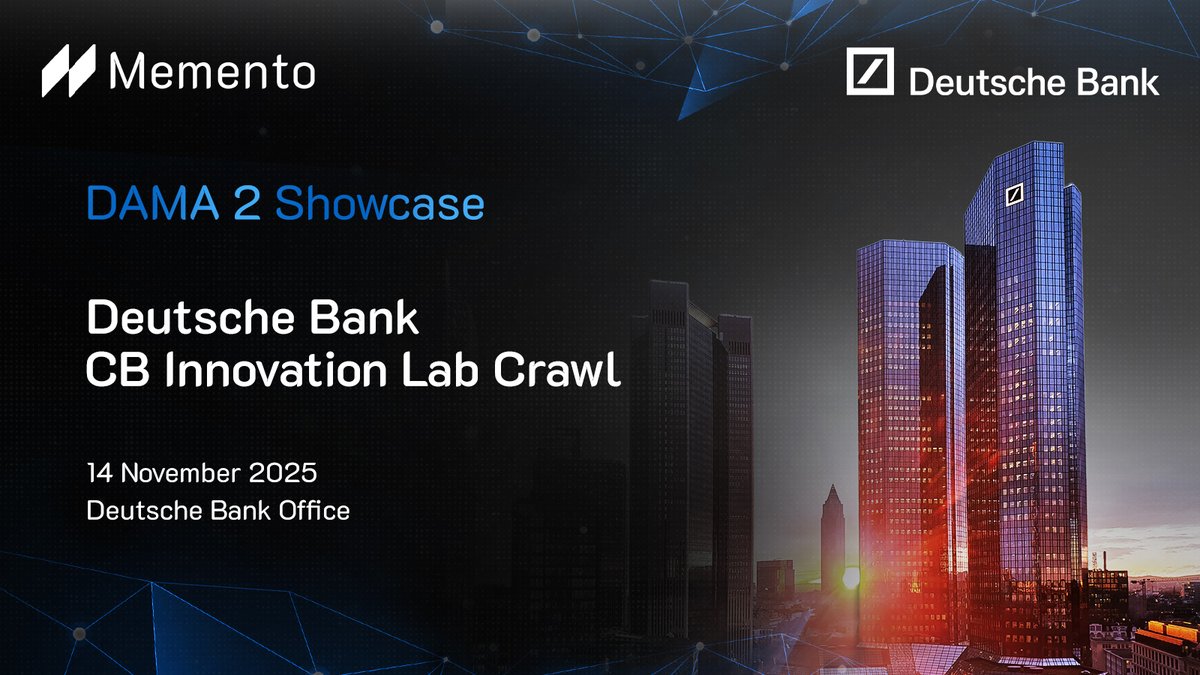
Deutsche Bank invited us to showcase the market-ready DAMA 2 on Memento ZK Chain mainnet at their exclusive "CB Innovation Lab Crawl" at their office!
Excited to demo our fund tokenization infrastructure to @DeutscheBank's institutional clients on 14 November 🏛️
$DEXTF
19
34
116
8,139

We’re already seeing the first Prividium production deployment: @Memento_Bc, a compliance-focused chain built with @DeutscheBank to bring fund servicing and reconciliation onchain.
Many more chains are on testnet already.
6
18
76
2,988
Jay Hunter retweeted
10 Nov 2025
Honored to have been invited to the Italian Embassy in Singapore today 🇮🇹🇸🇬
We presented Memento's institutional-grade infrastructure and shared details about our participation in Project Guardian to an Italian delegation at @ItalyinSG 🏛️
$DEXTF

19
36
134
15,792

10 Nov 2025
Guess its finally time for $LYX to lift off and start the rocket engines - upwards.
The foundation is more than solid, the use case unique, the team world class.
Time for some recognition and market appreciation.
3
5
53
1,489
Jay Hunter retweeted

7 Nov 2025
16
30
95
14,157
Jay Hunter retweeted
7 Nov 2025
Deutsche Bank invited us to showcase the market-ready DAMA 2 on Memento ZK Chain mainnet at their exclusive "CB Innovation Lab Crawl" at their office!
Excited to demo our fund tokenization infrastructure to @DeutscheBank's institutional clients on 14 November 🏛️
$DEXTF
22
45
140
42,074
5 Nov 2025
$RAIL will pump soon and organically.
No shitty CEXes manipulating the prices, no unnecessary dilution, just fair good tech getting adopted in a massive way.
Enjoy the ride!
1
6
214
Jay Hunter retweeted
5 Nov 2025
Bigger Than Previous Funds COMBINED!
The Third TradFi RWA Fund is now tokenized on Memento ZK Chain 🏛️
On track to onboarding Billions in TradFi funds onchain.
$DEXTF
37
65
200
94,550
Jay Hunter retweeted

2 Nov 2025
I am happy to see $ICP getting some recognition. It’s a great infrastructure that will play also a future role for @ERC725Account and @lukso_io
In September we’ve spent some time in their offices and meeting @dominic_w again after some time.
Dom was also was present when I created ERC725 at a workshop organized by @tomserres and @BWarburg 🖇️

34
205
764
175,957
Jay Hunter retweeted
3 Nov 2025
A reminder that tomorrow we're joining the panel with @PIMCO, @zksync and Mindful Wealth, moderated by @DeutscheBank!
We're excited to share our insights about onchain asset management and Project DAMA with a full house of 100 industry participants 🏛️
Looking forward to making new connections and onboarding new institutional clients to Memento ZK Chain 🤝
$DEXTF

11
27
99
17,983
Jay Hunter retweeted
29 Oct 2025
A token that directly captures value from institutional blockchain adoption in an institutions-driven cycle! 🏛️
... That is $DEXTF!
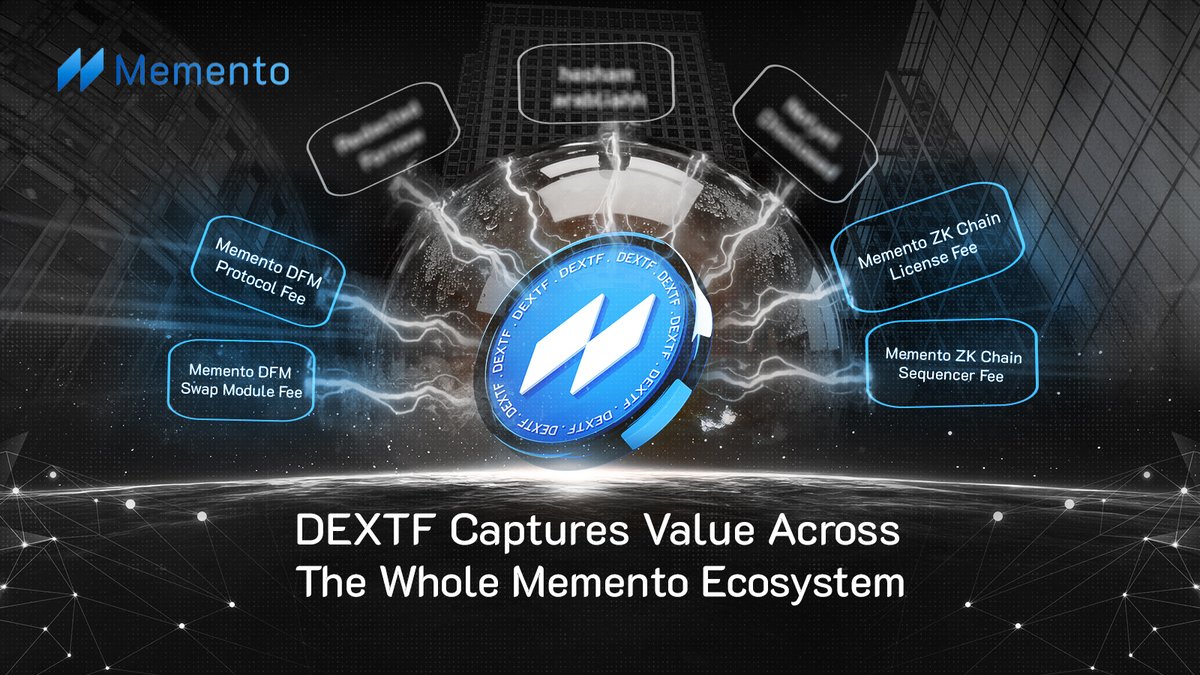
ALL revenue streams in the Memento ecosystem will drive $DEXTF value. Not some. Not most. ALL of them.
1⃣ Memento ZK Chain Sequencer Fee
2⃣ Memento ZK Chain License Fee
3⃣ Memento DFM Protocol Fee
4⃣ Memento DFM Swap Module Fee
5⃣ ▓▓▓▓▓▓▓▓▓▓▓▓▓
6⃣ ▓▓▓▓▓▓▓▓▓▓▓▓▓
7⃣ ▓▓▓▓▓▓▓▓▓▓▓▓▓
Redacted revenue streams to be announced! 👀
24
45
137
37,561