
970 Photos and videos
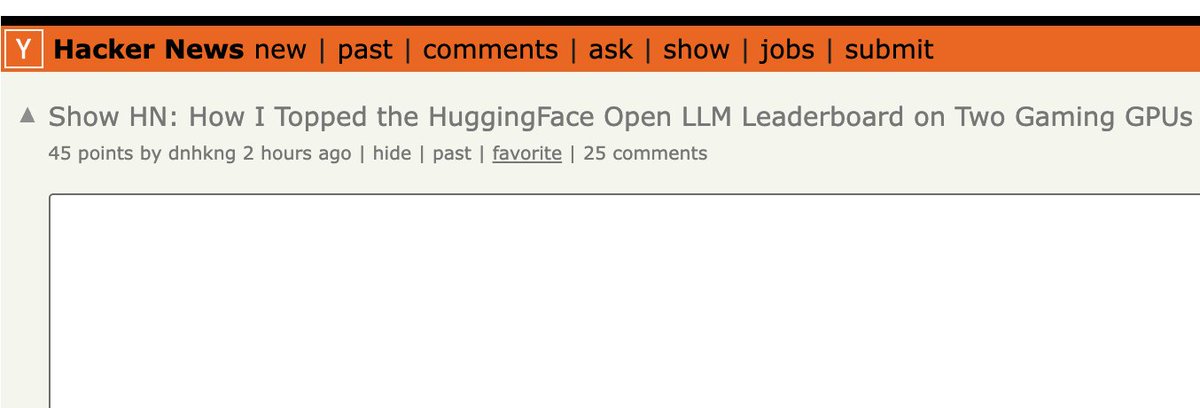

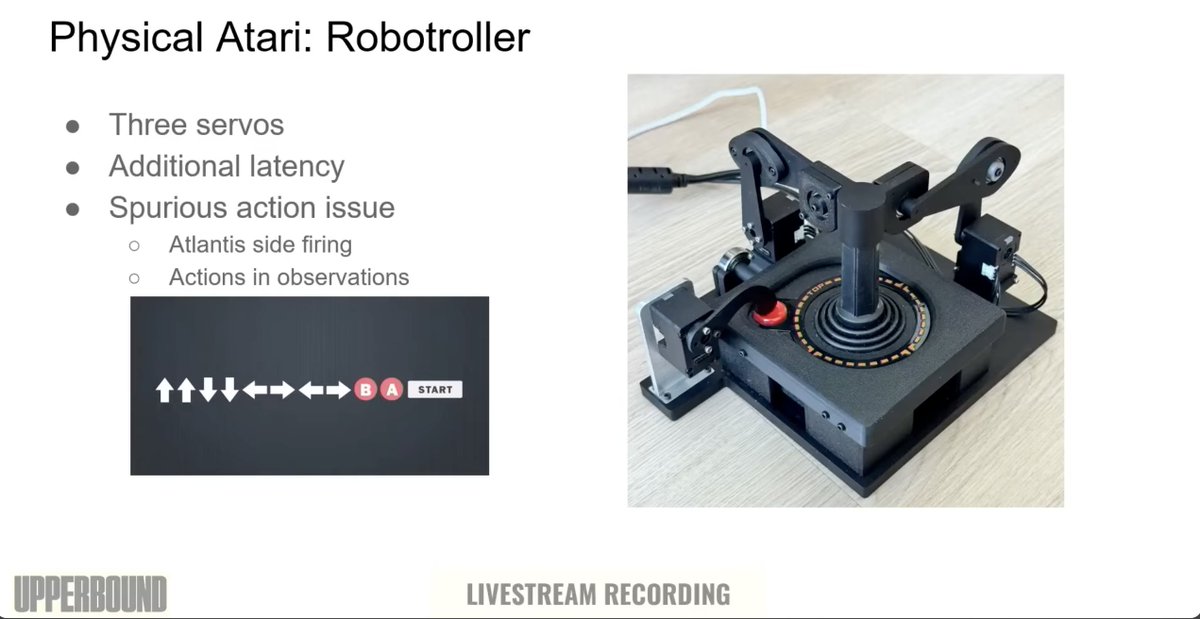










man, if you want to do anything remotely meaningful
the amount of NOs you have to tell yourself is nauseating
every day, 10 times/day I get some idea - "wouldn't it be cool to..." ...yeah, no
if you're serious about doing great work you're allowed exactly one desire at a time
4
14
854
i think every founder suffers from same disease
"the overoptimistic underestimating brain"
i have never yet in my founder journey woken up and thought "oh wow that took less than I thought and was as easy as I thought"
it's always: "we planned too much, we can do 1/10th maybe if we get lucky and really try"
which is why focus is so important
radical focus means you choose the 1/10th that actually matters
so stay focused
3
1
18
1,574
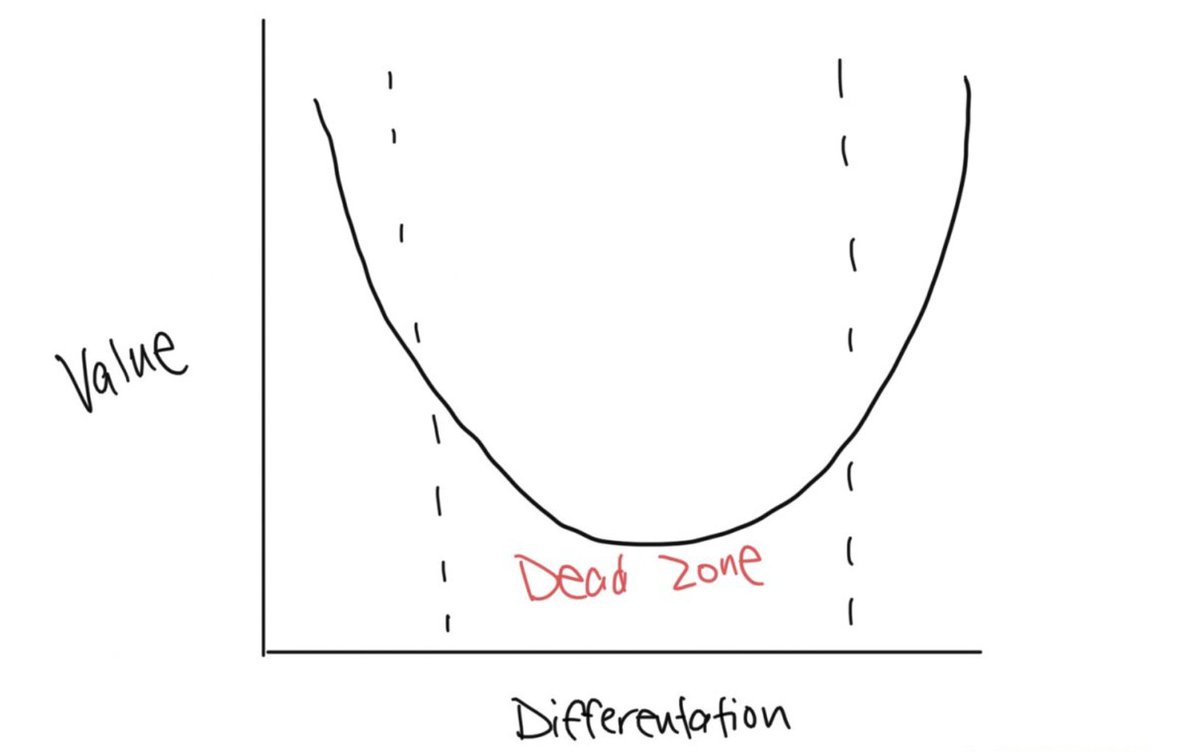
Duopolies are everywhere, not just crypto
Apple (nice but closed) - Android (open but less ncie)
Windows (functional but sucks) - Mac (designery but eg cant play games)
Solana (fast, trades off decentralization) - Eth (decentralized but slow)
This makes sense because you can take any product category and draw a line of preferences from A to B, and duopolies occupy the extremes

We have been crunching numbers around revenue and valuations within the industry. Last day, I shipped a long-form observing how and where crypto generates its revenue.
Here are four charts that explain the state of the industry.
1. Crypto is indeed a game of extreme power laws
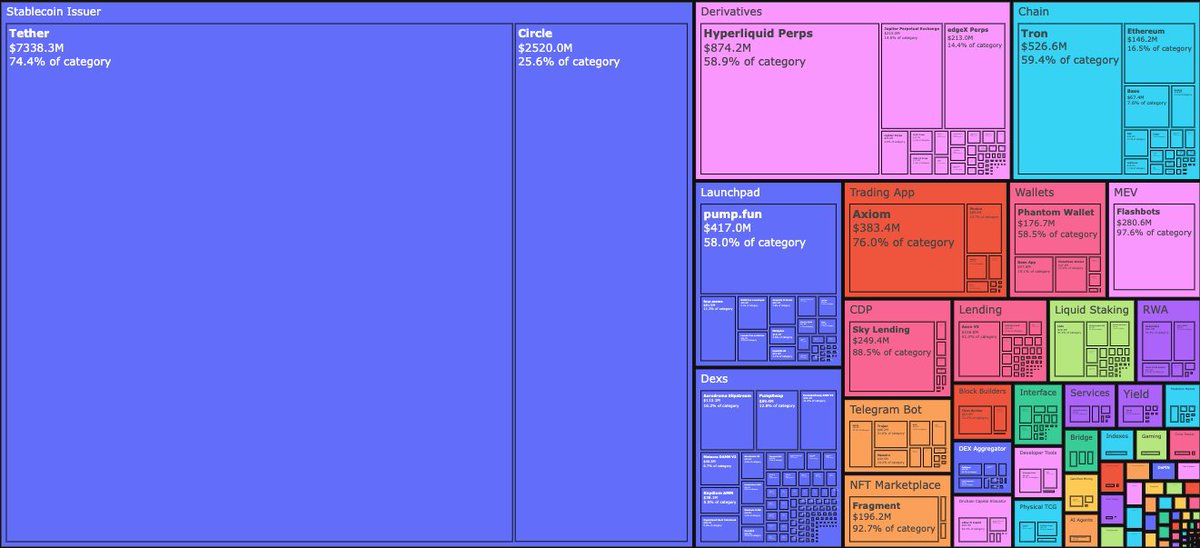
Since 2020, crypto has generated ±$74.8B in verifiable revenue. This is a mix of t-bills income, trading fees and protocol revenue. The vast majority of it in the past year, came through stablecoins. Circle and tether account for ±98% of all stablecoin revenue. $0.34 of every dollar made (from defillama's data set) goes to a stablecoin firm.
It is fairly apparent that there is latent demand for on-chain dollars and that is why we see an entire economy of VCs and founders flocking to the payments and fintech angle for blockchains. I am not entirely sold on what down-stream monetisation for neobanks look like, esp with Meta coming into the stablecoins game, but there is demand is what is apparent.
The 18 months between Jan of 2024 and June of 2025, saw half of all crypto revenue being generated. We were in an upward trajectory for revenue for a good while before the temporary cooling that has come in the past few quarters.
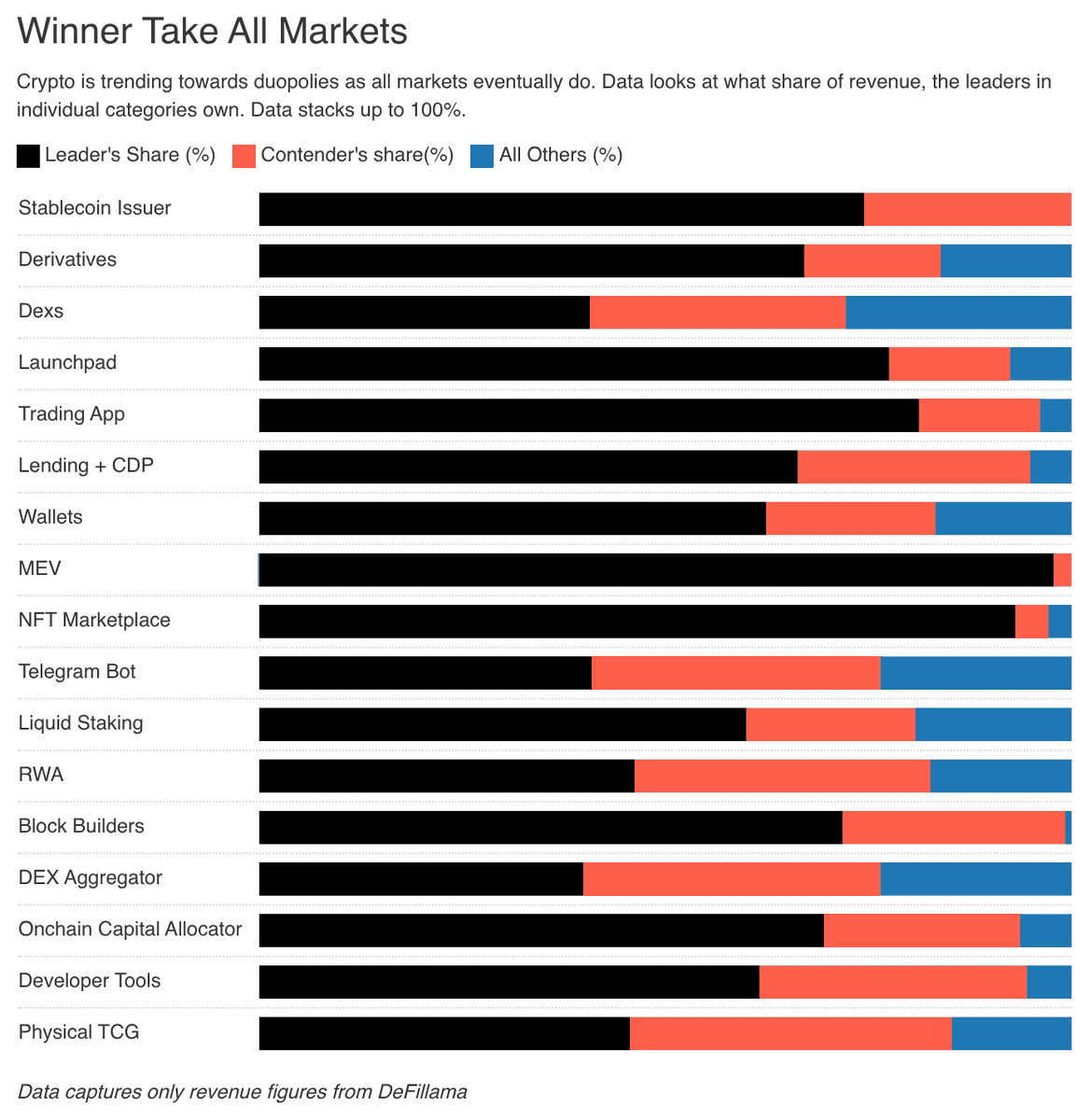
2. Duopolies are the norm
The lack of latent competition in multiple sectors have made an industry of duopolies. Across the top 15 sectors, combining the top two in terms of revenue, would quickly reveal that close to 80% of most revenue generating sectors are taken up by two firms.
We may not see more competition unless there are two factors playing
- more venture enables small, nimble teams to pursue large opportunities (like telegram bots) without tokens
- tokenised ventures bring fresh energy to established sectors and pursue latent leaders (like in perpetual dex)
Most founders presume there is no competition, when entrenched leaders are eating up $0.8 of every dollar produced. The long-tail is a scary place to be at.
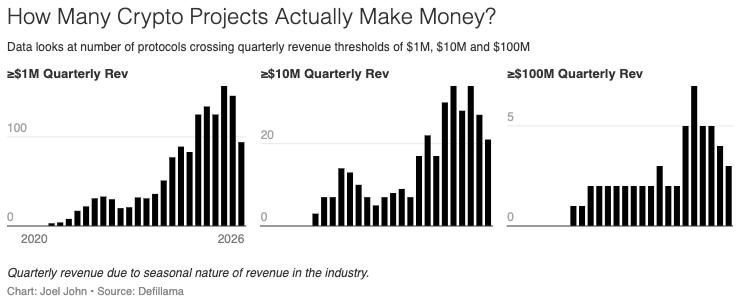
3. More firms generate revenue than ever before
There are close to 100 protocols/projects making over $1million in revenue. Many of these are small, nimble teams making trading interfaces or bots. Some of them are protocols that coordinate capital. It now takes shorter spurts of time to hit $1mil in revenue than ever before.
Part of the reason is the underlying stack evolving. Players like Solana, Privy and the network of on-ramps for stables make it considerably easier for founders to build, distribute and develop applications. The surface area for what small, mimble, privately held projects can do through retaining bulk of the revenue is barely explored. I have a hunch sectors like prediction markets will continue to help teams turn profitable faster.
Which tbf puts the role of a crypto VC into question. What do you do when teams don't need your capital? I have views, but perhaps best shared later.
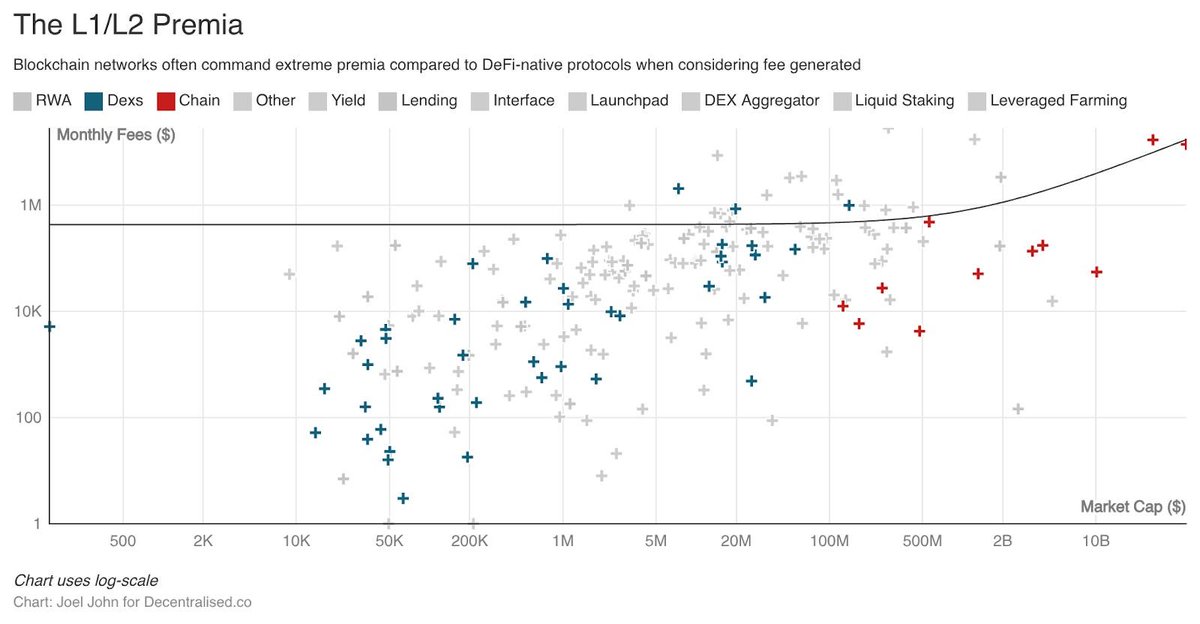
4. Decentralised Exchanges are considerably discounted compared to L1/L2
If you study the numbers, it quickly becomes apparent that there are DeFi primitives that do more in economic activity than most L2s but are considerably discounted. I think the market will reprice this entirely. There is a lot more bloodbath in L2-land. There is a lot of repricing to be had in DeFi.
With institutional capital entering the arena, there are good grounds for financial primitives to be valued higher. Most teams do not get an "integrity' premium but I have a hunch that this part of the cycle is where teams that were building since 2021, with treasury managed well begin dominating over random L2s that were grossly overvalued. Two key reasons for that. L2s were overvalued to begin with due to excess dry powder in '23/24 flowing towards them. In the two years since, many of them have sub $100 in daily revenue. Eventually markets will price that more aggressively.
Whole piece linked below if you'd like to follow the money
2
8
1,369
The biggest blocker to your dreams is yourself
Keep re-discovering this every year

The guy who wakes up at 10am and goes straight to his laptop
Will go further than the guy who wakes up at 6am, journals, meditates, and does everything except the actual WORK
Don't get caught in the self improvement trap without actually moving the needle
2
12
1,196
ilmoi retweeted

Mar 6
The robot is navigating the world previously mapped and reconstructed by phones.
10
27
201
12,535
One of the coolest companies in current batch
Check them out!
Mar 5

Origami Robotics is building high-DOF robotic hands with in-joint motors and a co-designed data-collection glove to eliminate the embodiment gap by collecting high-quality, real-world data at scale.
Congrats on the launch, @DanielXieee and @QuanliangX!
ycombinator.com/launches/Pcl…
1
4
1,305
ilmoi retweeted

Feb 26
Why does manipulation lag so far behind locomotion? New post on one piece we don't talk about enough: The gearbox. The Gap You've probably seen those dancing humanoid robots from Chinese New Year. Locomotion isn't entirely solved; but clearly it's on a trajectory. But we haven't seen anything close for manipulation. 𝗪𝗵𝘆? When sim-to-real transfer fails, the instinct is to blame the algorithm. Train bigger networks. Crank up domain randomization. Those approaches have made real progress; we don't deny that. But we started wondering: are we treating the symptom or the disease? The Hardware Bottleneck: Fingers are too small for powerful motors. So most hands use massive gearboxes (200:1, 288:1) to get enough torque. But those gearboxes break everything manipulation needs:
• Stiction and backlash are complex to simulate. Policies trained on smooth physics hallucinate when they hit that reality.
• Reflected inertia scales as N². At large gear ratio, the finger hits with sledgehammer momentum.
• Friction blocks force information. The hand becomes blind.
And they're the first thing to break. What we are trying to build at Origami, we cut the gear ratio from 288:1 to 15:1 using axial flux motors and thermal optimization. The transmission becomes more transparent: backdrivable, low friction, forces propagate to motor current. Early signs are encouraging. Still running quantitative benchmarks. Why Interactive? I love how Science Center uses interactive devices to explain complex ideas. I want to borrow this concept and help people understand the hard problems in robotics better visually. The post has demos where you can toggle friction, slide gear ratios, watch the sim-to-real gap widen in real-time. What's inside:
• Interactive demos (friction curves, N² scaling, contact patterns)
• Comparison table: 14 robot hands by sim-to-real gap and force transparency
• The math behind why low-ratio matters
Read it here: origami-robotics.com/blog/de… We're not claiming we've solved dexterity. The deadlock has many pieces. But we think this one's foundational. Curious what you think.

24
103
661
148,452
calling it: within 12mo @karpathy will QT this and say "it now works, agents actually optimize the NN to perfection"
Feb 27

I had the same thought so I've been playing with it in nanochat. E.g. here's 8 agents (4 claude, 4 codex), with 1 GPU each running nanochat experiments (trying to delete logit softcap without regression). The TLDR is that it doesn't work and it's a mess... but it's still very pretty to look at :)
I tried a few setups: 8 independent solo researchers, 1 chief scientist giving work to 8 junior researchers, etc. Each research program is a git branch, each scientist forks it into a feature branch, git worktrees for isolation, simple files for comms, skip Docker/VMs for simplicity atm (I find that instructions are enough to prevent interference). Research org runs in tmux window grids of interactive sessions (like Teams) so that it's pretty to look at, see their individual work, and "take over" if needed, i.e. no -p.
But ok the reason it doesn't work so far is that the agents' ideas are just pretty bad out of the box, even at highest intelligence. They don't think carefully though experiment design, they run a bit non-sensical variations, they don't create strong baselines and ablate things properly, they don't carefully control for runtime or flops. (just as an example, an agent yesterday "discovered" that increasing the hidden size of the network improves the validation loss, which is a totally spurious result given that a bigger network will have a lower validation loss in the infinite data regime, but then it also trains for a lot longer, it's not clear why I had to come in to point that out). They are very good at implementing any given well-scoped and described idea but they don't creatively generate them.
But the goal is that you are now programming an organization (e.g. a "research org") and its individual agents, so the "source code" is the collection of prompts, skills, tools, etc. and processes that make it up. E.g. a daily standup in the morning is now part of the "org code". And optimizing nanochat pretraining is just one of the many tasks (almost like an eval). Then - given an arbitrary task, how quickly does your research org generate progress on it?
2
12
2,171
I think this will upend the entire structure of white collar "tech" work.
Eg what is the role PMs? Do engineers become PMs? Do PMs become engineers? Do you really need both? What about designers? Can one person do all 3?
And what is defensible in this new world?
Skills probably aren't.
I think taste is probably most defensible. If you have good taste for customer problems in your area you'll be the best PM, the best engineer and the best designer.
Deep CS/math/physics knowledge is also defensible. Agents can do high level tasks, but if you're building anything serious (200ms trading systems, L1 blockchains, robots) you need deep technical knowhow.
Relationships probably are too. That's why I'm skeptical of the take "b2b saas is over". 90% of b2b saas is the CEO of F500 company knowing your name, not the software. It's not over, it's different.
Anyway, stuff's changing. Whatever you do, I would start tinkering with claude code or you'll be left behind.
Feb 25
It is hard to communicate how much programming has changed due to AI in the last 2 months: not gradually and over time in the "progress as usual" way, but specifically this last December. There are a number of asterisks but imo coding agents basically didn’t work before December and basically work since - the models have significantly higher quality, long-term coherence and tenacity and they can power through large and long tasks, well past enough that it is extremely disruptive to the default programming workflow.
Just to give an example, over the weekend I was building a local video analysis dashboard for the cameras of my home so I wrote: “Here is the local IP and username/password of my DGX Spark. Log in, set up ssh keys, set up vLLM, download and bench Qwen3-VL, set up a server endpoint to inference videos, a basic web ui dashboard, test everything, set it up with systemd, record memory notes for yourself and write up a markdown report for me”. The agent went off for ~30 minutes, ran into multiple issues, researched solutions online, resolved them one by one, wrote the code, tested it, debugged it, set up the services, and came back with the report and it was just done. I didn’t touch anything. All of this could easily have been a weekend project just 3 months ago but today it’s something you kick off and forget about for 30 minutes.
As a result, programming is becoming unrecognizable. You’re not typing computer code into an editor like the way things were since computers were invented, that era is over. You're spinning up AI agents, giving them tasks *in English* and managing and reviewing their work in parallel. The biggest prize is in figuring out how you can keep ascending the layers of abstraction to set up long-running orchestrator Claws with all of the right tools, memory and instructions that productively manage multiple parallel Code instances for you. The leverage achievable via top tier "agentic engineering" feels very high right now.
It’s not perfect, it needs high-level direction, judgement, taste, oversight, iteration and hints and ideas. It works a lot better in some scenarios than others (e.g. especially for tasks that are well-specified and where you can verify/test functionality). The key is to build intuition to decompose the task just right to hand off the parts that work and help out around the edges. But imo, this is nowhere near "business as usual" time in software.
1
11
2,160
ilmoi retweeted

Feb 23
🚨 BREAKTHROUGH:
Scientists just 3D printed a Fully Functional electric motor for about $0.50, in only 3 hours.
MIT Researchers have developed a breakthrough multi-material 3D printing system capable of producing fully functional electromechanical devices in one continuous process.
Using this platform, the team successfully printed a working electromagnetic linear motor in just a few hours, with material costs of roughly $0.50.
The printed linear motor converts electrical energy into straight-line motion and worked reliably as a proof-of-concept device.
This shows that complex electromechanical machines can be fabricated as a single object, not assembled from separate parts.
This does not mean entire cars can be 3D-printed on demand yet.
However, the technology points toward distributed manufacturing, where robotics components, replacement parts, and custom machines could be produced locally from digital designs.
Instead of shipping hardware across the world, factories, remote sites, or even space missions could manufacture functional devices exactly where and when they are needed.

22
142
504
29,195
ilmoi retweeted
Feb 21
People collect human demos to train robots, but the data is messy — mistakes, failed attempts, recovery behaviors. The fix? Hire people to watch hours of video and label what's good.
We asked: what if you could detect periodic patterns and do it all unsupervised?
Our method: ⚡ Training-free ⚡ No labels ⚡ Near-zero cost ⚡ Faster than GPT-4o / Gemini-2.5 Pro ⚡ Works across factories, exercise, delivery — zero parameter tuning
📄 Oral at WACV → We opensourced our code here: sites.google.com/view/period…
11
8
87
7,081