
research @messaricrypto | crypto venture ai maxi | deep dives & alfa
Joined December 2021
- Tweets 1,365
- Following 600
- Followers 4,537
- Likes 6,916
377 Photos and videos
Pinned Tweet
the monster has been unleashed. the $RAIL valuation report is live.
40 pages, 40 minute read.
messari.io/report/a-valuatio…
it is an enterprise report, so only @MessariCrypto enterprise clients have access. HOWEVER, let's break down the key points:
1) what is RAILGUN?
@RAILGUN_Project is onchain ZK privacy infra for EVM networks. it lets users transact on Ethereum, Arbitrum, Polygon, and BNB Chain without revealing wallet identity, balances, or transaction intent.
the protocol charges a 0.25% fee when assets enter or exit the privacy set (shield/unshield). all fees accrue onchain to the DAO treasury.
2% of the treasury is distributed to $RAIL stakers every two weeks, creating a direct link between usage, treasury growth, and staker cash flows.
2) how does RAILGUN work?
railgun lets users move assets from public ERC-20 balances into a shared private pool (shielding), then transact from that pool without revealing wallet identity, balances, or intent.
assets inside the pool aren’t account balances. they’re represented as private notes, proven valid with ZK proofs instead of being publicly readable onchain.
users keep their normal 0x address, but also generate a private railgun address (0zk…). private transactions are built in-wallet, proven locally, then executed onchain with no link back to the public wallet.
railgun is infrastructure, not a consumer wallet. wallets and apps integrate the railgun contracts and SDK to support private balances and private smart contract execution.
this design keeps users on Ethereum’s existing liquidity and apps, while adding privacy at the settlement layer.
3) what does railgun adoption and revenue look like?
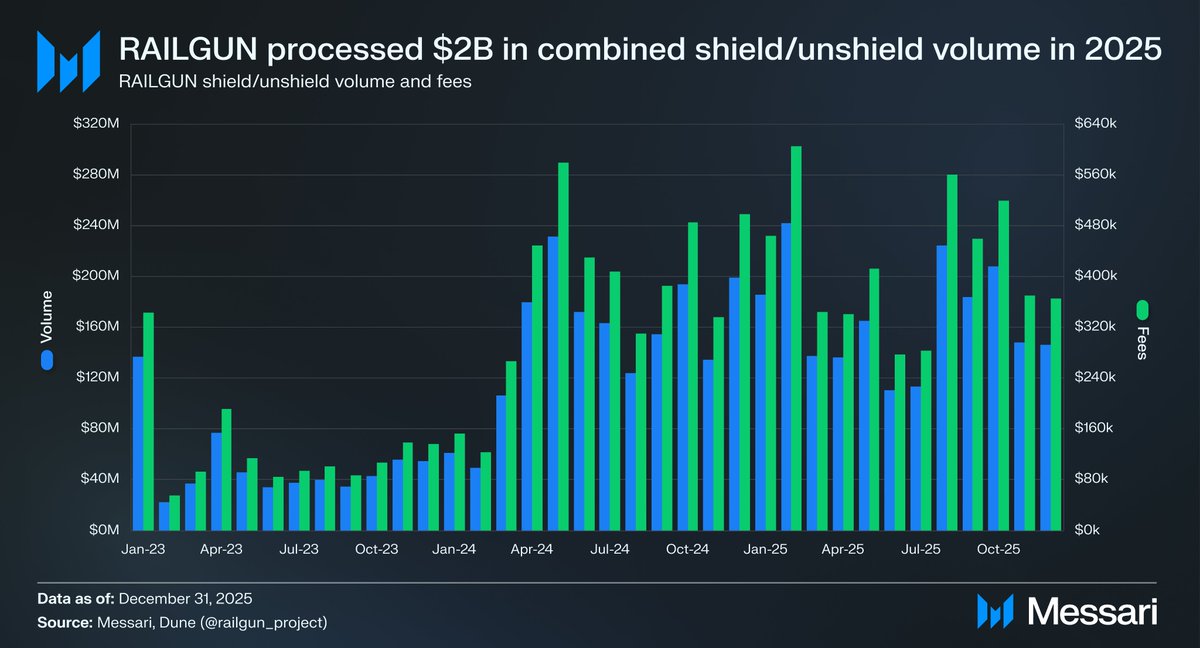
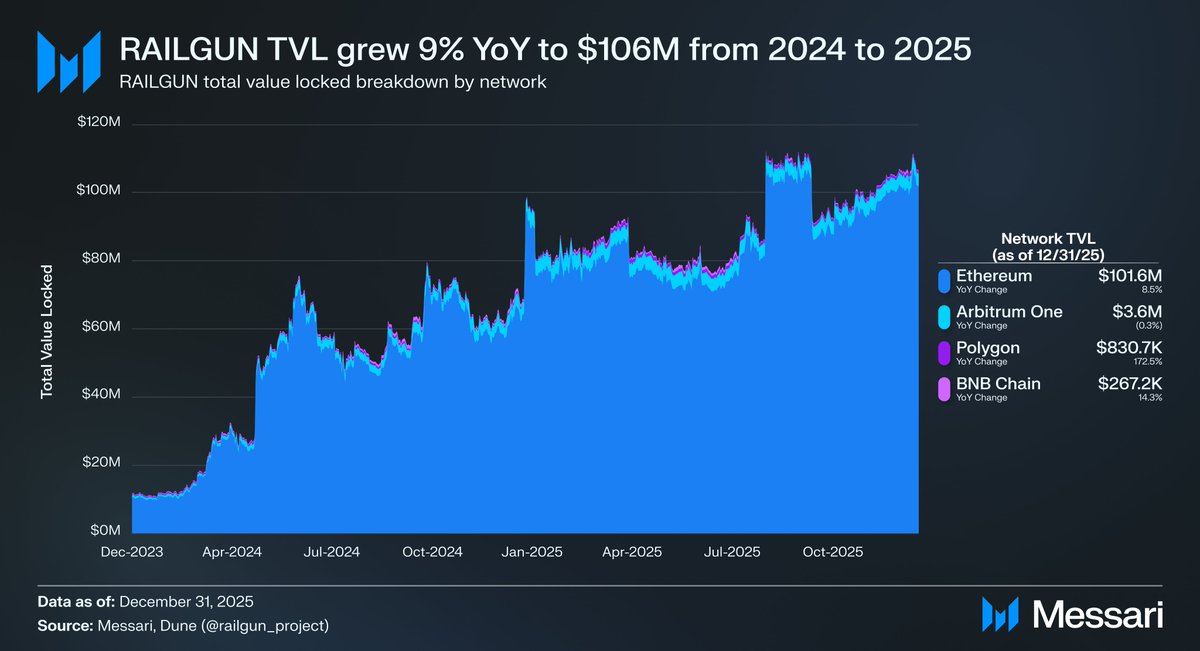
railgun processed $2b in combined shield/unshield volume in 2025. this generated the protocol $5M.
importantly, this revenue is earned without emissions, liquidity incentives, or subsidized activity. users are paying real fees for privacy.
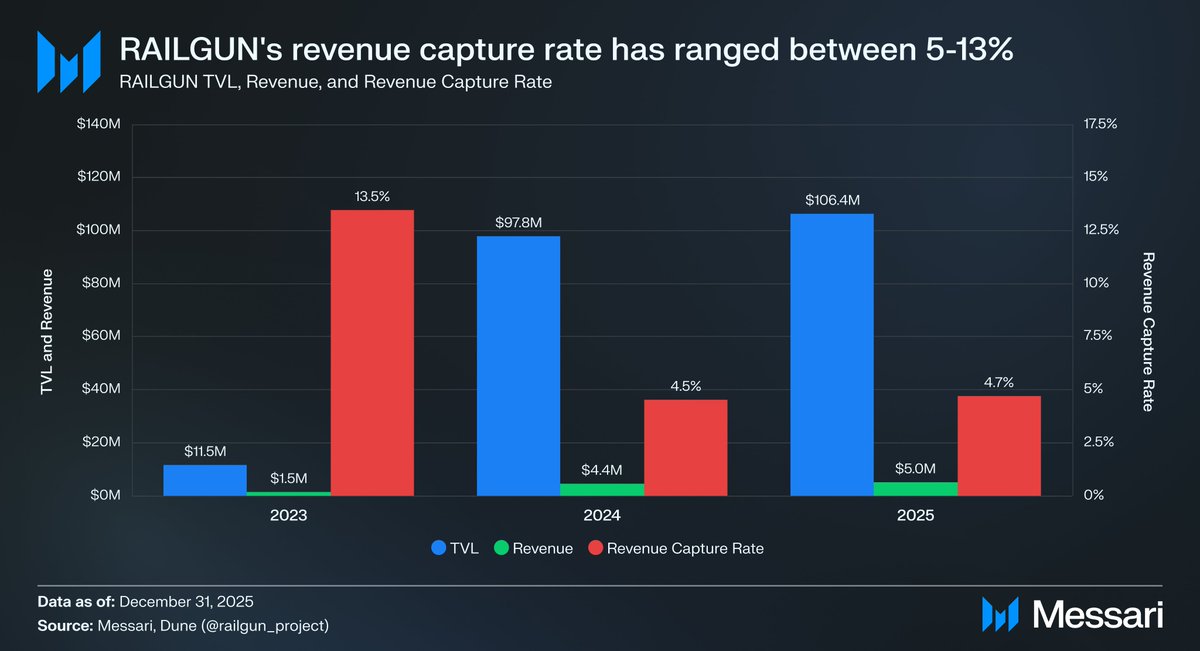
railgun captures nearly 5% of its TVL as revenue, materially higher than most DeFi infra protocols, which typically capture around 0.3-3%.
this reflects the transactional nature of privacy flows as railgun monetizes capital movement, not passive liquidity.
4) what is the Kohaku Wallet SDK and why does it matter for RAILGUN?
kohaku is an open-source wallet privacy SDK being developed under the @ethereumfndn. its goal is to make privacy native at the wallet layer, not a separate opt-in tool.
instead of users going out of their way to use a privacy protocol, wallets can integrate Kohaku and offer private balances and private transactions directly in normal wallet flows.
railgun is already integrated into Kohaku. that means railgun becomes part of default wallet transaction flows.
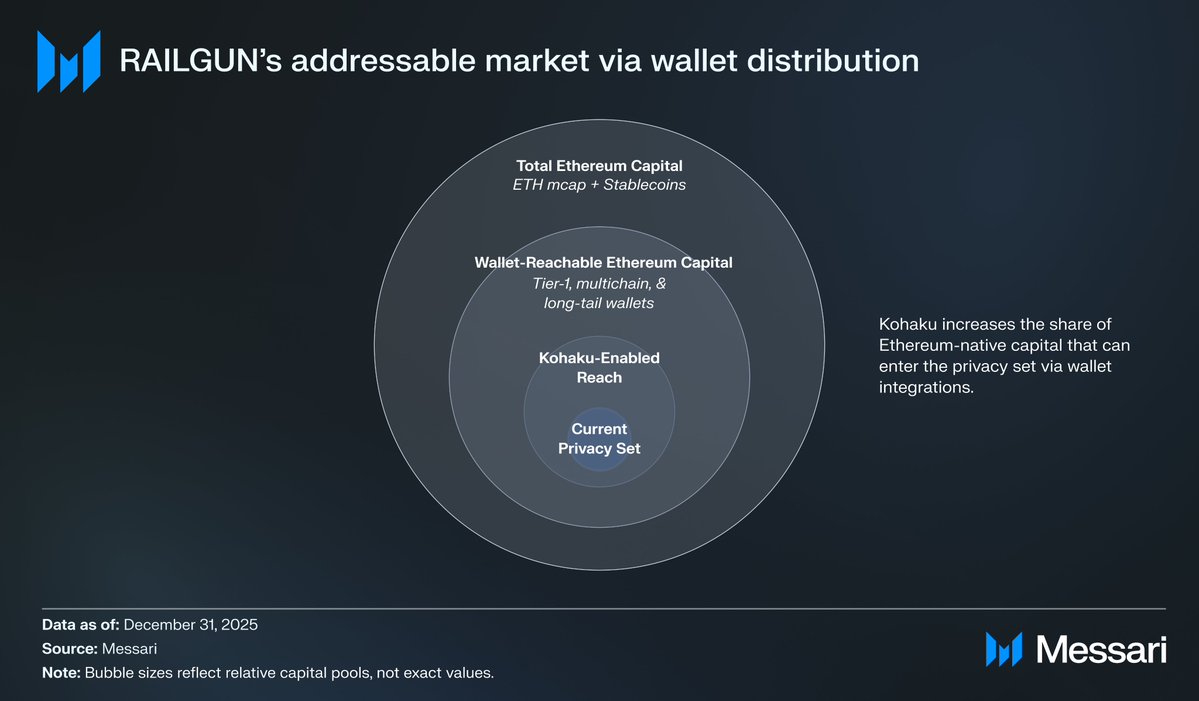
once Kohaku goes live and tier-1 wallets (like @MetaMask) start integrating it, railgun’s addressable market expands from users who actively seek privacy to a massive share of Ethereum’s wallet-reachable capital.
that shift, from niche tooling to default wallet infra, is the core driver behind the upside scenarios in my valuation.
5) how exactly did I value $RAIL?
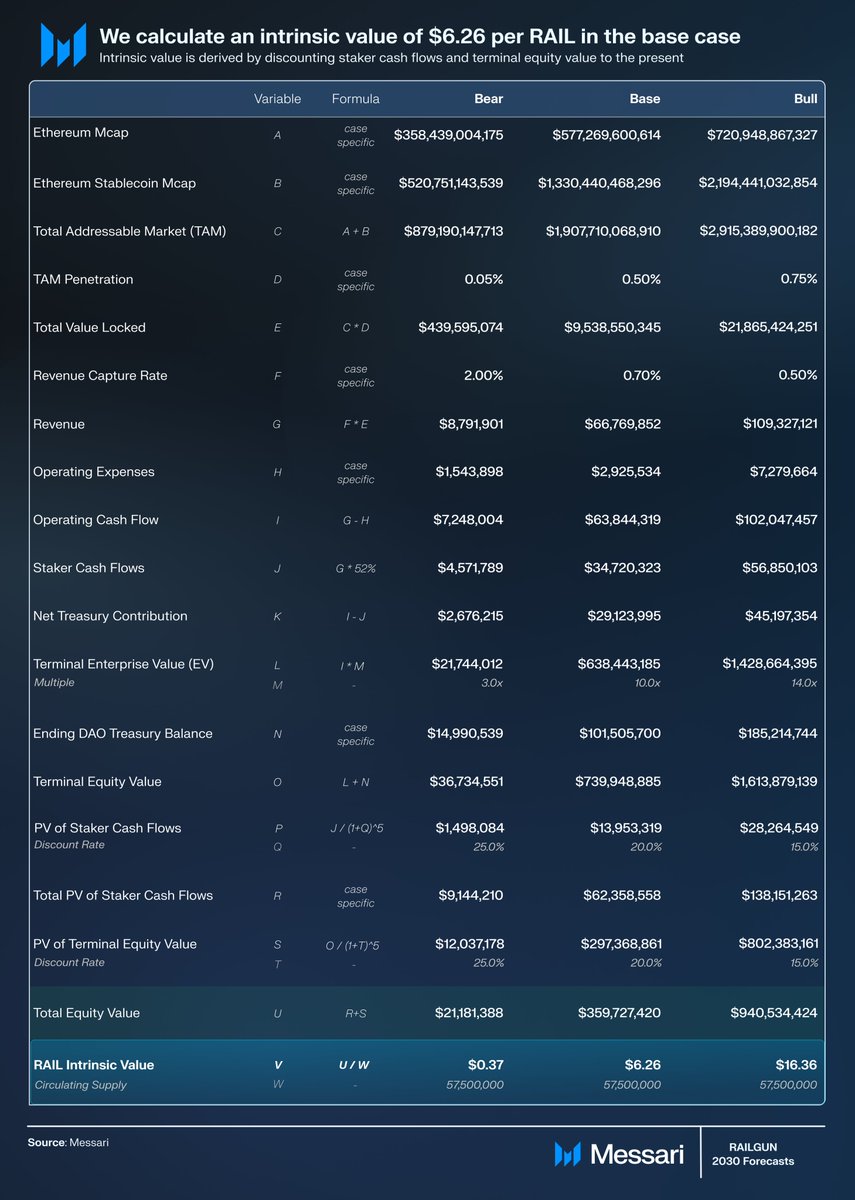
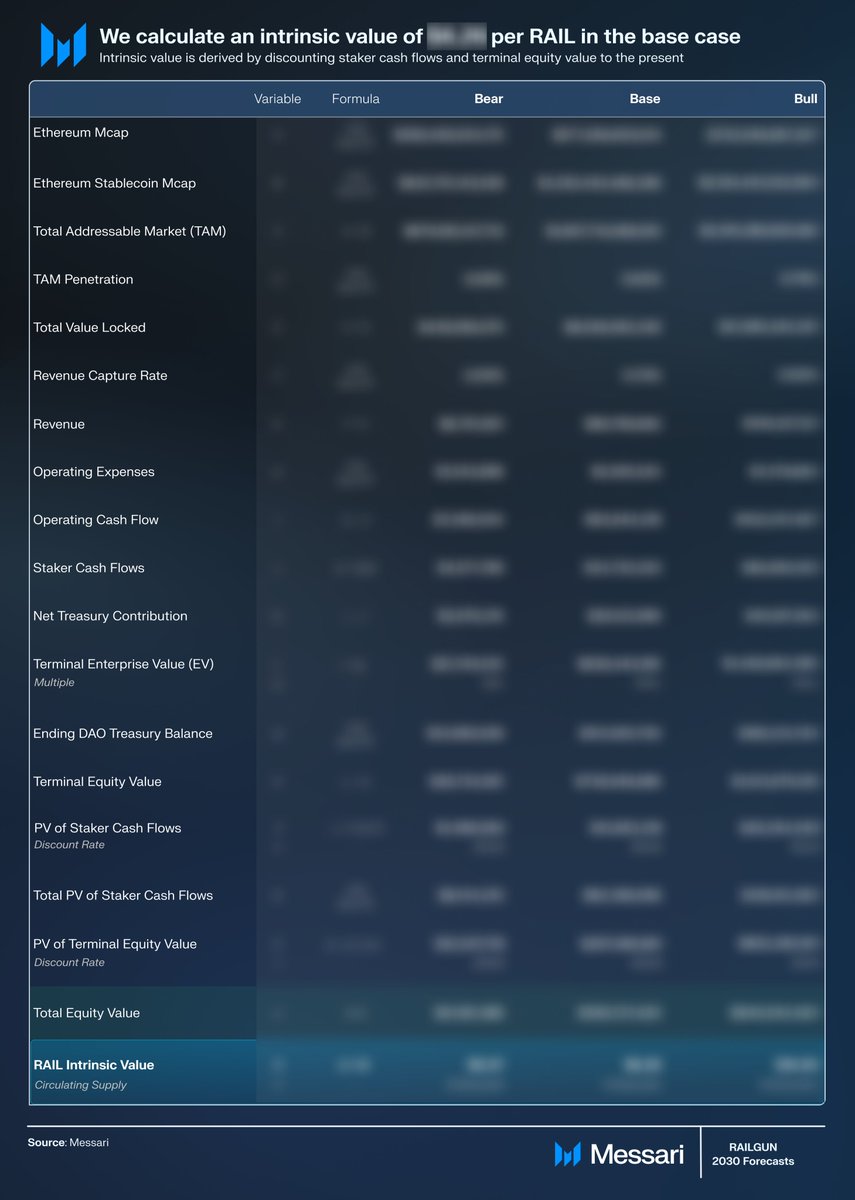
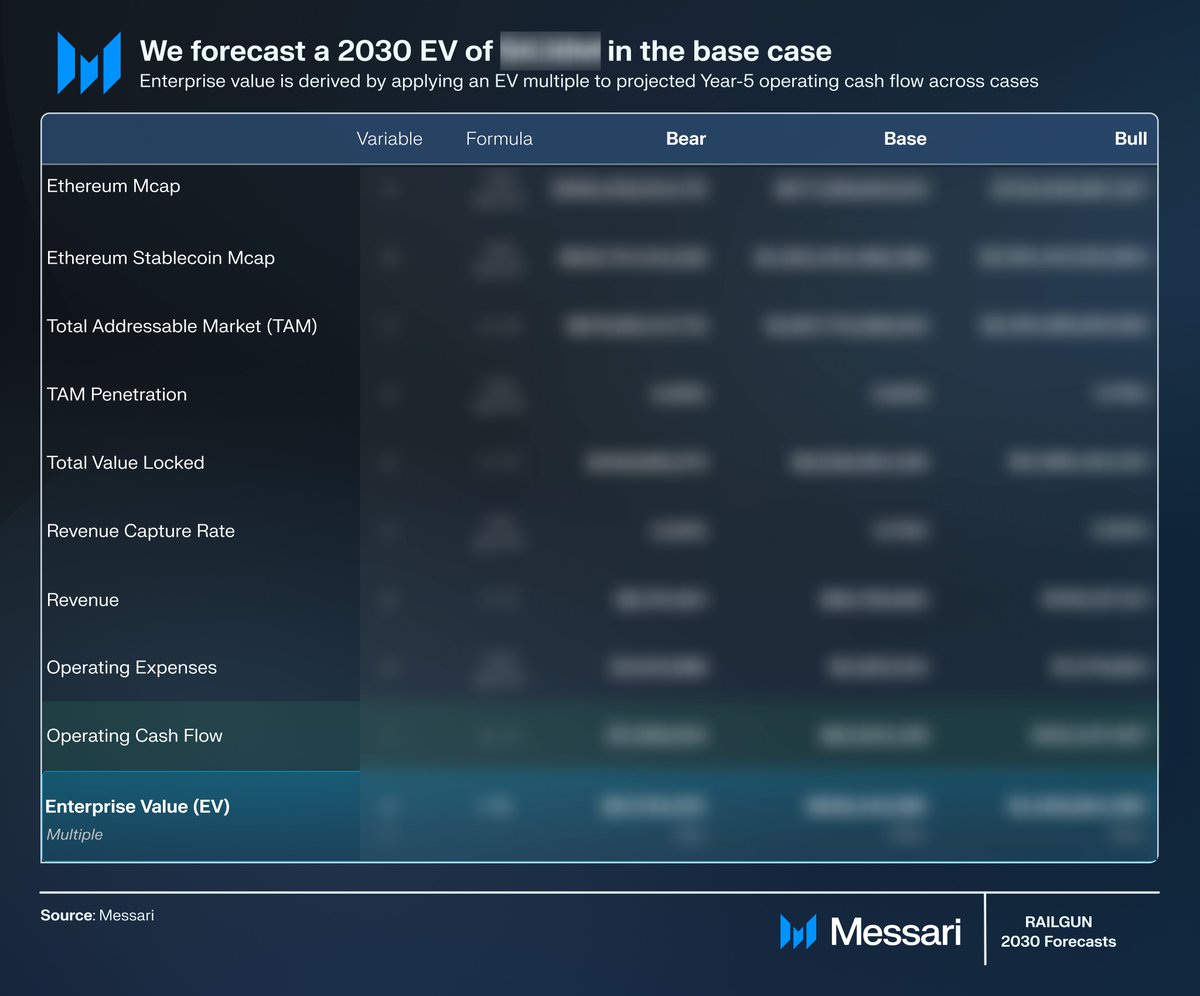
i start with Ethereum’s capital base (ETH market cap stablecoins), model how much of it migrates into RAILGUN’s privacy set over time, and translate that into revenue thru a declining capture rate.
revenue minus operating expenses = operating cash flow. ~52% gets paid to stakers, the rest accumulates in the DAO treasury, and i value both pieces (cash flows treasury) to arrive at intrinsic $RAIL per token.
the base case intrinsic value provides a clean and defensible anchor for what $RAIL should be worth if adoption plays out as modeled.
$RAIL's current price sits at a significant discount to that base case.
6) disclaimer: i hold $RAIL. this report is meant for informational purposes only. It is not meant to serve as investment advice.
7) railtardio.
- railgun quant

gm, my 40-page $RAIL valuation report drops tomorrow.
i spent 100 hours modeling how the upcoming Kohaku SDK will affect RAILGUN's total addressable market and revenues in bear, base, and bull scenarios.
because RAILGUN distributes ~52% of protocol revenue to $RAIL stakers and retains the remaining 48% in a DAO-owned treasury, I was able to build a clean valuation chain:
Ethereum capital growth → RAILGUN adoption → protocol revenue → operating cash flow → staker distributions treasury value → enterprise value → equity value → intrinsic $RAIL price
the first half of the report is the most detailed deep dive on RAILGUN out there, breaking down its tech stack, adoption metrics, and Kohaku integration.
the second half takes you step-by-step through the valuation model and ends on a well-defined, defensible $RAIL intrinsic price.
current price vs. modeled intrinsic price gap is insane.
- railgun quant
44
46
237
71,911
Jake Koch-Gallup retweeted

Jun 1
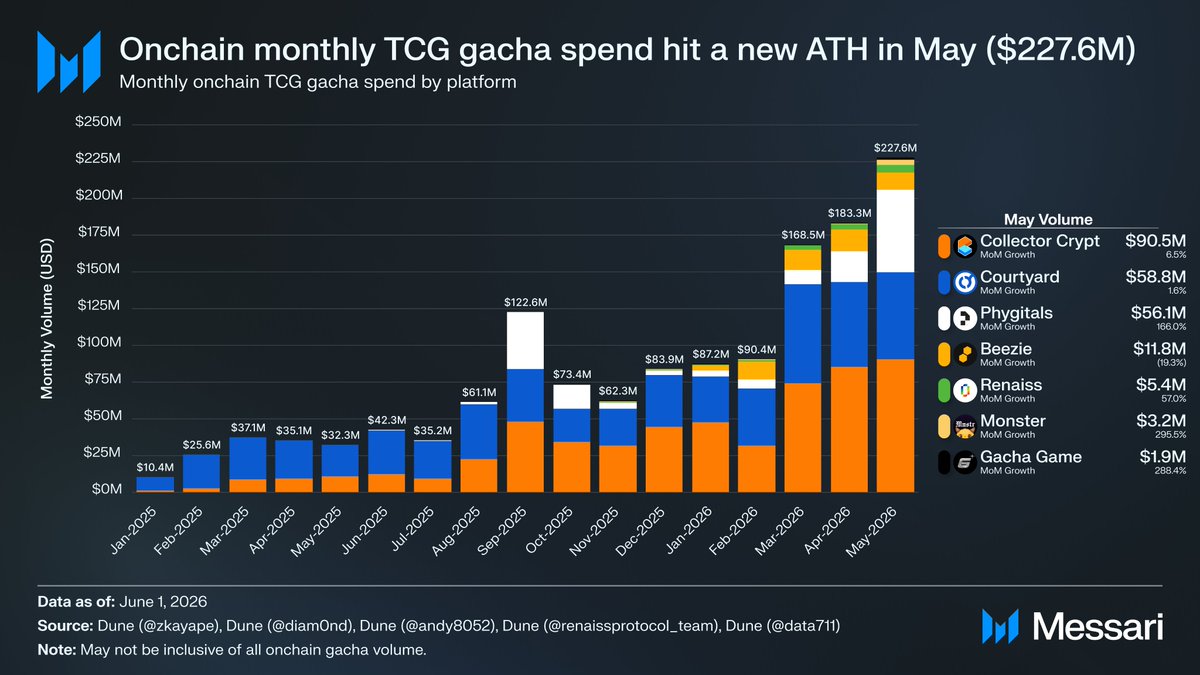
🚨NEW ATH FOR ONCHAIN GACHAS🚨
After setting ATHs in spend volume in both March ($148.6M) and April ($184.0M), the sector set another ATH in May at $227.6 million (24% MoM growth)!
The top 7 TCG platforms by May spend:
1) @Collector_Crypt - $90.5M
2) @Courtyard_io - $58.8M
3) @phygitals - $56.1M
4) @Beezie - $11.8M
5) @renaissxyz - $5.4M
6) @mnstr - $3.2M
7) @gacha_game_ - $1.9M
Onchain gachas are going vertical!
55
53
304
90,310

May 31
this is exactly why crypto regulation matters.
if we want tokenholders to capture the value created by businesses, teams need clearer rules around buybacks, revenue sharing, and other value accrual mechanisms.
right now, a lot of teams are operating in a gray area.
the CLARITY Act, for example, would provide a framework for tokens to avoid being treated as securities, giving teams more flexibility to align tokenholder value with business performance.
May 30

Ive said this in discord and on podcasts a few times. We neither confirm nor deny buybacks, and we will only disclose buybacks after the fact. We believe if there were a sandbox with regulatory clarity that $cards would be a great platform to demonstrate how a strong FCF company in crypto can return value to holders.
There are SEC things involved here unfortunately; there are no promises being made, and for meow, the token is worthless and for entertainment purposes only.
2
17
2,649
May 30
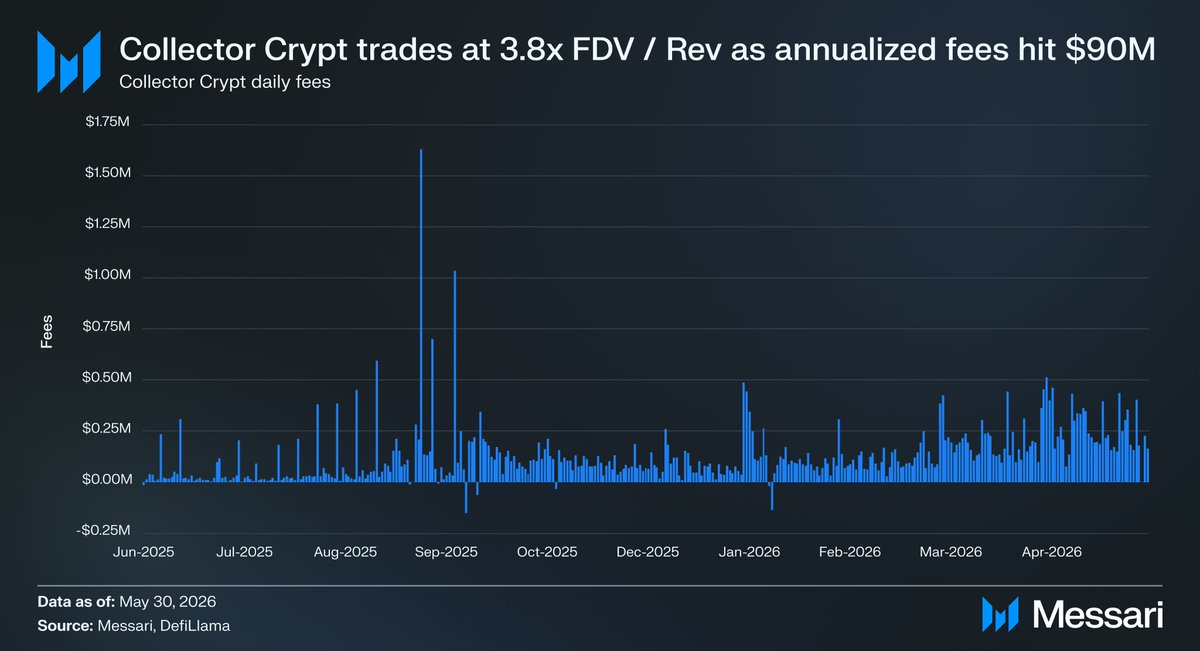
hard not to be bullish @Collector_Crypt.
$7.4m revenue over the last 30d, $90m annualized revenue, and only $345m FDV.
that is 3.8x FDV / annualized revenue for one of the fastest-growing, breakout consumer apps.
but the issue is token value capture.
there is treasury reinvestment and a lot of discussion around solana:CARDSccUMFKoPRZxt5vt3ksUbxEFEcnZ3H2pd3dKxYjp alignment, but no mechanism for revenue distribution, structural buybacks, or burns.
so until value accrual is made explicit, the app can win and solana:CARDSccUMFKoPRZxt5vt3ksUbxEFEcnZ3H2pd3dKxYjp can still be the wrong trade.
7
10
67
11,308
Jake Koch-Gallup retweeted
May 27
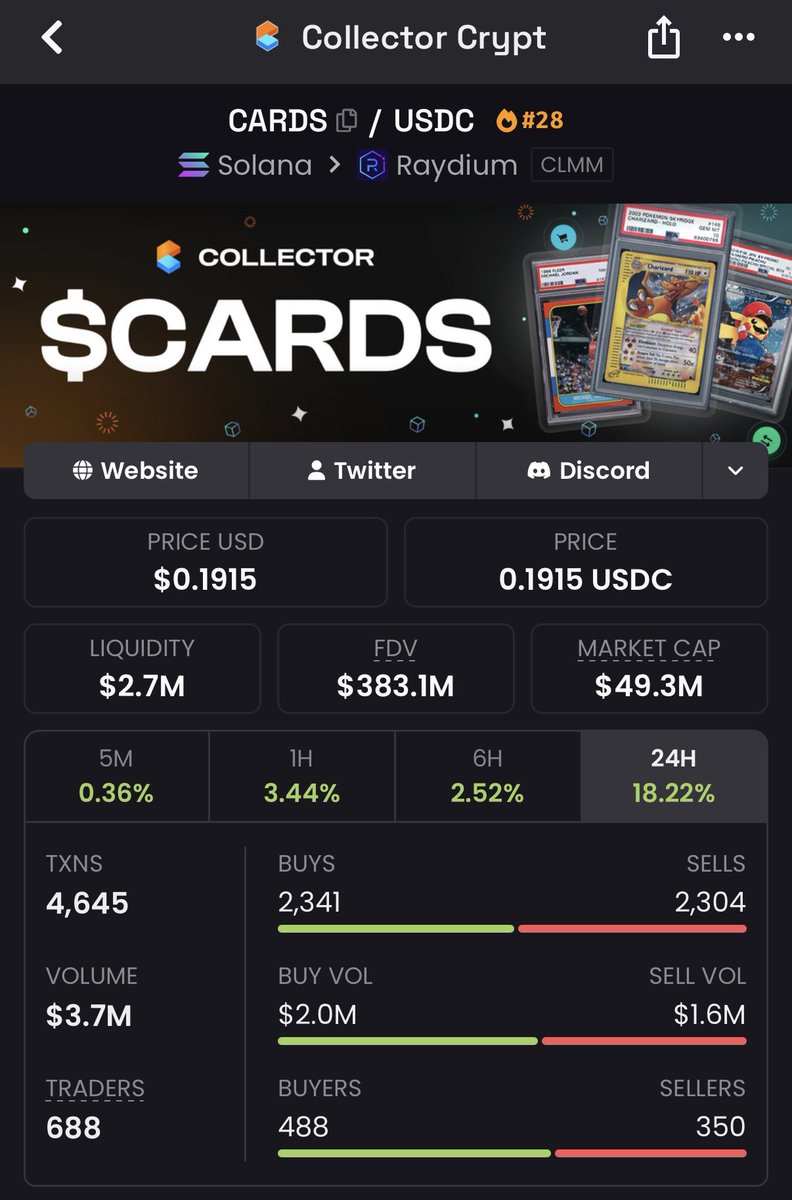
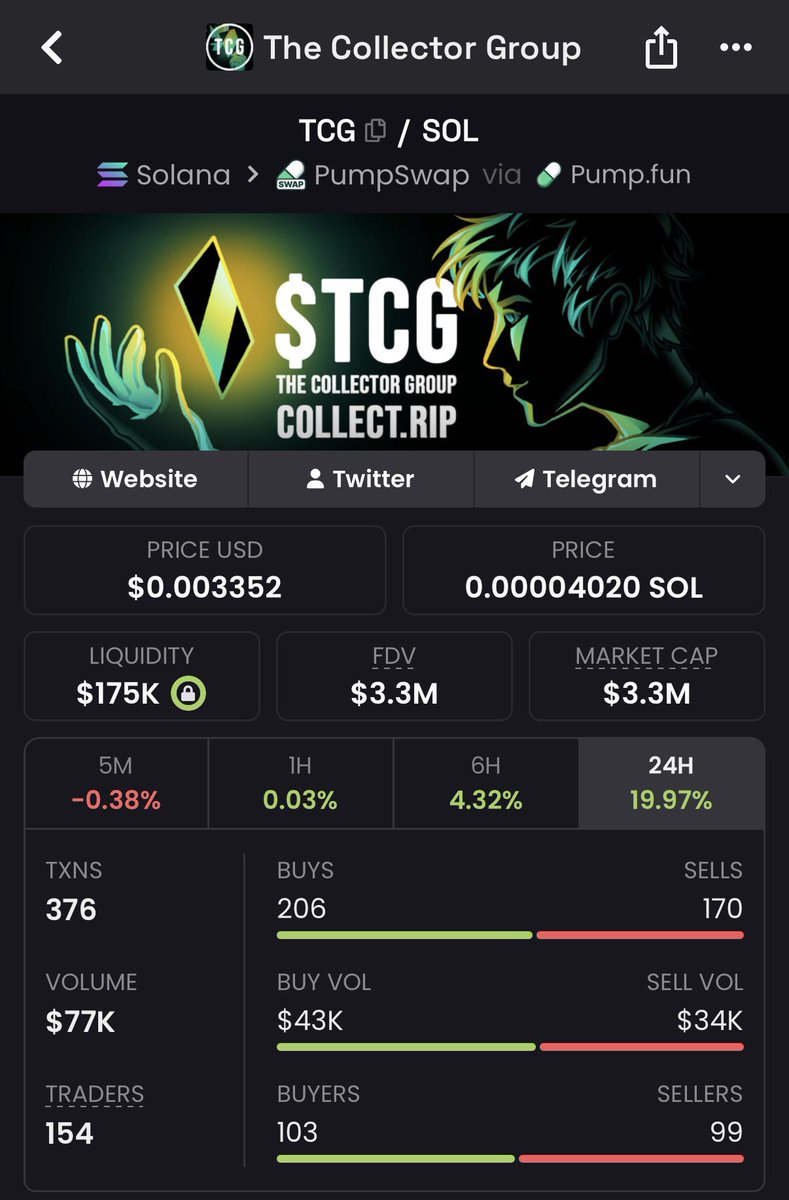
There are only two ways to get liquid exposure to onchain collectibles.
One is solana:CARDSccUMFKoPRZxt5vt3ksUbxEFEcnZ3H2pd3dKxYjp and trades at $383M FDV.
The other is solana:DLGRpmkMGr7J4KD1xR5x2XjaGeQH64PLFQkyxNNSpump and trades at $3M FDV.
Both are good buys IMO, but r/r favors TCG.
@Pumpfun backing for @collectdotrip is a game changer, would not fade them being able to tap into PF’s distribution.
May 20

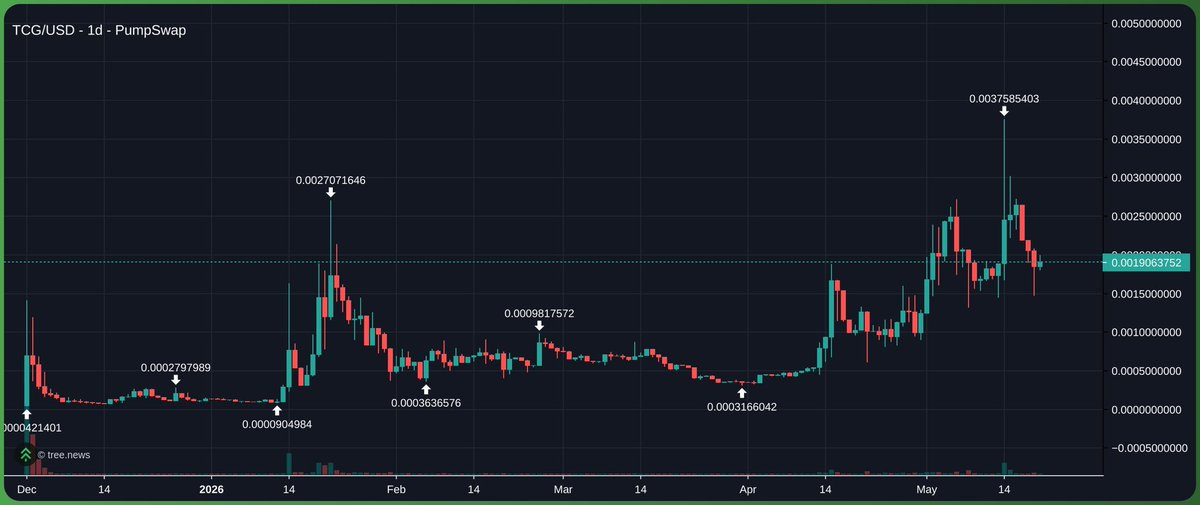
solana:DLGRpmkMGr7J4KD1xR5x2XjaGeQH64PLFQkyxNNSpump trading below $2M FDV after it won the @Pumpfun BiP Hackathon doesn’t make any sense to me.
Firmly believe this is best liquid r/r to Pokémon/onchain TCG at current valuations.
Winning the BiP Hackathon significantly derisks TCG as @collectdotrip now can:
- Tap directly into PF’s distribution
- Access additional funding sources (see @pumpcade funding rounds post-hackathon win)
- likely align token holders and equity holders through an ACE round (3 other BiP Hackathon winners have done so).
Also, as a cherry on top, the actual market cap (~$1.4M) is significantly less as the team controls >25% of supply.
Team is very sharp and has built out a great product to date. If you want to give the platform a shot, feel free to sign up using my referral link and I’ll even gift you a free Pokémon pack for doing so:
collect.rip/r/ajc
42
22
167
22,427
Jake Koch-Gallup retweeted

May 27
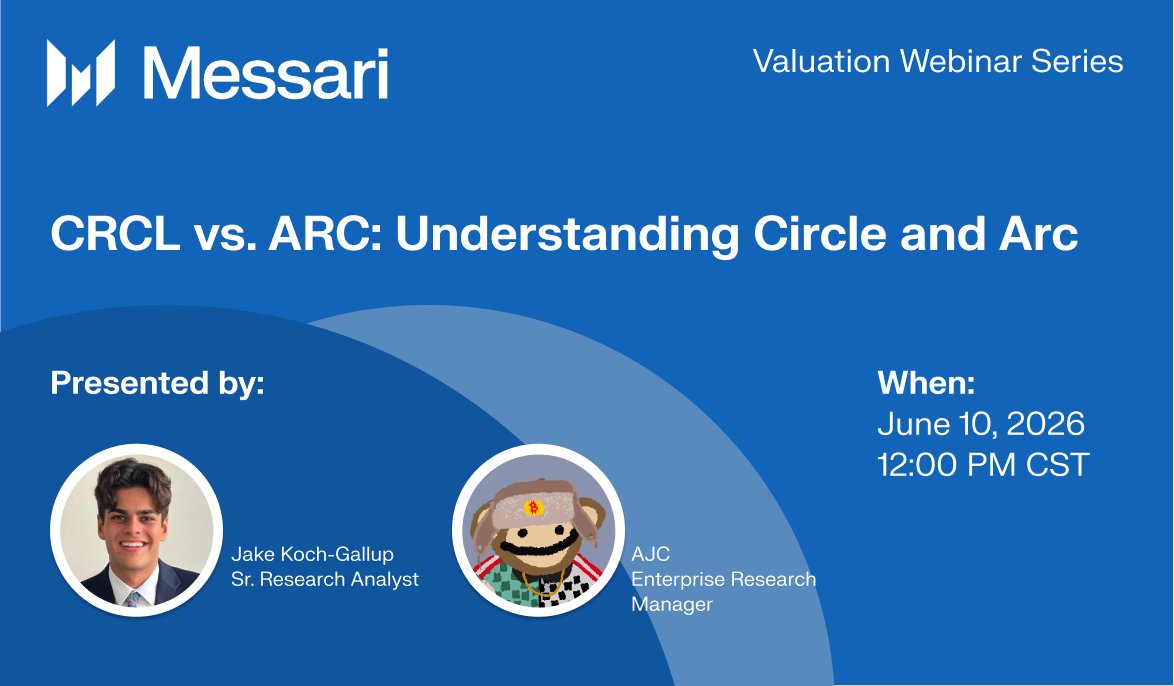
.@Circle ($CRCL) is a financial tech company providing stablecoin infrastructure for USDC.
Stablecoins have clear product-market fit in crypto, but not all parts of the stablecoin stack capture value equally.
Join @immutablejacob & @AvgJoesCrypto for our CRCL vs ARC webinar, where we’ll assess the value and potential of Circle’s stock and token.
After this session, you’ll leave with an understanding of how to compare stablecoin balance exposure against stablecoin velocity exposure.
7
4
27
4,281
May 26
ethereum:0xe76c6c83af64e4c60245d8c7de953df673a7a33d just got 3x perp listings from @Aster_DEX and @Lighter_xyz.
this is exactly what i wrote about in my valuation report:
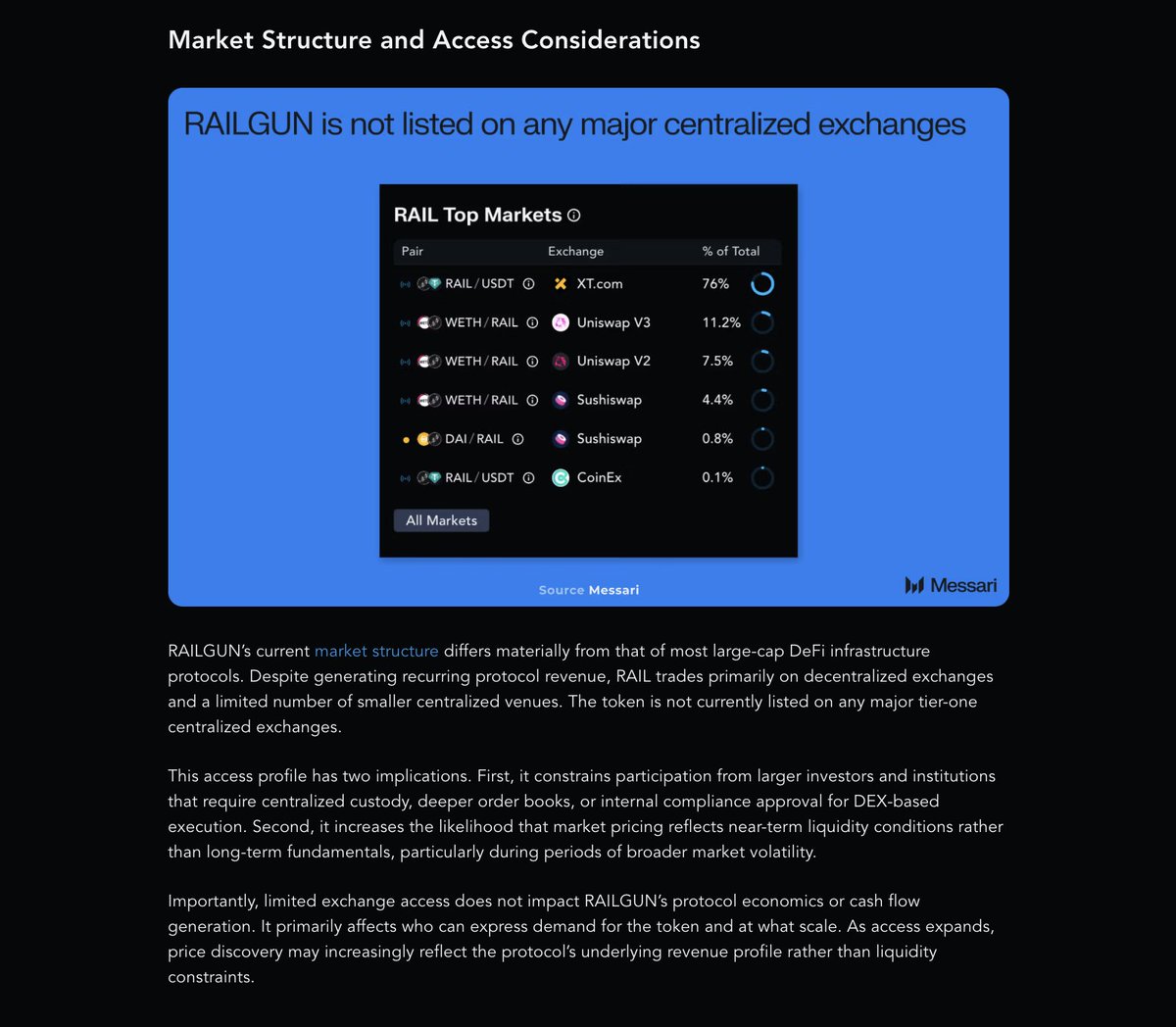
RAIL’s market structure has been constrained more by access and liquidity than fundamentals.
the protocol already generates recurring revenue, but the market still hasn’t fully repriced it because participation remains limited.
perps are the first step.
spot listings on T1 CEXs like Kraken, Coinbase, and Binance would deepen liquidity, expand participation, and improve price discovery.
raillions.
May 22
ethereum:0xe76c6c83af64e4c60245d8c7de953df673a7a33d is up more than 50% today.
but it's still only trading at $2.40.
in my ethereum:0xe76c6c83af64e4c60245d8c7de953df673a7a33d valuation report published a few months back, i calculated an intrinsic value of $6.26 in the base case.
that means ethereum:0xe76c6c83af64e4c60245d8c7de953df673a7a33d's true value is an easy 3x from here.
raillions.
8
7
66
3,639
May 22
ethereum:0xe76c6c83af64e4c60245d8c7de953df673a7a33d is up more than 50% today.
but it's still only trading at $2.40.
in my ethereum:0xe76c6c83af64e4c60245d8c7de953df673a7a33d valuation report published a few months back, i calculated an intrinsic value of $6.26 in the base case.
that means ethereum:0xe76c6c83af64e4c60245d8c7de953df673a7a33d's true value is an easy 3x from here.
raillions.
the monster has been unleashed. the $RAIL valuation report is live.
40 pages, 40 minute read.
messari.io/report/a-valuatio…
it is an enterprise report, so only @MessariCrypto enterprise clients have access. HOWEVER, let's break down the key points:
1) what is RAILGUN?
@RAILGUN_Project is onchain ZK privacy infra for EVM networks. it lets users transact on Ethereum, Arbitrum, Polygon, and BNB Chain without revealing wallet identity, balances, or transaction intent.
the protocol charges a 0.25% fee when assets enter or exit the privacy set (shield/unshield). all fees accrue onchain to the DAO treasury.
2% of the treasury is distributed to $RAIL stakers every two weeks, creating a direct link between usage, treasury growth, and staker cash flows.
2) how does RAILGUN work?
railgun lets users move assets from public ERC-20 balances into a shared private pool (shielding), then transact from that pool without revealing wallet identity, balances, or intent.
assets inside the pool aren’t account balances. they’re represented as private notes, proven valid with ZK proofs instead of being publicly readable onchain.
users keep their normal 0x address, but also generate a private railgun address (0zk…). private transactions are built in-wallet, proven locally, then executed onchain with no link back to the public wallet.
railgun is infrastructure, not a consumer wallet. wallets and apps integrate the railgun contracts and SDK to support private balances and private smart contract execution.
this design keeps users on Ethereum’s existing liquidity and apps, while adding privacy at the settlement layer.
3) what does railgun adoption and revenue look like?
railgun processed $2b in combined shield/unshield volume in 2025. this generated the protocol $5M.
importantly, this revenue is earned without emissions, liquidity incentives, or subsidized activity. users are paying real fees for privacy.
railgun captures nearly 5% of its TVL as revenue, materially higher than most DeFi infra protocols, which typically capture around 0.3-3%.
this reflects the transactional nature of privacy flows as railgun monetizes capital movement, not passive liquidity.
4) what is the Kohaku Wallet SDK and why does it matter for RAILGUN?
kohaku is an open-source wallet privacy SDK being developed under the @ethereumfndn. its goal is to make privacy native at the wallet layer, not a separate opt-in tool.
instead of users going out of their way to use a privacy protocol, wallets can integrate Kohaku and offer private balances and private transactions directly in normal wallet flows.
railgun is already integrated into Kohaku. that means railgun becomes part of default wallet transaction flows.
once Kohaku goes live and tier-1 wallets (like @MetaMask) start integrating it, railgun’s addressable market expands from users who actively seek privacy to a massive share of Ethereum’s wallet-reachable capital.
that shift, from niche tooling to default wallet infra, is the core driver behind the upside scenarios in my valuation.
5) how exactly did I value $RAIL?
i start with Ethereum’s capital base (ETH market cap stablecoins), model how much of it migrates into RAILGUN’s privacy set over time, and translate that into revenue thru a declining capture rate.
revenue minus operating expenses = operating cash flow. ~52% gets paid to stakers, the rest accumulates in the DAO treasury, and i value both pieces (cash flows treasury) to arrive at intrinsic $RAIL per token.
the base case intrinsic value provides a clean and defensible anchor for what $RAIL should be worth if adoption plays out as modeled.
$RAIL's current price sits at a significant discount to that base case.
6) disclaimer: i hold $RAIL. this report is meant for informational purposes only. It is not meant to serve as investment advice.
7) railtardio.
- railgun quant
10
5
74
7,733
May 20
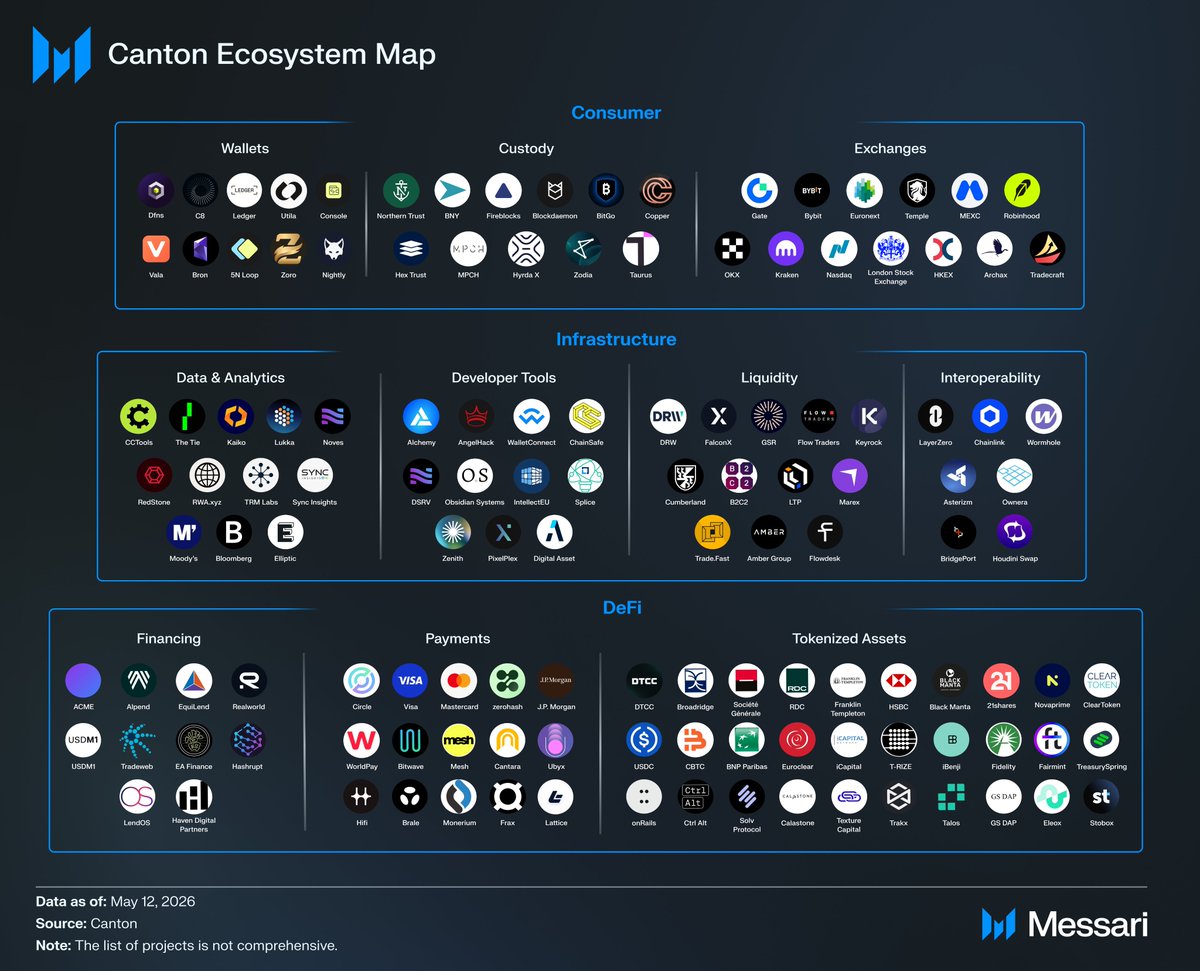
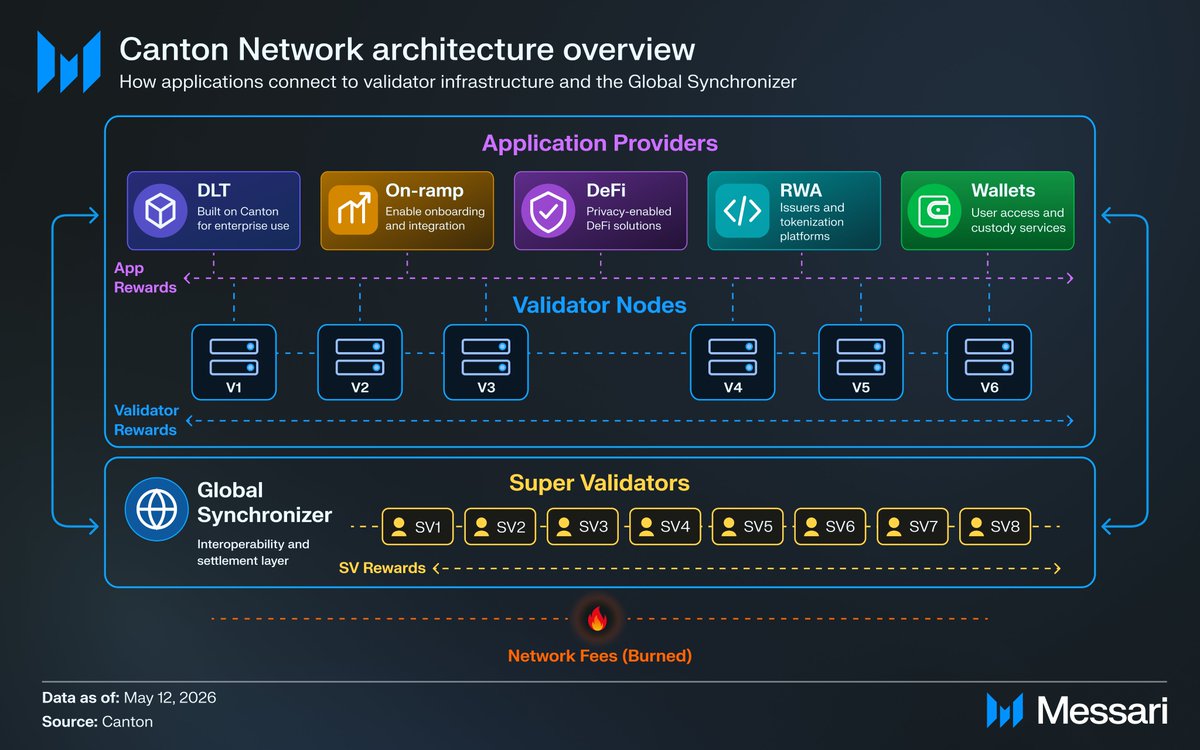
the most in-depth and up-to-date @CantonNetwork report is live.
22 pages covering:
> technical architecture
> privacy model
> tokenomics
> governance
> institutional adoption
> the role of $CC
👉 messari.io/report/understand…
let’s break down the key points:
1/ what is Canton Network?
Canton is a public network for interoperable, privacy-preserving financial applications.
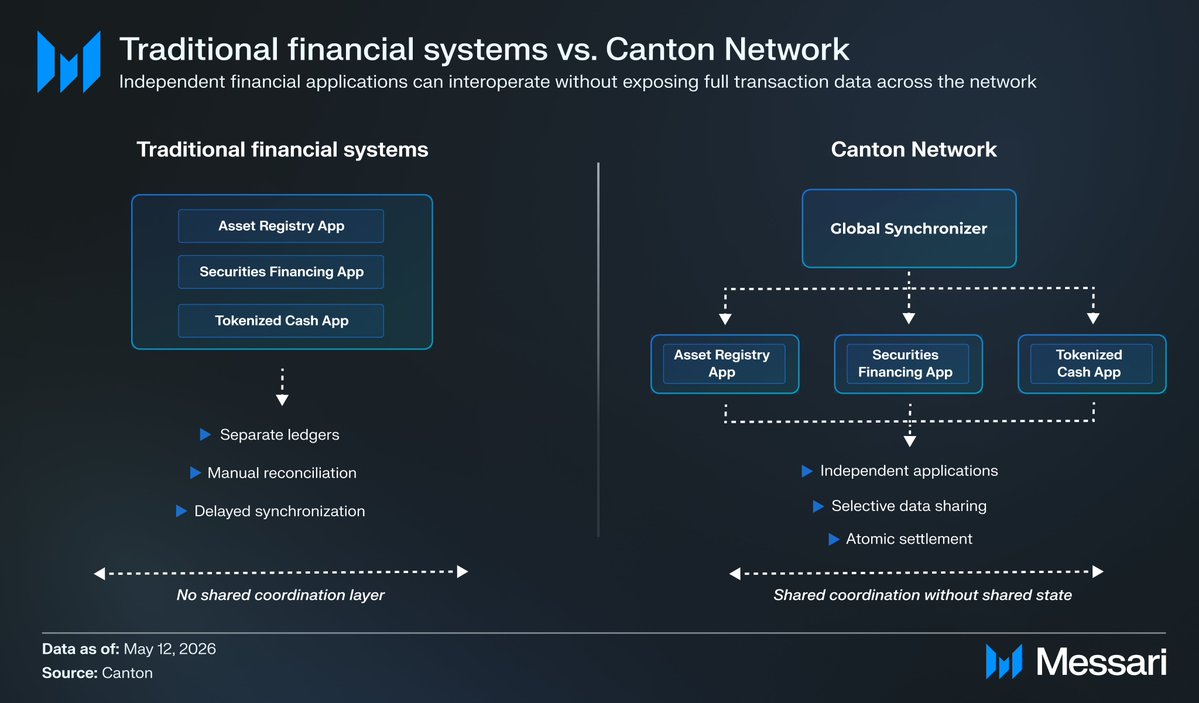
unlike most blockchains, Canton does not rely on a single globally replicated state where every validator sees every transaction.
instead, each participant only sees the part of a transaction it is entitled to access.
Canton’s core differentiator -> configurable sub-transaction privacy with composability.
independent financial applications can interoperate atomically across shared infrastructure without exposing all transaction data to the entire network.
2/ what problem is Canton solving?
traditional financial infrastructure is fragmented.
collateral, cash, securities, repo, and settlement workflows often sit across separate ledgers, intermediaries, and operational systems.
that creates:
> reconciliation overhead
> delayed settlement
> operational risk
> trapped collateral
> inefficient capital movement
most blockchains solve interoperability by making everything globally visible.
most private systems preserve confidentiality but recreate isolated silos.
Canton is designed to solve both problems at once:
> synchronized shared infrastructure
> without full public transparency
3/ how does Canton actually work?
Canton separates transaction coordination
from transaction visibility.
validator nodes only store and validate the subset of state relevant to the parties they host.
the Global Synchronizer orders transactions and prevents conflicts, but transaction contents remain encrypted and selectively disclosed.
applications can interoperate atomically across the network while preserving confidentiality.
this is very different from monolithic blockchain architecture.
4/ why does sub-transaction privacy matter?
financial workflows often involve multiple parties that need to settle together, but should not see the same information.
in Canton, a transaction can settle atomically while each participant only sees the portion relevant to them.
issuers, counterparties, validators, and applications can coordinate without every party observing the full transaction graph.
this is the privacy/composability tradeoff Canton is trying to solve.
5/ who is building on Canton?
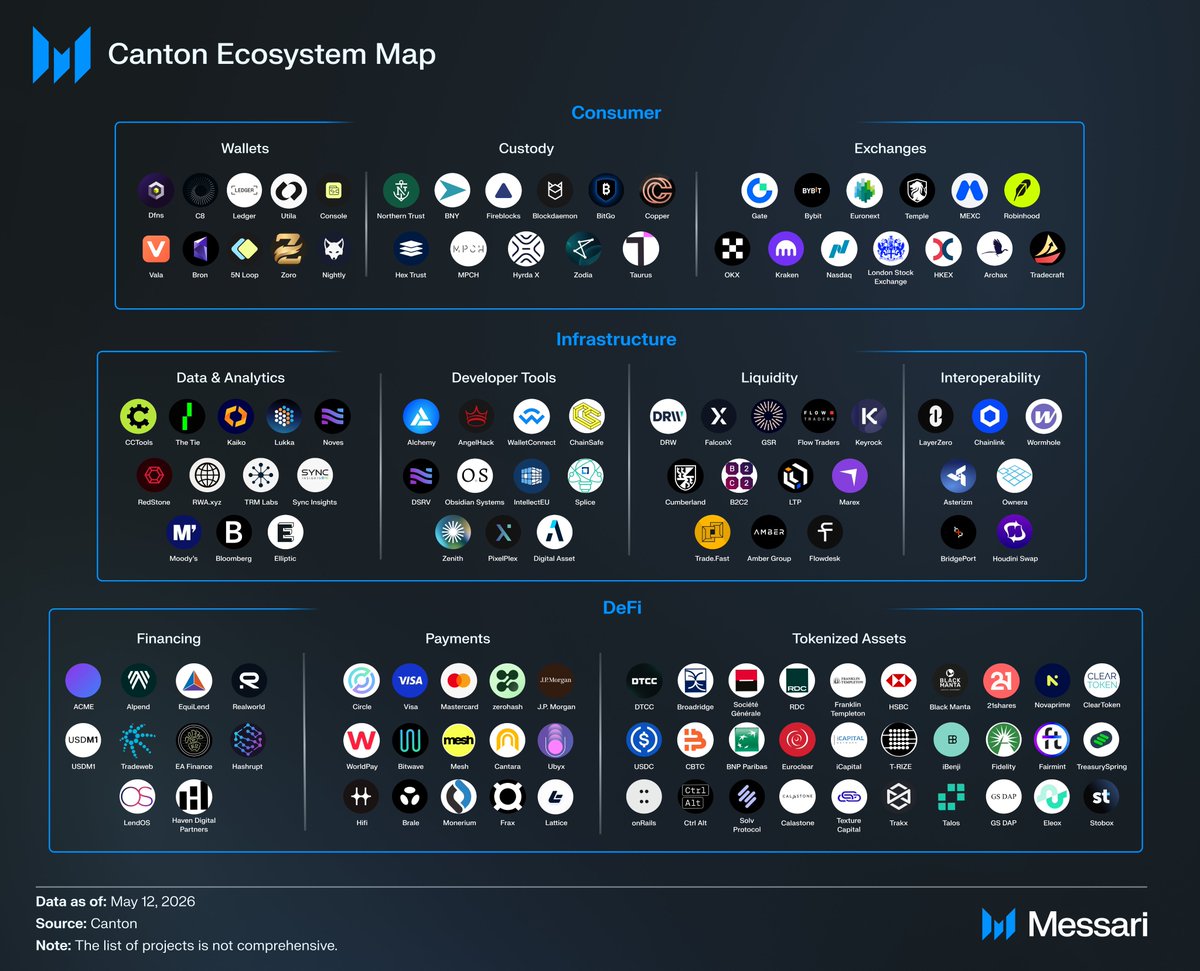
Canton already has a meaningful institutional and crypto-native footprint. examples include:
@Broadridge, @The_DTCC, @jpmorgan, @HSBC, @FTI_US, @Tradeweb, @Visa, @EuroclearGroup, @SocieteGenerale, @chainlink, @LayerZero_Core, @circle, @FireblocksHQ, @BitGo, @zerohashx, @tradecraftfi, & @temple_ny
key developments include:
> tokenized deposit pilots
> collateral mobility workflows
> synchronized repo settlement
> stablecoin and custody infrastructure
Broadridge DLR processes more than $8T in monthly repo volume on Canton infrastructure.
important note: much of Canton’s highest-value activity has historically occurred through private deployments or private synchronizers using the same underlying technology.
the next phase is the migration of these workflows toward shared public infrastructure coordinated through the Global Synchronizer.
6/ where does $CC fit in?
$CC is used for:
> transaction fees
> infrastructure incentives
> application rewards
> operation of the Global Synchronizer
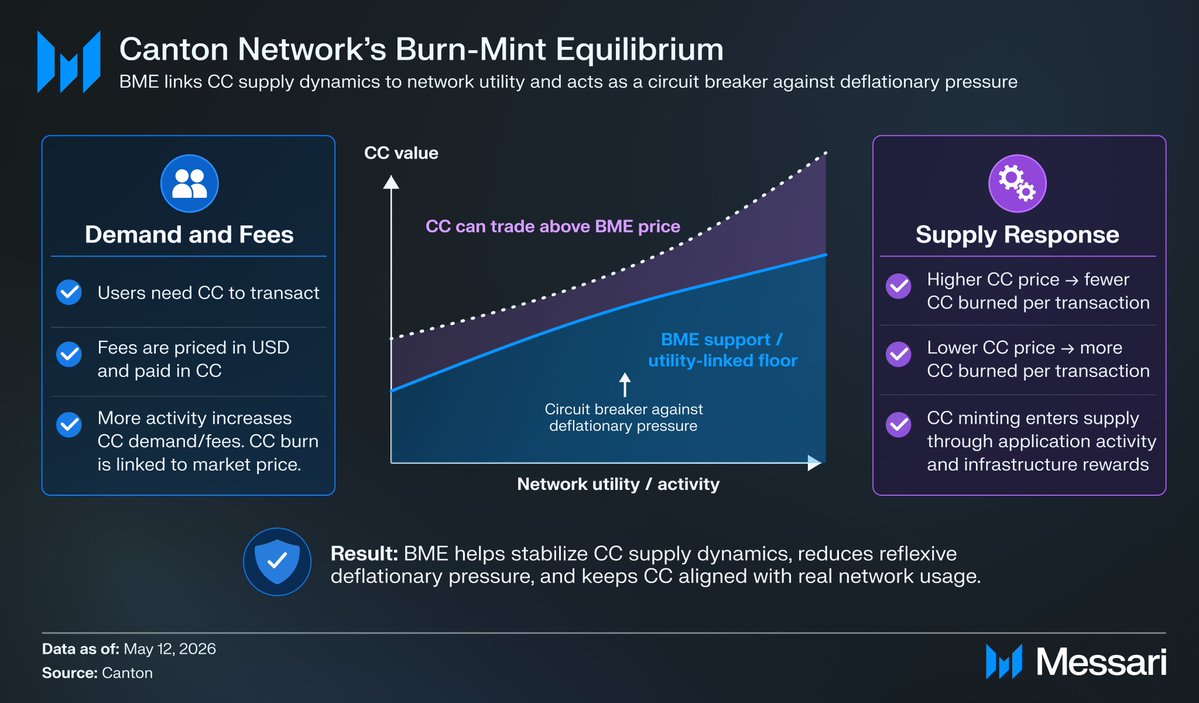
fees are denominated in USD terms and settled in $CC.
Canton’s token model uses a burn-mint equilibrium tied to network usage.
higher activity increases $CC demand/fees, and $CC burn is linked to market price.
higher $CC price -> fewer $CC burned per tx
lower $CC price -> more $CC burned per tx
issuance is distributed across:
> Super Validators
> validators
> application providers
> users
over time, the reward model increasingly shifts toward applications generating real network activity.
7/ what is next on Canton’s roadmap?
Canton’s 2026 priorities are focused on institutional asset adoption, performance, usability, standards, and ecosystem participation.
key roadmap items include:
> DTCC’s tokenized U.S. Treasury MVP, targeted for H2 2026
> initial phases of JPM Coin integration
> continued expansion of collateral mobility and synchronized settlement workflows
> scaling improvements targeting thousands of TPS on the Global Synchronizer
> higher throughput across application-specific subnets
> migration toward Canton-native BFT consensus
> broader adoption of wallet interoperability standard CIP-0103
> continued development of token standard CIP-0112
> further simplification of validator onboarding
longer term, Canton is focused on:
> regulated digital cash
> tokenized collateral
> privacy-preserving DeFi
> public-party functionality
> public verifiability for private transactions
> expanded smart contract language support beyond Daml
the roadmap reinforces Canton’s broader strategic focus of building shared infrastructure for privacy-preserving institutional settlement and regulated asset movement.
8/ disclaimer
this report was commissioned by Canton Network. all content was produced independently.
this post is informational only and not investment advice.
30
34
178
42,889
May 15
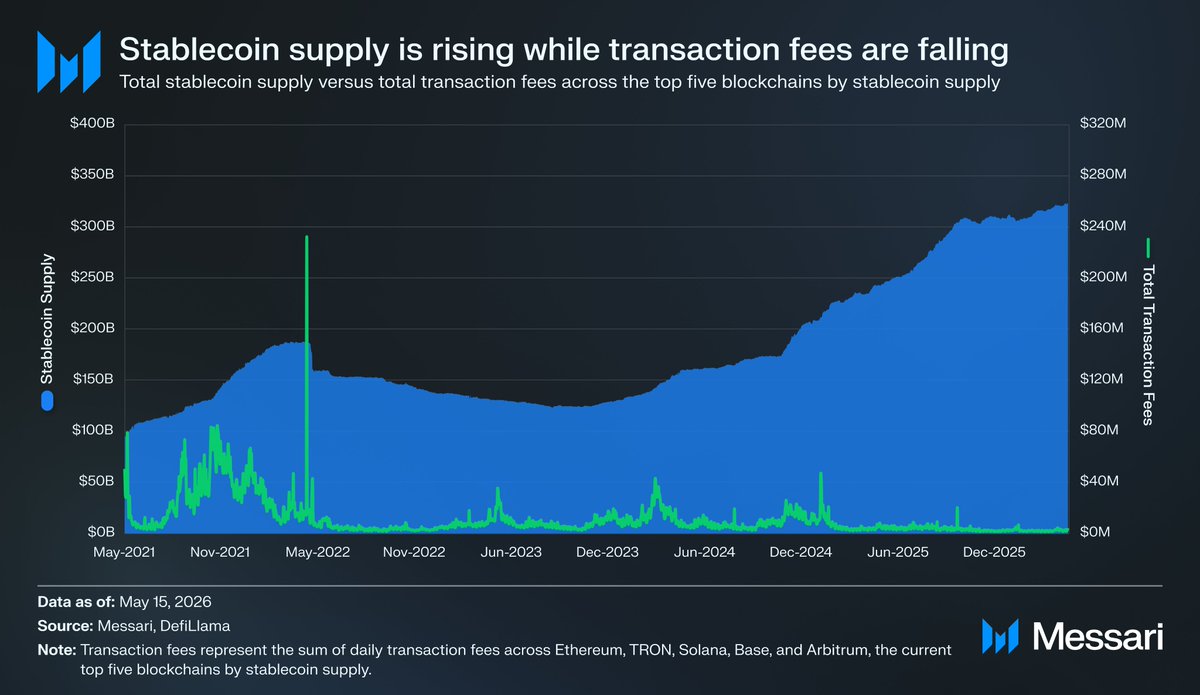
.@circle and @arc offer two very different ways to bet on stablecoin growth.
$CRCL monetizes solana:EPjFWdd5AufqSSqeM2qN1xzybapC8G4wEGGkZwyTDt1v balances through reserve income, while $ARC needs stablecoin activity to translate into durable tokenholder value through fees, staking demand, and value accrual.
in my latest report, I compare the two models and argue why CRCL is the better stablecoin investment.
exclusive to @MessariCrypto Enterprise subscribers, you can check out the report below 👇
4
2
19
7,747
May 11
can anyone explain why you would buy ARC over CRCL?
if you're bullish stablecoins:
> ARC is a long on stablecoin velocity, as stakers earn transaction fees.
> CRCL is a long on USDC supply and the yield Circle earns on reserves.
and the two are not separate. if stablecoin velocity goes up, USDC supply likely goes up too, which increases Circle’s T-Bill income and bottom-line revenue.
the real cash cow is the hundreds of millions Circle makes from reserve yield, not the fractions of a penny Arc charges per transaction.

Introducing the ARC whitepaper.
The paper outlines how ARC could serve as the native coordination asset of the Arc network, supporting security, economic governance, fee mechanics, and broader platform utility as Arc evolves.
The core idea: stablecoins move value. Arc provides the execution environment. ARC could help coordinate the participants who depend on the network.
Read the whitepaper: arc.network/arc-token-whitep…

9
1
35
3,815
Jake Koch-Gallup retweeted

May 7
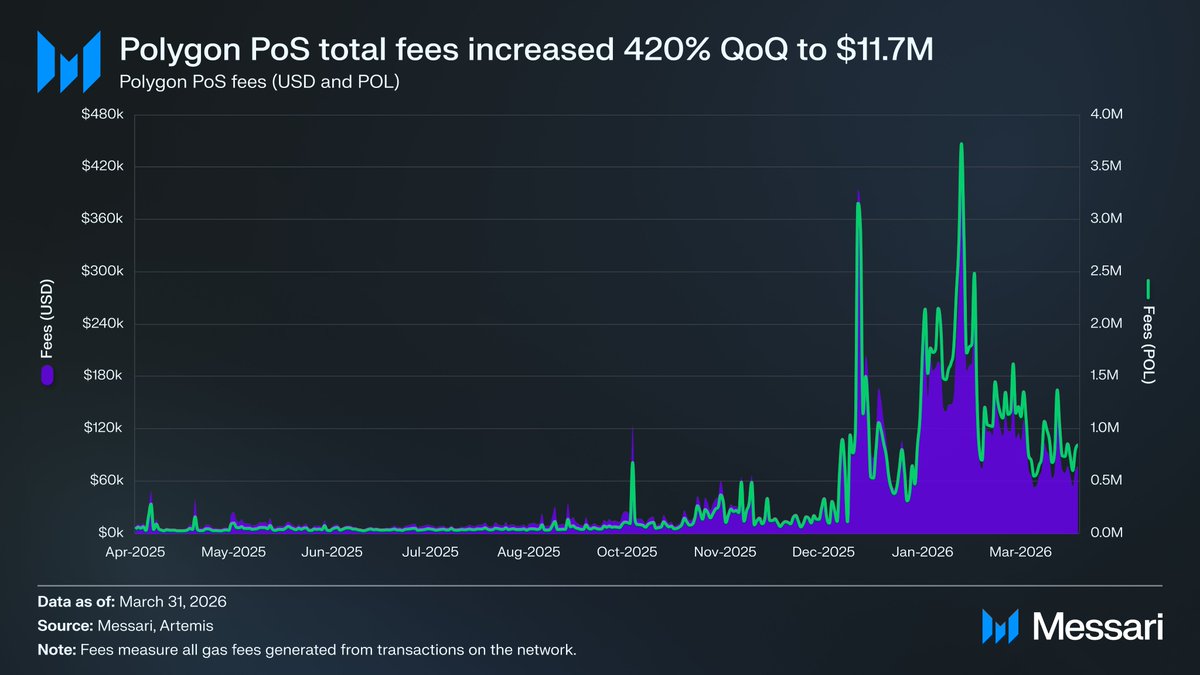
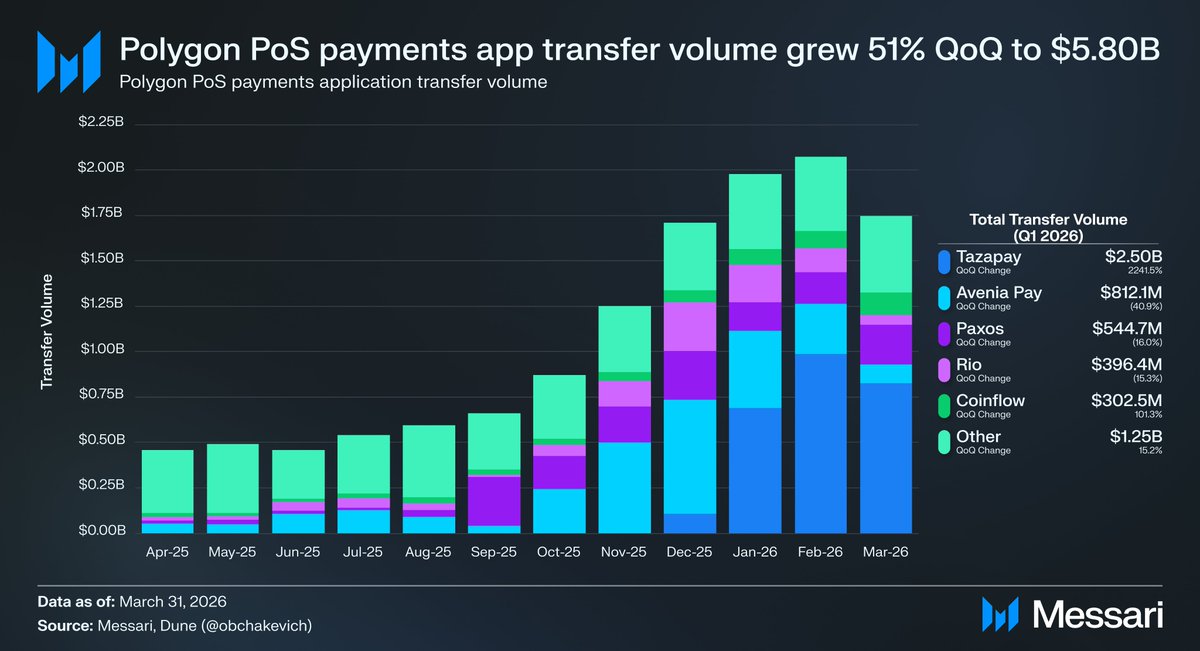
🟪 Payments apps 51% QoQ ($5.8B)
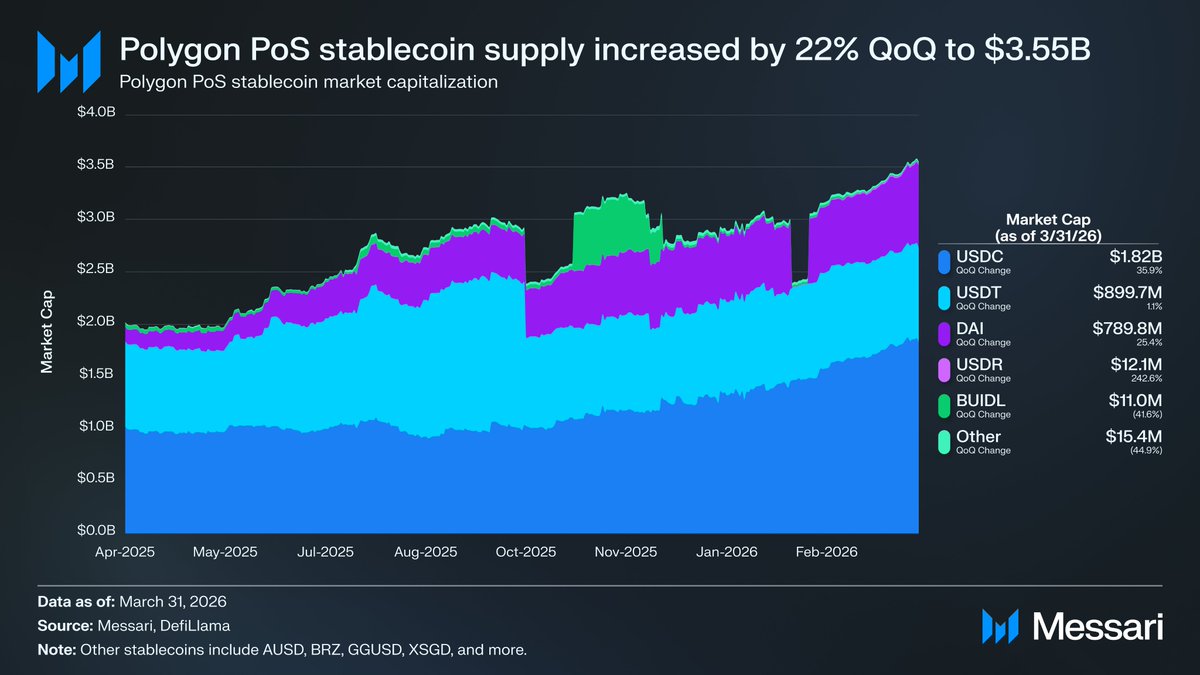
🟪 Stablecoin supply 21% QoQ ($3.5B)
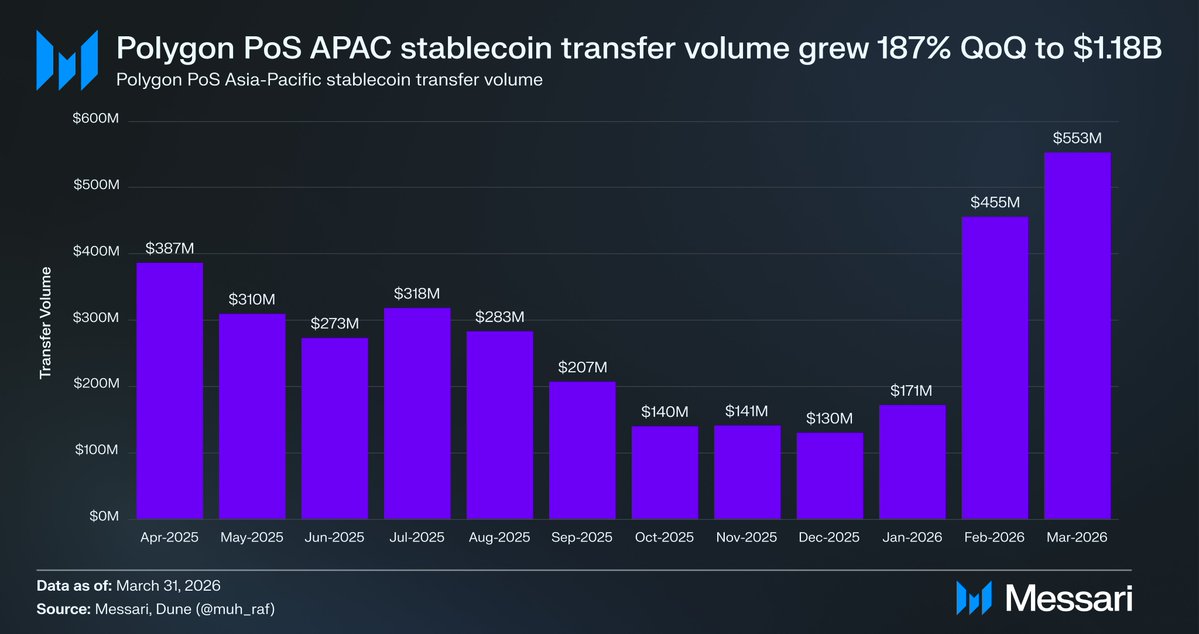
🟪 APAC non-USD stablecoins 187% QoQ
🟪 #1 in active USDC addresses globally
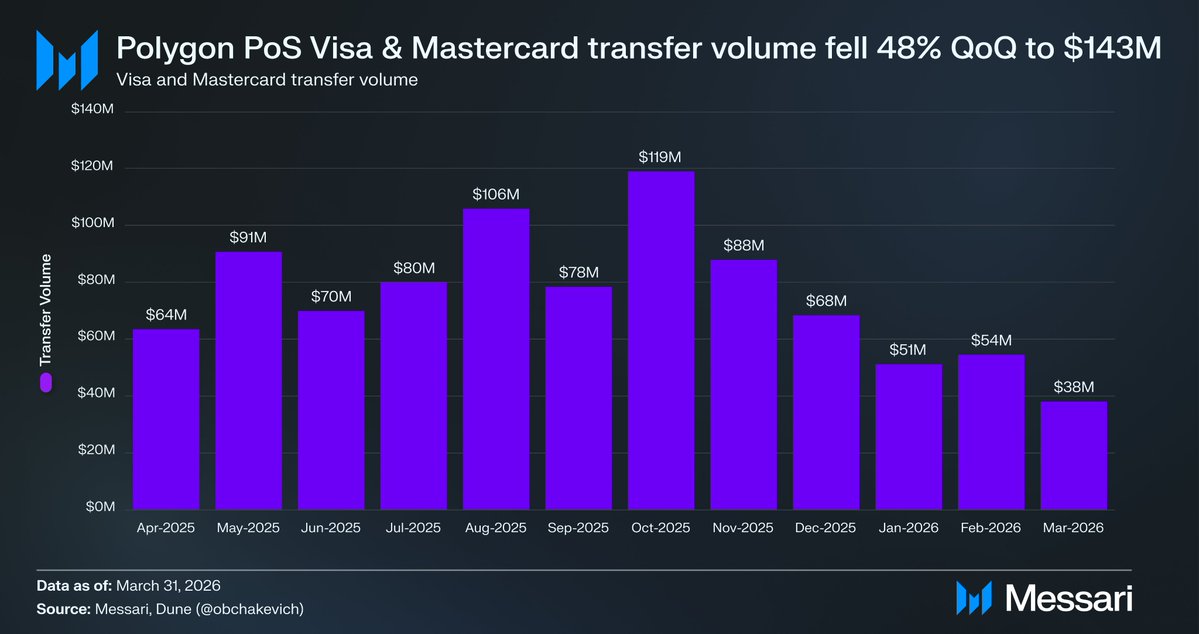
🟪 And more in the State of Polygon Q1 2026 Report
payments-focused apps on @0xPolygon facilitated $5.8B in transfer volume, up 51% QoQ.
stablecoin payments remain Polygon’s clearest growth vertical.
full @MessariCrypto report below 👇
23
53
306
11,842
payments-focused apps on @0xPolygon facilitated $5.8B in transfer volume, up 51% QoQ.
stablecoin payments remain Polygon’s clearest growth vertical.
full @MessariCrypto report below 👇
6
11
63
31,461
polygon also scaled capacity during the quarter.
successive upgrades doubled the gas limit from 60M to 120M and pushed peak throughput above 2,800 TPS.
the Lisovo hardfork improved fee stability, wallet compatibility, and agent-native payments.
x.com/0xPolygonFdn/status/20…
Feb 27

Lisovo Hardfork
The Lisovo hardfork will be released on Polygon mainnet before block number 83756500, at approximately 2pm UTC on Mar 4.
This update: subsidizes agent-to-agent gas costs for payments (PIP-82), improves smart contract compatibility for the Count Leading Zeros (CLZ), includes better support for passkey-based wallets, enables flexible fee tuning, and includes improvements for more reliable transaction delivery and stronger checks.
All node operators should upgrade Bor to v2.6.0 (or Erigon to v3.4.0).
See the countdown: polygonscan.com/block/countd…
1
2
365
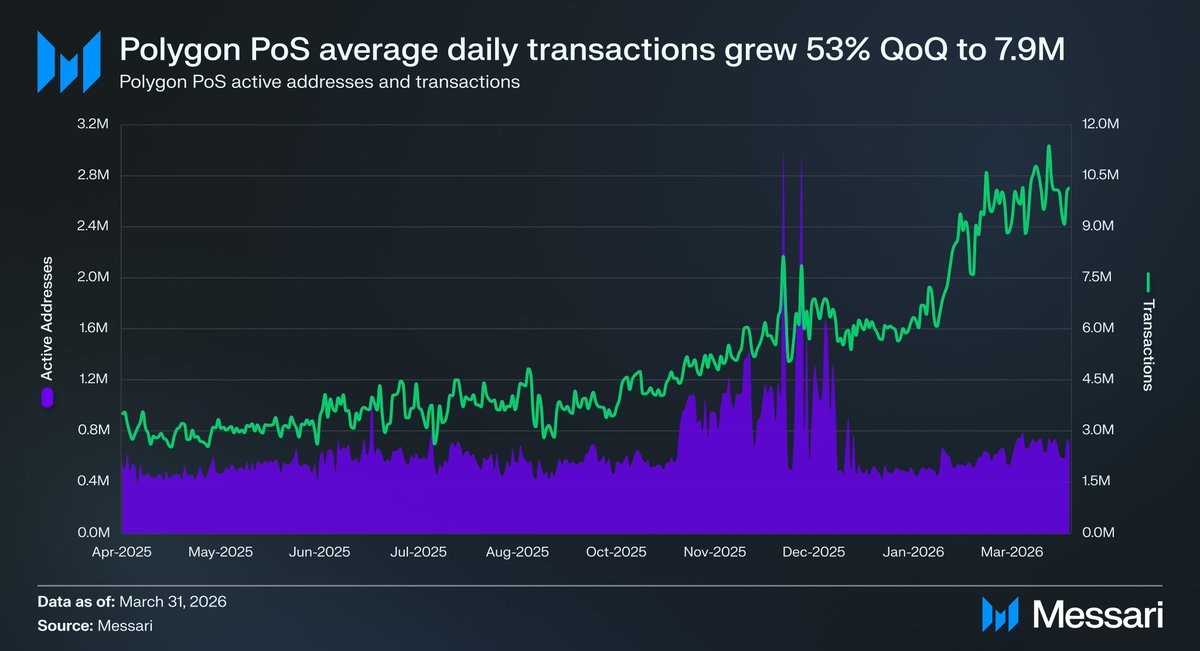
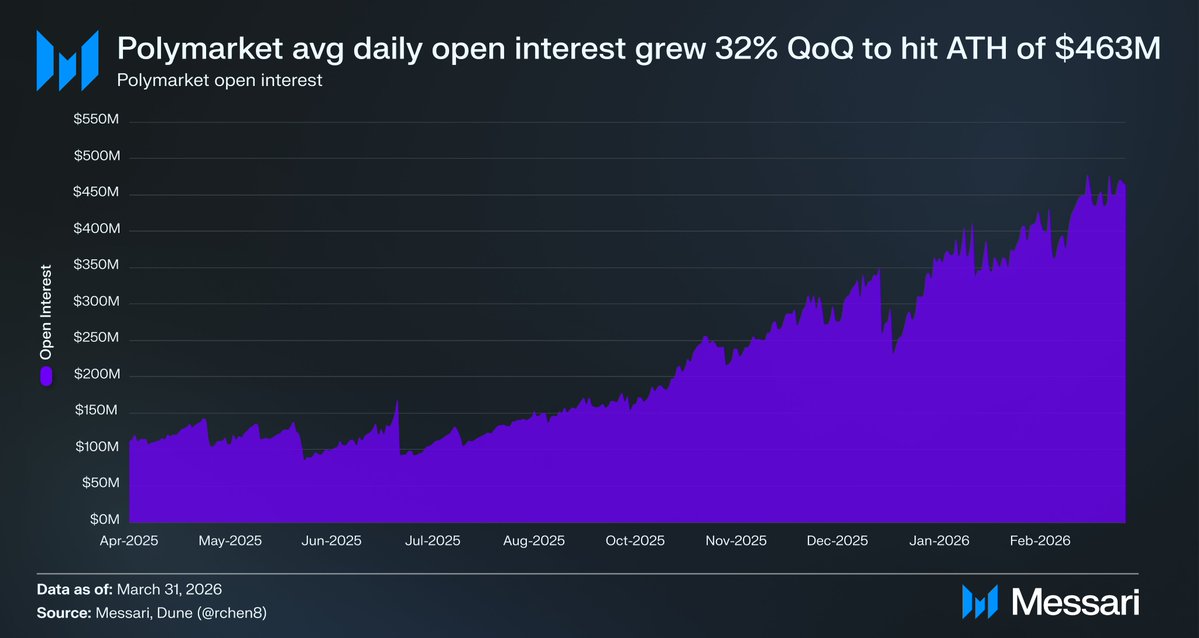
polygon is consolidating around three core demand drivers:
>> stablecoin payments
>> prediction markets
>> high-throughput settlement
growth was uneven across the ecosystem, but core usage continues to deepen.
read the full @MessariCrypto report here:
messari.io/report/state-of-p…
2
238