An Aussie fellow promoting uplifting joyful genuine math thinking and doing for students & teachers alike. Thrilled: globalmathproject.org reaching millions!
Joined December 2009
- Tweets 20,972
- Following 991
- Followers 33,340
- Likes 11,374
4,431 Photos and videos
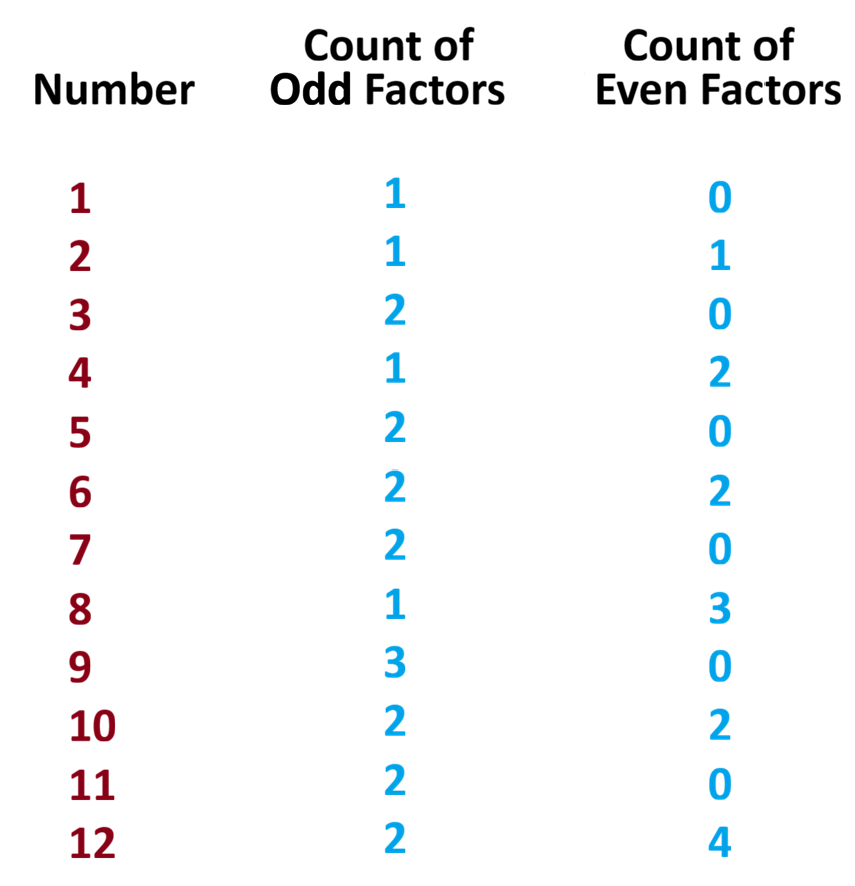



What needs to be true about a number for it to have more even factors than odd factors?
5
2
5
464

Jun 13
The number 30 has an equal number of even and odd factors. So too do the numbers 6, 58, and 110.
Describe the set of all numbers that have this property.
5
1
13
1,660
Jun 12
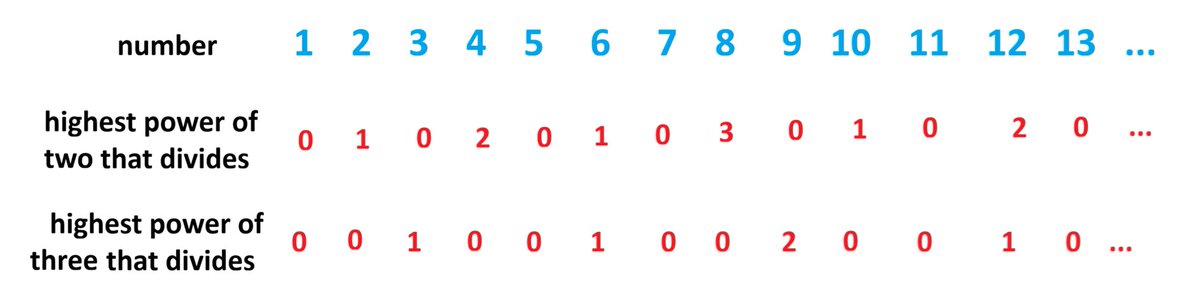
For a prime p, record the exponent of the highest power of p that divides each counting number.
If p = 2, the average of these values is 1.
If p = 3, the average of these values is 1/2.
What is the average value for a general prime p?
3
1
13
1,933
Jun 11
Among the first ten-billion counting numbers, what's the average value for the exponent of the largest power of 3 that divides each counting number?
(Well, exact value not needed! But what value will it be mighty close to?)
1
5
812
Jun 10
Among the integers 1, 2, 3,..., N:
* all have 1 as a factor
* about half have 2 as a factor
* about one quarter have 4 as a factor
etc.
Let F(N) = the highest value k such that 2^k is a factor of N.
To what value does Ave(N) = [F(1) F(2) ... F(n)] / N tend as N grows?
2
1
7
1,204
Jun 9
A Challenge:
Prove that there are 100 consecutive integers each with at least 100 distinct primes factors with all 10,000 primes identified distinct!
2
3
11
1,182
Jun 8
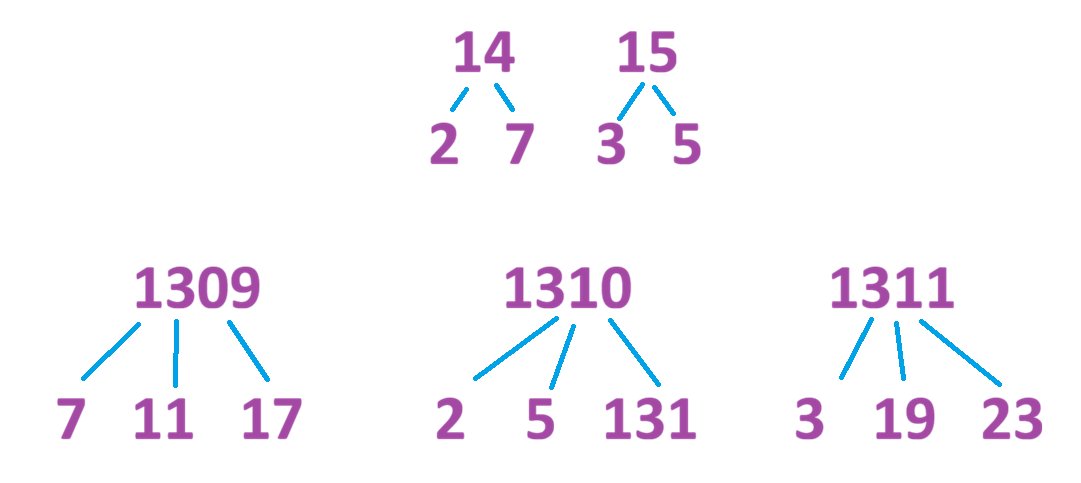
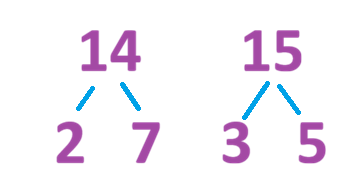
14 and 15 are two consecutive integers each with at least two distinct prime factors, all primes distinct.
Are there three consecutive integers each with at least three prime factors and all nine of those primes distinct?
3
3
16
1,518
Jun 7
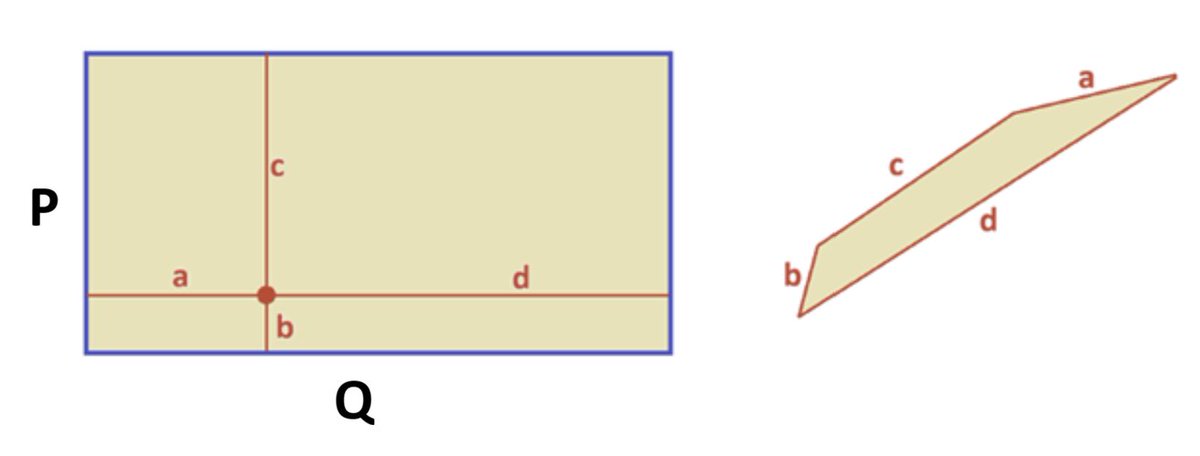
A point is chosen at random inside a P-by-Q rectangle (uniform distribution) and its distances from the four sides of the rectangle are measured. What is the probability that the those four lengths are also the side lengths of a quadrilateral?
3
1
13
1,445
Jun 6
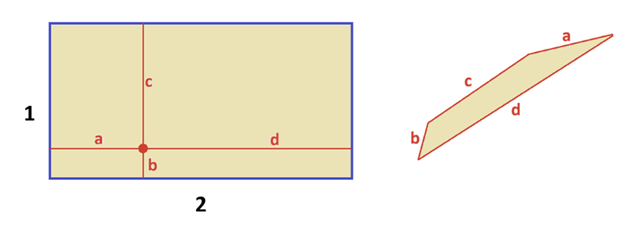
A point is chosen at random inside a 1-by-2 rectangle (uniform distribution) and its distances from the four sides of the rectangle are measured.
What is the probability that the those four lengths are also the side lengths of a quadrilateral?
3
3
14
2,184
Jun 5
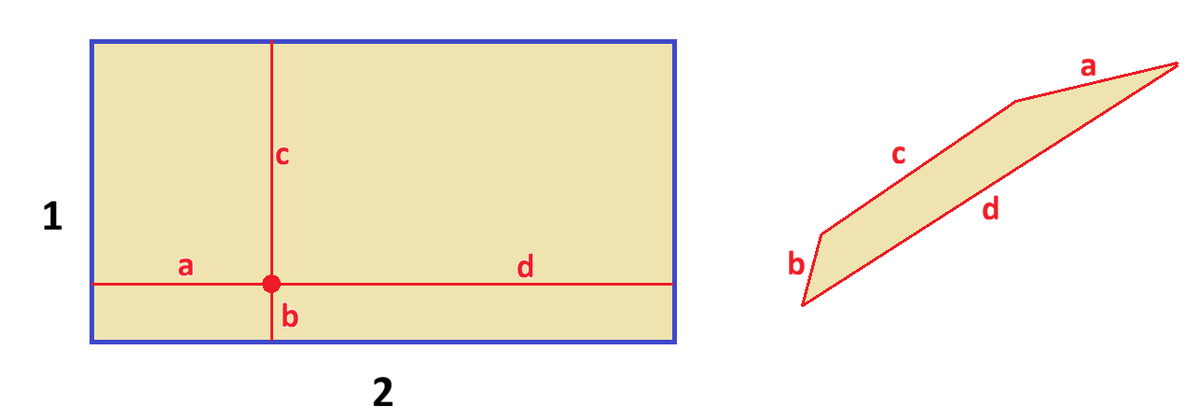
A point is chosen inside a 1-by-2 rectangle and its four distances to the sides of the rectangle are noted.
Must those four values also be the side lengths of a quadrilateral?
3
1
11
2,017
Jun 4
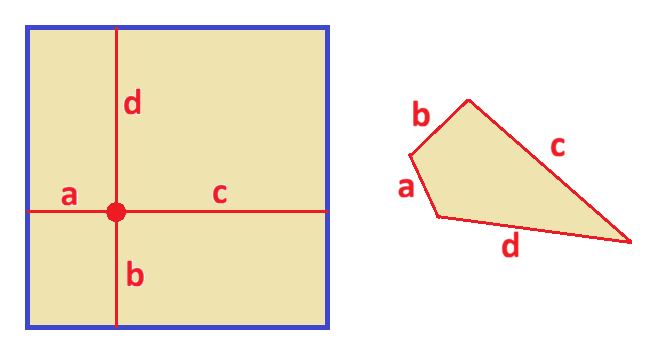
A point is chosen in a square and its four distances from a, b, c, d are noted. Could those distances, for sure, be the side lengths of a quadrilateral?
2
5
20
1,832
Jun 3
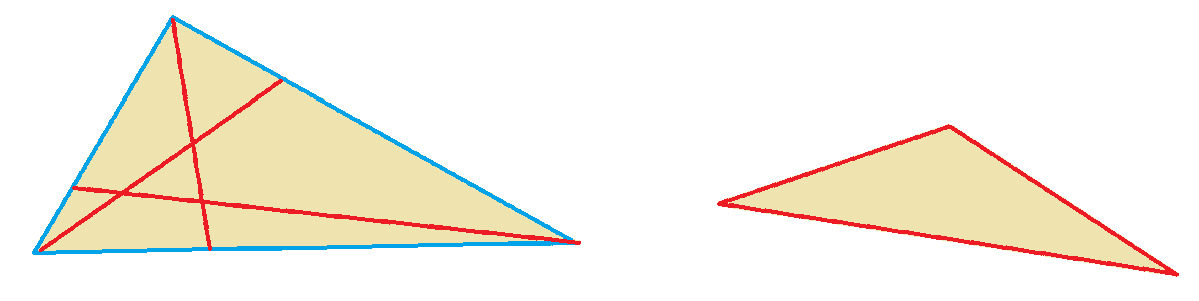
Three Cevians are drawn in a triangle, one from each vertex to its opposite side.
Could one, for certain, use those Cevians as the side lengths of another triangle?
1
1
14
1,276
Jun 2
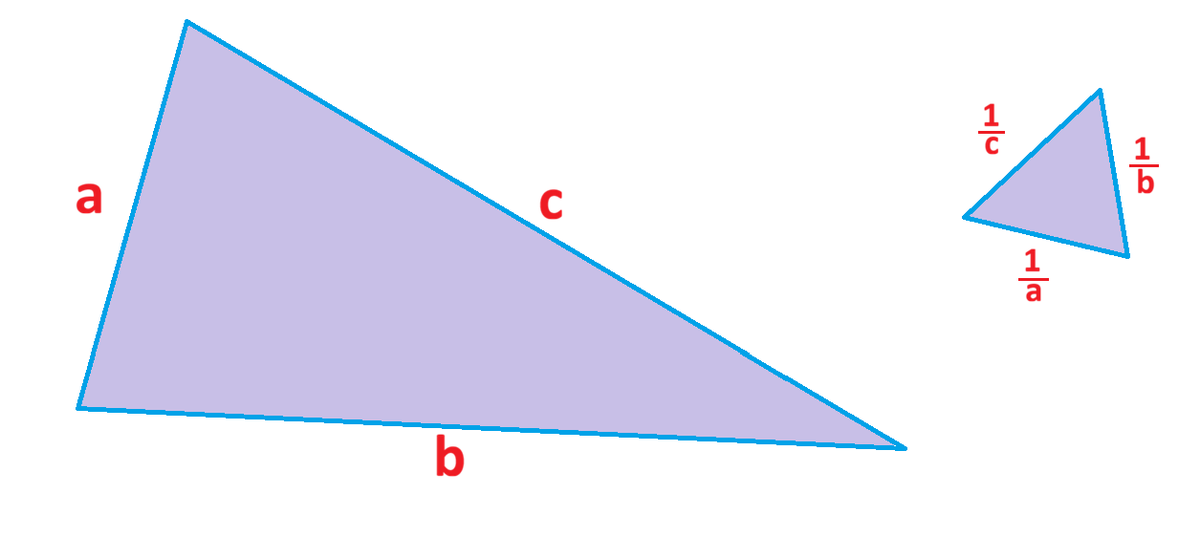
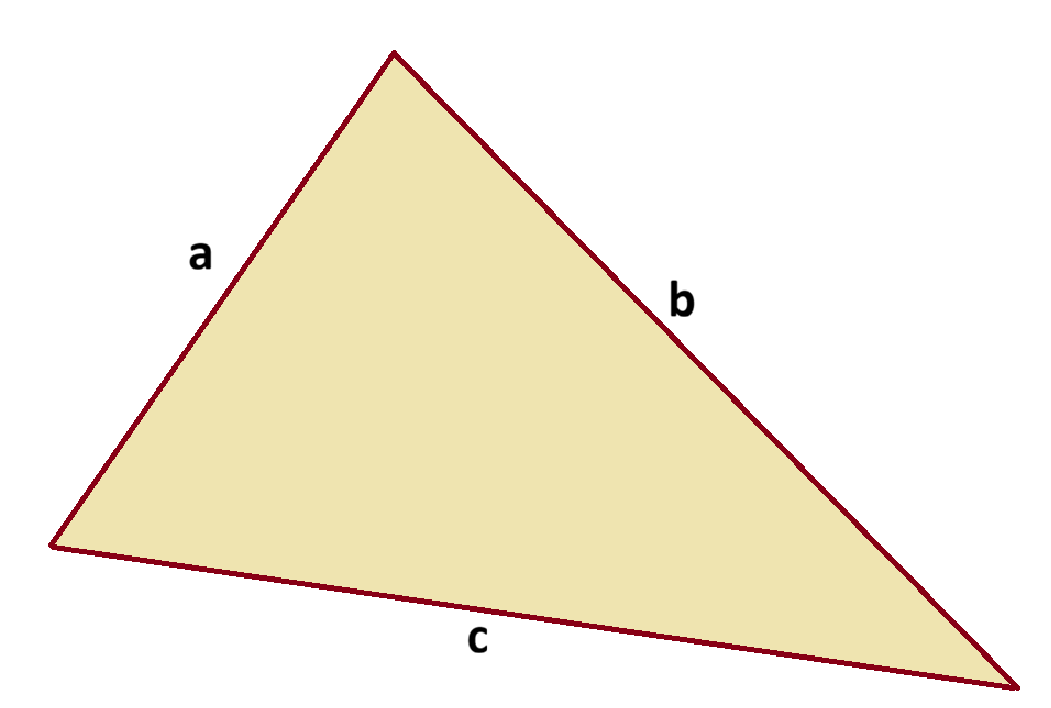
If a, b, c are the side lengths of a triangle, are 1/a, 1/b, 1/c sure to be the side lengths of a triangle as well?
5
4
16
2,486
Jun 1
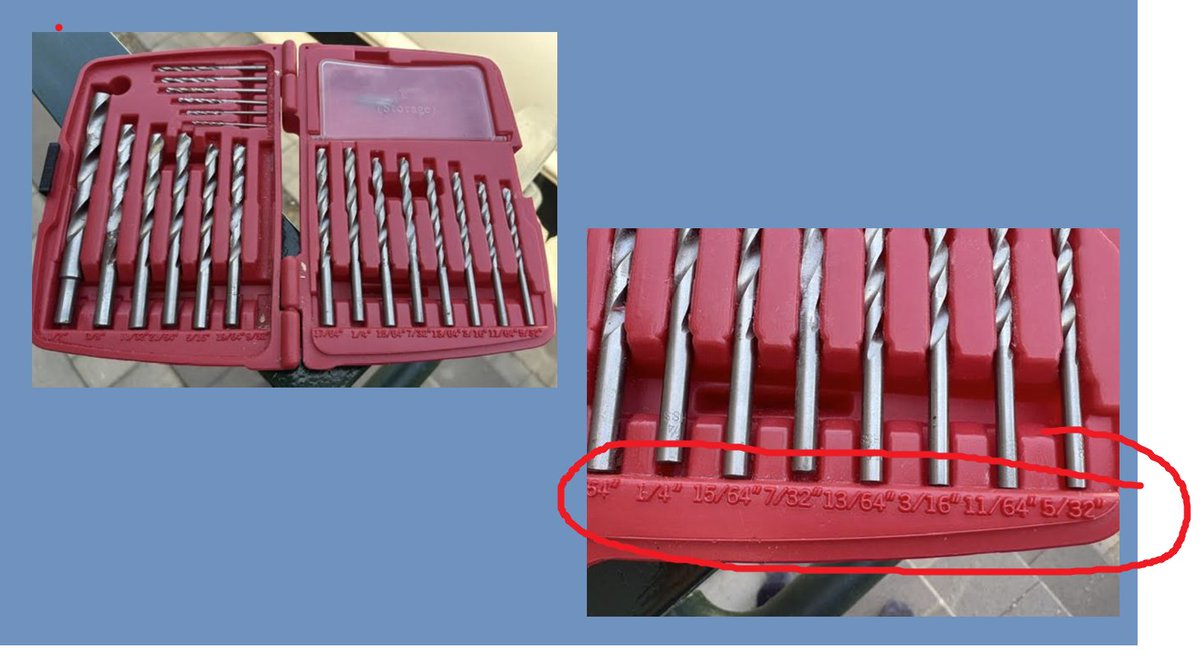
I need a 5.2 mm drill bit. But I live in America.
What do I do?
5
1
6
925
May 31
Six (school book and mathematical) views of what DIVISION is.
jamestantondivision.lovable.…
I had fun using AI to use the content of MATH DECODED (corwin.com/books/math-decode…)
to create summaries of some key math ideas!
3
561
May 31
Place r balls into N bins. How many essentially different ways?
Answers vary depending on whether or not the balls and/or bins are labeled.
Which scenario is sure to give the largest count?
Which the least? Of the remaining cases, will one count always be larger than the other?
1
9
1,119
May 30
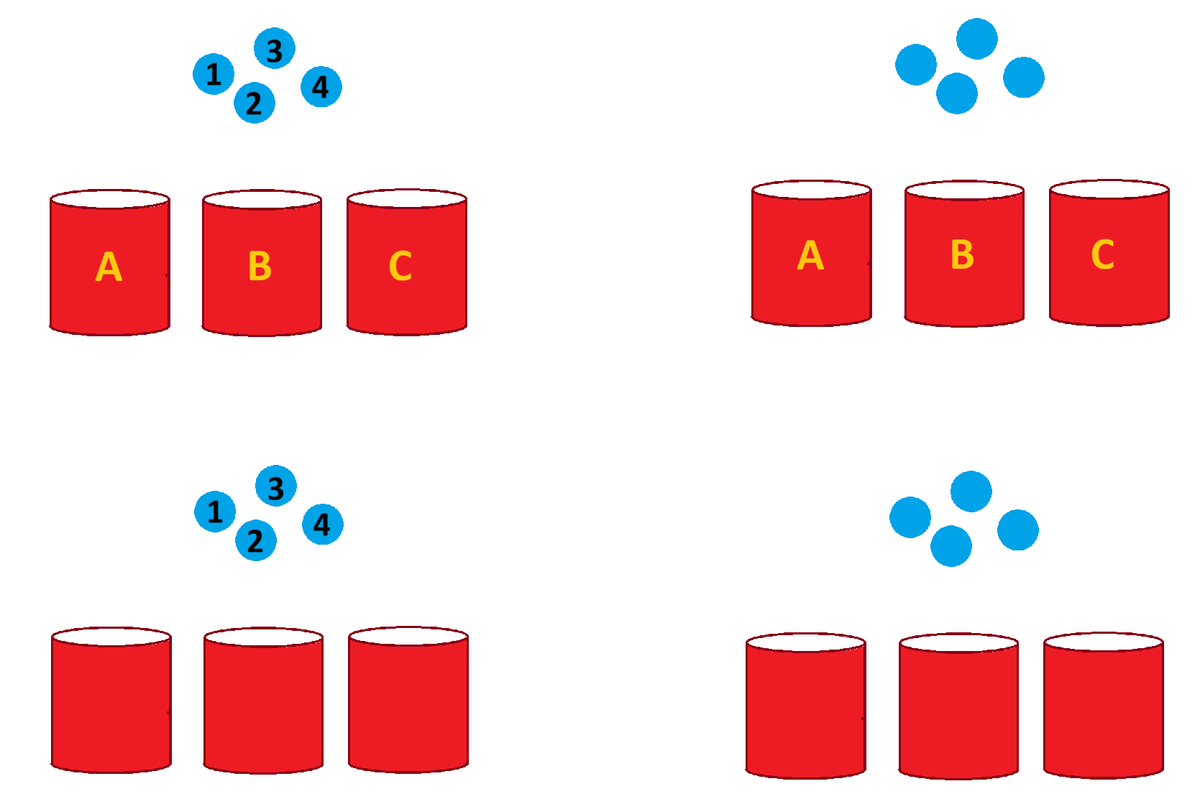
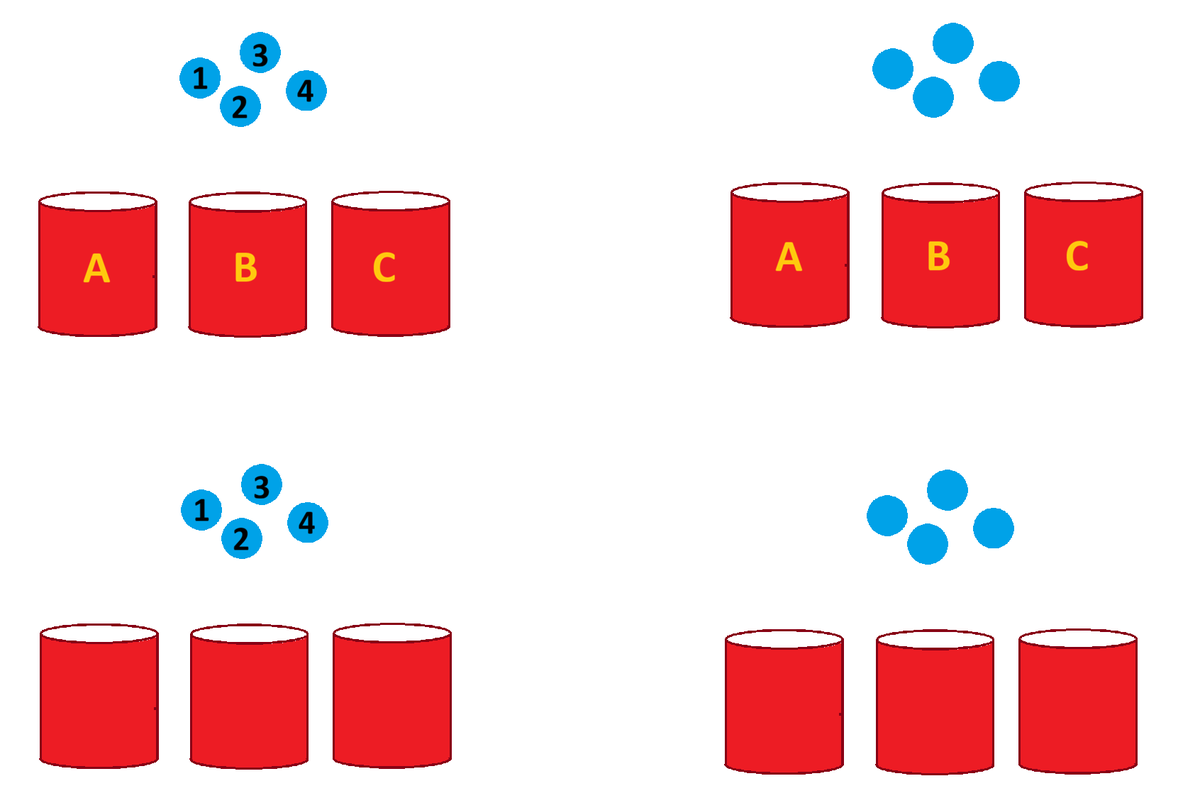
How many essentially different ways are there to insert 4 balls into 3 bins if:
a) The balls are labeled and the bins are labeled?
b) The balls are labeled but the bins are identical?
c) The balls are identical, the bins are labeled?
d) The balls are identical, as are the bins?
2
3
26
1,295
May 29
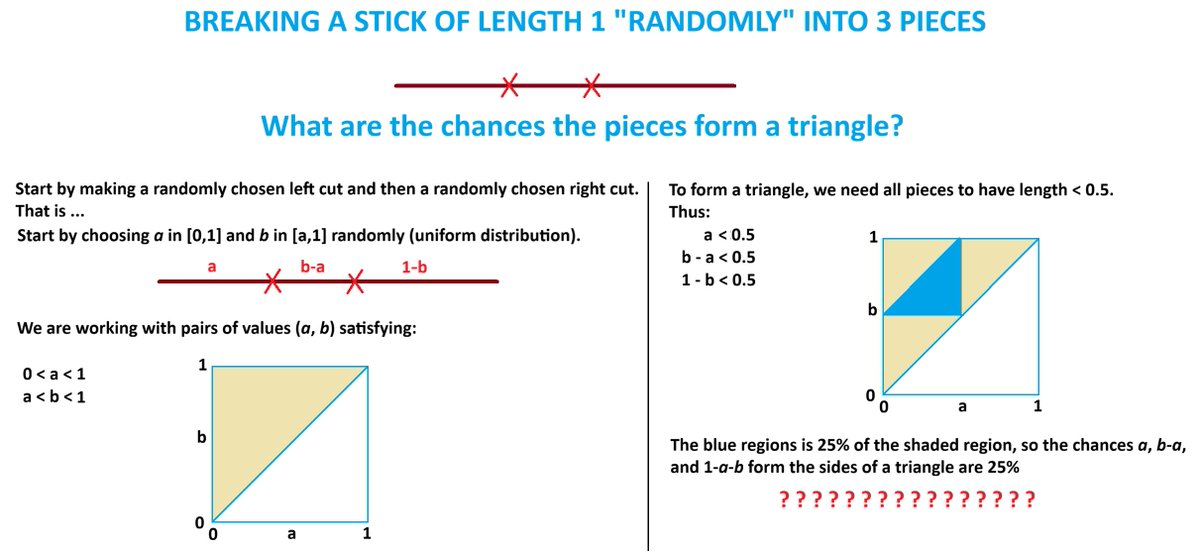
Does anyone else have trouble with the common answer to the famous stick-break-make-a-triangle problem?
Given we'll also start by first breaking off a left piece and then breaking the right piece, I personally think the answer is about 19.3%. (This comes from ln(2)-0.5.)
5
1
12
1,317
May 28
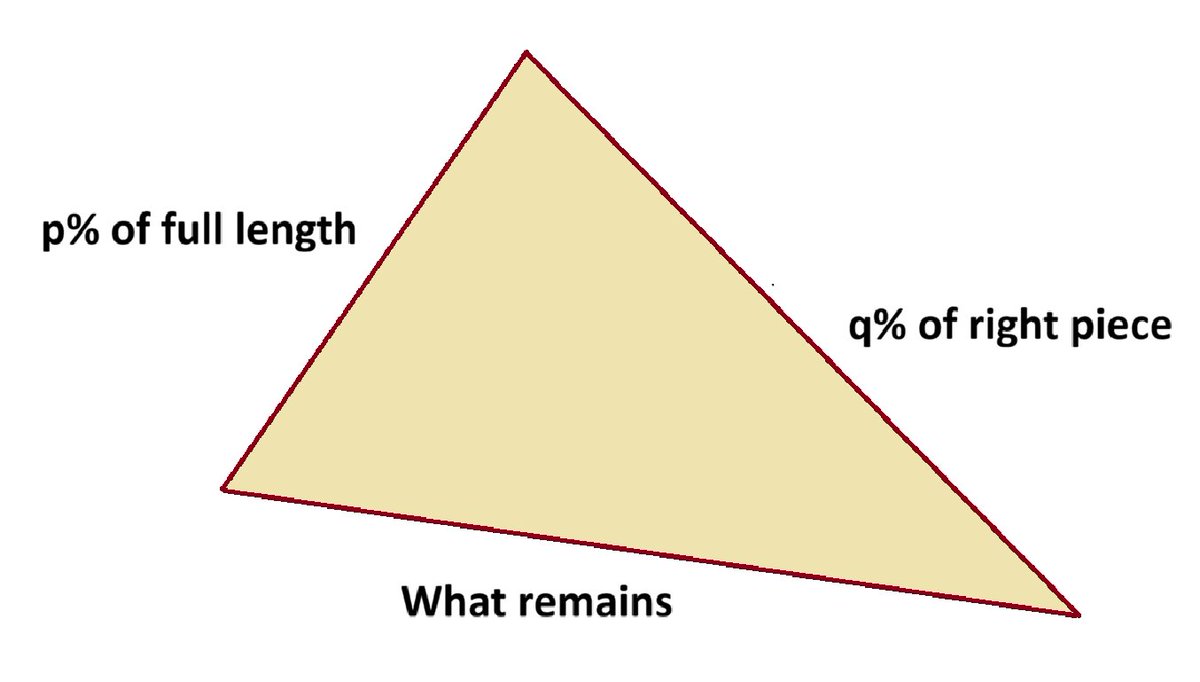
Values p, q each chosen from [0, 100] at random (uniform distribution).
Hold up a stick, cut off p% of its length from the left end. Hold up the right piece,cut of q% of its length from its right end.
Try to make a triangle with the three pieces you have.
Chances possible?
4
11
1,224
May 27
A Slight Variation on a Classic:
A stick is broken at random into two pieces, and then the longest piece is again broken into two pieces. (Each break point is chosen from a uniform distribution).
What are the chances that the three pieces can be used to make a triangle?
5
3
10
1,294