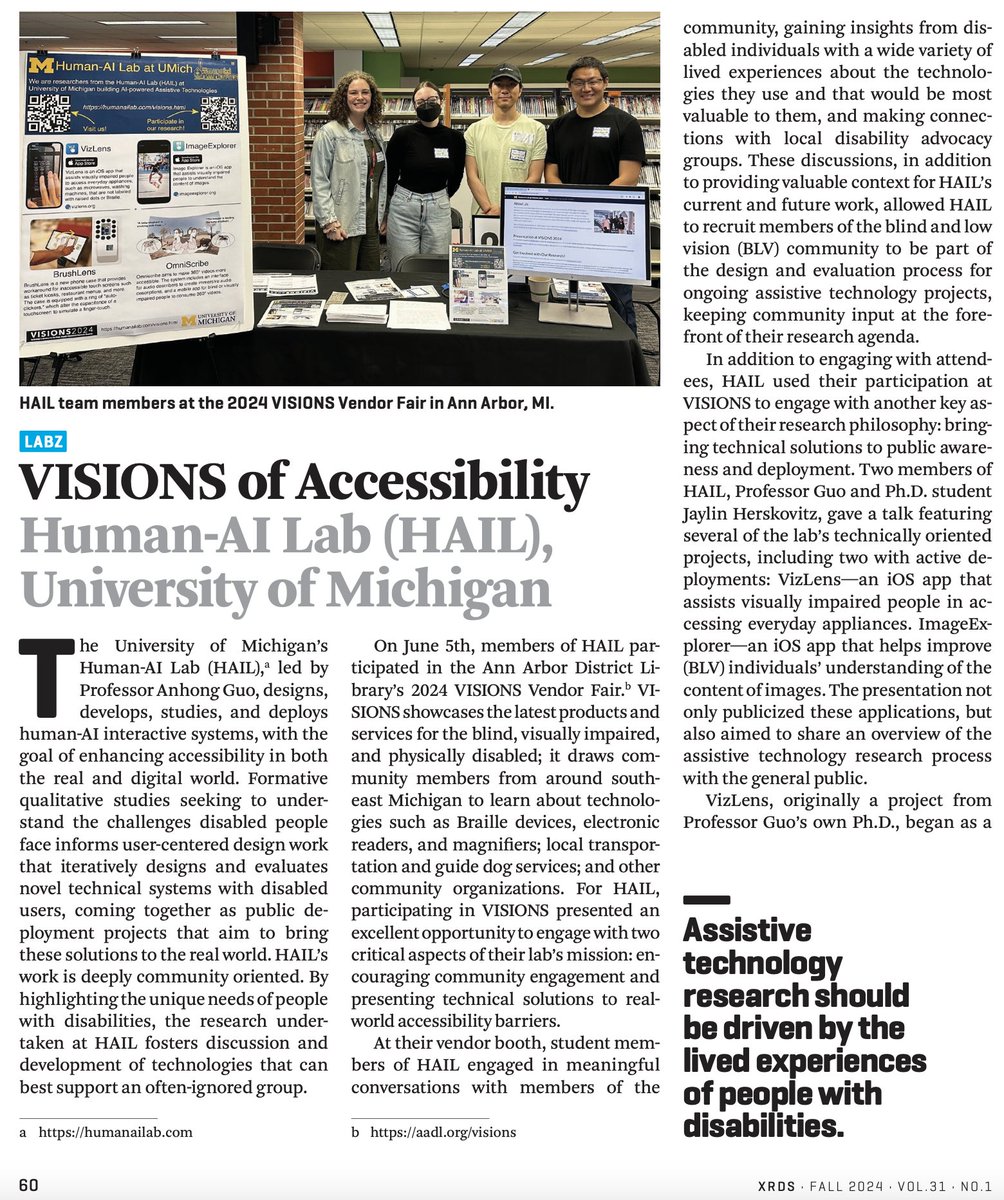
The Human-AI Lab at University of Michigan is at #CHI2026!
I am not there at CHI myself, please say hi to our lab folks, and hope to see many of you at #UIST2026! Also check out the many contributions by UMich CSE, School of Information, and beyond: cse.engin.umich.edu/stories/…
New accessibility techniques are developed all the time in HCI research, but they don’t often make it into the deployed applications that people use every day. What if you could add a missing feature to your assistive technology *without* waiting for the app to update? #CHI2026
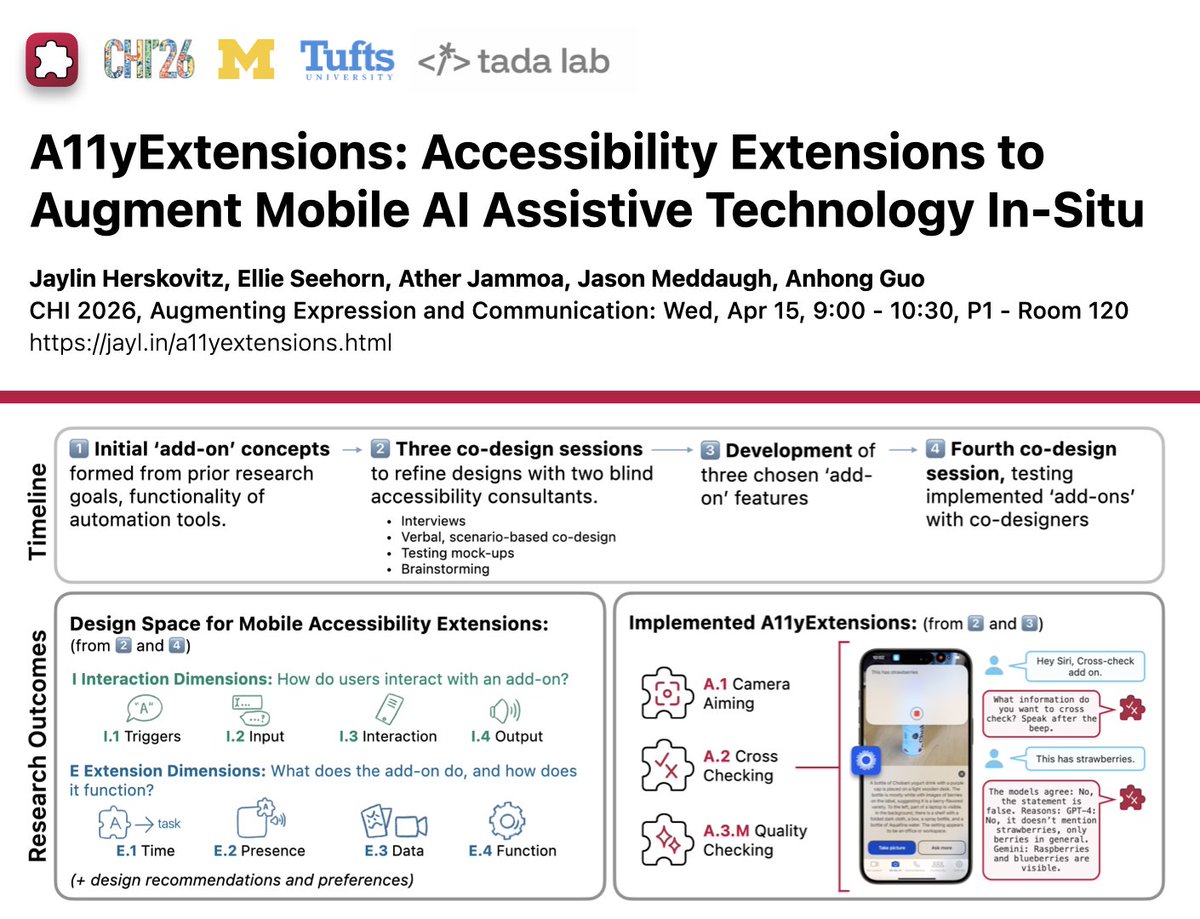
ALT An overview of A11yExtensions. (A) A timeline of the research process: 1. Initial add-on concepts formed from prior research goals, functionality of automation tools. 2. Three co-design sessions to refine designs. 3. Development of three chosen add-on features. 4. Evaluation through user testing with co-designers. (B) Design space for mobile accessibility extensions, showing two main categories. Interaction Dimensions: How do users interact with an add-on? (Triggers, input, interaction, output.) Extension Dimensions: What does the add-on do, and how does it function? (Time, presence, data, function). (C) Implemented A11yExtensions: A.1 Camera Aiming, A.2 Cross Checking, A.3.M Quality Checking. Shows an example interaction with A.2 Cross Checking: There is a screenshot of the app Be My Eyes with a speech recording box overlaid as a notification. There are speech bubbles showing a conversation. User: Hey Siri, Cross-check add-on. Siri: What do you want to cross-check? Speak after the bee
If you’re interested in accessibility, DIY technology, or AI software creation tools, I’d love to connect! Come find the talk: Wednesday, April 15, Augmenting Expression and Communication, 9:00–10:30am, Room P1-120. (5/n)
New lab alert ‼️🚨
I’m looking for PhD students who are passionate about creating assistive technologies and human-centered AI tools to join my research group at Tufts CS! I'm starting the Tufts AI, Design, and Accessibility Lab (TADA!) in January 2026 🥳
(1/4)
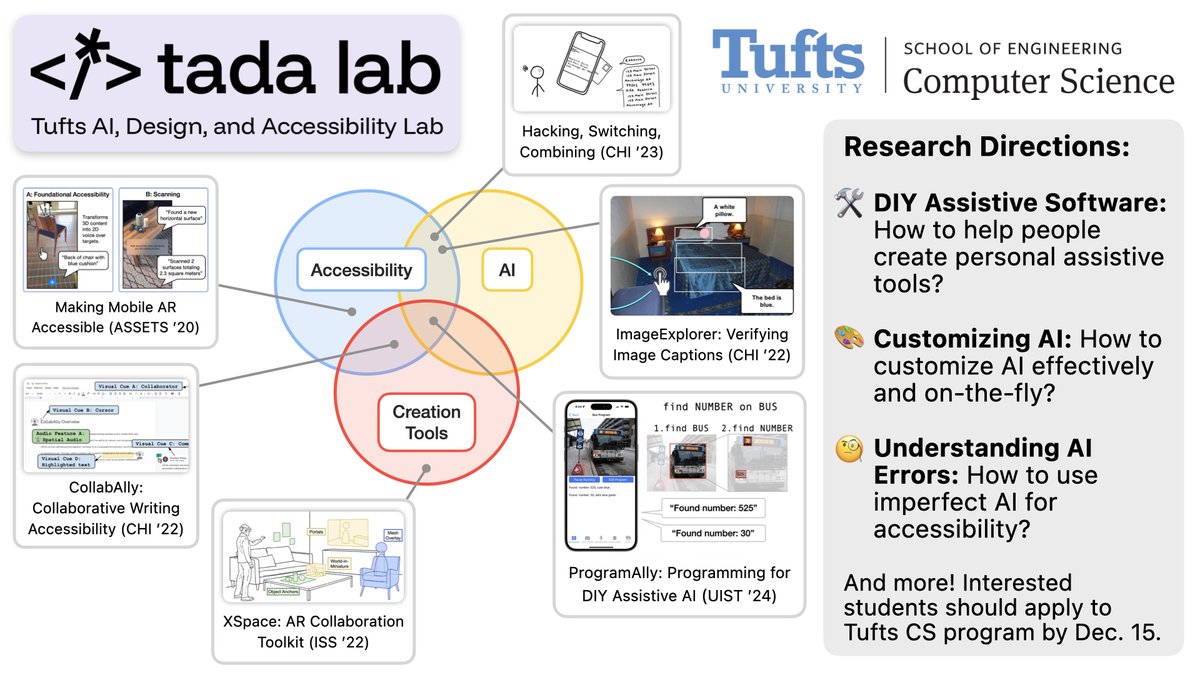
ALT Graphic showing research areas for the TADA lab. In the center, a three circle Venn Diagram with the research areas Accessibility, AI, and Creation Tools. Surrounding the Venn Diagram are projects from Jaylin's research, pointing to the research areas. (1) Making Mobile AR Accessible, ASSETS 2020 (Accessibility). (2) CollabAlly: Collaborative Writing Accessibility, CHI 2022 (Accessibility and Creation Tools). (3) XSpace: AR Collaboration Toolkit, ISS 2022 (Creation Tools). (4) Hacking, Switching, Combining, CHI 2023 (Accessibility and AI). (5) ImageExplorer: Verifying Image Captions, CHI 2022 (Accessibility and AI). (6) ProgramAlly: Programming for DIY Assistive AI, UIST 2024 (Accessibility, AI, and Creation Tools). The side of the image lists possible future research directions: "(1) DIY Assistive Software: How to help people create personal assistive tools? (2) Customizing AI: How to customize AI effectively and on-the-fly? (3) Understanding AI Errors: How to use imperfect AI?"
Possible broad directions include:
Personal Assistive Software: How to help people create assistive tools for themselves?
Customizing AI: How to customize assistive AI effectively and on-the-fly?
Understanding AI Errors: How to use imperfect AI for accessibility?
(3/4)
Interested PhD students should apply to the Tufts Computer Science Department by the December 15th, 2025 deadline! More info at: engineering.tufts.edu/cs/pro…
(4/4)
Looking forward to this year's PhD in technical HCI office hour this Wednesday 10/29 10.30am ET: docs.google.com/document/d/1… Ask your questions! Join me and other faculty to discuss admissions process, statements, and overall what a PhD is like and good for :) RT appreciated
We’re overwhelmed by the response to ASSETS 2025; this will be the largest ASSETS yet! We must limit new in-person registrations. Please sign up on our waitlist in case spots open up forms.gle/a9H5WpzVqn2hzNqQ6. Virtual reg is still available. More details: assets-conference.github.io/….
I love this summary of "what to learn in a PhD."
What Jack points out seems like a simple principle, but living through the intellectual uncertainty and chaos of being lost in your research for a long time—it's emotionally much harder learn to do it than it sounds.
the most satisfying takeaway from a phd is that you can solve problems far beyond your capabilities if you're willing to throw yourself at them again and again, over a long period, while staying open to new ideas
it's not really about being smart. just curious & persistent
I’m so happy to share that I’ll be joining @TuftsUniversity@TuftsCS as an Assistant Professor in January 2026! 🥳 I’ll be recruiting PhD students this upcoming cycle, so keep an eye out for more info if you’re interested in accessibility, AI, and HCI! (1/2)
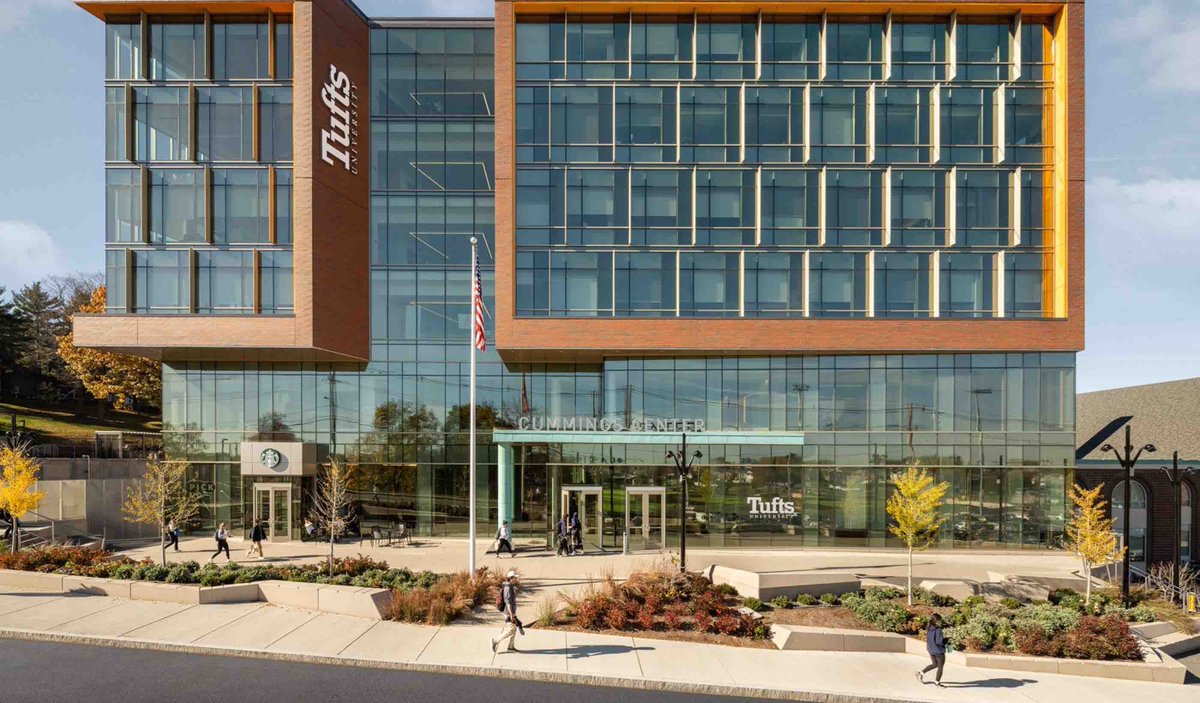
ALT The Tufts University Cummings Center, which houses the Computer Science Department. It's a modern glass office building featuring the university logo.
I owe many thanks to my advisor, mentors, collaborators, friends and family that have supported me through my PhD. So grateful for the opportunities and looking forward to what’s ahead. For now, back to thesis writing 😄 (2/2)
🎉So proud of PhD student @jayhersk Jaylin Herskovitz for receiving the @umichgradschool Susan Lipschutz Award! Congrats!👏
It recognizes her outstanding achievements, the interest in social responsibility, & a commitment to supporting women in academia.
cse.engin.umich.edu/stories/…