
genocide disliker
Joined November 2008
- Tweets 1,799
- Following 312
- Followers 687
- Likes 9,201
56 Photos and videos




Pinned Tweet

9 Apr 2025
Now out, "A Simple Explanation for Harmonic Word Order"
- we show that a core typological pattern in syntax can be explained as a consequence of word-class frequencies, so it does not need to be posited as an independent principle.
onlinelibrary.wiley.com/doi/…
1
2
16
988
May 22
_Uniform Information Density_
_Working Memory chunking_
... these seem related, both to do with unit size constraints
Any work on this?
1
78
Mar 25
I'm hiring! 2 x postdocs in Cognitive Anthropology, Archaeology and Linguistics, to work on the cultural history of Australia and Papua. More details in link below, and please do repost or share elsewhere!
isle.uzh.ch/en/jobs/postdoc-…
19
23
2,709
Jan 5
I'm hiring! 2 x PhD positions to work at Uni Zurich with me on "Evolutionary Semantics" for an ERC-funded project. semantically curious MA grads from linguistics, cog psych, anthro encouraged to apply
evolvinglanguage.ch/studying…
1
4
8
796
29 Sep 2025
Social functions of language may drive faster change and faster diversification in some features.
Thanks to growing diversity in variationst sociolinguistics, I gathered studies of 63 languages from 28 families. Here I sketch some potential patterns
compass.onlinelibrary.wiley.…
1
11
23
1,688
John Mansfield retweeted

20 Aug 2025
Don’t miss out on the upcoming ASAIN event on climate risk research and modelling on 27 Aug.
Looking forward to joining the panel of excellent speakers to discuss this important topic, particularly coming off the back of a 2nd heatwave this Summer in 🇨🇭
asain.ch/news-events/27th-of…
1
3
468
21 Aug 2025
"Evolutionary dynamics of language: Insights from a diverse sample of sociolinguistic studies" forthcoming article comparing findings from phylogenetic and sociolinguistic studies
ling.auf.net/lingbuzz/008948
1
3
149
9 Apr 2025
Now out, "A Simple Explanation for Harmonic Word Order"
- we show that a core typological pattern in syntax can be explained as a consequence of word-class frequencies, so it does not need to be posited as an independent principle.
onlinelibrary.wiley.com/doi/…
1
2
16
988
9 Apr 2025
We treat syntax as an evolving, inherently variable phenomenon. We also argue that word classes are better treated as gradient categories, rather than fully discrete. This approach fits natural language data better than rigid rule-based models.
1
1
225
9 Apr 2025
Thanks to Lothar Sebastian Krapp for adding a formal mathematical description!
I also got incredibly generous input along the way from Charles Kemp and Jeff Good.
... but not sure if I ever want to spend so long on one article again?? 😬
1
193
7 Apr 2025
I'm hiring! 2 x PhDs and 1 x PostDoc, to work with me at Uni Zurich on a project investigating how semantic patterns differ by geographic region. Linguistic typology, data science, spatial analysis, phylogenetic methods, potential fieldwork... REPOST 🙏 comparativelinguistics.uzh.c…
2
59
97
9,817
7 Apr 2025
For the PhDs, an interest in Papuan or Australian languages would be great, but other regions also possible. For the PosDoc, data science skills esp spatial and/or phylogenetic analysis are crucial.
1
5
487
8 Apr 2025
I am also open to applicants whose degree is not in linguistics, but still have relevant analytic skills or academic background, and can demonstrate a good understanding of linguistic structures and linguistic diversity.
3
340
7 Mar 2025
"A simple explanation for harmonic word order"
😎 new paper with Lothar Sebastian Krapp. Formal modelling of word order as a dynamic system helped us understand some fundamental mathematical patterns!
lingbuzz.net/lingbuzz/008852
1
3
6
816
7 Mar 2025
Main finding: Parallel harmonic word order can be explained as a frequency effect. Given a simple word-order that samples previous phrases and approximately replicates their order, the most frequent word class gravitates to the phrase edge by simple probabilistic processes.
1
4
198
7 Mar 2025
if this make no sense, don't worry, just read the paper :)
2
135
John Mansfield retweeted

27 Feb 2025
Thanks to John Lyons for sharing the newspaper ad of 500 Australian Jews calling on Australia to say NO to Trump and Netanyahu’s plan for the ethnic cleansing of Palestinians.
The advertisement was organised by an independent collective of Jews.
#OZJewsSayNO #NO2TrumpsPlan
100
1,155
2,544
43,684
31 Jan 2025
"the extraordinary callousness, bordering on racial contempt, in Germany over the fate of Palestinians"
theguardian.com/news/2025/ja…
1
151
John Mansfield retweeted

21 Jan 2025
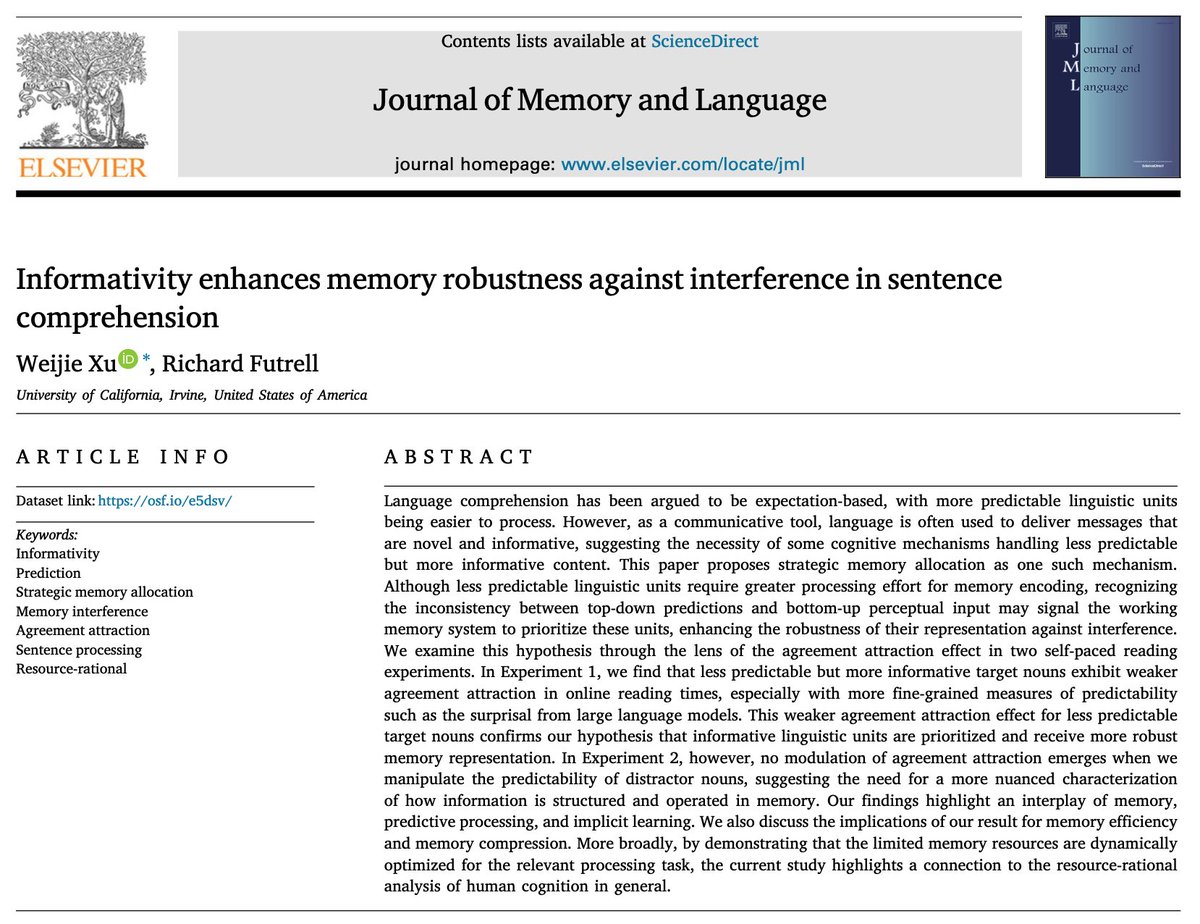
Glad to share that our paper (with @rljfutrell) is now on JML. In this paper, we proposed strategic memory allocation as a mechanism to handle less predictable but more informative linguistic units.
Check out this link for more details:
sciencedirect.com/science/ar…
1
9
42
2,873