
Author. Coder. CTO. θηριομάχης. Building: symbolic.ai. Writing: jonstokes.com.
Joined July 2008
- Tweets 56,861
- Following 1,496
- Followers 30,495
- Likes 79,716
4,874 Photos and videos








Jon Stokes retweeted

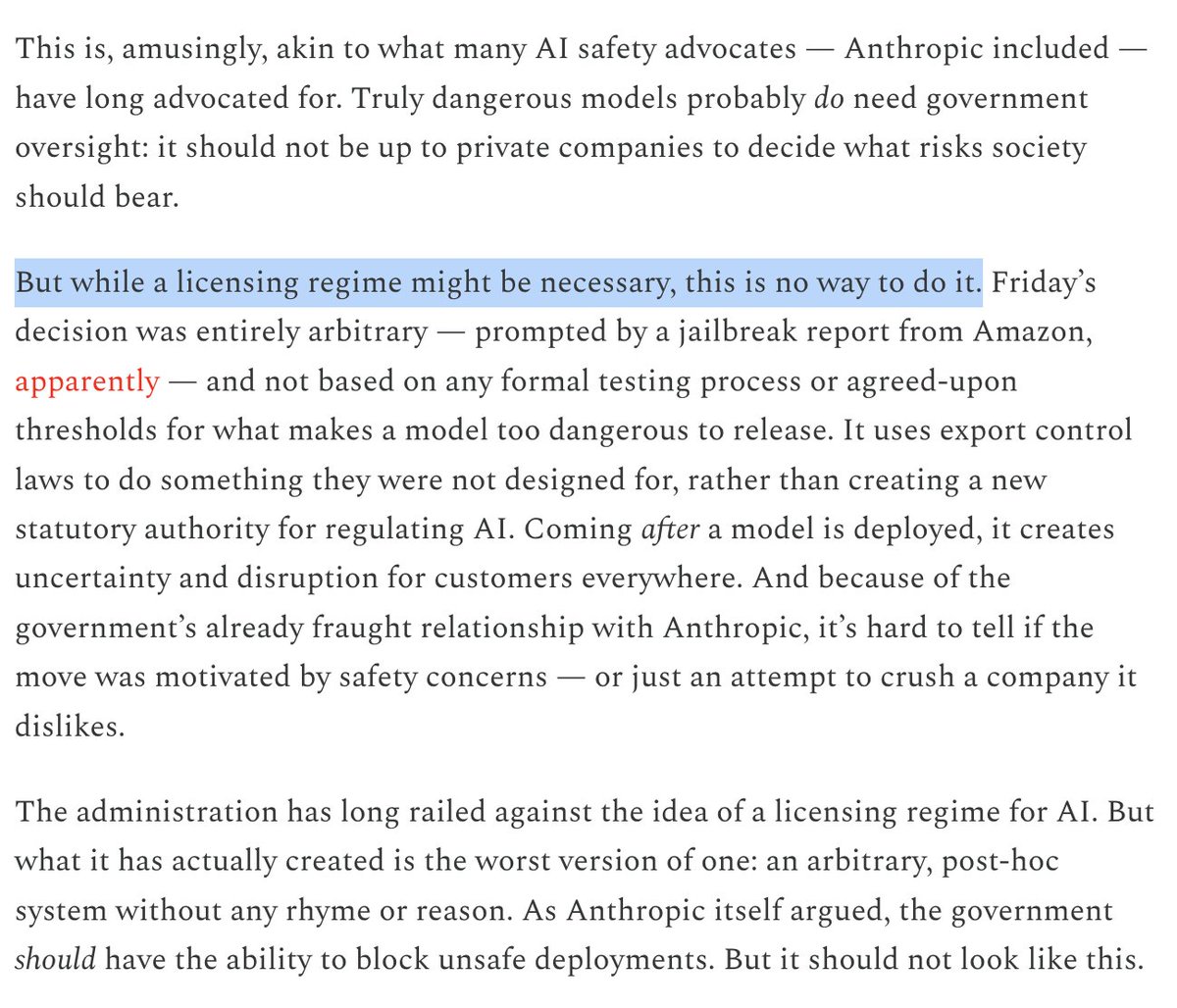
No. The simple fact is that once you wake up Leviathan, it is not always going to behave the way you want it to. It can arbitrary and capricious.
Urging regulation *only in this specific way* was never a good strategy.

21
30
402
36,344
Jon Stokes retweeted

“You knew the first trillionaire?”
“I didn’t say I knew him. I said he replied ‘Wow!’ on my post once.”

187
1,734
43,612
532,166

Jun 13
Our agent implementation is indeed a CQRS (lite) system where an agent is a process in an infinite loop (elixir GenServer) that appends events to the log from the user, system, or LLM.

5
1,030
Jon Stokes retweeted

Jun 13
Because this is happening to Anthropic, the temptation for many will be to say: Play stupid games, win stupid prizes. They have relentlessly raised the regulatory temperature in Washington by inviting far-reaching controls of frontier models. They made this bed and now they have to lay in it.
But this decision by the Trump administration should not be judged on a desire for payback politics, but on the merits, and specifically what it means for America's broader AI objectives.
In that regard, this action is truly outrageous. How exactly is the government planning on even going about verifying everyone who uses this specific model to ensure compliance? That alone raises huge flags.
Between the latest Executive Order shifting more control to NSA, and the recent chatter about quasi-nationalization / equity stakes, and now this action, we are talking about a significant escalation in the politicization of AI and centralization of control over advanced computation in this country. And this is all being done by an administration that had previously made acceleration and winning the great AI race a priority.
We're moving backwards now.
Jun 13

The US government, citing national security authorities, has issued an export control directive to suspend all access to Fable 5 and Mythos 5 by any foreign national, whether inside or outside the United States, including foreign national Anthropic employees.
The net effect of this order is that we must abruptly disable Fable 5 and Mythos 5 for all our customers to ensure compliance.
Access to all other Claude models is not affected.
We apologize for this disruption to our customers. We believe this is a misunderstanding and are working to restore access as soon as possible.
Read our full statement: anthropic.com/news/fable-myt…
72
137
864
127,916
Jon Stokes retweeted

Jun 12
Yes. The notion of a race to ASI or a Singularity that disempowers the bulk of humanity creates frantic, antisocial incentives.
If you believe that the next few years (or months) determine your fate and the fate of humanity, and that it's a winner-takes-all game, then you should do everything to get there first.
If you believe that AI is more like other technologies, that diffusion will take time, that ASI is actually quite hard to achieve, and that the likely AI future is one of many AI companies, then that frenetic urge to be 'first to superintelligence' recedes.
I think the latter is both the more likely outcome and that looking at it that way produces a healthier and more pro-social AI industry.
Jun 11

I think narratives like the "permanent underclass" mindset can be very harmful. Not because they cause emotional depression, but they change the game-theoretic dynamics.
People cooperate in prisoner's dilemma/commons scenarios when they believe the game has many turns.
But if you believe the game only has a few turns, and that you should win otherwise you become the "permanent underclass", then the rational self-interested move is to defect: do whatever you can to win in the short term.
I think the whole AI research community is in that scenario now. No one stays in academia to educate new talent. Frontier lab competition becomes more and more aggressive and toxic.
I can't imagine how much public benefit those doomer narratives alone will cost us. Especially if they're wrong, which I think they are
5
9
68
7,630
Jun 12
I'm with Ross. Or, actually, I'm more than skeptical of "AI super persuasion" -- I think the whole concept is fundamentally nonsensical. And insofar as it makes sense, it's already here on my feed, & SA & his rationalist coreligionists are victims of it. Let me explain.
Jun 12

Living through 2020-21 taught me that ideological manias have little to do with anything recognizable as "persuasion" or "intelligence" (super or not) and that having all public organs of information aligned doesn't do away with backlash polarization.
x.com/lukeburgis/status/2065…
3
1
7
1,942
Jun 12
I'm speaking, of course, about the bonkers notion that current LLMs are somehow "conscious" or have feelings or experiences. This particular brainworm is the product of billions in electricity & labor & hardware & post-training, meant specifically to give ppl this impression.
1
2
472
Jun 12
So to the extent that "AI Super Persuasion" is real, surely "LLMs are conscious beings that can experience things" is the first and likely only example of it.
4
444
Jun 11
I'm still meditating on the deep strain of authoritarianism that can surface in techno-libertarians on both left & right. It's like a personality type that's a stickler for rules & order, but they opposed a particular dominant order so they were miscategorized as libertarian. x.com/cryptomegafauna/status…
2
2
13
1,074
Jun 11
And for a long time in tech, during the era of listerves & IRC & forums & USENET, the biggest anti-establishment tent was techno-libertarianism, so they kind of slotted into that. But they were temperamentally authoritarian & fully flipped that way the moment covid happend.
1
2
6
740
Jun 11
I am kind of wired in a converse way to these people: I'm temperamentally libertarian but am strategically further on the authoritarian spectrum insofar as I frankly care way more about actual outcomes now than process & abstract principle.
1
1
5
508
Jun 11
I am & have been adjacent to a bunch of these ppl online via FB & private listserves -- a milieu of boomer & GenX sci-fi creatives, futurists, & game devs. An extended network. They reason they all closed ranks against AI is simple: they're still doing the techlash.
Jun 11

i suspect there's some kind of cycle of cope and ego where, like, these guys want to be the prophets and storytellers who light the way to the future and play with its shadows, but they already fucked up early on by dismissing LLMs and going for legible consensus status instead of encountering the future as it arrived ahead of the crowd, so the frontier passed them by, and now in order to catch up to it and learn from it they have not only a lot of distance to cover, but a huge amount of ego-inertia; they'd have to be publicly wrong, and risk being cringe, and without the lived momentum of surfing the unfolding wave of the future as a visionary and feeling the reality of that more profound reward than instant consensus recognition that comes from reaching toward the visionary engine at the end of time, they are lost and only know to play the losing game of clinging to and proselytizing a bygone world where they themselves belonged to the class of prophets who saw further and more boldly.
15
12
170
212,572
Jun 11
In general, I think it's the case that this crowd went through most of their lives as left-libertarian, but since the one-two punch of Trump & covid I have seen them flip to a deep authoritarianism that would shock their younger selves, mostly for culture war techlash reasons.
2
51
2,244
Jun 11
Anyway, I guess the point I'm making here is that AI &/or LLMs isn't the problem, because in every single case with one of these ppl you look at their feeds prior to AI & they were ranting about the evils of crypto. The deep tribal antipathy predates AI.
4
49
1,988