
Joined December 2017
- Tweets 2,736
- Following 443
- Followers 2,165
- Likes 2,216
911 Photos and videos
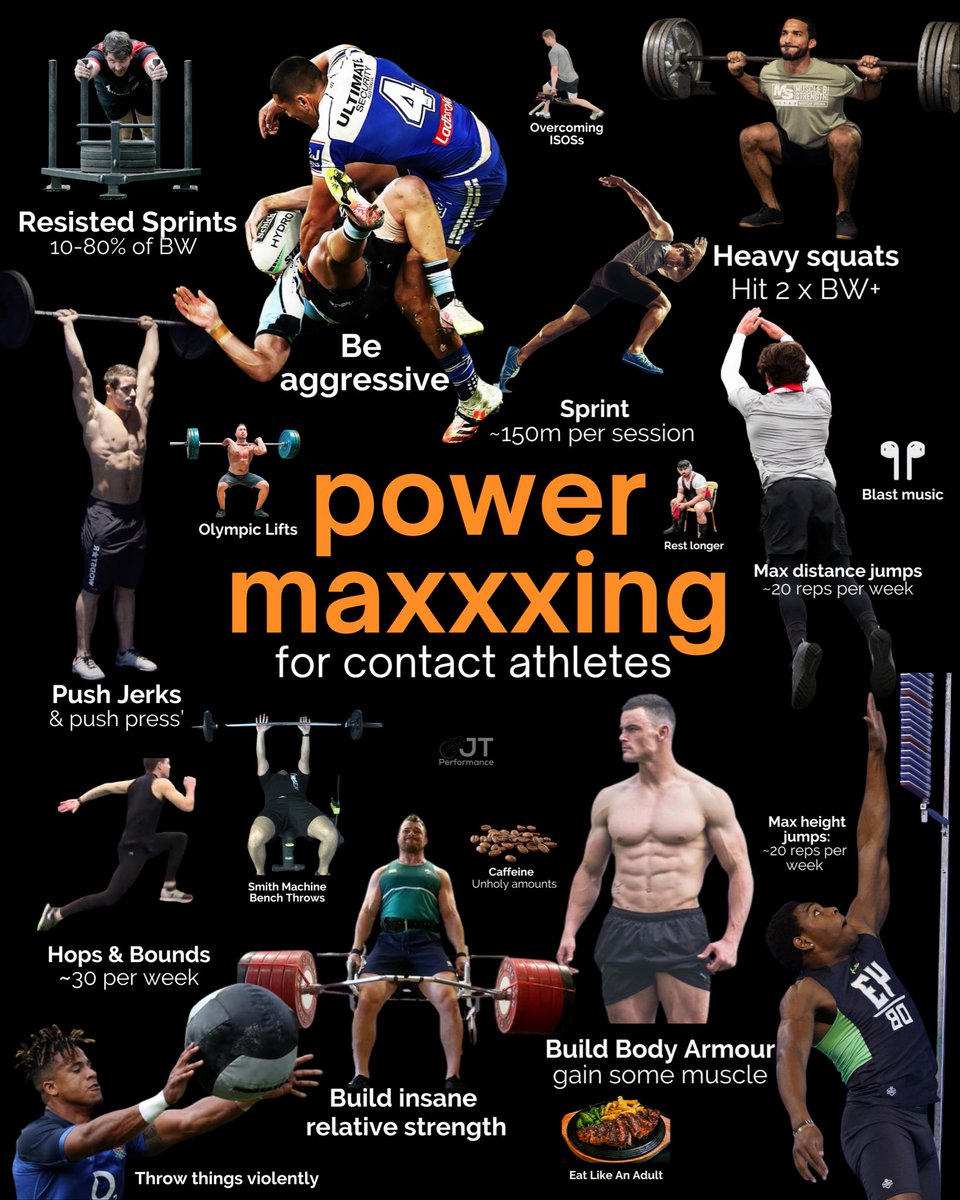
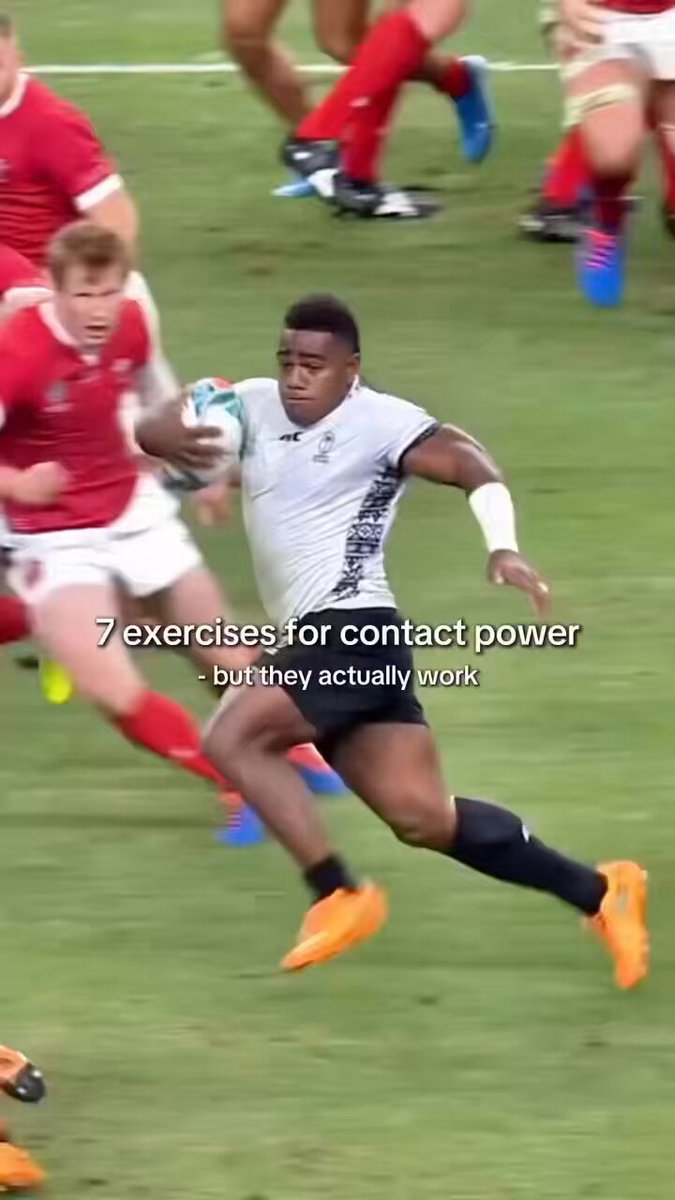

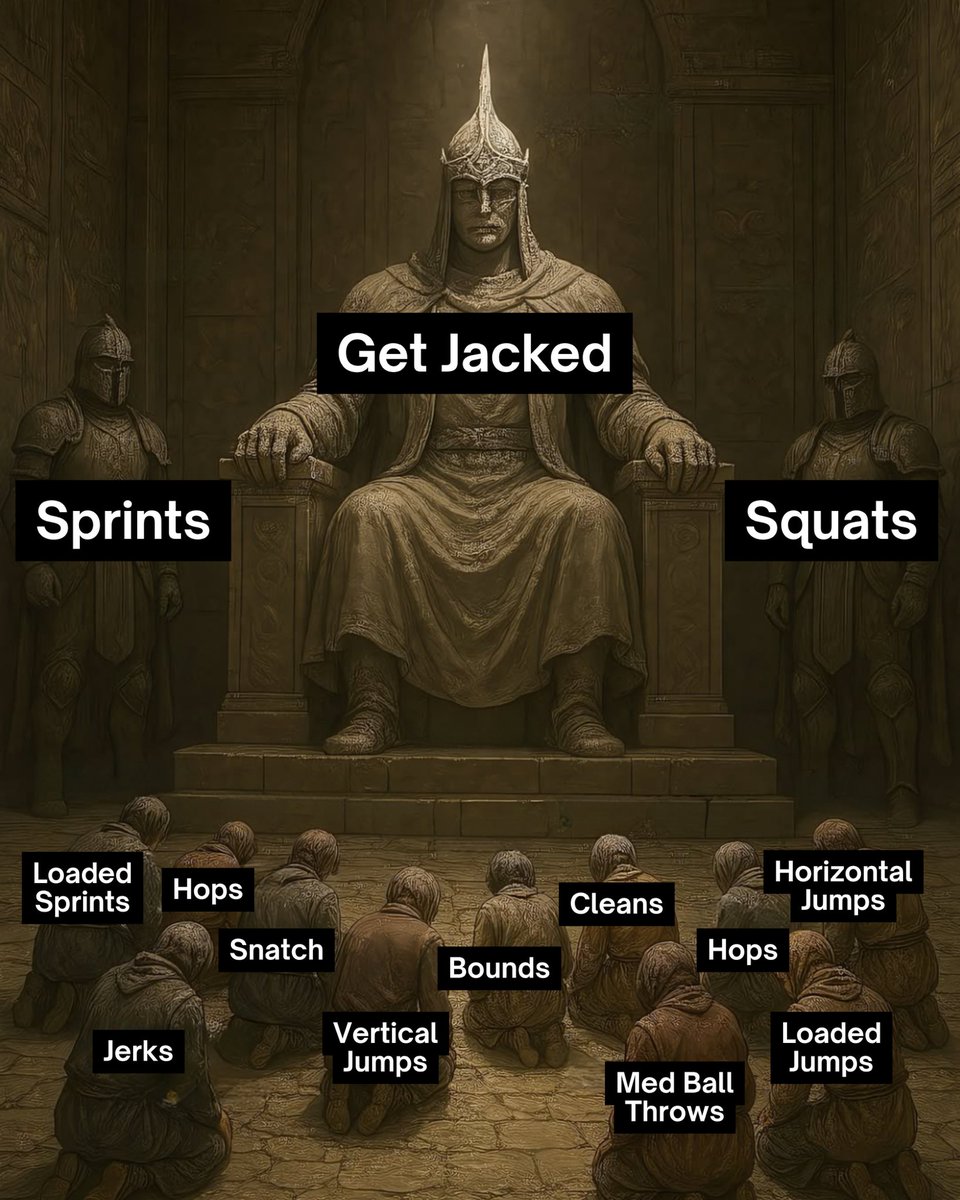

16 power training ideas for contact athletes
You don’t need to do them all
But these are my go-to tools
What would you add?
1
9
357

Jun 15
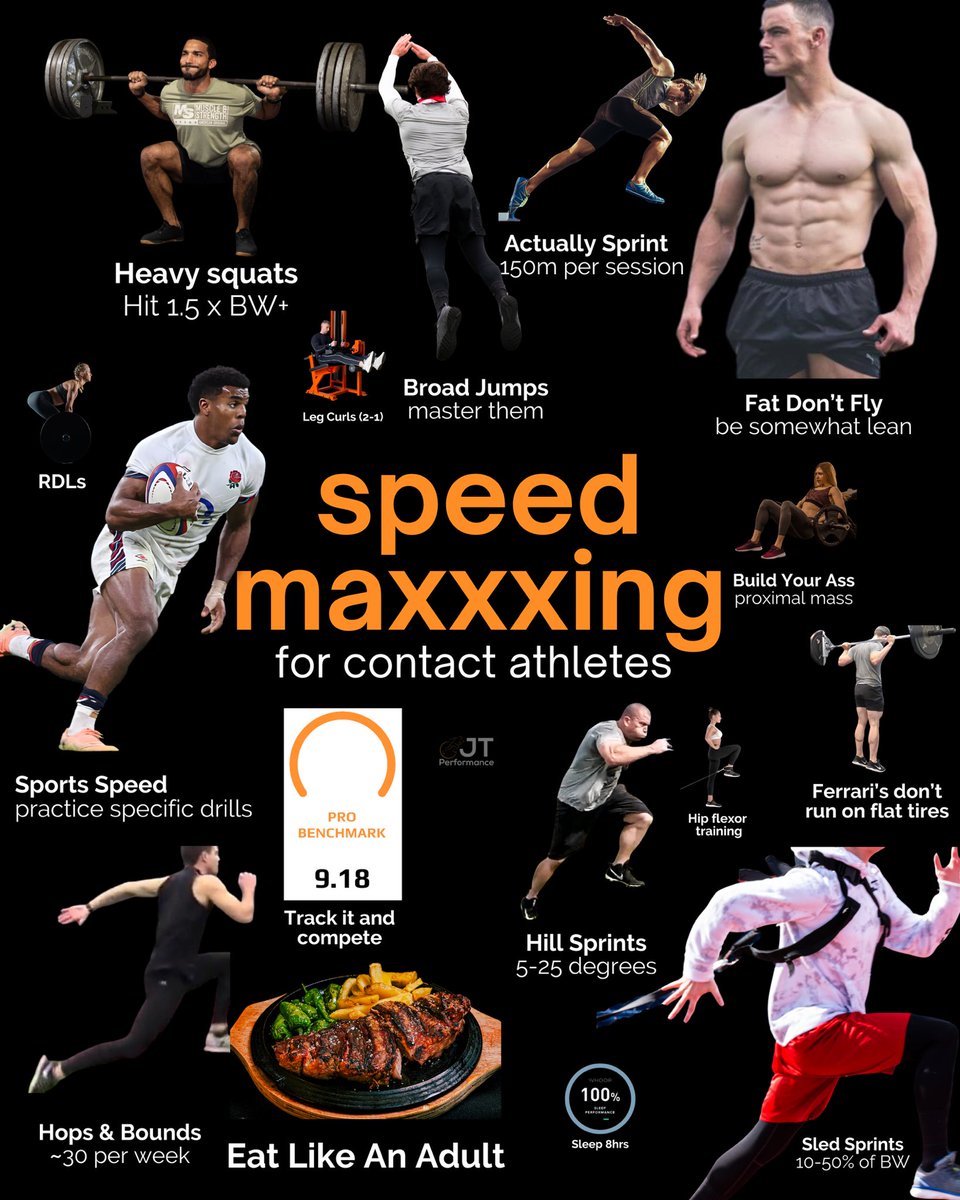
16 speed training ideas for contact athletes
You don’t need to do them all
But these are my go-to tools
What would you add?
2
22
1,200
Jun 14
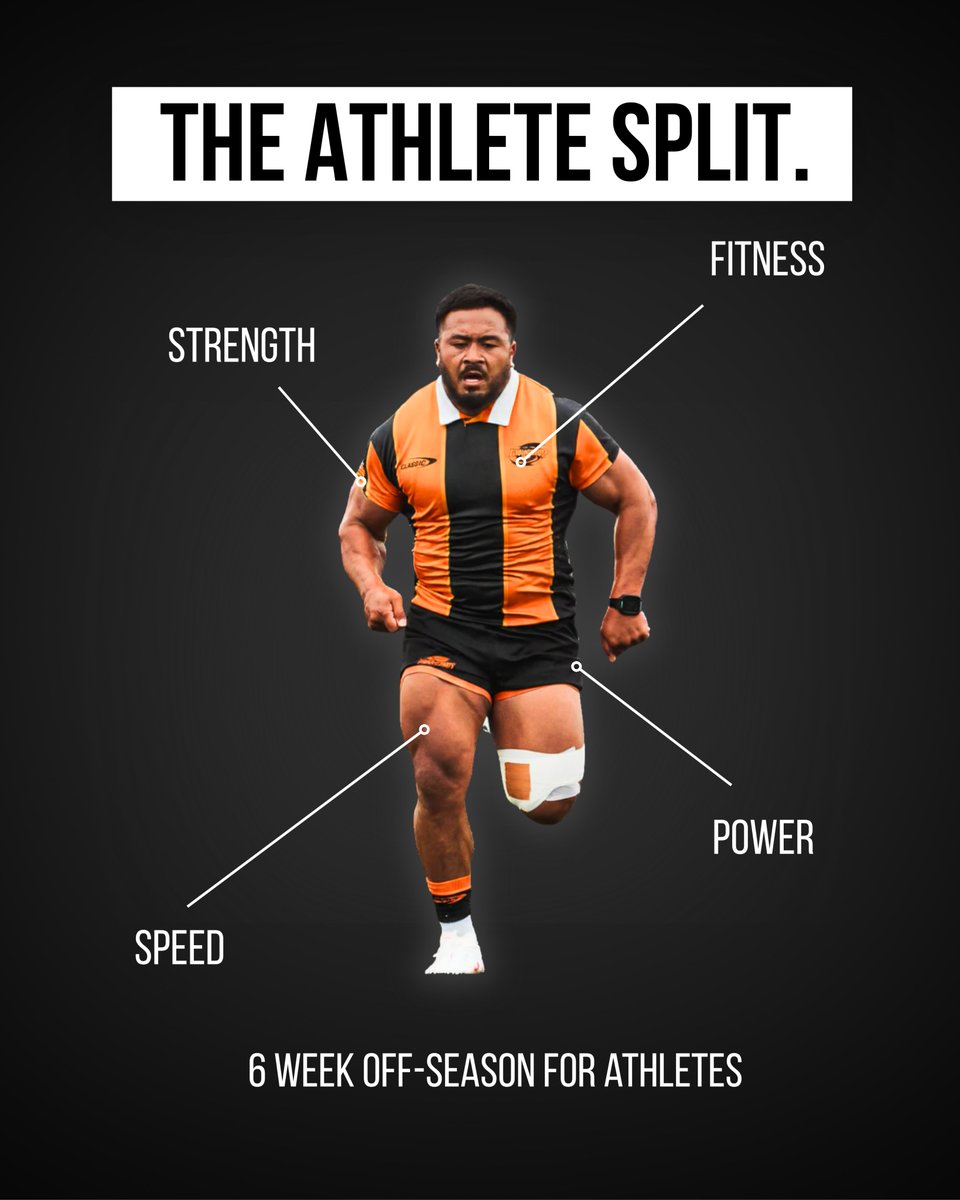
The Athlete Split gets released tomorrow 🥳
My first-ever program that isn't 1-1 coaching.
It teaches you to balance speed, strength, size, power, and conditioning using the high-low split.
A 6-week off-season program that can be repeated again and again. With lifetime access to the app.
Almost half price if you're one of the first 200 buyers.
Join the waitlist here: mailchi.mp/b02e73a380ba/jhy5…
123
May 29
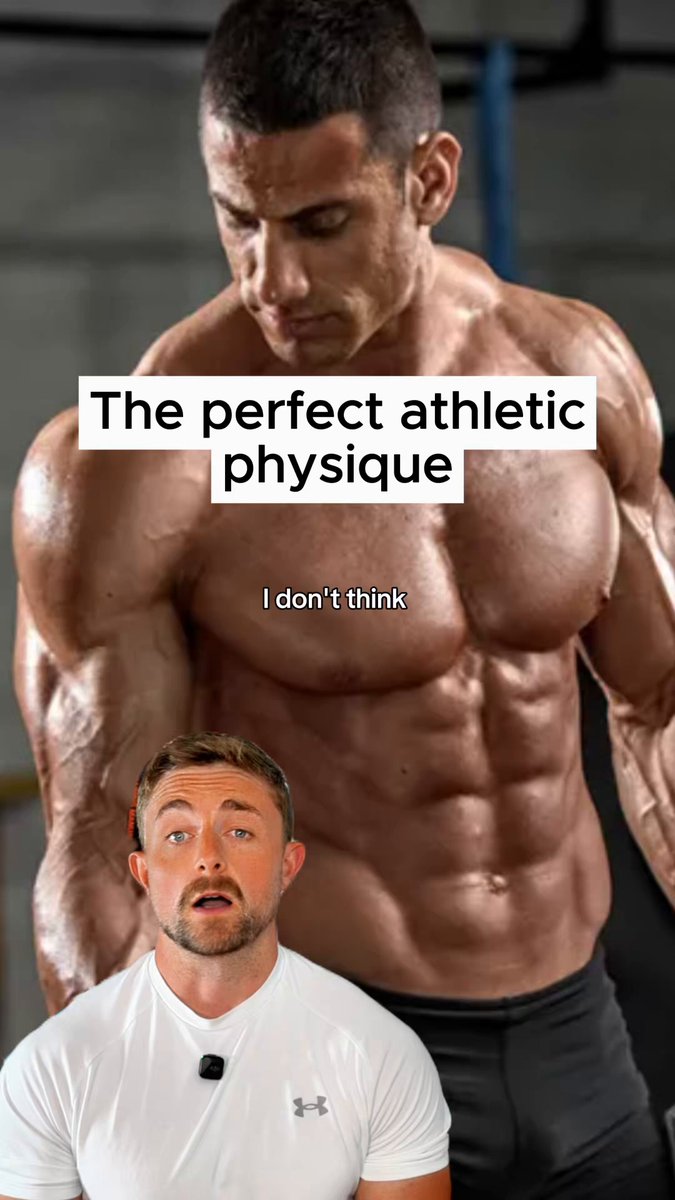
Some of the best athletes in the world have pretty average physiques.
I like the motorsport analogy:
When building an elite athlete, you're building the car AND the driver.
The car = your physical capacities (speed, strength, power, size)
The driver = technical skill, tactical awareness, game IQ
You could be absolutely shredded*
But if you can't drive – it's pretty pointless.
*Being shredded doesn’t mean you’ll be fast, strong, and fit. But let’s be generous for the example.
155
May 21
Building contact power isn’t as simple as squats and deadlifts.
It’s not even a power exercises like cleans or weighted jumps.
There’s no magic exercise.
It’s not the simple.
But research shows a strong link between momentum and collision power.
Momentum = your bodyweight x your speed.
(Usually measured over 10m)
Plus, 110kg loaded sprint time over 5-10m has been shown to predict collision dominance in international rugby.
Makes sense to me.
But you also need to use that momentum — the skill and body positions — in real situations.
There’s no secret exercise.
But if I could only pick 7, I’d pick these.
150
May 15
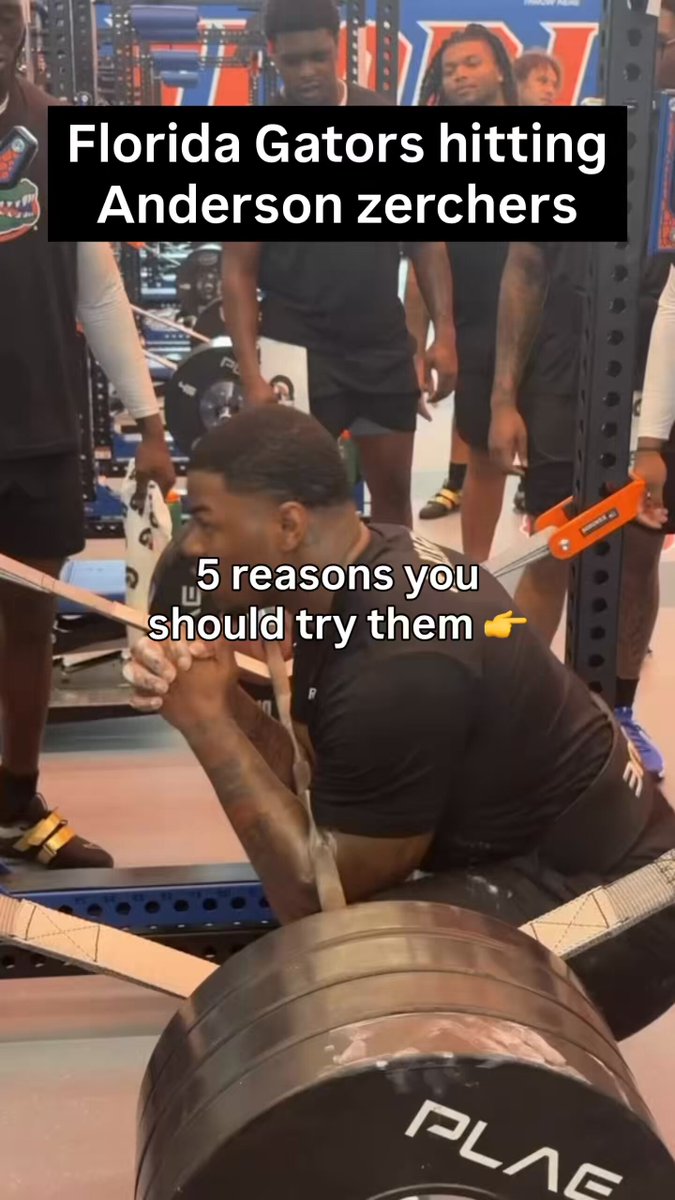
People are waking up to the power of zerchers
You should use Zerchers because they’re excellent for:
• Grooving squat mechanics
• Building the upper back and traps
• Reinforcing strong trunk bracing
• Being easier to learn than front squats
• Requiring less mobility than front squats
• Being friendlier on the wrists and shoulders
• Opening up the hips
• Look badass
But don’t use Zerchers just because they “look like the sport.”
5
3
98
17,642
May 14
The 6 upper-body exercises I use most
with contact athletes:
1. Push press / jerk
2. Heavy bench variation
3. Chest-supported row
4. Heavy chin-up
5. Smith machine bench throws
6. Manual-resistance neck
Not very fancy.
Very effective.
3
229
May 12
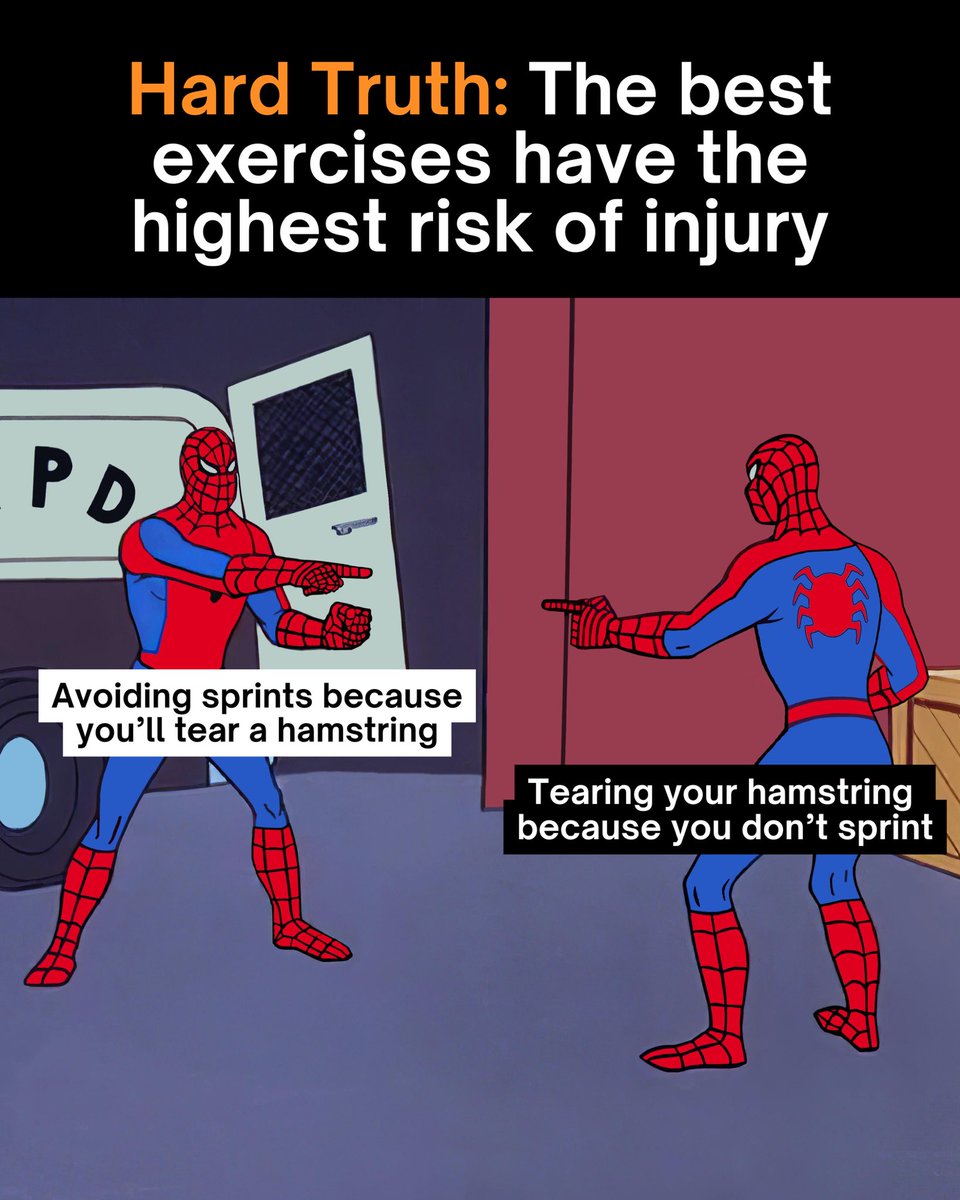
The best exercises have the highest risk of injury
* Sprints tear hamstrings
* Plyometrics blow out knees
* Deadlifts hurt backs
* Dips stress shoulders
The secret isn’t avoiding, it’s dosing.
Stress drives adaptation.
124
May 11
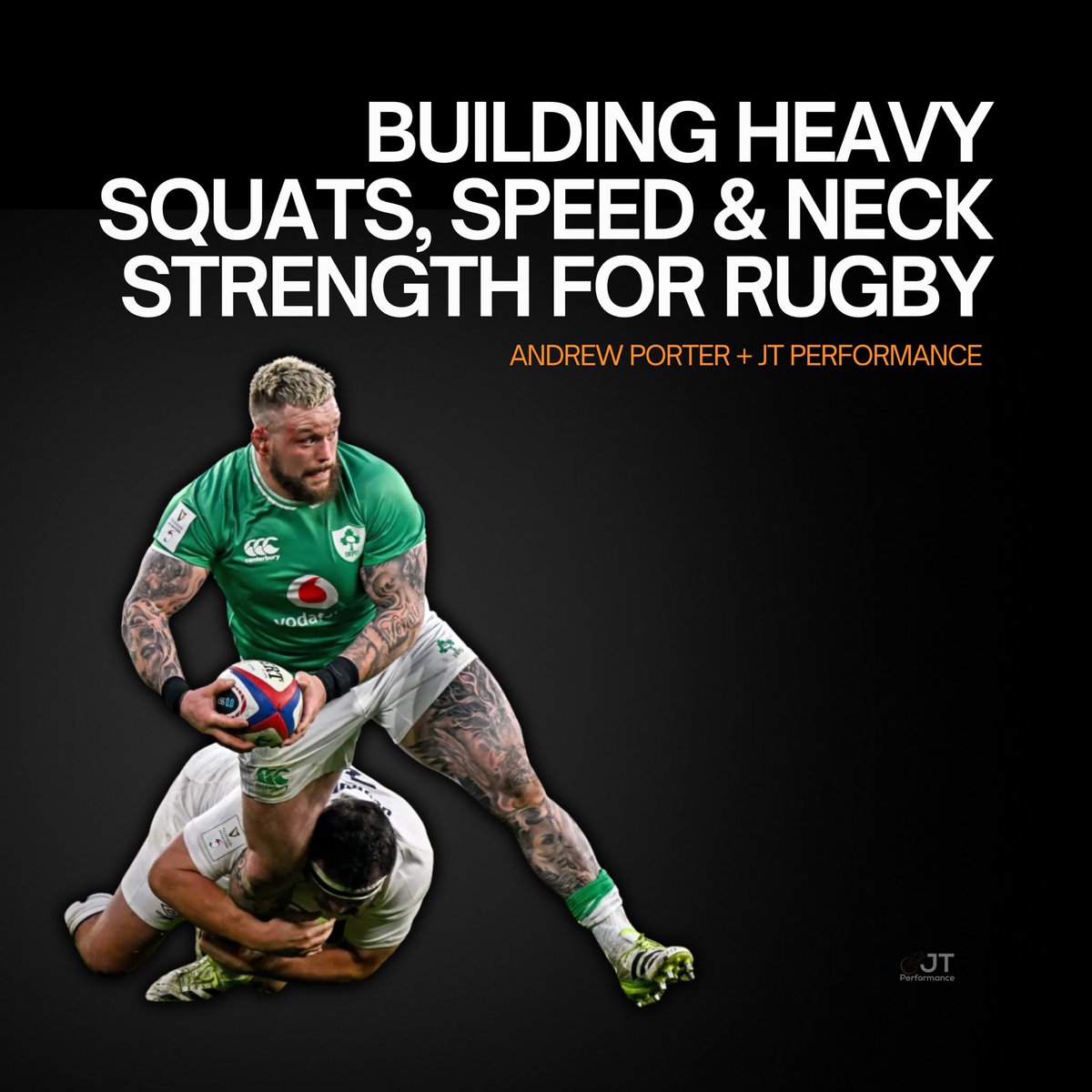
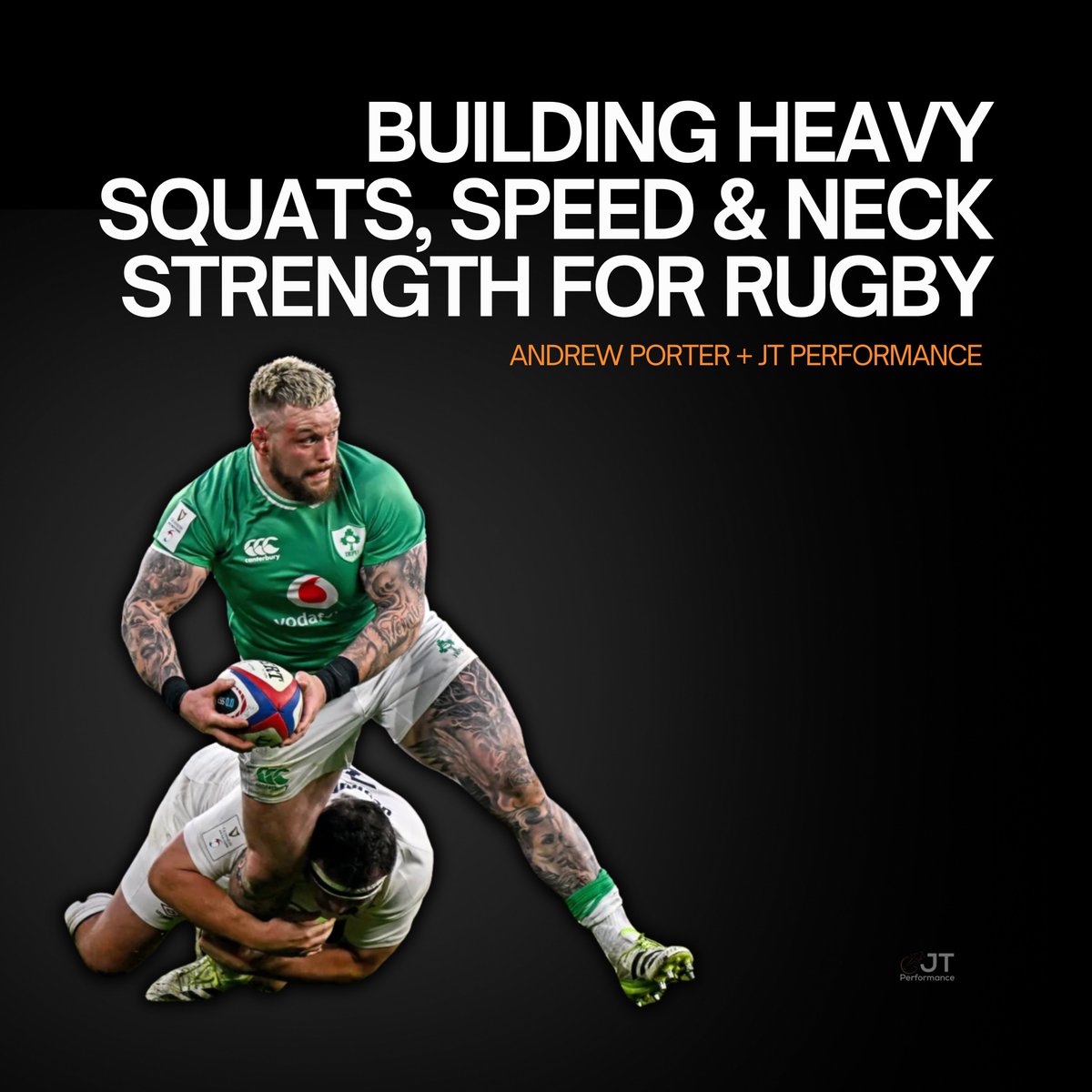
How does an elite rugby player actually train?
Got to chat with Ireland and British & Irish Lions front rower Andrew Porter to find out.
We talked box squats vs deep squats, neck training, speed work for big men, and off-feet conditioning.
This one's packed with gems.
open.spotify.com/episode/0Ox…
1
268
May 11
How does an elite rugby players actually train?
Got to chat with Ireland and British & Irish Lions front rower Andrew Porter to find out.
We talked box squats vs deep squats, neck training, speed work for big men, and off-feet conditioning.
This one's packed with gems:
open.spotify.com/episode/0Ox…
241
May 11
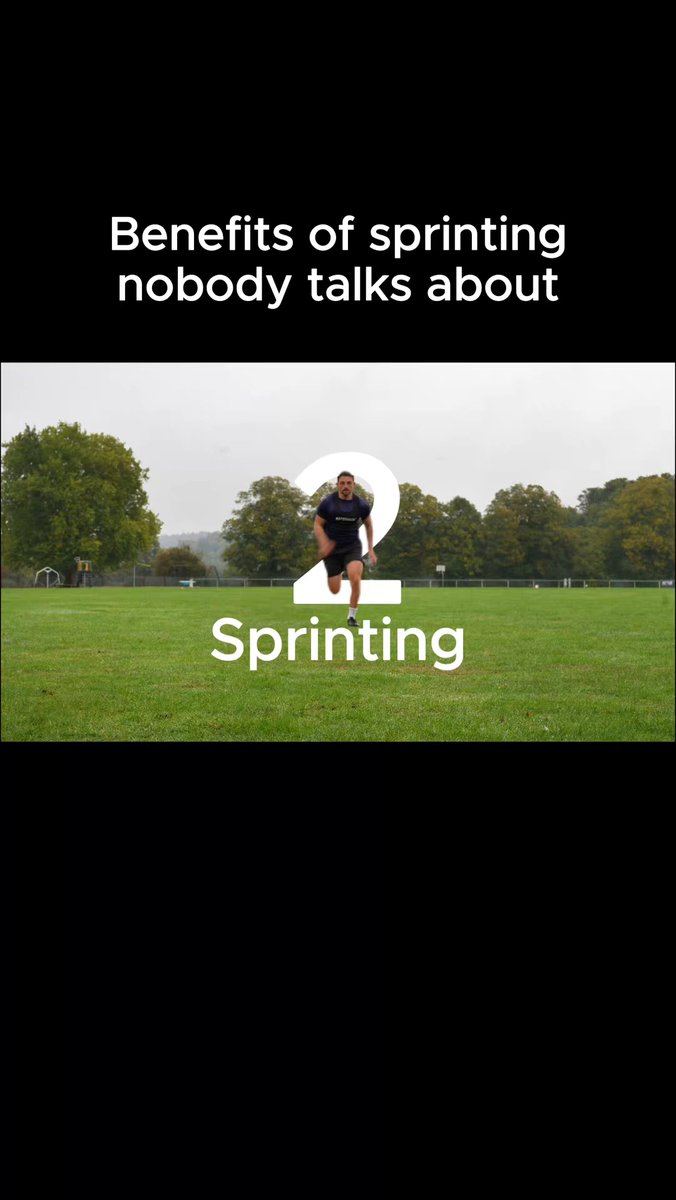
Most athletes don’t sprint enough.
And sprinting does more than just make you faster.
It can improve collision dominance too.
Because dominant collisions come down to 3 things:
Size – mass moves mass
Speed – size is useless if you can’t accelerate it
Technique – body position and timing let you use both. No point having a Ferrari if you can’t drive it.
It’s simple physics.
Momentum = mass x velocity
Momentum score has been linked to collision wins in elite rugby (Cunningham et al., 2018)
And even career success in D1 American Football (Mann et al., 2022)
Obviously, there’s nuanced details here.
But almost every contact should be doing a weekly sprint session.
A good start point is 150m per session,
broken up like this:
Weeks 1–2: 10m hill sprints
Weeks 2–4: 10–20m hill flat sprints
Weeks 5–7: 20–30m flat sprints
Weeks 8–9: 30–40m sprints with smooth acceleration
Rest 30s per 10m sprinted
Sprint at 80–95% effort — smooth is fast
8
567
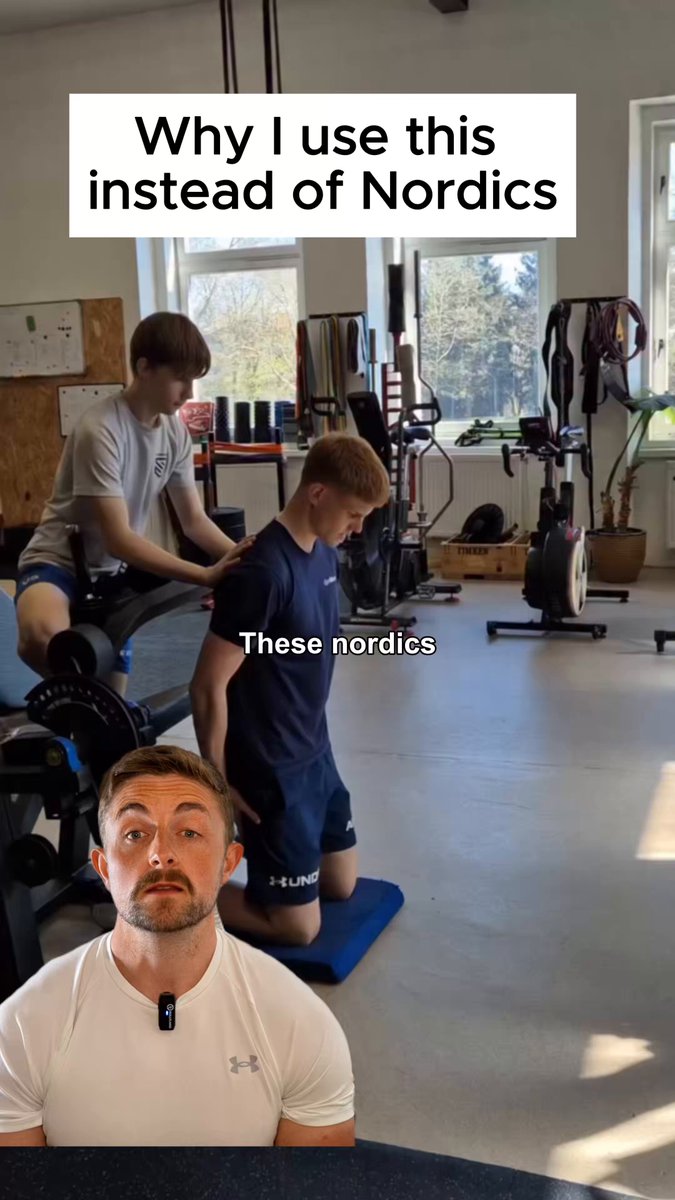
A better hamstring exercise than Nordics?
Nordics are great.
This version is particularly awesome with the overloaded eccentric.
However, like any exercise, they’re not without limitations.
They don’t train the biceps femoris long head at long muscle lengths.
And they can be impractical to load for bigger or weaker athletes.
If you constantly strain your hamstring, you might want to sprinkle in seated (2-1) hamstring curls.
Shout out to @niksotosek for the insane hamstring strength and his coach @curlycoach_ad
10
919
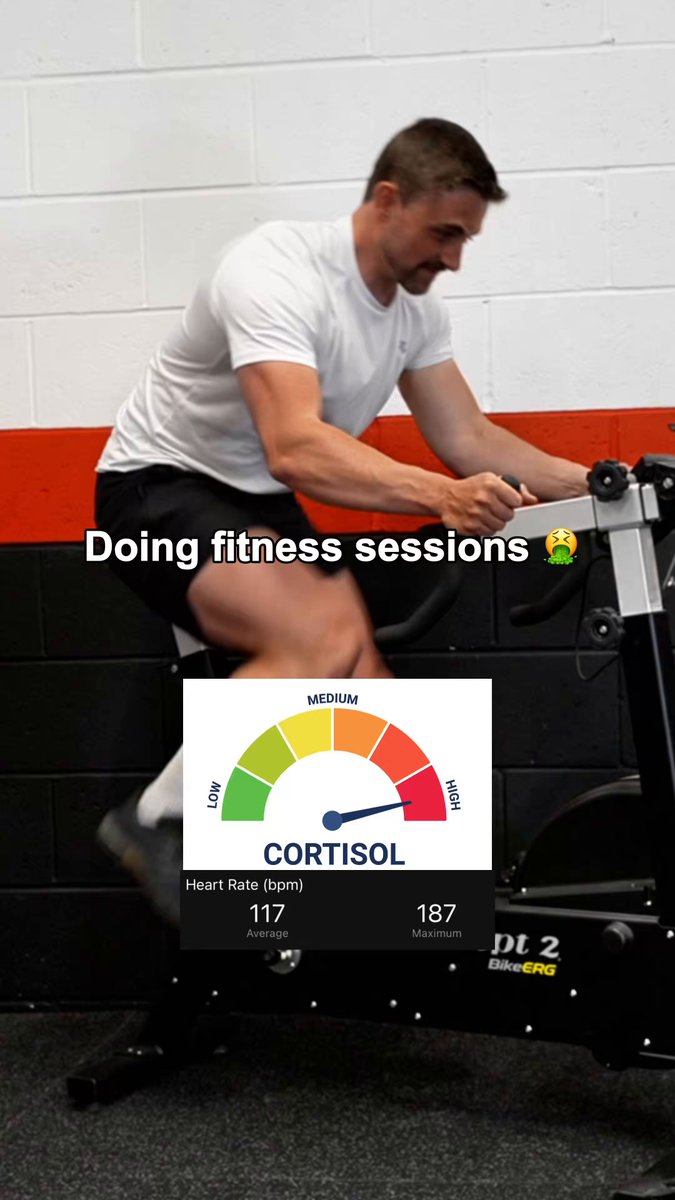
Play games > rigid conditioning programs
Well structured conditioning programs are awesome…
If you actually stick to them
and give them your full energy
But most athletes don’t need it
Because they wont stick to it
Picking up another sport in your off season (tag rugby, tennis, football, padel – it doesn’t matter) can be one of the best ways to build general conditioning without knowing it.
Plus get heaps of speed, agility, and real “athletic training”
213
Apr 28
The “big 9” for athletes
Skips, sprints, jumps, throws.
Push, pull, squat, hinge.
Your big rocks.
Sure, there’s other valuable exercises:
- Heavy calf raises
- Rotation
- Neck work etc
But these are secondary.
The art of training isn’t fancy exercises.
It’s smart application of basic tools.
Never drift from them.
Via @ChicagoBears
4
283
Apr 22
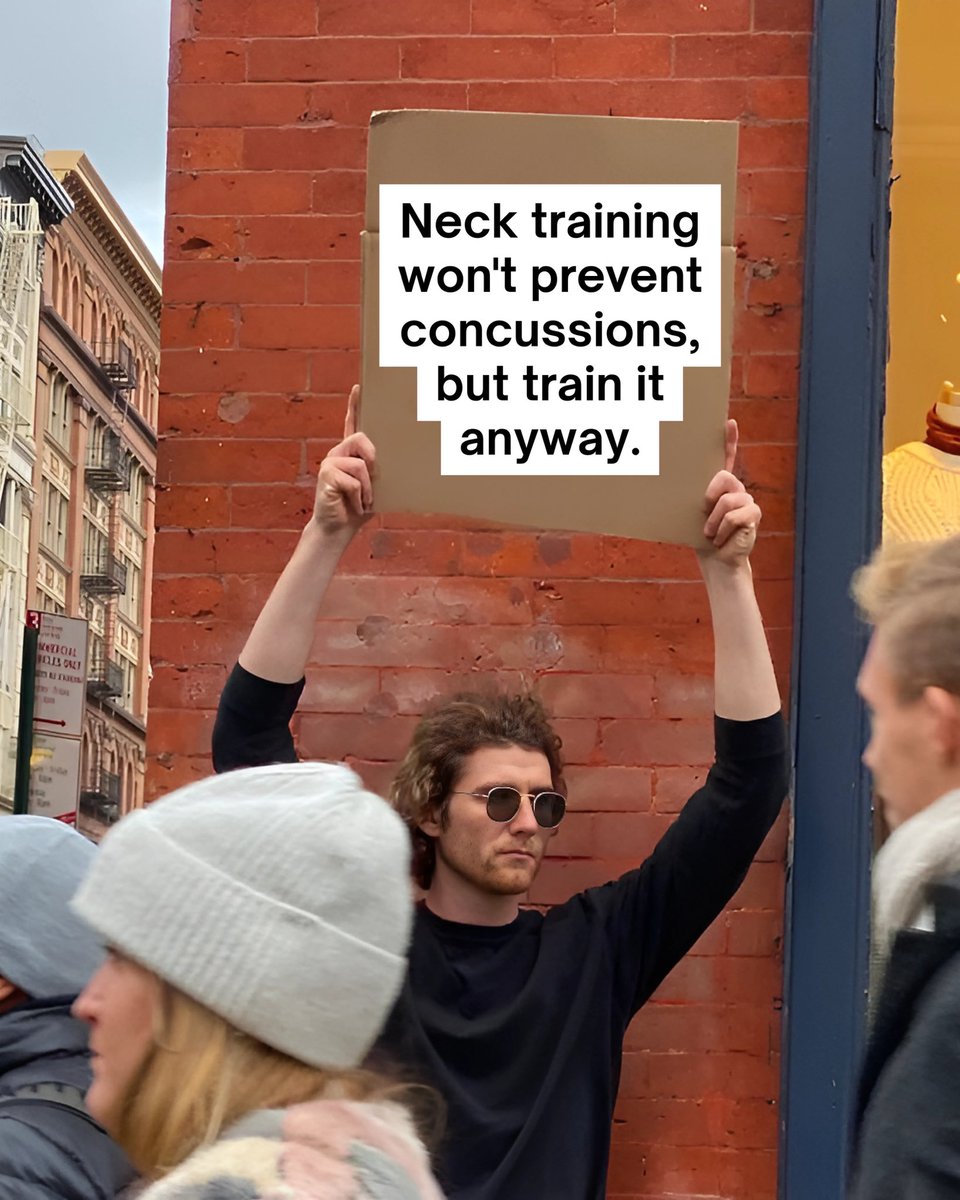
Neck Strength Doesn’t Prevent Concussions
I got this wrong… here’s why.
I used to think neck training reduced concussion risk.
Now I think its effect is small, if it exists at all.
Back in the early 2020’s there was a study flooding instagram:
“For every pound of neck strength, odds of concussion is reduced by 5%” (Collins et al., 2014)
Coaches and athletes were well intentioned in sharing it.
Logically it makes sense –
a stronger neck will resist head motion
Which reduces the risk of brain injury.
Turns out, no.
And I’m still ashamed of my lack of vigor before sharing this study.
Here’s my current view:
Neck research started on cats… (1940-1970)
The protocol was pretty fucked up.
They strapped cats heads down
And shot them with a bolt gun…
They found if that cats head was in a fixed position
They didn’t get concussed
(although a lot died…)
Therefore, researchers assumed that if you can increase your neck strength
You can resist head motion during impact (i.e. neck stiffness)
And, therefore, reduce concussion risk
There’s one huge problem
Peak brain strain occurs ~15ms after head impact (Viano et al., 2007)
It’s instantaneous.
As soon as you’re hit, you’re concussed.
But, your neck only starts contacting 80ms after impact
i.e. by the time your neck contracts, the damage is already done, meaning strength isn’t that valuable
Where neck strength may help is:
In situations where we know the impact is coming and we have the time to brace for it
However, you’d probably move your neck out the way… 😂
So for now, isolated neck strength training has little to no effect on concussions (Ivanic et al., 2024)
However, please, don’t bin neck training.
A stronger neck can help reduce neck pain and neck injuries, both of which are common in contact and combat sports. In some cases, it may also reduce headaches.
It may also help reduce head acceleration in controlled situations when the impact is anticipated.
1
239
Apr 17
How to Build ‘Power’
Most people think that increasing your power makes you:
- smash tackles
- sprint faster
- dominate collisions
- jump higher
That’s not accurate.
In fact, chasing power (force x velocity) shouldn’t be the end goal
If you want to move yourself faster, jump higher, or hit someone harder -
You need to change or express your own momentum (mass x velocity)
Power doesn’t change momentum. Impulse does.
There’s two ways to increase impulse
(force x time)
You produce more force
And/or
2. You do it over a longer period of time
But usually in sport - you can’t extend the time.
You need to produce force rapidly to hit someone hard, sprint fast, or dominate a collision.
That’s why I believe most contact athletes should focus on getting strong and sprinting. It will not only improve your force production, but your ability to apply it within the specific time period of the sport.
Yet, context is king. It does depends what your current strength and weakness are (see my last few posts). But for most contact athletes, I think this is a pretty useful ranking of power exercises.
1
206
Apr 17
True that.

Pet peeve is when people say dumb shit about always needing to “controll the eccentric" BRO.
Probably preaching to the choir, but eccentric strength already exceeds concentric strength by 20-50%. Fast eccentric contractions increase the rate of force development and, because force equals mass times accelerationa faster, intentional descent can actually create higher peak braking forces than a slow one..
1
2
340
Apr 15
Size matters but…
Speed kills.
Speed is one of the most important qualities in rugby -
being a sport of evasion and collisions.
But most people only focus on the collision part.
Speed isn't just genetic. It can be built.
As a rule of thumb. You should be doing at least:
- 150m of skips per week (ankling, A-skips, straight-leg skips)
- 3 sets of heavy calf raises at least once per week (build ankle stiffness)
- 20-40 max effort ballistic jumps
- 30-50 hops and bounds per week
- 150m of sprinting at least once per week
But, most importantly, play.
Game speed beats gym speed every time.
Don’t just spend more time playing rugby. Play tag rugby. Tag rugby. Football. Tennis. American Football. Whatever. Particularly from a young age.
A broad base of sports will build agility, “game speed”, elasticity, and game IQ more than any gym session.
1
5
499
Apr 14
I completely agree. Structured training for kids is overrated.
Apr 13

If you put your kid in this “training” at 7yo it is nothing more than a fancy daycare
At 7-14yo your kid doesn’t need training or to specialize in a sport. They need to be a kid.
Play multiple sports. Play pickup sports with their friends outside. Not every waking moment needs to be scheduled for kids.
If you disagree with me then go listen to all the pro athletes who say the same thing
1
595