
Joined July 2009
- Tweets 3,015
- Following 1,331
- Followers 368
- Likes 23,368
112 Photos and videos











Kelly retweeted

May 18
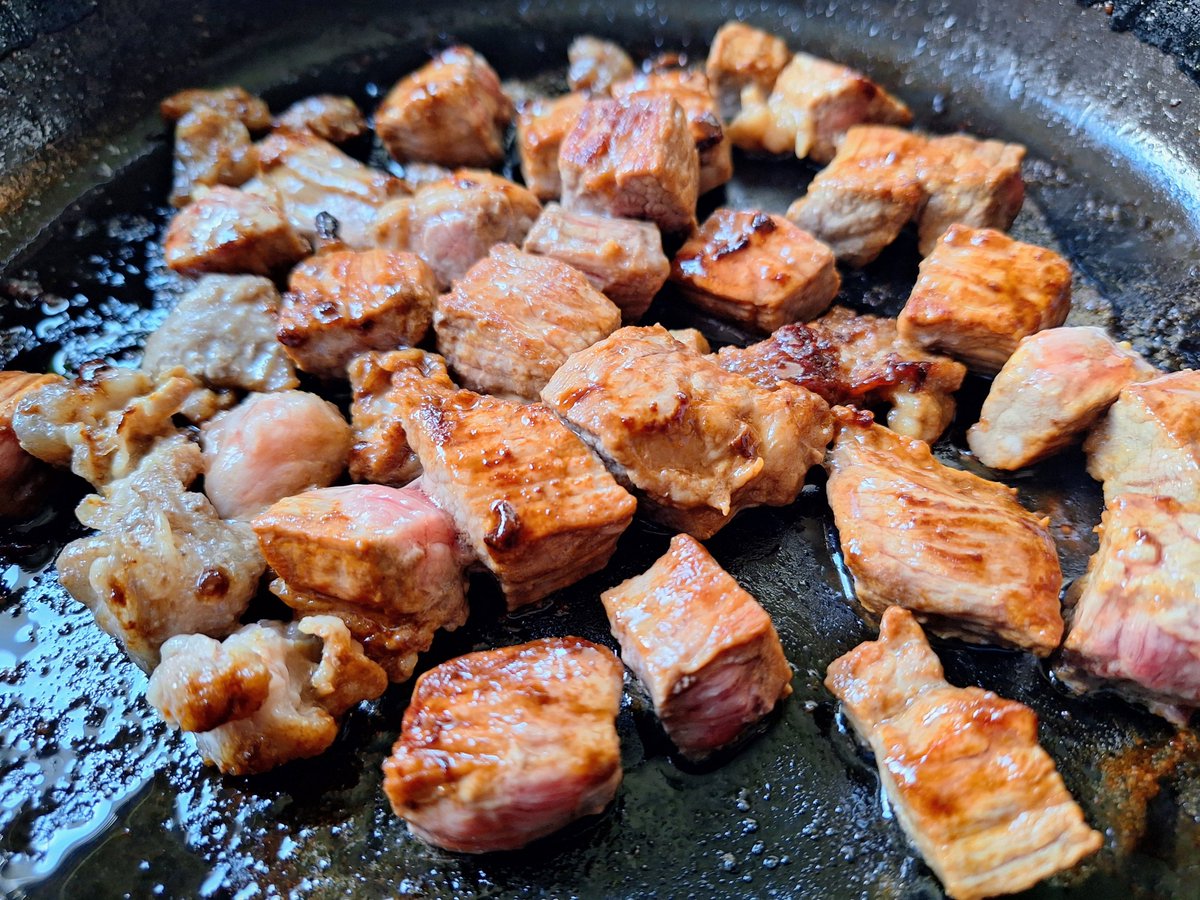
Round roast, sliced and diced ... and skillet fried.
I cooked this a little differently, instead of filling the skillet with meat, I cooked just enough for our meal. I also cooked this on medium high to sear it.
@junkjunkee said, "This is how I want you to cook this from now on."
I said, "Yes mum." 😅
We also had coddled eggs with the beef. #DiabeticFriendly #HumanFriendly
1
1
5
147
Kelly retweeted

I worked all morning and afternoon to make this to show Chinas grip on Canada and Carneys decent to the new world order. If this doesn't wake up every Canadian I don't know what will.
Please make it go viral!
The most important 12 minutes for any Canadian!
96
1,724
2,304
44,473
Kelly retweeted

Mar 24
NEW: Kentucky family rejects $26 million offer to convert part of their farm into a data center despite the offer being about 10 times the going rate for farmland in the area.
"If it's my way, I'll stay and hold and feed a nation. 26 million doesn't mean anything."
"As long as I'm on this land, as long as it's feeding me, as long as it's taking care of me, there's nothing that can destroy me if I've got this land."
Video: Local 12 WKRC
5,118
24,782
159,019
8,373,289
Kelly retweeted

Mar 12
The whole world is aware of Canada's slow march into tyranny. Everyone can see this except for Canadians. They have their elbows up, drooling on themselves.
618
2,696
9,350
213,236
Kelly retweeted

Mar 11
This smart and courageous woman is inspiring.
She has done what so many politicians fail to do. Dallas has stuck to her principles and turned out to be right.
She was right about Kamloops. She was right about what would happen if the "reconciliation" grift was allowed to snowball out of control.
Right now she is the only person in the legislature who British Columbian families can rely upon to protect their homes.

17
297
1,033
9,838
Kelly retweeted

Don't ever forget what the monsters did.
85
628
2,113
33,802
Kelly retweeted

Mar 10
Dates for my Alberta speaking tour this month:
* 23: Drumheller
* 24: Okotoks
* 25: Lethbridge
* 26: Brooks
* 27: Medicine Hat
I will address:
(1) how Alberta can be the freest nation;
(2) why the world needs Alberta nationhood.
My books will be available for sale, notably Financial Sovereignty for Canadians: Untether Yourself from the Ottawa Leviathan.
amzn.to/4sF6bdD
The events typically start at 7 p.m., and I will share the venues ASAP.
@fcalendardotnet livestreams a lot of these: youtube.com/@fcalendardotnet…
7
41
87
2,784
Kelly retweeted

Mar 9
The hearing in Amsterdam has ended - judgement 9th April. The 9 legal representatives of big pharma and the ‘elites’ are all trying to stand behind ‘we were in a pandemic’ and ‘the vaccines are safe and effective’ neither of which is true. Will justice be done ? we will see.
448
5,457
15,524
221,123
Kelly retweeted

🚨 HOLY SMOKES. NATO Secretary General Mark Rutte just dropped TRUTH NUKES on Europe — and he’s siding with Trump.
“If anyone thinks the European Union or Europe can defend itself without the U.S., KEEP ON DREAMING. You can’t. We can’t.”
And it gets better.
“Europe — if you REALLY want to go it alone, forget 5% of GDP for defense. It would be 10%. You’d have to build your own nuclear capability.”
“That costs billions and billions. You would lose the ultimate guarantor of our freedom — the U.S. nuclear umbrella. So… good luck.”
There it is.
No America. No security.
Trump was right. Again.
1,724
14,731
62,324
1,946,229
Kelly retweeted

Jan 21
Jan 21

I confronted Chrystia Freeland on her ethics, and she panicked!
Needless to say, Freeland was absolutely vicious, saying that anyone who would dare question her must be working for Vladimir Putin.
rebelne.ws/3YPXujK
17
108
576
18,814


Kelly retweeted

14 Dec 2025
Thank you Wyatt! We are going to move forward with integrity and courage.
14 Dec 2025

Dallas Brodie is an great leader and exceptional person.
Her moral integrity is unshakeable and she is someone I count as a dear friend.
53
37
371
25,815
Kelly retweeted

13 Dec 2025
What an absolute disgrace! The traitorous floor-crosser Michael Ma just stabbed Conservatives in the back by defecting to Mark Carney’s Liberals—mere hours after dancing at the Conservative Christmas party and posing with Pierre Poilievre. The people of Markham-Unionville voted Conservative; they didn’t vote for this opportunist Michael Ma to betray them and prop up the very Liberal policies he was elected to fight!
And get this: it was none other than Liberal MP Tim Hodgson from the neighbouring riding of Markham-Thornhill—the guy who persuaded Ma to cross the floor—who brokered this shady deal. Hodgson, the same one who’s been rubbing shoulders with questionable figures, including attending events with Chinese consular officials linked to the CCP. Ma himself was toasting wine at a major October 2025 Chinese-Canadian banquet alongside China’s Toronto consulate reps and controversial community leaders tied to PRC influence networks.
Now watch this powerful message from Conservative candidate Lionel Loganathan, who ran hard against Hodgson in Markham-Thornhill, calling out the traitorous Michael Ma for what he is. This is exactly why we need real Conservatives fighting for Canada—not sellouts cozying up to Carney’s crew.
More photos and details coming soon. Canadians deserve better than these backroom betrayals!
#cdnpoli #TraitorMa #PierrePoilievre
61
269
843
11,910
Kelly retweeted

13 Dec 2025
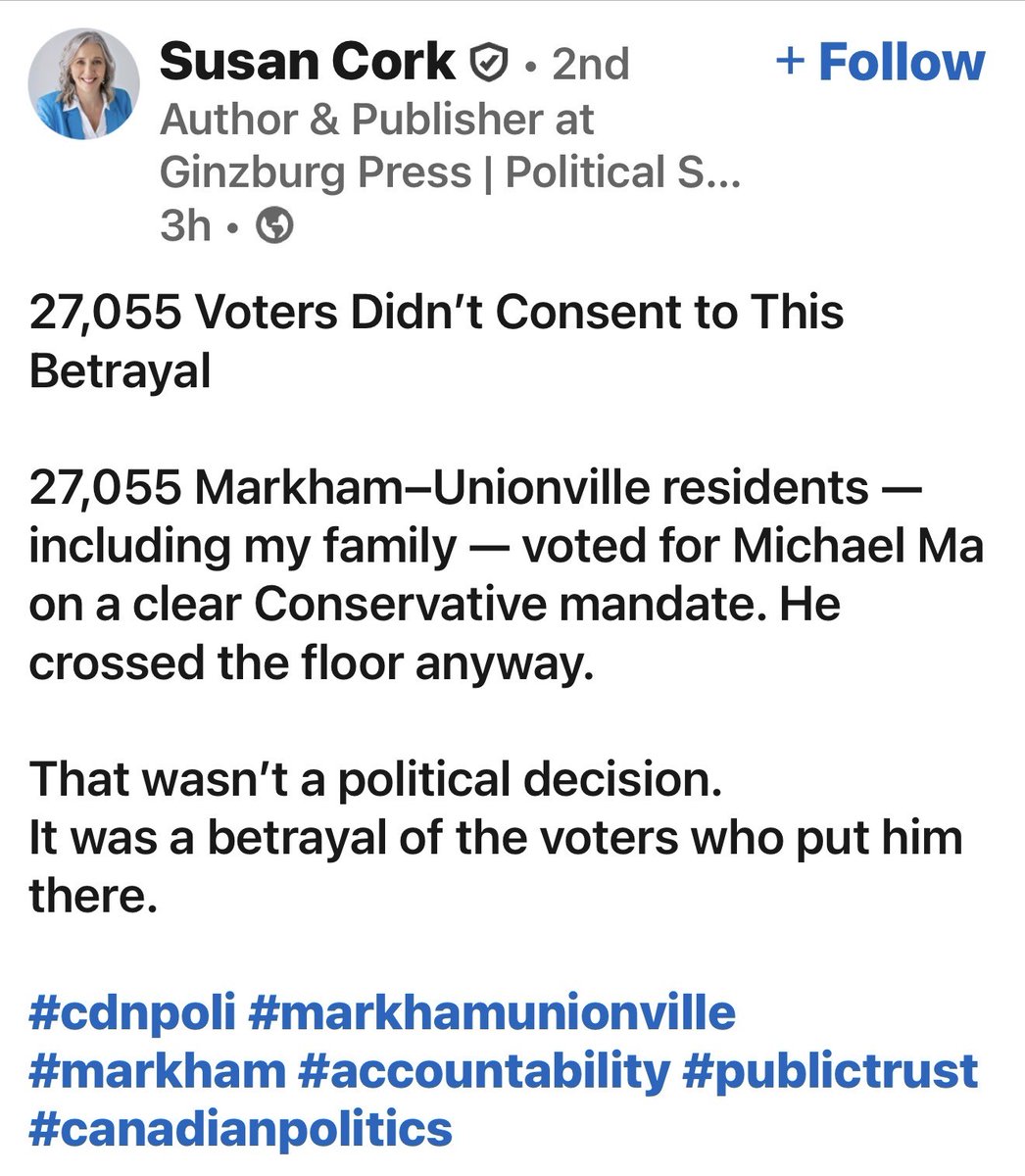
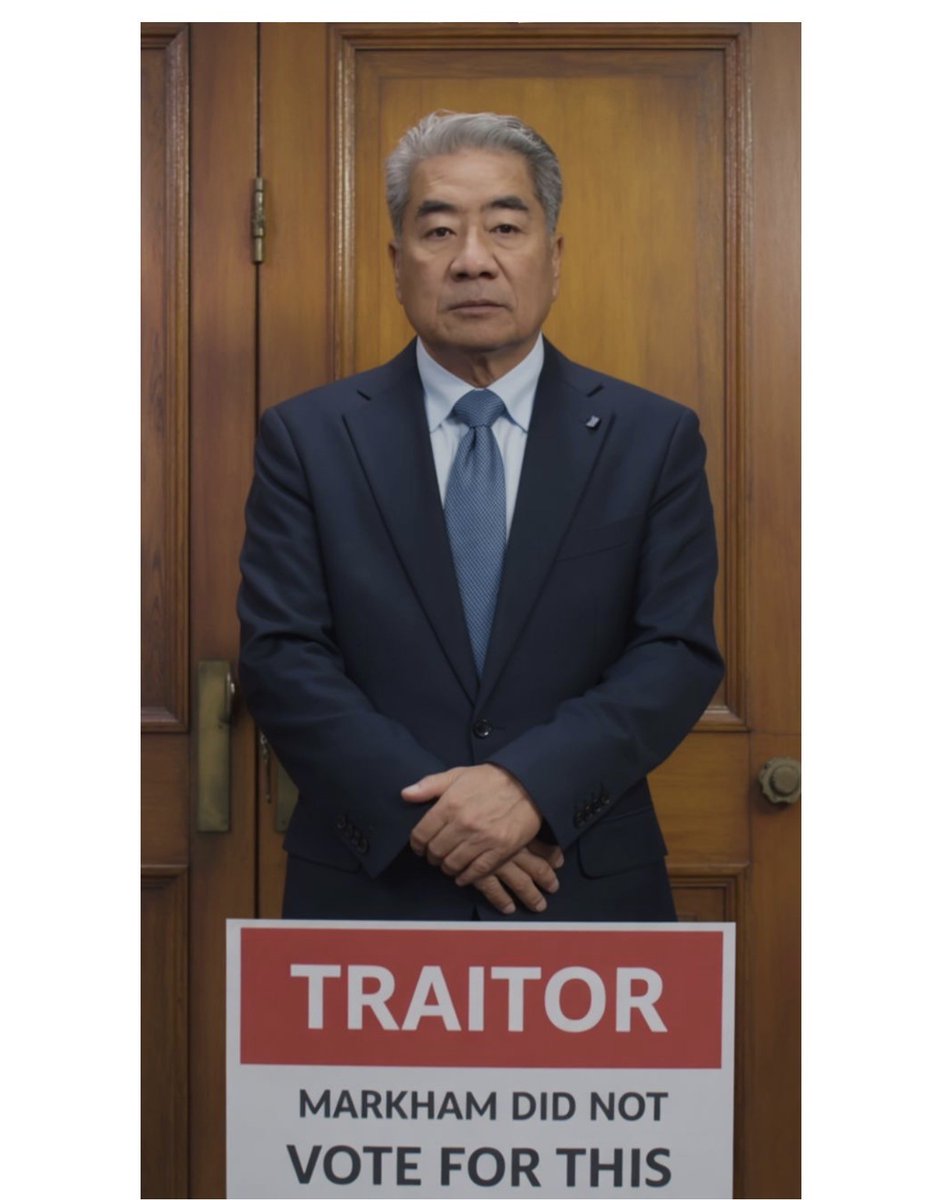
This image reflects what many voters feel but rarely get to say out loud.
27,055 people in Markham–Unionville didn’t vote for an individual in isolation. They voted for a party, a platform, and a mandate. They were clear about that choice. And yet, after the ballots were counted, that choice was effectively overwritten.
Let’s be honest about what crossing the floor actually is. It’s not a moment of political enlightenment. It’s not courage. And it’s certainly not accountability. It’s a decision made after voters no longer have a say, and that’s the problem.
If your values have genuinely changed, there is a straightforward, democratic path forward: resign and run again in a by-election. Make your case openly. Put it back to the people. Anything less treats voters as a formality rather than the foundation of the system.
I genuinely feel for Susan Cork, who articulated this so clearly, and for the constituents of Markham–Unionville. Regardless of where you sit politically, no one votes expecting their decision to be reversed after the fact. That kind of move doesn’t just hurt one party, it erodes trust in the entire process.
Public trust is fragile. Once lost, it’s hard to rebuild. And moments like this are exactly how it gets damaged.
Democracy only works if voters’ choices are respected, even when they’re inconvenient.
93
375
1,115
17,543

Kelly retweeted

23 Nov 2025
In 2008, CBS actually aired a report by Sharyl Attkisson exposing how top vaccine advocates received substantial funding from pharmaceutical companies—raising serious concerns about conflicts of interest in vaccine safety claims.
23
861
1,860
43,316

Kelly retweeted

17 Oct 2025
Last night, I caught a Wayne County (WV) teacher dropping off dogs on the side of the road.
She is also a leftist which isn’t surprising for a teacher, but is surprising considering I thought most leftists were advocates for animal rights.
The dogs ran into the woods last night. I couldn’t find them. I went back this morning. I did find the dogs, but they won’t come out of the woods. I will try again by bringing some food to them etc.
They are obviously pretty skiddish right now.
4,408
15,037
44,863
1,725,254
Kelly retweeted

18 Oct 2025
I want corrupt and pillaging government officials held accountable throughout time until the statute of limitations is up.
It IS an issue of ongoing concern and should be made a lesson to any current and future politicians to stay clean and honestly represent the constituents.
1
10
61
1,017