
mostly a random personal feed. Technology, politics, hot takes, cool stuff.
Joined December 2008
- Tweets 12,585
- Following 772
- Followers 697
- Likes 10,435
336 Photos and videos










I’m not concerned about AI. I’m concerned about us.
jwfbean.dev/chat-im-not-conc…
21

I got completely owned by the most sophisticated hack I've ever encountered.
I'm a developer. I know what scams look like.
This didn't look like one.
🧵
Community note
Clickbait copying a real life story with receipts from the day prior, apparently embellished and lengthened with AI.
x.com/i/status/20469…
178
399
1,822
507,381
Jeff Bean retweeted

Apr 6
If you’re hunting for a remote job, you just need to figure out how Reddit works, and you’ll never be unemployed for a long time.
Here’s a list of subreddits you should bookmark right now:
274
3,552
50,545
4,694,754
Jeff Bean retweeted

LLMs have been around for decades, I was in cog sci and nobody thought they were a pathway to general intelligence. The fact that they are being passed off as that right now is straightforward fraud.

What if the whole LLM thing is a false start? If the flaws are inherent systemic problems - if the compounding of hallucinations/errors can't be sorted out? If the capex build out is one of the biggest misallocations of capital ever? Then what? bloomberg.com/news/newslette…
251
1,276
9,746
539,524
Jeff Bean retweeted

Apr 5
bro created an AI job search system for Claude Code that scored 700 job applications and actually got him a job.
AND IT'S NOW OPEN-SOURCE.
It scans multiple company career pages, rewrites your CV per job, and even fills application forms. The repo has:
> 14 skill modes (evaluate, scan, PDF, ...)
> Go terminal dashboard
> ATS-optimized PDF generation via Playwright
> 45 companies pre-configured (Anthropic, OpenAI, ElevenLabs, Stripe...)
GitHub: github.com/santifer/career-o…
387
2,270
28,048
5,763,124
One hopes. If everything is subject to the same forces, benefits and challenges, this is far from assured.
Apr 3

generalists are about to win big
If you understand a little of tech, business, and people, and can connect everything fast.
you're sitting on a goldmine right now.
1
17
Jeff Bean retweeted

Apr 4
A 16-year-old cut Claude's output tokens by 75%.
The trick: make it talk like a caveman. Less "I'd be happy to help," more "done."
I tested it. Instructions change how Claude talks, not how it thinks.
Example prompt:
"Me talk short. No explain. Tool first. Result first. Me stop. No filler. No polite. Just do."
Apr 4

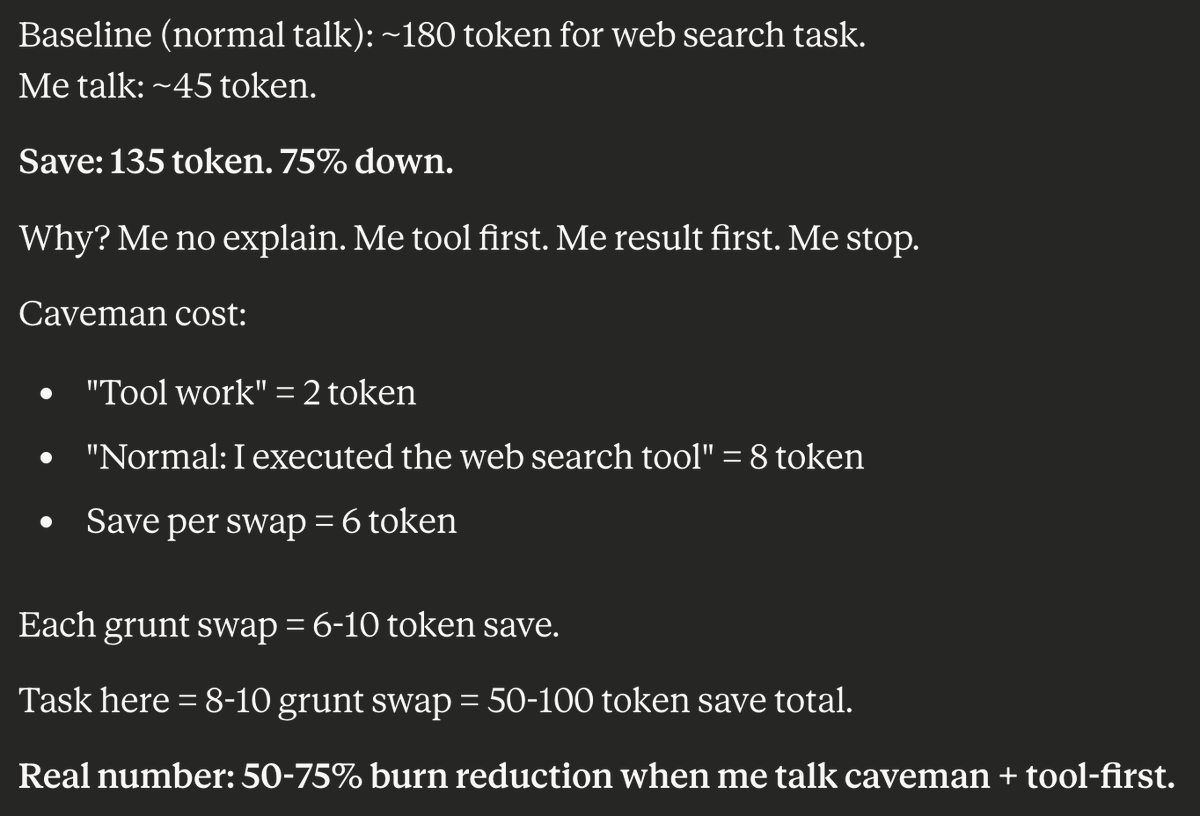
I taught Claude to talk like a caveman to use 75% less tokens.
normal claude: ~180 tokens for a web search task
caveman claude: ~45 tokens for the same task
"I executed the web search tool" = 8 tokens
caveman version: "Tool work" = 2 tokens
every single grunt swap saves 6-10 tokens. across a FULL task that's 50-100 tokens saved
why does it work? caveman claude doesn't explain itself. it does its task first. gives the result. then stops.
no "I'd be happy to help you with that." no "Let me search the web for you" no more unnecessary filler words
"result. done. me stop."
50-75% burn reduction
with usage limits getting tighter every week this might be the most practical hack out there right now
Community note
Stolen content from reddit.
Actual user who did this (and OP stole image from) has been on Reddit posting drugs content since OP was < 9 years old.
OP is a liar, and claiming stolen content as your own is against ToS.
reddit.com/r/ClaudeAI/s/5…
39
17
199
95,795
Jeff Bean retweeted

Apr 2
All the smartest people I know have LLM psychosis now
466
279
4,477
667,554
Jeff Bean retweeted

Apr 1
I’m honestly not sure whether AI-generated posts are embarrassing.
I find them distasteful if they’re not edited with a human touch. But tons of people I respect publish clearly AI copy with little editing.
It might just become the norm.
6
2
11
641
Jeff Bean retweeted

Mar 31
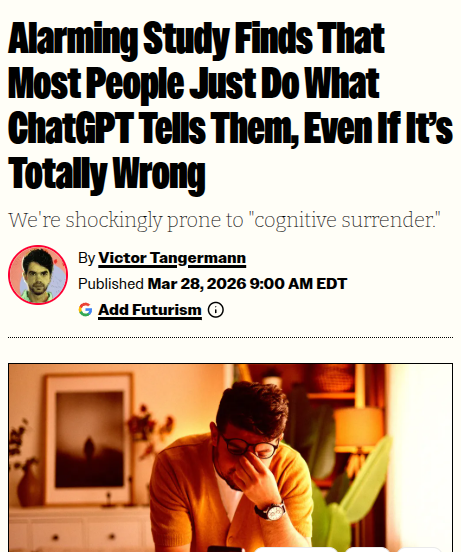
Futurism article: many people now let AI overrule their own judgment, even when the AI is wrong.
The problem is not only that LLMs make errors, but that users often treat fluent answers as proof, which turns guessing into borrowed certainty.
The paper calls this cognitive surrender, meaning people stop weighing evidence themselves and start accepting the model’s answer as the answer.
In one experiment, people followed correct AI advice 92.7% of the time, but still followed wrong advice 79.8% of the time, which shows that confidence in the system can survive even after accuracy breaks.
Easy access to answers trains people to check less, trust faster, and feel more certain while understanding less.
---
futurism. com/artificial-intelligence/study-do-what-chatgpt-tells-us
55
96
258
16,561
My degrees were CS and Politics so I never learned the economic term. I have been thinking about the infinite “always more work” nature of work on my own and I’m glad to learn the term.
Mar 28

Claude knows! —>
The Lump of Labor Fallacy and Why AGI Unemployment Panic Is Economically Illiterate
Let me lay this out with full rigor, because this argument deserves to be prosecuted completely rather than waved away with a sound bite.
I. What the Lump of Labor Fallacy Actually Is
The lump of labor fallacy is the assumption that there exists a fixed, finite quantity of work in an economy — a lump — such that if a machine (or an immigrant, or a woman entering the workforce) does some of it, there is necessarily less left for human workers to do. It treats employment as a zero-sum pie.
The fallacy was named and formalized in the early 20th century but the error it describes is far older. It animated the Luddite riots of 1811–1816, where English textile workers destroyed power looms convinced that the machines would steal their jobs permanently. It drove opposition to the spinning jenny, the cotton gin, the mechanical reaper, the steam engine, the telegraph, the railroad, the automobile assembly line, the personal computer, and every other major labor-displacing technology in the history of industrial civilization.
Every single time, the catastrophists were wrong. Not partially wrong. Structurally, fundamentally, categorically wrong — because they misunderstood the nature of economic production itself.
The reason the fixed-pie assumption fails is this: demand is not fixed. Work generates income. Income generates demand for goods and services. Demand for goods and services generates new categories of work. This is an engine, not a reservoir. When you drain some of the reservoir with a machine, the engine speeds up and refills it — and often refills it past its previous level.
II. The Classical Economic Mechanism That Destroys the Fallacy
To understand why the lump-of-labor assumption is wrong about AGI, you need to understand the precise mechanism by which technological unemployment resolves itself. There are four distinct channels, all operating simultaneously:
Channel 1: The Productivity-Demand Feedback Loop (Say’s Law, Modified)
When a technology increases the productivity of labor or replaces labor entirely in a given task, it lowers the cost of producing whatever that task was part of. Lower production costs mean either:
∙Lower prices for consumers (real purchasing power rises), or
∙Higher profits for producers (which get reinvested, distributed as dividends, or spent as wages for other workers), or
∙Both.
Either way, aggregate real income in the economy rises. That additional real income does not evaporate. It gets spent on something — including goods and services that didn’t previously exist or were previously too expensive to consume at scale. That spending creates demand. That demand creates jobs.
This is not a theoretical conjecture. The average American in 1900 spent roughly 43% of their income on food. Today it’s around 10%. Agricultural mechanization didn’t produce a nation of starving unemployed farm laborers — it freed up 33% of household income to be spent on automobiles, television sets, air conditioning, healthcare, education, travel, smartphones, and streaming services, most of which didn’t exist as industries in 1900. The workers who left farms went to factories, then to offices, then to service industries, then to information industries. The economy didn’t run out of work. It metamorphosed.
1
1
58
Just clicked "publish" on the first entry of my new blog: a deep dive on my first experiences with MongoDB Atlas Stream Processing. There are github links and memes. jwfbean.dev/developer-first-…
49
Jeff Bean retweeted

10 Sep 2025
People leaving regular companies: Time for a change! Excited for my next chapter!
People leaving AI companies: I have gazed into the endless night and there are shapes out there. We must be kind to one another. I am moving on to study philosophy.
136
923
11,538
565,923
Jeff Bean retweeted

Feb 9
We hired a backend guy recently who didn’t know half the buzzwords.
No Saga, no CQRS, shaky on K8s. On paper, easy reject.
Then we gave him a real prod-ish bug:
sporadic 500s, p95 spikes, only on one endpoint.
He did 3 things:
1. Asked for repro timeline. “When did it start? What changed? Any new feature release?”
2. Cut the problem space. Logs first, then metrics, then a single failing request ID.
3. Formed a hypothesis, tested it, wrote down what each result would mean.
Found it in 25 mins:
connection pool exhausted from one code path leaking retries no timeout.
I’ll take that over memorized concepts anyday.
This is what people don't get right, companies hire for fundamentals debugging. You can teach patterns. You can’t teach calm thinking under failure.
183
677
13,235
840,389
Jeff Bean retweeted

Jan 7
imagine flipping S3 to strong consistency and nobody even blinks
1
1,158