
PhD student @GeorgiaTech 🐝 and LIT Lab. Interested in how brains and machines learn know about the world and use langauage.
Joined June 2016
- Tweets 93
- Following 230
- Followers 175
- Likes 1,999
9 Photos and videos


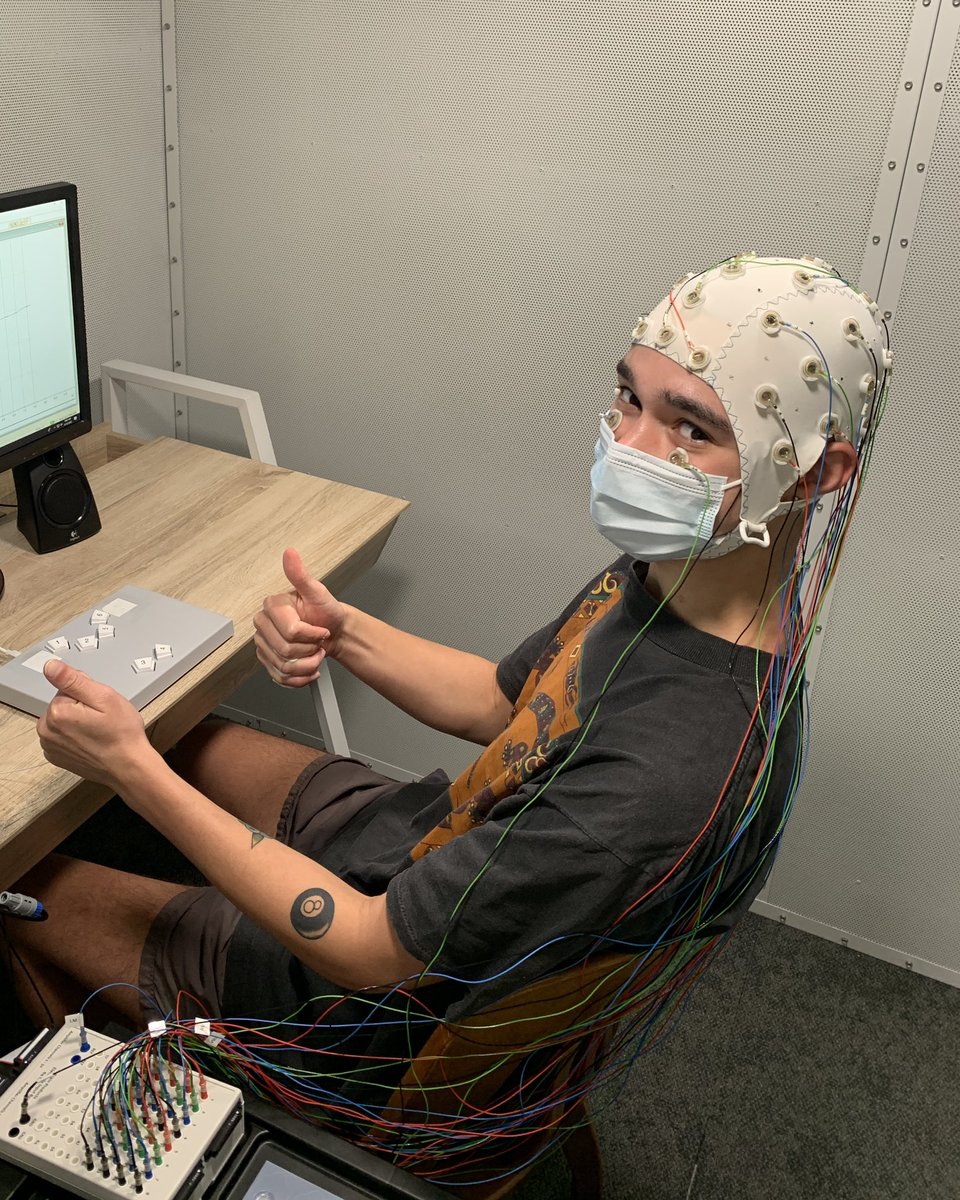

Will Decker retweeted

Mar 31
We show face patches implement the following code through recurrent dynamics:
Detect face
If (face found)
Discriminate face
else
Continue to detect face
IMHO, our paper conclusively resolves a debate that has raged since I was a graduate student, about whether face patches are specialized for processing faces or not. It turns out domain-general folks were right early on, domain-specific folks were right later in the response.
So proud of @Yuelin_Shi and the entire team!
Mar 31

Our paper is now out!
nature.com/articles/s41586-0…
A big question:
1) Is IT cortex well described as a general-purpose feedforward DNN?
OR
2) Are face patches genuinely specialized for processing faces?
Read on to find out the answer. (1/N)
5
29
148
21,731
Will Decker retweeted

Mar 17
We’re hiring a new Lab Manager!
I’ve loved working in this lab — super supportive environment and meaningful work in AI cognitive neuroscience
Highly recommend for anyone looking to gain research experience before grad school!
Mar 17

Language, Intelligence & Thought lab is looking for a lab manager! This is a 2-year postbac position that will allow you to gain experience in human neuroscience, cognitive science, and AI research prior to applying to PhD programs.
Express interest here: forms.gle/289sLgZdJ2bQr1Y48
2
5
665

Mar 18
Come work in LIT Lab!
Mar 17
Language, Intelligence & Thought lab is looking for a lab manager! This is a 2-year postbac position that will allow you to gain experience in human neuroscience, cognitive science, and AI research prior to applying to PhD programs.
Express interest here: forms.gle/289sLgZdJ2bQr1Y48
1
78
Will Decker retweeted

Mar 17
Language, Intelligence & Thought lab is looking for a lab manager! This is a 2-year postbac position that will allow you to gain experience in human neuroscience, cognitive science, and AI research prior to applying to PhD programs.
Express interest here: forms.gle/289sLgZdJ2bQr1Y48
1
27
58
9,099
Will Decker retweeted

29 Sep 2025
🚨 Paper alert:
To appear in the DBM Neurips Workshop
LITcoder: A General-Purpose Library for Building and Comparing Encoding Models
📄 arxiv: arxiv.org/abs/2509.09152v1
🔗 project: litcoder-brain.github.io/

2
13
23
9,332
Will Decker retweeted

20 Dec 2024
Honored that a piece I wrote made it to NYTimes. It's about how my mom's stroke changed my relationship to time, science, and nature. What a privilege to honor my mom in Modern Love.
Below is a gift link. Let me know your thoughts🙏🏼
nytimes.com/2024/12/20/style…
13
7
47
2,383
Will Decker retweeted

18 Dec 2024
🧩 Why do task vectors exist in pretrained LLMs?
Our new research uncovers how transformers form internal abstractions and the mechanisms behind in-context learning(ICL).

6
30
187
21,909
Will Decker retweeted

14 Dec 2024
🚀At @NeurIPSConf tomorrow? Don't miss @nikolasmcneal and @MainakDeb19 's poster at the @unireps workshop on the adversarial sensitivity of vision encoding models of fMRI responses! A brief teaser about what they find.
2
6
21
3,331
Will Decker retweeted

Graduate training opportunity! See thread...
The Center for Research and Education in Navigation (CRaNE) is seeking a graduate student in our Cognition & Brain Sciences (CBS) Ph.D. Program in the School of Psychology at Georgia Institute of Technology.
1
5
5
1,102
23 Oct 2024
Working on a figure and google searched "MLP images" for some inspo...
1
3
217
Will Decker retweeted

16 Oct 2024
1/6 I usually don’t comment on these things, but @RylanSchaeffer et al.'s paper contains enough misconceptions that I thought it might be useful to address them. In short, effective dimensionality is not the whole story for model-brain linear regression, for several reasons: 🧵👇
(1) The spectral theory due to @canatar_a @jenellefeather @s_y_chung is misrepresented in this paper, and crucially relies on model alignment with brain data (this is already evident from their equations). In fact, they conclude that effective dimensionality alone doesn’t fully predict neural data.
(2) Even in this paper’s own Figure 2 (top left panel), networks with low participation ratios, like SRNN, still achieve high neural predictivity, already indicating that participation ratio is not a unilateral predictor of whether a model will match the brain via linear regression.
(3) Beyond MEC, this lack of a trend with effective dim. is also the case when looking at models in their match to macaque IT or human OTC. For example, Colin Conwell @_jacobprince_ @talia_konkle et al.’s very thorough work: biorxiv.org/content/10.1101/… shows that effective dim isn’t related to linear prediction of human OTC (cf. their Figure 5). Moreover, in macaque IT, as @apurvaratan & others have seen, if you include very predictive models of IT responses, the effective dim to linear predictivity trend also doesn’t hold. (@jenellefeather & others don’t see this trend holding up in matches to auditory cortex either.)
(4) Furthermore, the models they cite participation ratios for, were also compared against several non-fitted metrics (like RSA, score distributions, simpler-than-linear mappings, etc.), which found similar conclusions that matched linear regression results, across MEC, IT, and auditory cortex.
14 Oct 2024

My 2nd to last #neuroscience paper will appear @unireps !!
🧠🧠 Maximizing Neural Regression Scores May Not Identify Good Models of the Brain 🧠🧠
w/ @KhonaMikail @neurostrow @BrandoHablando @sanmikoyejo
Answering a puzzle 2 years in the making
openreview.net/forum?id=vbtj…
1/12
3
27
156
93,416
Will Decker retweeted

17 Oct 2024
Ev Fedorenko's Keynote at COLM.
youtube.com/watch?v=8xS7tjy9…
This talk is quite accessible for computer scientists interested in cognitive and neuro questions. Also touches on many of the shared themes of the two areas.
2
26
149
22,066
22 Sep 2024
Just now finding out voxel is a portmanteau from volumetric pixel...what else have I missed?!
5
315
Will Decker retweeted

17 Sep 2024
*TWO* job searches @EmoryPsychology ‼️
Open rank Neural Mechanisms of Behavior in Small Animal Systems
apply.interfolio.com/153594
Assoc/Asst Professor, Clinical Science
apply.interfolio.com/152692
And I’m recruiting a PhD student! Several opportunities to join our amazing dept ✨
2
36
55
12,438
Will Decker retweeted
10 Sep 2024
Excited to have been named one of @techreview's 35 under 35!
I am happy that, these days, language & human cognition are topics that the world cares deeply about (thanks to recent developments in AI). Not only are these topics impactful, they are also fun to study!
10 Sep 2024

The Download: introducing our 35 Innovators Under 35 list for 2024 trib.al/eXYFtVL
9
9
182
13,183
Will Decker retweeted

26 Jul 2024
Have you ever wondered what’s going on in a baby’s brain when she looks at you? I have! So, @rebecca_saxe and I set out to investigate.
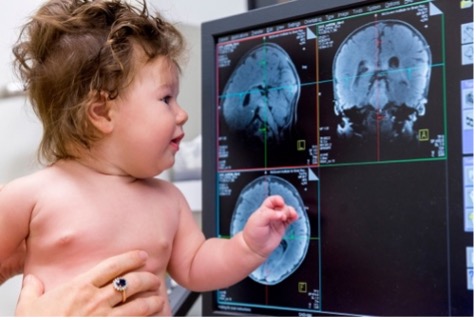
ALT Picture of baby looking at MRI images of a brain on a computer monitor.
3
13
102
11,432
Will Decker retweeted

26 Aug 2024
🚨New paper!🚨My first (co)first-authored paper is now out in @NatureHumBehav! We show that neural populations in the language network differ in the size of their temporal receptive windows rdcu.be/dR0sz co-led w/ @tamaregev 1/ 🧵
2
24
75
20,730
Will Decker retweeted

Thanks @NatRevNeurosci for the chance to clarify that1️⃣the language network is not monolithic (we never said it was, but happy to emphasize); and2️⃣language network boundaries don't depend on a specific 'localizer' and can be recovered from task-free data: tinyurl.com/5y3rhfrh

Thrilled to share a review on THE LANGUAGE NETWORK AS A NATURAL KIND—a culmination of ~20 yrs of thinking about studying language from linguistic, psycholinguistic, and cog neuro perspectives. @NatRevNeurosci rdcu.be/dEylV
With the amazing @neuranna @tamaregev 🥳
🧵1/n

4
32
156
21,491
Will Decker retweeted

2 Aug 2024
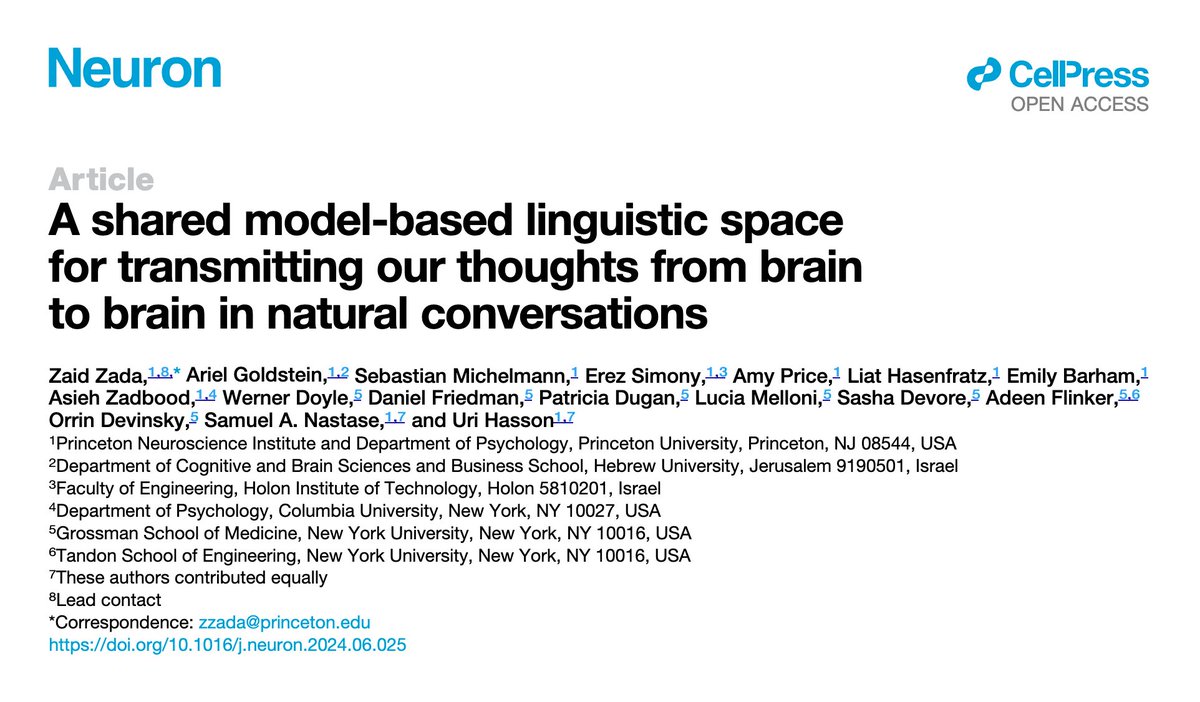
Happy to see this work led by @zaidzada_ now published in @NeuroCellPress! We use LLM embeddings to capture word-by-word linguistic content transmitted from the speaker's brain to the listener's brain in real-time, face-to-face conversations: cell.com/neuron/fulltext/S08…
4
63
221
30,750
Will Decker retweeted

26 Jul 2024
Some thoughts on how to think about "world models" in language models and beyond: lingo.csail.mit.edu/blog/wor…

8
52
254
34,579