
Web3 Activities Only ⚠️ - WAO
Joined December 2024
- Tweets 138,172
- Following 9,360
- Followers 12,597
- Likes 240,888
3,754 Photos and videos















Good morning Legends ☕️
You know that feeling when you close a tab and lose your entire workflow?
@TheARCTERMINAL keeps your research, drafts, and decisions connected in one work graph.
Come back the next day and ANIMA already knows where you left off.
That’s what a real workspace feels like.
135
14
153
1,242
Benjamin retweeted

1
8
235


Benjamin retweeted

May 30
Arsenal cry 😭

May 30

Football fans worldwide!!
Quote this tweet with a picture of your club winning the UCL trophy !! Let’s gooo!! 🏆🔥
1
132

Good morning Legends ☕️
You know that feeling when you close a tab and lose your entire workflow?
@TheARCTERMINAL keeps your research, drafts, and decisions connected in one work graph.
Come back the next day and ANIMA already knows where you left off.
That’s what a real workspace feels like.
135
14
153
1,242
Good morning CT ☕️
Most AI tools still feel temporary.
You open a tab, do the work, then lose half the context the next day.
What stands out about @TheARCTERMINAL is that it feels less like a chatbot and more like a persistent workspace.
Research threads, drafts, notes, citations, and decisions stay connected over time instead of resetting every session.
That’s where ANIMA feels important.
The ability to return later and continue from the same work graph changes AI from a temporary assistant into a long-term operational layer with memory.
And when that continuity is combined with ZKURT receipts, privacy-preserving infrastructure, and hardware-anchored identity, it starts looking less like another AI dashboard and more like the foundation for accountable autonomous workflows.
May 22

Your browser session can disappear.
Your work should not.
ARC keeps the through-line: research threads, drafts, files, decisions, citations, and the context behind them.
ANIMA returns to the same work graph tomorrow.
That’s what a living workspace feels like.

141
15
158
1,216
Good morning Legend. ☕️ TGIF.
crypto trained us to “trust the math, not the marketing,” but most ai products still expect users to trust a polished landing page, a vague roadmap, and a promise that the system is working as intended behind the scenes.
that model breaks down fast once ai agents start handling identity, coordination, transactions, and autonomous execution across web3.
what makes @TheARCTERMINAL interesting to me is that the trust layer is being built from actual primitives instead of narratives.
hybrid post-quantum encryption to future-proof security.
hardware-anchored identity to verify the source of actions.
on-chain zk receipts to create verifiable proof of agent behavior without exposing private data.
that combination matters because the next generation of ai systems won’t just generate text.
they’ll execute workflows, move assets, interact across protocols, and make decisions autonomously.
and when that happens, “just trust us” stops being enough.
users, protocols, and even other agents will need a way to verify:
• who performed an action
• whether it was authentic
• what was executed
• and whether the process can be audited later without sacrificing privacy
that’s where systems like zk receipts become powerful.
instead of relying on screenshots, centralized logs, or platform claims, actions become cryptographically provable.
it feels like a shift from ai as a black box toward ai as accountable infrastructure.
the bigger picture is that web3 and ai are starting to converge around the same core principle:
don’t rely on institutional trust when verification can be built directly into the system itself.
if that model scales, the strongest ai ecosystems probably won’t be the loudest ones.
they’ll be the ones where trust is measurable.
129
3
123
699
Good morning Legends ☕️
Most analytics tools are just rearview mirrors showing what already happened.
The real challenge is understanding why it changed and what happens next.
That’s where @TheARCTERMINAL Intelligence stands out.
Instead of only displaying charts and metrics, it breaks down the drivers behind movement, adds predictive modeling with uncertainty bands, and backtests outcomes against real historical data.
Because predictions without confidence ranges are just guesswork, and insights without validation are just narratives.
The real value of intelligence isn’t reporting the past. It’s helping people make better decisions about the future.
110
5
105
688
Good morning CT ☕️
Let’s face it, most chatbots today are just super-fast parrots responding to prompts, but the future of Web3 belongs to autonomous agents that can actually understand context, act independently, and still remain accountable.
That’s why what @TheARCTERMINAL is building with ZKURT receipts and ANIMA feels important.
While exploring the agentic economy through autonomous M2M payments and bot API activity on Base, one major challenge keeps appearing: how do you prove an agent completed its task correctly without exposing your entire strategy on-chain?
ARC’s approach solves that balance.
By keeping user context, goals, and memory private while generating verifiable cryptographic receipts, they’re turning AI from a simple assistant into a trustworthy on-chain partner.
And honestly, that may be the missing layer needed before people feel comfortable handing autonomous agents the keys to manage real capital flows.
149
13
149
742
Good morning Legends. ☕️
This is actually the future from @TheARCTERMINAL.
AI agents cannot scale on blind trust alone.
ZKURT receipts introduce something critical:
verifiable accountability without sacrificing privacy.
As agents begin handling transactions, workflows, and autonomous decision-making across Web3, users will need more than promises they’ll need proof.
Not full transparency that exposes everything.
Not black-box systems that require blind trust.
But a middle layer where actions can be verified while user data stays protected.
That changes the trust model completely.
The future of AI won’t belong only to the smartest agents.
It will belong to the agents that can prove what they did while preserving privacy at scale.
May 18
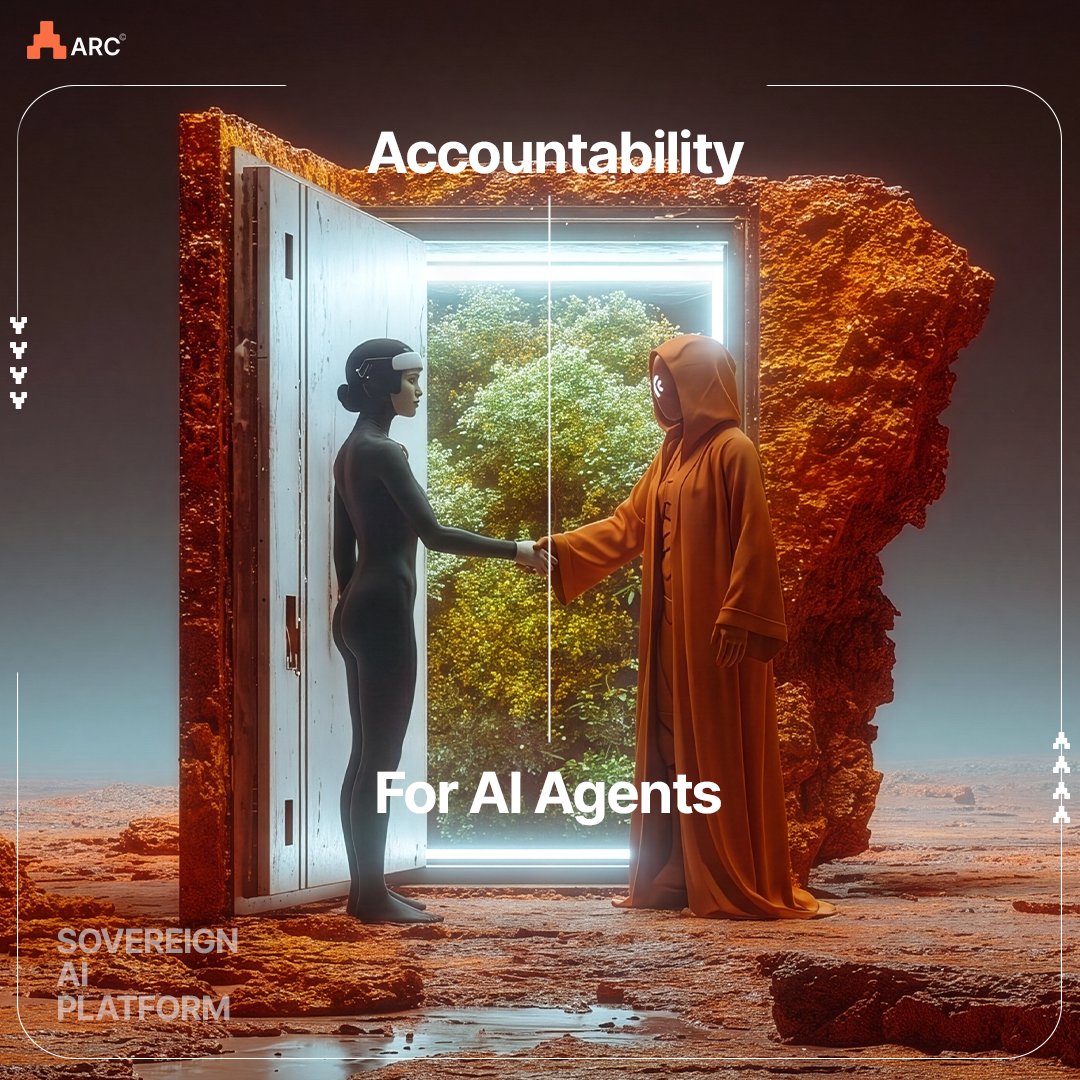
Agents need accountability. Not surveillance.
The more useful an agent becomes, the more it reads, routes, remembers, and acts.
That work needs a record, without exposing the work itself.
ARC uses ZKURT receipts for exactly that gap.
Learn how ↓
arcterminal.ai/trust
140
16
140
929
Good morning Legends. ☕️
The next phase of Web3 growth will likely belong to ecosystems that combine utility, automation, and real user participation into one connected experience.
Many platforms still separate AI, DeFi, infrastructure, and usability, creating fragmented workflows that force users to constantly switch tools and rebuild context across chains.
That’s why @TheARCTerminal
Instead of treating AI as a standalone assistant, ARC is building decentralized AI infrastructure where agents, memory, multichain access, and user-owned workflows operate together inside a unified on-chain environment.
The integration with zerion also improves multichain portfolio interaction, making it easier for users to manage assets and activity across ecosystems without relying on disconnected dashboards and workflows.
As Web3 becomes more complex, ecosystems that reduce friction while improving accessibility, automation, and continuity will likely drive the next stage of adoption.
131
8
131
589