
Joined February 2022
- Tweets 4,035
- Following 408
- Followers 298
- Likes 2,748
281 Photos and videos






Pinned Tweet

9 Jun 2025
Attention, all Galxe explorers! I'm embarking on a Kadena Campaign and wanted to invite you along for the ride. Sign up using my referral link and win rewards! 🎁 app.galxe.com/quest/Kadena/G…
1
97
Westernmonk | Alpha Aces retweeted

Men,
You need to hear this ‼️💯
1
17
49
2,433
I completed my first blockchain training module inside Crypto U. Structured education for the digital economy.
Structured education for the digital economy. cryptou.ai
12



Happy 51st birthday to Satoshi Nakamoto 🎂
The man dropped Bitcoin on the world, then vanished & never came back
Yet somehow created millions of opportunities, entire industries, financial freedom for people all over, & gave this grateful intern a career in shitposting 🙏

41
38
701
5,079
youtu.be/8T4ri9w05xE
Want to earn passive income on your usdt join
Aurum! You can start with 100 usdt!
backoffice.aurum.foundation/…
44
Westernmonk | Alpha Aces retweeted

Feb 17
Eish… did he lie???
70
1,484
5,588
78,258
Westernmonk | Alpha Aces retweeted

Men move mountains for this kind of women 🔥🔥♥️
104
2,161
8,883
219,954
Westernmonk | Alpha Aces retweeted

Jan 31
Sometimes the strongest thing a man can do is walk away calmly
9
56
636
31,275
Westernmonk | Alpha Aces retweeted

Jan 29
Stay away from low vibrational people.
137
1,545
7,419
209,195
Westernmonk | Alpha Aces retweeted
Jan 27
Gotcha moment right there… did Myron cook tho?
35
664
5,119
115,136
Westernmonk | Alpha Aces retweeted

Jan 10
This is how transparency build trust faster than honesty…
5
117
525
16,056
Westernmonk | Alpha Aces retweeted
Jan 10
She thinks this is normal but…
10
43
348
5,854
Westernmonk | Alpha Aces retweeted
The @DGramNetwork VPN app now supports IPv6.
This expands compatibility across a wider range of network architectures and operating conditions, allowing more nodes to participate reliably and improving overall coverage and resilience...and still drives $DGRAM burn.
We know some people are frustrated about price. Markets are markets, and we do not control trading behavior or what anyone does with their tokens.
What we do control is execution.
So we keep shipping, keep hardening the network, and keep building real infrastructure.
More updates soon.
98
79
154
17,935
Westernmonk | Alpha Aces retweeted
Why $DGRAM?
In our view, tokens should be judged on what they do, not what they promise.
Datagram has live products in market today, with real users and real usage. That usage already drives $DGRAM burn mechanics at the protocol level. This is not a future state or a roadmap milestone, it is happening now.
A concrete example is vpn.datagram.network, a functioning consumer product that people actively use. Activity on the network translates into economic activity tied to $DGRAM, aligning the token with real infrastructure demand rather than speculative incentives.
Across the broader market, many projects trade at substantial valuations despite having limited or no live products, minimal users, or unclear token utility. That dynamic is common in emerging technology cycles, and it highlights the difference between narrative-driven value and usage-driven value.
Datagram is focused on the latter.
$DGRAM is designed to be connected to:
Live DePIN infrastructure
Products that exist and are usable today
Token mechanics linked to real network activity
A roadmap that extends deployed systems rather than relying on hypothetical launches
This approach may not be the loudest, but over time, execution tends to speak for itself.
$DGRAM is for those who care about real systems in operation, not just future potential.
106
73
144
15,061
Westernmonk | Alpha Aces retweeted
82
72
106
2,200
Westernmonk | Alpha Aces retweeted

28 Dec 2025
77
62
100
1,973
Westernmonk | Alpha Aces retweeted

15 Dec 2025
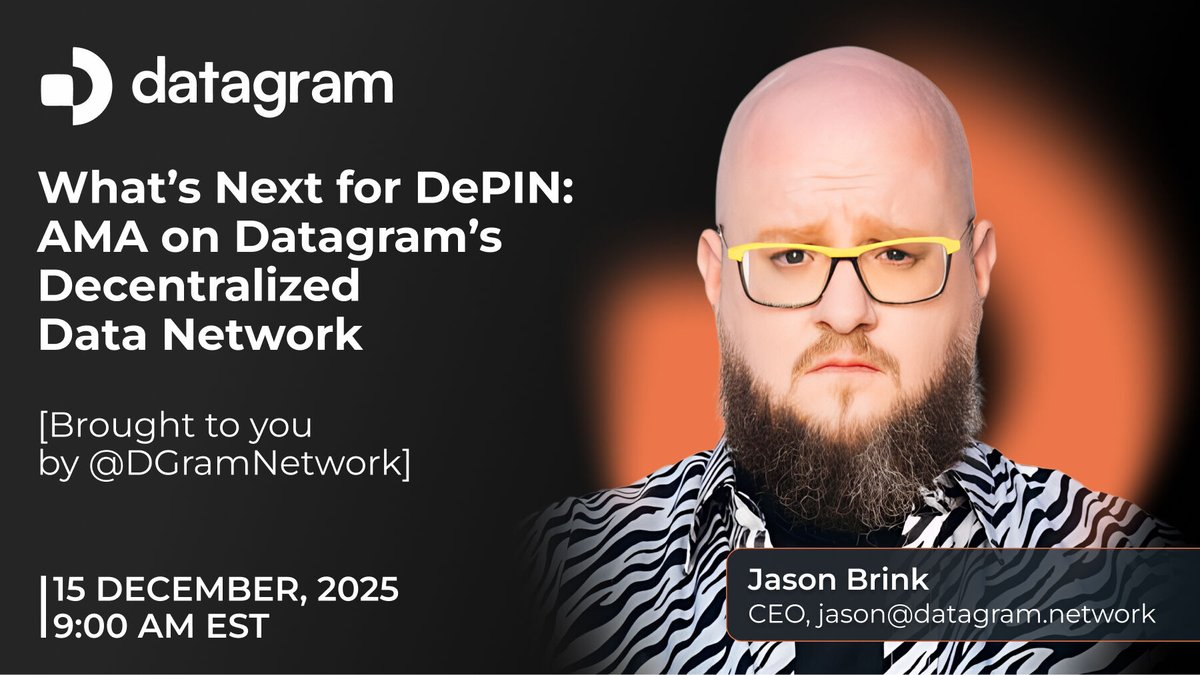
We’re going LIVE in 1 hour with @DGramNetwork to cover Full Cores, the Datagram Core Substrate, and why transparent on-chain verifiability is becoming a requirement for DePIN and AI infrastructure. Bring your questions.
🕜 9:00 am EST
119
83
166
21,091