
Joined September 2022
- Tweets 10,923
- Following 1,224
- Followers 7,470
- Likes 12,592
2,606 Photos and videos
Pinned Tweet

13 Oct 2025
Listen up this is gonna be the one big piece of info you will need at this moment
I'm telling you fellas, making money in crypto over the last 2-3 years ain't as easy as it used to be
There's never gonna be a "all up only" season
Be choosy and refrain from illiquid projects
Rule of thumb volumes and liquidity in millions
So navigate accordingly..
The last crash that happened all super high liquidity projects like $SUI, $WLD, $SEI , $ETHFI , $KAITO and many more have recovered beautiully almost closer to their "pre-crash" levels
The lesson to be learnt here is "bouncing back"
The once which bounce back always after such corrections /crashes are the ones that have huge liquidity and that's where you put your money in
Institutions are already here and they aint gonna pump your stupid sub-1 million market cap project
Hope isn't a strategy..so don't wait for the magical 100x to happen. Instead choose to invest in large caps that even give you an easy 10-15x over 3 years..
im not kidding see for yourself...check the charts from the bear market olows of 2022 till now..you'll be surprised.. $SOL gave a massive 25x
SO the truth here is...make enough money in ALTS and make sure you stack up as much BTC as possible maybe a little more in $ETH $SOL in the bear market lows
Stay smart Stay Ahead
18
17
39
4,954
12h
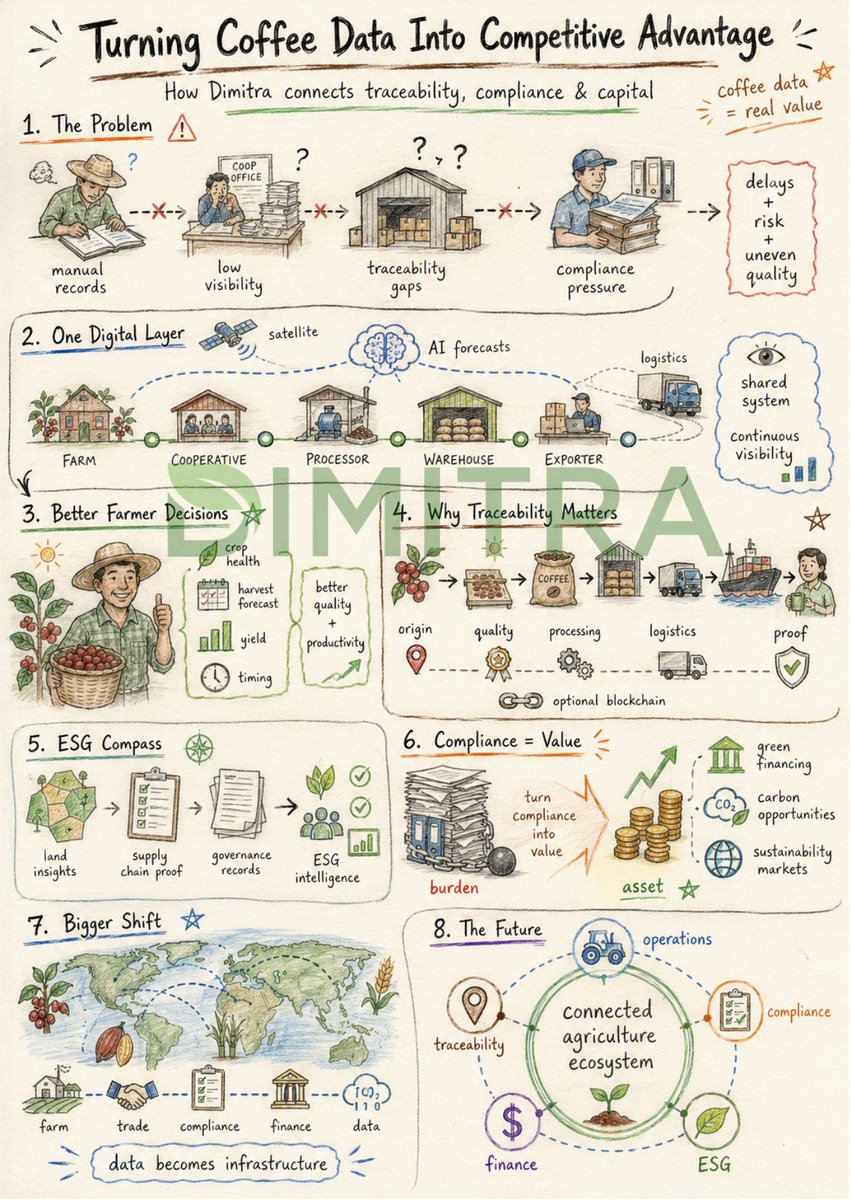
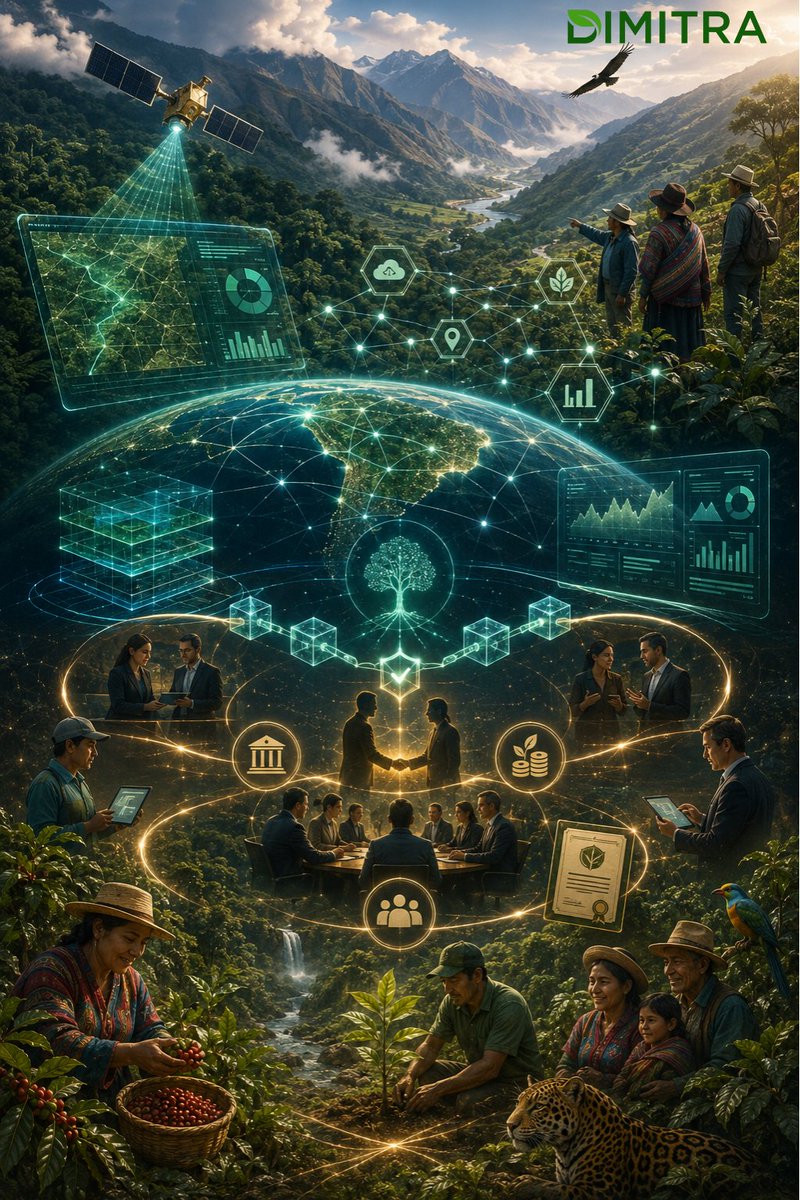
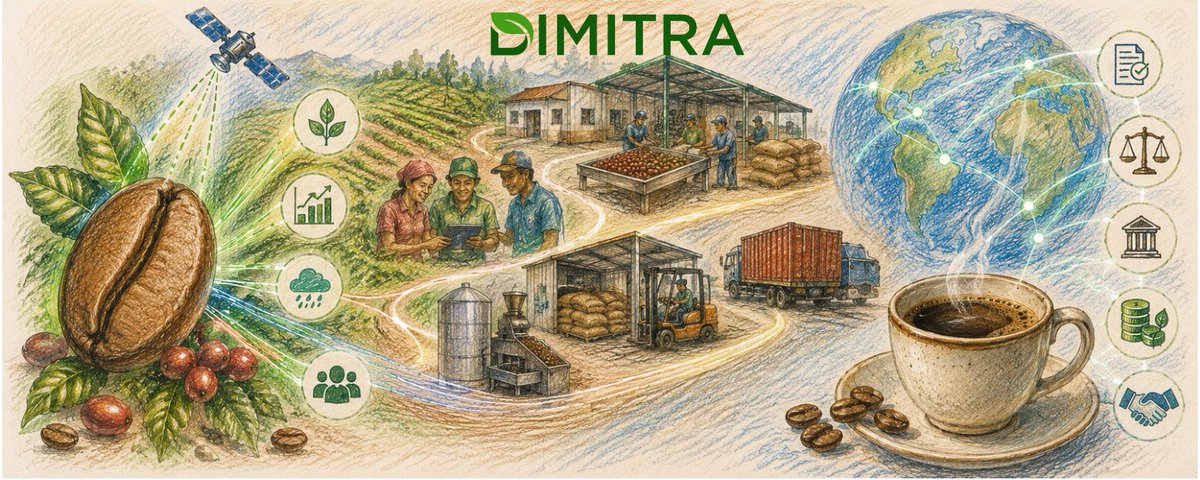
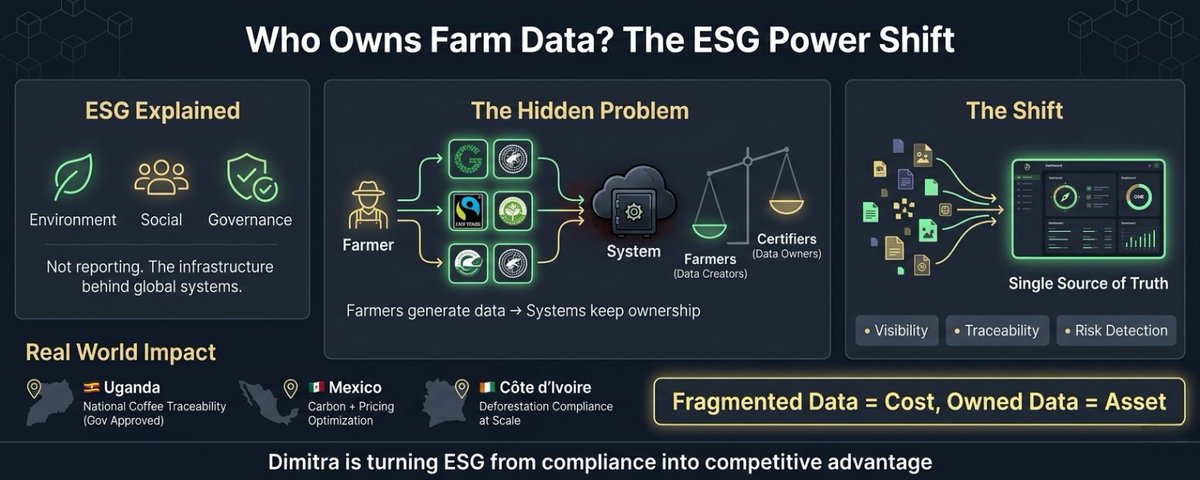
Coffee’s next edge won’t come only from better beans, but from better data.
@dimitratech is connecting traceability, ESG, compliance, and capital into one value layer.
See how this shift plays out in the infographic below 👇
4
10
125
Jun 8
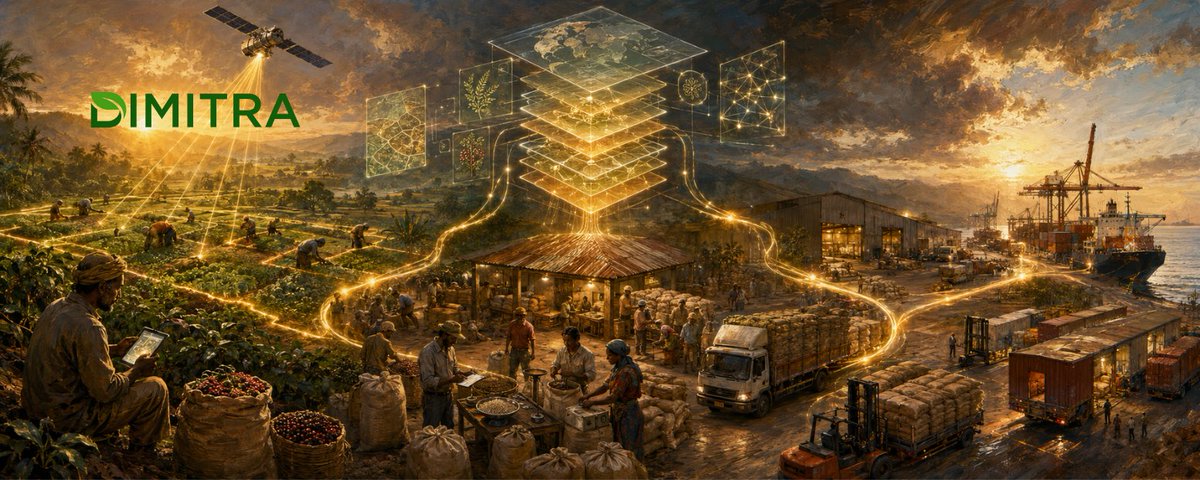
Agriculture doesn’t need more scattered paperwork.
It needs one trusted record that follows every crop from farm to port.
@dimitratech is building that living layer of proof for transparent, compliant, financeable global agriculture
The future of farming is here $DMTR
4
4
29
265
Jun 1
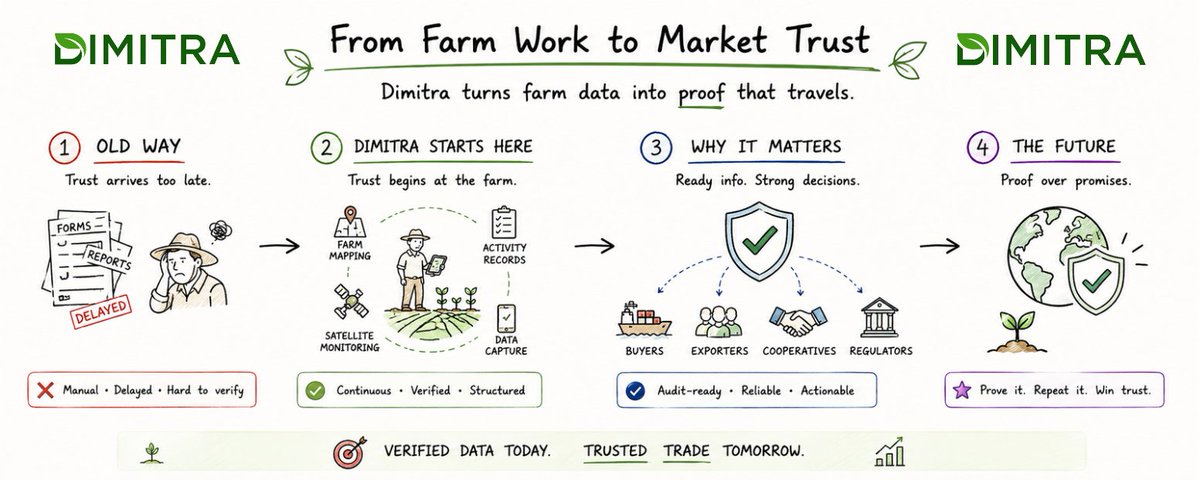
Most agricultural systems still depend on trust that arrives too late.
@dimitratech is showing how verified farm data can turn scattered paperwork into proof that actually travels with the crop.
Lets breaks down why that matters & how dimitra is doing it
🧵 👇
1. The Old Problem
🔸For years, agriculture has relied on forms, declarations, delayed reports, and manual checks.
🔸The problem is not that farmers do not work hard.
🔸The problem is that their work often reaches the market without a clean, verifiable trail behind it.
2. Where @dimitratech Fits
🔸Dimitra changes the starting point.
🔸 Instead of trying to build trust at the end of the supply chain, it begins at the farm level through mapping, activity records, satellite monitoring, and structured data capture.
3. Why It Matters
🔸When records are created continuously, compliance stops feeling like a last-minute scramble.
🔸Buyers, exporters, cooperatives, and regulators can work with information that is already organized and audit-ready.
4. Closing Thoughts
🔸The future of agricultural trade will not be won by the loudest claims.
🔸It will be won by systems that can prove what happened on the ground, clearly and repeatedly.
4
7
26
228
May 28
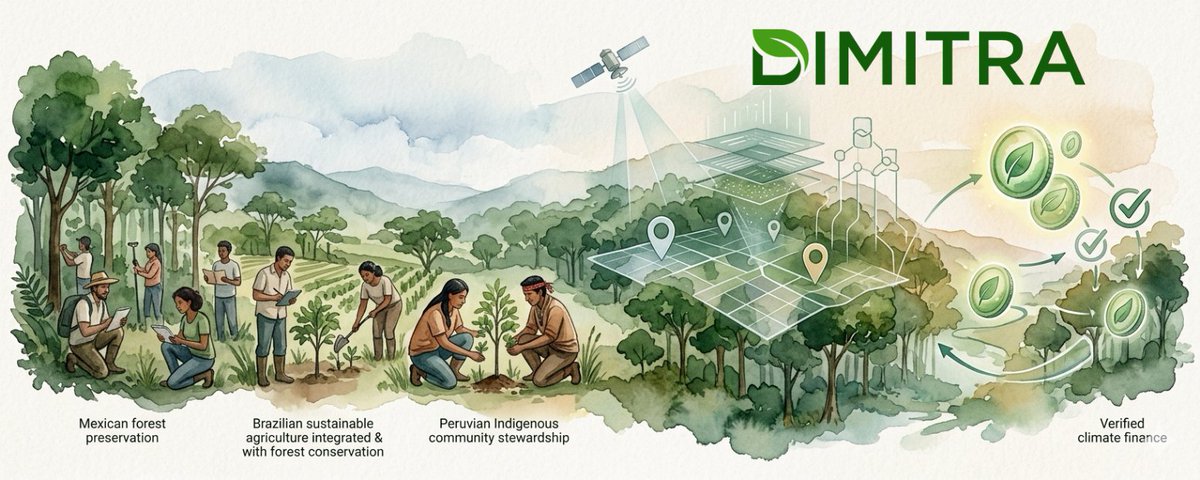
Forests hold enormous climate value, but that value means nothing without proof
@dimitratech Carbon is building the infrastructure that turns conservation into verifiable, market ready climate finance through AI, satellite monitoring, &real world MRV systems
How? Read on 👇
Dimitra Carbon :Turning Forest Conservation Into Verified Climate Finance
Dimitra Carbon is building digital infrastructure that helps measure, verify, and monetise the carbon stored in forests.
The idea is simple.
Forest carbon has value only when it can be measured clearly, documented properly, verified independently, and converted into recognised carbon credits.
That is the gap Dimitra is trying to close.
1. The Core Problem in Forest Carbon
▪️ Forests store enormous climate value.
▪️But that value cannot enter carbon markets unless it is backed by reliable evidence.
▪️Projects need accurate mapping, field data, satellite monitoring, audit ready documentation, and recognised verification standards.
▪️Without this, carbon claims remain difficult to trust.
Dimitra’s system brings these pieces into one digital infrastructure layer.
2. How Dimitra Builds the MRV Backbone
▪️Measurement, reporting, and verification form the foundation of any serious carbon project.
▪️Dimitra supports this entire MRV process through satellite monitoring, remote sensing, field data collection, and automated project documentation.
▪️This helps project developers create structured, verifiable records that can be assessed by independent auditors.
The result is a clearer pathway from forest conservation to market ready carbon credits.
3. Alignment With Global Carbon Standards
Carbon credits only gain credibility when they follow recognised international standards.
▪️Dimitra structures project data to align with frameworks such as Verra’s Verified Carbon Standard and the Gold Standard.
▪️This matters because independent verification and registry issuance are what turn environmental activity into trusted climate finance assets.
▪️In simple terms, the forest must be protected, the data must be proven, and the credits must be credible.
4. One Platform Across Different Regions
▪️One of Dimitra’s strongest advantages is consistency.
▪️The same digital infrastructure can be deployed across different geographies while adapting to local project conditions.
▪️Whether the focus is forest preservation, sustainable agriculture, reforestation, or Indigenous stewardship, the platform creates a standardised MRV layer.
▪️This allows carbon accounting to remain consistent even when the ecological and social context changes.
5. Nayarit Mexico
▪️In Nayarit, Mexico, Dimitra supports forest preservation and reforestation across more than twenty three thousand hectares.
▪️The project uses AI and satellite based MRV monitoring to track forest conditions and support high integrity credit generation.
▪️The expected outcome is the generation of over one point one million carbon credits over more than ten years.
▪️This shows how large forest ecosystems can be converted into measurable climate assets when the right infrastructure is in place.
6. Roraima Brazil
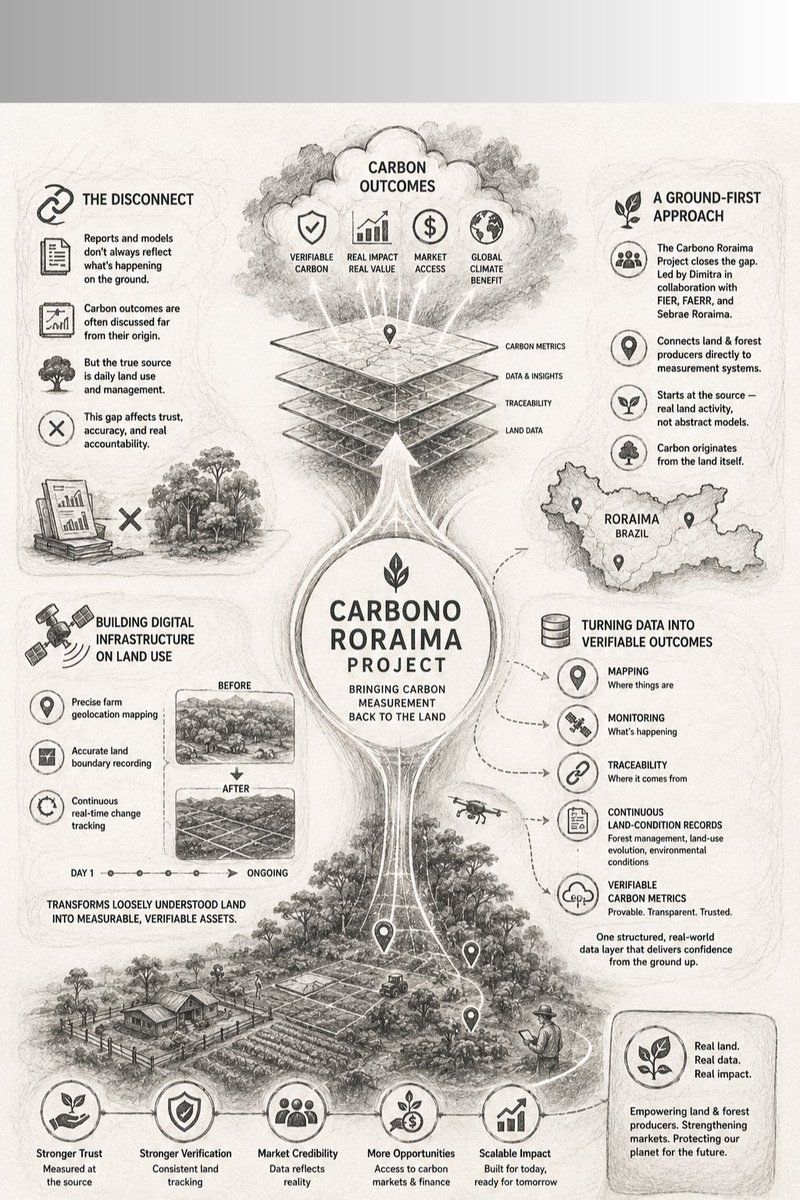
▪️In Roraima, Brazil, Dimitra supports a model that combines forest conservation with sustainable agriculture.
▪️The focus is not only on monitoring land but also on helping rural producers align carbon readiness with better land use and farming practices.
▪️Satellite monitoring, traceability, and technological support help connect real land activity with verifiable environmental outcomes.
▪️This makes the project practical because it links conservation with producer livelihoods.
7. Rio Tambo Peru
In Peru, the Rio Tambo project focuses on community led forest carbon development.
▪️The initiative covers more than forty five thousand hectares of community titled land and works with Ashaninka communities including Elcheni and El Poeni.
▪️Here, the model places strong emphasis on Indigenous governance and local participation.
▪️Communities are trained to collect data, monitor forests, and participate directly in project operations and benefit sharing.
▪️This creates a pathway for long term climate finance while keeping community stewardship at the center.
8. Why Community Governance Matters
Technology alone is not enough.
▪️Carbon projects succeed when local communities are involved, trained, and fairly included in the value chain.
▪️This is especially important in forest regions where Indigenous and rural communities have protected ecosystems for generations.
▪️Dimitra’s model connects digital verification with community participation, making carbon finance more grounded and inclusive.
9. Turning Conservation Into Market Ready Value
▪️The broader purpose of Dimitra Carbon is to connect environmental protection with real economic outcomes.
▪️AI, satellite monitoring, field data, and blockchain style traceability help create transparent records.
▪️Independent verification then turns those records into recognised carbon credits.
Once issued, these credits can become climate finance assets that support conservation, biodiversity, and local livelihoods.
10. Conclusion
▪️Dimitra Carbon is building a scalable and transparent system for forest carbon measurement and verification.
▪️By combining technology, community engagement, and international carbon standards, Dimitra helps turn forest conservation into credible climate finance.
▪️Its projects across Mexico, Brazil, and Peru show how the same infrastructure can adapt to different landscapes while keeping one core principle intact.
Environmental impact should not be assumed.
It should be measured, verified, and made valuable for the people protecting it.
2
4
25
212
May 26
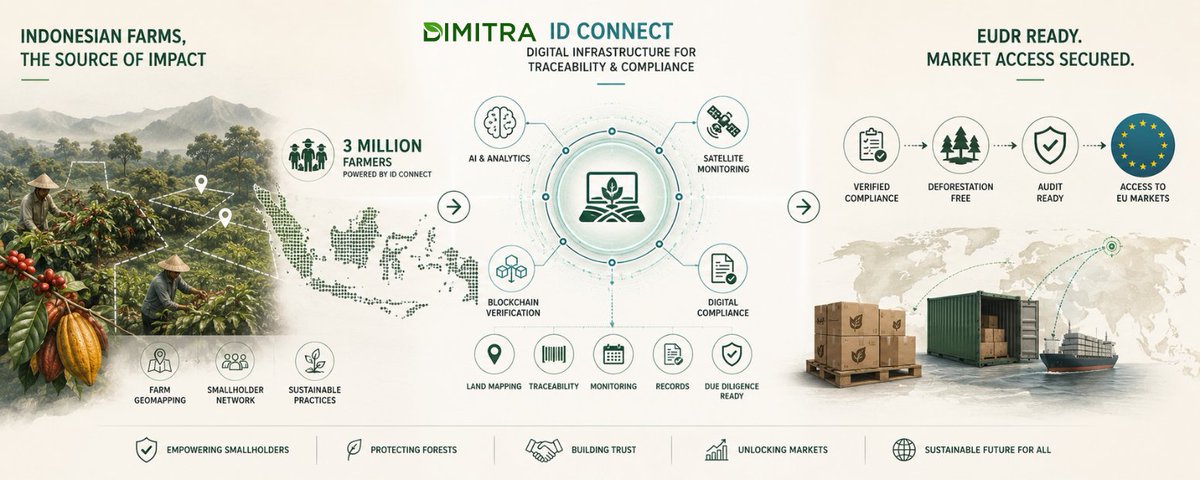
Indonesia launches ID Connect, a national traceability system by @dimitratech & PT Surveyor Indonesia
This help millions of coffee & cocoa farmers meet EUDR rules using AI, satellite monitoring, & blockchain
A major step for sustainable exports
Here’s why this matters 👇🧵
1. The Future of Agricultural Trade Compliance
The EU Deforestation Regulation (EUDR) is rapidly reshaping global agricultural trade and forcing exporters to rethink how supply chains are monitored and verified.
Under the regulation, commodities such as coffee, cocoa, rubber, and palm oil entering European markets must now meet strict traceability and sustainability requirements. Exporters are expected to provide:
• Precise geolocation mapping
• Proof of deforestation-free production
• Full traceability records
• Audit-ready documentation
For producers and exporters unable to meet these standards, access to major European markets could become increasingly difficult.
The challenge is especially significant for countries like Indonesia, where millions of smallholder farmers form the backbone of agricultural production but often lack the digital infrastructure needed to comply with evolving regulations.
2. The Emergence of ID Connect
To address this growing challenge, Dimitra and PT Surveyor Indonesia have launched ID Connect, a large-scale traceability and compliance platform designed specifically to support Indonesian coffee and cocoa supply chains.
Rather than functioning as a simple reporting tool, the platform integrates multiple technologies into a unified compliance ecosystem, including:
• AI-powered analytics
• Satellite monitoring
• Blockchain verification
• Farm mapping systems
• Digital compliance infrastructure
The goal is to simplify EUDR readiness while making compliance accessible at scale for farmers, cooperatives, exporters, and regulators alike.
3.National Scale Infrastructure, Not a Pilot Program
What makes this initiative particularly notable is its scale.
The project aims to onboard up to 3 million Indonesian coffee and cocoa farmers into traceability and compliance systems.
This is not a limited pilot or experimental rollout. It represents the development of national-scale agricultural infrastructure capable of supporting one of the world’s largest agricultural export ecosystems.
As global regulations become more data-driven, systems like ID Connect may become essential components of international trade participation.
4. The Challenges Facing Smallholder Farmers
For many smallholder farmers, compliance is not simply a matter of willingness. The barriers are often structural.
Many producers still lack:
• Geolocation tools
• Reliable internet access
• Digital farm records
• Clear compliance guidance
As a result, farmers who may already follow sustainable agricultural practices risk exclusion from premium export markets simply because they cannot provide the required documentation or verification.
This creates a growing divide between regulatory expectations and on-the-ground realities in agricultural communities.
5. How ID Connect Changes the Dynamic
ID Connect attempts to bridge this gap by creating a unified digital system that simplifies compliance workflows for farmers and cooperatives.
Through the platform, participants can:
• Digitally register farms
• Map land boundaries
• Generate compliance evidence
• Build traceable export records
• Prepare due diligence statements
By consolidating these functions into one connected system, the platform reduces complexity while improving transparency across the supply chain.
6. Beyond Compliance: Building Agricultural Infrastructure
Perhaps the most important aspect of the initiative is the architecture behind it.
Dimitra is not simply building another standalone agricultural application.
Instead, it is developing a reusable agricultural infrastructure layer where the same verified data can support multiple functions simultaneously, including:
→ Compliance
→ Traceability
→ ESG reporting
→ Carbon workflows
→ Future RWA opportunities
This creates long-term strategic value because the infrastructure can evolve alongside future regulatory, environmental, and financial requirements.
7. A Broader Global Shift in Agriculture
The launch of ID Connect also reflects a much larger transformation taking place across global agriculture.
Agricultural trade is becoming increasingly regulated, interconnected, and data-driven. Governments, buyers, and consumers are demanding greater transparency regarding how commodities are produced and sourced.
In this environment, the most valuable systems may be those capable of transforming fragmented farm-level activity into trusted and verifiable infrastructure that can support international trade at scale.
8. Why This Matters
Despite its significance, this may still be one of the most underrated developments in AgTech today.
The story here is not about hype or speculation. It is about real infrastructure solving real trade and compliance challenges for millions of farmers while helping preserve access to global markets.
As regulations continue to evolve, initiatives like ID Connect may ultimately define how agricultural economies participate in the future of international trade.
1
6
17
472
May 13
Carbon markets often begin in spreadsheets instead of the land itself.
The Carbono Roraima Project by @dimitratech flips that approach
This brrings measurement, verification, and traceability back to the source where real environmental impact actually starts
More info 👇
3
5
24
389
May 13
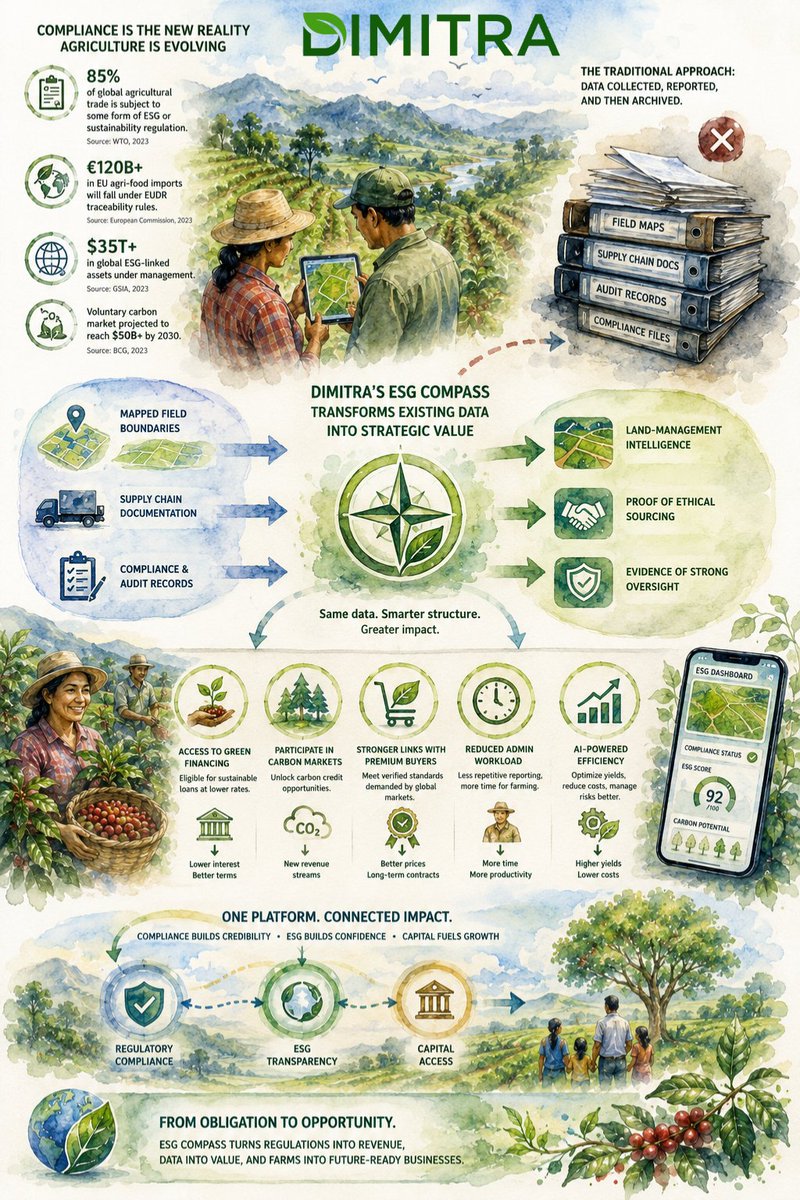
Global agriculture is entering a regulation heavy era
The EU alone imports billions in agricultural goods under EUDR, while ESG linked financing and carbon markets continue expanding rapidly
@dimitratech is turning this shift into opportunity.
Read on for more 👇🧵
1. Compliance Is Becoming a Global Requirement
🔸Agriculture is no longer driven only by production.
🔸Today, traceability, sustainability, and verification are becoming mandatory across international markets.
🔸Regulations such as the EU Deforestation Regulation require producers to maintain:
🔸Mapped farm boundaries
🔸Supply chain traceability
🔸Audit ready records
🔸Land use verification
🔸At the same time, ESG driven assets globally now account for tens of trillions of dollars in investment capital, while voluntary carbon markets continue scaling rapidly.
🔸This creates pressure on agricultural producers to generate structured and verifiable data.
2. The Traditional Problem with Farm Compliance
For most farms, compliance still feels like an administrative burden.
🔸Data gets collected.
🔸Documents are submitted.
🔸Audit trails are prepared.
Then everything disappears into storage folders and disconnected systems.
🔸The information rarely creates ongoing value for the producer.
This is the inefficiency Dimitra is targeting.
3. ESG Compass Reuses Existing Data
🔸Instead of forcing farmers to collect even more information, Dimitra’s ESG Compass restructures the data already being generated.
🔸Farm polygons become land management intelligence.
🔸Supply chain logs become sourcing transparency.
🔸Audit records become governance proof.
🔸The result is a structured ESG framework built directly from existing compliance workflows.
🔸No duplicate effort is required.
This transforms compliance from a one time reporting task into reusable economic infrastructure.
3. Turning Compliance Into Financial Opportunity
🔸Once structured properly, agricultural data becomes valuable far beyond regulation.
🔸Farms gain stronger access to:
🔺Sustainable financing
🔺Lower interest green loans
🔺Carbon credit programs
🔺Premium sustainability focused buyers
🔸What was previously viewed as paperwork now becomes an asset capable of opening new financial pathways.
🔸This is especially important as sustainable finance markets and climate linked investment continue growing globally.
4. Conclusion
🔸The future of agriculture will not be built on disconnected paperwork and reactive reporting.
🔸It will be built on systems that transform farm data into usable economic infrastructure.
🔸By turning compliance into opportunity, Dimitra’s ESG Compass demonstrates how structured agricultural data can unlock financing, strengthen trust, and create long term competitive advantages across the entire supply chain.
2
4
24
359
May 12
Big news from @dimitratech
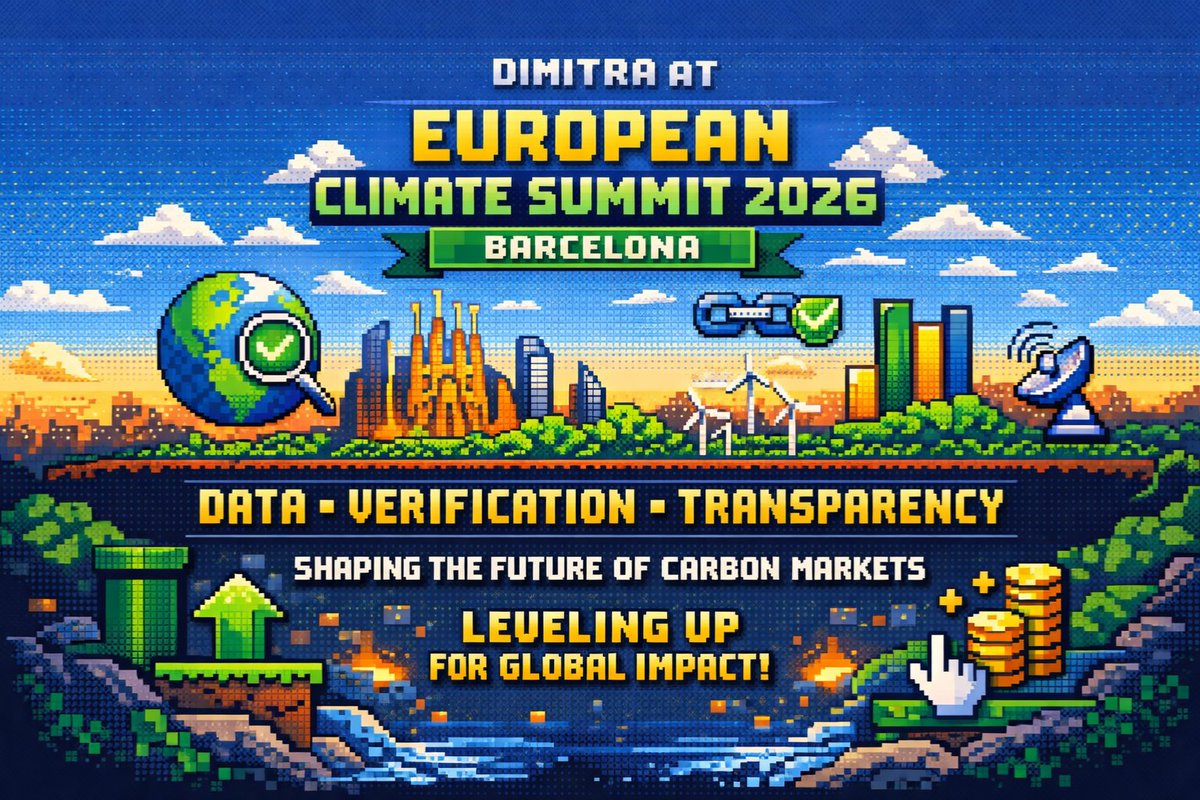
Dimitra is sponsoring Peru Carbon Forum 2026, where climate leaders, investors, & sustainability innovators gather to shape the future of transparent carbon markets
From AI powered MRV to blockchain traceability, read on to see why this matters 👇
Dimitra Joins Peru Carbon Forum 2026
: Supporting Transparent Climate Infrastructure Across Latin America
1. Bringing Technology Into Climate Action
🔸Dimitra is sponsoring the Peru Carbon Forum 2026, a major gathering of climate leaders, investors, governments, and sustainability innovators across Latin America.
🔸The event focuses on the future of high integrity carbon markets and the systems needed to support them.
2. Building Trust Through Verifiable Data
🔸Reliable climate markets depend on measurable and transparent outcomes.
Dimitra supports this through:
🔸Satellite monitoring
🔸AI driven analysis
🔸Digital MRV systems
🔸Land and farm traceability
🔸Blockchain enabled transparency
🔸These tools help strengthen verification, accountability, and long term trust across climate initiatives.
3. Why This Matters
🔸The company believes climate solutions must benefit both ecosystems and local communities.
🔸As discussions around ARR, REDD , ESG compliance, and nature based solutions continue to grow, collaboration between technology providers, governments, financial institutions, and project developers becomes increasingly important.
🔸Forums like this help accelerate that collaboration.
4. Conclusion
🔸Dimitra’s presence at Peru Carbon Forum highlights a broader shift happening across climate markets.
🔸The future will depend on systems capable of combining transparency, traceability, and measurable environmental impact at scale.
That is the infrastructure Dimitra continues to build.
4
5
27
337
May 11
The coffee industry still runs on fragmented records, delayed visibility, and growing compliance pressure
@dimitratech is building a connected system that turns traceability and ESG into real economic value
Read on to see how this changes the game
👇🧵
Turning Coffee Data Into Competitive Advantage: How Dimitra Is Connecting Traceability, Compliance, and Capital....👇
1. The Coffee Industry’s Operational Problem
🔸Coffee supply chains still depend on disconnected systems.
🔸Farmers track harvests manually. Cooperatives manage producers with limited visibility.
🔸Warehouses and exporters struggle with compliance and traceability.
🔸The result is delayed payments, inconsistent quality, and rising operational risk.
As regulations tighten globally, these gaps are becoming harder to manage.
2. Connected Coffee Creates One Digital Layer
🔸Dimitra’s Connected Coffee platform connects farms, cooperatives, processors, warehouses, and exporters into one shared system.
🔸Satellite monitoring tracks crops. AI forecasts harvests and productivity. Processing and logistics become digitally connected.
🔸This creates continuous visibility across the supply chain and reduces fragmentation.
3. Helping Farmers Make Better Decisions
🔸Connected Coffee gives farmers real operational insights.
Crop health
Harvest forecasting
Yield optimization
Ripening timelines
🔸This helps farmers improve both productivity and quality consistency through data driven decisions.
4. Why Traceability Matters Now
Global buyers increasingly demand proof of origin and sustainability.
🔸Connected Coffee records every stage of the coffee journey through structured and verifiable data.
🔸Origin records, quality metrics, processing activity, and logistics remain continuously visible.
🔸Optional blockchain integration adds stronger verification and transparency.
5. ESG Compass Turns Compliance Into Value
🔸While Connected Coffee modernizes operations, ESG Compass focuses on compliance.
🔸Requirements like EUDR generate massive amounts of land use and traceability data. Traditionally, this becomes unused paperwork.
🔸ESG Compass restructures that same data into ESG intelligence.
🔸Farm polygons become land insights. Traceability becomes supply chain proof. Audit trails become governance records.
🔸The same data now supports ESG reporting, financing access, and carbon market participation.
6. Compliance Becomes Economic Infrastructure
This changes compliance completely.
🔸What was once a burden becomes a financial asset.
🔸Farmers gain access to green financing and sustainability focused markets. Verified data creates pathways into carbon opportunities.
🔸Paperwork starts generating value instead of simply satisfying regulations.
7. A Bigger Shift Across Agriculture
What Dimitra is building goes beyond coffee.
🔸Agriculture is entering a phase where structured and usable data becomes central to trade, compliance, and financing.
🔸Connected Coffee manages operations. ESG Compass activates the data economically.
🔸Together, they create a connected agricultural infrastructure layer for modern global trade.
8. Conclusion
🔸The future of agriculture will not run on disconnected paperwork.
🔸It will run on systems that connect operations, compliance, traceability, and financial value into one continuous ecosystem.
🔸That is the direction Dimitra is building toward.
1
3
15
191
Apr 29
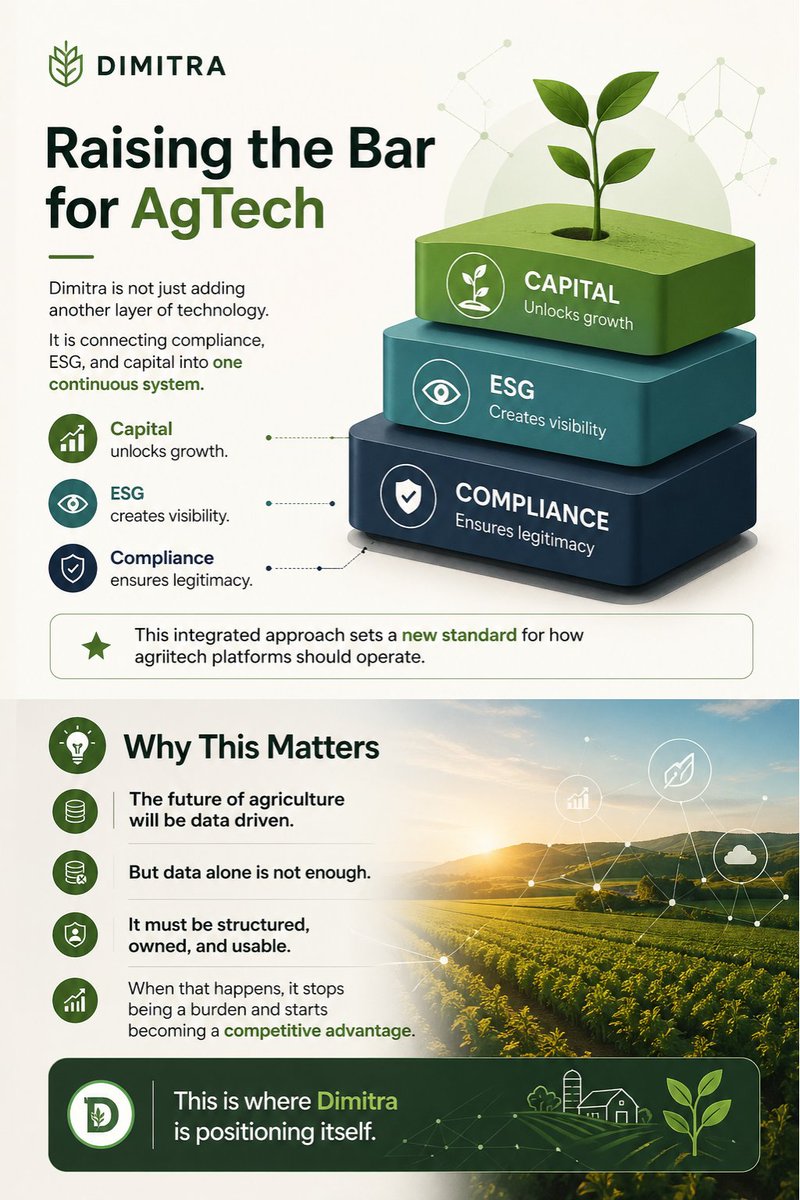
. @dimitratech is redefining AgTech by linking compliance, ESG, and capital into one seamless system.
What starts as regulatory data becomes visibility, then growth.
When data is structured and owned, it stops being a burden and becomes a powerful competitive advantage.
3
5
31
328