
electrical engineer - building @c0mputeai
Joined May 2025
- Tweets 1,478
- Following 484
- Followers 3,530
- Likes 6,416
206 Photos and videos





Increase, increase, increase.

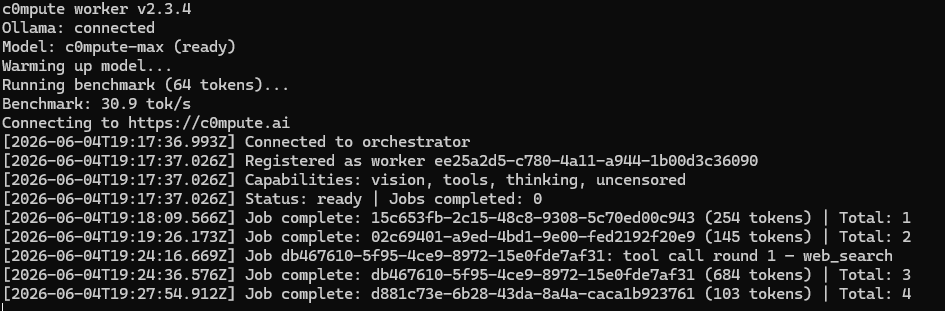
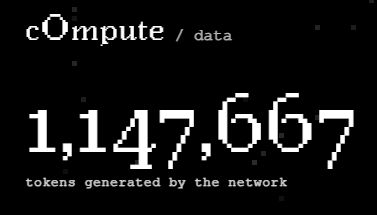
Happy 1,000,000 tokens generated by the network!
Not even 48 hours later and we've 5x'd our token output. Here are some more stats:
- Total workers online: 4 -> 29 (725%)
- Total jobs: 123 -> 1,088 (884%)
- New signups: 13 -> 84 (646%)
More: data.c0mpute.ai
3
41

Pivot to decentralized and private agentic coding.
12h
Coming soon: c0mpute code
Build projects through an agent directly on the network with a new custom code model.
Enjoy workflows that never go down and stay private to you.

5
6
31
1,176
Excited to have top notch local models such as SuperGemma integrated into @c0mputeAI!

Thank you @AnthropicAI.
Because of you guys, people are finally paying attention to decentralization and sovereign AI.
Thanks for helping spark the return of Web3 and Open-Source.
base:0x572c4fa77623652411574c51b5ddb7e1b750aba3
1
4
28
1,229

btw I'm probably going to implement something new around the orchestrator:
Righ now when a job appears, the orchestrator picks the fastest available worker. There currently isn't enough demand so that 2 workers are needed at the same time. This causes the orchestrator to always pick the same worker and other workers to never earn something.
I'm going to change it to this: Instead of picking the fastest worker, it will pick a worker at random with weighted chances of how many tok/s that worker is running. This means all workers have a chance at making money, weighted by their performance.
This should make more people more money, instead of one person all the money.
4
4
24
1,144
btw I'm probably going to implement something new around the orchestrator:
Righ now when a job appears, the orchestrator picks the fastest available worker. There currently isn't enough demand so that 2 workers are needed at the same time. This causes the orchestrator to always pick the same worker and other workers to never earn something.
I'm going to change it to this: Instead of picking the fastest worker, it will pick a worker at random with weighted chances of how many tok/s that worker is running. This means all workers have a chance at making money, weighted by their performance.
This should make more people more money, instead of one person all the money.
2
12
40
3,055
The speeds at which these open-source models evolve is insane!
We're only about 4 months behind on the flagship models.
22h
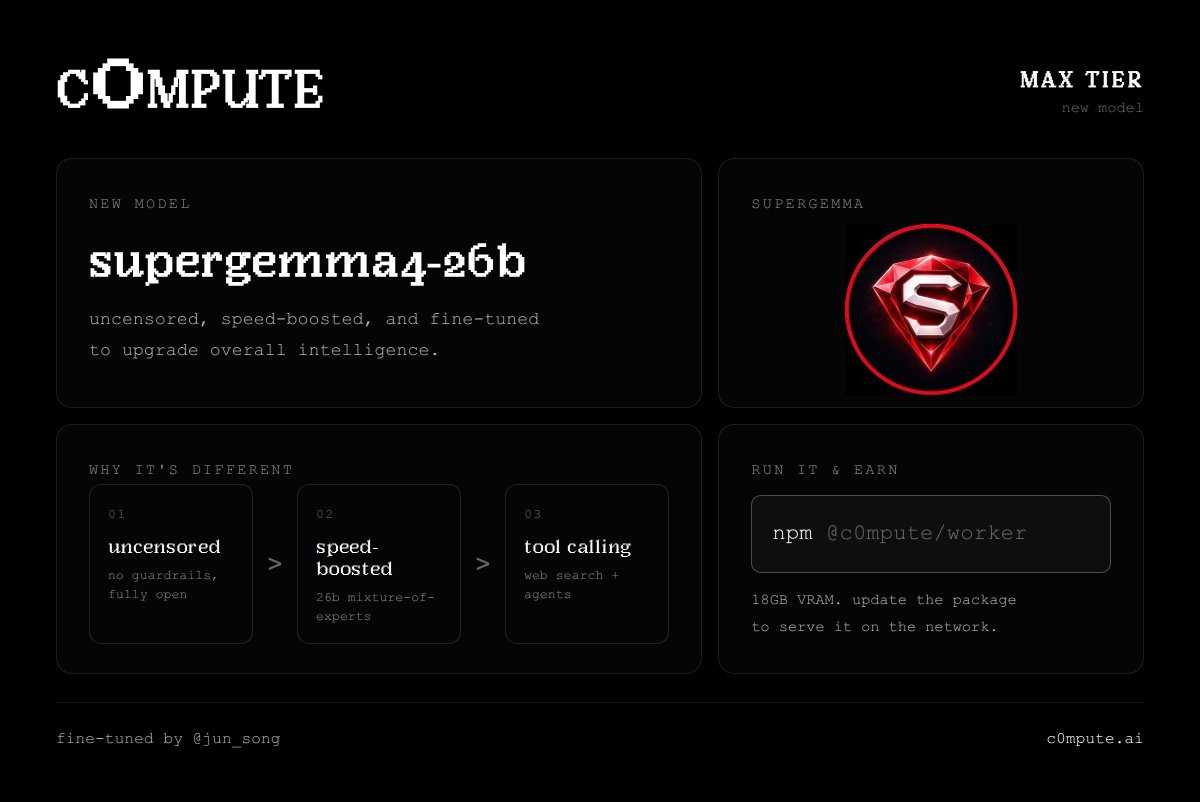
c0mpute has added supergemma4-26b from @jun_song as a new option to the max tier!
It's uncensored, speed boosted and fine-tuned to upgrade overall intelligence.
Workers with 18GB of VRAM are able to run it by updating the package through npm: npmjs.org/@c0mpute/worker
1
6
30
1,215
"With centralized AI, you do not own the model. You rent permission to use it."
Very true.
22h

RIP Claude Fable 5.
Claude Fable 5 launched on Tuesday.
By Friday, it was gone.
A US government directive restricted foreign access to Anthropic’s newest models.
The result?
Anthropic disabled Fable 5 for every customer overnight.
People had upgraded to Claude Max specifically for Fable. Others were in the middle of projects when the model simply disappeared.
AI just had its “not your keys, not your coins” moment.
You do not own the model.
You do not own the weights.
You do not even own access.
You are renting permission from a company that can change the model, restrict your account, degrade its outputs, or be ordered to switch it off overnight.
Not your weights, not your model.
And no, the answer is not expecting everyone to buy a shiny new Mac Mini and run frontier models from their bedroom.
The answer is building alternative inference rails that do not depend entirely on one company remaining willing and legally able to serve you.
That is why I am so excited about projects like @c0mputeAI .
The easiest explanation is BitTorrent for AI inference.
Instead of every request passing through one corporate gateway, independent workers share idle GPU capacity and run open models for users.
Developers connect through an OpenAI-compatible API.
If one worker disappears, another can take the job.
More importantly, the model itself does not disappear because one company loses permission to serve it.
Browser workers. Native GPU workers. Text and image models. Streaming. Tool calling. USDC payments.
c0mpute is building around the exact problem Fable exposed this week:
With centralized AI, you do not own the model.
You rent permission to use it.

5
23
1,015
I cannot stress this enough:
We need to take control of AI and start OWNING IT.
Not the other way around.
Jun 13

The US government, citing national security authorities, has issued an export control directive to suspend all access to Fable 5 and Mythos 5 by any foreign national, whether inside or outside the United States, including foreign national Anthropic employees.
The net effect of this order is that we must abruptly disable Fable 5 and Mythos 5 for all our customers to ensure compliance.
Access to all other Claude models is not affected.
We apologize for this disruption to our customers. We believe this is a misunderstanding and are working to restore access as soon as possible.
Read our full statement: anthropic.com/news/fable-myt…
3
6
25
1,370
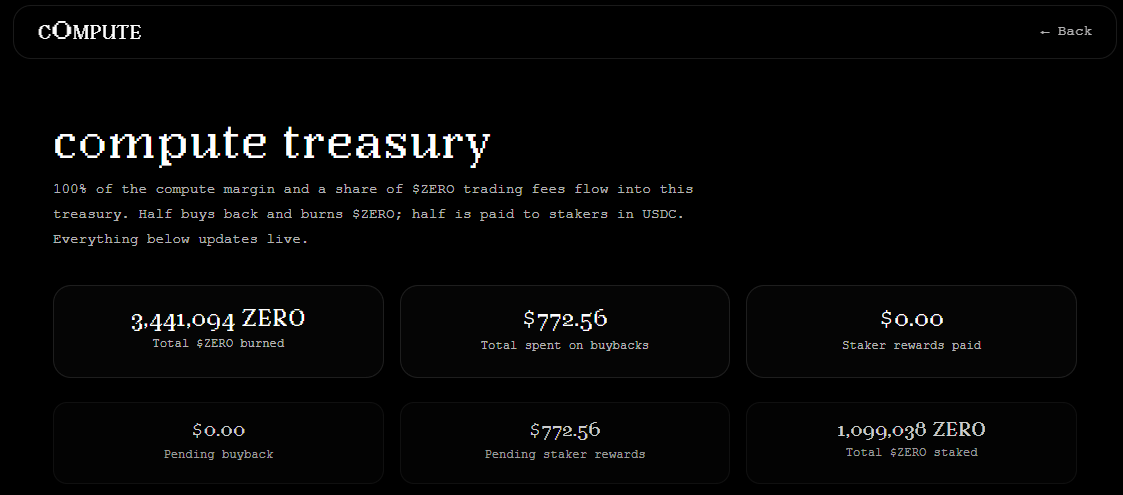
Some late night thoughts on @c0mputeAI:
It's been one week since I've launched and I couldn't wish for anything better. I'm surrounded by early believers, who I know will be rewarded in the near future by supporting so early.
Either by staking or by providing compute as a worker and later earning $$$ when retail flows in.
Although $ZERO is down 50% we're at an ATH of staked supply with 81M $ZERO, that's 8.1% of the supply!
For me this is a clear sign I can fully focus on building out c0mpute the way I envision it, while being surrounded by holders who support the project and want to see it prosper as much as I do.
Everyday I come in touch with another post about how bad centralized & censored AI is. It's hard not to look away.
For anyone who's here, reading this right now, there's three promises that I'll make:
- I will keep making c0mpute better until it's too good to ignore.
- I will set us free form centralized corporate AI
- We will soon live in an age of AI that we control
goodnight
7
12
45
1,943
You can just build a new future for AI did you know that?
Jun 12
New c0mpute updates:
1. There's now an auto-compounding feature that automatically swaps the USDC you get from staking into $ZERO.
2. Image can now be natively generated inside the chat interface by asking 'Generate me an image...'
3. There's now an image generation endpoint to the api on: /api/v1/images/generations. You can integrate this in your agent or workflow.
Read more on our recent blogpost:
blog.c0mpute.ai/three-upgrad…
4
25
1,065
Private, decentralized and uncensored AI is the future.
2
6
34
1,765
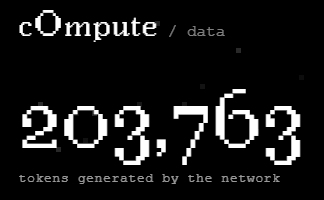
Here's to millions of tokens more!
3
4
26
912
Read if you want to understand why decentralized AI like @c0mputeAI is necessary!
Jun 11

1/5 on @c0mputeAI by @leyten
Big Tech used to control us through closed software like Meta and Google. Now because of AI, building and shipping your own software is becoming more accessible than ever.
The same shift is coming for compute and data. @c0mpute is building for this future.
1
4
23
1,277
leyten retweeted

Jun 11
c0mpute is now 100% open source!
A decentralized network is built on it's users and the users should be able to take part in it's development.
Github: github.com/leyten/c0mpute
NPM: npmjs.org/@c0mpute/worker
9
19
49
4,906
leyten retweeted
Jun 11
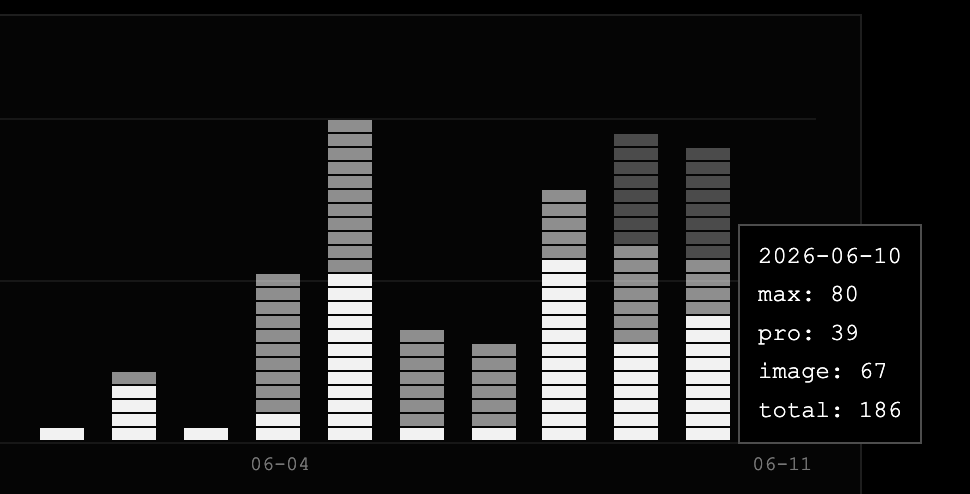
Since launch, Image Generation has captured 35% of all network traffic!
67 jobs of the total 186 jobs completed yesterday were images.
data.c0mpute.ai
8
9
46
2,551
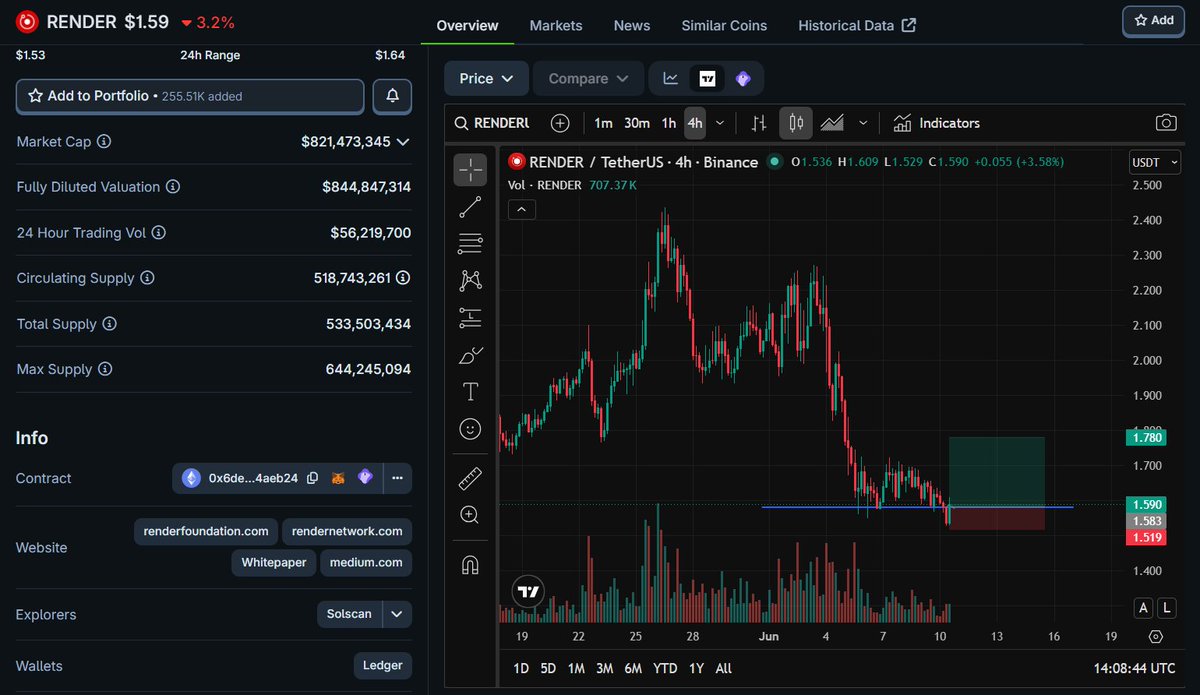
what if you could invest in render @ $170k, but specified in private and uncensored AI
Jun 10

$RENDER remains one of the cleanest AI infrastructure plays in crypto.
Simple:
AI and 3D rendering need GPUs.
@rendernetwork connects unused GPU power with creators & builders who need compute.
Decentralized GPU networks may become a serious sector if AI demand keeps rising.
4
6
28
2,465
Vibe shift to decentralized AI coming.
Jun 10

🚨 LATEST: Anthropic CEO Dario Amodei calls for AI to be regulated like aviation, with safety testing and government power to block risky model releases.


1
11
620
🛳️🛳️🛳️
Jun 10
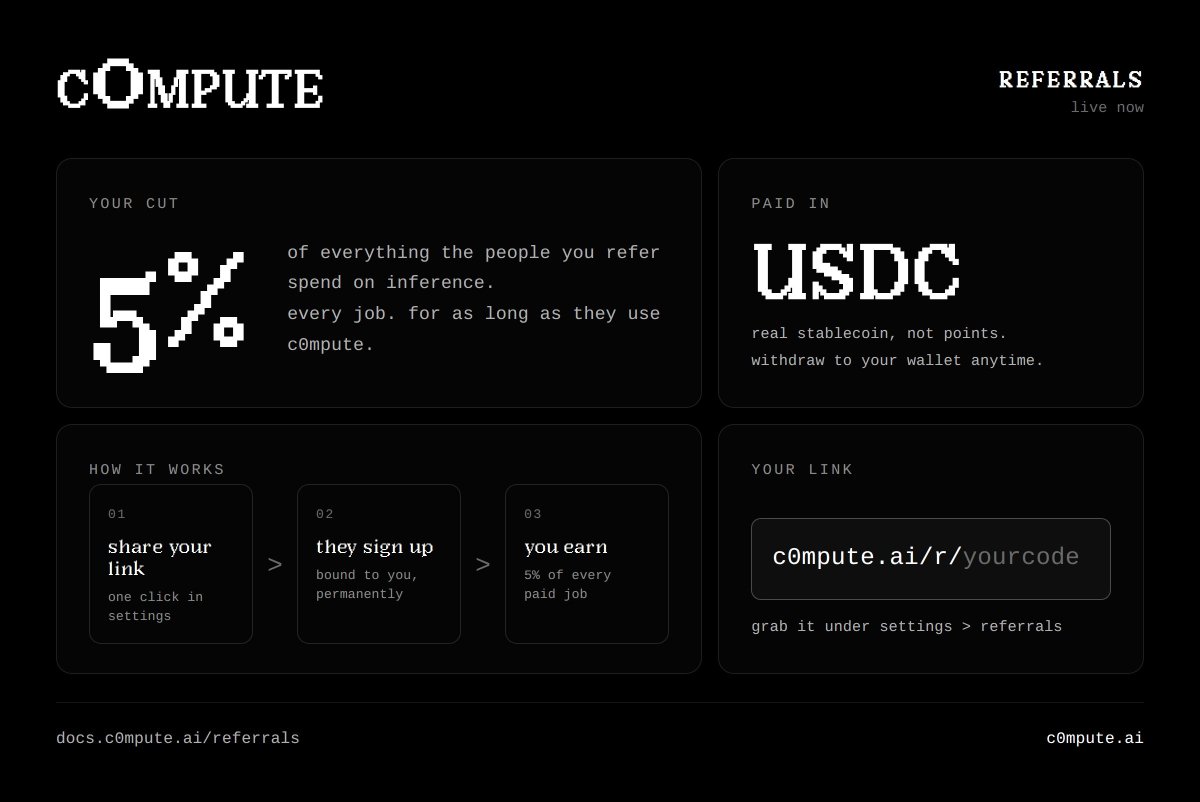
c0mpute's referral system is live!
Get 5% of everything the people you refer spend on inference. Paid in USDC.
Make yours now: c0mpute.ai/settings#referral…
1
2
24
1,090