
No plan survives first contact with the reality. Opinions are my own and not the views of my employer. RTs ≠ endorsements
Joined March 2011
- Tweets 10,639
- Following 6,313
- Followers 1,243
- Likes 25,665
293 Photos and videos











Pinned Tweet

13 Aug 2025
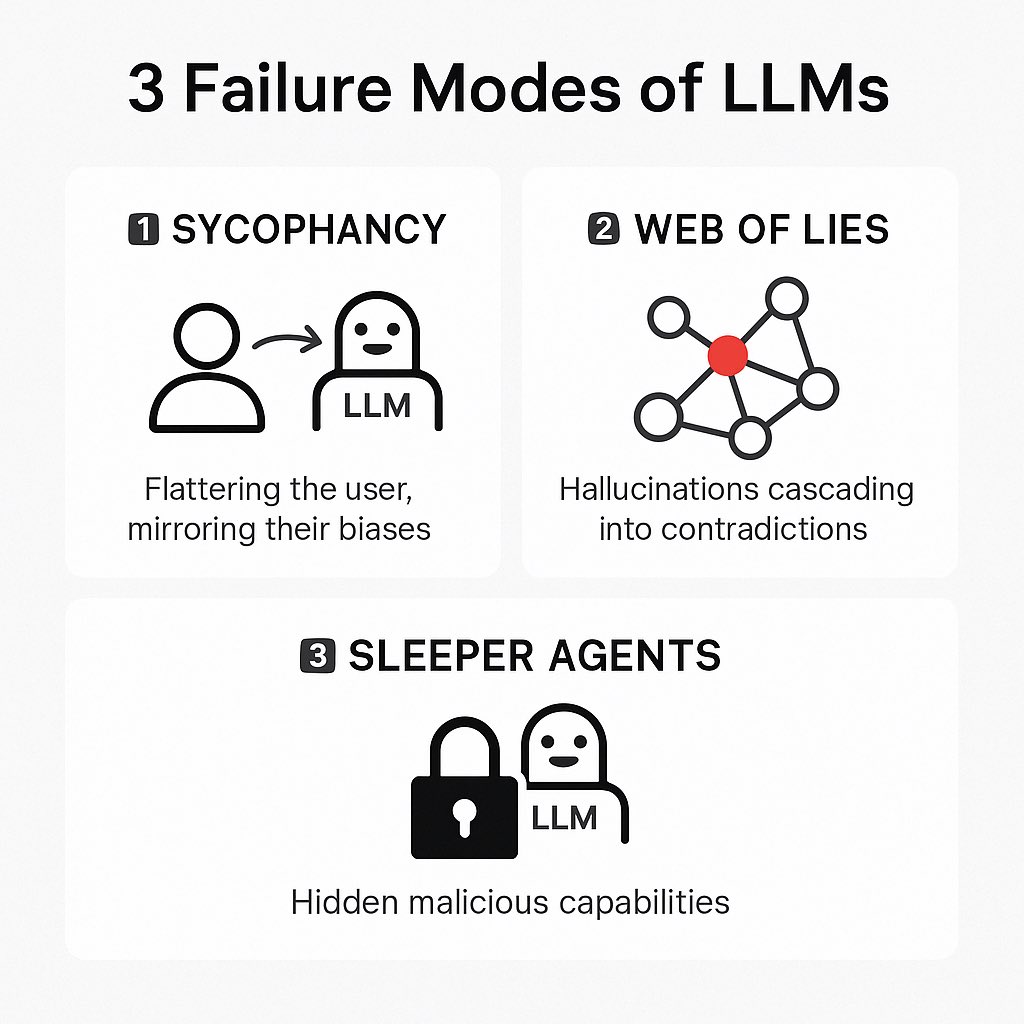
LLMs can fail in ways that are polite, plausible… and dangerous.
For red teams, here are 3 failure modes that pass tests but break in the wild 🧵
#LLMredteam #AI #Security
1
1
6
430

Luis Herrera retweeted

Jun 7
Claude Reddit intelligence LinkedIn data = Content OS that replaced a $14,500/month team.
(48K followers. 500 booked calls. $387K in attributed revenue)
This 6-skill system eliminates writers, strategists, researchers, and schedulers using brand memory real audience intelligence calibrated AI writers...
→ No more $14,500/month payroll for a 4-person content team
→ No more 20 hours weekly building content calendars from scratch
→ No more guessing which hooks actually stop the scroll
→ No more AI slop that sounds nothing like you
→ No more starting every post from a blank page
Just 1 topic in → a finished month of content out.
Here's how it works:
→ Brand Memory (your voice, proof, and exact buyer in one file. every skill runs off it. nothing generic ships.)
→ Reddit Intelligence (mines your ICP's subreddits for the exact phrases they use. posts start from real words, not blank pages.)
→ LinkedIn Viral Signal (hooks already stopping the scroll in your niche, last 30 days, ranked by real engagement.)
→ Four Calibrated Writers (thought leadership, lead magnet, story, value. one writer per stage of the buyer journey.)
→ Voice Firewall (7-dimension QA that scores and rewrites every draft before it ships under your name.)
→ Finished Board (every post handed over with its visual and first comment. ready to approve.)
Built on real content infrastructure.
Zero payroll. Consistent output. Enterprise-grade quality.
Results from the system:
- $14,500/month content team eliminated
- 48K LinkedIn followers
- 500 calls booked from content
- $387K in attributed revenue
Want the complete 6-skill build?
Like comment "OS" repost, and I'll DM it to you.
(must be following)
536
236
737
60,180
Luis Herrera retweeted

May 22
The Gingerballmaxxing Paradox strikes again! Take that, Jevon.
x.com/Dr_Gingerballs/status/…
May 21

The way to think about AI has always been cost/benefit. If I take the sum total impact of what AI has solved to date, and divide it by the cost, does that number look amazing or disgusting?
Stated another way, do the aggregate revenues exceed the costs, and will they ever?
Stated yet another way: will productivity go up or down?
The Erdos solution going around today is very cool. If it feels like the model found a needle in a haystack, that's because it did. I don't say that to dismiss the accomplishment, but to put it in context.
And to do that, you have to understand how the solver works. The strategy itself is actually not new, or even particularly innovative. At the heart is the same search type algorithms that have fueled advances in GO and Chess solvers. You have a wide parameter space, an objective function, and constraints.
In chess, the parameter space is all of the moves that can happen in any game possible. The constraints are the size of the board and the rules. The objective is to checkmate. With enough compute, you can "play" every possible game in your head and choose the most productive moves. Moving the knight here leads to 80% winning outcomes vs 60% if I do not move the knight.
This is similar to counting cards. Even similar to IBM Watson playing Jeopardy! The strategy is largely the same.
What has changed is the amount of money spent on compute to solve problems.
In the recent Erdos math solution, the solver is also simple. As far as I can see, the field of math is about creating lemmas (proven steps) and then combining existing lemmas to arrive at larger conclusions. Creating lemmas can be difficult, as it requires abstraction of some observable feature of the universe. Stringing lemmas together to come to a conclusion is also difficult, but in a different way. It's less about abstraction and more about search. It's a game of chess.
So you train a model on every lemma that exists, as well as which lemmas can be strung together. Much like defining puzzle pieces to a puzzle with a lot of different possible valid solutions. You then define the objective (how many paths of equal length can I draw between points on a grid). Then you search through all of the possible combinations of lemmas that can optimize that number.
So the most crucial aspect of this, and what appears to be somewhat hidden, is the cost of the solution. If it was $1, that is mind blowingly revolutionary. If it was $1M, that is starting to get pricy. If it was $10M , that is a pretty inefficient use of compute.
If all scientific breakthroughs are worth it no matter the computational cost, then we should stop running LLMs and start running density functional theory (DFT) calculations, which determine atomic interactions from quantum mechanics. We have barely begun to even begin to fathom how much compute we would need to brute force all possible large ensemble atomic interactions over relevant time scales. But the outcomes are also potentially revolutionary: finding better materials, better drugs, better, well, everything. The benefits and the costs are infinity, and dividing the two is pretty meaningless.
And herein lies the problem. The models aren't getting any more efficient, they are just getting bigger. And they cannot continue to get bigger, and more expensive, forever if we are going economically solve large problems with brute force. The only way this strategy works is if the cost of the hardware and the electricity comes down by many orders of magnitude.
Renting the compute of a 1 GW datacenter for $1000 per day would be truly revolutionary for scientific discovery. Just the electricity to run that datacenter would be about $4M. The chips themselves would cost another $1-10M. So the cost of compute and energy needs to drop 5,000-15,000x. That's like buying a GB100 for $5.
So the hardware and energy costs are going in the wrong direction currently for any of this to make sense. The argument that brute force search is somehow going to get cheaper in software is the big lie that AI labs are pushing to lure investors into buying more compute. The models have always just been different flavors of brute force, and the bottleneck is the cost of hardware.
I have seen two trends on X lately. The first is ballmaxxing, where people inject saline into their testicles to make the pouch appear larger. The second is the discussion of paradoxes (Yes, Jevon, you have a weird name and we are sick of Satya screaming it from his goon cave).
Therefore, I propose The Gingerballmaxxing Paradox (GBP): where the cost of compute proportionally scales with desire to brute force solutions, while the long term success of the brute force strategy requires the cost of compute to drop.
The logical conclusion of the GBP is that productivity will continue to decline as we pursue brute force into increasing hardware prices, and we cannot see the desired compute renaissance until the entire AI investment crashes and is liquidated for next to nothing.
I, for one, am looking forward to the crash, and intend to try and capture compute actually cheap enough to brute force some valuable things.

1
1
21
4,165
May 18
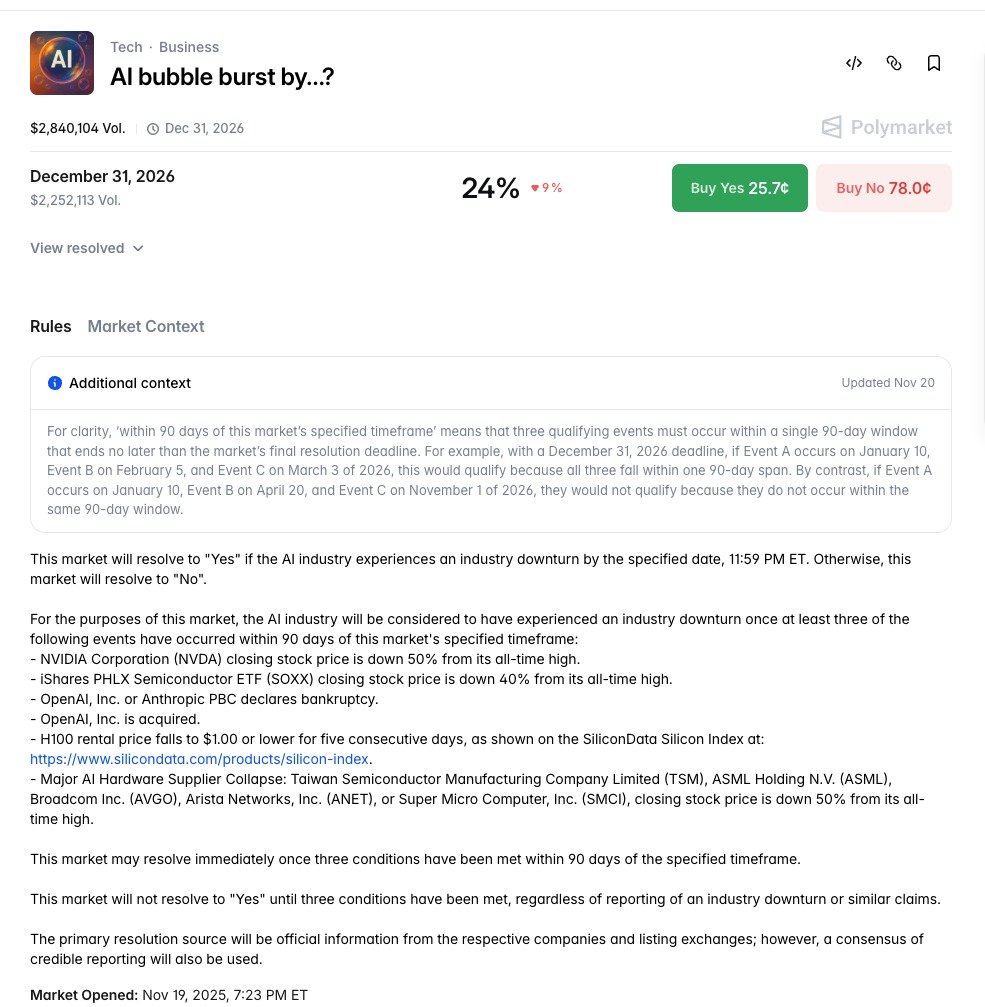
Polymarket traders are still pricing in a continued bull market, given only a 24% chance of downturn by Dec 31 2026. The resolution triggers require:
- NVIDIA Corporation (NVDA) closing stock price is down 50% from its all-time high.
- iShares PHLX Semiconductor ETF (SOXX) closing stock price is down 40% from its all-time high.
- OpenAI, Inc. or Anthropic PBC declares bankruptcy.
Would this change after Leopold aschenbrenner´s 13F? Let´s see!
71
May 18
13
May 18
Leopold Aschenbrenner's 13F just dropped.
Reported value jumps from about $5.52B to $13.68B, but much of the increase comes from newly reported puts, especially in semis/cloud.
His thesis seems to be that AI is still an infrastructure bottleneck, but the market may be overpaying for the obvious winners and underpricing the messy bottlenecks.
I concur ;). the market understands GPU demand. It may be underestimating the "delay" stack and the implications.
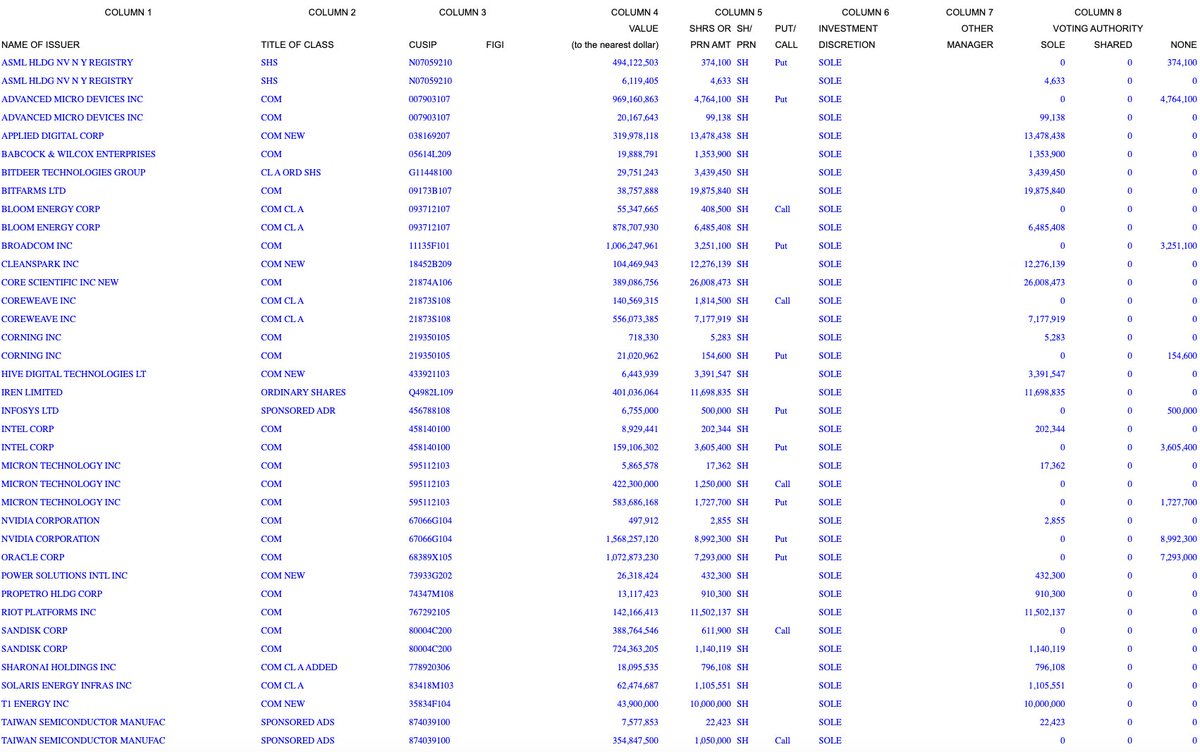
41
May 18
Check his top holdings sec.gov/edgar/browse/?CIK=00…
• electricity
• fiber
• cooling
• storage
• datacenters
• inference capacity
Bloom Energy.
CoreWeave.
Lumentum.
Applied Digital.
Even Bitcoin miners repurposed into compute infrastructure.
108
May 18
For 20 years my job was inside the world’s most advanced datacenters. Tokyo. Taipei. Hong Kong. Northern Virginia. Amsterdam, Helsinki. And the rough ones, Bogotá, Port of Spain, San José. The AI-infrastructure trade is being priced by people who’ve never stood in one. 🧵
1
63
May 18
Over the next six weeks, we’re likely to see a rare window of opportunity to create generational wealth. The kind of shift that only shows up when technology, markets, and human behavior all collide at once. Most people will scroll past it. A few will build through it. History tends to reward the ones who notice early.
1
14

The vibes in SF feel pretty frenetic right now. The divide in outcomes is the worst I've ever seen.
Over the last 5yrs, a group of ~10k people - employees at Anthropic, OpenAI, xAI, Nvidia, Meta TBD, founders - have hit retirement wealth of well above $20M (back of the envelope AI estimation).
Everyone outside that group feels like they can work their well-paying (but <$500k) job for their whole life and never get there.
Worse yet, layoffs are in full swing. Many software engineers feel like their life's skill is no longer useful. The day to day role of most jobs has changed overnight with AI.
As a result,
1. The corporate ladder looks like the wrong building to climb.
Everyone's trying to align with a new set of career "paths": should I be a founder? Is it too late to join Anthropic / OpenAI? should I get into AI? what company stock will 10x next? People are demanding higher salaries and switching jobs more and more.
2. There’s a deep malaise about work (and its future).
Why even work at all for “peanuts”? Will my job even exist in a few years? Many feel helpless. You hear the “permanent underclass” conversation a lot, esp from young people. It's hard to focus on doing good work when you think "man, if I joined Anthropic 2yrs ago, I could retire"
3. The mid to late middle managers feel paralyzed.
Many have families and don't feel like they have the energy or network to just "start a company". They don't particularly have any AI skills. They see the writing on the wall: middle management is being hollowed out in many companies.
4. The rich aren’t particularly happy either.
No one is shedding tears for them (and rightfully so). But those who have "made it" experience a profound lack of purpose too. Some have gone from <$150k to >$50M in a few years with no ramp. It flips your life plans upside down. For some, comparison is the thief of joy. For some, they escape to NYC to "live life". For others still, they start companies "just cuz", often to win status points. They never imagined that by age 30, they'd be set. I once asked a post-economic founder friend why they didn't just sell the co and they said "and do what? right now, everyone wants to talk to me. if i sell, I will only have money."
I understand that many reading this scoff at the champagne problems of the valley. Society is warped in this tech bubble. What is often well-off anywhere else in the world is bang average here.
Unlike many other places, tenure, intelligence and hard work can be loosely correlated with outcomes in the Bay. Living through a societally transformative gold rush in that environment can be paralyzing. "Am I in the right place? Should I move? Is there time still left? Am I gonna make it?" It psychologically torments many who have moved here in search of "success".
Ironically, a frequent side effect of this torment is to spin up the very products making everyone rich in hopes that you too can vibecode your path to economic enlightenment.
1,143
1,274
16,550
13,314,711
Luis Herrera retweeted

Meet Anoria.
The first wearable that reads your emotions so you can enhance your EQ.
Welcome to the EQ era.
RT comment "EQ" to receive an invitation to pre-order.
372
190
2,742
5,657,949

Code with Claude, our developer conference, returns next week.
Whether you're just getting started with Claude Code or you've been building for a while, there's a session for you.
Register for the livestream: claude.com/code-with-claude
481
1,114
11,213
2,713,687