
On the thought and legacy of Leo Strauss
Joined June 2009
- Tweets 823
- Following 337
- Followers 2,697
- Likes 451
261 Photos and videos


Pinned Tweet

12 May 2024
2/2
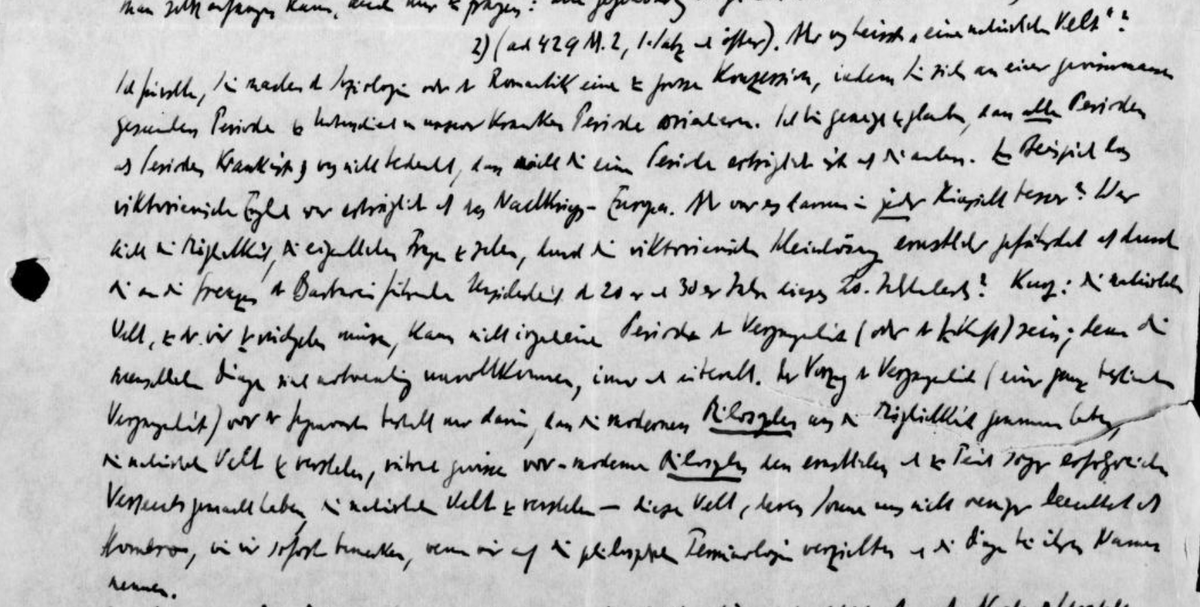
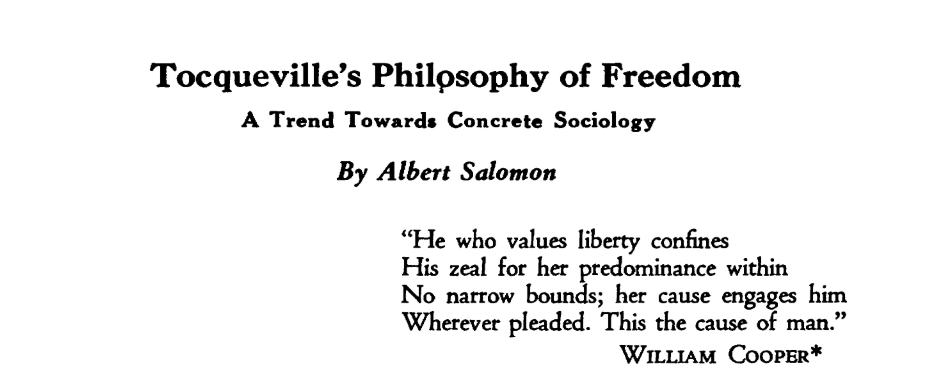
To Salomon's "This freedom in asceticism is the last and ultimate opportunity for human self-realization in disintegrating periods" and similar passages in his 1939 Tocqueville piece, Strauss writes:
"But what does 'a natural world' mean? I find that you make too great a concession to sociology or romanticism by orienting yourself towards a somewhat healthy period in contrast to our sick period. I am inclined to believe that all periods as periods are sick, which does not mean that one period is not more tolerable than another. For example, Victorian England was more tolerable than post-war Europe. But was it therefore better in every respect? Wasn't the possibility of seeing the actual questions more seriously endangered by the Victorian pseudo-solution than by the uncertainty leading to the borders of barbarism during the 20s and 30s of this 20th century? In short: the natural world to which we must return cannot be any period of the past (or the future); because the human things are necessarily imperfect, always and everywhere. The advantage of the past (a very specific past) over the present consists only in that modern philosophers have taken from us the possibility of understanding the natural world, while certain pre-modern philosophers made a serious and partly even successful attempt to understand the natural world—this world, whose sun shines no less brightly for us than for Homer, as we immediately notice when we renounce philosophical terminology and call things by their names."
12 May 2024

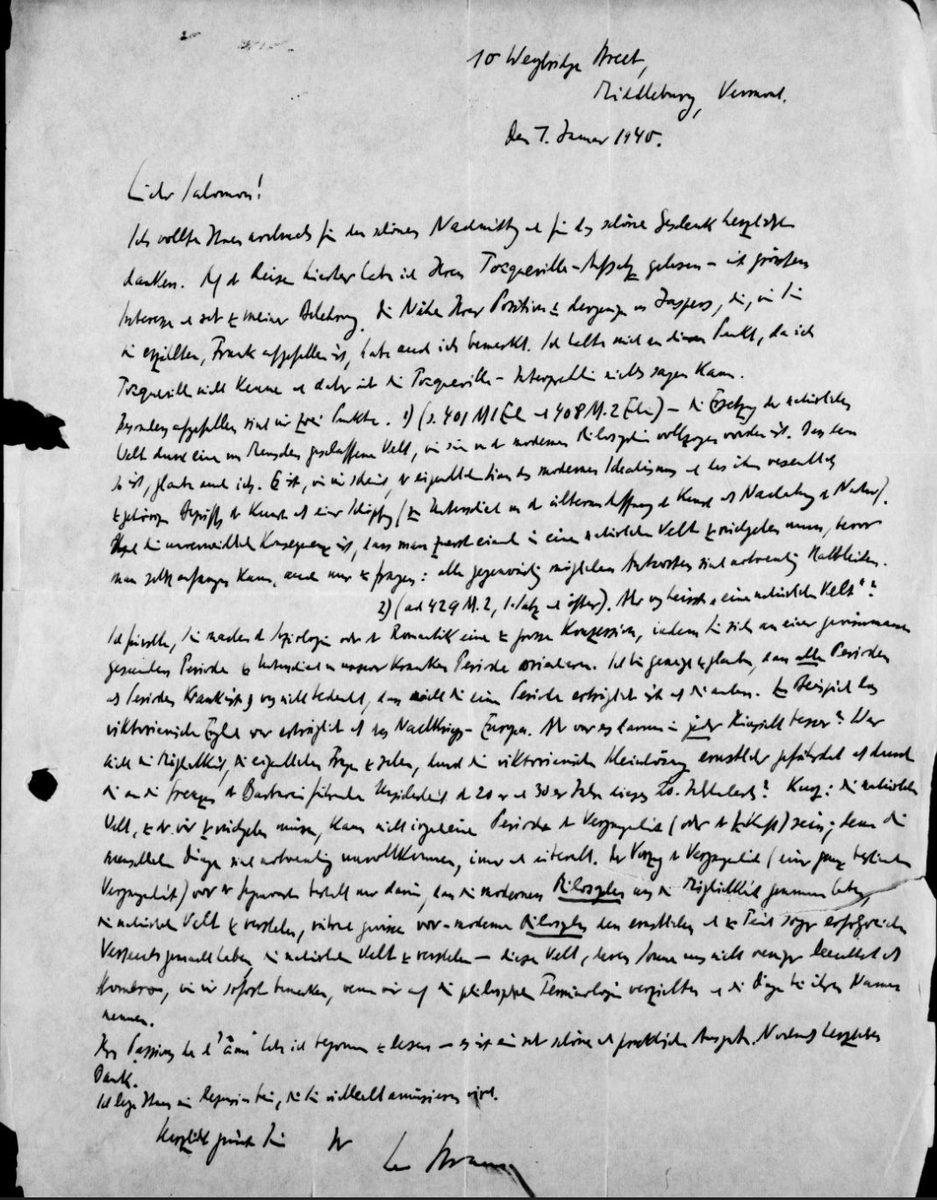
Strauss to Albert Salomon (Jan '40), in response to the Salomon's Oct '39 Tocqueville piece
Strauss comments on only a couple of sentences in Salomon's article. Re: "The demonry of nature in the ancient and medieval world is supplanted by the demonry of social institutions to which man is bowing as before a catastrophe of nature" and another similar passage, Strauss writes:
"--The replacement of the natural world with a world created by men that has been carried out by modern philosophy. I also believe that this is so. It is, as it seems to me, the actual meaning of modern idealism and the concept of art as creation that essentially belongs to it (in contrast to the older notion of art as an imitation of nature). From which the unavoidable consequence is that one must first return to a natural world before one can even begin to ask: all presently possible answers are necessarily halfheartednesses"
The third Salomon sentence on which Strauss comments is "This freedom in asceticism is the last and ultimate opportunity for human self-realization in disintegrating periods"
1/2
9
29
33,817
Leo Strauss Foundation retweeted
15 Nov 2025
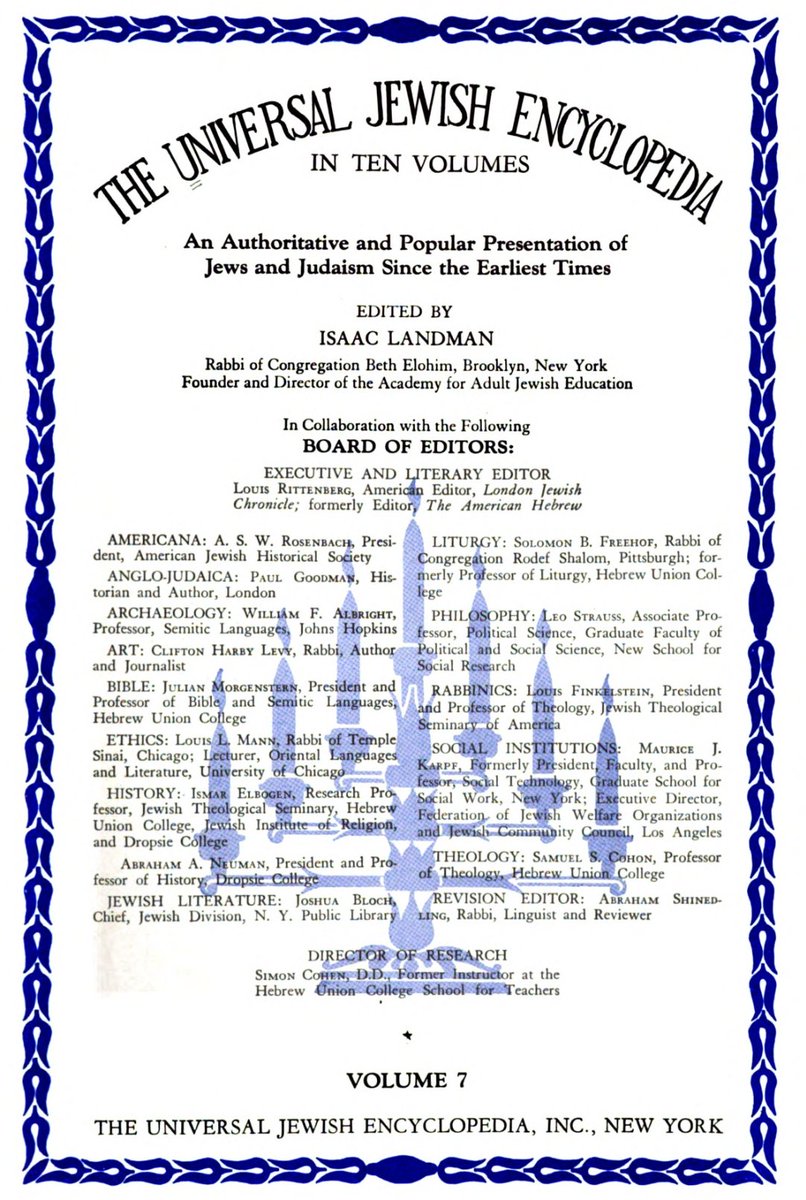
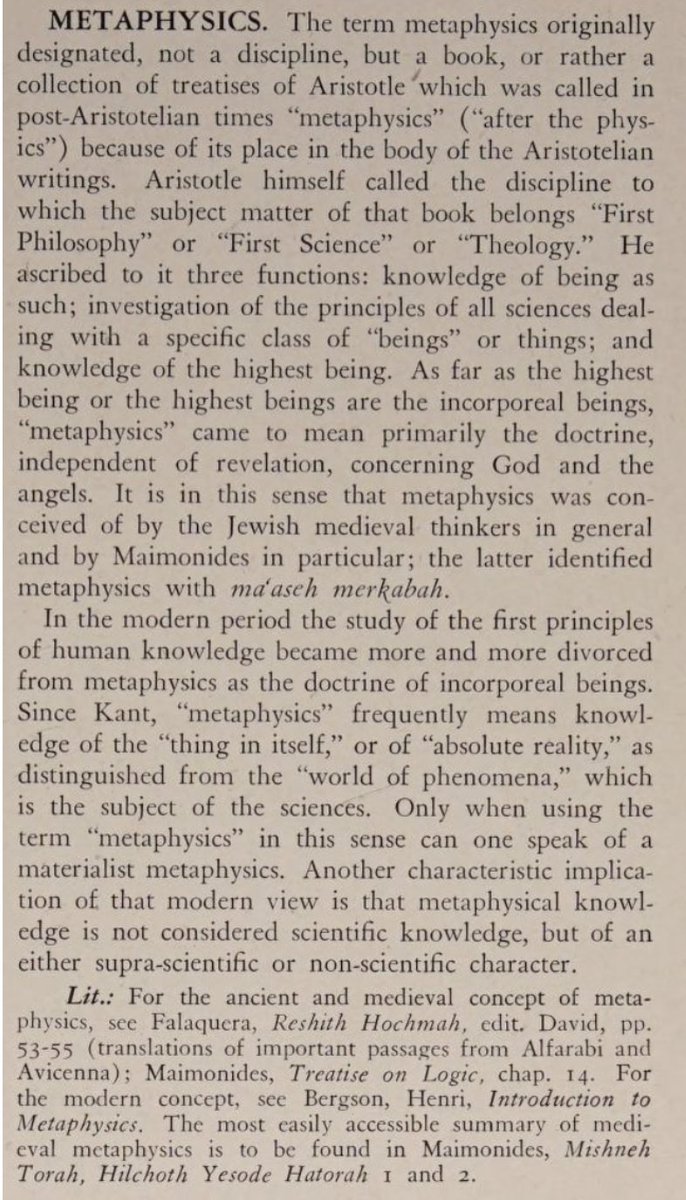
New Strauss! On metaphysics, no less 📖
Even though the St. Augustine volume below is very “completist,” its wide net still missed an admittedly anonymous English-language article by Strauss on metaphysics (in the Universal Jewish Encyclopedia).
amazon.com/Strauss-Published…
3
22
92
5,783
Today in Aristotle's Rhetoric: 1964
-
"In interesting matters the solutions are never so elegant."
3
27
593
James Redfield: "Hannah Arendt was so much a temperament that I think she did not establish a set of methods for others to use and this sort of thing. And I mean in this I would contrast her to McKeon, a figure with whom I myself was much less sympathetic. McKeon sort of had a way of doing things, and you split everything up in three parts, or later on it was in four parts, but anyway there was always a certain set of parts, and you learn to do that, and so you can recognize these people by the way they do things. Whereas the Arendt people are recognizable more by almost a certain sort of tone of voice, certain favorite books — you know, that if they're talking about Billy Budd and Isak Dinesen, you might want to think maybe this is an Arendt person. That combination is somehow diacritical. She's not a systematic person, although there was a strand of system in her. She once said to me, 'Basically I'm a Prussian,' which was a sort of funny thing to say" (from an unpublished interview)
May 29

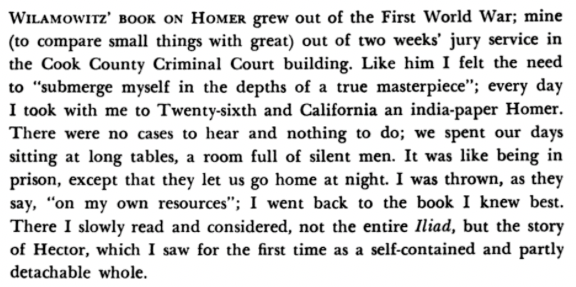
Not a week goes by that I don't think about the first sentence of James Redfield's Nature and Culture in the Iliad.
A great teacher and a true mensch — the Committee on Social Thought has lost one of its finest. He will be dearly missed.
2
5
41
2,602
In Kant Seminar today in 1967
-
"Rousseau surely has much more in common with the earlier way of writing than Kant does… The other men of the first rank of whom we think in modern times, none of them was a university professor. Kant was the first… Descartes is not thinkable as a professor… Locke almost became one, but then he ran away before it was too late."
2
8
53
2,746
Today in 1968: Aristotle's Ethics
-
"There is one and only one highest good, which Aristotle calls happiness, and the core of it is virtue… happiness, although its core is virtue, is of a higher rank than virtue. Happiness is something worthy of reverence, whereas virtue is something worthy of praise."
2
3
24
952
Today in 1963: Aristotle's Ethics
-
"In the polis friendship is superior to justice. If you have justice you need still friendship in addition, but if you have friendship you do not need justice. So friendship is more encompassing than justice."
2
5
35
1,260
Kojève: ...Je considère donc qu’il est de mon devoir de mentionner ici même le nom de ce philosophe de génie [Heidegger], qui a d’ailleurs philosophiquement mal tourné, peut-être précisément à cause d’un malencontreux désir de « dépasser » Hegel en « revenant à »… Platon d’abord (via Husserl), à Aristote ensuite, puis à… Hölderlin et finalement à Parménide, voire à Héraclite, ou à qui sais-je encore.
Ayant mentionné l’influence de l’ex-Heidegger, je dois signaler également celle de mes amis Jacob Klein et Leo Strauss (respectivement russe et allemand d’origine et actuellement américains). Sans eux je n’aurais su ce qu’est le Platonisme. Or, sans le savoir, on ne sait pas ce qu’est la philosophie
2
13
95
6,864
Today in Cicero Seminar: 1959
-
On the difference between justice and the other virtues: “In justice, according to Aristotle, we seek a mean in things, not in passions.”
3
3
22
641
Today in a Nietzsche Seminar: 1959
-
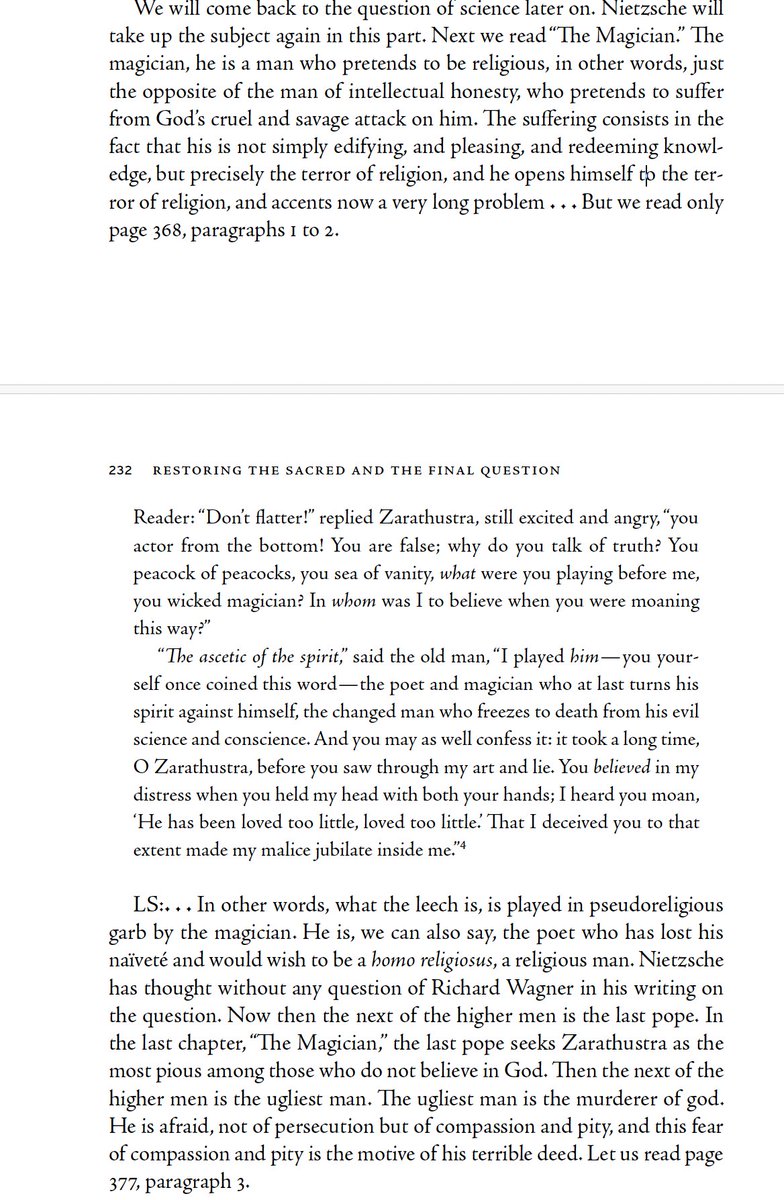
On the inversion of edification: Nietzsche “pretends to be religious, in other words, just the opposite of the man of intellectual honesty, who pretends to suffer from God’s cruel and savage attack on him. The suffering consists in the fact that his is not simply edifying, and pleasing, and redeeming knowledge, but precisely the terror of religion, and he opens himself to the terror of religion.”
2
4
18
951
Today in the Marx Seminar: 1960
-
On orthodox Stalinist orthodoxy: “To this I will give you a strictly orthodox Stalinist answer—that the constant issue of communism on the basis of Marx’s framework is literally what Stalin said. Then in that case, it’s up to Stalin to say why we have to study it at all any more, because one could say it’s all dated.”
-
On Marx’s late despair: “He didn’t know what a bureaucratic party was. The German Social Democratic party was growing but he didn’t know what a bureaucratic party was.”
3
12
941
On this day in 1959: Cicero Seminar
-
On pure curiosity and the philosophical life: “A passion for miscellaneous omniscience no doubt stamps a man as a mere dilettante; but it must be deemed the mark of a superior mind to be led on by the contemplation of high matters to a passionate love of knowledge.”
1
2
25
818
Today in 1959: Cicero Seminar
-
On the relation of Roman civil law to natural right: “It is conceivable, of course, that a certain Roman civil law formulates what in fact is natural law. That would need an argument. In the case of oaths, that might be of some importance.”
3
19
783
Today in 1964: Aristotle's Rhetoric
-
On shame as the missing exhortatory rhetoric: “How to instill people with shame, this he must know. And is this not perhaps the equivalent in Aristotle—it occurs to me just now—of the exhortatory rhetoric for which I was looking in vain? To fill the public, the deliberative body, or the jury with shame is of course an indirect way of appealing to their better instincts."
2
26
912
Today in 1967: Kant Seminar
-
On Kant via Montesquieu: “Kant makes here a distinction between despotism and a free society. The free society requires public spiritedness, or to use the more common expression, virtue. That was Montesquieu’s famous teaching. The principle of republics and especially of democracies is virtue. In a despotic state, there is no need or place for public spirit, for virtue.”
2
7
27
1,942
May 8, 1961: Letter to Seth Benardete, on the Lysistrata:
-
“The sexual starvation itself is based on the premise that the husbands are at home, for otherwise no opportunity for the women’s policy; on the other hand it presupposes that the husbands are in the field, for otherwise no motive for the women. The husbands are both at home and in the field, i.e. they are neither at home nor in the field. In a word, the poet hints at the war widows who would as a matter of course act as strike breakers (Ares and Aphrodite are in perfect harmony: the war feeds the war even regarding sex).”
2
2
32
2,095
Today in 1958: Kant Seminar
On the universality requirement: “The moral law must be of such a kind as to apply equally to all rational beings, man or non-man, i.e., angels and God. That is a crucial point.”
-
On divine vs. human justice: “Some theologians were inclined to say that God’s justice cannot be measured by human notions—if you define justice in human terms, as Aristotle did in his Ethics, then this justice cannot be applied to God as Aristotle says, because God does not” stand in need of anything.
1
2
21
850
Nietzsche today in 1959
On the predicament faced by modern intellectuals: "either to be specialists or to be swindlers."
1
2
23
827
Today in 1959: Cicero Seminar
On the practical understanding of the good: “For practical and ordinary understanding, we do not refer explicitly to nature. We use such terms as decent, or serious, or whatever it may be. But according to Cicero as well as according to Aristotle or Plato, if we would theoretically articulate it we would have to have recourse to the nature of man.”
6
34
1,360
Today in 1967: Political Philosophy of Kant
On Kant’s freedom-formula in moral matters: “The limitation is freedom: to be as beastly as you please, provided you grant the same freedom to everybody else.”
1
2
14
460