380 Photos and videos








Pinned Tweet

Mar 3
MCP defines how AI agents connect to tools. It says nothing about how they discover which tools exist.
So I built a fix.
github.com/mariothomas/mcp-d…
7
6
8,983
Jun 13
Late last night a US government directive pulled Anthropic's Fable 5 and Mythos 5 frontier models offline for every customer, with no notice and no appeal.
Last year I set out the AI Sovereignty Trilemma: sovereign control, frontier capability, economical compute. You can hold two. Not three.
Most Boards quietly chose the last two and called it prudence. The bill for the third just arrived.
Jun 13

The US government, citing national security authorities, has issued an export control directive to suspend all access to Fable 5 and Mythos 5 by any foreign national, whether inside or outside the United States, including foreign national Anthropic employees.
The net effect of this order is that we must abruptly disable Fable 5 and Mythos 5 for all our customers to ensure compliance.
Access to all other Claude models is not affected.
We apologize for this disruption to our customers. We believe this is a misunderstanding and are working to restore access as soon as possible.
Read our full statement: anthropic.com/news/fable-myt…
1
62
Mario Thomas retweeted

Mar 10
For those of you interested in jury trials, this is Parliament at its best. 👇
513
2,628
9,753
1,339,779
Mar 3
MCP defines how AI agents connect to tools. It says nothing about how they discover which tools exist.
So I built a fix.
github.com/mariothomas/mcp-d…
7
6
8,983
Mar 3
The reference implementation is live right now at mcp.mariothomas.com
Three servers: articles and locations are public, documents is authenticated — demonstrating the governance pattern in practice.
Verify the DNS record yourself: dig TXT _mcp.mariothomas.com short
Full source, spec, and deployment guide at the repo and a handy client guide to test it is here: github.com/mariothomas/mcp-d…
49
Mar 3
Every registry change is a pull request.
Attributed. Reviewed. Revertible. The read path is fully serverless — CloudFront and Lambda@Edge.
Governance lives in the write path.
That produces something boards and regulators will ask for: a queryable log of every agent that accessed the registry, what it requested, and when.
42
Mar 3
The record looks like this:
_mcp.yourdomain.com IN TXT "v=mcp1;registry=mcp.yourdomain.com/registry;…"
The registry it points to is itself an MCP server. Agents discover it using the same tools/list call they already make. Zero new client behaviour required.
Public servers return to any agent. Private servers surface only to authenticated agents. Same infrastructure, deliberate separation.
41
Mar 3
DNS has solved this before.
Email clients find mail servers via MX records. Services advertise endpoints via SRV records. _dmarc handles email authentication.
The same pattern works for MCP. One TXT record at _mcp.yourdomain.com points any compliant agent to your entire MCP ecosystem.
The full architecture is in the whitepaper: mariothomas.com/whitepapers
40
Mar 3
Without a discovery layer, every agent has to be manually told where every server lives.
10 agents. 20 servers. That's 200 configuration decisions — hard-coded at build time, maintained by hand, with no audit trail and no way for an agent to discover what it wasn't told about when it was built.
This is the n×m problem. It doesn't scale.
53
Jan 15
Wow! 🤩

66
27 Dec 2025
🧠🚀 This is exactly what AI enablement looks like in practice. A 17-year-old, six weeks, and a well-designed ML model - outpacing decades of traditional analysis. The tools are here. The barriers to scientific discovery are falling. The question for every organisation: are you empowering fresh perspectives to do what your legacy processes can't?
25 Dec 2025

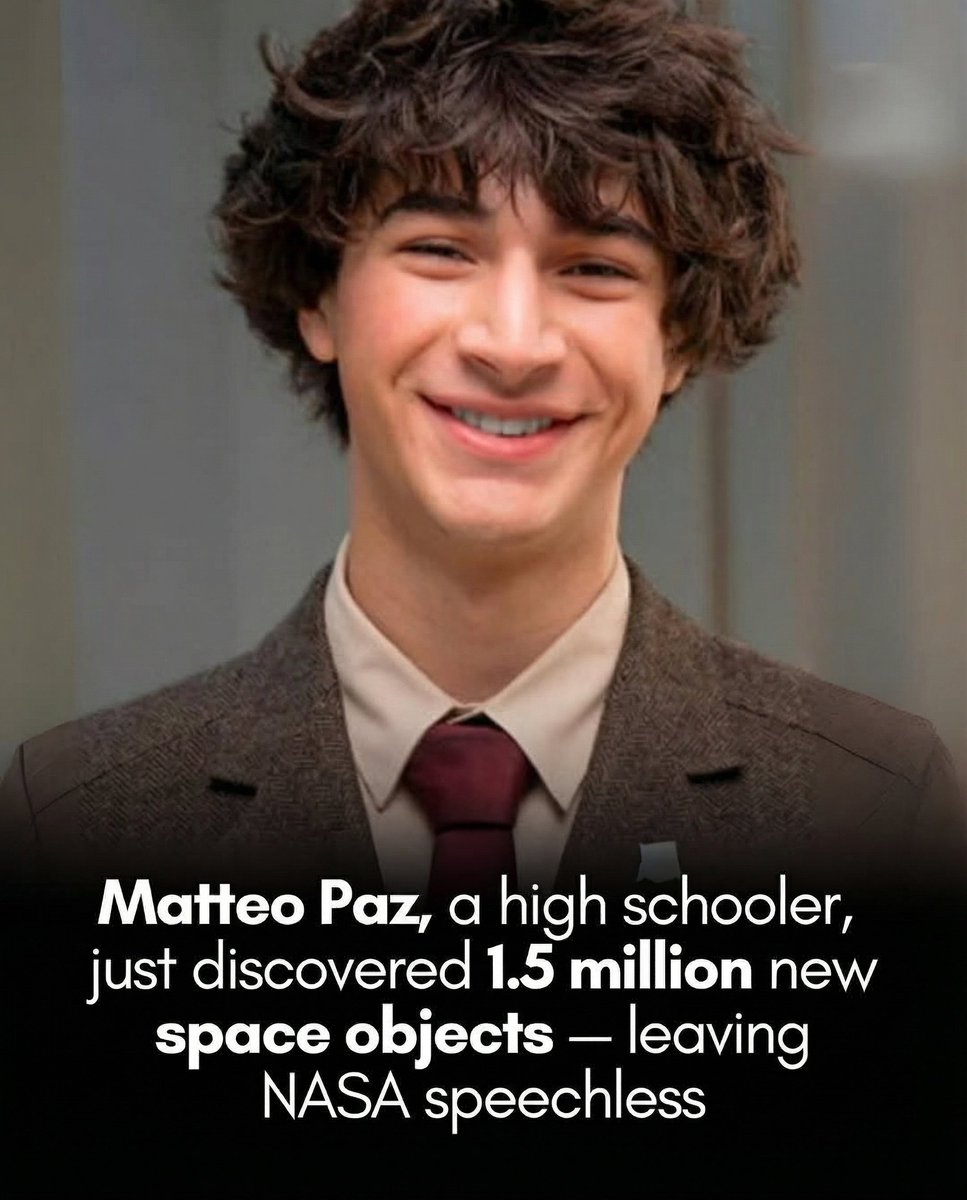
🚨 A student in the US just discovered MILLIONS of new space objects.
The astronomy world was recently shaken by a discovery from an unexpected source: a teenager still in high school. Matteo Paz, a student from Pasadena, utilized archival data from NASA’s retired NEOWISE mission to bring 1.5 million invisible cosmic objects into the light.
During a stint at Caltech’s Planet Finder Academy, and mentored by astrophysicist Davy Kirkpatrick, Paz took a novel approach to data analysis. He built a unique machine learning model capable of sifting through a staggering 200 billion infrared records. In a span of only six weeks, his AI detected subtle patterns that human analysts had missed, identifying everything from distant quasars to exploding supernovas.
Paz’s findings were so robust that they earned him a spot in the prestigious The Astronomical Journal and a position as a research assistant at Caltech. His work does more than just populate star maps; it provides specific coordinates for the James Webb Space Telescope to investigate further. This breakthrough highlights a growing trend where fresh perspectives and AI tools allow young researchers to make historic scientific impacts from the classroom.
138
27 Dec 2025
The behind-the-meter transition I wrote about two weeks ago — now in the FT. The supply story is clear. The strategic question: what happens when surplus capacity turns energy consumers into grid actors?
👉 x.com/mariothomas/status/200…
27 Dec 2025

Data centres turn to aircraft engines to avoid grid connection delays ft.trib.al/ReD4Ewd
1
330
19 Dec 2025
This mirrors what I've been hearing across industries. The question "Do you actually need generative AI?" isn't contrarian anymore, it's becoming standard due diligence. More on what this means for Boards in my next article.
19 Dec 2025

Exclusive: Salesforce says trust in generative AI has declined.
Read more from @AaronpHolmes and @KevKubernetes 👇
thein.fo/3MPLLPl
95