
Assistant prof at UT Austin Finance (on leave), currently at Yale. Interested in household, public, and entrepreneurial finance, aguardiente de agave
Joined June 2013
- Tweets 200
- Following 1,110
- Followers 1,172
- Likes 1,572
Photos and videos
Pinned Tweet

21 Oct 2024
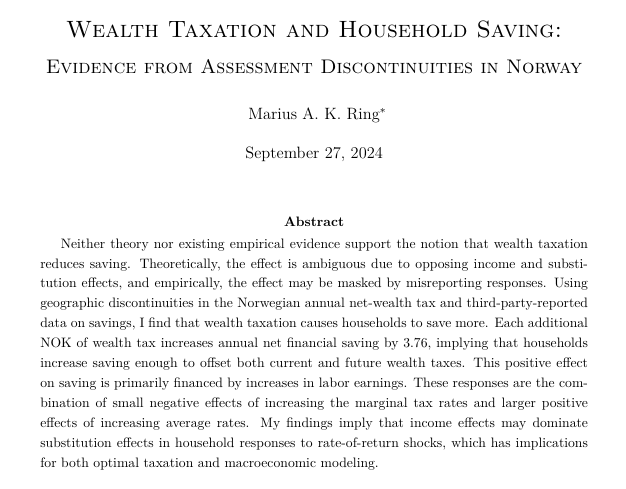
Very happy to see that my paper on the effects of wealth taxation on saving has found its new home. Short summary thread below. Special thanks to @DimitrisPapan20, @AnthonyDeFusco, @ProfNoto for bearing with me while I turned a research idea into a JMP!
18 Oct 2024

New paper from @mariusring using Norwegian data shows that a tax on wealth may cause households to save *more*. 1/3
👇
3
8
94
21,196

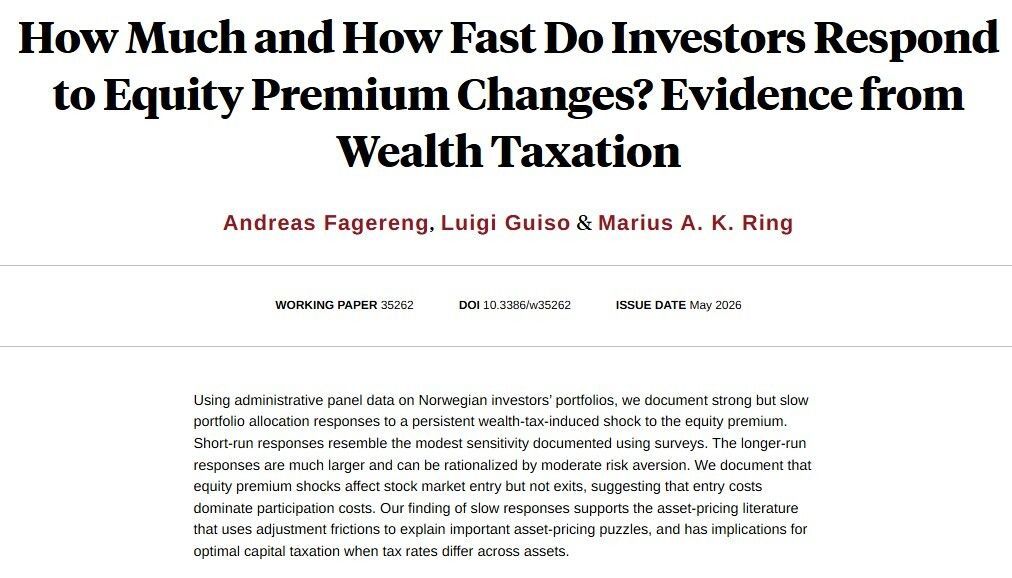
Documenting strong but slow portfolio responses to a wealth-tax-induced shock to the equity premium that are consistent with adjustment frictions and moderate risk aversion, from Andreas Fagereng, Luigi Guiso, and @Mariusring nber.org/papers/w35262
1
17
3,479
Marius Ring retweeted
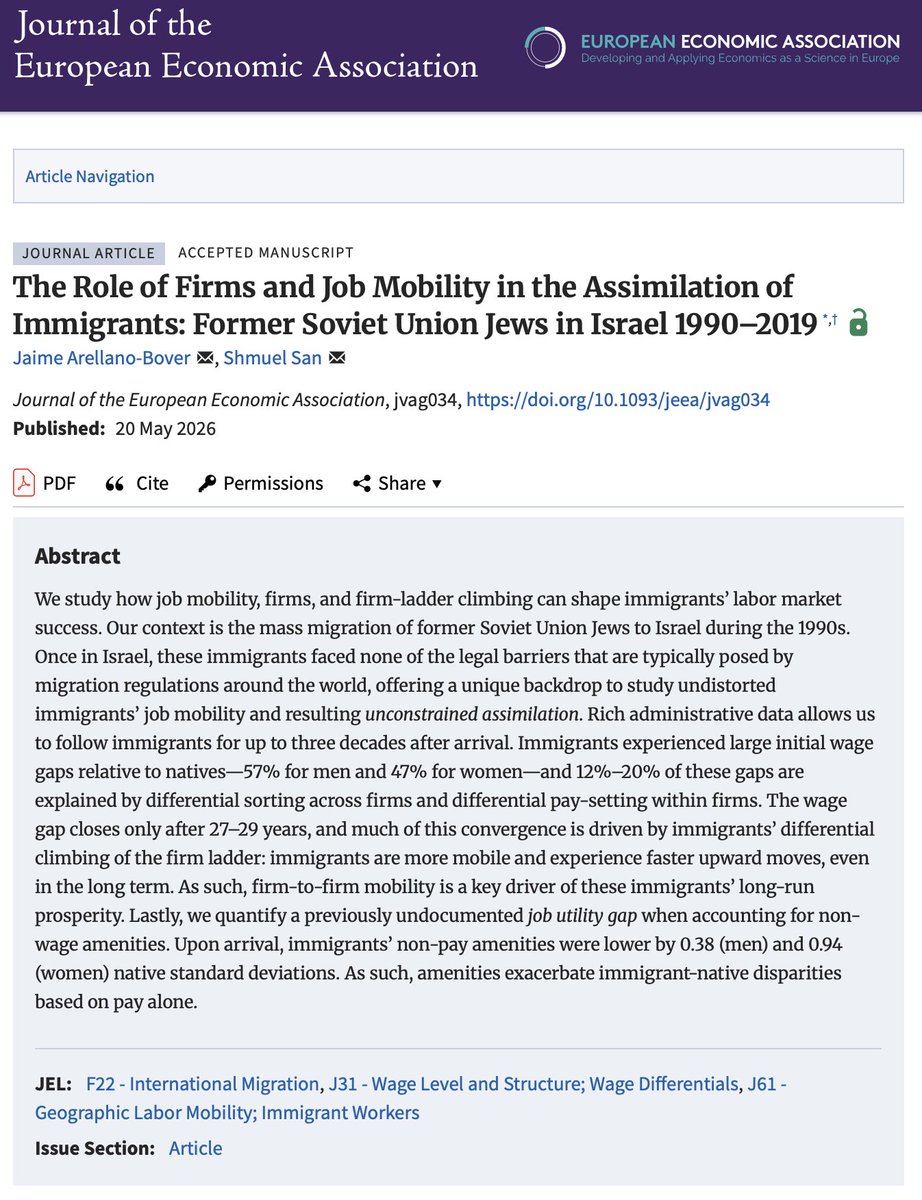
At @SOLE_Labor_Econ 2019, @san_muly and I met for the first time. Both graduate students, both with a JMP about first jobs.
We started working on our paper on FSU immigrants and firms in Israel shortly after.
7 years later it is wonderful to see it come out @JEEA_News 🙏
1/3👇
5
12
86
5,632
Marius Ring retweeted

May 9
I’m sure I’m not the first one to say this, but Sergio Correia deserves a prize for his service to the profession. I bet if we added up just the amount of hours that reghdfe has saved economists since it came out, his contribution would be in the top 10 for applied research.
1
15
143
10,941
Apr 25
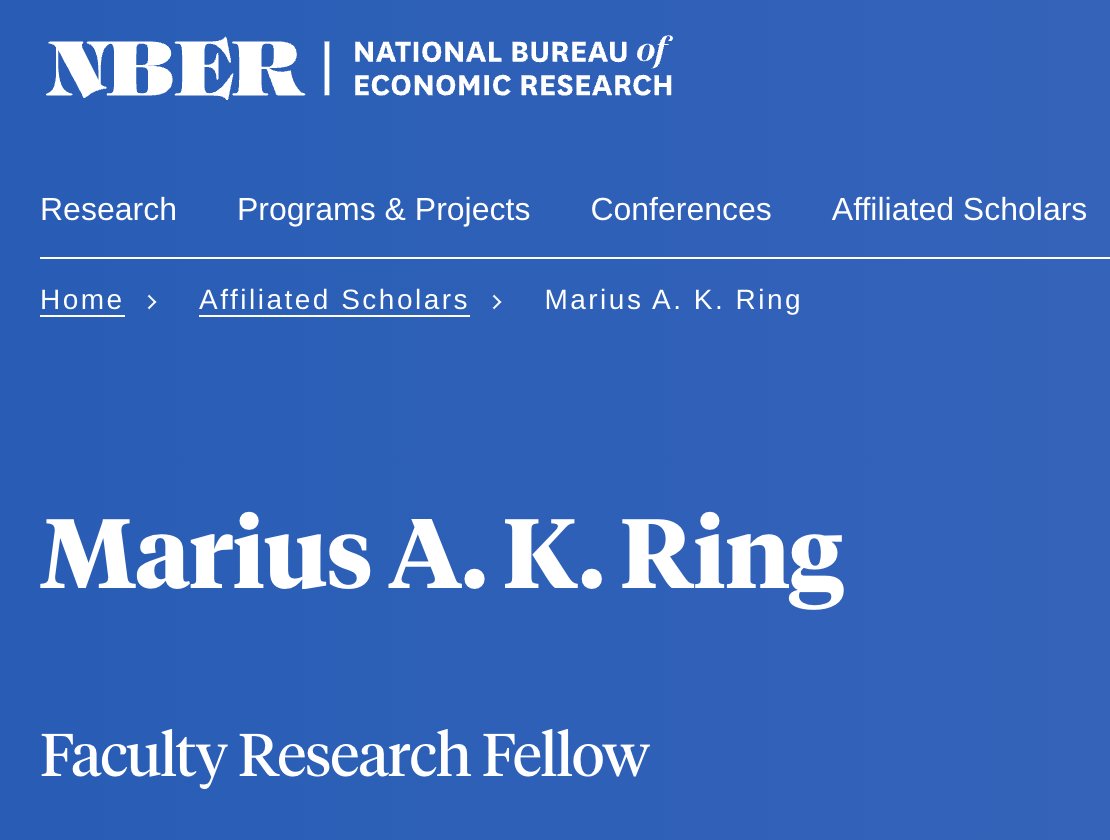
I'm very excited to join the NBER as a Faculty Research Fellow in the Public Economics program! I'm continuously inspired by the great economists I get to interact with at the public meetings. Many thanks to those who nominated me! @nberpubs
nber.org/news/nber-appoints-…
3
61
2,870
Marius Ring retweeted

Apr 10
Now that there's a $100 ChatGPT Pro tier, it's a no brainer for any economist to choose ChatGPT over Claude at EVERY price point.
1. $100/mo now gets you access to Pro in the web UI, which is invaluable for academic work. See x.com/aniketapanjwani/status… for how to optimally use Pro. No Anthropic model compares
2. $20/mo usage with Claude Code is a joke. $20/mo usage with Codex is limiting but not that far off of $100/mo Claude Code usage. I've myself experienced getting capped within an hour at $100/mo with Claude Code with normal usage. With $100/mo with Codex, for the typical economist's usage, you'll never hit 5 hour or weekly limits.
3. GPT 5.4 itself is a much better model than Opus 4.6 for almost everything economists would care about. CC has a better developed plugin ecosystem, subagents in CC work better IMO, and CC IMO is by default a better writer. For anything else - helping you understand papers, write code, plan out structural estimation, think through identification arguments, choose between estimators - I'd prefer Codex.
4. Whenever OpenAI has an outage, they reset usage for everyone, and they keep extending the length to which you get double usage from your subscription (now until end of May!). Anthropic is crunched heavily for compute and seems to be both explicitly (
x.com/trq212/status/20372546…) and perhaps surreptitiously (x.com/om_patel5/status/20417…) trying to restrict their compute provision.
5. The Codex Desktop app is hands down the best interface for agentic coding right now. The Claude desktop app is probably the worst way to use Claude Code (go to /r/claudecode to read about all the bugs people encounter). There's a dearth of educational material about the Codex Desktop App though (which I will be solving soon)
I walk through each of these points in more detail in this YouTube video: youtu.be/_oKPa8_7w3Y?si=1Bru…
So, what are the switching costs from Claude Code to Codex?
> The models feel different/act differently. You have to get used to it.
> Skills are an open format, so you can just copy all your skills over to ~/.agents/skills from ~/.claude/skills . There are some CC specific skill features which don't port over 1 to 1 to Codex.
> Subagents are configured differently and act differently in CC compared to Codex.
> Hooks are experimental in Codex and you have fewer options of harness actions onto which you can configure hooks.
I'd say if you haven't yet started with these tools, choose Codex for sure.
If you're hitting your Claude Code session limits regularly, then also switch to Codex for sure.
If you're not hitting your session limits, or you have a $200 budget, I'd recommend getting a $20/mo Codex sub and just try it out/feel it out.
Codex and CC pair well together anyway, for example by having one write a plan/code and having the other review the plan/code.
I have Codex at a $200/mo subscription and CC at a $100/mo subscription - that works well for me, I use Codex 80% of the time and CC 20% of the time.

We’re updating our ChatGPT Pro and Plus subscriptions to better support the growing use of Codex.
We’re introducing a new $100/month Pro tier. This new tier offers 5x more Codex usage than Plus and is best for longer, high-effort Codex sessions.
In ChatGPT, this new Pro tier still offers access to all Pro features, including the exclusive Pro model and unlimited access to Instant and Thinking models.
To celebrate the launch, we’re increasing Codex usage for a limited time through May 31st so that Pro $100 subscribers get up to 10x usage of ChatGPT Plus on Codex to build your most ambitious ideas.
7
24
354
69,322
8 Dec 2025
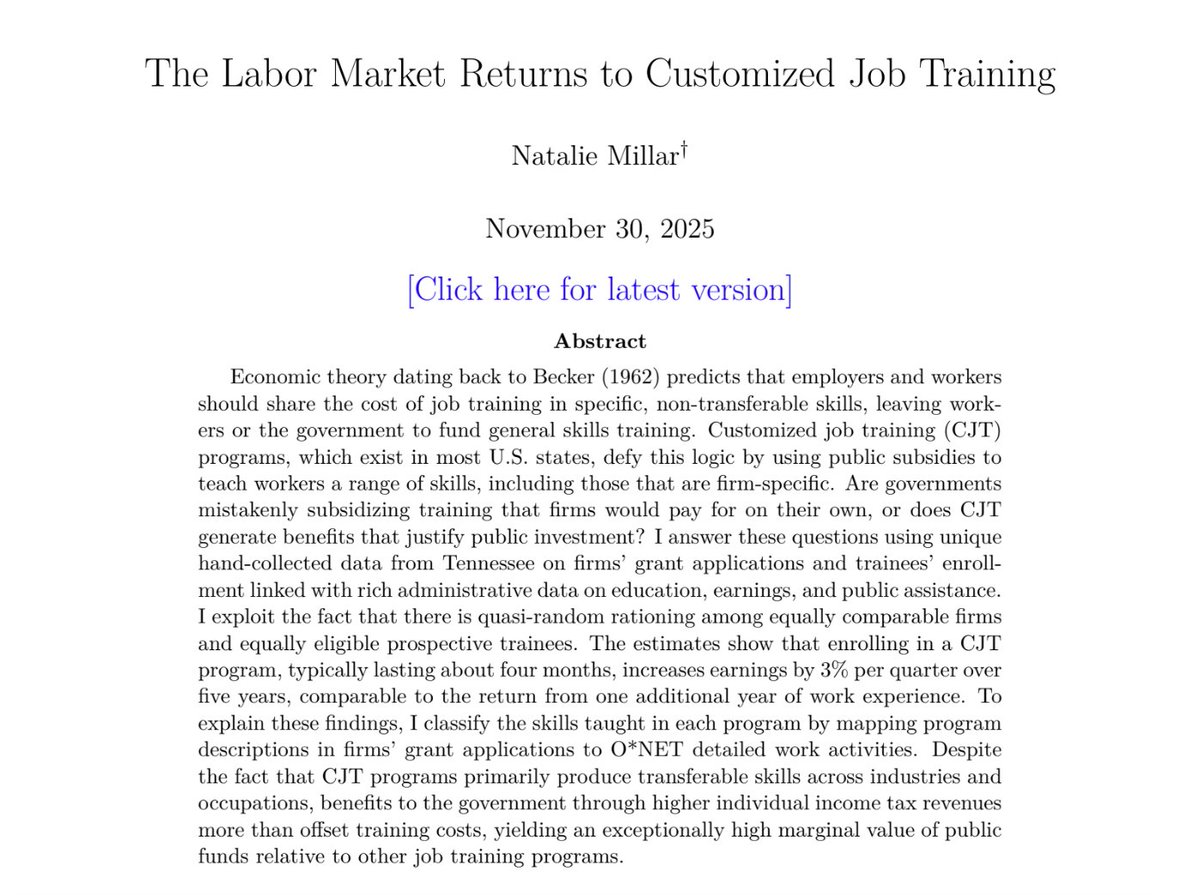
Very interesting paper on positive fiscal externalities from subsidizing job training programs
8 Dec 2025

My #EconJMP, “The Labor Market Returns to Customized Job Training”, examines how subsidized firm training that aligns skill supply with skill demand affects workers and whether subsidies generate benefits that justify public investment.
Website: nataliemillar.net/
1
11
3,147
Marius Ring retweeted

28 Nov 2025
I’m on the #EconJobMarket! 🎓
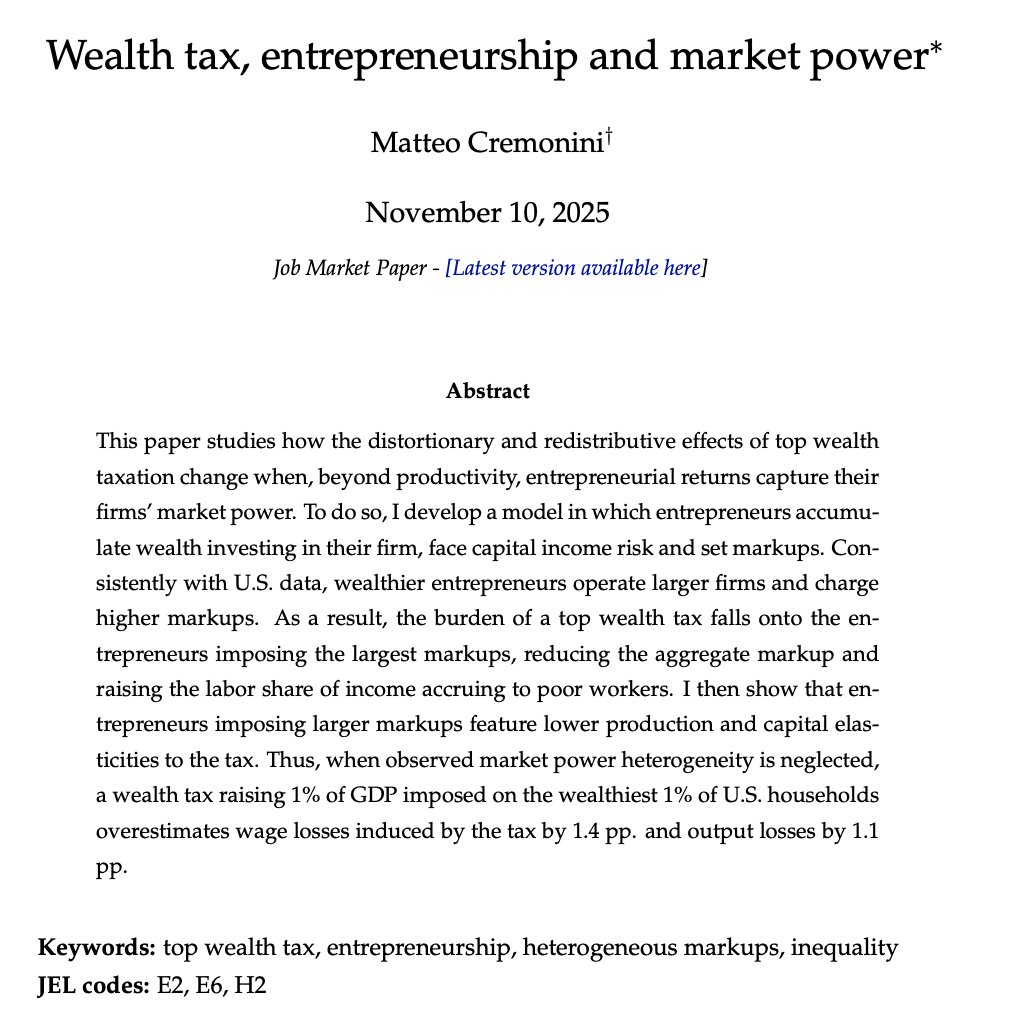
The wealthy earn high returns from their entrepreneurial activities, should we tax them?
My JMP shows a top wealth tax creates smaller distortions and stronger redistribution when high returns reflect market power, not just productivity.
👇 More
4
30
156
57,614
14 Oct 2025
Finance dept at BI Norwegian Biz School in Norway is hiring! Excellent department that spans many fields, co-located w/ a great econ dept, attractive teaching load, unique admin data opportunities, and v. nice place to live. Job post below
ssrn.com/index.cfm/en/janda/…

1
3
20
1,319
Marius Ring retweeted

8 Oct 2025
We are officially on the market this year with 3⃣ positions! Come work with us in 🇨🇦!
I am happy to talk to anyone about our department, DMs open!
Please share widely and let your students know.
PS: You can visit our department if you are coming to this year CSMG, Nov 14-15!
8 Oct 2025

🚨We are Hiring🚨
We have 3⃣ tenure-track positions:
• 2 Open-Field
• 1 linked to our Masters in Financial Economics (open to various fields)
Come work with us in 🇨🇦!
📄 Open-Field: uwo.ca/facultyrelations/care…
📄 MFE Position: uwo.ca/facultyrelations/care…
1
33
78
35,373
Marius Ring retweeted

29 Sep 2025
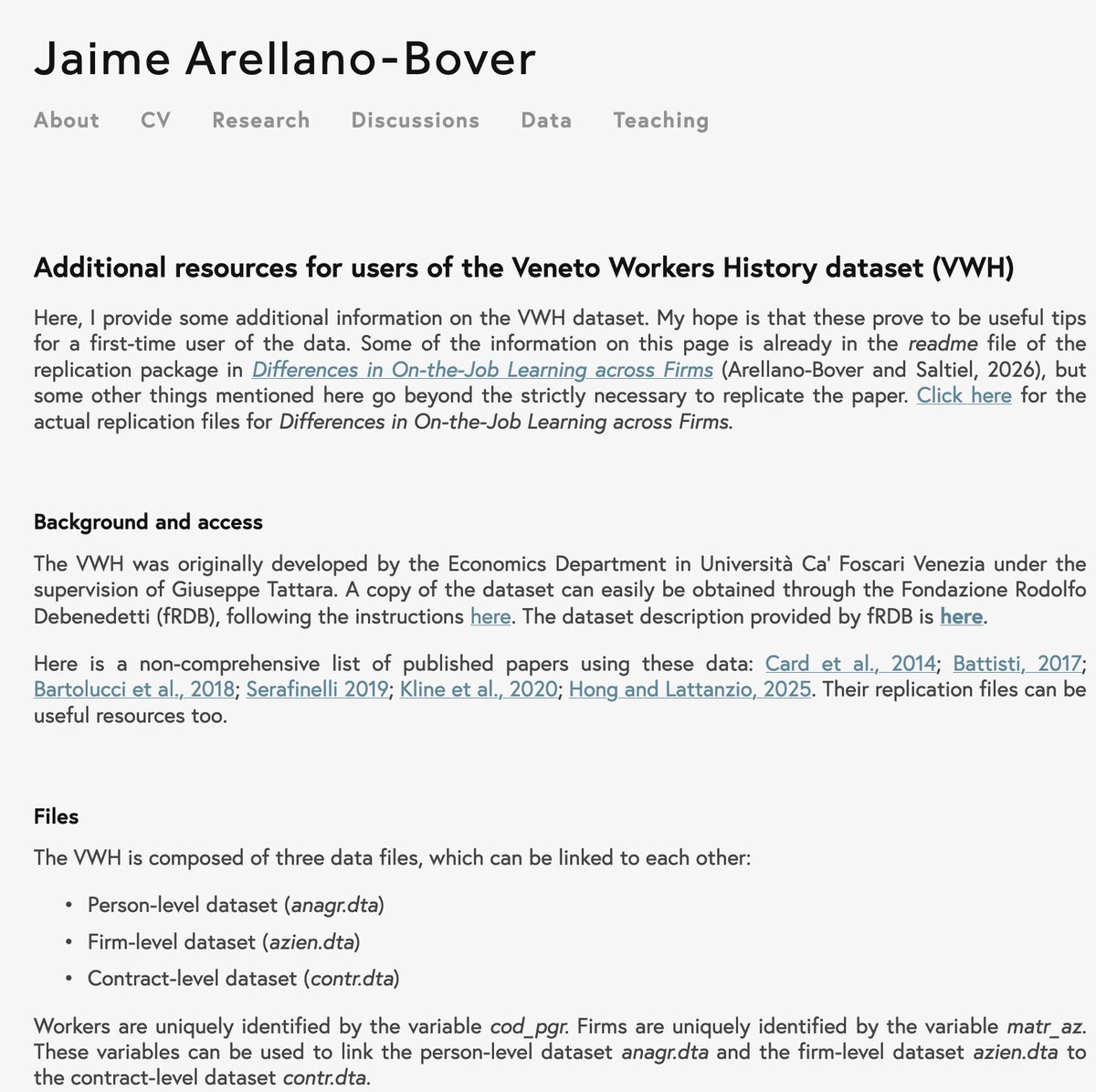
The Veneto Workers Histories (1975–2001) is probably the easiest-to-access population-level employer–employee dataset there is.
I’ve put together a page with practical user tips beyond the sparse official docs.
1/3 🧵

2
10
46
5,747

New CEPR Discussion Paper - DP20632
Insuring Labor Income Shocks: The Role of the Dynasty
@AndreasFagereng, Luigi Guiso @EIEF_Rome, Luigi Pistaferri @SIEPR @Stanford, @mariusring @UTexasMcCombs @UTAustin
ow.ly/eQFp50WUmJm
#CEPR_HF #EconTwitter
5
7
2,171
Marius Ring retweeted

Over the entire past century, Switzerland's wealth was worth ~5x national income. Now wealth is worth 8x NNI. In the July issue, by Enea Baselgia (@eneabaselgia) and Isabel Z. Martínez (@IZMartinez86) zurl.co/Wmbup
6
20
2,818
Marius Ring retweeted

19 Aug 2025
🧵1/11 My paper "Default Options and Retirement Saving Dynamics" is forthcoming in the AER!
Auto-enrollment is often hailed as behavioral economics' greatest policy success and now covers 100M workers worldwide.
But: does it actually increase lifetime wealth and welfare?
2
18
115
15,554
Marius Ring retweeted

6 May 2025
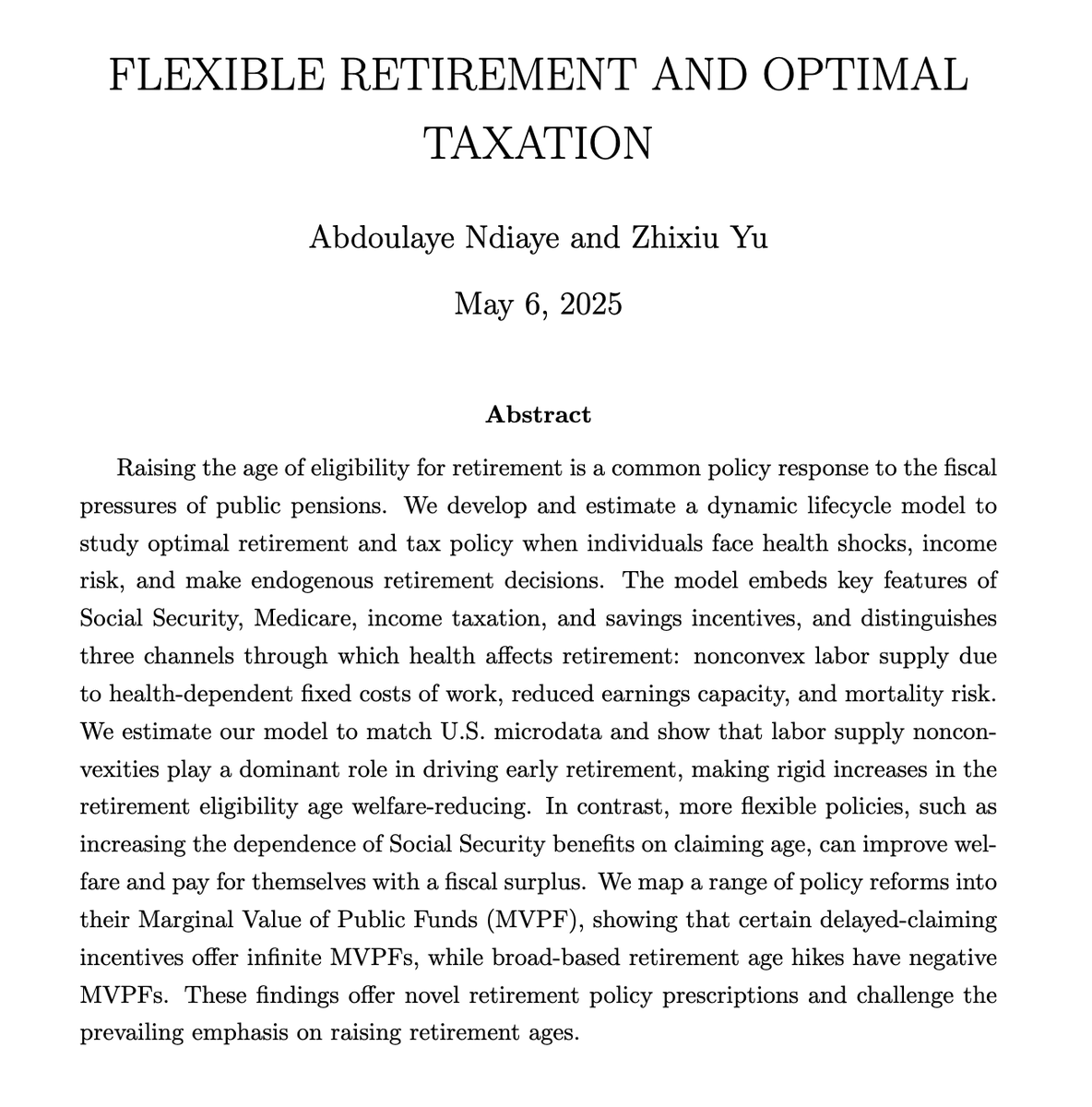
A few days ago, I told you about the public finance research of the newest John Bates Clark medalist 🏅 Stefanie Stantcheva. There are important open questions in that research, such as, what are the best retirement policies?
My paper with Zhixiu YU answers that question. A 🧵
22 Apr 2025

Stefanie Stantcheva just won the John Bates Clark Medal. 🏅 here her greatest hits in public finance research explained
5
31
151
50,401
Marius Ring retweeted

18 Apr 2025
Forthcoming in AEJ: Applied Economics: "The Long-Term Impacts of Mixing the Rich and Poor: Evidence from Conscript Dorms" by Elias Einiö. aeaweb.org/articles?id=10.12…
27
91
14,899
Marius Ring retweeted

24 Mar 2025
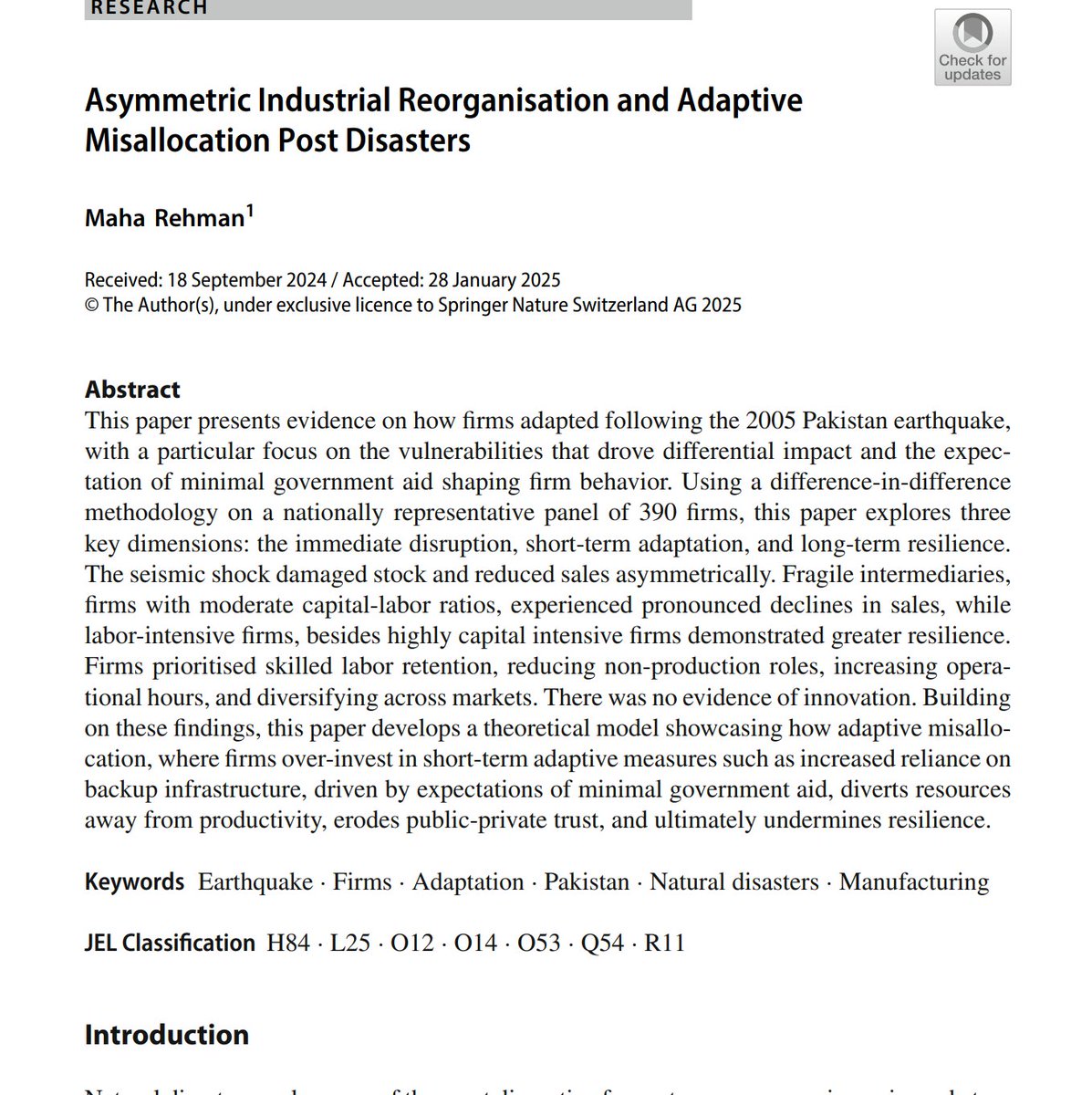
My new paper, now in print, examines how the 2005 Pakistan earthquake triggered firm-level over-adaptation in response to policy uncertainty. Fragile intermediaries, dependent on both capital and labour, suffered the greatest productivity losses as firms, operating amid weak state support, rationally prioritised short-term survival over long-term investment. (1/n)
Link: link.springer.com/article/10…
2
7
23
24,926
5 Mar 2025
New pub!🚨 (i) Income effects rather than intertemporal substitution (avoidance through giving quicker) dominate giving responses to wealth taxes. (ii) Studying bunching at inc. tax deduction cap, we find modest own-price elasticity, invariant to income

A 1% wealth tax reduces charitable giving by 26%, inconsistent with a strong acceleration effect. Just Accepted new paper by Marius A. K. Ring (@mariusring) and Thor O. Thoresen zurl.co/FKPf5
1
6
43
8,568
5 Mar 2025
Some details: We use comprehensive 3rd-party-reported data on charitable giving. For the wealth tax part, we exploit changes to assessment rules after 2012 This reform affected both the marginal and average tax rates dep. on ex-ante taxable wealth, facilitating a decomposition.
2
347
Marius Ring retweeted

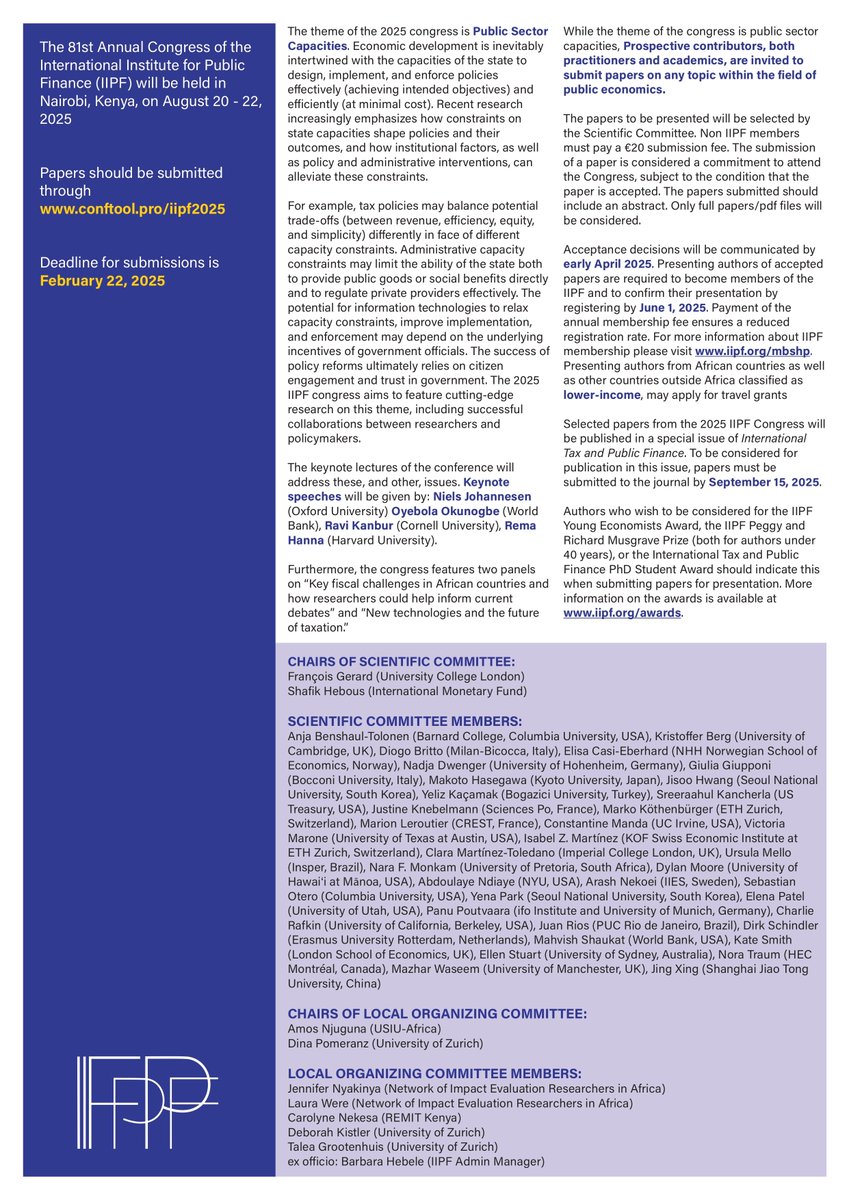
⌛️Reminder to submit by the weekend 👇
#IIPF2025 congress organizers @fgerard_BE @ShafikHebous @DinaPomeranz @dr_njuguna look forward to your papers!

Deadline Extended – Submit Your Paper for the 81st Annual #IIPF Congress! Theme: Public Sector Capacities
New Deadline: February 22, 2025
Don’t miss your chance to present your research!
Submit now:🔗conftool.pro/iipf2025/
Visit Website:🔗usiu.ac.ke/iipf/index
#IIPF2025

6
4
5,089
Marius Ring retweeted

28 Jan 2025
🚨Updated🚨
Check out the substantially revised version of my JMP👇
28 Jan 2025

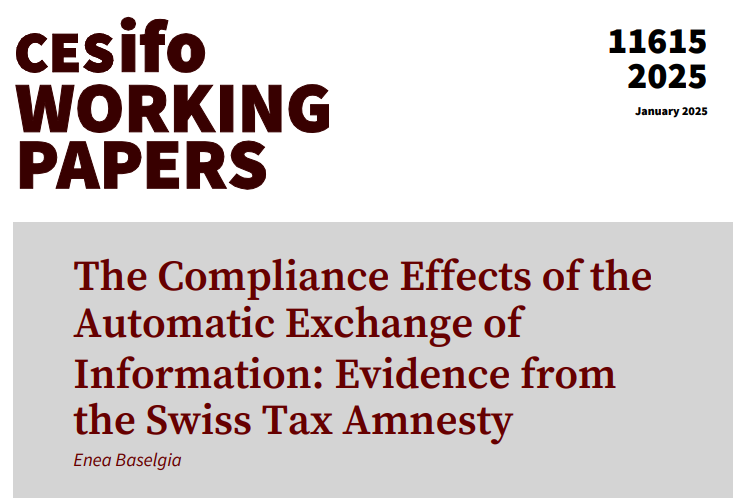
New Paper Alert❗️"The Compliance Effects of the Automatic Exchange of Information: Evidence from the Swiss Tax Amnesty" by @eneabaselgia
Find out more in the latest CESifo Working Paper! 🔗cesifo.org/en/publications/2…
📚More cutting-edge research:cesifo.org/en/publications/c…
3
18
1,560