
Joined December 2020
- Tweets 261
- Following 582
- Followers 177
- Likes 1,066
11 Photos and videos







Pinned Tweet

Jan 2
I started from 0 in the Web3 space just 4 months ago.
The first 2 months I wasn’t serious — I was watching videos and reading books/articles, but progress was slow and unfocused. I didn’t manage to gain much real knowledge despite spending time on it.
Then everything changed. The last 2 months - especially after starting @0xSimao 's challenge, things got heated. I found direction, focus & motivation, and learning started to flow so much faster.
Because of that focus and consistency, I managed to find my first 2 bugs: 1 High & 1 Medium
Not mind-blowing but huge for me. Proof that focus consistency motivation = real progress.
2025 taught me a lot but in 2026, my goals are VERY high. 🫡
10
2
110
6,163

Today, we're announcing that Immunefi is partnering with @code4rena to onboard their bug bounty customers to our platform following Code4rena's decision to wind down operations.
Code4rena played a huge role in shaping crypto security, and they deserve real recognition. As they wind down, our focus is to make sure every protocol continues to receive top-tier security.
We're working hand-in-hand with the Code4rena team to make the transition as smooth as possible.
Protocol teams onboarding to Immunefi will get:
* Access to the largest and most elite whitehat community in crypto
* Professional triage and mediation, battle-tested across $135M in bounties paid
* Dedicated migration support to port over scope, rules, and reward structures
And to every C4 warden: we want you here. You've been the backbone of one of the most respected security communities in crypto, and your work has made this industry materially safer. Come join us in continuing that mission. We're committed to picking up the banner Code4rena raised around improving the whitehat experience.
A sincere thank you to the Code4rena team for trusting us to carry this forward, and for putting their customers' security first throughout this process. The industry is better for what they built.
Onward.
May 13

An important update from the C4 team. 🧵
39
55
366
28,196
Mathriel retweeted

May 13
An important update from the C4 team. 🧵
140
41
545
131,881
Mar 31
HUGE!!!
Mar 31

This one has a bit of story behind it.
Less than 12h after the report was submitted, it was confirmed by the team. The team didn’t even try to argue about how catastrophic the impact was. They were fast responsive and professional and transparent with their users, something I really admired. They simply straight told me because of a large hack last year that they suffered from they’re struggling financially and they’re letting a lot of their people go. The direct impact was around 7 million dollars. They were honest and I like honesty so instead of the normal 700k bounty, I accepted the 300k, I don’t regret my decision and I hope the project bounces back even stronger during these hard times, I admire them and their security standards and I wish them the best.
1
131
Mar 11
"Price oracle issuses are OOS" results to $26M in liquidations
Mar 11

🚨 AAVE ORACLE GLITCH TRIGGERS $26M IN WRONGFUL LIQUIDATIONS
A pricing oracle error on Aave caused about $26million in wstETH positions across 34 accounts to be unfairly liquidated after the system reported an incorrect exchange rate, with affected users set to be compensated.

7
261
Mar 2
I won a giveaway from @ValvesSec. Thank you 🫡
Everyone should follow and support them, the same way they support the SRs.
14
394
Mar 2
Wowwww!!! That's amazing, I've believed in those guys from the first day. Thank you for the win!!! 🫡

6
227
Mathriel retweeted

Feb 27
🚨FREE AUDIT GIVEAWAY🚨
If you're building a Solidity protocol and want to protect your protocol and the users that trust you, you're in the right place.
We're exclusively opening 1 slot for a FREE audit.
• Your protocol should be solidity-based
• The codebase contains fewer than 1,000 nSLOC.
✉️ How to apply
Like this post, DM us on X, or reach out via Telegram.
🎁 We're also running a giveaway
100 USDC is going to 2 winners who follow us, repost and like this post.
This initiative ends in 72 hours, after which we'll pick all the winners at random.
Good luck everyone! 🍀
11
23
48
5,975
Feb 16
The workload outside of web3 has been crazy this past week - so much on my plate. Still grinding, staying consistent, and learning every single day. Next week we’re coming back with 100% power 💪. I truly believe in the topic I’ve committed to and the results will show soon 🤞 @0xSimao
1
11
531
Feb 11
No words!!! Congrats man 👏

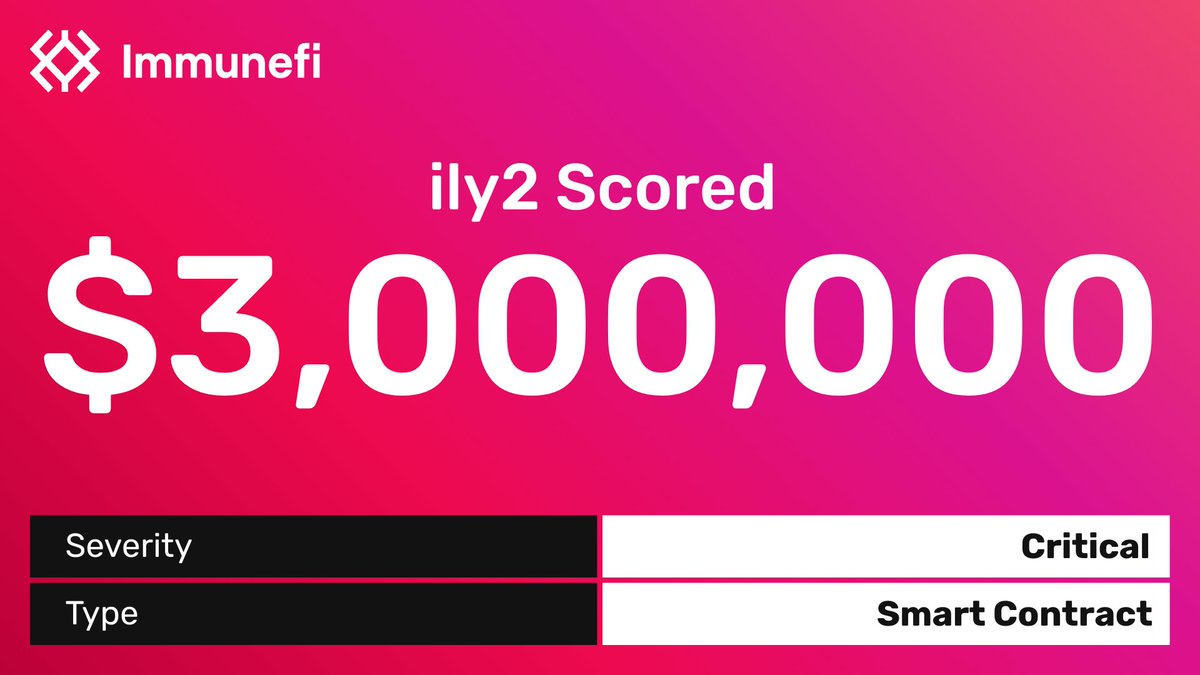
Security researcher ily2 has just earned a staggering $3,000,000 from submitting a critical smart contract bug via Immunefi.
That's the largest single payout in web3 security in recent memory.
In total, he's submitted 3 reports. All 3 were paid. 100% accuracy.
His leaderboard update is coming soon, but you can pledge IMU to him now and earn when he finds the next one:
immunefi.com/pledge/ily2
14
439
Feb 6
Decided to deep dive into one feature and take it slow - bug bounty really isn’t a sprint, it’s a marathon. It feels way different from Contests. Honestly? I’m enjoying this style more.
The only downside is you never know if you’ll find something, but I’m trying to keep the mindset that it’s just a matter of time before that first win 🫡
Bug hunters think long term it’s months of focus. @0xSimao
1
15
760
Feb 5
I believe in those guys and I wish them a great success @Vesko_210 @Merulez99
Feb 5
🚨 Excited to launch Valves Security! 🛡️
Our mission is simple: stop the theft of millions of dollars every year.
We’re putting all our effort into protecting protocols, preventing exploits, and losses for innocent users and protocol teams.
1
3
439
Feb 4
In the past couple of days I’ve been digging deeper into blockchain infrastructure. I can’t even begin to imagine how much there is to learn in this field, it’s unbelievable... and so interesting! @0xSimao
1
6
366
Feb 3
Big Alpha Drop from the Magee!!! @WhiteHatMage
Feb 3

I've created a site to share some ideas.
My first post is about being a professional whitehat, and how I evaluate potential rewards to decide where to hunt.
whitehatmage.github.io/posts…
3
625
Feb 1
Still reading through a lot of code and haven’t found a bug yet, but learning tons along the way. A few beginner tips that helped me:
Focus on one type of flow at a time and study how it works and if there are any pitfalls
Take notes and stay organized
Read write-ups and reports to see how others approach targets
Patience persistence! Let’s see where this journey goes @0xSimao
1
14
711
Jan 30
Bug bounty feels a lot slower - there’s way more lines of code, flows and contracts to go through than contests. It’s a very interesting approach, but you have to dedicate much more time to see any results. Let’s see where this journey goes @0xSimao
2
148
Jan 30
Wow, very interesting finding by @0xSimao
Jan 30

Welcome back to Sherlock’s Vulnerability Spotlight, where we highlight an impactful vulnerability uncovered during a Sherlock audit.
This week, we examine a signature malleability vulnerability found by @0xSimao in the @crestalnetwork Contest. This vulnerability has already been fixed following the contest, far before the launch of mainnet contracts.
Summary of the Vulnerability
Several “WithSig” entrypoints recover the signer from an EIP-712 digest that only commits to:
- projectId
- base64RecParam / base64Proposal
- serverURL
The typed data does not include other calldata inputs that materially affect execution, such as:
- tokenAddress (determines what token is charged and the cost mapping used)
- tokenId (which NFT gets consumed / marked as used)
- privateWorkerAddress (affects which worker the request is privately routed to)
Attack Steps
1) User produces a valid signature for a deployment request
The user signs getRequestDeploymentDigest(projectId, base64Proposal, serverURL) (only these 3 fields)
2) Signature becomes observable (ERC-4337 relayer/bundler mempool)
When routed via an AA service (e.g., Biconomy), user operations are commonly broadcast to a bundler mempool, making the signature available to third parties monitoring it.
3) Attacker re-submits onchain with malicious unsigned parameters
Because the signature does not commit to additional calldata:
Token route:
attacker calls createAgentWithTokenWithSig(...) with:
- same projectId/base64Proposal/serverURL/signature
- but a different tokenAddress (still “enabled” and possibly more expensive)
- and/or a different privateWorkerAddress (invalid or attacker-chosen)
NFT route:
attacker calls createAgentWithSigWithNFT(...) with:
- same signed fields
- but a different tokenId (any NFT the user owns), consuming/locking it via nftTokenIdMap[tokenId] = Pickup
- and/or a different privateWorkerAddress, forcing a wrong/censoring worker path
Root Cause
Signed message is incomplete:
the EIP-712 deployment request struct only includes (projectId, base64RecParam, serverURL) and omits execution-critical inputs like tokenAddress, tokenId, and privateWorkerAddress.
Digest reuse across multiple entrypoints:
multiple “WithSig” functions rely on getRequestDeploymentDigest() while taking additional calldata, enabling parameter substitution and even cross-function replay (same digest, different semantics).
What’s the Impact?
Forced/incorrect payments:
in createAgentWithTokenWithSig, attacker can select a different tokenAddress (among enabled tokens) so the user pays a cost they did not agree to.
Persistent DoS / censorship:
- attacker can lock an unintended NFT tokenId as “used” (Status.Pickup), preventing legitimate future use
- attacker can supply malicious privateWorkerAddress to misroute or break private deployments, harming liveness and enabling worker censorship incentives
User intent violation:
users can be forced to create agents with parameters they never authorized, breaking trust assumptions around signature-based flows.
Mitigation
Sign all parameters that affect execution, at minimum:
- privateWorkerAddress
- tokenId
- tokenAddress
We are proud to have helped secure @crestalnetwork through this discovery.
When it absolutely needs to be secure, Sherlock is the right choice.
6
605
Jan 28
Spent the last couple of days deep-diving into past bounty write-ups and lessons from impactful bugs - starting to really get the program I’m hunting on. It’s super interesting looking for bugs that actually matter in real deployed systems - everything feels so different @0xSimao
1
11
487
Jan 26
Picked an interesting protocol type the last two days and found a target to hunt bugs on - way more confusing than your typical “git clone the repo” contests style. All the forks & stuff made it a real challenge 😅 @0xSimao
9
549
Jan 24
First day switching to bug hunting - I researched different types of protocols because a brutally good bug hunter once advised that it’s always good to pick something interesting to you so you don’t get bored. I’ve started compiling a list of promising targets, which I’ll finish tomorrow, and then I’ll decide what I want to focus on hunting. @0xSimao
9
444
Jan 23
Today I’m finishing the Contest. I didn’t manage to find a solid attack path that I can prove, and time felt a bit tight for me. Starting today, I’m taking on a new bug bounty approach suggested by @WhiteHatMage - I’ll be diving deep into this process and seeing how it goes. Let’s get to work! @0xSimao
4
19
987