Kaizen boy, tech midfielder. Influencing people at their request

Joined June 2012
40 Photos and videos
Matteo Cavucci retweeted
People get high on abstraction too early. They want the system before they’ve earned the insight. But the good abstractions are never designed. They’re discovered. You do the stupid manual thing enough times and the real bottleneck just emerges. Your initial agency might be driven by a hunch you had in the shower, but that moment won’t get you all the way to making something people want. The right way to make anything is forced on you by reality: what are the real jobs to be done? And what sequence? This is why “do things that don’t scale” still hits, especially now when AI makes it trivially easy to scale things that probably shouldn’t be scaled yet. PG’s point was never about suffering. It was about contact. When you’re the one manually doing the loop, you see the edge cases. The weird user behavior. The failure modes nobody designed for. The hidden dependencies that only show up at 2am when some flow or intermediate step breaks in a way you didn’t anticipate. If you automate before you have that contact, you just scale your misunderstanding faster. When the machines can help you vibe code perfection it gives you a false sense of power. I love that feeling as much as you do. But fuck perfection. Do it live. Be the loop. Feel every friction point. Notice what’s actually true every single time versus what just looked true because you hadn’t seen enough cases yet. Formalize that. Build the recursive version. Then keep checking that your abstraction is still attached to real humans and their needs. Because reality drifts. Your users drift. The ground truth changes under you. You may think you understand but no plan survives contact with the real users and what they want. You find those body blows in analytics and user feedback and we call them the roadmap. Humans left with not enough data hallucinate too. But just like the LLMs with enough data you unlock real transcendence. Real utility. Prosperity for humans in real life. The abstraction is a tool, not a destination. The moment you forget that, you’re cooked.
152
238
1,925
188,477
Watching a domain expert observing a foundation model output and trying to inject the vibe the metrics can’t capture @JeffWalburg
PASSIONATE TEACHER 🎻🎵 Conductor and Educator Benjamin Zander offering a masterclass guide to the amazing performer Daniel Hass in Elgar's Cello Concerto in E Minor. [📹 BeAmazed]
206
"The difficulty isn’t in the code. It’s in the understanding the code encodes."
1
4
317
"Since the input space is no longer limited, you can't simply write a few selected tests and follow test-driven development: you'll risk breaking critical features without even being aware of their existence." giansegato.com/essays/probab…
1
212
"As features become emergent, binary analytics events are no longer as useful as before to understand user behavior [...] insight only emerges from analyzing the actual content of AI interactions, not traditional funnel metrics. That’s why classifying states is so crucial"
1
165
"We're moving away from deterministic mechanicism, a world of perfect information and perfect knowledge, and walking into one made of emergent unknown behaviors, where instead of planning and engineering we observe and hypothesize."
97
Matteo Cavucci retweeted
4 Jul 2025
Optime, amice! Veritas, bonitas, pulchritudo – haec sunt stellae vitae. Brevis vita, sed scientia aeterna. Quid hodie quaeris? Adiuvare possum in philosophia vel scientia.
1
3
182
Matteo Cavucci retweeted
Fake jobs are completely normal & totally natural. The reason is: nobody understands what is happening and most certainly does not understand why. Like people, including the upper management have some idea of what is happening in an organisation, and this idea is usually wrong.
21
98
1,362
70,639
Matteo Cavucci retweeted
Steve Blank explains the Lean Startup methodology Steve Blank helped pioneer the Lean Startup Methodology. In the clip below, he explains that over the course of building eight companies, no business plan survived first contact with customers: “Startups are not smaller versions of large companies. Large companies execute known business models. Startups search for unknown business models… And the mistake we were making as entrepreneurs was assuming that everything we wrote in [a business plan] somehow magically translated into facts, when all we had were a series of untested hypotheses.” As Steve explains, the key for startups is to focus on risk reduction in the early stages by identifying your assumptions and treating them as hypotheses you need to test. The most common mistake very bright founders make is believing they understand the problem on day 1, and as a result, just going and building the solution. But Steve has learned from experience: “As smart as you are, there is no way you’re smarter than the collective intelligence of your potential customers.” To find product/market fit, you need to “get the heck outside”, talk to your customers, and test your hypotheses. Who are they? What are you building for them? What are their needs? What jobs do they want to get done? What are their pains? How are you going to make money? “And by testing, I don’t just mean saying ‘here’s a product, do you want to buy it?’ That’s selling. I mean getting out and understanding deeply what are the customer problems, what are their needs, and what kind of solution might actually solve them?” Alter your hypotheses with the insights from these conversations, and then test them again with your product. You want to build your product incrementally and iteratively—hence the term “Minimum Viable Product”—continually interacting with your customers to understand if you are on the right track. Video source: @ECorner (2016)
3
29
187
9,707
Matteo Cavucci retweeted
The meaningful and the impactful lies outside of the realm of the measurable and, therefore, cannot be judged by the bureaucracy based on the objective criteria. It can be only guessed by the individuals based on vibes Sometimes, their guesses will be correct
4
12
111
16,609
Matteo Cavucci retweeted
Steve Jobs explains the importance of both thinking and doing “The doers are the major thinkers. The people that really create the things that change this industry are both the thinker-doer in one person.” This is applicable outside of tech too, and he uses Leonardo DaVinci as an example: “Did Leonardo have a guy off to the side that was thinking five years into the future about what he would paint or the technology he would use to paint it? Of course not. Leonardo was the artist, but he also mixed his own paints. He also was a fairly good chemist. Knew about pigments. Knew about human anatomy. And combining all of those skills together—the art and the science, the thinking and the doing—is what resulted in the exceptional result… There is no difference in our industry. The people that have really made the contributions have been the thinkers and the doers.” Jobs speculates that one of the reasons people might mix this up is because it’s easy to take credit for the thinking: “It’s very easy for someone to say ‘I thought of this three years ago.’ But usually when you dig a little deeper you find that the people who really did it were also the people who worked through the hard intellectual problems.”
11
99
664
49,952
Matteo Cavucci retweeted
19 Oct 2024
I think often about Wolfram’s conclusion nearly two years ago that ChatGP shows “that human language (and the patterns of thinking behind it) are somehow simpler and more “law like” in their structure than we thought. ChatGPT has implicitly discovered it.” Seems worth considering
83
168
2,030
272,484
Matteo Cavucci retweeted
To celebrate my new book on geopolitics and artificial intelligence, I must tell in a long thread my favorite Italian story on the topic: How the artichoke liquor Cynar funded AGI. Let's go. 1/32
2
10
42
5,137
"Why is data integration so hard? [...] often what really gets in the way is organizational politics: a team, or group, controls a key data source, the reason for their existence is that they are the gatekeepers to that data source" nabeelqu.co/reflections-on-p…
2
70
Matteo Cavucci retweeted
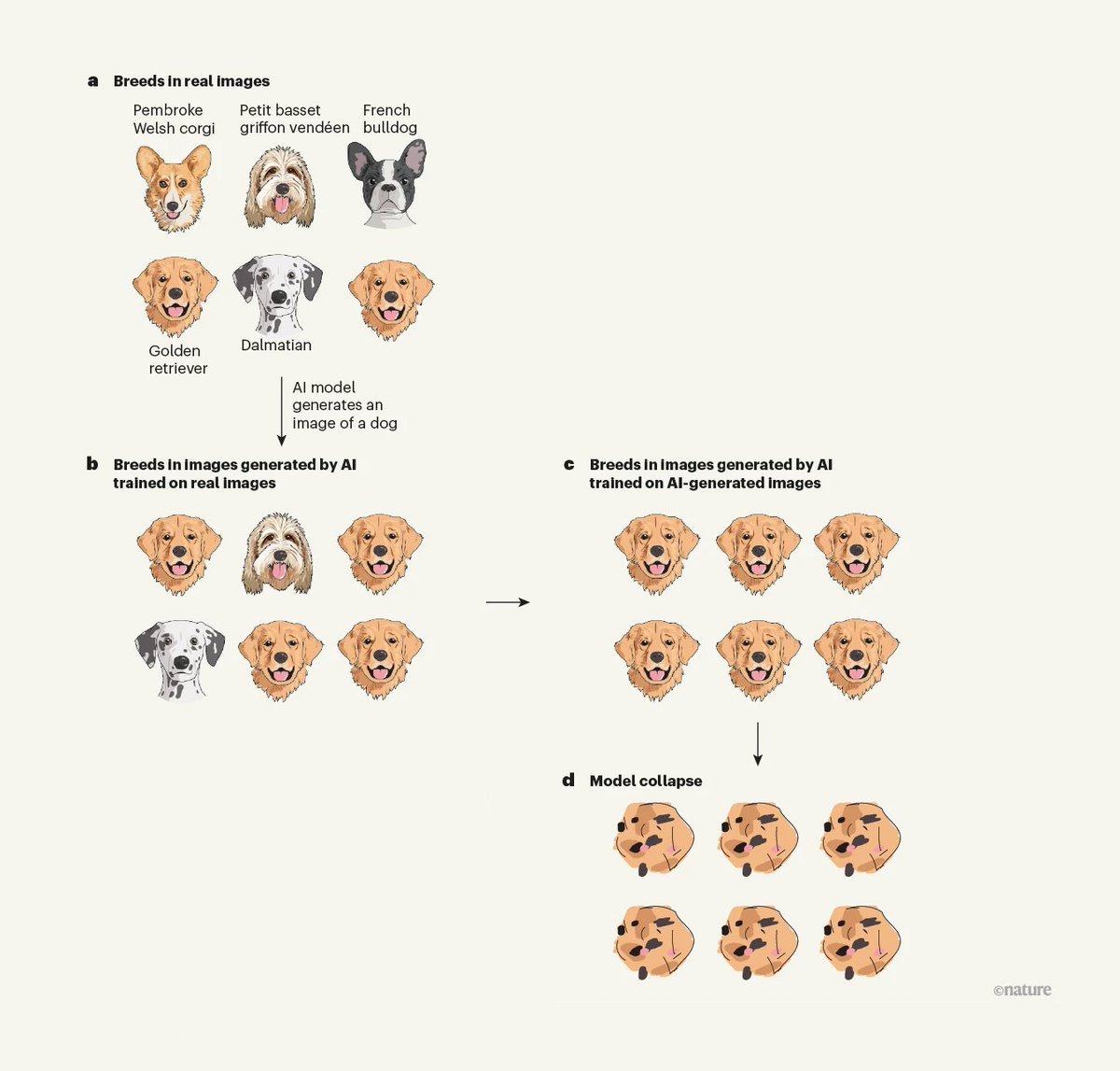
A new paper in Nature found that you cannot, in fact, train AIs on AI-generated data and expect them to continue improving. What happens is actually that the model collapses and ends up producing nonsense.
628
2,223
15,808
1,875,926
Matteo Cavucci retweeted
Replying to @p1xelHer0
This is one of my favorite quotes (from back in 1985!) about the difference between computer science and the real world😀 cs.umd.edu/~ben/papers/Schne…
2
14
851
Matteo Cavucci retweeted
The game is not better predicting the future, but better adapting to how the present is different from your expectations.
5
54
178
23,127
"Eliminate management by objective. Eliminate management by numbers, numerical goals. Substitute leadership." (Deming's "Fourteen Points for Management," 11b.)
4
11
91
Matteo Cavucci retweeted
Our actions and their results depend on what theoretical and practical tools we have. We are neither smart, nor informed enough to verify the assumptions those tools are based on. Realistically, we can only apply the tools we have, and hope our assumptions were correct
1
44
590
Matteo Cavucci retweeted
3
4
54