
Life & Business Coach, PNL Master Trainer, consulente aziendale, ingegnere... anche quando non serve. #coaching #consulenza #training
Joined October 2011
- Tweets 229
- Following 224
- Followers 261
- Likes 776
34 Photos and videos












Jun 15
Uno spunto di riflessione per i manager.
Il leader coach: quando la sfida non è diventare qualcuno, ma riconoscere chi si è già lagazzettadelmezzogiorno.it/… articolo di @emanuelamegli #coaching #management #leadership #identità
5
Un interessante argomento da sviluppare per chi "lavora con la mente". Follow the white rabbit...
Grazie a @LibertiMedia
La guerra delle interfacce neurali: non solo Neuralink, la Cina accelera la corsa agli impianti cerebrali open.substack.com/pub/libert…
1
1
1
287
28 Sep 2025
Mi è capitato spesso di sentire la frase: “le scelte che faccio si rivelano sempre sbagliate”. Le ho sentite pronunciate da professionisti, genitori, studenti, bambini, manager (ma questo non lo ammetterebbero mai in pubblico!); le ho sentite...
massimilianotavolacci.it/202…
2
3
78
5 Jan 2025
Attraverso gli strumenti e le tecniche del PNL Practitioner si ha la possibilità di osservare, acquisire la consapevolezza e modificare le nostre abitudini, i nostri programmi inconsci che ci fanno essere chi siamo. Questo ci porta alla conoscenza che chi siamo convinti di essere non è chi siamo veramente. E qui comincia il carminio di trascendenza spirituale: chi siamo è in relazione allo scopo per cui siamo. Conoscere l'uno e l'altro è la porta alla libertà, alla verità e alla vita piena in noi stessi
1
2
247
16 Dec 2024
Direi che il #coaching aggiusta ciò che è rotto proprio perché risveglia ciò che è già in noi per poterlo fare. Il nostro corpo ha un sistema immunitario che guarisce le nostre ferite, ma la nostra mente ha qualcosa di più.
16 Dec 2024

Coaching isn't about fixing what's broken. It's about awakening what's already within.
2
126
Massimiliano Tavolacci retweeted

2 Dec 2024
🚨 THE MOST MIND-BLOWING GRAPH YOU’LL SEE
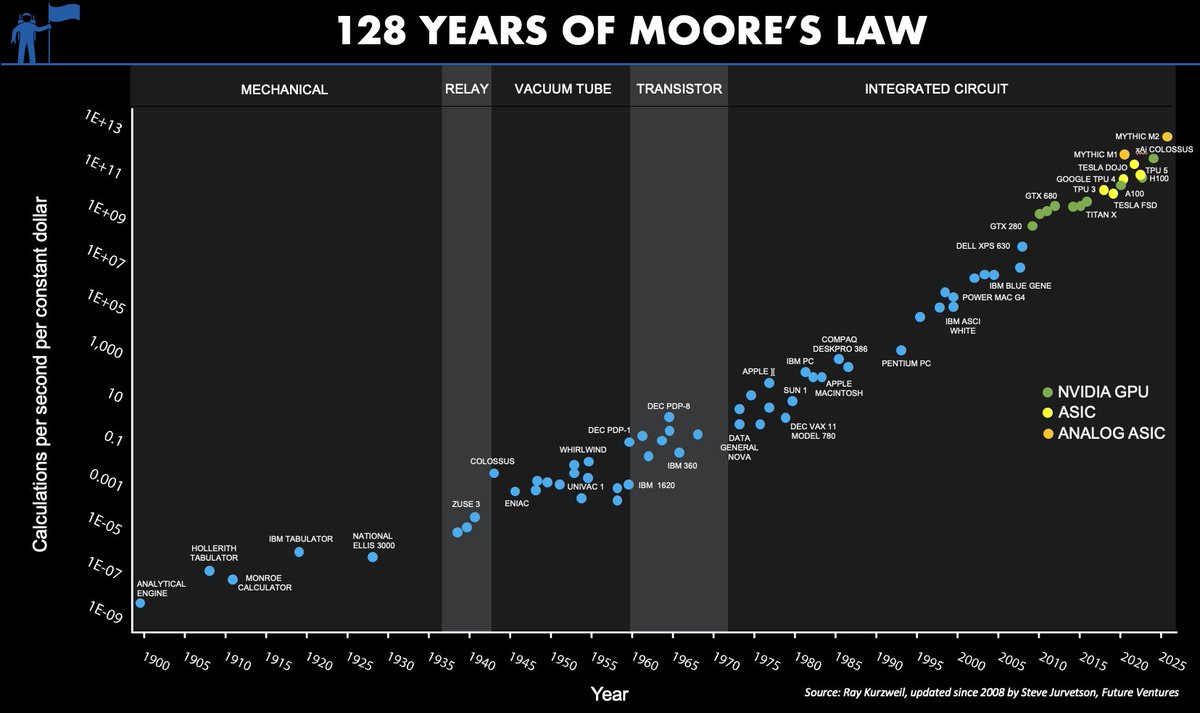
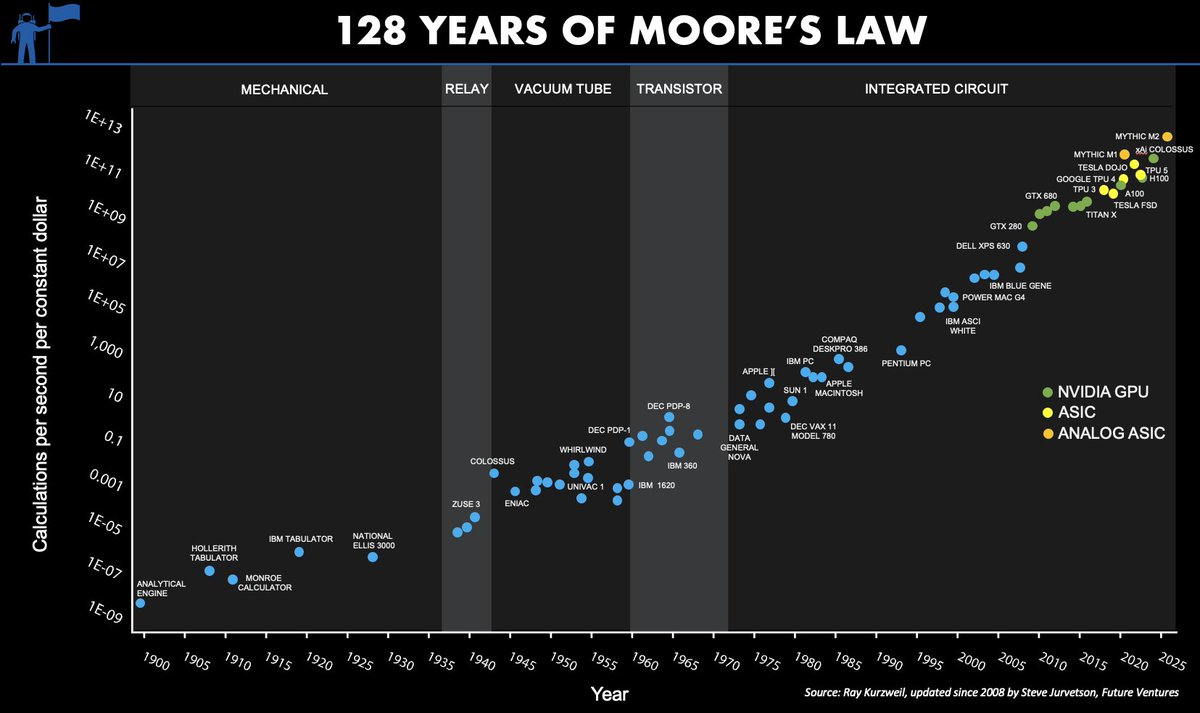
This graph isn’t just about tech—it’s about how humanity’s ability to compute has skyrocketed, reshaping industries and transforming the future.
Here’s the kicker: it’s a semi-log graph, so a straight line = exponential growth.
Each tick on the y-axis marks a 100x improvement, and the entire span covers a 1,000,000,000,000,000,000,000x increase in computation per dollar.
What’s behind this? Moore’s Law, the observation that computer power doubles roughly every two years while costs fall.
That kind of growth has held steady for over a century, even as tech transitioned from basic circuits to GPUs, AI-optimized chips, and beyond.
Think about it: in just 100 years, we’ve gone from computers that filled rooms to chips powering self-driving cars and AI.
This graph shows not just progress—but how fast the future is arriving. And the crazy part? The exponential curve isn’t slowing down.
2 Dec 2024

The Moore's Law Update
NOTE: this is a semi-log graph, so a straight line is an exponential; each y-axis tick is 100x. This graph covers a 1,000,000,000,000,000,000,000x improvement in computation/$. Pause to let that sink in.
Humanity’s capacity to compute has compounded for as long as we can measure it, exogenous to the economy, and starting long before Intel co-founder Gordon Moore noticed a refraction of the longer-term trend in the belly of the fledgling semiconductor industry in 1965.
I have color coded it to show the transition among the integrated circuit architectures. You can see how the mantle of Moore's Law has transitioned most recently from the GPU (green dots) to the ASIC (yellow and orange dots), and the NVIDIA Hopper architecture itself is a transitionary species — from GPU to ASIC, with 8-bit performance optimized for AI models, the majority of new compute cycles.
There are thousands of invisible dots below the line, the frontier of humanity's capacity to compute (e.g., everything from Intel in the past 15 years). The computational frontier has shifted across many technology substrates over the past 128 years. Intel ceded leadership to NVIDIA 15 years ago, and further handoffs are inevitable.
Why the transition within the integrated circuit era? Intel lost to NVIDIA for neural networks because the fine-grained parallel compute architecture of a GPU maps better to the needs of deep learning. There is a poetic beauty to the computational similarity of a processor optimized for graphics processing and the computational needs of a sensory cortex, as commonly seen in the neural networks of 2014. A custom ASIC chip optimized for neural networks extends that trend to its inevitable future in the digital domain. Further advances are possible with analog in-memory compute, an even closer biomimicry of the human cortex. The best business planning assumption is that Moore’s Law, as depicted here, will continue for the next 20 years as it has for the past 128. (Note: the top right dot for Mythic is a prediction for 2026 showing the effect of a simple process shrink from an ancient 40nm process node)
----
For those unfamiliar with this chart, here is a more detailed description:
Moore's Law is both a prediction and an abstraction. It is commonly reported as a doubling of transistor density every 18 months. But this is not something the co-founder of Intel, Gordon Moore, has ever said. It is a nice blending of his two predictions; in 1965, he predicted an annual doubling of transistor counts in the most cost effective chip and revised it in 1975 to every 24 months. With a little hand waving, most reports attribute 18 months to Moore’s Law, but there is quite a bit of variability. The popular perception of Moore’s Law is that computer chips are compounding in their complexity at near constant per unit cost. This is one of the many abstractions of Moore’s Law, and it relates to the compounding of transistor density in two dimensions. Others relate to speed (the signals have less distance to travel) and computational power (speed x density).
Unless you work for a chip company and focus on fab-yield optimization, you do not care about transistor counts. Integrated circuit customers do not buy transistors. Consumers of technology purchase computational speed and data storage density. When recast in these terms, Moore’s Law is no longer a transistor-centric metric, and this abstraction allows for longer-term analysis.
What Moore observed in the belly of the early IC industry was a derivative metric, a refracted signal, from a longer-term trend, a trend that begs various philosophical questions and predicts mind-bending AI futures.
In the modern era of accelerating change in the tech industry, it is hard to find even five-year trends with any predictive value, let alone trends that span the centuries.
I would go further and assert that this is the most important graph ever conceived. A large and growing set of industries depends on continued exponential cost declines in computational power and storage density. Moore’s Law drives electronics, communications and computers and has become a primary driver in drug discovery, biotech and bioinformatics, medical imaging and diagnostics. As Moore’s Law crosses critical thresholds, a formerly lab science of trial and error experimentation becomes a simulation science, and the pace of progress accelerates dramatically, creating opportunities for new entrants in new industries. Consider the autonomous software stack for Tesla and SpaceX and the impact that is having on the automotive and aerospace sectors.
Every industry on our planet is going to become an information business. Consider agriculture. If you ask a farmer in 20 years’ time about how they compete, it will depend on how they use information — from satellite imagery driving robotic field optimization to the code in their seeds. It will have nothing to do with workmanship or labor. That will eventually percolate through every industry as IT innervates the economy.
Non-linear shifts in the marketplace are also essential for entrepreneurship and meaningful change. Technology’s exponential pace of progress has been the primary juggernaut of perpetual market disruption, spawning wave after wave of opportunities for new companies. Without disruption, entrepreneurs would not exist.
Moore’s Law is not just exogenous to the economy; it is why we have economic growth and an accelerating pace of progress. At Future Ventures, we see that in the growing diversity and global impact of the entrepreneurial ideas that we see each year — from automobiles and aerospace to energy and chemicals.
We live in interesting times, at the cusp of the frontiers of the unknown and breathtaking advances. But, it should always feel that way, engendering a perpetual sense of future shock.
20
41
115
97,156
11 Nov 2024
generattivita.it/io-sono-il-…
Partecipa a "io sono il mio Futuro".
È l'occasione per conoscere e sperimentare la PNL, a cosa serve cosa cambia nella vita personale e professionale.
Un occasione per fare domande e trovare le risposte che ci fanno scoprire come utilizzare tutte le nostre potenzialità.
Solo tre ore e mezzo, Sabato 23 novembre all'Holiday Inn Cagliari. Puoi scegliere se partecipare la mattina o il pomeriggio, in base ai tuoi impegni.
Solo per 49€.
Solo per questa volta!
Scegli di accendere la tua luce e di illuminare la tua vita...
1
1
31
10 Nov 2024
Sabato 23 novembre a Cagliari un corso di mezza giornata per conoscere, capire e sperimentare gli strumenti e le tecniche della PNL nella tua vita personale o professionale e scegliere di costruire il tuo futuro con la PNL.
generattivita.it/io-sono-il-…
1
26
21 Jul 2024

1
148
Massimiliano Tavolacci retweeted

10 Jul 2024
🏀 Michael Jordan missed 12345 shots in his NBA career
20
92
1,034
8,859,101

14 May 2024
Quando usi bene la tua immaginazione, diventi creativo.
Quando usi male la tua immaginazione, diventi ansioso.
Quando smetti di immaginare, sei morto.
Immaginare sempre il meglio di sé fa diventare il meglio di sé. #coaching #pnl #creatività #iosonoilmiofuturo
75
1 May 2024
Dieci anni fa ho pubblicato, su quello che allora era il mio blog, ciò che pensavo e credevo sul significato della parola "verità". Da allora ho continuato a cercare verità. E c'è molto di più. E quella verità è vera, sempre di più.
massimilianotavolacci.it/201…
#pnl #coaching #verità #ricerca #truth
1
47
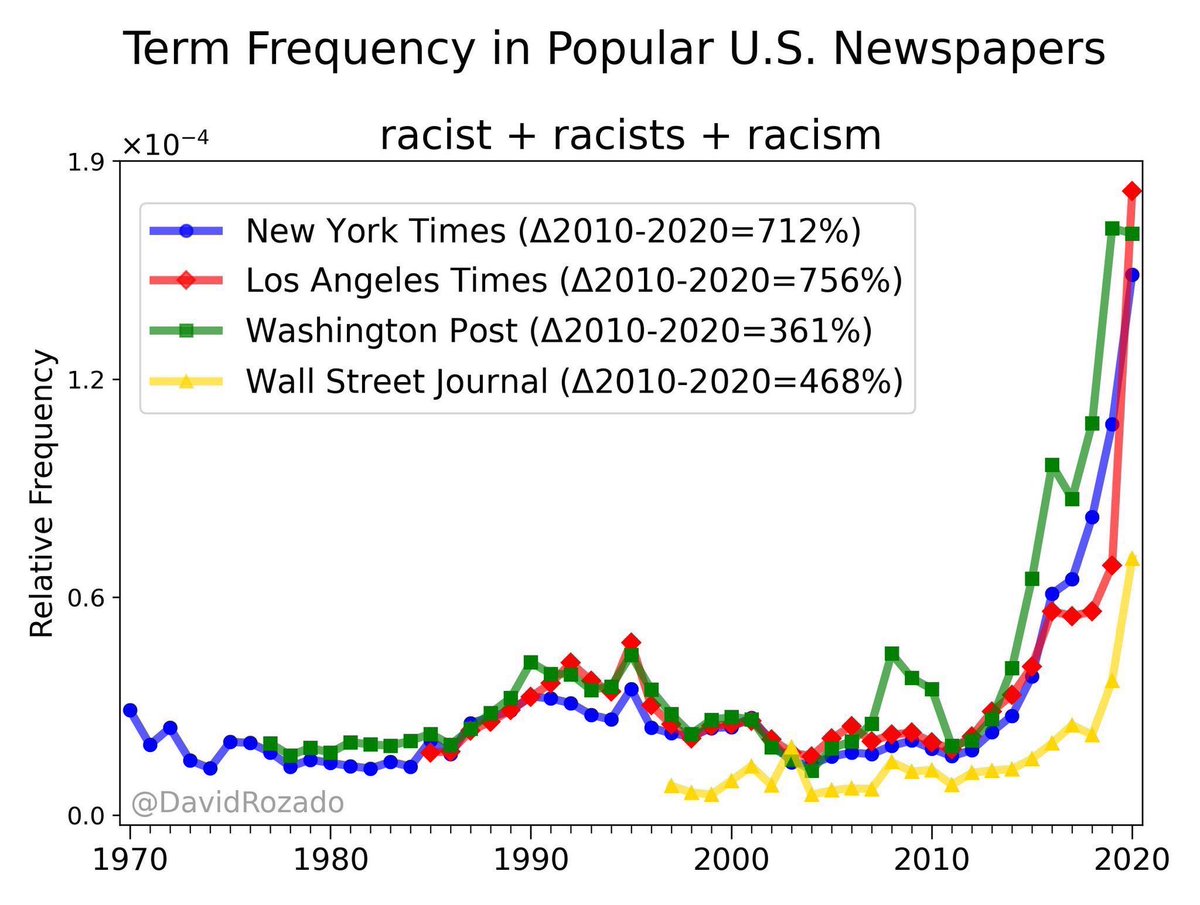
This graph illustrates the woke mind virus taking over legacy media.
Same happened with online media and the education system. Then it spread to other countries.
Infection rate almost 100%.
But now it will die.
18,719
56,017
301,271
42,829,867
21 Mar 2024
"Presupponi che..."
Il mondo delle nostre presupposizioni, dei nostri preconcetti è pieno di limiti e di stereotipi. Cambiare #mindset apre prospettive, opportunità e cambia il mondo. Davvero.
Questo è un potente video per la Giornata mondiale a favore dei portatori della Sindrome di Down. Che sono capaci, assieme a tanti altri che lo vogliono, di cambiare il mondo. #WorldDownSyndromeDay #AssumeThatICan #EndTheStereotypes

If we have positive assumptions about people with Down syndrome, we'll give them more opportunities. And maybe these positive assumptions will become reality. #AssumeThatICan #WDSD24 #WorldDownSyndromeDay #EndTheStereotypes
45
18 Mar 2024
Utilizzare al meglio il nostro #Mindset ci consente di sfruttare tutte le nostre potenzialità risparmiandoci inutili fatiche, stress, emozioni negative, frustrazioni e tempo che non recupereremo più. Tu quando vuoi iniziare? #MindsetMatters #coaching
38
16 Mar 2024
È possibile "vedere" che tipo di #Mindset stiamo utilizzando?
In questi ultimi decenni si sono moltiplicate esponenzialmente le ricerche sul mindset e sulla neurofisiologia ad esso connessa. Gli studi scientifici portano alcune evidenze che, certo, vanno interpretate e che ci possono servire come base per una più ampia riflessione e ulteriori approfondimenti.
Certo è che lo studio delle onde cerebrali, attraverso le differenti tecnologie, ci mette a disposizione dati e conoscenze di grande interesse.
Monitorando le onde cerebrali in gruppi di persone di differente cultura, estrazione sociale, interessi ed età, si è riscontrato che, in alcuni, l'attività cerebrale era particolarmente intensa quando ricevevano un feedback rispetto ad una particolare attività per cui si sentivano particolarmente portati ed "adatti"; mostravano interesse e coinvolgimento solo quando il feedback riguardava le loro capacità e, in particolare, quando gli veniva rivelato se le risposte date fossero giuste o sbagliate.
Quelle stesse persone evidenziavano un'attività cerebrale molto scarsa quando il feedback era relativo a informazioni che sarebbero state utili per imparare o, nel caso avessero fornito una risposta errata, riguardo all'informazione relativa a quale fosse la la risposta giusta.
Un altro gruppo di persone, viceversa, mostrava una forte attività cerebrale proprio nel momento in cui venivano fornite informazioni utili ad imparare o a correggere l'errore.
Mentre per alcuni si trattava di "verificare" ciò che avevano appreso, per altri la priorità era quella di imparare qualcosa di nuovo.
Questi due diversi e antitetici risultati rispecchiano le due opposte formae mentis: statica e dinamica (o di crescita), che sono "leggibili" attraverso la valutazione delle onde cerebrali, ma, soprattutto, con un più utile ed agevole set di tecniche e strumenti di natura psicologica a disposizione dei Coach che lavorano sul mindset.
Ci sentiamo più portati per un successo che confermi e rafforzi quelle che consideriamo le nostre attitudini e caratteristiche peculiari o per un successo fatto di continue sfide in situazioni in cui non ci sentiamo appartenere alla "top ten" e in cui ci dobbiamo sempre mettere in gioco per imparare qualcosa di nuovo?
Quali sono i vantaggi in entrambi i casi? E qual è il rovescio della medaglia?
Seguimi qui su X @maxmaimax per continuare ad approfondire #mindsetmatters #coaching
nota: in questo post ho fatto riferimento a diverse ricerche scientifiche pubblicate da C. Dweck in collaborazione con J. Mangel e C. Good tra il 2000 e il 2015 ed ulteriori studi connessi pubblicati dal Psychology Department della Columbia University, dall'American Psychological Association e dalla Stanford University.
1
34