
MDCMS is an enterprise headless CMS built for AI-native content lifecycle management. Database-backed & markdown-first. Open-source, MIT licensed.
Joined April 2026
- Tweets 12
- Following 1
- Followers 1
- Likes 2
11 Photos and videos

3 architectural decisions in MDCMS that stop the CMS from becoming a system that developers have to work around.
1) The content model lives in the repo.
Types, fields, and validation are defined in mdcms.config.ts and checked into git. This keeps the code and CMS in sync, so there’s no mismatch between them.
2) The Studio runs inside your app.
It is a React component with access to your design system and custom components. Editors get live previews of real components.
3) AI agents use the same API, validation, and permissions as your team.
You don’t need to build or maintain a separate integration layer.
4
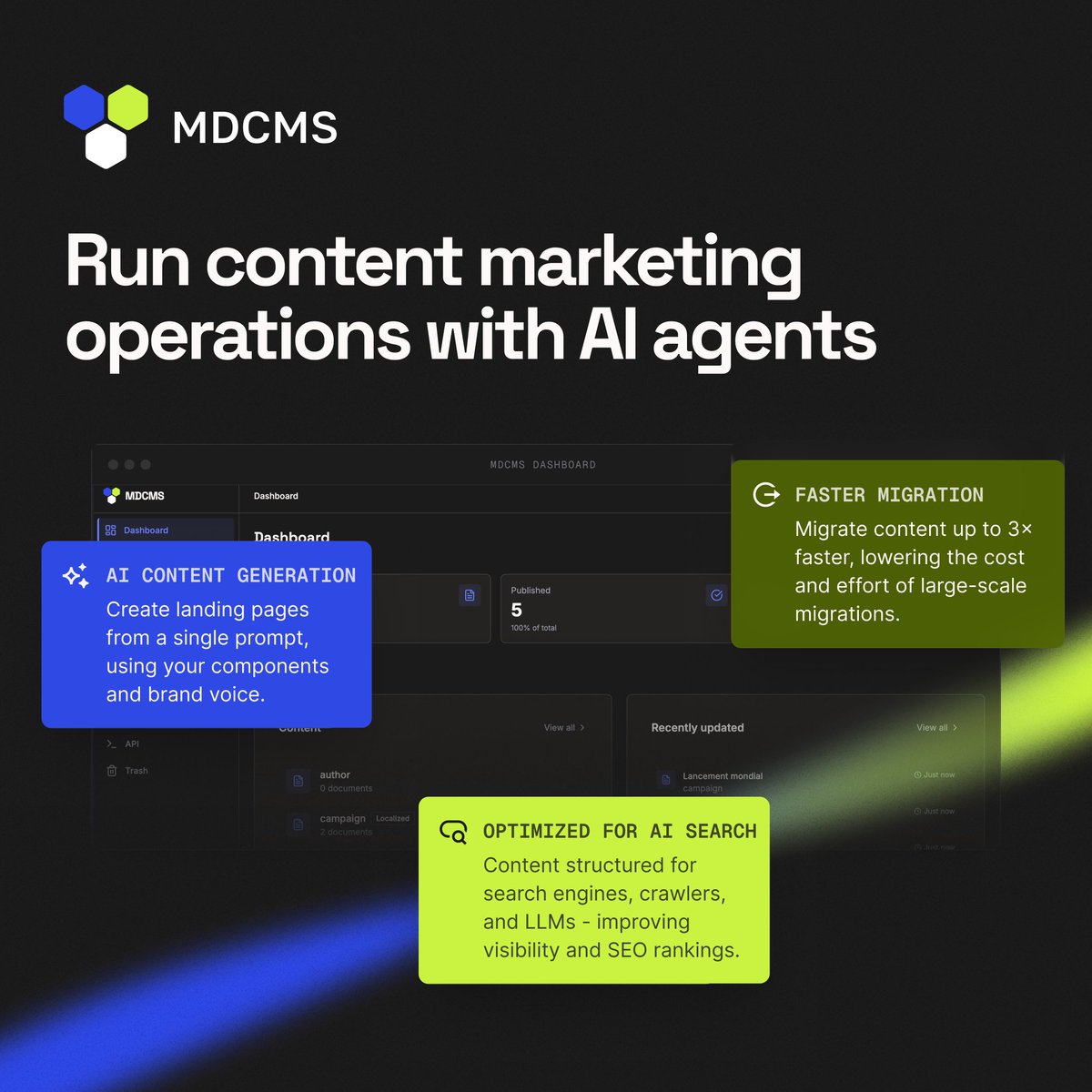
AI tools write the landing page copy in seconds, but your team still spends a week getting it published.
Most content tools only help with drafting. Someone still has to paste the text, format each section, adapt it for different markets, and publish each page by hand.
MDCMS lets AI agents handle the production work within the content system your team controls.
→ Generate landing pages, components, and content structures with prompts.
→ Get higher SEO rankings & visibility in AI search, thanks to structured Markdown.
→ Migrate up to 3× faster, thanks to structured content and a simplified data model.
→ You stay in control with role-based access, complete version history, and one-click rollback for anything the agent changes.
Let your team spend less time building pages and more time choosing which ones to publish.
See how MDCMS manages marketing content with agents: mdcms.ai/for-business
5
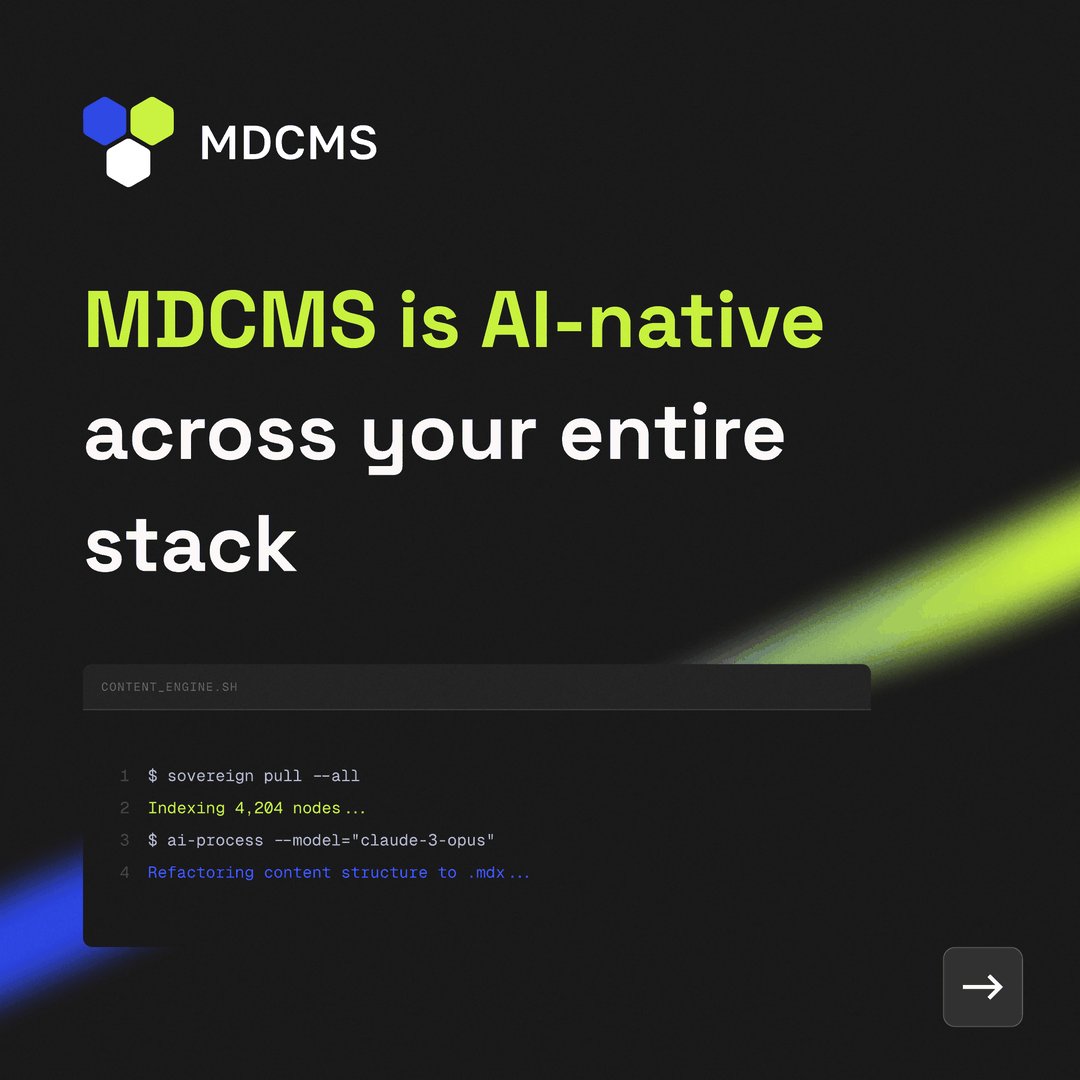
"AI features" is where most CMSs stopped. An AI agent that does the work like someone on your team is a different thing.
A chatbot in the sidebar is just a feature.
An agent that can read your schema, edit your config, and publish content is a user.
Most CMS solutions added the first option and call themselves AI-native.
MDCMS was built with the agent as a user from day one.
→ Content: The agent reads and writes Markdown like any other file.
→ Config: The agent edits mdcms.config.ts in plain language, validated before anything syncs.
→ Code: The agent can read, implement, and extend type-safe contracts.
→ Same API and permissions as any human user. There is no special access just for agents.
Full breakdown: mdcms.ai/for-developers
8
Developers did not sign up to be a dependency for the marketing team. But that is what most CMS setups produce.
The new content type is a ticket.
Component preview requires a developer to set it up.
Schema changes happens outside the codebase, which means it drifts from what the code expects.
MDCMS is built to prevent these problems.
→ The content model is stored in mdcms.config.ts and checked into git with the rest of your code.
→ Schema changes go through pull requests.
→ The Studio runs inside your app and uses your design system, so editors work with real components.
→ AI agents work through the same API as your team, so you do not need to build any special integrations.
This creates a CMS that fits into your workflow, instead of adding another system to maintain.
You can find a full technical breakdown at mdcms.ai/for-developers
1
24
Your CMS is the reason your marketing team needs a developer for every campaign.
Most platforms were built when "content management" meant editing text in a box. They were not made for today, when marketing teams need to launch landing pages in a day, support five languages, and use AI on every piece of content before it goes live.
As a result, every campaign spawns a ticket, and each localization is a project.
MDCMS changes this approach. Marketing teams manage the content layer on their own. Developers only need to set up the architecture once. AI agents handle repetitive production tasks.
Content is stored in structured Markdown. This helps search engines index it faster, lets AI systems cite it directly, and allows your team to control the content layer without needing to touch any code.
Role-based access, versioning, rollback, visual editor, multi-language support – all built in.
See full breakdown of how MDCMS handles marketing content operations → mdcms.ai/for-business
8
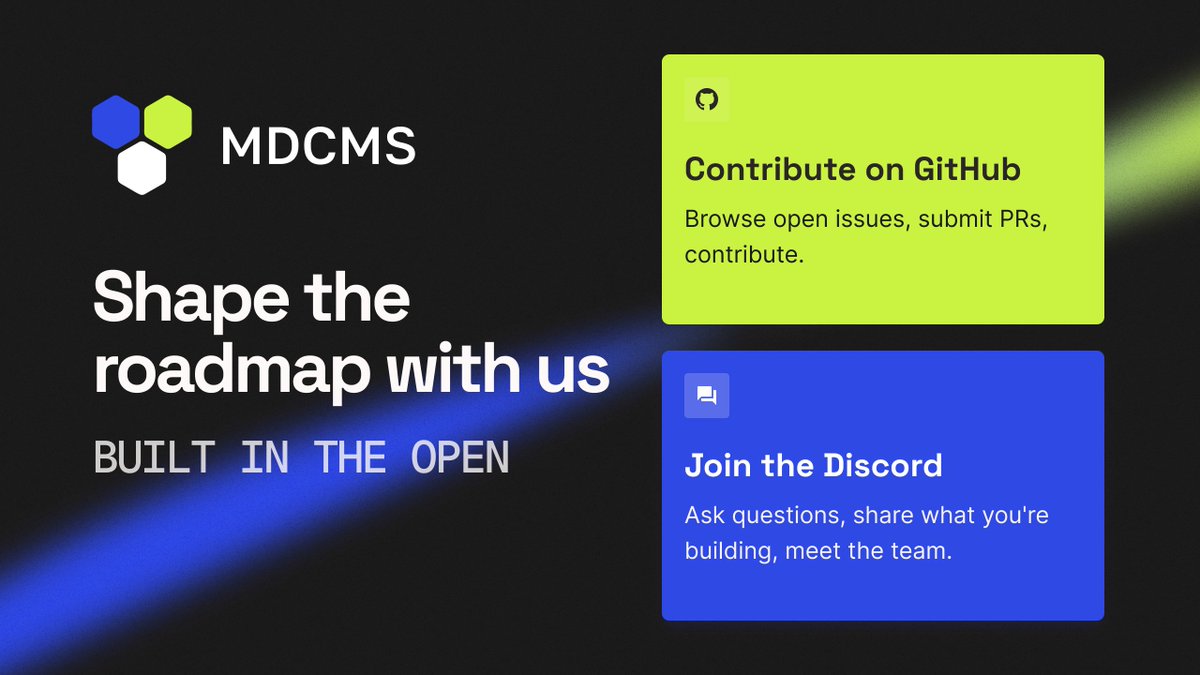
MDCMS is in built-in-public mode from day one. Join our Discord and GitHub communities!
We've opened both to work with you and shape MDCMS together.
Discord is the place where our engineering team hangs out and talks with a growing group of people building on MDCMS.
GitHub is where bug reports, feature requests, and pull requests are welcome.
If you're building with MDCMS or even just considering it, now is the perfect time to reach out to us.
Tell us where it fits into your stack and where it might need a little adjustment.
We count on your presence and feedback.
→ Contribute on GitHub: github.com/mdcms-ai/mdcms
→ Join Discord Community: discord.com/invite/VXbBVGgZX…
10
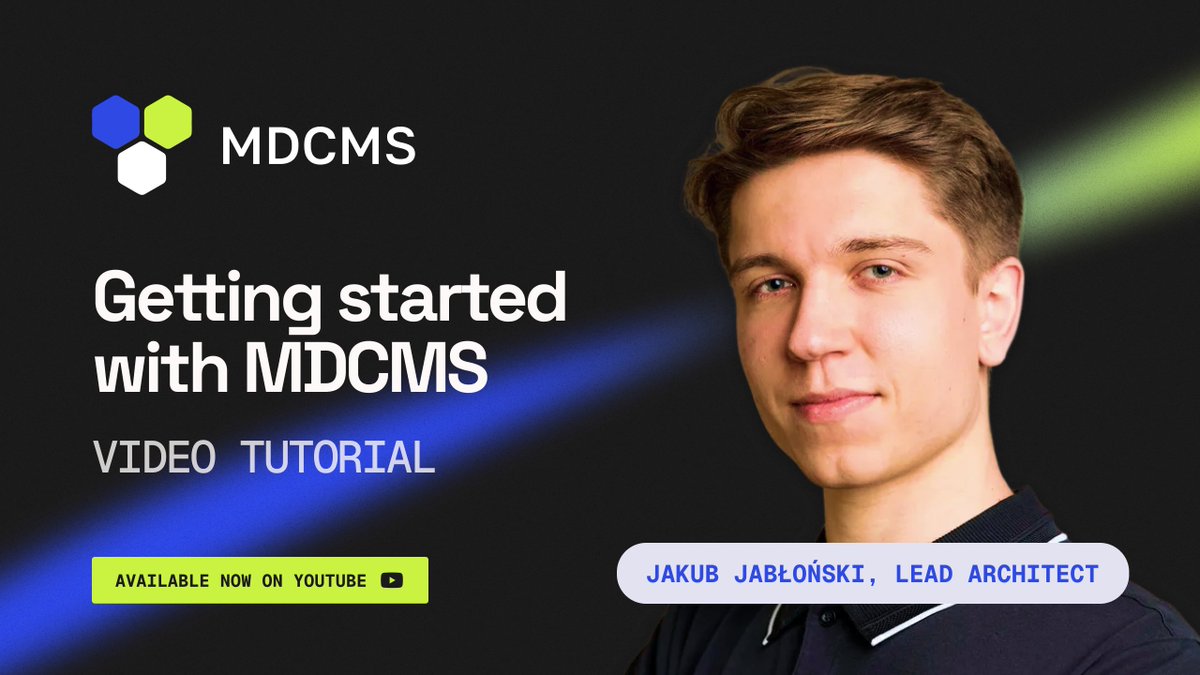
The fastest way to figure out if a CMS works for your team is to watch someone use it.
Our Lead Architect recorded a getting-started walkthrough of MDCMS: why we built it, and how it works end-to-end.
See how to migrate your existing Markdown/MDX projects and edit content through Visual Studio.
Watch the video on YouTube → youtu.be/18ciq_Ak8oA
11
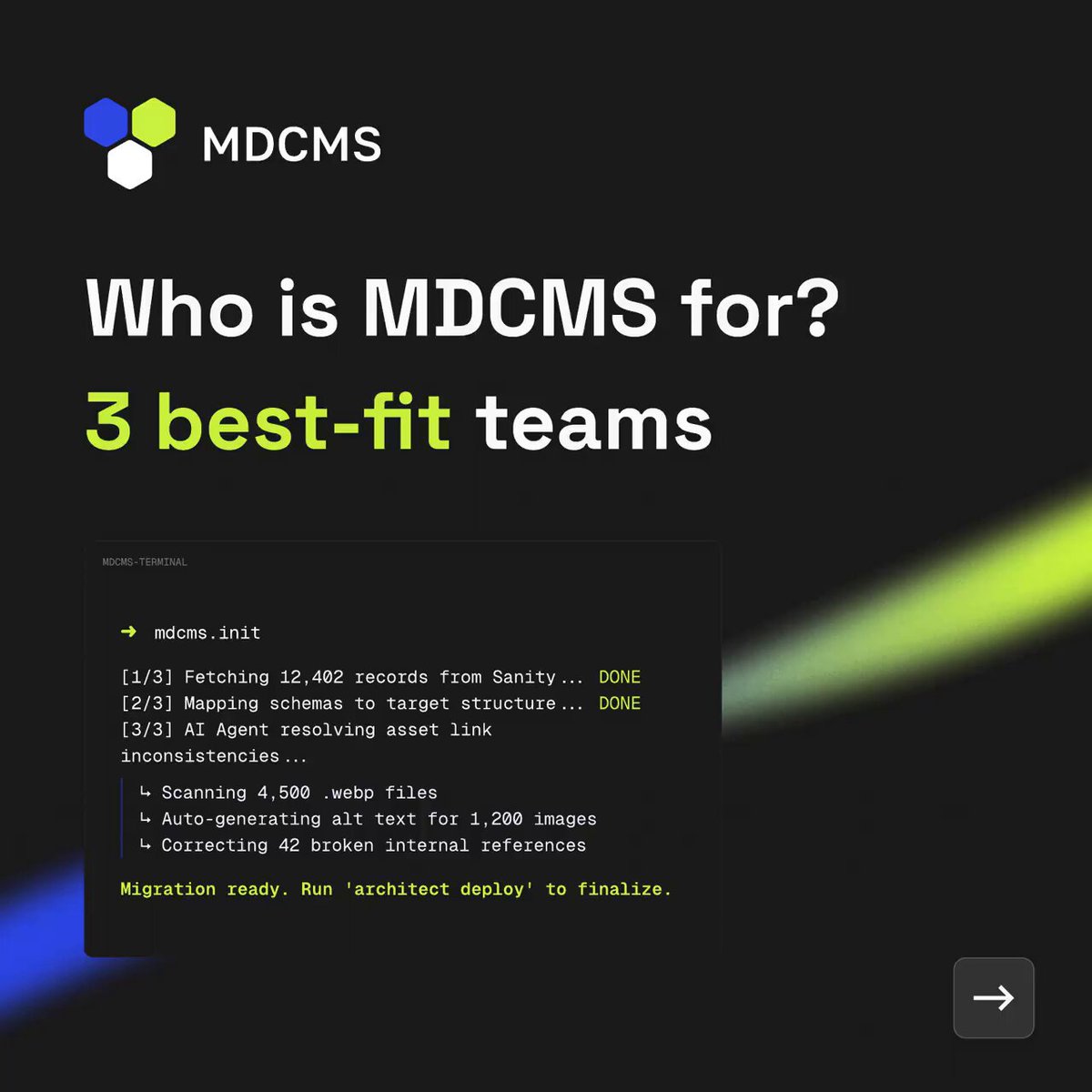
Trying to figure out if MDCMS is for your team? It usually comes down to 3 things.
Best-fit teams are:
1) Companies with content-heavy websites, existing Markdown/MDX content, modern React-based stacks, documentation sites, blogs, and marketing pages.
2) Teams that want AI-assisted content operations but still need to keep control and oversight.
3) Businesses that need full ownership, easier migrations, and less reliance on closed CMS vendors.
If two of these sound like you, our demo will cover the rest in just 15 minutes.
Book a demo: mdcms.ai/
10
Out of 800 CMSs, only a handful are built for what you actually need. MDCMS is one of them.
Most existing options on the market make teams choose between compromises that don’t really work for them.
SaaS CMS platforms give editors a user interface, but they often lead to vendor lock-in, ongoing enterprise costs, proprietary APIs, tough migrations, and workflows that don’t work well with AI.
Git or Markdown-based setups are great for developers and AI agents, but they force editors to deal with code, rebuilds, pull requests, terminal commands, and unstable content processes.
MDCMS fills the missing middle: a real CMS that still works like a file-based system when developers or AI agents need to handle content.
What sets it apart is the unique combination of features it offers:
1) You own your content. MDCMS is MIT-licensed, open-source, and self-hosted, so there’s no risk of being locked into a proprietary API.
2) One data layer, three interfaces. Everyone on your team gets a workspace built for their needs.
3) AI agents can work with content, config, and eventually the CMS itself through CLI/API/MCP-style workflows.
4) Switch fast with what you already have. MDCMS detects your schema, imports your content, sets up a visual Studio, and helps you switch your CMS in just a few weeks.
Want to see more? Check out MDCMS → mdcms.io/
15
Meet MDCMS, an open-source, markdown-first content operations platform for modern businesses. Built for every role on your team, including the AI agents.
MDCMS addresses the gap between two flawed defaults: traditional CMS platforms that lock content into vendor dashboards and file-based Markdown/MDX workflows that developers and AI tools love but editors cannot comfortably use.
The core idea is simple: keep the speed, portability, and AI-readiness of local files, but add the collaboration, permissions, versioning, publishing, and editor experience of a real CMS.
It solves migration pain by letting existing Markdown/MDX content become CMS-managed content.
It solves editor/developer friction by giving each group the interface they need.
It solves AI-readiness by keeping content structured and file-native enough for agents to process.
It solves ownership risk by avoiding a proprietary API as the only way out.
It solves maintainability by adding version history, roles, environments, localization, preview, and rollback around content workflows.
Use MDCMS your way:
→ Self implementation by your internal team (MIT licensed).
→ Implementation with @blazity, the team that built MDCMS from the ground up.
Explore CMS: mdcms.io/
Contribute on GitHub: github.com/mdcms-ai/mdcms
1
1
26