
Joined September 2013
- Tweets 68
- Following 272
- Followers 126
- Likes 353
9 Photos and videos









Michael Diskin retweeted

14 Mar 2023
Heterophilous graphs, in which edges connect dissimilar nodes, are challenging for GNNs. In our #iclr2023 paper, we propose a new benchmark of 5 structurally diverse heterophilous graph datasets. Read more in this post by Oleg Platonov and @LProkhorenkova research.yandex.com/blog/int…
3
10
1,235
Michael Diskin retweeted

13 Feb 2023
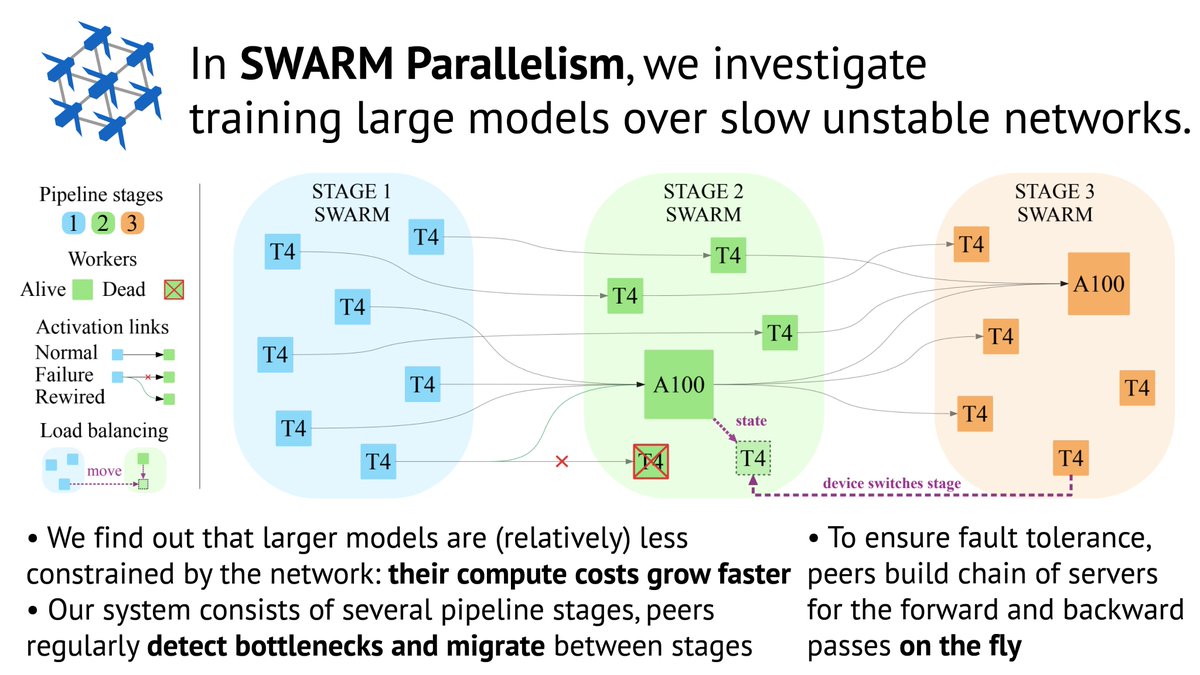
We present SWARM, an efficient algorithm for model-parallel training across the Internet (e.g. with volunteers).
Key advantages:
💎 Fault-tolerant
⚖️ Self-balancing on slow GPUs/networks
🐌 Works in low-bandwidth setups
📜 arxiv.org/abs/2301.11913
🖥️ github.com/yandex-research/s…
11
61
263
53,675
Michael Diskin retweeted

10 Dec 2021
Want to assess uncertainty and robustness in Self-Driving, Translation and Weather Prediction? Check out our #NeurIPS2021 paper:
Shifts: A Dataset of Real Distributional Shift Across Multiple Large-Scale Tasks: tinyurl.com/2p8833dp
See poster B1 at DBT, session 4 room 2

1
6
12
Michael Diskin retweeted
1 Nov 2021
At #NeurIPS2021, we will showcase our latest research in a variety of ML-related areas, with a total of eight papers, two benchmarks and one demonstration accepted at the conference.
You can find the full details in the link below:
research.yandex.com/news/pap…
4
5

3 Aug 2021
I'll continue bragging about our work.
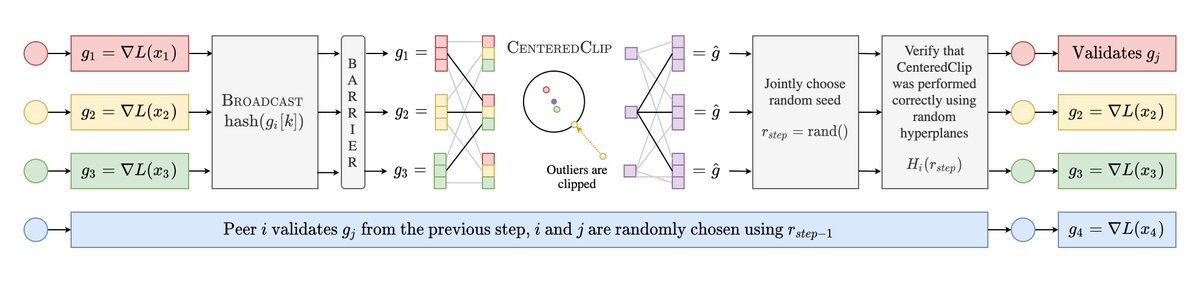
We were able to make distributed learning secure without losing the efficiency of the approach from the previous article.
A lot of math is included.😉
3 Aug 2021

Secure Distributed Training at Scale: our latest work proposes a protocol that protects decentralized training of large neural nets from malicious participants with marginal communication overhead. (1/8)
Paper: arxiv.org/abs/2106.11257
2
18 Jul 2021
It's hard to brag about your own work.
But we have proved here that it is possible to train neural nets distributed, on heterogeneous hardware in unstable conditions. In particular, using volunteers, and Google Colab. And it can even be useful to people.
arxiv.org/abs/2106.10207
15 Jul 2021

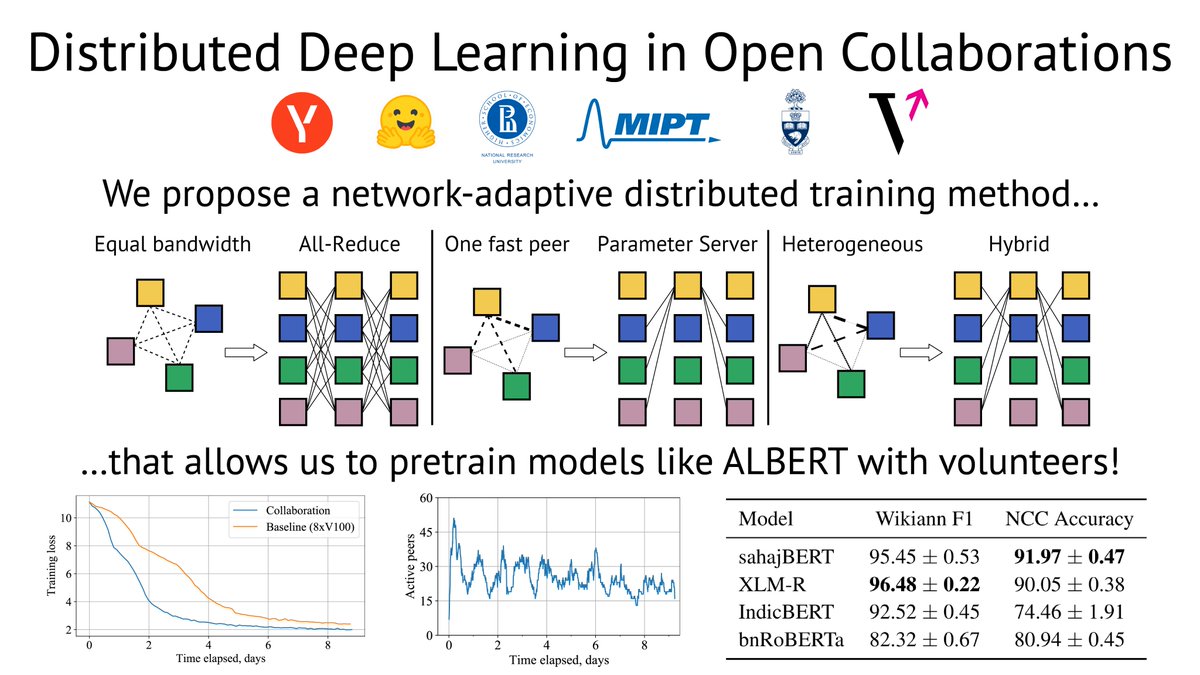
🧐What if we could use existing computing resources from different entities to train large models? We have shown that is possible by collaboratively training a language model with 40 volunteers🔥🔥
Read our new blog post on our 🤗 website to know more!
🔍 hf.co/blog/collaborative-tra…
1
2
17
18 Jul 2021
And yes, we are trying to make such distributed training accessible to everyone. Just try it github.com/learning-at-home/…
1
6
Michael Diskin retweeted
21 Jun 2021
In our latest work, we propose DeDLOC — a method for efficient collaborative training. This approach allowed us to pretrain sahajBERT (a Bengali-language ALBERT) together with the help of volunteers from the community! (1/10)
arxiv.org/abs/2106.10207
github.com/yandex-research/D…
3
39
133