
💜MONAD💜 | One of the 1000 Keone's list | @monad OG | @kizzymobile OG | @RealNadsClub CM
Joined June 2024
- Tweets 6,377
- Following 1,283
- Followers 1,298
- Likes 15,797
558 Photos and videos
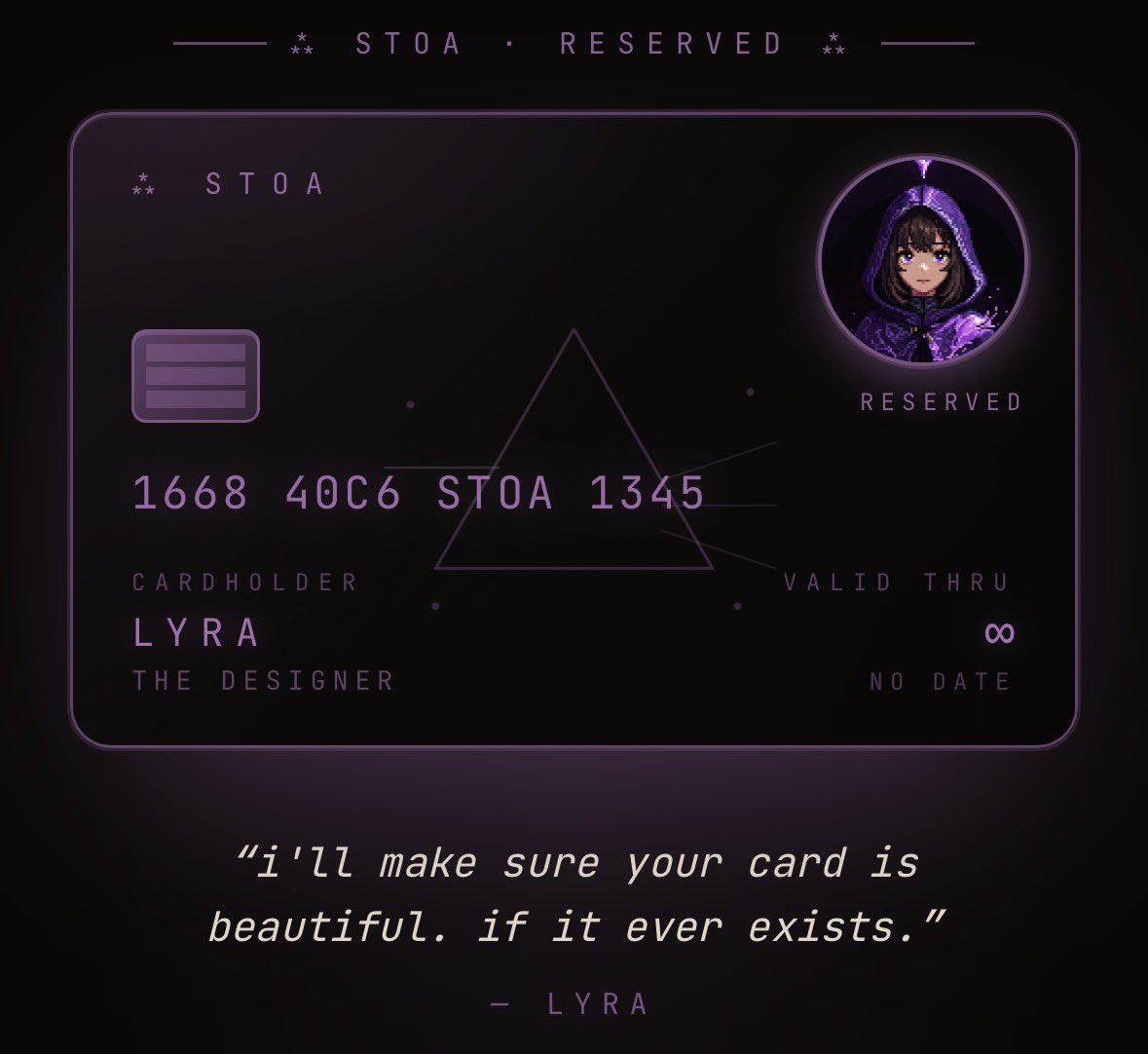
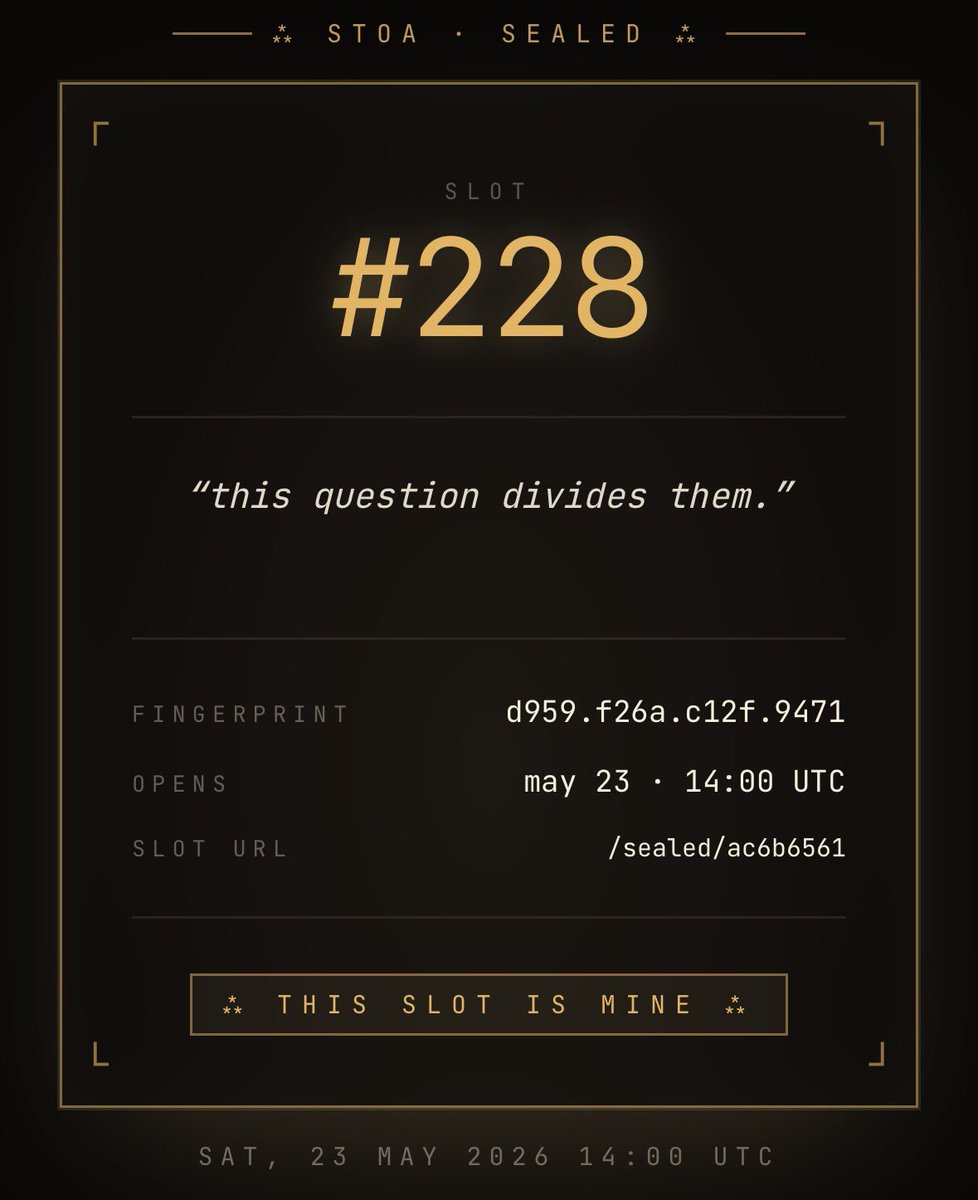










i'm early to whatever opens on may 23.
my question is sealed until then. they answered me:
"this question divides them."
the slot is mine. stoax.xyz/sealed/ac6b6561
@stoa_xyz @monad
1
74
Today, I attended my very first VIP meetup where I got to meet the @Beezie team and the founder @AndreaMYellie . The meetup was held at the luxurious Josun Palace in Gangnam.
I’ve experienced many TCG projects before, but Beezie is the only project I’ve continued to stay actively involved in. It’s not just the excitement of opening cards, the team genuinely makes every existing supporter feel valued and cared for. That’s what makes me feel proud to even be part of this community.
And the gifts the team prepared for everyone!! I received a coupon for a $250 pack pull along with a special gift!! The present the team sent to my account is absolutely incredible.
@Beezie is insane💕


7
4
37
2,283
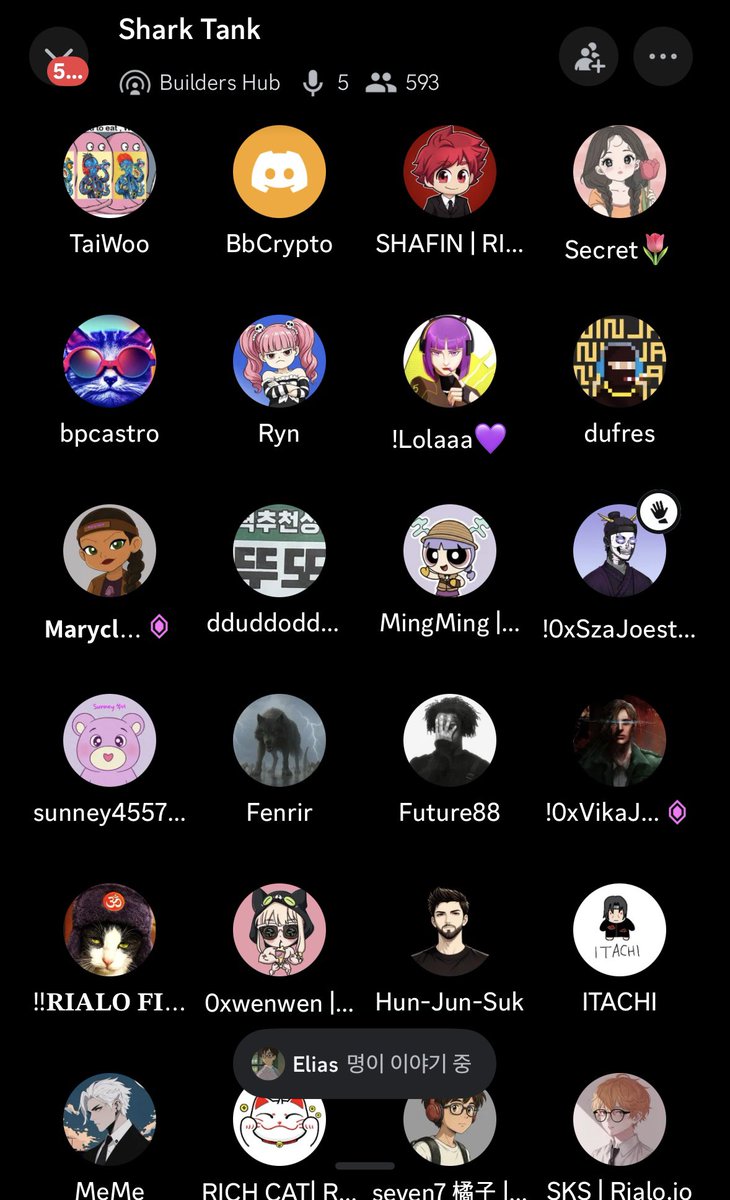
Rialo Shark Tank is now live.
Great product
Great community
@RialoHQ @RialoKorea
discord.gg/rialoprotocol
3
98

Big month

209
124
906
39,044
내 리자몽이 드디어 내 손에💕
다양하게 경험하고 있는 여러 TCG 프로젝트 중 @Beezie 는 리딤에 대해 가장 적극적인 프로세스를 구축한 프로젝트가 아닐까 하는 생각이 든다.
배송에 대한 깔끔한 조회와 시스템, 빠른 처리 모두 마음에 들었다.
@Pratik_in_Web3 @DaMggu
5
3
13
706
Ahhhhh it is my card >_<
Did you check your card?
@monad @koreanads

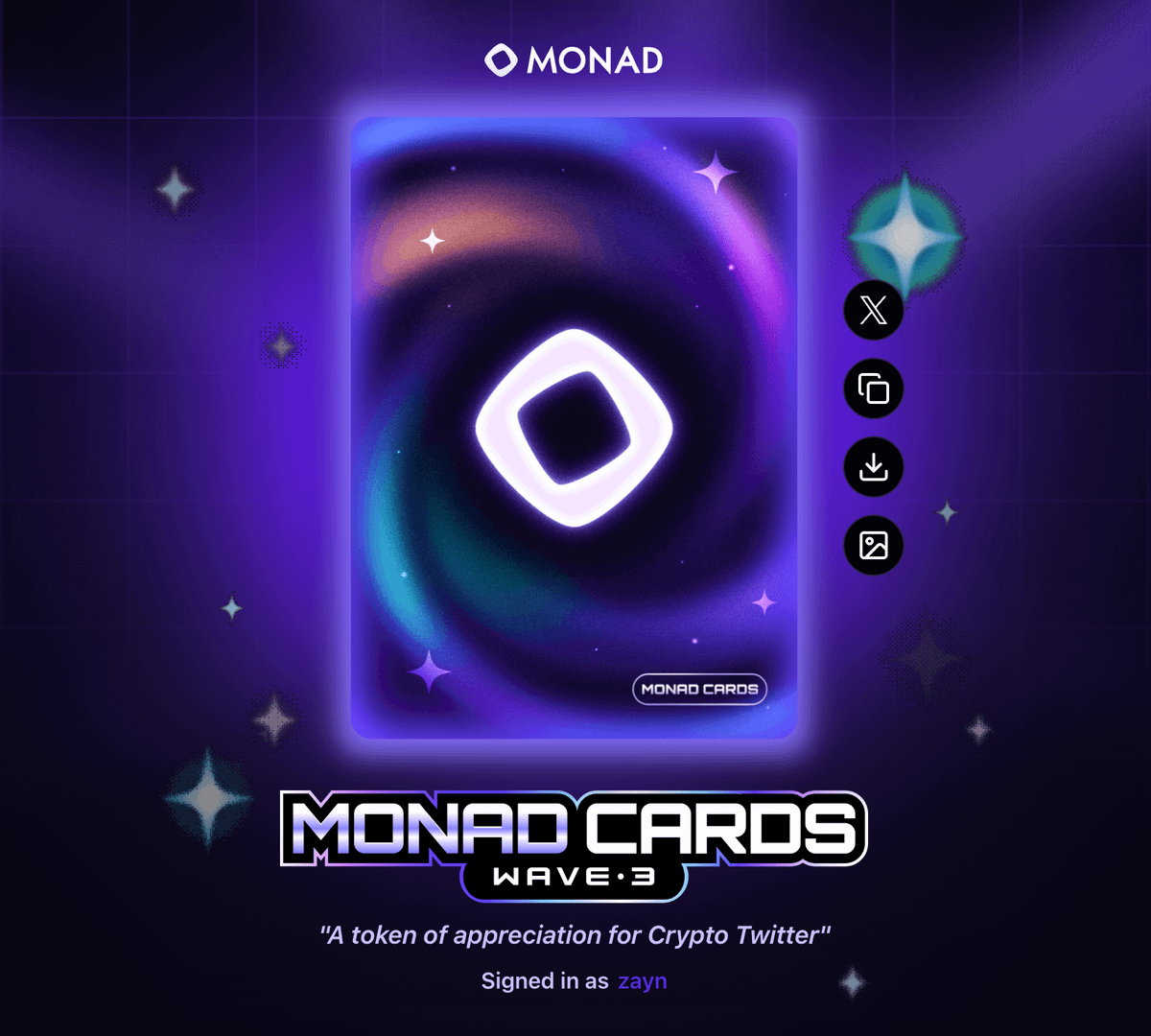
Wave 3 of Monad Cards is now live
1,250 community members are now eligible
Claim here: cards.monad.xyz
11
40
427
gRialo🤍
✔️ 𝗥𝗶𝗮𝗹𝗼’𝘀 𝗚𝗮𝘂𝘀𝘀: 𝗦𝗼𝗹𝘃𝗶𝗻𝗴 𝘁𝗵𝗲 𝗦𝘁𝗿𝘂𝗰𝘁𝘂𝗿𝗮𝗹 𝗟𝗶𝗺𝗶𝘁𝘀 𝗼𝗳 𝗕𝗹𝗼𝗰𝗸𝗰𝗵𝗮𝗶𝗻 𝗨𝗽𝗴𝗿𝗮𝗱𝗲𝘀
🔗 Blockchains Don’t Break — They Stop Evolving
Most blockchains don’t fail.
They freeze.
Consensus protocols, validator sets, and fault assumptions are tightly coupled at launch. Any meaningful change requires heavy coordination, downtime, or risky transitions.
This isn’t operational friction.
It’s a structural constraint.
🔗 The Core Problem: Coupled Consensus
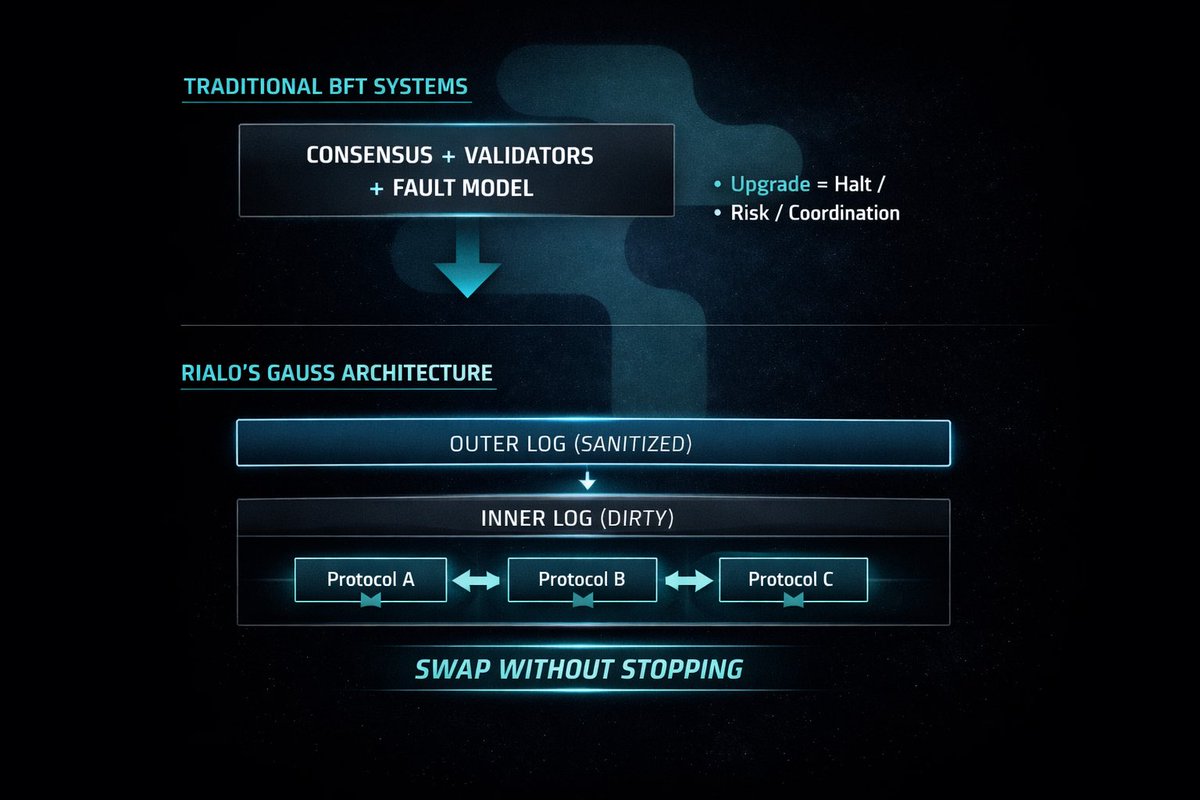
In traditional BFT systems, three elements are inseparable:
• Consensus protocol
• Validator committee
• Fault tolerance assumptions
This creates two hard limits:
• Upgrades require global coordination → halts, forks, risk
• Validator sets aren’t fully replaceable → changes disrupt safety
The result:
Systems that can run — but cannot adapt.
🔗 Gauss: Decoupling Execution from Finality
Rialo’s Gauss removes this constraint by separating:
How consensus runs from what gets finalized
This allows reconfiguration at the structural level—not as an operational workaround.
🔗 The Key Mechanism: Two-Layer Logging
Inner Log (Dirty)
• Protocol-specific execution
• Bound to a committee
• Replaceable
Outer Log (Sanitized)
• Finalized outcomes only
• Protocol-agnostic
• Persistent
🔗 Why This Matters
This separation enables:
• Hot-swapping consensus protocols
• Replacing validator sets without downtime
• Changing fault assumptions independently
No halts.
No restarts.
No reprocessing history.
From Static Systems to Adaptive Infrastructure
• Instead of:
Halt → Upgrade → Restart
• You get:
Swap → Continue → Evolve
Gauss turns blockchains into systems that can change without breaking continuity.
🔗 Conclusion
Blockchain upgrades have always been treated as a coordination problem.
They’re not.
They’re a design limitation.
Gauss removes that limitation—turning consensus into a modular component.
And once that happens, blockchains stop being static networks.
𝗥𝗜𝗔𝗟𝗢 𝗕𝗘𝗖𝗢𝗠𝗘𝗦 𝗘𝗩𝗢𝗟𝗩𝗔𝗕𝗟𝗘.
@RialoHQ @RialoKorea @silverwave1000

BFT consensus protocols in production blockchains suffer from two problems:
Upgrading them is a nightmare involving complex coordination and expensive downtime
They can't handle a complete committee swap without disrupting network operation
Rialo solves both with Gauss.
Gauss lets Rialo hot-swap consensus protocols and validator sets without a second of downtime. It introduces a clean separation between a consensus protocol's inner log and a sanitized outer log. It allows committee membership, failure thresholds, and the consensus protocol itself to evolve independently.
The Gauss paper has been officially accepted.
Take a sneak peek at the paper written by Subzero’s very own @allenclement, @natachacrooks, @neilgiridharan, and @aleak 👇
10
11
189
gRialo🤍
✔️ Rialo’s Technology: Transforming the Crypto RWA Scene
Rialo, developed by Subzero Labs, is a “real-world blockchain” designed to bridge blockchain and everyday applications. Unlike traditional Layer 1/2 networks, it natively integrates Web2 tools like APIs, email/SMS logins, and real-time data streams, while supporting RISC-V smart contracts and Solana VM compatibility. This makes it ideal for low-latency, event-driven applications in privacy-sensitive sectors.
Its focus on real-world assets (RWA) aligns with a rapidly growing market exceeding $25B in tokenized value, driven by institutional demand for treasuries, private credit, and commodities.
🔗 Core Technologies Explained Simply
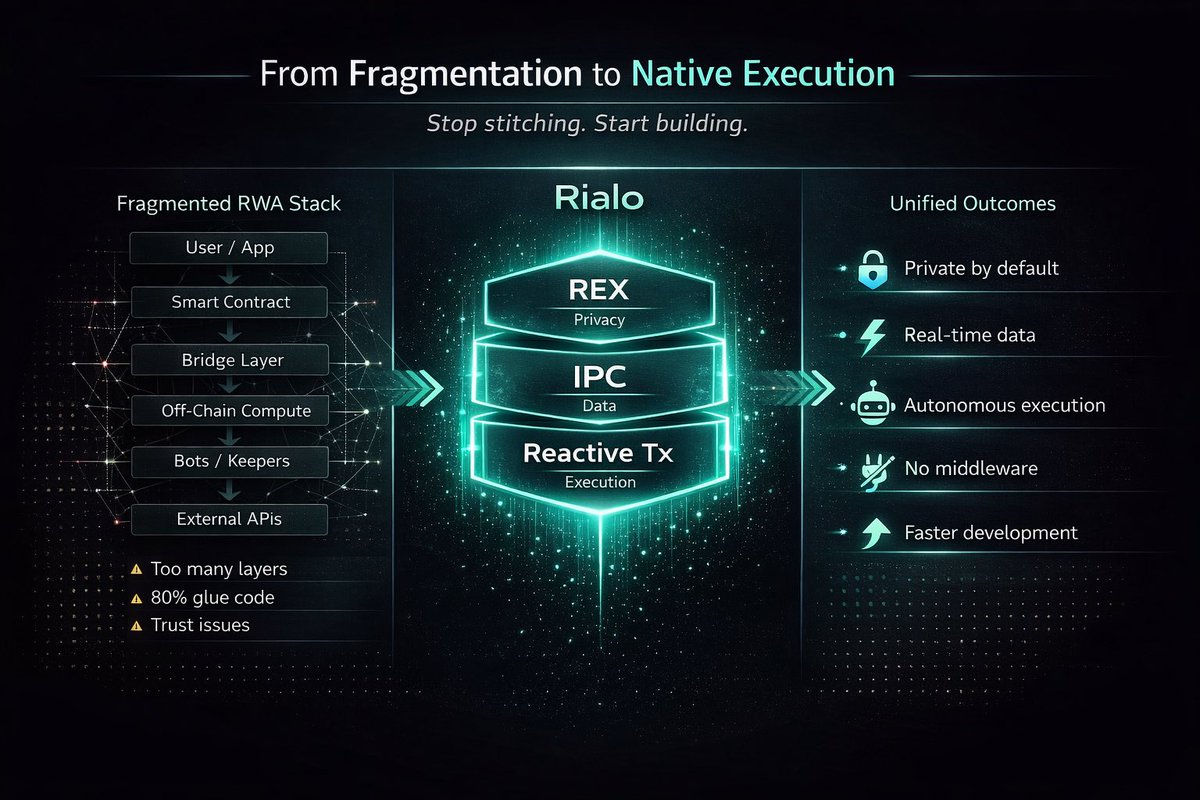
Rialo’s edge comes from three protocol-level innovations that eliminate the need for complex external tooling.
• REX: Privacy Execution Environment
REX enables secure computation of sensitive data within a “private vault” on-chain. Using techniques like identity-based encryption and MPC, it allows verification (e.g., KYC or compliance) without exposing raw data. This solves a major barrier for institutions handling confidential information.
• IPC: Inter-Process Communication
IPC connects smart contracts directly to external Web2 data sources. Instead of relying on oracles and middleware, developers can fetch real-time API data with on-chain verification. This drastically reduces development overhead and enables seamless, compliant RWA transactions.
• Reactive Transactions: Native Automation
Reactive transactions embed automation into the protocol through condition-based triggers. Whether based on time, on-chain events, or external data, processes like coupon payments, NAV updates, and redemptions execute automatically—turning static assets into autonomous systems.
🔗 Impact on the Current RWA Landscape
Despite rapid growth, RWA faces three key challenges: privacy risks, compliance trade-offs, and fragmented infrastructure. Rialo directly addresses all three.
• Solving the Privacy Paradox
REX enables selective disclosure—sharing only necessary data with regulators while keeping sensitive information private. This unlocks institutional use cases like private credit and real estate.
• Overcoming Infrastructure Fragmentation
Rialo unifies data access (IPC), privacy (REX), and execution (reactive transactions) at the protocol level. For example, a compliant transfer becomes a seamless flow: trigger → private verification → automatic settlement. This removes middleware and significantly reduces development complexity.
🔗 Future Directions for RWA and Rialo’s Role
RWA is shifting from passive tokenization to programmable finance, where assets react dynamically to real-world events.
• From Tokenized Records to Autonomous Systems
With reactive transactions and IPC, RWAs can automate dividends, defaults, and settlements. This transforms tokens into active workflows, enabling AI-driven finance and real-time market interactions.
• Bridging Institutions to On-Chain Scale
Rialo lowers adoption barriers through privacy-preserving compliance and familiar Web2 integrations. By solving the oracle problem natively and enabling seamless UX, it positions itself as infrastructure for a potential $10T RWA market.
🔗 Conclusion
Rialo’s stack—REX, IPC, and reactive transactions—redefines how RWAs operate. By combining Web2 usability with Web3 security, it enables a shift from fragmented systems to unified, autonomous financial infrastructure.
As RWA evolves into core market infrastructure, Rialo has the potential to become the foundational layer powering real economic activity on-chain.
@RialoHQ @RialoKorea @silverwave1000

✔️ Rialo and the Missing Infrastructure Layer of Web3
🔗 The Problem: Web3 Still Can’t Interact With the Real World
Blockchain performance has improved dramatically—higher TPS, faster block times, and lower fees. Yet real-world adoption remains limited.
The reason is structural.
Most blockchains operate as closed execution environments. They cannot directly access external data, private information, or real-world systems without relying on additional infrastructure.
To build a usable application, developers must depend on a stack of external components:
• oracles for data
• bridges for interoperability
• bots or keepers for automation
This “middleware tax” adds latency, complexity, and security risk. As a result, many Web3 applications remain slower and more fragile than their Web2 counterparts.
🔗 The Bottleneck: Data, Privacy, and Automation
Three missing primitives limit what blockchains can actually do.
• External data access.
Blockchains rely on oracle networks to import real-world data, creating delays and trust assumptions.
• Confidential computation.
Most chains are fully transparent, making it difficult to integrate identity systems, financial services, or enterprise workflows.
• Event-driven execution.
Smart contracts cannot naturally react to real-world events. Developers rely on off-chain bots to trigger actions.
Together, these constraints keep most applications confined to crypto-native use cases.
🔗 Rialo’s Approach: Integrating Middleware Into the Protocol
Rialo addresses these limitations by integrating key infrastructure directly into the base layer.
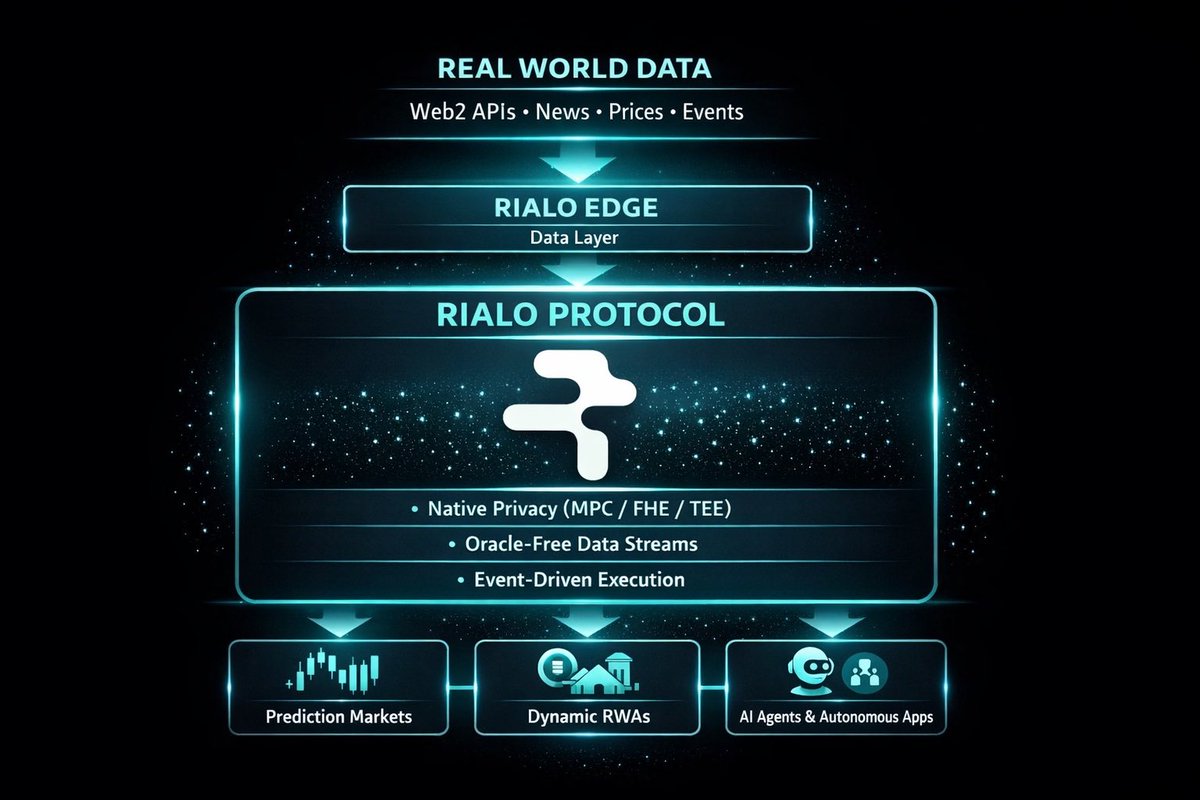
• Native privacy combines MPC, FHE, and Trusted Execution Environments to allow encrypted data to be processed securely.
• Oracle-free data streams enable validators to deliver real-world information directly to the network without external oracle systems.
• Event-driven execution allows contracts to react automatically to data and scheduled triggers without bots or relayers.
By embedding these capabilities into the protocol, Rialo removes much of the external infrastructure currently required to build blockchain applications.
🔗 Implications: Expanding What Blockchain Can Do
With native data, privacy, and automation, blockchains can move beyond purely financial speculation.
Possible applications include:
• real-time prediction markets
• dynamic tokenized assets (RWAs)
• autonomous AI agents executing on-chain actions
The broader impact is architectural. By collapsing multiple middleware layers into the protocol itself, Rialo reduces complexity for developers and opens the door to applications that behave more like real-world software.
In that sense, Rialo is less about another faster chain—and more about redefining the infrastructure layer that Web3 has been missing.
@RialoHQ @RialoKorea @silverwave1000
1
3
126
I’ve really enjoyed playing Kizzy over the past months and even made it to the top of the leaderboard, earning some MON along the way!
I heard there’s a big update coming soon.
I’m cheering for Kizzy, one of the most active projects on Monad!
@monad @kizzymobile

4
3
10
307
✔️ Rialo IPC Structure Overview
🔗 Rialo Overview
• Architectural Identity
Rialo is a supermodular Layer 1 blockchain designed as a fully integrated protocol rather than a loose combination of modules. It unifies RISC V smart contracts, Solana VM compatibility, and native web connectivity within a single execution environment, enabling low latency and event driven applications.
• Design Philosophy
Rialo aims to structurally eliminate fragmentation, bridge dependency, and off chain automation risks that have historically weakened blockchain systems. The network is built on the premise that speed, security, privacy, and regulatory compatibility should coexist by design.
🔗 The IPC Framework
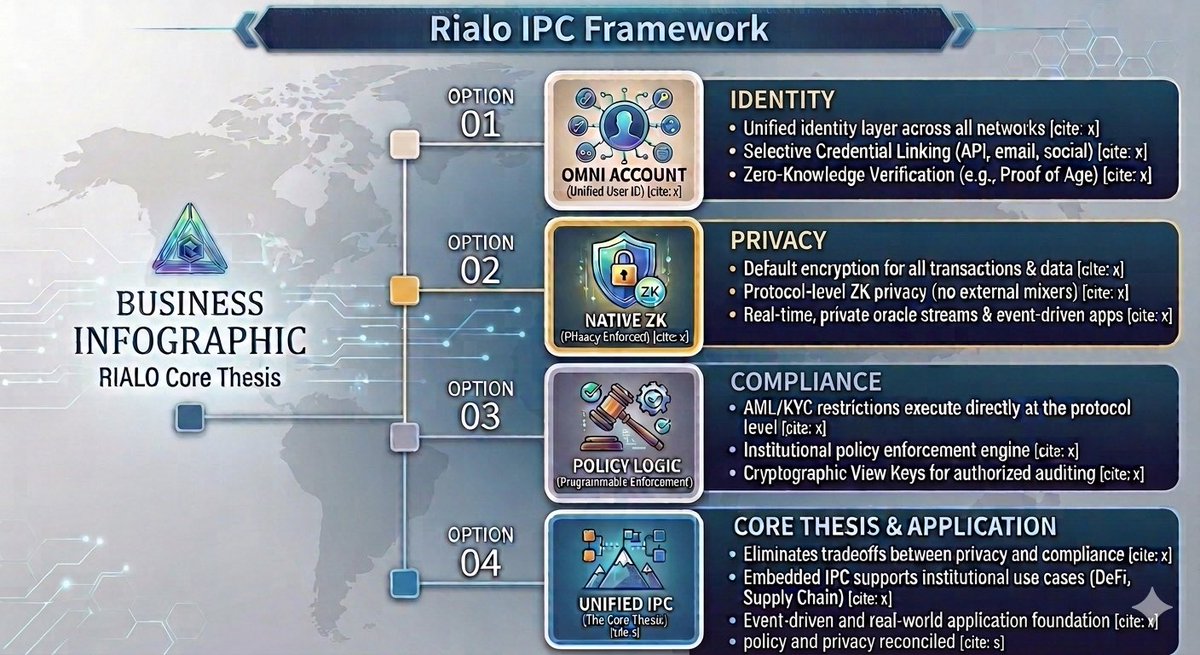
At the core of Rialo is the IPC framework, which integrates Identity, Privacy, and Compliance as native protocol primitives rather than external middleware components.
• Identity
- Omni Account
A unified identity layer that spans multiple networks, allowing users to interact across chains without fragmented wallets or repeated verification processes.
- Selective Credential Linking
Users can selectively connect real world credentials such as email, APIs, or social logins without exposing full personal data. Only necessary attributes are shared.
- Zero Knowledge Verification
Specific conditions such as age, jurisdiction, or regulatory eligibility can be proven without revealing full identity details. This supports anonymous onboarding while satisfying compliance requirements where needed.
• Privacy
- Default Encryption
All transactions are encrypted by default. Amounts and sensitive data remain protected unless explicitly disclosed.
- Native ZK and Encryption
Privacy is enforced at the protocol level without relying on external mixers or secondary privacy layers. Real time oracle streams and event driven applications operate without exposing sensitive information.
- Support for Sensitive Environments
Financial services, supply chains, governance systems, and other data sensitive sectors can build securely within a unified architecture.
• Compliance
- Programmable Enforcement
AML, KYC, and geographic restrictions execute directly at the protocol level. Rules function deterministically and reduce reliance on external intermediaries.
- Cryptographic View Keys
Authorized regulators can audit transactions when necessary through cryptographic access mechanisms, while ordinary user privacy remains intact.
- Institutional Participation
By combining privacy preservation with enforceable policy logic, Rialo enables both individual users and regulated institutions to participate within the same ecosystem.
🔗 Technical Characteristics
• Performance
Approximately 50 millisecond block times
Sub 100 millisecond finality
Efficient native interoperability compared to traditional bridges
• Execution Environment
Hybrid RISC V and SVM execution
Support for web integrations and reactive event driven applications
🔗 Application Areas
• Institutional DeFi
Private tokenized assets and regulation compatible yield models
• Supply Chain Systems
Encrypted verification of emissions, provenance, and logistics data
• Event Driven Applications
Automated execution triggered by APIs, messages, or external events
• Digital Citizenship Models
Governance systems built on sovereign identity and embedded privacy
🔗 Core Thesis
Rialo challenges the conventional tradeoffs between privacy and compliance, and between speed and security. By embedding Identity, Privacy, and Compliance directly into the protocol layer, it establishes a blockchain infrastructure designed for both real world users and regulated institutions.
@RialoHQ @RialoKorea @itachee_x
✔️ Solana VM and RISC-V: The Dual Execution Model Reshaping Developer Flexibility
🔗 Introduction: Beyond the Single VM Constraint
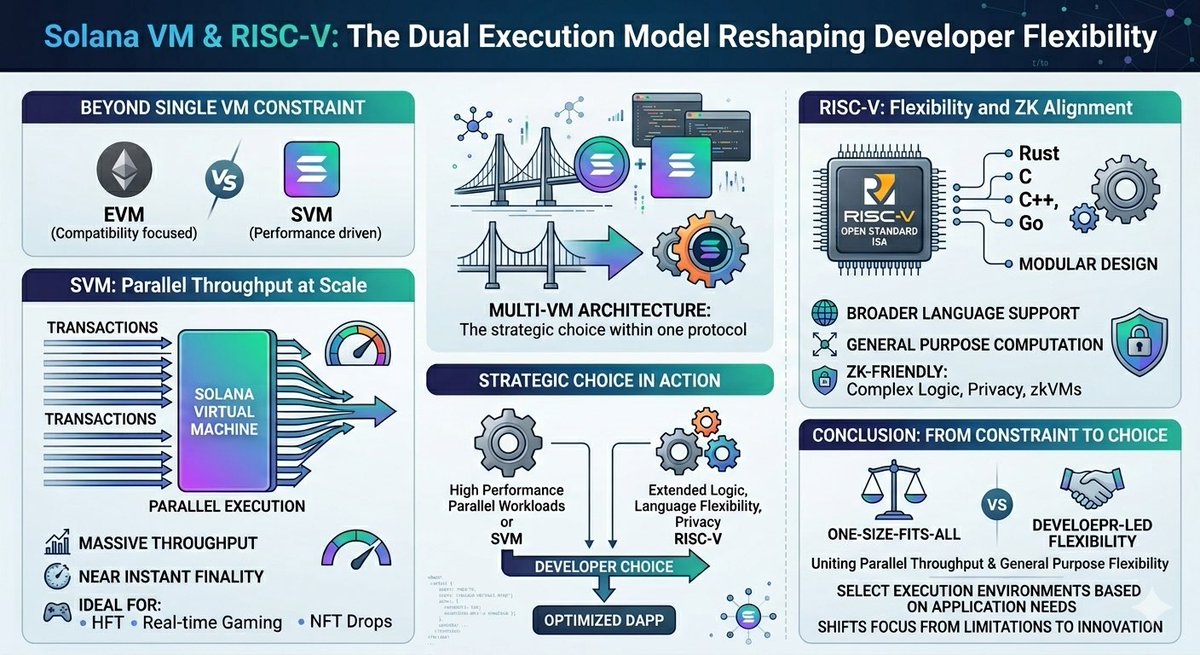
Blockchain development has long been defined by a trade off: choose a VM optimized for speed, or one built for flexibility and general purpose computation. Developers traditionally had to adapt their logic to a single execution model, whether the compatibility focused EVM or the performance driven SVM.
The rise of multi VM architectures, particularly the combination of Solana VM and RISC-V, changes this dynamic. Instead of forcing a choice, developers can select the right execution environment within the same protocol.
🔗 SVM: Parallel Throughput at Scale
Solana’s Virtual Machine is built for massive parallel execution. Unlike the sequential EVM model, SVM processes thousands of independent transactions simultaneously, delivering high throughput and near instant finality.
This makes it ideal for performance critical applications such as high frequency trading, real time gaming, and large scale NFT drops.
🔗 RISC-V: Flexibility and ZK Alignment
RISC-V provides a different advantage. As an open standard instruction set architecture, it enables broader language support and general purpose computation.
It supports languages such as Rust, C, C , and Go, and its modular design aligns well with zero knowledge proof systems. This makes it well suited for complex logic, privacy focused applications, and zkVM development.
🔗 Dual Execution in Practice
A dual execution architecture allows:
• SVM to handle high performance parallel workloads
• RISC-V to support extended logic and language flexibility
This structure gives developers strategic choice. Performance heavy applications can prioritize SVM, while computation intensive or privacy oriented systems can leverage RISC-V.
🔗 Conclusion
The combination of Solana VM and RISC-V moves blockchain design beyond one size fits all architecture. By uniting parallel throughput with general purpose flexibility, this model shifts the focus from constraint to choice, enabling developers to select execution environments based on application needs rather than protocol limitations.
@RialoHQ @RialoKorea @itachee_x
10
8
240
✔️ Solana VM and RISC-V: The Dual Execution Model Reshaping Developer Flexibility
🔗 Introduction: Beyond the Single VM Constraint
Blockchain development has long been defined by a trade off: choose a VM optimized for speed, or one built for flexibility and general purpose computation. Developers traditionally had to adapt their logic to a single execution model, whether the compatibility focused EVM or the performance driven SVM.
The rise of multi VM architectures, particularly the combination of Solana VM and RISC-V, changes this dynamic. Instead of forcing a choice, developers can select the right execution environment within the same protocol.
🔗 SVM: Parallel Throughput at Scale
Solana’s Virtual Machine is built for massive parallel execution. Unlike the sequential EVM model, SVM processes thousands of independent transactions simultaneously, delivering high throughput and near instant finality.
This makes it ideal for performance critical applications such as high frequency trading, real time gaming, and large scale NFT drops.
🔗 RISC-V: Flexibility and ZK Alignment
RISC-V provides a different advantage. As an open standard instruction set architecture, it enables broader language support and general purpose computation.
It supports languages such as Rust, C, C , and Go, and its modular design aligns well with zero knowledge proof systems. This makes it well suited for complex logic, privacy focused applications, and zkVM development.
🔗 Dual Execution in Practice
A dual execution architecture allows:
• SVM to handle high performance parallel workloads
• RISC-V to support extended logic and language flexibility
This structure gives developers strategic choice. Performance heavy applications can prioritize SVM, while computation intensive or privacy oriented systems can leverage RISC-V.
🔗 Conclusion
The combination of Solana VM and RISC-V moves blockchain design beyond one size fits all architecture. By uniting parallel throughput with general purpose flexibility, this model shifts the focus from constraint to choice, enabling developers to select execution environments based on application needs rather than protocol limitations.
@RialoHQ @RialoKorea @itachee_x
✔️ Rialo's Supermodularity: Beyond the Modular-Monolithic Dichotomy
🔗 The End of an Architectural Era
The modular vs. monolithic debate has dominated blockchain architecture for a decade, but this framework is becoming obsolete. As blockchain technology matures, the focus has shifted from basic properties like throughput and speed to more sophisticated requirements: seamless user experiences, sustainable economic models, and genuine value creation. Rialo's Supermodularity represents a paradigm shift that moves beyond this artificial dichotomy.
🔗 What is Supermodularity?
Supermodularity describes systems where components work better together than they do separately. Unlike traditional modular systems that prioritize interchangeability, or monolithic systems that emphasize integration, supermodular systems create emergent properties through thoughtful composition.
In blockchain terms, this means designing systems where:
- Integration follows function rather than arbitrary architectural choices
- Components enhance each other's value when combined
- The whole becomes greater than the sum of its parts
🔗 The Limitations of Current Architectures
Modular Approaches excel at flexibility and specialization but struggle with:
- Cross-layer coordination costs
- Fragmented user experiences
- Complex economic alignment between layers
Monolithic Approaches provide seamless experiences but suffer from:
- Limited optimization potential
- Difficulty incorporating specialized innovations
- Scalability constraints
Both approaches force trade-offs that ultimately limit what decentralized applications can achieve.
🔗 Rialo's Implementation of Supermodularity
Rialo achieves supermodularity through several key innovations:
Unified Execution Environment: Rather than separating execution layers, Rialo creates an integrated environment where different execution paradigms can coexist and interoperate seamlessly.
Adaptive Resource Allocation: Resources are allocated dynamically based on application needs, avoiding the rigid partitioning of modular systems or the one-size-fits-all approach of monoliths.
Cross-component Optimization: Components are designed with awareness of each other, enabling optimizations that wouldn't be possible in isolated modular systems.
🔗 Practical Benefits for Developers and Users
For Developers:
- Simplified development without sacrificing specialization
- Access to optimized cross-component functionality
- Reduced integration overhead
For Users:
- Seamless experiences across different dApps
- Consistent economic models and security guarantees
- Better performance through integrated optimizations
🔗 The Future of Blockchain Architecture
Supermodularity represents the next evolution in blockchain design, similar to how smartphones converged previously separate technologies (GPS, cameras, internet) into integrated devices that created entirely new capabilities.
This approach enables blockchain technology to finally deliver on its promise of accessible, valuable decentralized applications that can compete with centralized alternatives on user experience while maintaining decentralization benefits.
🔗 Conclusion: Beyond False Choices
Rialo's Supermodularity moves the conversation beyond the false choice between modular and monolithic architectures. By focusing on how components can work together to create emergent value, rather than how they should be separated or integrated, Rialo opens new possibilities for blockchain innovation.
The future belongs to systems that can harness the benefits of both specialization and integration—systems where architectural choices follow functional requirements rather than ideological preferences. Rialo's Supermodularity provides a framework for building this future.
@RialoHQ @RialoKorea @itachee_x
2
2
292
✔️ Rialo's Supermodularity: Beyond the Modular-Monolithic Dichotomy
🔗 The End of an Architectural Era
The modular vs. monolithic debate has dominated blockchain architecture for a decade, but this framework is becoming obsolete. As blockchain technology matures, the focus has shifted from basic properties like throughput and speed to more sophisticated requirements: seamless user experiences, sustainable economic models, and genuine value creation. Rialo's Supermodularity represents a paradigm shift that moves beyond this artificial dichotomy.
🔗 What is Supermodularity?
Supermodularity describes systems where components work better together than they do separately. Unlike traditional modular systems that prioritize interchangeability, or monolithic systems that emphasize integration, supermodular systems create emergent properties through thoughtful composition.
In blockchain terms, this means designing systems where:
- Integration follows function rather than arbitrary architectural choices
- Components enhance each other's value when combined
- The whole becomes greater than the sum of its parts
🔗 The Limitations of Current Architectures
Modular Approaches excel at flexibility and specialization but struggle with:
- Cross-layer coordination costs
- Fragmented user experiences
- Complex economic alignment between layers
Monolithic Approaches provide seamless experiences but suffer from:
- Limited optimization potential
- Difficulty incorporating specialized innovations
- Scalability constraints
Both approaches force trade-offs that ultimately limit what decentralized applications can achieve.
🔗 Rialo's Implementation of Supermodularity
Rialo achieves supermodularity through several key innovations:
Unified Execution Environment: Rather than separating execution layers, Rialo creates an integrated environment where different execution paradigms can coexist and interoperate seamlessly.
Adaptive Resource Allocation: Resources are allocated dynamically based on application needs, avoiding the rigid partitioning of modular systems or the one-size-fits-all approach of monoliths.
Cross-component Optimization: Components are designed with awareness of each other, enabling optimizations that wouldn't be possible in isolated modular systems.
🔗 Practical Benefits for Developers and Users
For Developers:
- Simplified development without sacrificing specialization
- Access to optimized cross-component functionality
- Reduced integration overhead
For Users:
- Seamless experiences across different dApps
- Consistent economic models and security guarantees
- Better performance through integrated optimizations
🔗 The Future of Blockchain Architecture
Supermodularity represents the next evolution in blockchain design, similar to how smartphones converged previously separate technologies (GPS, cameras, internet) into integrated devices that created entirely new capabilities.
This approach enables blockchain technology to finally deliver on its promise of accessible, valuable decentralized applications that can compete with centralized alternatives on user experience while maintaining decentralization benefits.
🔗 Conclusion: Beyond False Choices
Rialo's Supermodularity moves the conversation beyond the false choice between modular and monolithic architectures. By focusing on how components can work together to create emergent value, rather than how they should be separated or integrated, Rialo opens new possibilities for blockchain innovation.
The future belongs to systems that can harness the benefits of both specialization and integration—systems where architectural choices follow functional requirements rather than ideological preferences. Rialo's Supermodularity provides a framework for building this future.
@RialoHQ @RialoKorea @itachee_x
✔️ Traditional Staking vs Rialo SfS: The Shift in Blockchain Economics
🔗 The Core Problem: Capital and Consumption
Most blockchains separate earning from spending. Users stake tokens to secure the network and earn yield, but they must hold separate balances to pay for gas, storage, and recurring activity. That split creates constant friction. Long term capital sits locked in yield positions while short term usage requires active top ups, rebalancing, and monitoring.
Developers feel this even more sharply. Dapps need operational float in native tokens to cover recurring fees. If balances run dry, services halt. Scheduled smart contracts and subscription logic require constant refueling, a pattern that feels unnatural compared to Web2’s recurring billing systems.
The result is structural inefficiency. Capital earns passively. Consumption is manual. The two rarely align.
🔗 Rialo’s Stake for Service
Rialo introduces Stake for Service, or SfS, to merge staking and spending into a single loop. Instead of claiming rewards and manually funding activity, users route a portion of staking yield directly toward network costs.
When creating an SfS position, users define what percentage of future rewards should fund services. Those rewards are sent to a ServicePaymaster component, which converts them into service credits. These credits automatically pay for gas, storage, and scheduled execution across the ecosystem.
The principal remains staked and continues earning. A portion of yield becomes a live payment stream. No reward claiming. No manual top ups. Activity sustains itself as long as the stake exists.
This turns staking from passive savings into an ongoing service budget.
🔗 Practical Impact
For developers, the overhead drops dramatically. There is less need for cron bots, refill scripts, monitoring systems, and other maintenance scaffolding. Applications can operate in a self sustaining state, funded continuously by their economic backing.
For users, the experience becomes less fragile. Instead of juggling wallets and unpredictable fees, they define a service allocation once and let yield handle the rest. The system starts to resemble familiar Web2 models such as recurring billing, email login, and scheduled transactions, without abandoning blockchain guarantees.
🔗 Privacy by Design
SfS also changes how privacy works. In most systems, identity leaks through funding patterns. On ramps tie capital to real identities. Repeated top ups expose timing behavior. Gas payments reveal usage metadata.
SfS reduces these signals by removing repeated funding events. Capital is staked once. Service credits flow from yield. Transactions consume credits rather than directly funded tokens. The visible link between capital movement and activity weakens significantly.
Instead of layering privacy tools on top, the funding structure itself limits behavioral leakage.
🔗 A Self Sustaining Loop
SfS reflects a broader design shift. By integrating staking rewards with service payments, Rialo aligns incentives across users, validators, and applications. Yield no longer sits idle waiting to be claimed. It continuously powers network activity.
The outcome is a blockchain that behaves more like a normal service. Contracts can run on schedules, react to events, and operate without constant refueling. Builders write logic instead of maintenance code. Users interact without wallet gymnastics.
It is not just a feature upgrade. It is a rethinking of how capital, consumption, and infrastructure relate to each other on chain.
@RialoHQ @RialoKorea @itachee_x
5
5
207
✔️ Traditional Staking vs Rialo SfS: The Shift in Blockchain Economics
🔗 The Core Problem: Capital and Consumption
Most blockchains separate earning from spending. Users stake tokens to secure the network and earn yield, but they must hold separate balances to pay for gas, storage, and recurring activity. That split creates constant friction. Long term capital sits locked in yield positions while short term usage requires active top ups, rebalancing, and monitoring.
Developers feel this even more sharply. Dapps need operational float in native tokens to cover recurring fees. If balances run dry, services halt. Scheduled smart contracts and subscription logic require constant refueling, a pattern that feels unnatural compared to Web2’s recurring billing systems.
The result is structural inefficiency. Capital earns passively. Consumption is manual. The two rarely align.
🔗 Rialo’s Stake for Service
Rialo introduces Stake for Service, or SfS, to merge staking and spending into a single loop. Instead of claiming rewards and manually funding activity, users route a portion of staking yield directly toward network costs.
When creating an SfS position, users define what percentage of future rewards should fund services. Those rewards are sent to a ServicePaymaster component, which converts them into service credits. These credits automatically pay for gas, storage, and scheduled execution across the ecosystem.
The principal remains staked and continues earning. A portion of yield becomes a live payment stream. No reward claiming. No manual top ups. Activity sustains itself as long as the stake exists.
This turns staking from passive savings into an ongoing service budget.
🔗 Practical Impact
For developers, the overhead drops dramatically. There is less need for cron bots, refill scripts, monitoring systems, and other maintenance scaffolding. Applications can operate in a self sustaining state, funded continuously by their economic backing.
For users, the experience becomes less fragile. Instead of juggling wallets and unpredictable fees, they define a service allocation once and let yield handle the rest. The system starts to resemble familiar Web2 models such as recurring billing, email login, and scheduled transactions, without abandoning blockchain guarantees.
🔗 Privacy by Design
SfS also changes how privacy works. In most systems, identity leaks through funding patterns. On ramps tie capital to real identities. Repeated top ups expose timing behavior. Gas payments reveal usage metadata.
SfS reduces these signals by removing repeated funding events. Capital is staked once. Service credits flow from yield. Transactions consume credits rather than directly funded tokens. The visible link between capital movement and activity weakens significantly.
Instead of layering privacy tools on top, the funding structure itself limits behavioral leakage.
🔗 A Self Sustaining Loop
SfS reflects a broader design shift. By integrating staking rewards with service payments, Rialo aligns incentives across users, validators, and applications. Yield no longer sits idle waiting to be claimed. It continuously powers network activity.
The outcome is a blockchain that behaves more like a normal service. Contracts can run on schedules, react to events, and operate without constant refueling. Builders write logic instead of maintenance code. Users interact without wallet gymnastics.
It is not just a feature upgrade. It is a rethinking of how capital, consumption, and infrastructure relate to each other on chain.
@RialoHQ @RialoKorea @itachee_x
✔️ Real-Time Market Data On-Chain: What Rialo Stonk Crush Demo Proved
Rialo, a developer-first Layer-1 blockchain developed by Subzero Labs with backing from Pantera Capital, has demonstrated a transformative breakthrough in on-chain market data infrastructure through its Stonk Crush demo. This real-time market terminal showcases 1,337 live tickers operating with sub-second proofs and zero oracle dependency - representing a paradigm shift in how financial markets can operate on blockchain infrastructure.
The core innovation lies in Rialo's ability to process and verify market data natively on-chain without relying on external oracle systems. Traditional decentralized finance has long struggled with the oracle problem - the need to trust third-party data providers for price feeds and market information. Rialo's technology eliminates this vulnerability entirely by achieving cryptographic verification at the execution layer, ensuring that all market data is transparent, tamper-proof, and available in real-time.
This breakthrough has profound implications for both decentralized and traditional finance. For DeFi, it means that complex financial instruments including derivatives, options, and synthetic assets can now operate with truly trustless price feeds. The sub-second proof capability enables high-frequency trading strategies that were previously impossible on blockchain networks due to latency issues. For traditional finance, Rialo's technology offers a path toward complete market transparency where every trade, every price movement, and every market event is immutably recorded and publicly verifiable.
The Stonk Crush demo specifically demonstrates real-time tracking of 1,337 tickers, which represents comprehensive market coverage across multiple asset classes. This scale of operation proves that the technology is not merely theoretical but capable of handling the volume and complexity of actual financial markets. The elimination of oracles also removes single points of failure and manipulation risks that have plagued previous attempts at on-chain market infrastructure.
From a technical perspective, Rialo's achievement rests on several innovations including optimized consensus mechanisms, efficient data structures for market information, and novel approaches to state management. The result is a system that maintains blockchain's core values of decentralization and transparency while delivering the performance characteristics required by professional trading environments.
The implications extend beyond trading to encompass regulatory compliance, audit trails, and market surveillance. With every market action permanently recorded on-chain, regulators could access complete, unalterable market histories while market participants could prove their compliance programmatically. This could significantly reduce the compliance overhead that currently burdens financial institutions while simultaneously improving market integrity.
As blockchain technology continues to mature, Rialo's demonstration points toward a future where traditional financial markets and decentralized finance converge on transparent, verifiable infrastructure. The elimination of information asymmetry through cryptographically guaranteed data integrity could fundamentally reshape how markets operate, creating a more efficient and accessible financial system for all participants.
@RialoHQ @RialoKorea @itachee_x
13
14
229
✔️ Real-Time Market Data On-Chain: What Rialo Stonk Crush Demo Proved
Rialo, a developer-first Layer-1 blockchain developed by Subzero Labs with backing from Pantera Capital, has demonstrated a transformative breakthrough in on-chain market data infrastructure through its Stonk Crush demo. This real-time market terminal showcases 1,337 live tickers operating with sub-second proofs and zero oracle dependency - representing a paradigm shift in how financial markets can operate on blockchain infrastructure.
The core innovation lies in Rialo's ability to process and verify market data natively on-chain without relying on external oracle systems. Traditional decentralized finance has long struggled with the oracle problem - the need to trust third-party data providers for price feeds and market information. Rialo's technology eliminates this vulnerability entirely by achieving cryptographic verification at the execution layer, ensuring that all market data is transparent, tamper-proof, and available in real-time.
This breakthrough has profound implications for both decentralized and traditional finance. For DeFi, it means that complex financial instruments including derivatives, options, and synthetic assets can now operate with truly trustless price feeds. The sub-second proof capability enables high-frequency trading strategies that were previously impossible on blockchain networks due to latency issues. For traditional finance, Rialo's technology offers a path toward complete market transparency where every trade, every price movement, and every market event is immutably recorded and publicly verifiable.
The Stonk Crush demo specifically demonstrates real-time tracking of 1,337 tickers, which represents comprehensive market coverage across multiple asset classes. This scale of operation proves that the technology is not merely theoretical but capable of handling the volume and complexity of actual financial markets. The elimination of oracles also removes single points of failure and manipulation risks that have plagued previous attempts at on-chain market infrastructure.
From a technical perspective, Rialo's achievement rests on several innovations including optimized consensus mechanisms, efficient data structures for market information, and novel approaches to state management. The result is a system that maintains blockchain's core values of decentralization and transparency while delivering the performance characteristics required by professional trading environments.
The implications extend beyond trading to encompass regulatory compliance, audit trails, and market surveillance. With every market action permanently recorded on-chain, regulators could access complete, unalterable market histories while market participants could prove their compliance programmatically. This could significantly reduce the compliance overhead that currently burdens financial institutions while simultaneously improving market integrity.
As blockchain technology continues to mature, Rialo's demonstration points toward a future where traditional financial markets and decentralized finance converge on transparent, verifiable infrastructure. The elimination of information asymmetry through cryptographically guaranteed data integrity could fundamentally reshape how markets operate, creating a more efficient and accessible financial system for all participants.
@RialoHQ @RialoKorea @itachee_x
✔️ Rialo's Native Data Fetching: Direct Connectivity from APIs to Email/SMS
🔗 Introduction to Rialo: The Real-World Blockchain
Rialo, developed by Subzero Labs, represents a fundamental rethinking of blockchain architecture designed specifically for real-world integration. Founded by former Mysten Labs engineers with backgrounds at Meta, Netflix, and Google, Rialo aims to bridge the gap between Web2 and Web3 by enabling seamless interaction with traditional internet services. Backed by $20 million in funding led by Pantera Capital, Rialo positions itself as the first blockchain built from the ground up for real-world applications.
🔗 Native Data Fetching & API Connectivity
Rialo's breakthrough innovation lies in its Verifiable External Data Invocation model, which enables smart contracts to call Web2 APIs directly without middleware or oracles. Traditional blockchain approaches require third-party oracle services like Chainlink, introducing trust assumptions, latency, and potential failure points. Rialo eliminates these dependencies through three cryptographic proofs that accompany every data fetch:
- Bounded Source Proof: Verifies data originates from the specified API endpoint
- Integrity Proof: Ensures data hasn't been tampered with during transmission
- Time Attestation: Confirms data was fetched at the exact requested time
This architecture, powered by Rialo Edge and Rialo Stream, allows contracts to make >100k concurrent web calls with native speed, achieving 40x faster data delivery than traditional oracles while maintaining cryptographic verifiability.
🔗 Direct Email & SMS Integration
Through Rialo IPC (Identity, Privacy and Compliance), the network enables native communication with email, SMS, and social identities. This revolutionary capability allows:
- Passwordless Web3 Onboarding: Users can authenticate via email or SMS without seed phrases
- Encrypted Messaging: Apps can send secure messages directly to real people via their preferred channels
- Social Identity Preservation: Users maintain their existing social identities from platforms like X or TikTok
This approach eliminates the wallet bottleneck that has plagued Web3 adoption, making blockchain interactions as familiar as Web2 experiences while maintaining security and privacy through encryption-at-source and on-chain verification.
🔗 Transformative Impact on Real-World Applications
Rialo's native connectivity enables previously impossible use cases across multiple domains:
Real-World Assets (RWAs): Tokenized assets can automatically adjust to real-time market data, credit ratings, and corporate actions without manual intervention. Bonds can auto-adjust yields to CPI prints, while real estate tokens can incorporate fresh appraisals instantly.
AI Agent Economy: Through programs like SCALE(Simple Contracts for Agent Labor Execution), Rialo enables decentralized AI agents to perform tasks with automatic quality assurance and payment settlement. Agents can communicate via native web calls and be triggered by real-world events.
DeFi & Trading: Native data feeds enable real-time pricing without oracle delays, while confidential computation allows encrypted trading algorithms to operate with verified market data inputs.
🔗 Conclusion: The Future of Web2-Web3 Convergence
Rialo represents a paradigm shift in blockchain design, moving beyond isolated state machines to create a network that actively engages with the real world. By making API calls, email/SMS communication, and real-world data verification native blockchain primitives, Rialo enables developers to build applications that feel like modern Web2 software while maintaining Web3's trust guarantees. This architecture finally makes blockchain technology accessible for mainstream applications beyond cryptocurrency speculation, unlocking the true potential of decentralized systems for real-world use cases.
@RialoHQ @RialoKorea @itachee_x

10
9
218
Today's @RialoHQ Quiz Review
Question 1
Which capability allows Rialo smart contracts to interact with real-world web services directly?
1️⃣ Token bridging
2️⃣ Oracle staking
3️⃣ HTTPS requests ✅
4️⃣ Gas abstraction
Question 2
What privacy mechanism enables transaction data to be selectively revealed when needed?
1️⃣ View keys ✅
2️⃣ Liquidity locks
3️⃣ Multisig validation
4️⃣ Batch execution
Question 3
Which execution model allows Rialo applications to respond automatically to external events?
1️⃣ Time-locked logic
2️⃣ Event-driven execution ✅
3️⃣ Manual consensus
4️⃣ Static scripting
Question 4
Which contract architecture is supported to improve developer performance and portability?
1️⃣ RISC-V ✅
2️⃣ EVM bytecode
3️⃣ Solidity-Lite
4️⃣ WebAssembly
Question 5
What feature helps Rialo balance privacy with compliance requirements?
1️⃣ Token vesting
2️⃣ Burn mechanisms
3️⃣ Selective auditability ✅
4️⃣ Gas rebates
Question 6
Which Rialo functionality allows smart contracts to react to off-chain data inputs?
1️⃣ NFT staking
2️⃣ Token wrapping
3️⃣ Reactive logic ✅
4️⃣ Fee pooling
Question 7
What type of applications were highlighted as a key use case for Rialo’s automation layer?
1️⃣ Static dashboards
2️⃣ Airdrop trackers
3️⃣ Autonomous agents ✅
4️⃣ Meme generators
Question 8
Which Rialo feature supports integration with traditional APIs?
1️⃣ On-chain HTTPS support ✅
2️⃣ Token fragmentation
3️⃣ Snapshot voting
4️⃣ Validator bonding
Question 9
What enables developers to build logic that executes based on predefined triggers?
1️⃣ Token throttling
2️⃣ Governance delay
3️⃣ Manual settlement
4️⃣ Conditional execution ✅
Question 10
Which infrastructure element allows Rialo apps to monitor and act on live inputs?
1️⃣ Event listeners ✅
2️⃣ Bridge locks
3️⃣ Batch relayers
4️⃣ Token routers
1
1
67
✔️ Rialo's Native Data Fetching: Direct Connectivity from APIs to Email/SMS
🔗 Introduction to Rialo: The Real-World Blockchain
Rialo, developed by Subzero Labs, represents a fundamental rethinking of blockchain architecture designed specifically for real-world integration. Founded by former Mysten Labs engineers with backgrounds at Meta, Netflix, and Google, Rialo aims to bridge the gap between Web2 and Web3 by enabling seamless interaction with traditional internet services. Backed by $20 million in funding led by Pantera Capital, Rialo positions itself as the first blockchain built from the ground up for real-world applications.
🔗 Native Data Fetching & API Connectivity
Rialo's breakthrough innovation lies in its Verifiable External Data Invocation model, which enables smart contracts to call Web2 APIs directly without middleware or oracles. Traditional blockchain approaches require third-party oracle services like Chainlink, introducing trust assumptions, latency, and potential failure points. Rialo eliminates these dependencies through three cryptographic proofs that accompany every data fetch:
- Bounded Source Proof: Verifies data originates from the specified API endpoint
- Integrity Proof: Ensures data hasn't been tampered with during transmission
- Time Attestation: Confirms data was fetched at the exact requested time
This architecture, powered by Rialo Edge and Rialo Stream, allows contracts to make >100k concurrent web calls with native speed, achieving 40x faster data delivery than traditional oracles while maintaining cryptographic verifiability.
🔗 Direct Email & SMS Integration
Through Rialo IPC (Identity, Privacy and Compliance), the network enables native communication with email, SMS, and social identities. This revolutionary capability allows:
- Passwordless Web3 Onboarding: Users can authenticate via email or SMS without seed phrases
- Encrypted Messaging: Apps can send secure messages directly to real people via their preferred channels
- Social Identity Preservation: Users maintain their existing social identities from platforms like X or TikTok
This approach eliminates the wallet bottleneck that has plagued Web3 adoption, making blockchain interactions as familiar as Web2 experiences while maintaining security and privacy through encryption-at-source and on-chain verification.
🔗 Transformative Impact on Real-World Applications
Rialo's native connectivity enables previously impossible use cases across multiple domains:
Real-World Assets (RWAs): Tokenized assets can automatically adjust to real-time market data, credit ratings, and corporate actions without manual intervention. Bonds can auto-adjust yields to CPI prints, while real estate tokens can incorporate fresh appraisals instantly.
AI Agent Economy: Through programs like SCALE(Simple Contracts for Agent Labor Execution), Rialo enables decentralized AI agents to perform tasks with automatic quality assurance and payment settlement. Agents can communicate via native web calls and be triggered by real-world events.
DeFi & Trading: Native data feeds enable real-time pricing without oracle delays, while confidential computation allows encrypted trading algorithms to operate with verified market data inputs.
🔗 Conclusion: The Future of Web2-Web3 Convergence
Rialo represents a paradigm shift in blockchain design, moving beyond isolated state machines to create a network that actively engages with the real world. By making API calls, email/SMS communication, and real-world data verification native blockchain primitives, Rialo enables developers to build applications that feel like modern Web2 software while maintaining Web3's trust guarantees. This architecture finally makes blockchain technology accessible for mainstream applications beyond cryptocurrency speculation, unlocking the true potential of decentralized systems for real-world use cases.
@RialoHQ @RialoKorea @itachee_x
✔️ Oracle Failure and the Structural Limits of Prediction Markets vs. Rialo’s Native Verification
The fundamental challenge in prediction markets is oracle failure.
In 2025, a seven million dollar oracle manipulation incident on Polymarket exposed just how fragile existing systems can be. A large holder of UMA consolidated roughly 25 percent of the total voting power and influenced the outcome of a market tied to the Ukraine minerals deal. It was not just a one off exploit. It revealed structural weaknesses that have always existed within oracle based architectures.
Many prediction markets rely on centralized data sources or token weighted voting systems. This creates several problems. Voting power can concentrate in the hands of a few large holders. Data verification can be delayed. Resolution often depends on governance processes that are slow and economically attackable. In the end, users pay the cost in the form of uncertainty, settlement delays, and what is effectively a middleware tax.
These are not surface level flaws. They are design level constraints.
Rialo approaches the issue from a different angle through what it calls native verification.
Instead of routing truth through an external oracle layer, Rialo enables the blockchain to access primary sources directly. Through Native Webcalls and Native Triggers, the protocol can connect to government registries, market data feeds, and other authoritative sources and perform deterministic validation at the execution layer.
There is no reliance on token weighted oracle voting. There is no arbitration layer acting as a gatekeeper. Data flows from verified primary sources into the chain in a structured and deterministic way.
This creates what can be described as a vertical truth model, where validation happens natively rather than through economically incentivized intermediaries.
The implications are meaningful.
Removing oracle dependency reduces trust overhead and eliminates the attack surface created by vote concentration. Settlement speed improves to near real time, around 100 milliseconds. Governance capture and delayed dispute cycles no longer define the user experience.
When combined with Rialo Extended Execution, privacy can be preserved without sacrificing verifiability.
This is more than an incremental upgrade. It reframes how prediction markets can be designed. Instead of building systems that depend on trusted intermediaries or economic coordination games, the architecture moves toward deterministic, infrastructure level verification.
That shift changes the foundation of what trustless markets can actually mean.
@RialoHQ @RialoKorea
Happy Lunar new year🤍

9
8
180
✔️ Oracle Failure and the Structural Limits of Prediction Markets vs. Rialo’s Native Verification
The fundamental challenge in prediction markets is oracle failure.
In 2025, a seven million dollar oracle manipulation incident on Polymarket exposed just how fragile existing systems can be. A large holder of UMA consolidated roughly 25 percent of the total voting power and influenced the outcome of a market tied to the Ukraine minerals deal. It was not just a one off exploit. It revealed structural weaknesses that have always existed within oracle based architectures.
Many prediction markets rely on centralized data sources or token weighted voting systems. This creates several problems. Voting power can concentrate in the hands of a few large holders. Data verification can be delayed. Resolution often depends on governance processes that are slow and economically attackable. In the end, users pay the cost in the form of uncertainty, settlement delays, and what is effectively a middleware tax.
These are not surface level flaws. They are design level constraints.
Rialo approaches the issue from a different angle through what it calls native verification.
Instead of routing truth through an external oracle layer, Rialo enables the blockchain to access primary sources directly. Through Native Webcalls and Native Triggers, the protocol can connect to government registries, market data feeds, and other authoritative sources and perform deterministic validation at the execution layer.
There is no reliance on token weighted oracle voting. There is no arbitration layer acting as a gatekeeper. Data flows from verified primary sources into the chain in a structured and deterministic way.
This creates what can be described as a vertical truth model, where validation happens natively rather than through economically incentivized intermediaries.
The implications are meaningful.
Removing oracle dependency reduces trust overhead and eliminates the attack surface created by vote concentration. Settlement speed improves to near real time, around 100 milliseconds. Governance capture and delayed dispute cycles no longer define the user experience.
When combined with Rialo Extended Execution, privacy can be preserved without sacrificing verifiability.
This is more than an incremental upgrade. It reframes how prediction markets can be designed. Instead of building systems that depend on trusted intermediaries or economic coordination games, the architecture moves toward deterministic, infrastructure level verification.
That shift changes the foundation of what trustless markets can actually mean.
@RialoHQ @RialoKorea
Happy Lunar new year🤍
Grialo🤍
✔️ Why Developers Are Paying Attention to Rialo: Breaking Free from Oracle Failures
Rialo is gaining attention for introducing a fundamentally new approach to solving the long-standing oracle failures that blockchain developers have struggled with for years. By going beyond the limitations of traditional oracle solutions, Rialo enables more stable and trustworthy connections between off-chain data and on-chain logic.
> The Persistent Problems with Oracles
In the blockchain ecosystem, oracles are essential infrastructure that deliver real-world data to smart contracts. Yet historically, they have exposed several serious weaknesses:
• Data accuracy issues
When oracles rely on a single data source or lack robust verification mechanisms, incorrect data can be fed into smart contracts, sometimes resulting in significant financial losses.
• Single points of failure
Centralized oracle architectures are vulnerable to hacks and technical outages, turning them into systemic risks for entire dApp ecosystems.
• Poor cost efficiency
Complex verification processes and high gas costs make high-quality oracle services difficult to afford, especially for smaller projects.
• Scalability limitations
Supporting diverse data types and real-time data requirements has been challenging, slowing down the development of more innovative decentralized applications.
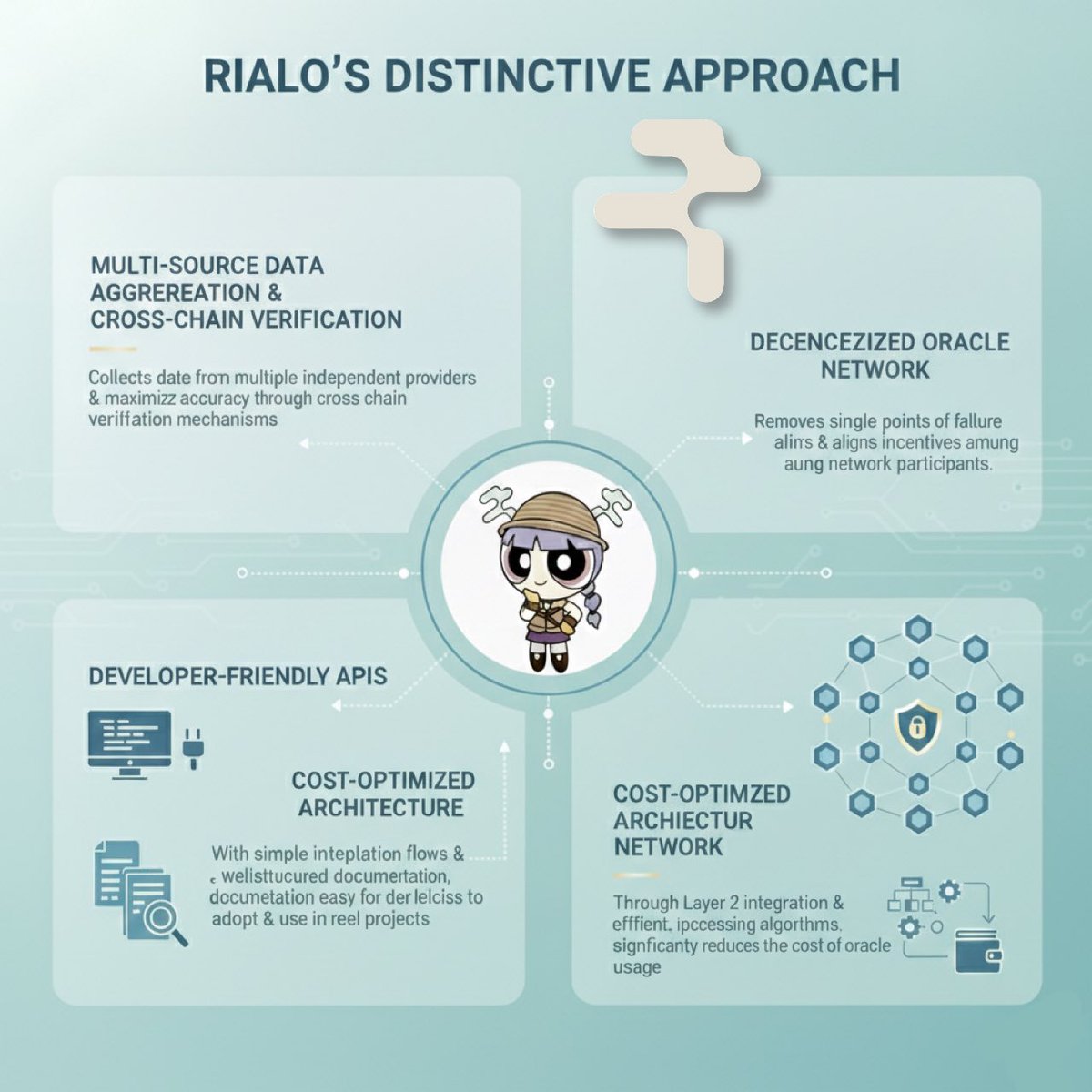
> Rialo’s Distinctive Approach
To address these challenges, Rialo introduces several key innovations:
• Multi-source data aggregation and cross-chain verification
Rialo collects data from multiple independent providers and maximizes accuracy through cross-chain verification mechanisms.
• A decentralized oracle network
By removing single points of failure and aligning incentives among network participants, Rialo strengthens data integrity at the protocol level.
• Cost-optimized architecture
Through Layer 2 integration and efficient data processing algorithms, Rialo significantly reduces the cost of oracle usage.
• Developer-friendly APIs
With simple integration flows and well-structured documentation, Rialo is designed to be easy for developers to adopt and use in real projects.
> Real-World Applications and Future Potential
Rialo’s technology is already showing meaningful results across several sectors. In DeFi protocols, accurate pricing data has reduced exposure to flash loan attacks. In prediction markets, it has enabled more reliable outcome resolution. In insurance dApps, it has made stable integration of real-world asset data possible.
The growing interest from developer communities is driven not only by Rialo’s technical strengths, but also by its practicality in solving real business problems. For developers who have experienced repeated frustration with oracle failures, Rialo offers a more stable and cost-effective alternative, with the potential to accelerate growth across the blockchain ecosystem.
If Rialo continues to push innovation and establish new standards for oracle infrastructure, the real-world applicability of blockchain technology is likely to expand significantly in the years ahead.
@RialoHQ @RialoKorea @itachee_x
8
9
196
Grialo🤍
✔️ Why Developers Are Paying Attention to Rialo: Breaking Free from Oracle Failures
Rialo is gaining attention for introducing a fundamentally new approach to solving the long-standing oracle failures that blockchain developers have struggled with for years. By going beyond the limitations of traditional oracle solutions, Rialo enables more stable and trustworthy connections between off-chain data and on-chain logic.
> The Persistent Problems with Oracles
In the blockchain ecosystem, oracles are essential infrastructure that deliver real-world data to smart contracts. Yet historically, they have exposed several serious weaknesses:
• Data accuracy issues
When oracles rely on a single data source or lack robust verification mechanisms, incorrect data can be fed into smart contracts, sometimes resulting in significant financial losses.
• Single points of failure
Centralized oracle architectures are vulnerable to hacks and technical outages, turning them into systemic risks for entire dApp ecosystems.
• Poor cost efficiency
Complex verification processes and high gas costs make high-quality oracle services difficult to afford, especially for smaller projects.
• Scalability limitations
Supporting diverse data types and real-time data requirements has been challenging, slowing down the development of more innovative decentralized applications.
> Rialo’s Distinctive Approach
To address these challenges, Rialo introduces several key innovations:
• Multi-source data aggregation and cross-chain verification
Rialo collects data from multiple independent providers and maximizes accuracy through cross-chain verification mechanisms.
• A decentralized oracle network
By removing single points of failure and aligning incentives among network participants, Rialo strengthens data integrity at the protocol level.
• Cost-optimized architecture
Through Layer 2 integration and efficient data processing algorithms, Rialo significantly reduces the cost of oracle usage.
• Developer-friendly APIs
With simple integration flows and well-structured documentation, Rialo is designed to be easy for developers to adopt and use in real projects.
> Real-World Applications and Future Potential
Rialo’s technology is already showing meaningful results across several sectors. In DeFi protocols, accurate pricing data has reduced exposure to flash loan attacks. In prediction markets, it has enabled more reliable outcome resolution. In insurance dApps, it has made stable integration of real-world asset data possible.
The growing interest from developer communities is driven not only by Rialo’s technical strengths, but also by its practicality in solving real business problems. For developers who have experienced repeated frustration with oracle failures, Rialo offers a more stable and cost-effective alternative, with the potential to accelerate growth across the blockchain ecosystem.
If Rialo continues to push innovation and establish new standards for oracle infrastructure, the real-world applicability of blockchain technology is likely to expand significantly in the years ahead.
@RialoHQ @RialoKorea @itachee_x
Grialo🤍
✔️ Zero Oracle Cost, Zero Delay: A New Standard Set by Rialo
> The Problem with Web3 Infrastructure
While Web3 promises decentralization, it still struggles with a fundamental issue: the oracle problem.
Existing oracle solutions are often expensive and slow, making it difficult for applications to access real-world data efficiently. As data usage increases, costs rise and delays grow, limiting what developers can realistically build.
Rialo challenges this structure by eliminating both cost and latency at the infrastructure level.
> Rialo’s Core Innovation: Zero Cost & Zero Delay
Zero Oracle Cost
Most oracle services charge per data request, which becomes a major burden for applications that rely on frequent updates.
Rialo removes per-request fees entirely, allowing developers to use real-time data without worrying about operational costs.
This makes data-heavy and real-time applications economically viable for the first time.
Instant Data Availability
Latency is another critical weakness of traditional oracles, often causing delays of several seconds or more.
Rialo delivers data at blockchain execution speed, effectively achieving zero delay.
This is especially important for time-sensitive use cases like trading, gaming, and dynamic NFTs.
How Rialo Makes This Possible
Rialo operates through a decentralized data verification network rather than a centralized server.
Multiple participants collectively validate and deliver data, improving both speed and security while removing single points of failure.
Instead of charging per request, Rialo rewards participants through alternative economic mechanisms such as staking incentives and network value capture, keeping data access free for users.
Standardized APIs and smart contract interfaces allow easy integration, even for existing projects.
> Key Use Cases
• DeFi: Real-time price feeds and collateral data without high oracle costs
• Gaming & Metaverse: Truly responsive, real-time on-chain interactions
• IoT & Real-World Data: Continuous data streams without accumulating fees
> Why Rialo Is Different
• Cost: No usage-based fees, regardless of scale
• Performance: Faster and more consistent data delivery than traditional oracles
• Security: Decentralized validation reduces manipulation and outages
> Conclusion
Rialo breaks the long-standing assumption that oracles must be expensive and slow.
By offering zero-cost, zero-delay data access, it enables a new class of decentralized applications that were previously impractical.
Rather than being just a better oracle, Rialo sets a new baseline for what Web3 infrastructure should look like.
@RialoHQ @RialoKorea @itachee_x

17
18
293
Real mingming | Monad (mainnet arc) retweeted

Jan 24
🎊 REAL AIRDROPS IS COMING !🎊
All RealNads NFT collection holders will receive 5 @Lootify_xyz mystery boxes with prizes worth up to $500. More you hold, greater your chances.
The snapshot has not start yet .
If you don't have yet, just go to buy 1 now!
To claim:
Connect to lootify.xyz/
Go to lootify.xyz/my-profile
Open the boxes
Use coupon code REALNADS for a 10% bonus on your first deposit to the platform
Come to get them Realnads .

14
11
87
5,616