
И чтец, и жнец, и на дуде игрец. Affirm, Glow, SciFi. ✡️
Joined April 2008
- Tweets 4,500
- Following 600
- Followers 255,288
- Likes 850
245 Photos and videos











Pinned Tweet

22 Nov 2024
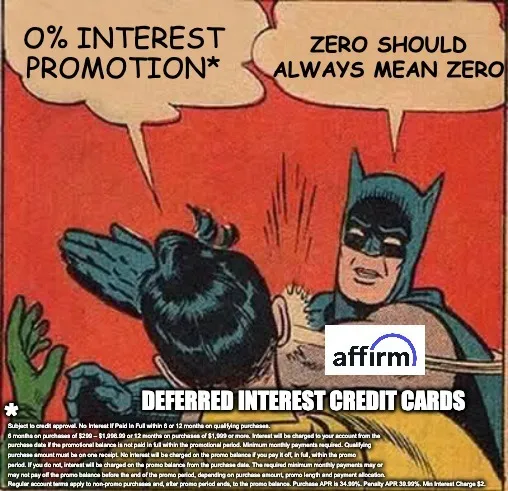
🚨A PSA as you consider your holiday shopping budget.🚨
When a traditional credit card bank suddenly announces they too offer BNPL services -- are they really trying to get their credit card holders to pay less interest and not revolve?!! Are they really turning pro-consumer?!!
Absolutely not: what they are trying to do is give their transactors (who never revolve) a feeling of a "safe debt" and ease them into revolving, which is where the money is for the bank . It's the "first one's free" honeypot.
So this holiday season, if you are considering using a pay-later service, the absolute WORST place you can get it from is a credit card issuing bank. They are just trying to trap ya. I'd give you names, but you already know who they are.
Praemonitus praemunitus!
55
22
149
79,684
Max Levchin retweeted

Jun 12
This single tweet cost California hundreds of billions of dollars in taxes, revenue, and jobs:
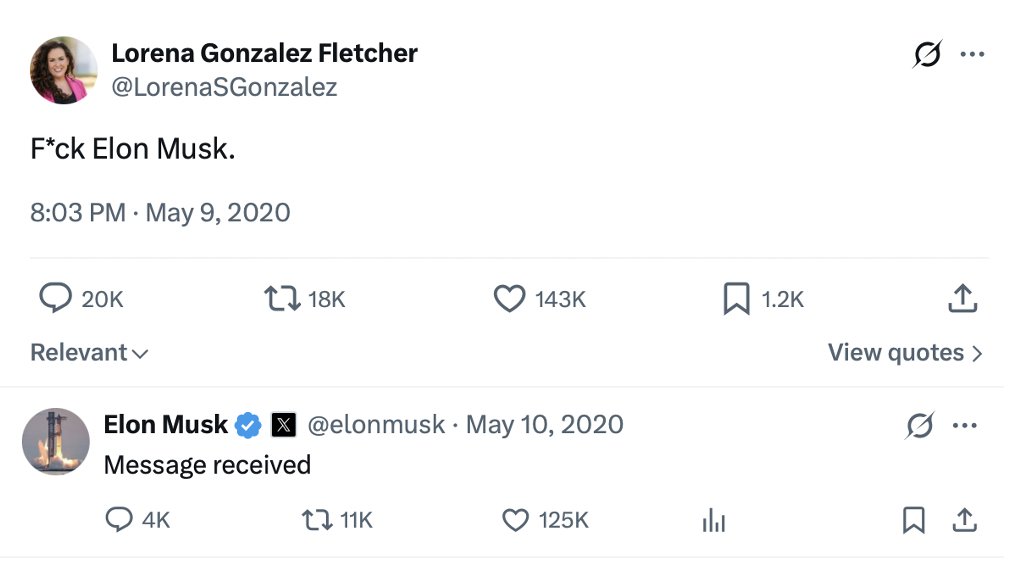
1,012
11,589
125,053
3,759,326
Max Levchin retweeted

Cute theory, let's play it out.
A monkey hoards a trillion bananas. The troop, enraged, beats him to death. They gather around the pile to feast at last.
But... oh wait, there is no pile.
It turns out the "bananas" were shares in a banana-launching company the dead monkey founded.
The shares were worth a trillion because he was alive to run it.
Now he is dead and the stock is worth $0.
The retarded monkeys have clubbed their way into a recession.
But it gets worse.
Half the "bananas" were tied up in a rocket that supplies bananas to monkeys on the far mountain who had no bananas at all.
Another chunk was tied up in a little satellite dish that beamed banana coordinates to the troop after a flood took out their trees.
So now they realized they beat to death the only monkey who knew how the dish worked.
So the monkeys sit there.
No bananas.
No rockets.
No coordinates to get more banananas.
Just a dead body and a powerful sense of fairness as they all now became infinitely poorer.
OH
And somewhere a smaller monkey watches the whole thing and quietly decides he will never build anything in front of these animals again.
776
2,717
21,326
306,254
Jun 11
This was a lot of fun to record. Long chat with fellow deep-nerd / anime fanatic / sci-fi reader / data-maxxer / reader of fine books / the one and only @tferriss!
Jun 11

Watch my full interview with @mlevchin: youtube.com/watch?v=uOjgVxOf…
4
5
50
19,987

“don’t train your own model” is common ai advice. it's wrong. your token bill's the proof.
today, we’re excited to launch castform into open preview. castform is the easiest way for you to train your own model, on your own data.
open-weights models are performant and much cheaper. when trained on your task & proprietary data, they beat closed models. the thing standing between you and that was weeks of plumbing & years of ml expertise.
with castform, model training is as simple as prompt engineering. @castformai
bring your agent traces or raw corpora. castform turns it into training data, picks the right algorithmic recipes, manages gpus, and gives you an ide to watch and chat with your model as it learns.
see what you can build with castform👇
222
233
2,523
415,388
Jun 10
My family and I came to the US from Kyiv in '91 with a few hundred dollars and a willingness to work hard. I owe everything to this great nation and am very proud to be an American by choice. Grateful to share my story with @CNBC.

From refugee to entrepreneur, @mlevchin reflects on the experiences and principles that have shaped his career in @CNBC's America: 250 Years Bold series.
bit.ly/4xnX6Ju
4
6
82
12,537

From refugee to entrepreneur, @mlevchin reflects on the experiences and principles that have shaped his career in @CNBC's America: 250 Years Bold series.
bit.ly/4xnX6Ju
3
4
19
13,583
Jun 4
I don’t know who did this, but it’s blasphemy. Blasphemy of the very best kind.

Im almost embarrassed to say how many times I listened to this. It actually gave me goosebumps. 😂
👉𝐋𝐨𝐫𝐝 𝐨𝐟 𝐭𝐡𝐞 𝐑𝐢𝐧𝐠𝐬 𝐃𝐢𝐬𝐜𝐨: 𝐎𝐧𝐞 𝐅𝐮𝐧𝐤 𝐭𝐨 𝐑𝐮𝐥𝐞 𝐭𝐡𝐞𝐦 𝐀𝐥𝐥
3
1
20
7,700
Jun 3
Always good talking with @BrianSozzi — he does the homework, which makes for a genuinely fun conversation. We got into payments, AI, sci-fi, and why Affirm is the longest job I've ever had. More below.
“This is by far the best time in history to run a company as an engineer.”
@mlevchin sat down with @BrianSozzi on @YahooFinance's Power Players to break down engineering-led companies, the future of AI, authentic communication, and more.👇
bit.ly/4xibLWy
1
3
23
5,799
“This is by far the best time in history to run a company as an engineer.”
@mlevchin sat down with @BrianSozzi on @YahooFinance's Power Players to break down engineering-led companies, the future of AI, authentic communication, and more.👇
bit.ly/4xibLWy
2
3
11
8,659
Max Levchin retweeted

May 26
Max Levchin (@mlevchin) Founded @Affirm and Slide. Co-Founded @PayPal, along with Peter Thiel and Elon Musk. Invented the CAPTCHA. Runs a $22 Billion publicly traded company. And launched the Levchin Prize for real-world cryptography.
I sat down with Max Levchin, Co-Founder and CEO of Affirm, for an in-depth @Fintech_Leaders interview. Max is one of the most technically brilliant founders in the history of fintech.
He arrived in the US from Ukraine at age 16 with zero English. He taught himself the language by watching TV and playing clarinet. Today he runs one of the largest publicly traded fintechs in the world.
We discussed the backstory of Affirm and their deliberate removal of late fees and compounding interest, why he believes the credit card is a broken product and how they’re fixing it, Affirm's powerful network effects, what the Citrini Research bear case got wrong, and what he learned working directly with Elon Musk and Peter Thiel.
This was a special live recording at Affirm's headquarters in San Francisco.
Thank you, Max and team, for hosting me!
9
5
51
12,763
"I challenge any lender, any bank, any financial services provider, to have the degree of … love" that consumers show Affirm. — Our founder and CEO @mlevchin on @MiguelArmaza's Fintech Leaders podcast.
🎧 bit.ly/4dK1R6P
2
3
20
3,027
Max Levchin retweeted

May 21
Please do a quick read of this. It’s short, well written, and will remove a bit of wool from over your eyes.

1,951
3,425
23,378
3,631,431
May 9
An incredible true story. Shabbat Shalom!
May 8

Two nine-year-old girls stood in a Berlin schoolyard in May 1939, holding each other and crying like the world was ending. For them, it was.
Annemarie Wahrenberg and Ilse Kohn had been best friends since they were six. They went to the same school, the same synagogue, the same ballet classes. They spent afternoons in each other’s apartments eating too much candy, laughing until they got in trouble, and dreaming about ordinary things little girls dream about. But by 1939, the Nazi laws had already stolen the city from them. No parks. No pools. No theaters. Just each other’s company in a shrinking world.
That morning, their fathers walked them to school for the last time. In the yard, the girls clung to one another and made a promise: they would stay in touch. They would find each other after the war. Then their fathers gently pulled them apart and led them in opposite directions.
Ilse’s family had scraped together enough to buy passage on a freighter from Italy to Shanghai — one of the last places on Earth still accepting Jewish refugees without visas. Annemarie’s family was still desperately searching for any exit.
A few weeks later, Ilse wrote her best friend a letter from Shanghai. She told her where she was. She said they would see each other again someday.
Annemarie never wrote back.
For the next eighty-two years, each woman carried the quiet grief of believing her best friend had been murdered in the Holocaust.
Ilse — who later became Betty Grebenschikoff — survived the war in Shanghai with about 20,000 other Jewish refugees. She eventually moved to Australia, then New York, then Atlantic City. She married, raised five children, and had seven grandchildren. She became a Holocaust educator, wrote a memoir for her family, and spoke in schools for decades. In nearly every talk, she mentioned her childhood best friend by name: Annemarie Wahrenberg. She recorded it in her 1997 USC Shoah Foundation testimony, hoping against hope that somewhere, somehow, Annemarie might hear her voice.
Annemarie — who became Ana María — escaped with her family to Santiago, Chile, in November 1939. Her father had been arrested and released by the Gestapo; they knew time was running out. She learned Spanish, built a life, married, had two children, six grandchildren, and ten great-grandchildren. She too became a Holocaust educator, speaking to students about what it meant to be a Jewish child in Berlin in those final months before the world caught fire. She searched databases. She asked questions. She never stopped wondering.
Both women had changed their names. Both had moved across continents. The spellings and surnames no longer matched. Search after search turned up nothing. Over time, each quietly accepted that the other had not survived.
Then, in November 2020, in the middle of the COVID pandemic, an archivist named Ita Gordon at the USC Shoah Foundation was watching a virtual Kristallnacht event from the Interactive Jewish Museum of Chile. A 90-year-old woman from Santiago began speaking about fleeing Berlin as a little girl. She talked about her best friend. The schoolyard. The goodbye.
Something clicked in Ita’s memory. She went into the archive, typed in names, schools, and synagogues. She found Betty’s 1997 testimony — the one where she spoke Annemarie’s name with such longing.
Ita made the call. She connected them.
In December 2020, Betty and Ana María saw each other on a Zoom call for the first time in eighty-two years. Their families gathered around, crying. The two old women looked at each other, started speaking German — a language Betty’s grandchildren had rarely heard — and then they began to laugh. Not polite laughter. Real, giddy, nine-year-old laughter.
“We’re not the girls we used to be,” Betty later told a reporter. But in that moment, they were.
They started weekly Sunday phone calls. They talked about the old neighborhood, the candy, the ballet, the people they lost. In November 2021, Ana María flew from Chile to Florida. At the airport, two 91-year-old women hugged for the first time since that terrible morning in 1939. They drank champagne. They appeared together at the Florida Holocaust Museum. They held on to each other like they were making up for eight decades in a single year.
Betty Grebenschikoff passed away in February 2023 at the age of 93. Ana María still lives in Chile.
Of all the millions of painful goodbyes said in 1939 — on schoolyard pavement, train platforms, and doorsteps — these two found their way back to each other before the end. Not because of fame or fortune, but because one persistent archivist refused to let a small detail in a testimony disappear.
Their story wrecks me every time I think about it. Not just because it’s a miracle of survival and reunion, but because it shows how stubborn love can be. How two little girls who promised to find each other kept that promise across continents, name changes, wars, and decades of assumed loss. How the human heart can hold onto hope long after logic says it should let go.
In a world that often feels divided and cruel, this story whispers something powerful: some bonds refuse to die. Some friendships are stronger than history. Some promises outlive the people who tried to break them.
The schoolyard in Berlin is still there. There’s a memorial stone listing the names of the children from that school who never came home. It’s a long list. Annemarie’s and Ilse’s names are not on it.
They got to say hello again.

5
6
132
23,900
May 1
Please watch this.
May 1

This is one of the most jaw-dropping, chilling interviews I have seen. Watch this Rabbi from London, respond to question about the terror stabbing in Golders Green!
3
5
122
12,070
Apr 21
Waffling on wanderlust? Vacillating on vacationing? Dithering over destination?
Watch this, and skip the trip yips.
youtube.com/watch?v=aEbhbEZf…
1
7
3,036
Apr 18
All document-editing software needs to have a preference setting for “Start numbered lists with 0.”
4
16
4,774
Apr 14
If there is one thing you take from this pod, it’s this: socialism corrupts more profoundly than simple words can express, and as the grift gets tougher, the socialists inevitably move from propaganda to oppression as the primary motivating approach. Don’t let it happen here!
Apr 14

.@mlevchin: "Socialism sucks."
"Take it from somebody who spent his first 16 years under the 'warm embrace of collectivism' as a certain mayor recently put it—socialism sucks."
"The only people who do well in redistribution of wealth are the ones doing redistribution."
"It's fundamentally corrupt. There's not enough bad things I can say about socialism."
34
142
956
66,253
Max Levchin retweeted

Apr 14
.@mlevchin: "Socialism sucks."
"Take it from somebody who spent his first 16 years under the 'warm embrace of collectivism' as a certain mayor recently put it—socialism sucks."
"The only people who do well in redistribution of wealth are the ones doing redistribution."
"It's fundamentally corrupt. There's not enough bad things I can say about socialism."
Apr 13

BREAKING: Max Levchin (@mlevchin), Co-Founder of PayPal & CEO of @Affirm — HQ Tour
A Masterclass in: Espressos → Big Lebowski → PayPal lessons → Affirm → Economics of AI
The Dude abides.
“The net IQ of the world Is about to go up 50 points”
Result: As intelligence becomes normalized, bad actors & "fine print" companies will get exposed faster.
We cover:
• Capitalism vs the “warm embrace” of socialism
• You can’t perfectly time an IPO
• The best time ever to be a CS CEO
• AI collapsing the cost of intelligence
• Great economic shift underway
Strikes & gutters, ups & downs.
Recorded at Affirm HQ, March 30, 2026
𝐓𝐈𝐌𝐄𝐒𝐓𝐀𝐌𝐏𝐒
(00:00) Max Levchin, Co-Founder & CEO at Affirm
(01:35) Inside Affirm's office espresso bar
(06:46) How the love for espressos started at age 5
(10:30) Truth about bad coffee beans
(13:51) Strava & cycling
(14:56) Meeting Alfred Lin & Tony Hsieh over poker
(21:14) Onboarding 800K Shopify merchants in one week
(22:59) Big Lebowski in every shareholder letter
(32:11) The PayPal lesson that built Affirm
(35:25) Being a technical CEO
(37:57) Why this is the best time to be a technical CEO
(42:10) Should engineers still learn to code?
(44:48) Side quest with AI
(46:59) Companies AI will destroy
(49:46) How AI has changed engineering at Affirm
(50:54) Agentic commerce & DoorDash
(52:28) Devolution of Credit
(55:06) Biggest misconceptions about BNPL
(57:42) Being a public company CEO
(01:07:01) Advice for private companies
(01:11:09) Creating his own economy
(01:14:29) Can AI help solve the $39T debt problem?
(01:16:00) Learnings
(01:17:46) Will average IQ rise or fall?
15
167
1,094
143,549
Apr 14
Thank you for visiting us at Affirm, @MollySOShea and nerding out with me on coffee (and some other topics)!
Apr 13
BREAKING: Max Levchin (@mlevchin), Co-Founder of PayPal & CEO of @Affirm — HQ Tour
A Masterclass in: Espressos → Big Lebowski → PayPal lessons → Affirm → Economics of AI
The Dude abides.
“The net IQ of the world Is about to go up 50 points”
Result: As intelligence becomes normalized, bad actors & "fine print" companies will get exposed faster.
We cover:
• Capitalism vs the “warm embrace” of socialism
• You can’t perfectly time an IPO
• The best time ever to be a CS CEO
• AI collapsing the cost of intelligence
• Great economic shift underway
Strikes & gutters, ups & downs.
Recorded at Affirm HQ, March 30, 2026
𝐓𝐈𝐌𝐄𝐒𝐓𝐀𝐌𝐏𝐒
(00:00) Max Levchin, Co-Founder & CEO at Affirm
(01:35) Inside Affirm's office espresso bar
(06:46) How the love for espressos started at age 5
(10:30) Truth about bad coffee beans
(13:51) Strava & cycling
(14:56) Meeting Alfred Lin & Tony Hsieh over poker
(21:14) Onboarding 800K Shopify merchants in one week
(22:59) Big Lebowski in every shareholder letter
(32:11) The PayPal lesson that built Affirm
(35:25) Being a technical CEO
(37:57) Why this is the best time to be a technical CEO
(42:10) Should engineers still learn to code?
(44:48) Side quest with AI
(46:59) Companies AI will destroy
(49:46) How AI has changed engineering at Affirm
(50:54) Agentic commerce & DoorDash
(52:28) Devolution of Credit
(55:06) Biggest misconceptions about BNPL
(57:42) Being a public company CEO
(01:07:01) Advice for private companies
(01:11:09) Creating his own economy
(01:14:29) Can AI help solve the $39T debt problem?
(01:16:00) Learnings
(01:17:46) Will average IQ rise or fall?
8
9
50
8,739