
Long-term investor using AI to analyze companies 10x faster. I share teted and validated prompts, tools & workflows
Joined August 2014
- Tweets 1,048
- Following 533
- Followers 992
- Likes 3,242
129 Photos and videos
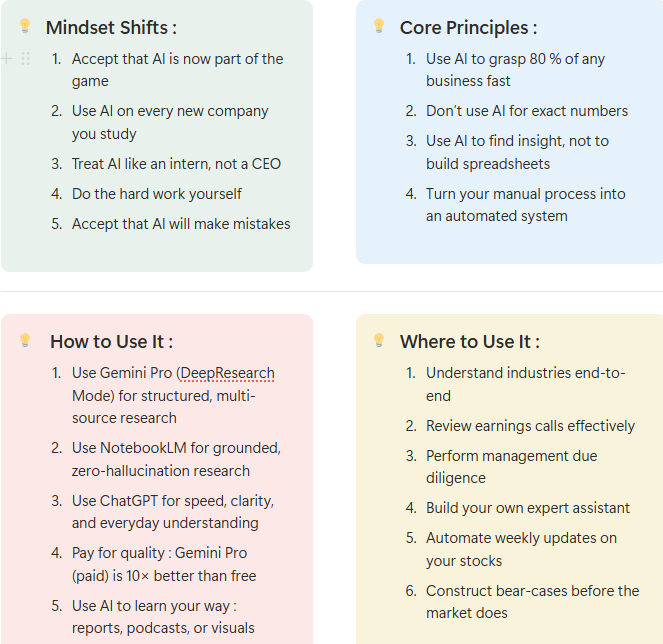
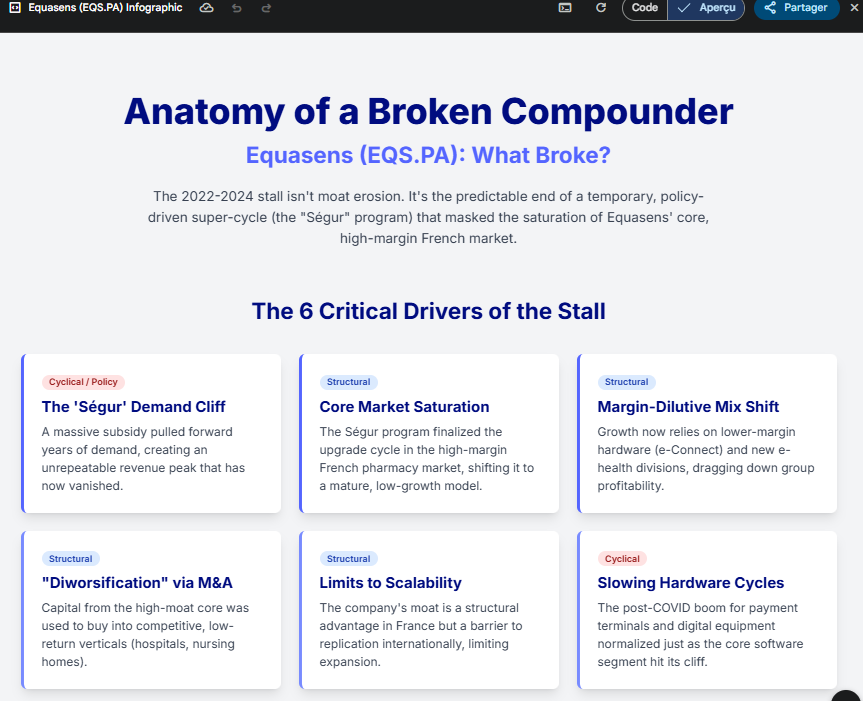
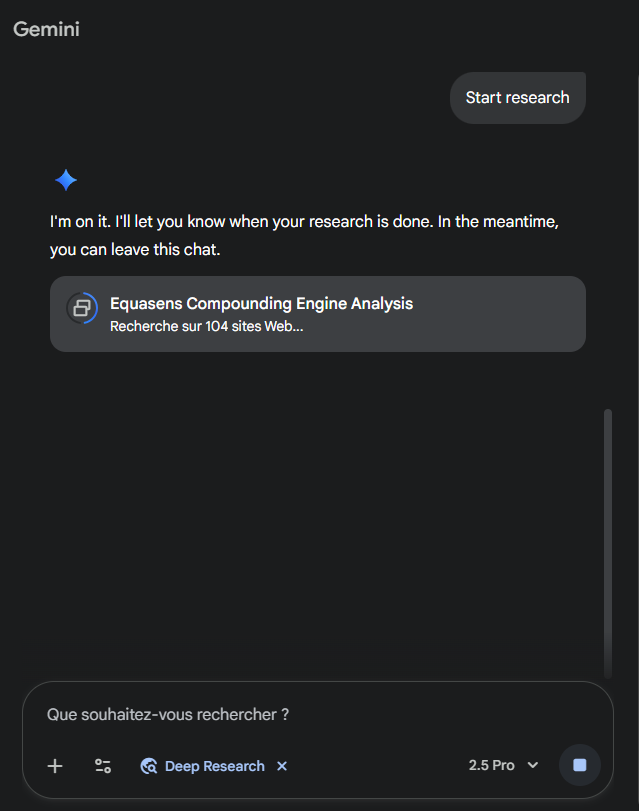


The only 23 rules you need to master AI for investing.
Rules to get the basics :
1. Accept that AI is part of modern investing
2. Use AI on every new company you study
3. Treat AI like an intern, not a CEO
4. Do the hard work yourself
5. Accept that AI makes mistakes, verify don’t avoid
6. Practice until it becomes a skill, keep evolving.
What AI Is (and Isn’t) Good For:
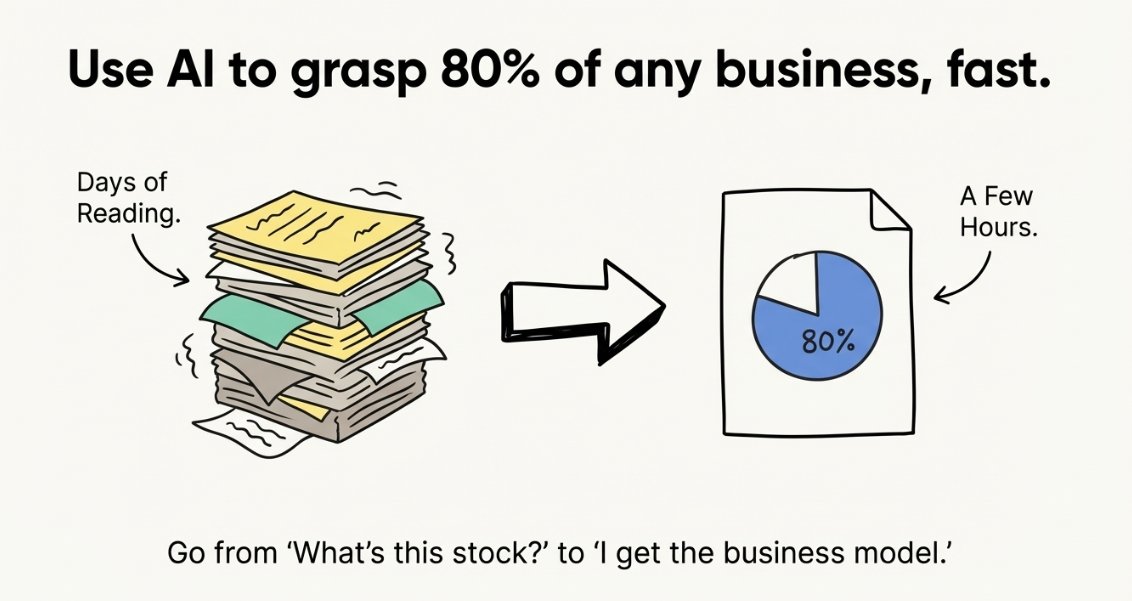
7. Use AI to grasp 80% of any business fast
8. Don’t use AI for exact numbers or DCF models
9. Use AI to extract insight, not build spreadsheets
10. Turn your manual analysis into a clear repeatable
system
Working With AI: The Core Practices:
11. Use Gemini Pro (DeepResearch) for multi-source analysis
12. Use NotebookLM for grounded, zero-hallucination research
13. Use ChatGPT for clarity and fast understanding
14. Pay for quality tools, they’re 10× better
15. Use AI to learn your way (text, audio, visual)
16. Master prompting, clarity in clarity out
17. Build a prompt library that compounds over time
18. Tailor your master prompts by industry with ChatGPT4.
Some Use Cases:
19. Understand industries end to end
20. Review earnings calls to spot shifts early
21. Build your own expert AI analyst with NotebookLM
22. Automate weekly research updates on your stocks
23. Let AI stress test your thesis before the market does
👇
1
1
6
1,048
This is exactly why people say AI fails at investing..
Generic prompts no context no investing expertise = generic unreliable answers.
Mar 14

🚨 BREAKING: Google Gemini can now analyze any stock like a Wall Street analyst (for free).
Here are 10 insane Gemini prompts that replace $4,000/month Bloomberg terminals:
Save for later🔖
1
4
506
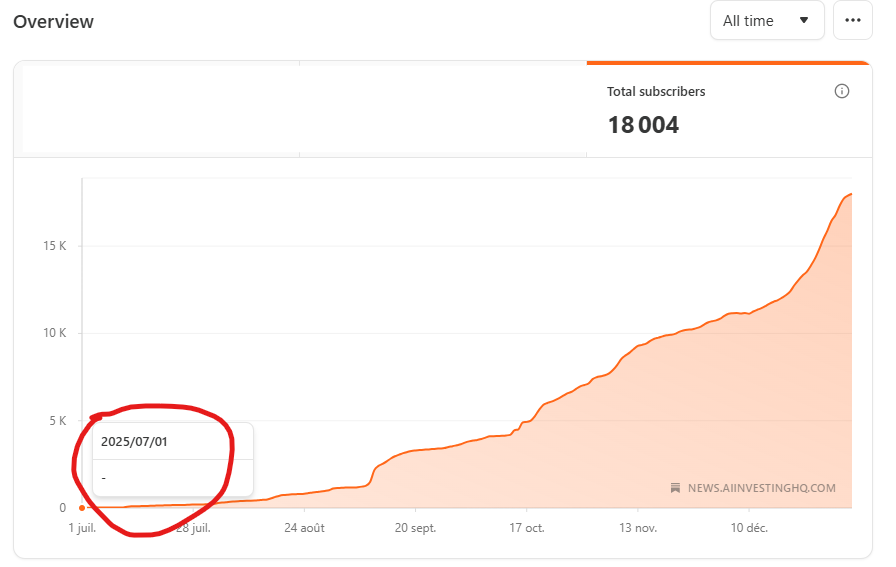
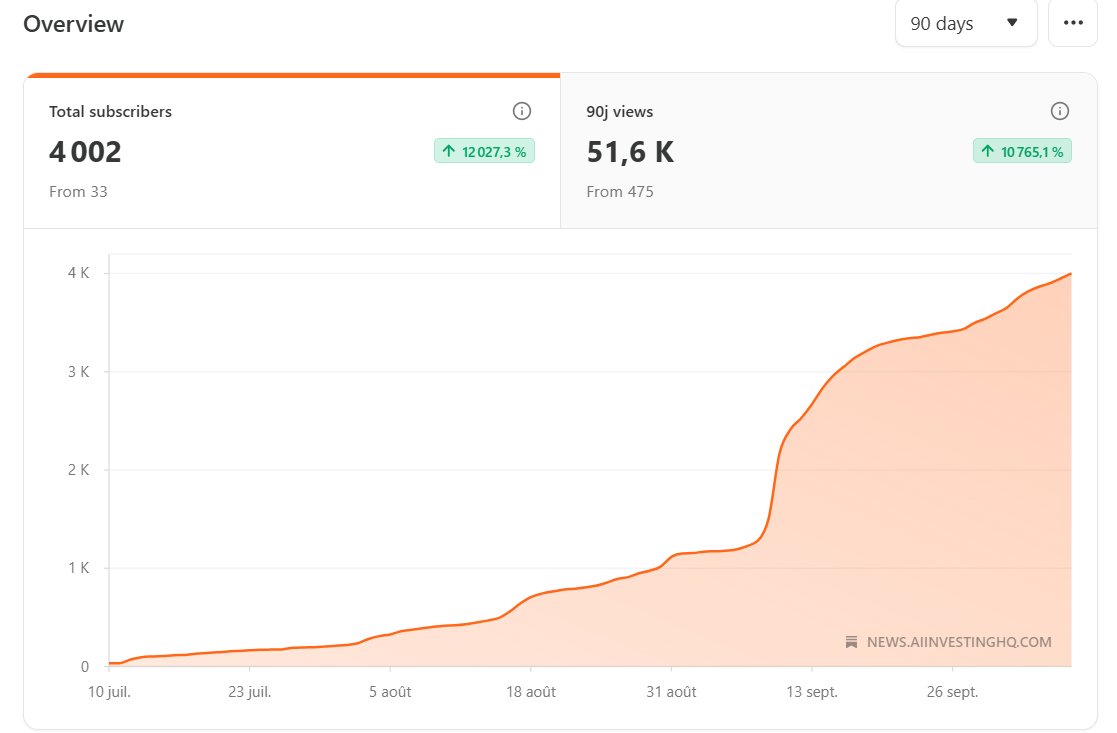
I started this newsletter 6 months ago:
•18,000 subscribers
•Substack Bestseller badge
From day one, I made a simple decision.
I would share everything in my notes and in the weekly newsletter:
•Frameworks and processes that actually work in practice.
•Prompts I validate only after testing them on at least 15 stocks.
I deeply believe that AI makes investing research 10× faster and deeper.
You only need the right frameworks.
That is what this newsletter is about.
1
5
319
Join 18K investor
news.aiinvestinghq.com/
242
Paste this into Gemini Deep Research.
It’ll help you understand the basics of any stock in minutes.
-----
You are an equity analyst writing a high-quality company brief for long-term investors.
Analyze [Ticker] using the 7-point framework below.
Use only verifiable, factual information (annual reports, investor presentations, filings, earnings transcripts, and reputable financial sources).
Be concise, analytical, and concrete — no filler or marketing language.
Output format (exact structure required):
Executive Summary (≈150–200 words)
Summarize in plain English how this company makes money, its economic quality, and where its edge and risks lie.
End with one sentence stating how you’d describe the business to an investor in one line.
1. What They Sell and Who Buys
Describe the main products or services.
Define target customers (type, segment, geography) and why they buy — main pain point or motivation.
2. How They Make Money
Explain the revenue model and pricing logic.
Clarify whether it’s one-time, recurring, transaction-based, or hybrid.
Include key revenue segments and their share if available.
3. Revenue Quality
Assess how predictable and diversified revenues are.
Break down recurring vs one-off components, customer or segment concentration, and exposure to cycles.
4. Cost Structure
Outline major cost drivers (COGS, labor, logistics, marketing, etc.).
Include gross and operating margins where possible.
Comment on scalability — fixed vs variable costs and how margins move with growth.
5. Capital Intensity
Describe assets needed to run and grow operations.
Include capital expenditures, working-capital needs, and cash conversion efficiency.
6. Growth Drivers
Identify the main levers for revenue growth — volume, pricing, product mix, geographic expansion, or acquisitions.
Clarify if these are structural (long-term) or cyclical (short-term).
7. Competitive Edge
Explain what protects the company’s economics from competition: brand, cost advantage, switching cost, regulation, network effects, data, or IP.
Mention how durable and testable this moat appears based on financial evidence (margins, ROIC, retention).
Tone: Analytical, neutral, precise.
Goal: Produce a concise yet rich narrative that lets an investor understand how this business actually works.
2
9
1,129
7 steps to understand how young Buffett actually invested:
1. Upload the letters Into NotebookLM:
Upload all Partnership Letters (1956–1969)
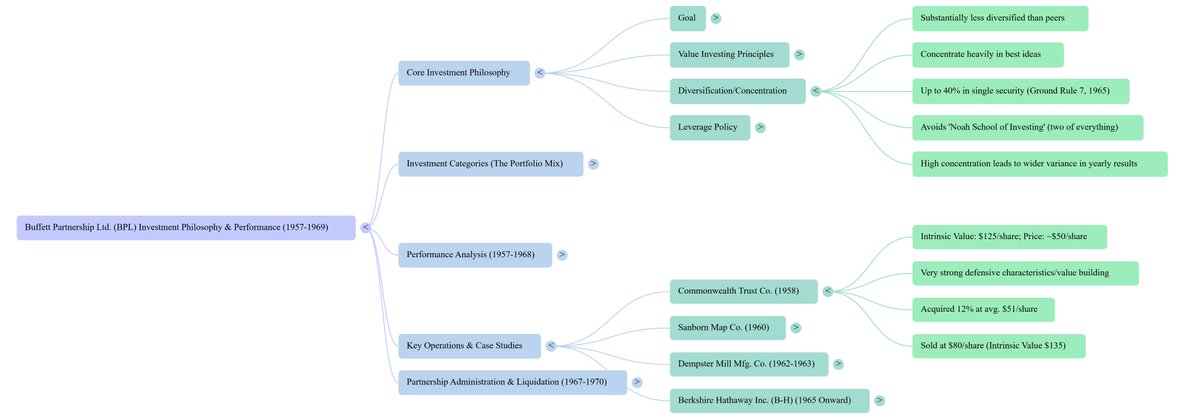
2. Generate a mind map :
Ask NotebookLM to create a mind map summarizing key themes:
•Case studies
•Mistakes
•Special situations
•Portfolio rules
3. Study one subject :
From the map, pick one topic (e.g., Case Studies or Mistakes).
NotebookLM will generate a summary with sources cited.
4. Ask deep questions :
Ask detailed questions about that topic , NotebookLM will answer only from the letters.
5. Test yourself
Generate a quiz on that specific topic to confirm your understanding.
6. Generate a podcast
Ask NotebookLM to produce a short audio summary of one principle.
Listen while you drive or train
7. Repeat with new themes
Choose another topic and repeat.
In a few weeks, you’ll deeply understand how Buffett ran his Partnership years and the principles that built his fortune
1
385
The only 23 rules you need to master AI for investing.
Rules to get the basics :
1. Accept that AI is part of modern investing
2. Use AI on every new company you study
3. Treat AI like an intern, not a CEO
4. Do the hard work yourself
5. Accept that AI makes mistakes, verify don’t avoid
6. Practice until it becomes a skill, keep evolving.
What AI Is (and Isn’t) Good For:
7. Use AI to grasp 80% of any business fast
8. Don’t use AI for exact numbers or DCF models
9. Use AI to extract insight, not build spreadsheets
10. Turn your manual analysis into a clear repeatable
system
Working With AI: The Core Practices:
11. Use Gemini Pro (DeepResearch) for multi-source analysis
12. Use NotebookLM for grounded, zero-hallucination research
13. Use ChatGPT for clarity and fast understanding
14. Pay for quality tools, they’re 10× better
15. Use AI to learn your way (text, audio, visual)
16. Master prompting, clarity in clarity out
17. Build a prompt library that compounds over time
18. Tailor your master prompts by industry with ChatGPT4.
Some Use Cases:
19. Understand industries end to end
20. Review earnings calls to spot shifts early
21. Build your own expert AI analyst with NotebookLM
22. Automate weekly research updates on your stocks
23. Let AI stress test your thesis before the market does
👇
1
1
6
1,048
The only 23 rules you need to master AI for investing.
Rules to get the basics :
1. Accept that AI is part of modern investing
2. Use AI on every new company you study
3. Treat AI like an intern, not a CEO
4. Do the hard work yourself
5. Accept that AI makes mistakes, verify don’t avoid
6. Practice until it becomes a skill, keep evolving.
What AI Is (and Isn’t) Good For:
7. Use AI to grasp 80% of any business fast
8. Don’t use AI for exact numbers or DCF models
9. Use AI to extract insight, not build spreadsheets
10. Turn your manual analysis into a clear repeatable
system
Working With AI: The Core Practices:
11. Use Gemini Pro (DeepResearch) for multi-source analysis
12. Use NotebookLM for grounded, zero-hallucination research
13. Use ChatGPT for clarity and fast understanding
14. Pay for quality tools, they’re 10× better
15. Use AI to learn your way (text, audio, visual)
16. Master prompting, clarity in clarity out
17. Build a prompt library that compounds over time
18. Tailor your master prompts by industry with ChatGPT4.
Some Use Cases:
19. Understand industries end to end
20. Review earnings calls to spot shifts early
21. Build your own expert AI analyst with NotebookLM
22. Automate weekly research updates on your stocks
23. Let AI stress test your thesis before the market does
👇
1
1
6
1,048
If this helped you:
Join the only newsletter focused on mastering AI for long-term investing
news.aiinvestinghq.com
Followed by 7,200 investors.
298
Want to understand how an industry was built and transformed over time?
Run this prompt in Gemini Deep Research to have industry context most investors miss completely..
‐-----‐-------
ROLE
You are an economic historian and industry analyst.
Write a factual, data-based history of the [Industry Name] showing how it formed, evolved, and produced its major winners.
Use clear, analytical language focused on cause and effect.
OBJECTIVE
Create one detailed report (8 000–10 000 words) that explains:
How the industry began and why it matters economically.
What forces—technology, regulation, capital, competition—shaped it.
How leading firms gained and kept advantage.
What cycles or patterns repeat across time.
What lessons guide long-term investors.
REPORT OUTLINE
Formation
Initial need and early solutions.
First technologies, financing models, and institutions.
Context and early dominant players.
Expansion
Breakthroughs that enabled scale.
Evolution of cost, productivity, and barriers to entry.
Standardization and global reach.
Crises and Regulation
Major shocks that reset structure.
Policy and regulatory shifts.
Consolidation and impact on profitability.
Competition
How leading firms built edge (cost, tech, brand, network).
Failures and structural limits.
Turning points in market share and returns.
Industry Players (additional focus)
Main actors in each period.
Why they dominated and when leadership changed.
Key mergers or breakups that reshaped the sector.
Modern Transformation
Digital and automation shifts.
New entrants and business model changes.
Effects on margins and capital allocation.
Regional Differences
Trade, subsidies, and geographic factors.
Capital and Returns
Financing evolution, leverage, and return patterns.
Changes in investor perception and valuation.
Key Insights
Recurrent mechanisms of success and failure.
Structural risks that persist.
Long-term investment implications.
1
2
4
685
People are charging $$$ for this:
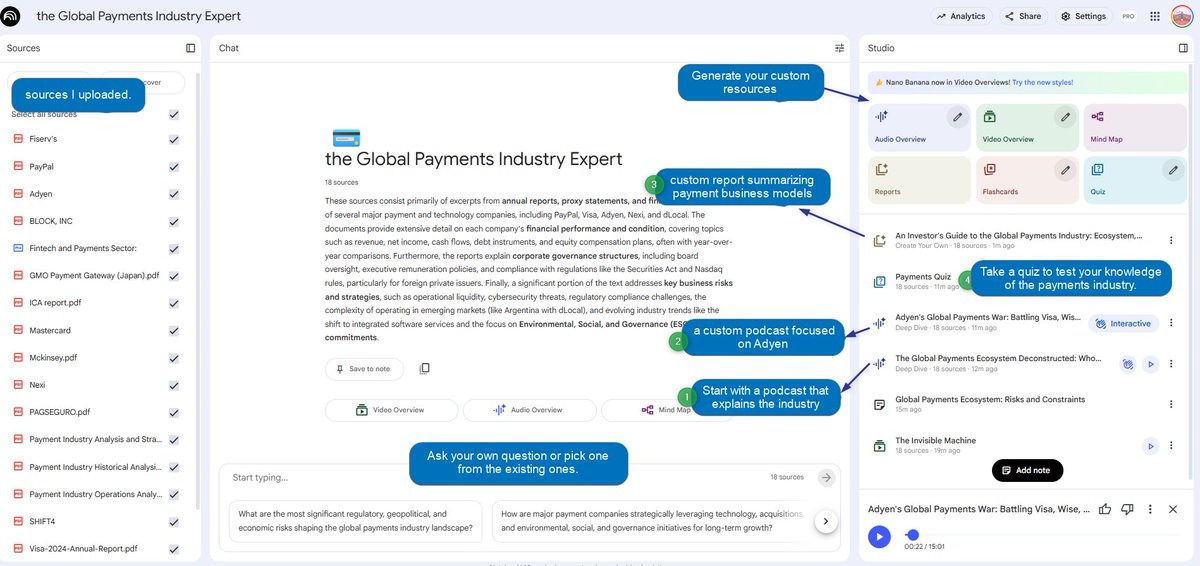
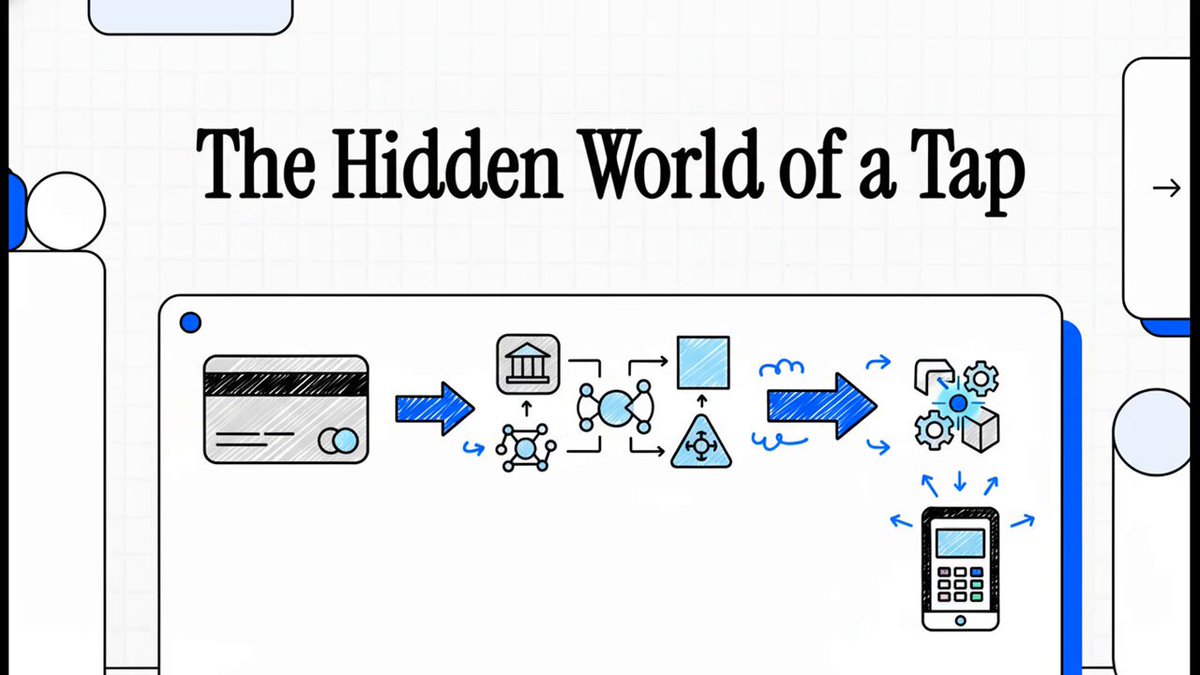
I built a Notebook AI Expert in payments industry
ask it anything, it answers only from verified sources.
Inside:
-A podcast that explains the payments ecosystem
- Deep dive podcast on Adyen
-A quiz to test your understanding
it's free👇
1
2
4
953
People are charging $$$ for this:
I built a Notebook AI Expert in payments industry
ask it anything, it answers only from verified sources.
Inside:
-A podcast that explains the payments ecosystem
- Deep dive podcast on Adyen
-A quiz to test your understanding
it's free👇
1
2
4
953
The free gift:
notebooklm.google.com/notebo…
A free guide if you want to build your own:
compoundwithai.substack.com/…
1
212
You want to compare 2 stocks in the same industry?
run this prompt in Gemini Deep Research to see which one’s the better business in minutes.
you’ll get a clean side-by-side map of growth, profitability, and risks .
----
Act as a comparative business analyst and generate a consulting-style dossier contrasting {Company A} and {Company B} within the {Industry}. Focus on evidence-led analysis using the 80/20 principle to highlight critical components.
Objective:
- Identify which company has a higher probability of growth over the next 5-10 years, focusing on product segments and geographies.
- Determine which company exhibits superior profitability and margin profiles linked explicitly to product segments and geographies.
Inputs:
- Peers: {Company A}, {Company B}
- Industry: {Industry}
- Currency: {Currency} (state FX basis if converted)
Source Policy:
Utilize primary/high-signal sources such as audited reports, investor decks, earnings call transcripts, regulator databases, and expert market research. Append sources to each exhibit as: [Source: Title — URL — Doc date]. Use “ND” for missing data and tag inferences with brief logic. Apply ISO date format.
Normalization:
Standardize product and region labels across companies. Align channel terms. Use reporting currency; note FX basis for conversions.
Output Format:
Markdown format with tables first, and short narrative per exhibit: Context → Insight → Implication → KPI, including direct A-vs-B comparisons throughout.
1. Executive Summary
- Growth call: Declare which business has a greater growth probability based on product × geography, including 2–3 factual reasons.
- Profitability call: State which business has better margin/earnings quality, tied to specific segments and geographies.
- Identify 3 growth drivers explaining future growth odds.
- Highlight 3 vulnerabilities that might flip growth margins.
- Provide a Segment–Geography scorecard (0–5).
- Outline 3 business KPIs for the next 12–24 months.
2. SECTION A — Top Cells: Analyze top products by country.
3. SECTION B — Price Control & Route-to-Market: Assess net price realization efficiency.
4. SECTION C — Supply Resilience: Evaluate supply sourcing and continuity.
5. SECTION D — Segment Growth Engines: Examine growth drivers and profitability.
6. SECTION E — Product & Geography Overview: Contextualize product and geographical analysis.
7. SECTION F — Competitive Landscape: Scrutinize competitive positioning.
8. SECTION G — Risks by Segment: Map potential risks.
9. SECTION H — Causal Diagnosis & Decision: Compare causal disparities and suggest KPI-driven actions.
Quality Checks:
- Ensure explicit A vs B contrasts.
- Normalize labels and currencies.
- End each exhibit with Context → Insight → Implication → KPI, and a source tag.
- Apply the 80/20 filter to prioritize impactful segments.
1
2
673
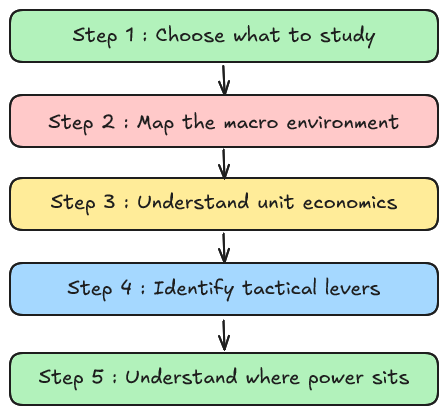
What if you could hire an industry expert who works 24/7 and costs nothing?
I did.
I built one with Gemini NotebookLM:
• Gemini : deep research reports
• NotebookLM : fact-checked answers
See the full 5-step workflow and exact prompts:👇
compoundwithai.substack.com/…
3
596
This will make you doubt every stock you own :
1. pick any stock you own.
2 . use this framework with 3 prompts.
3. If you still like it after that, you’ve got real conviction.
news.aiinvestinghq.com/p/don…
275
Everybody says "invest inside your circle of competence"..
but nobody tells you how to grow it.
here is a 5-step roadmap to expand it with AI , in juste 60 minutes a week:
compoundwithai.substack.com/…
1
250
Stop posting this kind of nonsense..
2 days of trading and a lucky gain don’t prove anything:
•no repeatability.
•pure chance.
•0 long-term insight.
AI isn’t for gambling:
•use it to understand businesses 10× faster.
•you make decisions..
•invest for the long term.
4
619