
Orbiting Planet E, searching for AI. Weekend Golfer. FTC supporter. k8s fan since v1.5.
Joined July 2009
- Tweets 1,114
- Following 301
- Followers 41
- Likes 2,638
19 Photos and videos














ET retweeted

Jun 15
As a Muslim, there's something that genuinely bothers me.
Millions of Muslims live in Christian majority countries, build mosques, preach Islam publicly, distribute Qur'ans, open halal businesses, and demand religious freedom,and rightly so.
Some even call for aspects of Shariah to be accommodated in the societies they've moved to.
Yet in some Muslim majority countries, Christians cannot openly preach the Gospel, build churches freely, or practice their faith without restrictions.
Why?
If we demand religious freedom for ourselves, we should be willing to grant it to others.
Truth does not need censorship.
If Islam is the truth, it has nothing to fear from a church, a Bible, or a Christian preacher.
You can't demand tolerance and freedom for Muslims abroad while denying the same freedoms to others at home.
The double standard needs to be called out.
2,318
4,053
19,415
1,381,916
ET retweeted

If I were President of South Africa, I’d pursue a policy of leaving South Africans alone. Leave South Africans alone and focus on ensuring stronger law and order, quality education, and skills development. Let robust capitalism be in control. Do that, South Africa thrives and becomes one of the richest countries in the world in a few decades. #economy #politics #markets
25
21
177
4,840
ET retweeted

Laughing at us behind closed doors taking us farmers for a poes while our cows die because Jana and John thinks it is one moerse fokken joke ☝🏻😭
1
4
12
334
ET retweeted
On illegal immigrants, my views have been clear: no illegal immigrants should be in South Africa. It’s that simple. If you are in South Africa illegally, you should be deported. The idea of a “borderless Africa” is complete nonsense. Africans must fix their messy, corrupt, dysfunctional, and destitute countries before talking about “borderless Africa”. #economy #immigration #markets
76
347
1,273
28,999
ET retweeted

Jun 7
South Africans are deeply frustrated and with good reason about illegal immigration and the pressure it places on already scarce opportunities.
But the real crisis is not the immigrants themselves. The root cause is our failure, over the past fifteen years, to deliver inclusive economic growth that creates enough jobs, dignity and hope for our own people.
This failure has been driven by three systemic issues we can no longer ignore:
• A collapse in the rule of law that has enabled corruption, criminality, land invasions, illegal migration, and the brazen theft of electricity and water.
• Bureaucracy and red tape that continue to strangle enterprise, deter investment and kill job creation.
• Incompetent and, in too many cases, corrupt leadership in key positions across government, state-owned enterprises and parts of the private sector.
As leaders, we must have the courage to look in the mirror and ask a difficult but necessary question: How have we allowed these conditions to take root and persist?
This question is not about blame. It is about responsibility and that is precisely why it is empowering. It places the power to change things back where it belongs: with us. We are not helpless. We are not victims of forces beyond our control. By focusing on what lies within our sphere of influence our decisions, our standards, our willingness to confront uncomfortable truths and act decisively, we can begin to reverse the damage we have helped create.
The time for self-criticism and honest reflection is now. The time for excuses has long passed. South Africa’s future will be determined by leaders who are prepared to own their part in the mess and do the hard, disciplined work required to fix it.
185
348
960
85,584
ET retweeted

Jun 5
Ethiopia was never colonized.
For much of its history, it was one of the poorest countries on the continent.
Meanwhile, Vietnam was colonized by the French, devastated by decades of war, and is now on its way to serious economic prosperity.
If colonialism were the answer to why Africa is poor, Ethiopia should be rich and Vietnam should be broke. Neither is true.
Can we please retire this excuse?
3,721
8,313
57,512
18,082,578
ET retweeted

Jun 7
Labeling anyone in disagreement with you as "far-right" goes to show that your politics really is just as divisive.
You've used both race and ideological positioning here to make a statement that could have simply been done on merit.
Same politics.
10
15
193
2,020
ET retweeted
The solution to South Africa’s economic problems isn’t more government controls. It’s less government and a commitment to good governance. Most of our economic problems have been caused by the government. Therefore, more government controls can’t be the solution. #economy #politics #markets
8
11
37
1,174

ET retweeted

Jun 1
From 1977 to the early 80s, people were rightly concerned with events unfolding in the Rhodesian war, and the new Zimbabwe and many 10s of 1000s people left the country for greener pastures. Those who stayed behind labeled those who were leaving as "taking the Chicken Run" or "taking the gap."
There was a distinct rift between the two. Some saw leaving as a cowardly act and snickered and bickered about the turncoats running away from the war-torn nation and leaving them behind to "fight the commies."
It was a time of great pressure and desperation. Families torn apart, a people already under much duress further fractured by these issues.
50 years later, the same thing is happening in South Africa to minorities here who are being forced to be either 'stayers' or 'leavers'.
It is a hugely traumatizing circumstance when one has to decide the fate of one's family and future under stress from both the local environment, such as the clear and imminent fall of South Africa and the cultural peer pressure one falls under during the gut-wrenching decision to "take the gap."
In my experience, those who left mostly thrived in their new worlds, and those who stayed fought bravely through the decline, often succeeding in work and business.
We should remember these things today. Be kind to one another and remember that there's nothing new under the sun. It's all happened before.
One thing to add is that those who stayed on in Rhodesia will testify to the fact that it gets a whole lot tougher over the years as the revolutionary governments destroy the country before your very eyes.
Have a great day, whatever you choose to do.
45
123
647
20,424
ET retweeted

I just watched a @udacity video about building AI Agents. It started with the presenter admitting they knew nothing about product development, couldn't tell us what the acronym PRD stood for, and then presented a really awful PRD as an essential first step in the work. The presenter joked that they were a programmer, so, of course, didn't know (or evidently need to know) what a PRD was. They then presented a "user story" that was actually a waterfall requirement that didn't mention the user's work at all.
In AI-assisted software engineering, not understanding product development is a guaranteed path to a crappy result. It's an essential part of the minute-to-minute work. The initial prompts are all about the product, and product decisions permeate the implementation details in subsequent prompts as well. If you don't even know what that term means, you can't do the work. When you write a prompt, you own it. Working with third-hand information from a Product person you don't know or talk to just doesn't cut it. If you don't have the skill, you need to pair or mob with somebody who does.
Programmers using AI cannot bury their heads in the sand and imagine that coding is the only thing that matters. I've heard devs make jokes about their ignorance while rolling their eyes as they say the word "product," as if it's some sort of lesser skill. They often frame the product people as adversaries. (Sometimes they are, but that's a different level of organizational dysfunction.) These same programmers often denigrate testing as well, and think of architecture as some black art they don't need to understand. None of that is justified or correct. Living in a silo will specialize you right out of a job.
To me, the minimum skill set needed to use an AI effectively is communication (with users, each other, and the LLM), product development, programming (not just coding), testing, refactoring, software architecture, and English composition. (Badly written prompts quickly get you into garbage-in/garbage-out territory.) Every one of those skills is involved in every prompt I write. If you don't have the skills, then again, pairing or mobbing solves the problem, but working alone without essential skills doesn't cut it with me.
This thinking, of course, flies in the face of the push to solo work I see in some AI-heavy development shops, but I think those shops will solo themselves to failure. Programming is not now, nor ever was, something you could do alone if you wanted optimal results. "It takes a village" and a plethora of skills. If you don't have those skills, acquire them. Learning is part of the work.
2
3
35
3,421
ET retweeted
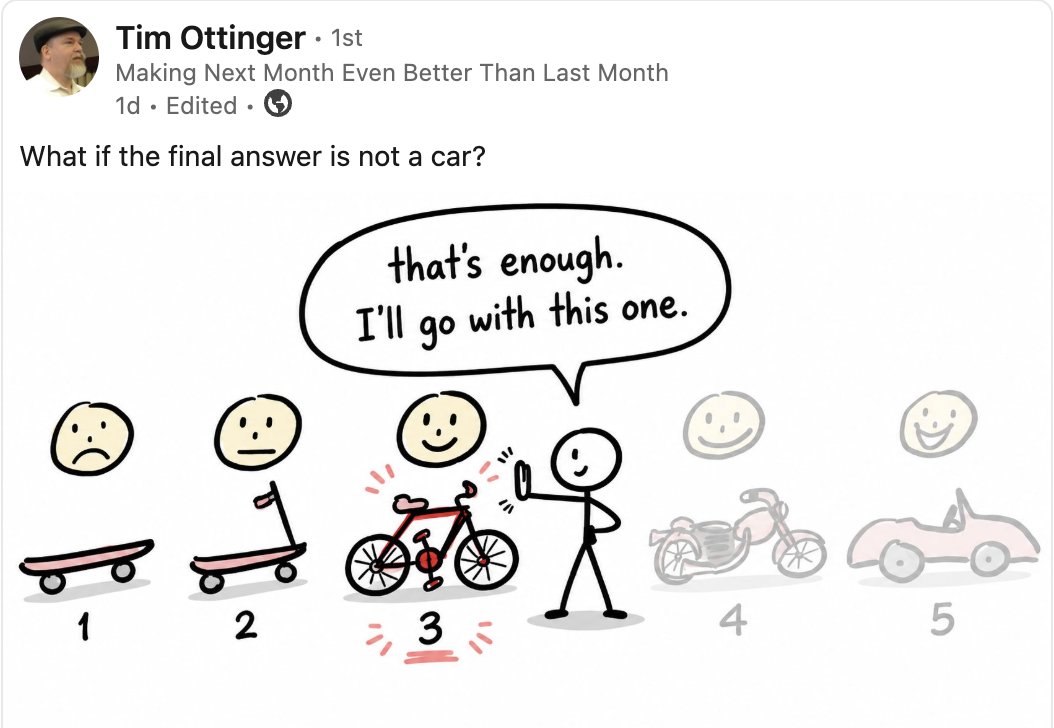
Tim Ottinger posted this drawing over on LinkedIn 👇 [t.ly/bll9E]. He's absolutely correct about this.
Here's an example: I once built what amounted to a small blog system that had a comments feature. My initial idea was a standard comments dashboard. When somebody made a comment, it would go onto the dashboard, and then I'd send an email out asking for approval. A link in the email got you to the dashboard. Google Groups works exactly that way.
Then I started building. I like to keep early versions as simple as possible, so my first version skipped the dashboard entirely and sent an email with an "approve" link in it. If I didn't get an approval within a few days, I deleted the comment.
I released that.
Nobody complained. Nobody asked for a dashboard. A link in the email was just fine.
So, I was finished. There was no need to create that complicated dashboard at all, given that everybody was happy. Nobody ever requested a dashboard, but if they had, I would have added it at that point.
Here's another example:
When I build microservices, I take the notion seriously that the service should be fully self-contained with impermeable boundaries and no dependencies on anything external. That principle means that every microservice must have its own data store. There is no shared database in the system. (This is standard microservice architecture, described in a myriad books—please read one of those before you argue with me about how crazy I am. Many thousands of microservice systems don't have a shared database.)
Version one of my services often uses the simplest data store possible: everything is in memory. No SQL. No serialization. Just a collection (usually JSON in a key/value dictionary).
So, once I've deployed that and proven to myself that the business logic is working, I often (not always) add persistence by serializing to a local file on the disk using the easiest mechanisms available. Usually, that's not any official serialization system—I just create a flat file with those key/value pairs in it.
Often, I'll stop at that point. If the key/value pairs are working, there's no point in doing anything fancier. In any event, seems like bringing in an SQL server to handle a database with one table and a couple of columns is way more trouble than it's worth.
So, the lesson here is: (1) work incrementally in very small batches; (2) build the simplest possible thing; (3) if absolutely necessary, add a bit more, but again, build the simplest possible thing; (4) don't futureproof—if the current thing is good enough, stop.
4
10
90
6,682
ET retweeted
All too often, the word "leader" is used to describe a mere manager. That's not a leader in any real sense. You cannot be anointed as a "leader" by upper management. Leadership cannot be imposed. A person in that position claiming they're a leader is puffery—a source of (often quiet because they're in a position of power) ridicule.
Leaders don't call themselves "leaders." They lead simply by being themselves.
Leadership is a personality trait. You cannot train a person to be a leader. The notion of a "leadership seminar" is a snake-oil rebranding of management training.
Teams confer leadership. It emerges when someone behaves in an inspiring way. A true leader does not have "followers" in the conventional sense. Mindlessly obeying or mimicking someone is cult behavior. Being forced to follow or obey is bullying, not leadership.
Leaders set examples, not impose ways of working. They make sacrifices, not require them. They inspire, not demand. They don't require respect; they're respected. Force and leadership cannot coexist. A power dynamic is a bully's tool, not a leader's.
So, I find that whole "leadership" framing to be disengenuous at best. I wish we'd drop it altogether.
2
6
31
2,543
ET retweeted

May 25
Happy Birthday #KafkaStreams 🎉
10 years ago, Apache Kafka 0.10.0.0 was released. It was the inaugural release of @kafkastreams — What a journey!
Thanks to almost 500 contributors! It would not have been possible without each and everyone of you!
1
16
55
3,861

The Court Order
Farmers may, without permission from the Minister or other state officials:
✅ Privately procure lawfully produced vaccines.
✅ Privately administer lawfully procured vaccines.
The Minister may not:
❌ Interfere in the commercial relations of those who lawfully import vaccines and their international suppliers.
7
42
238
4,090
Context
The Minister tried to centralise control over FMD vaccines, barring farmers and livestock owners from privately procuring and administering vaccines without state permission.
Sakeliga, SAAI, and Free State Agriculture have argued since January 2026 that there is no lawful impediment to privately obtaining and administering approved FMD vaccines.
Today, the court confirmed our assessment.
8
36
223
4,753


ET retweeted

We are called xenophobic for asking a simple question:
How does a country with 33% unemployment absorb millions of undocumented migrants WITHOUT a plan?
That's not hate.
That's MATH.
The leaders who should answer that question are too busy calling you names to avoid answering it.
Migration is real. So is the cost.
Who's paying it? Not the politicians.
The poor are.
8
29
110
3,045
ET retweeted

May 20
Not to mention the hot mess that is Petrosa.
But sure, let's start even more state owned companies to do the same thing that the ones they already ran into the ground did, and lose even more billions.
1
3
39
567
ET retweeted

May 16
Explain to me why our electric bills never decrease, even though we have swapped to all LED lights, energy star appliances, built massive solar and wind farms.
1,183
7,821
77,172
2,171,809