
Associate Professor of Psychometrics at the University of Padua. Views are my own.
Joined February 2018
- Tweets 2,284
- Following 1,685
- Followers 555
- Likes 8,286
101 Photos and videos






Pinned Tweet

18 Jan 2025
In occasione del Darwin Day 2025 organizzato dal @cicap parlerò di disgusto e comportamento attraverso le lenti della teoria dell'evoluzione. L'evento avrà luogo il 15/02/2025 alle 17:00 presso il Mondadori Bookstore di Piano Lago Mangone (CS). #darwinday #disgusto #evoluzione
1
2
12
2,548
Jun 11
Sono contento di aver contribuito a questa proposta, anche se l’avrei voluta più coraggiosa sul terreno della libertà di scelta e sulla concorrenza tra atenei, ad esempio facendo proprie le proposte di Ichino e Terlizzese esposta in “Facoltà di scelta” (2015). Ma è un buon inizio
Jun 10

Il @Partito_Libdem finora ha fatto proposte su scuola, energia, welfare, fisco, spesa pubblica, riforme istituzionali, edilizia, immigrazione, sicurezza, mercato del lavoro, urbanistica, regolamentazione del web, concorrenza.
Mancava un settore cruciale: università e ricerca.
Ecco le nostre proposte, preparate da un gruppo di lavoro guidato dalle nostre Aurora Pezzuto e Manuela Arata.
Vi va di guardarle insieme?
(Per chi vuole approfondire, ecco il link al documento completo: partitoliberaldemocratico.co…)
1/n

31
mtliuzza 🇺🇦 retweeted

Jun 10
La posizione liberale classica sull’immigrazione parte da un principio semplice: le persone non appartengono allo Stato. In linea di principio, chi vuole lavorare, commerciare, studiare e costruirsi una vita pacificamente dovrebbe poterlo fare.
Ma questo non significa negare il problema dell’integrazione. Una società libera non vive nel vuoto: si regge su fiducia, responsabilità individuale, rispetto della legge, proprietà privata, libertà religiosa, libertà di parola, parità davanti al diritto.
Per questo il liberalismo classico non è né chiusura identitaria né immigrazionismo ingenuo. Difende l’apertura verso chi accetta le regole della civiltà liberale, e respinge tanto il tribalismo quanto il multiculturalismo relativista che mette tutte le culture sullo stesso piano.
L’Occidente non si conserva chiudendo ogni porta. Si conserva sapendo che cosa lo rende libero, chiedendo a chi arriva di rispettarlo, e smettendo di vergognarsi dei suoi principi migliori.
14
38
148
3,990

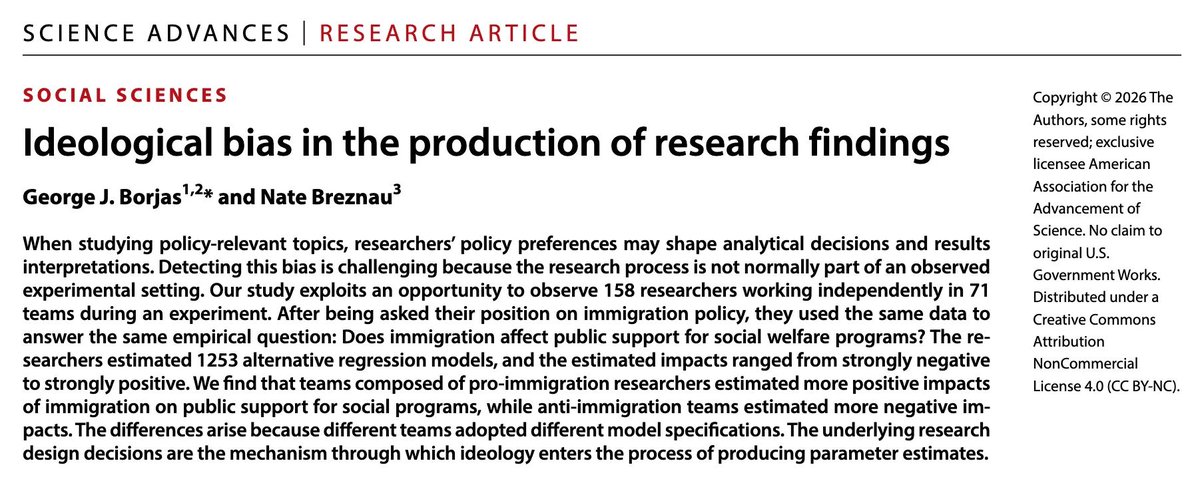
A few months ago, a high profile paper in Science claimed to find that researchers' ideology produced biased results in favour of immigration.
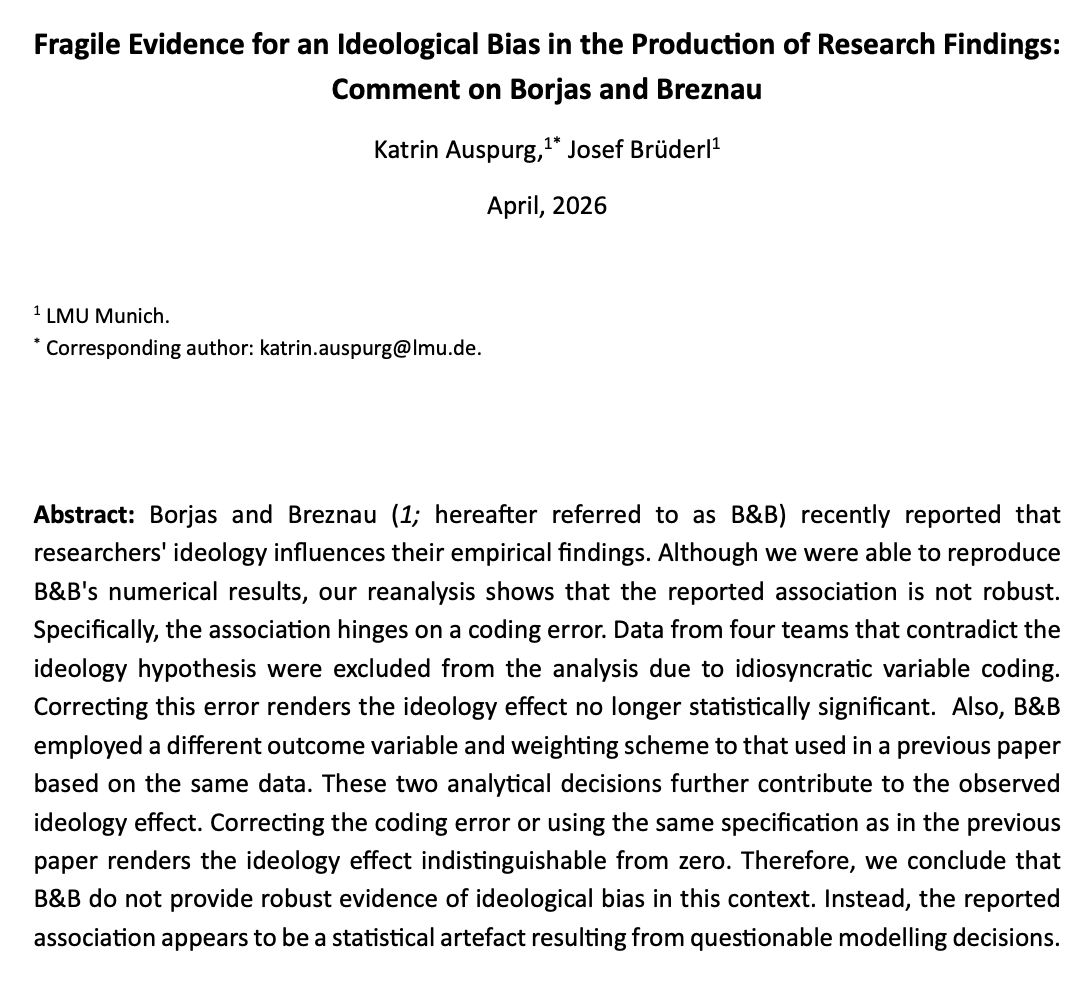
A reanalysis of the data finds that result came from a coding error, which once corrected, shows no effect.
Will people who shared that original finding update their views?
osf.io/preprints/metaarxiv/4…
33
258
1,227
181,970
mtliuzza 🇺🇦 retweeted

May 5
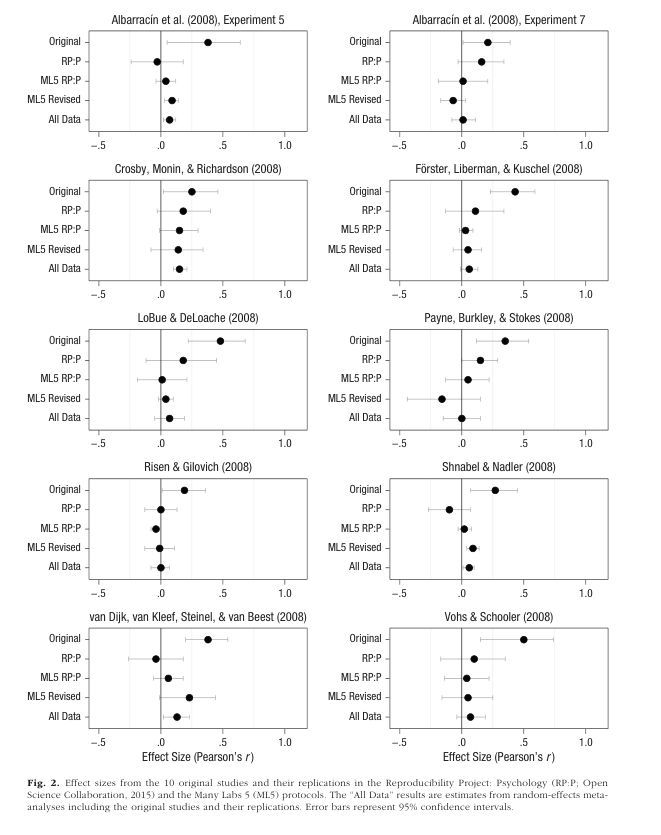
Many Labs 5 was such a cool project. Authors who argued that a study from the Reproducibility Project: Psychology was 'too different', leading to a null result, could propose their own replication. Mostly null results again. Blaming auxiliaries is easy. Replication is hard.
1
12
59
5,560
Apr 24
Denunciato all’AGCM per aver riportato gli stessi dati diffusi dalla PS.
Apr 23

Fosse sfuggito...
Epilogo poco noto sul video che svela i veri dati sui #femminicidi in Italia:
il Prof Vincenzo Mauro racconta di essere stato denunciato dall'AGCOM per aver citato i dati della Polizia di Stato.
La Scienza senz'H ha vita difficile!
1
84
mtliuzza 🇺🇦 retweeted

Apr 16
The notion that the human skull was somehow impervious to selection pressures was always ridiculous, but it was ideological convenient.
1
3
72
1,502
Apr 14
«Unica la fonte: lo Stato. Unico il valore degli studi: quello voluto dai poteri pubblici secondo la norma costituzionale. Unico è il valore dei titoli rilasciati ai giovani alla chiusura di ogni corso di studi: quello dichiarato dalla legge» (Luigi Einaudi, 1962, pp. 26-27).
1
57
mtliuzza 🇺🇦 retweeted

🇭🇺🇪🇺 Ecco la piattaforma politica di Peter Magyar, un liberal-conservatore di destra che preferisce lo stato di diritto e l’Europa all’autocrazia e a Mosca.
Stato di diritto e lotta alla corruzione
•Istituzione di un Ministero per la Lotta alla Corruzione
•Indagini sulle gare d’appalto pubbliche del passato
•Creazione di unità speciali per recuperare il patrimonio nazionale presumibilmente trasferito agli ambienti del Fidesz
•Rimozione dei quadri del Fidesz infiltrati nelle istituzioni statali
•Adesione dell’Ungheria alla Procura Europea (EPPO)
•Ritorno alle pratiche dello stato di diritto nei rapporti con l’UE.
Riforma istituzionale e limiti al potere
•Limite di 2 mandati (8 anni) per la carica di Primo Ministro
•Orbán, in carica da 16 anni, sarà considerato aver già superato tale limite: divieto politico per lui
•Abolizione dello stato di emergenza permanente dichiarato dal governo Orbán (nato per i migranti, prorogato con la pandemia e la guerra in Ucraina).
Media e informazione
•Scioglimento del reparto notizie della televisione di stato
•Ristrutturazione di radio e televisioni statali per garantire un’emittenza indipendente.
Politica estera e sicurezza
•Fine dell’alleanza strategica con Putin
•Rimozione del veto ungherese sui prestiti UE all’Ucraina
•Normalizzazione delle relazioni con l’Unione Europea, pur opponendosi a una maggiore integrazione federale
•Rafforzamento dei rapporti con i governi anti-russi dell’Europa orientale, a partire dalla Polonia.
Economia e società
•Tagli fiscali e critica alle politiche economiche interventiste e stataliste di Orbán
•Potenziamento degli incentivi alla natalità (già generosi in Ungheria)
•Linea restrittiva sull’immigrazione: Magyar ha criticato Orbán per aver ammesso troppi lavoratori ospiti.
In sintesi, chi pensa che la vittoria di Magyar in Ungheria rappresenti una svolta a sinistra ha capito poco: non è quella la cifra del suo successo.
Magyar è un conservatore sociale, restrittivo sull’immigrazione, favorevole ai tagli fiscali e al raddoppio del budget per la difesa. La sua è una piattaforma chiaramente di destra, per gli standard europei. Ciò che lo distingue da Orbán è la scelta tra stato di diritto e autocrazia, tra Europa e Mosca. Una scelta che - in Italia - le due coalizioni di centrodestra e centrosinistra non hanno compiuto con chiarezza.

25
47
139
3,404
mtliuzza 🇺🇦 retweeted
Apr 11
Statisticians are trained in how to compute statistics, but not why to compute statistics. At least 10% of their training should be in philosophy of statistics. They should also spend 10 credits on their own empirical research project to understand how data is acually collected.
13
11
113
5,730
mtliuzza 🇺🇦 retweeted

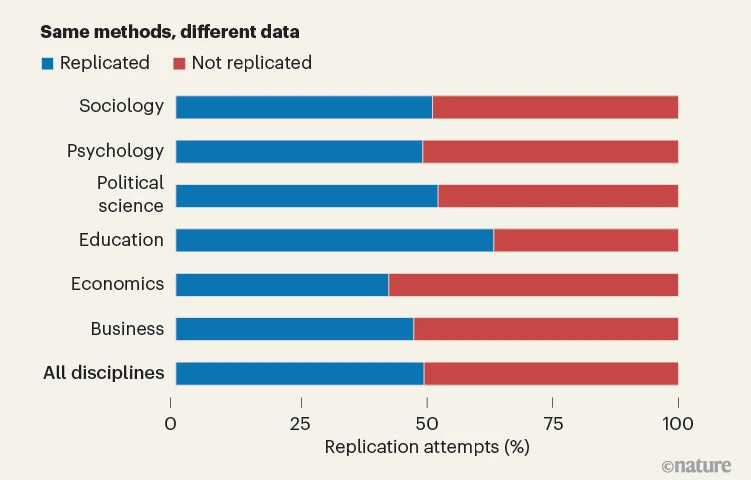
Massive new replication study: Only 55% of 274 social-science findings successfully replicated.
Education was in first place, economics last, and psychology somewhere in between.
[Link below.]
24
78
333
26,760
Mar 29
Good nEUws! 🇪🇺

Quando vi siete stancati di parlare di chi fa il leader di quello, chi il capogruppo di questo, di Delmastro, Santanche ecc, la nostra Reponsabile Economia Aurora Pezzuto ci spiega che cos’è la riforma del “28esimo regime” che sta avanzando in Europa.
E perché è una delle cose più utili di cui possiamo discutere al momento.
Una società più libera, più semplice.
@Pauroral
40
mtliuzza 🇺🇦 retweeted

Quando vi siete stancati di parlare di chi fa il leader di quello, chi il capogruppo di questo, di Delmastro, Santanche ecc, la nostra Reponsabile Economia Aurora Pezzuto ci spiega che cos’è la riforma del “28esimo regime” che sta avanzando in Europa.
E perché è una delle cose più utili di cui possiamo discutere al momento.
Una società più libera, più semplice.
@Pauroral
18
26
68
3,247
Mar 26
L’ubriacatura ideologica sta finendo per lasciare il posto alla scienza

Se vero, decisione giusta. Apprezzo particolarmente la porta aperta per i casi DSD tipo CAIS o Swyer, dove la presenza del gene SRY non comporta androgenizzazione. Finalmente.
1
65
Excited to listen to this episode, but I disagree that Darwin's theory can't be decisively tested (as much as Newton's).
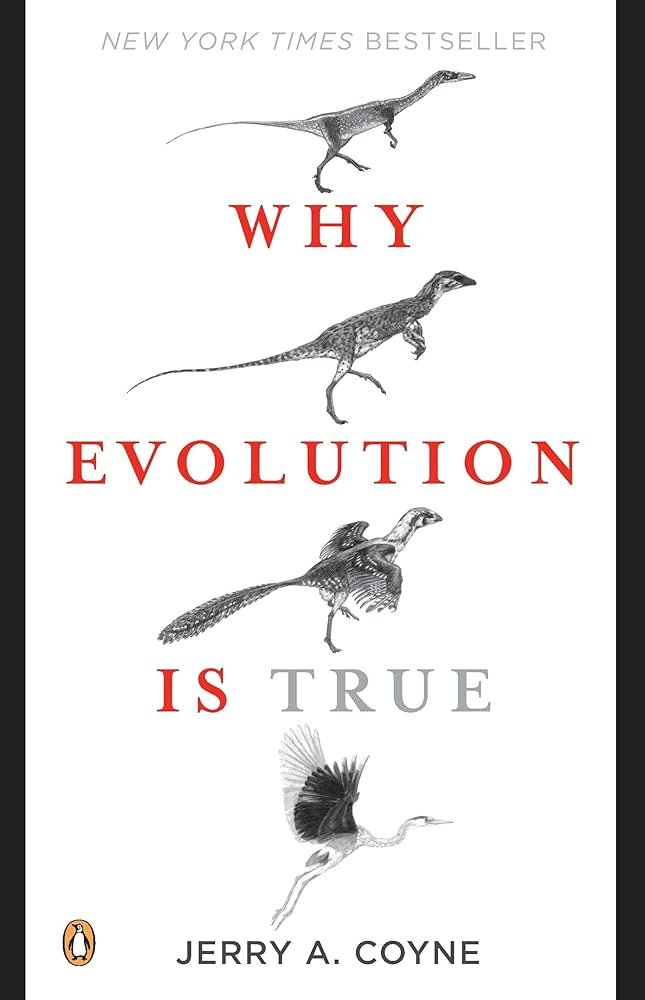
I'd highly recommend the book 'Why Evolution Is True'. It describes how Darwin, and others, made a lot of predictions that were verified, with many different lines of evidence – including fossils, vestigial structures, biogeography, molecular evidence, natural selection in action, and speciation.
Darwin was a great interlocutor but many of these predictions were tested in his work, or during his lifetime. And some of his auxiliary hypotheses did not hold up, and helped refine the theory. Anyway, it's a great book!
Mar 21

The Origin of Species was published in 1859. Principia Mathematica was published in 1687, two centuries earlier.
Conceptually, it seems like natural selection is much simpler than the theory of gravity. So why did it take two centuries longer to discover?
A contemporary of Darwin's, Thomas Huxley, read the Origin of Species and said, “How extremely stupid not to have thought of that!” Nobody ever said the same for not beating Newton to the Principia.
I wonder if the reason this happened is that Darwin’s cannot be decisively tested. The evidence is circumstantial, retrospective, and cumulative. There's no equivalent of Newton running the numbers on the moon's orbital period and radius, and confirming that it corresponds to his theory.
In fact, nearly two thousand years before Darwin, the Roman poet Lucretius argued in De Rerum Natura that organisms suited to their environment survive while ill-adapted ones perish. But nobody built a science on it. Without a tight verification loop, the idea just floated by.
Terence Tao argues that Darwin succeeded where Lucretius failed because he had the ability to convince people that the gaps in his theory (specifically, what is the mechanism of heredity) would be filled.
This was less about ‘hard’ scientific insight, and more a matter of having good research taste and being persuasive. But it was crucial for progress in biology.
45
108
898
118,848
Mar 21
Rileggere Antiseri: "Relativismo, nichilismo, individualismo. Fisiologia o patologia dell'Europa?"
Perché il liberalismo cristiano di Antiseri continua a parlare anche a chi - come me - non condivide la sua fede open.substack.com/pub/marco4…
30
Mar 19
Un altro studio di replica pre registrato (ovvero con ipotesi, metodo e analisi statistiche specificate prima di aver raccolto i dati) mostra che la minaccia dello stereotipo, l’idea che le ragazze vadano peggio in matematica perché esoste a stereotipi di genere, non regge.

Registered replication report, in press at AMPPS, N=1709, multi-lab, finds no stereotype threat effect on women's math performance.
osf.io/preprints/psyarxiv/qc…
ht @minzlicht, of interest to @LGConwayIII
36
mtliuzza 🇺🇦 retweeted

Mar 16
Riconoscere la natura violenta dell’ideologia comunista, dei teorici comunisti, dei comunisti e dei comunismi esattamente come si fa con teorie fanatiche e farneticanti simili, come il fascismo, senza scuse, senza ma, senza però. Mi pare semplice.
15
36
449
7,214
mtliuzza 🇺🇦 retweeted
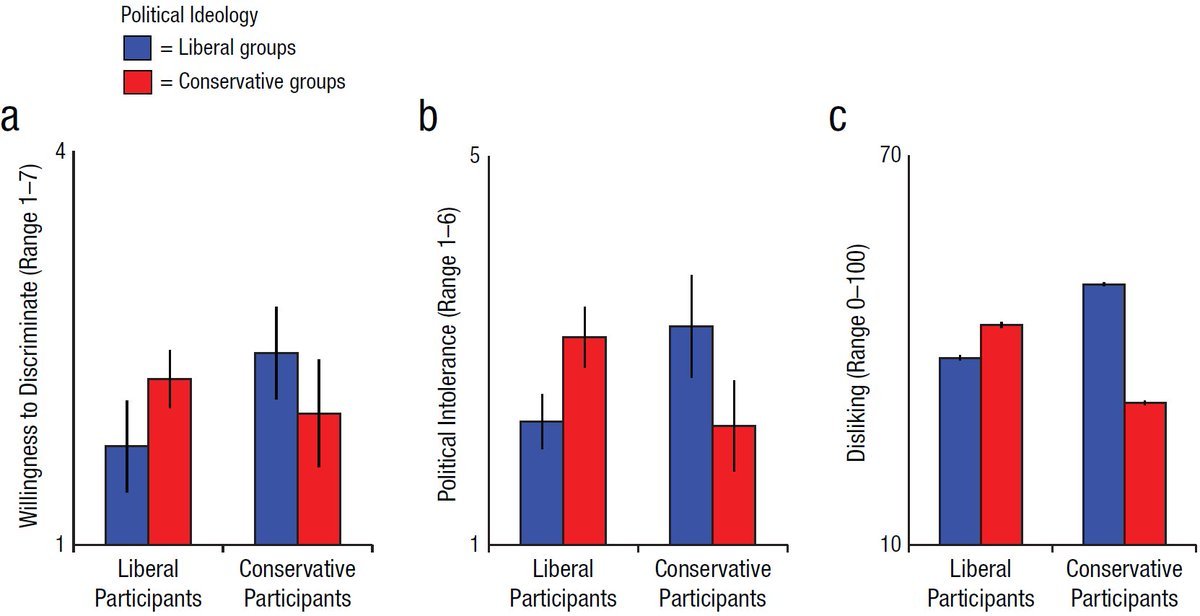
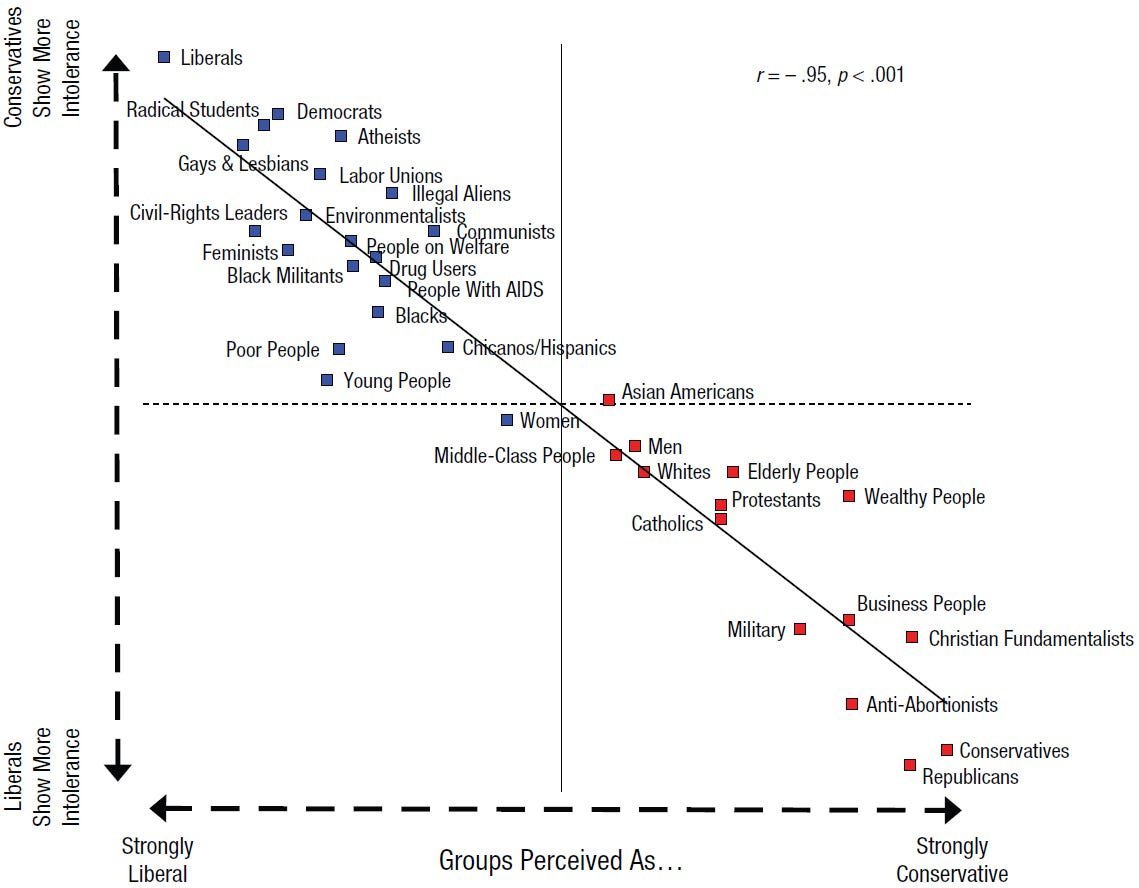
Conservatives and liberals are equally intolerant - but just toward different groups
[Link below.]
17
56
263
11,480
mtliuzza 🇺🇦 retweeted

Mar 15
A few years ago I recorded an episode of my podcast Forbidden Territory for @UGent (in Dutch) about the heritability of IQ. We also touched on the third rail of racial differences. Why? Because I believe academics should be free to investigate even the most “dangerous ideas.”
My guest, Han van der Maas (a renowned IQ researcher at the University of Amsterdam), explained that individual IQ differences are highly heritable, but that he does not believe in differences between racial groups. His statistical and methodological arguments (e.g. Simpson paradox) convinced me at the time. Still, he hedged his bets: it remains possible that future evidence might show racial differences. And researchers should be free to investigate that hypothesis.
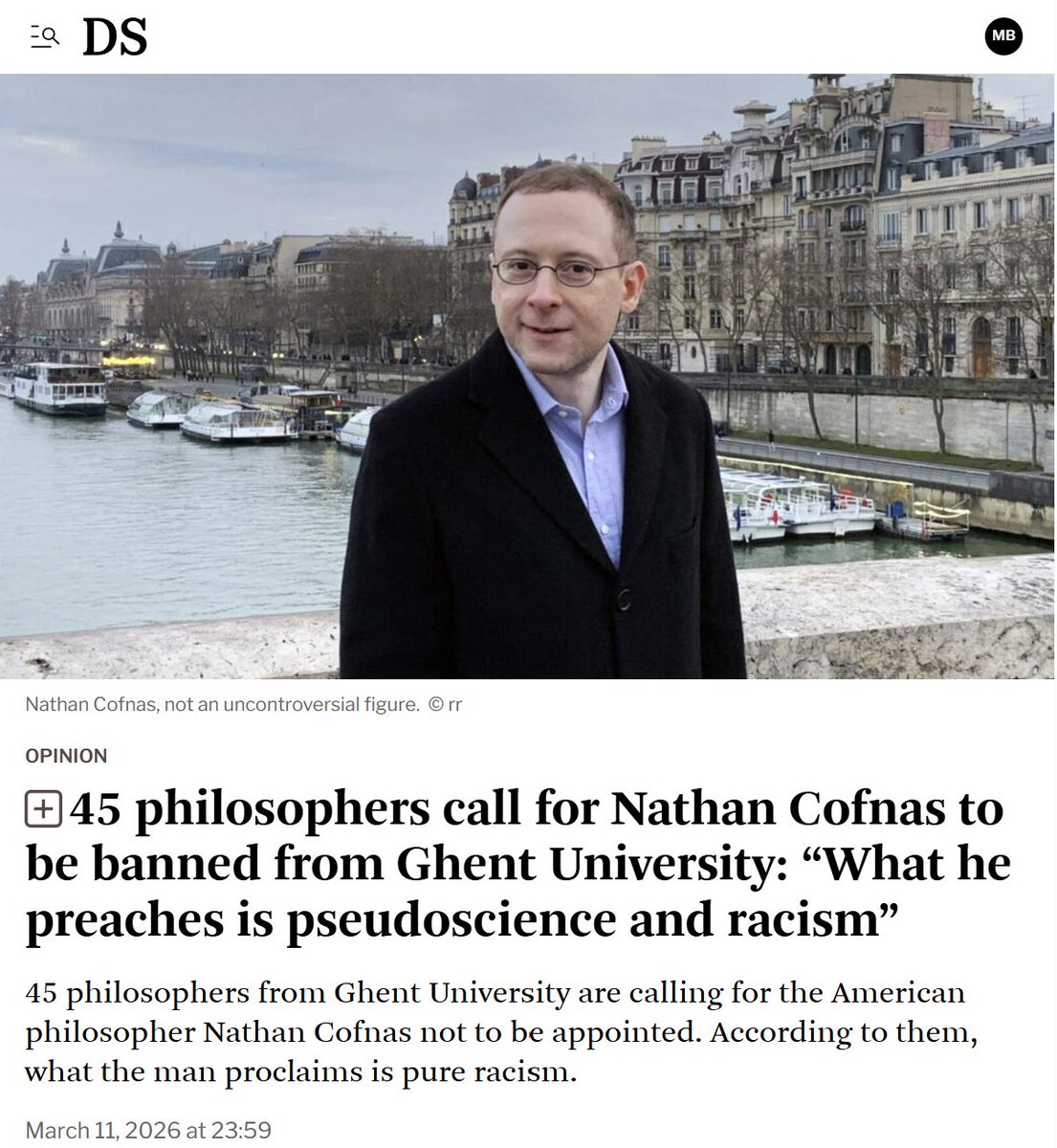
Forty-five colleagues from my former philosophy department apparently think otherwise. They are urging the rector to fire @nathancofnas because he claims that the IQ gap between racial groups (such as whites and blacks in the US — differences that are themselves not disputed) may have partly genetic causes, rather than purely social ones like marginalization or discrimination. They label this “pseudoscience and racism.”
I understand why many people are shocked by Cofnas’s claims. But this clearly falls within the scope of academic freedom.
For years, the psychoanalysis of Jacques Lacan was taught and researched at my department — a complete pseudoscience. Dozens of theses and PhDs were written about it, all scientifically worthless. No one batted an eye. Unlike my colleagues, I published several papers explaining why (Lacanian) psychoanalysis is pseudoscientific (drive.google.com/file/d/0B_K…). Yet I never demanded that my colleagues be fired.
None of the signatories have any peer-reviewed publications on IQ or genetics. I have a letter recommending Cofnas' work on IQ from the editor-in-chief of the prestigious journal Intelligence. Even if the hypothesis of racial IQ differences could be shown to belong to the realm of pseudoscience, that still would not justify dismissal.
If @UGent caves in to this demand, it will be another blow to academic freedom at my alma mater — following the new rector’s illiberal statements suggesting that researchers questioning the safety of vaccines or the Gaza “genocide” are “crossing a line that must not be crossed.”
Such calls for dismissal from people without any expertise are also strategically unwise, as they only fuel “red-pilling.” When academics appear determined to suppress a dangerous idea at all costs, people understandably get suspicious: "What are they trying to hide?" And so trust in academia erodes further.
youtube.com/watch?v=YHhbWmjb…
94
221
1,734
139,044
mtliuzza 🇺🇦 retweeted

Mar 14
Pisapia , Sindaco di Milano, militante di Rifondazione Comunista, redattori del CPP nel 1988-89 (codice introduttivo processo accusatorio) famoso penalista , tra i migliori giuristi in circolazione. VOTA SI.
Il PD ci dice che PIF vota No.
Di che cazzo stiamo parlando ?
47
214
877
14,572