
4 Photos and videos
musnit retweeted

12 Aug 2024
I'm excited to share that we've built the world's most capable AI software engineer, achieving 30.08% on SWE-Bench – ahead of Amazon and Cognition. This model is so much more than a benchmark score: it was trained from the start to think and behave like a human SWE.
247
349
2,612
820,000
musnit retweeted

25 Jun 2024
With our initial launch done, it's time to secure the long term and start to ramp up!
Our upcoming funding proposal is now up on Polkassembly!
Get all the details on what we've been up to and our future plans.
🙏🙏Please come support and discuss🙏🙏
polkadot.polkassembly.io/pos…
1
7
58
4,639
musnit retweeted
20 Jun 2024
🚀 Snowbridge Launch on Polkadot! 🌉
We’re thrilled to announce Snowbridge is now live on Polkadot! This trustless bridge between Polkadot and Ethereum is a game-changer for interoperability in the ecosystem. 🌐✨
28
128
402
132,004

excited for this launch! we've been working on this for a while, plz try it out and share your feedback 🙏

It's been a while - we've got something new:
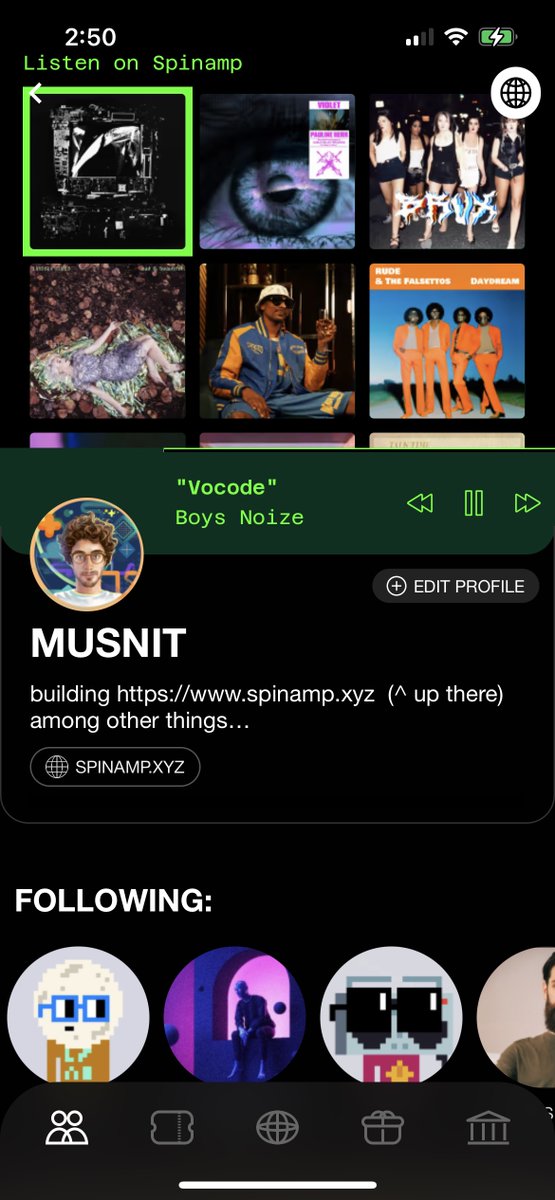
Spinamp Channels: A dynamic, blazing fast way to discover new artists and collect their music fast, all on mobile
We've worked on this a while and we're sure you'll have a ton of fun with it.
This launch is filled to the brim:
7
733


My @spin_amp Wrapped, 2023
app.spinamp.xyz/wrapped/0xeF…
7
482
is this one of the first examples/contexts in which gpt4 can consistently produce better code than professional coders :O?

Can GPT-4 teach a robot hand to do pen spinning tricks better than you do?
I'm excited to announce Eureka, an open-ended agent that designs reward functions for robot dexterity at super-human level. It’s like Voyager in the space of a physics simulator API!
Eureka bridges the gap between high-level reasoning (coding) and low-level motor control. It is a “hybrid-gradient architecture”: a black box, inference-only LLM instructs a white box, learnable neural network. The outer loop runs GPT-4 to refine the reward function (gradient-free), while the inner loop runs reinforcement learning to train a robot controller (gradient-based).
We are able to scale up Eureka thanks to IsaacGym, a GPU-accelerated physics simulator that speeds up reality by 1000x. On a benchmark suite of 29 tasks across 10 robots, Eureka rewards outperform expert human-written ones on 83% of the tasks by 52% improvement margin on average. We are surprised that Eureka is able to learn pen spinning tricks, which are very difficult even for CGI artists to animate frame by frame!
Eureka also enables a new form of in-context RLHF, which is able to incorporate a human operator’s feedback in natural language to steer and align the reward functions. It can serve as a powerful co-pilot for robot engineers to design sophisticated motor behaviors.
As usual, we open-source everything! Welcome you all to check out our video gallery and try the codebase today: eureka-research.github.io/
Paper: arxiv.org/abs/2310.12931
Code: github.com/eureka-research/E…
Deep dive with me: 🧵
5
728
I just collected "Jesse Pollak: Summer Shines Brighter Onchain - Mint Podcast by @levychain on @spin_amp ~
💿 app.spinamp.xyz/track/jesse-…
Great first podcast with @jessepollak on @BuildOnBase!
4
323
musnit retweeted

29 May 2023
I may just only listen to music that is onchain from now on.
28
9
73
13,324
1/ Introducing Spinamp Collect: a way for fans and collectors to support artists through minting and collecting tracks directly on desktop and mobile browsers.
mirror.xyz/spinamp.eth/kXjYZ…
7
520
gpt-4 gets pretty wild and loses control when you bias out all the most obvious outputs 😅
18 Apr 2023

How many peeps have played with logit bias / how useful have you found it? I think I'm going to start using it to try to improve the reliability of structured outputs.
6
628
Yay! I just minted "hedsTAPE 11" by @hedsDAO for 0.02 ETH on @spin_amp 💿🎶 ~ 🌱 app.spinamp.xyz/track/hedsta…
6
420
looks like someone put a music nft player inside the @FWBtweets app (;
9 Feb 2023

Today, FWB introduces a new kind of social network
Owned by the creatives and builders who believe in the promise of a better internet
𝓦𝓮𝓵𝓬𝓸𝓶𝓮 𝓗𝓸𝓶𝓮
app.fwb.help/
3
1
11
2,105
Yay! I just minted "Haymaker" by @talktimeband for 0.05 ETH on @spin_amp 💿🎶 ~ 🌱 app.spinamp.xyz/track/haymak…
1
1
8
366
Yay! I just minted "ruin everything" by @hi_mija for 0.01 ETH on @spin_amp 💿🎶 ~ 🌱 app.spinamp.xyz/track/ruin-e…
2
368
Yay! I just minted "see ya next year (ft. brother bird)" by @kathleenrmusic and @brotherbird_ for 0.04 ETH on @spin_amp 💿🎶 ~ 🌱
app.spinamp.xyz/track/see-ya…
1
1
7
462
1/ Introducing Spinamp Collect: a way for fans and collectors to support artists through minting and collecting tracks directly on desktop and mobile browsers.
mirror.xyz/spinamp.eth/kXjYZ…
21
35
163
33,466
