
no bio yet.
Joined April 2024
- Tweets 2,509
- Following 198
- Followers 781
- Likes 4,778
570 Photos and videos















Jun 5
unpopular opinion: Robinhood is already dead - it just doesn’t know it yet
why would I need a brokers UI/UX when I can trade directly through ChatGPT in three seconds?
AI interfaces like @coinvestai aren’t "the future". they’re already here, and you’re still just tapping buttons
people already live in ChatGPT/Claude for work, research, decisions
why context-switch to another app for execution?
Co-Invest meets you where you already are
@liquidtrading
2
7
160
May 31
the future of trading isn’t "smart assistants", but a battle of algorithms, where humans serve as exit liquidity
the biological brain is too slow, too emotional, and too limited in the amount of data it can process
AI doesn’t "feel" the market - it calculates it
competing with it is like trying to outrun a F1 car on a bicycle
@liquidtrading
May 26

Today, Co-Invest is live.
The first way to trade directly through ChatGPT and Claude.
1
52
May 27
The UX we deserve
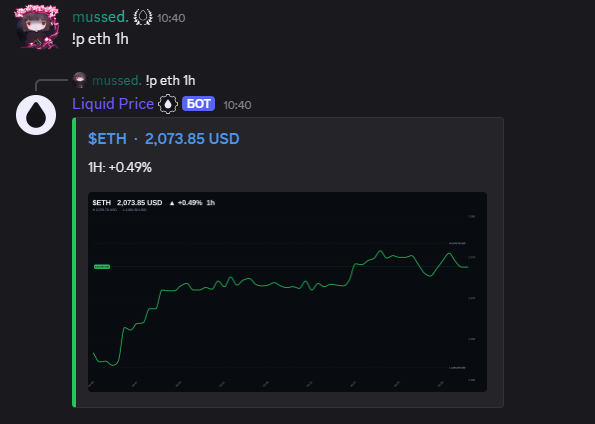
If you’re still switching between Discord and TradingView to check prices - you’re living in 2021
The !p command on the @liquidtrading Discord server isn’t just a chart in chat - it’s a game-changer for any trader
A chart in chat in a second
This takes community coordination to a whole new level
Now every point can be backed up with a live chart instantly
Discord is becoming a full-fledged trading terminal, not just a hangout
The future belongs to integrations like this
try it -> discord.gg/fYqydj54xM
2
6
328
May 11
stop fading referral revenue
@liquidtrading gives you up to 50% of the referral fees
no "badges"
no "points"
how it works?
> share your referral code
> friend signs up
> friend trade on liquid
> you earn up to 50% of their trading fees
> earnings paid in USDC automatically
> claim ANYTIME
trade whatever wherever whenever
docs: docs.tryliquid.xyz/referrals…
my code: MUSSED
2
9
125
May 3
goated traders are sitting on Discord @liquidtrading
why? It’s very simple:
> a powerful real-time news aggregator
> instant sharing of your wins directly from the Liquid app
> in-depth strategy discussions and trade reviews
> live alpha, trading ideas and market analysis
> a community of skilled traders who actually trade and help each other
no fluff
just pure trading-focused communication that will help you take money from the market, not leave it there
want to be part of this community? join us 👇
discord.gg/gwCGAR3MdG
6
12
239
Apr 13
Is privacy important to you?
Are you a developer?
Then apply for the @colosseum Frontier hackathon, sponsored by MagicBlock!
This is a great opportunity to win $5,000 by building an app for confidential DeFi services, payments, and agents that Solana needs
Link below 👇
superteam.fun/earn/listing/p…
@magicblock @MagicIntern @16vivz
4
13
183
Mar 31
Want to build a cool project using modern technology? Here’s an example:
Loofta Pay by @lisabeyy isn’t just "another crypto payment solution"
It’s a pretty impressive showcase of the latest Web3 stack all rolled into one product. And that’s where it gets interesting
Technologically, projects like this are already outpacing classic fintech - not because of scale, but because of architecture
Check out what’s actually inside 👇
> Multi-chain logic
You’re not tied to a single network - a user can send anything from any network, and you receive the asset you need. This means that under the hood, cross-chain routing and swaps are handled automatically
> Non-custodial approach
There’s no classic "we hold your money"
Payments go through generated addresses and are routed by the system - this reduces risks and eliminates unnecessary trust layers
> Wallet abstraction and UX
Users don’t need to understand networks, bridges, or tokens - the system handles everything itself. This is the level of wallet abstraction that the entire web3 ecosystem is currently striving for
> Privacy by default
Transactions do not become a public "trail" with an obvious sender - receiver link. This is a trend toward privacy-first finance within web3
> Payment links as an API product
You simply create a link and send it out - this essentially turns payments into an HTTP-level primitive: sent - received. Minimal friction, maximum scalability
> Programmable payments
Judging by the positioning, these aren’t just "transfers" but "programmable payments" - meaning the logic can be expanded
Whereas fintech used to compete on interfaces,
competition is now shifting to the level of infrastructure and abstractions
Loofta Pay is an example of how:
it’s not the UI that simplifies complexity,
but the system itself that eliminates complexity as a category
And if such solutions become the norm, then:
people will simply stop understanding what a "network", "token", and "bridge" are just as today no one thinks about which protocol their bank transfer uses
Loofta Pay does not "use MagicBlock" directly,
but it does employ the same new paradigm:
not to improve the blockchain,
but to hide the blockchain behind an execution layer
@magicblock @MagicIntern @16vivz
4
16
210
Mar 30
Want to see the results of the Solana Blitz v2 Hackathon?
Here they are ⬇️
🥇 1st place: Loofta Pay by @lisabeyy
Private USDC payments on Solana
🥈 2nd place: Veil
Sealed-bid auction in Solana where bidders commit a hash of their bid, then reveal it for verification
🥉 3rd place: Who Rug Us? by @ailto_s
Among Us on Solana
🧙♂️ Wizardio's choice: Shyft by @ShaanXSol
Privacy-first social platform where posts, chats, and payments all live inside a TEE in the PER
Huge congrats to all winners!
@magicblock @MagicIntern @16vivz
6
13
198
Mar 29
MagicBlock isn’t just "another tool for Web3 gaming"
It’s an attempt to finally fix a fundamental problem that everyone is keeping quiet about
For years, Web3 games have been stuck between two worlds:
> either normal gameplay without on-chain interactions
> or "true" on-chain gameplay, but with lag, workarounds, and a 2013-era UX
And this is where MagicBlock breaks the paradigm
Instead of dragging blockchain into the game (and suffering), they’re doing the opposite - creating an environment where the game can work with blockchain natively, without compromising on speed or responsiveness
The most interesting part:
this isn’t about "even faster transactions"
It’s about the fact that online gameplay can finally be on-chain without feeling like you’re playing through PowerPoint.
If this takes off, then:
> PvP on the blockchain will stop being a meme
> real-time mechanics will become the norm, not a demo
> "ownership" will stop being the only selling point of Web3 games
And that’s when things will get awkward for 90% of current projects, because it will turn out:
the problem wasn’t with the players, but with the technology
MagicBlock could be the very moment when Web3 gaming stops making excuses and starts competing with Web2
And yes - if that happens, most "token-based games" simply won’t survive this transition
@magicblock @MagicIntern @16vivz
9
16
167
Mar 24
Blockchains still can’t do 2 things:
> real-time (<100ms)
> privacy
Even Solana ~400ms
Everything is public - MEV, frontrunning
MagicBlock fixes this:
ER - real-time execution
PER - private execution (TEE)
> ~50ms oracle updates
> ~500ms finality
> no liquidity fragmentation
Games. Trading. Payments. On-chain.
This is what Web3 UX should look like
@magicblock @MagicIntern @16vivz
13
20
170
Mar 23
2,300 new players, planets for 480 SOL, $44,000 paid out to players
What am I talking about?
@colonythegame is a game developed specifically for Solana Mobile
It runs on Ephemeral Rollups from @magicblock , so interactions happen in real time, with no gas fees!
Mint a planet, mine resources, trade, and compete on the leaderboard for treasury rewards
Season 1 has already started, but you can still join!
@MagicIntern @16vivz

11
20
196