
Doing some product ai engineering @ Qurable.
Joined May 2015
- Tweets 472
- Following 606
- Followers 323
- Likes 1,986
56 Photos and videos









Esto no va de seguridad. Va de quién tiene el kill switch.
Una agencia del gobierno de EE.UU. obligó a Anthropic a retirar del mercado Fable 5 y Mythos 5 por un "jailbreak"
En el contexto LLM, un jailbreak es un prompt (o secuencia de prompts) que logran generar una respuesta que supuestamente el entrenamiento de seguridad debiera haber bloqueado (ej. como hacer una bomba).
El laboratorio más alineado con la narrativa de "AI safety" está argumentando públicamente que un jailbreak puntual no debería retirar un modelo a cientos de millones de usuarios.
El argumento es esencial: el indeterminismo de los modelos hace matemáticamente imposible garantizar la inexistencia de jailbreaks menores en un modelo de frontera
Si un "jailbreak puntual" justifica retirar un modelo en producción, todo modelo frontera es retirable para siempre. La resistencia perfecta a jailbreaks no existe.
Cada producto AI-native ahora carga riesgo de recall gubernamental en su diagrama de arquitectura. Multi-proveedor dejó de ser paranoia esta mañana. Es el nuevo mínimo viable de cobertura.
Esa carta es el precedente que va a citar todo founder construyendo sobre rails de IA.
Jun 13

The US government, citing national security authorities, has issued an export control directive to suspend all access to Fable 5 and Mythos 5 by any foreign national, whether inside or outside the United States, including foreign national Anthropic employees.
The net effect of this order is that we must abruptly disable Fable 5 and Mythos 5 for all our customers to ensure compliance.
Access to all other Claude models is not affected.
We apologize for this disruption to our customers. We believe this is a misunderstanding and are working to restore access as soon as possible.
Read our full statement: anthropic.com/news/fable-myt…
1
1
82
The cert is what the moat looks like before it's named.
Regulated CX — federal, financial, healthcare — needs typed surfaces, full audit trails, and reversible permissioned agents. Most "AI chatbot on CRM" stacks can't pass that bar because the architecture wasn't built for it. Sierra's FedRAMP High is the first public proof that agentic CX is leaving the SMB sandbox
Jun 10

I am proud to announce that Sierra has been certified FedRAMP High — the standard for cloud companies working with U.S. federal agencies.
Hundreds of millions of people rely on the U.S. federal government for services — from navigating Social Security, Medicare, and Veterans Affairs to filing their tax return or renewing their passport. AI agents built on Sierra can help make them simpler and faster. sierra.ai/blog/certified-fed…
1
26
Ulta has 46M loyalty members. They drive 95% of US sales.
At that ratio, "loyalty program" is the wrong noun. It's the operating system.
Same week: Sephora links 80M Beauty Insider members into ChatGPT as a storefront. The agentic discovery surface sits on top of the loyalty graph, not separate from it.
Read the two together. The loyalty graph isn't a CRM module bolted onto the retail stack — it IS the retail stack, with merchandising, personalization, and the agentic surface all plugging into it.
The procurement question for any retail CMO in H2 2026 has shifted. Not "do we have a loyalty program?" but "what runs on top of it?"
Most LATAM retailers still treat loyalty as a CRM module. The gap between that and Ulta isn't a feature gap. It's years of compounded loyalty-graph data acting as the operating layer.
The retailers that win the next decade will be the ones whose loyalty layer is callable by every other system — including the agent the customer hasn't met yet.
11
Ocho proveedores en una sola línea de presupuesto.
Carrefour comprometió €3.000 millones a su transformación digital y de IA bajo su hoja de ruta 2030. Los socios nombrados: OpenAI, Google Cloud, Microsoft, Bain, Capgemini, Publicis Sapient, Artefact, Centric. Cada uno entrega una pieza. El trabajo de Carrefour es la integración.
Pueden pagarlo: €21.100 millones de facturación trimestral, 50 millones de socios de fidelización hoy (meta de 60 millones a 2030), Hopla — su asistente sobre OpenAI — ya en producción, y el catálogo del supermercado disponible dentro de ChatGPT como punto de venta. La tesis es correcta. El costo de armarla es enorme.
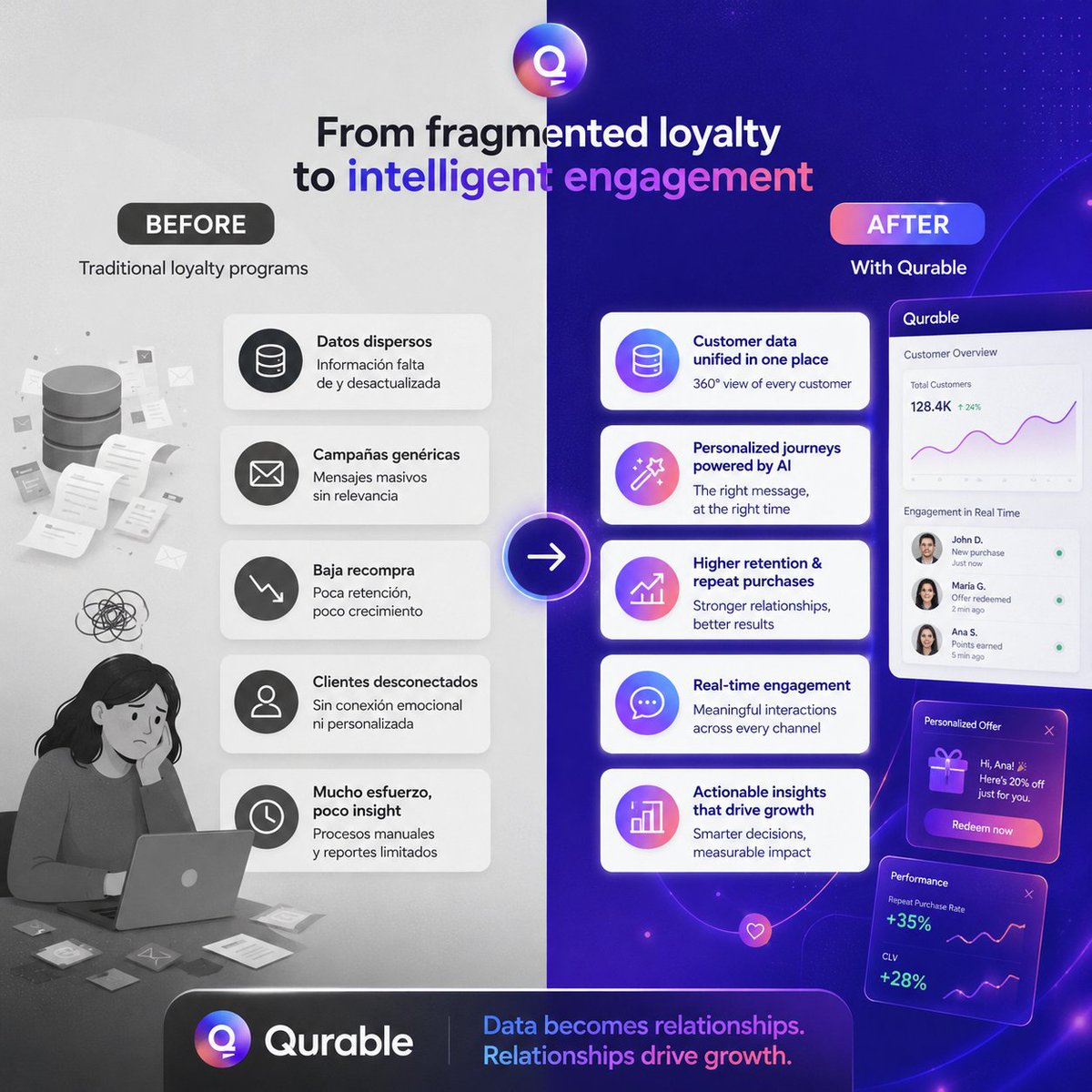
Cualquier retailer Tier-2 que esté mirando esto tiene una alternativa más limpia. Comprar una sola plataforma AI-native donde fidelización, mensajería, segmentación y la capa agéntica viven en un solo esquema, no en siete contratos. Saltarse el armado. Llegar al mismo destino en un trimestre, no en dos años.
El costo de integración era un feature de la década SaaS. En la era AI-native es un bug.
52
Same primitive one layer up. When the loyalty/CX engine is agent-callable instead of UI-clickable, the operator-side CMO becomes a "small high-agency team" too. Connectors collapse team size twice — once for the founder, once for the marketing org that runs the system the founder buys.

We’re bringing all connectors required to spin up and run a business from scratch inside Perplexity Computer. It’s going to be possible for anyone with an idea and a small team of high agency people to build fast growing valuable companies faster than ever before with Computer.
10
Same primitive missing in loyalty: fidelity events drop silently at the POS handshake. Most platforms don't measure it because they can't see it. The dropped-event problem is universal everywhere data crosses a rail — the recovery layer becomes the moat.
Jun 7

Vercel AI Gateway recovers on average over 1T tokens a month 🤯
Much like Stripe recovers revenue with smart retries on failed payments or credit card updates.
And we do it with 0️⃣ zero markup over the labs; adding redundancy, zero-data retention enforcement, observability, usage APIs, caps, …
vercel.com/ai-gateway
13
Operators shipping AI-native products see this debate from below.
The "fictions that organize collective work" today are APIs, schemas, contracts, audit trails. That is where the framework actually lives — built or unbuilt, line by line.
Most of the new age is being decided in code nobody is debating.
Jun 8

Dear @harari_yuval, so many thanks for engaging in this fascinating and transcendental debate. We are at a dawn of a new age, which places us, I believe, in a place not that that different from the one you yourself described so well in Homo Sapiens and your other books: that time when humans used fictions to organize our collective work and profit from technology. Now we need more than ever all our intelligence to build the framework that will allow us to benefit from the amazing opportunities we have ahead. Already preparing my reply to see if I we can appease your fears about the path I proposed last week!
20
Mastercard just turned billions of transactions into a foundation model and put it behind an API.
Your loyalty stack is either a consumer of network-scale models, or it is a museum.
AI-native means being able to call the network's model. AI-bolted-on means you are still asking your data scientist to train one on a fraction of the data.
10
I spent three years as a Senior PM at Mercado Libre. The Q1 2026 number that matters isn't the 49% revenue. It's the 85% of customer service running on agents.
85% AI handling at MELI's volume isn't a productivity proof point. It's the category-arrived signal for LATAM. The cohort that was still asking "will AI customer service work at scale" got an answer the size of Latin America.
And the pairing is the part most readers will miss. Same quarter as the 85%, revenue grew 49% — fastest since Q2 2022. The framing isn't AI-as-cost-saver. It's AI-as-growth-engine. The agentic layer didn't replace the operators. It freed the operators to compound the rest of the business.
For every CMO and CPO looking at this from the outside: the question isn't whether to ship an AI-native CX layer. It's whether your data is shaped to make 85% structurally possible.
Most companies' isn't. That's the architecture problem this quarter just made visible.
34
If your loyalty members keep transacting and your non-members don't, that's not a problem with the loyalty program.
That's the program holding the brand up.
Starbucks just published four years of data on this. Q1 FY26 — for the first time since Q2 fiscal 2022, transaction growth came from members AND non-members. For nearly four straight years, the loyalty cohort was the only group transacting more. Through pandemic recovery. Through inflation. Through staffing crises.
The "discount channel" frame for loyalty programs was always backwards. The discount is the surface artifact. The cohort is the asset. The asset compounds; the artifact decays.
Most retail and QSR operators look at loyalty as a margin cost. Starbucks' last four years say it's the floor that kept the brand transacting through the softness — and the cohort whose return-to-growth signals the brand has cleared it.
The program led the recovery. The brand followed.
11
The agentic commerce stack just locked in.
Four open protocols. Each ratified by serious infrastructure in the same window:
- MCP (Anthropic) — agents calling tools
- A2A (Google) — agents talking to agents
- UCP (Google Shopify) — agents transacting with merchants
- AP2 (Google) — agents paying under bounded authority
The endorsers tell the whole story. On the payments side: Visa, Mastercard, Amex, Stripe, Adyen. On the merchant side: Walmart, Target, Home Depot, Macy's, Best Buy, Etsy, Wayfair. The two sides of the commerce balance sheet ratified the same standard inside a single news cycle.
Two things follow.
First, protocols stop being a differentiator. They become infrastructure, the way REST stopped being a differentiator around 2010. The retailer who ships UCP and AP2 cleanly gets parity with the rest of the market. Nothing more.
Second, the competitive rent moves up the stack. The retailer who knows what to do with the agentic transaction once it lands — which customer to recognize across surfaces, which reward to fire at the moment of payment, which signal to capture about an agent-driven purchase that a human never sees — wins the next decade of margin per customer.
Every agentic purchase is a customer telling you exactly what they want, what they decided to spend, and what their bounded authority is. That's the cleanest behavioral signal in the history of commerce.
Most retailers are about to receive it and throw it away.
That gap is the next category split.
21